RESEARCH ARTICLE
Development of a multiplex Loop-Mediated Isothermal Amplification (LAMP) assay for on- site diagnosis of SARS CoV-2
Woong Sik Jang
1☯, Da Hye Lim
2☯, Jung Yoon
2, Ahran Kim
2, Minsup Lim
1, Jeonghun Nam
1, Richard Yanagihara
3, Sook-Won Ryu
4, Bo Kyeung Jung
5, Nam- Hee Ryoo
6*, Chae Seung Lim
ID2*
1 Emergency Medicine, College of Medicine, Korea University Guro Hospital, Seoul, Republic of Korea, 2 Departments of Laboratory Medicine, College of Medicine, Korea University Guro Hospital, Seoul, Republic of Korea, 3 Pacific Center for Emerging Infectious Diseases Research, John A. Burns School of Medicine, University of Hawaii at Manoa, Honolulu, HI, United States of America, 4 Department of Laboratory Medicine, Kangwon National University, School of Medicine, Kangwondo, Republic of Korea, 5 Department of Laboratory Medicine, Dankook University College of Medicine, Cheonan, Korea, 6 Department of Laboratory Medicine, Dongsan Medical Center, Keimyung University, Daegu, Korea
☯These authors contributed equally to this work.
*[email protected](NHR);[email protected](CSL)
Abstract
A newly identified coronavirus, designated as severe acute respiratory syndrome coronavi- rus 2 (SARS CoV-2), has spread rapidly from its epicenter in China to more than 150 coun- tries across six continents. In this study, we have designed three reverse-transcription loop- mediated isothermal amplification (RT-LAMP) primer sets to detect the RNA-dependent RNA polymerase (RdRP), Envelope (E) and Nucleocapsid protein (N) genes of SARS CoV- 2. For one tube reaction, the detection limits for five combination SARS CoV-2 LAMP primer sets (RdRP/E, RdRP/N, E/N, RdRP/E/N and RdRP/N/Internal control (actin beta)) were evaluated with a clinical nasopharyngeal swab sample. Among the five combination, the RdRP/E and RdRP/N/IC multiplex LAMP assays showed low detection limits. The sensitivity and specificity of the RT-LAMP assay were evaluated and compared to that of the widely used Allplex™ 2019-nCoV Assay (Seegene, Inc., Seoul, South Korea) and PowerChek™
2019-nCoV Real-time PCR kit (Kogenebiotech, Seoul, South Korea) for 130 clinical sam- ples from 91 SARS CoV-2 patients and 162 NP specimens from individuals with (72) and without (90) viral respiratory infections. The multiplex RdRP (FAM)/N (CY5)/IC (Hex) RT- LAMP assay showed comparable sensitivities (RdRP: 93.85%, N: 94.62% and RdRP/N:
96.92%) to that of the Allplex™ 2019-nCoV Assay (100%) and superior to those of Power- Chek™ 2019-nCoV Real-time PCR kit (RdRP: 92.31%, E: 93.85% and RdRP/E: 95.38%).
Introduction
In December 2019, an outbreak in Wuhan, China of a severe respiratory illness was caused by a previously unrecognized coronavirus, which has since been named severe acute respiratory a1111111111
a1111111111 a1111111111 a1111111111 a1111111111
OPEN ACCESS
Citation: Jang WS, Lim DH, Yoon J, Kim A, Lim M, Nam J, et al. (2021) Development of a multiplex Loop-Mediated Isothermal Amplification (LAMP) assay for on-site diagnosis of SARS CoV-2. PLoS ONE 16(3): e0248042.https://doi.org/10.1371/
journal.pone.0248042
Editor: Henk D. F. H. Schallig, Academic Medical Centre, NETHERLANDS
Received: December 27, 2020 Accepted: February 18, 2021 Published: March 3, 2021
Peer Review History: PLOS recognizes the benefits of transparency in the peer review process; therefore, we enable the publication of all of the content of peer review and author responses alongside final, published articles. The editorial history of this article is available here:
https://doi.org/10.1371/journal.pone.0248042 Copyright:© 2021 Jang et al. This is an open access article distributed under the terms of the Creative Commons Attribution License, which permits unrestricted use, distribution, and reproduction in any medium, provided the original author and source are credited.
Data Availability Statement: All relevant data are within the paper and itsSupporting Information files.
syndrome coronavirus 2 (SARS CoV-2) (genus Betacoronavirus, subgenus Sarbecoronavirus) [1–5]. Clinical signs of the disease, which was subsequently designated coronavirus disease 2019 (COVID-19), included fever, cough and shortness of breath, making it difficult to distin- guish from other viral respiratory infections [6,7].
Despite intense efforts to contain the outbreak at the epicenter, the disease has spread throughout China and beyond. The World Health Organization (WHO) declared COVID- 19 as a global pandemic, and as of 24 November 2020, Worldometers, which is a real-time international statistics site, announced that the total number of confirmed SARS CoV-2 patients in 220 countries around the world exceeded 59 million, with 1,402,972 that died of the infection. In particular, the USA and India have respectively accumulated over 12 mil- lion (263,687 deaths) and 9 million cases (134,254 deaths) of SARS CoV-2. SARS CoV-2 is still spreading worldwide, and there is an urgent need to conduct rapid diagnosis followed by patient isolation and treatment. Currently, an RT-qPCR-based test distributed by WHO is being deployed in many countries to detect SARS CoV-2 RNA, and several commercial RT-qPCR kits (PowerChek™ 2019-nCoV Real-time PCR kit [Kogenebiotech, Seoul, South Korea], granted EUAL in Korea) are available to diagnose SARS CoV-2 in Korea. However, these RT-qPCR detection methods require nearly three hours to produce results, and skilled technicians and advanced laboratory infrastructure are necessary. As a result, testing is lim- ited to institutions in which specialized medical services are available and in areas where wide-scale surveillance is required.
Loop-mediated isothermal amplification (LAMP) is a highly sensitive, low-cost, single-tube technology to detect the target nucleic acid sequences [2,8]. Typically, six primers, including four primers selected by combining parts of the target DNA and two additional loop primers, are used to amplify a specific gene region. Bst DNA polymerase, a strand-displacement DNA polymerase, enables a loop structure formation for the inner primers, producing LAMP’s unique rapid self-priming amplification [9,10]. LAMP has been widely applied to detect vari- ous microbial pathogens [11–13]. In particular, reverse-transcription LAMP (RT-LAMP) has been used for point-of-care-testing for RNA virus infections [14].
In this study, we have developed multiplex SARS CoV-2 LAMP primer/probe sets using strand-displaceable probes, based on the region of the RdRP, E and N gene of the aligned sequences of SARS CoV-2 subtypes. Among five combination SARS CoV-2 LAMP primer sets, RdRP/N/internal control (actin beta, IC) multiplex LAMP assay showed the lowest detec- tion limits. The performance of the multiplex SARS CoV-2 RdRP/N/IC LAMP assay was com- pared with direct RT-qPCR methods using the Seegene Allplex
TM2019-nCoV Assay and Kogenebiotech PowerChek™ 2019-nCoV Real-time PCR kit for SARS CoV-2 clinical samples.
Materials and methods
Clinical samples and RNA extraction
This study was approved by the Medical Ethics Committee of Korea University’s Guro Hospi- tal (2019GR0055). Informed consent was waived by the Institutional Review Board (IRB) because this study used residual samples. To estimate the number of samples required for clini- cal test of the multiplex RT-LAMP assay, the following formula was used:
n � ð1:96Þ
2pð1 pÞ x
2where p is the suspected sensitivity, and x is the desired margin of error [15,16]. The true- positive rate (sensitivity) was defined as the proportion of SARS-CoV-2 positive which is correctly identified by the multiplex RT-LAMP assay compared to the Allplex
TMFunding: This study was supported by a government-wide R&D fund project for infectious disease research (HG18C0012), National Research Foundation of Korea (NRF-2016R1A5A1010148), and a grant of the Korea Health Technology R&D Project through the Korea Health Industry Development Institute (KHIDI), funded by the Ministry of Health & Welfare, Republic of Korea (grant number: HR20C0021)
Competing interests: No authors have competing interests.
2019-nCoV Assay (Seegene, Inc., Seoul, South Korea). We suspected the sensitivity and specificity of the multiplex RT-LAMP assay to be 95% with a desired margin of error of 0.04%. Under these conditions, the number of required samples is 114.0475 (rounded up to 115) per group. In this experiment, we have tested total 292 samples (130 positive and 162 negative). A total of 130 clinical samples, including nasopharyngeal (NP) swabs, oropharyn- geal (OP) swabs, sputum, saliva and urine, were collected from 91 patients suspected of being infected with SARS CoV-2 in the Republic of Korea. All clinical samples were con- firmed using the Allplex
TM2019-nCoV Assay (Seegene, Inc., Seoul, South Korea) and PowerChek™ 2019-nCoV Real-time PCR kit (Kogenebiotech, Seoul, South Korea). To assess the specificity of the multiplex SARS CoV-2 RT-LAMP assay, 162 NP swab specimens were tested from individuals with (72) and without (90) viral respiratory infections. Respiratory viral infections, as confirmed by PCR using the Anyplex
TMII RV16 detection kit, included 39 coronavirus (KHU1, NL63, 229E), 3 influenza virus A/H1N1, 3 influenza virus A/H3N2, 3 influenza virus B, 3 respiratory syncytial virus (RSV) A, 3 RSV B, 3 adenovirus, 3 parain- fluenzavirus (PIV) types 1 to 4, 3 human bocavirus (HboV), 3 human enterovirus (HEV), 3 human rhinovirus (HRV) and 3 metapneumovirus (MPV). RNA was extracted from 200 μL of SARS CoV-2 clinical samples using an InviMag Universal RNA Mini Kit (Stratec Molec- ular, Berlin, Germany), according to the manufacturer’s manual. RNA extraction from the 162 NP swab controls was performed using the QIAamp Viral RNA Mini kit (Qiagen, Hil- den, Germany), according to the manufacturer’s instructions. RNA was stored at -50˚C.
The SARS CoV-2 RT-LAMP was performed blindly with the operator unaware of any previ- ous test results.
Primer design
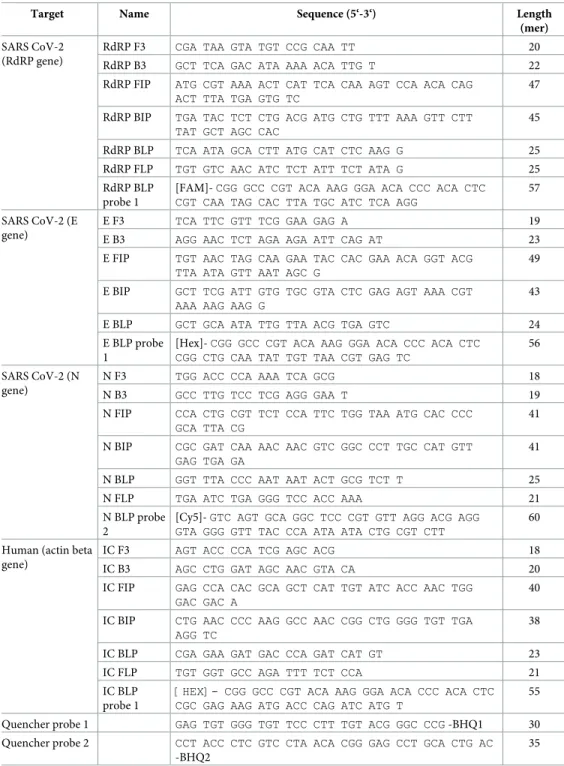
The RT-LAMP primer sets for SARS CoV-2 were designed from conserved regions of the RdRP, E and N genes (Table 1). All LAMP primers including two outer primers (forward primer F3 and backward primer B3), two inner primers (forward inner primer FIP and back- ward inner primer BIP), and two loop primers (forward loop primer LF and backward loop primer LB) were designed using the Primer Explorer version 4 software (Eiken Chemical Co., Tokyo, Japan). A 32-oligomer or 35-oligomer fluorophore strand-displaceable probes was designed at the 5’ end of the LB primer, and the 30-oligonucleotide or 35-oligonucleotide quencher was complementary to the probe. Strand-displaceable probes were 5
0-labeled with FAM, Hex and Cy5 for RdRP, E and N, respectively. Before use in LAMP, all primers were assessed for specificity by performing a BLAST search. All LAMP primers and probes were synthesized by Macrogen, Inc (Seoul, South Korea).
Real-time RT-PCR
To evaluate the performance of the multiplex SARS CoV-2 RT-LAMP assay, two real-time RT-PCR tests, using the PowerChek™ 2019-nCoV Real-time PCR kit (Kogenebiotech, Seoul, Korea) and Allplex
TM2019-nCoV Assay (Seegene, Inc., Seoul, South Korea), were performed by using CFX96 Touch Real time PCR detection System (Bio-Rad, USA). For the PowerChek™
2019-nCoV Real-time PCR kit, the thermocycling parameters were used as follows: reverse
transcription at 50˚C for 30 min, inactivation at 95˚C for 10 min, 40 cycles of denaturation at
95˚C for 15 s, and annealing with fluorescence detection at 60˚C for 1 min. The PCR cycling
conditions of the Allplex
TM2019-nCoV Assay were as follows: reverse transcription at 50˚C
for 20 min, inactivation at 95˚C for 15 min, 45 cycles of denaturation at 95˚C for 15 s, and
annealing with fluorescence detection at 58˚C for 30 sec.
Multiplex RT-LAMP
The RT-LAMP assay was performed with the Miso1 RNA amplification kit (Mmonitor, Daegu, South Korea). For multiplex SARS CoV-2 RdRP/N/IC RT-LAMP assay, the reaction mixture was prepared with 12.5 μL of 2x reaction buffer, 1.2 μL of SARS CoV-2 RdRP gene LAMP primer mix, 0.6 μL of SARS CoV-2 N gene LAMP primer mix, 0.6 μL of internal con- trol LAMP primer mix, 600 nM quencher 1 solution, 240 nM quencher 2 solution, 2 μL of
Table 1. The multiplex SARS CoV-2 RT-LAMP primer sets used in this study.
Target Name Sequence (5‘-3‘) Length
(mer) SARS CoV-2
(RdRP gene)
RdRP F3 CGA TAA GTA TGT CCG CAA TT 20
RdRP B3 GCT TCA GAC ATA AAA ACA TTG T 22
RdRP FIP ATG CGT AAA ACT CAT TCA CAA AGT CCA ACA CAG ACT TTA TGA GTG TC
47
RdRP BIP TGA TAC TCT CTG ACG ATG CTG TTT AAA GTT CTT TAT GCT AGC CAC
45
RdRP BLP TCA ATA GCA CTT ATG CAT CTC AAG G 25
RdRP FLP TGT GTC AAC ATC TCT ATT TCT ATA G 25
RdRP BLP probe 1
[FAM]- CGG GCC CGT ACA AAG GGA ACA CCC ACA CTC CGT CAA TAG CAC TTA TGC ATC TCA AGG
57
SARS CoV-2 (E gene)
E F3 TCA TTC GTT TCG GAA GAG A 19
E B3 AGG AAC TCT AGA AGA ATT CAG AT 23
E FIP TGT AAC TAG CAA GAA TAC CAC GAA ACA GGT ACG TTA ATA GTT AAT AGC G
49
E BIP GCT TCG ATT GTG TGC GTA CTC GAG AGT AAA CGT AAA AAG AAG G
43
E BLP GCT GCA ATA TTG TTA ACG TGA GTC 24
E BLP probe 1
[Hex]- CGG GCC CGT ACA AAG GGA ACA CCC ACA CTC CGG CTG CAA TAT TGT TAA CGT GAG TC
56
SARS CoV-2 (N gene)
N F3 TGG ACC CCA AAA TCA GCG 18
N B3 GCC TTG TCC TCG AGG GAA T 19
N FIP CCA CTG CGT TCT CCA TTC TGG TAA ATG CAC CCC GCA TTA CG
41
N BIP CGC GAT CAA AAC AAC GTC GGC CCT TGC CAT GTT GAG TGA GA
41
N BLP GGT TTA CCC AAT AAT ACT GCG TCT T 25
N FLP TGA ATC TGA GGG TCC ACC AAA 21
N BLP probe 2
[Cy5]- GTC AGT GCA GGC TCC CGT GTT AGG ACG AGG GTA GGG GTT TAC CCA ATA ATA CTG CGT CTT
60
Human (actin beta gene)
IC F3 AGT ACC CCA TCG AGC ACG 18
IC B3 AGC CTG GAT AGC AAC GTA CA 20
IC FIP GAG CCA CAC GCA GCT CAT TGT ATC ACC AAC TGG GAC GAC A
40
IC BIP CTG AAC CCC AAG GCC AAC CGG CTG GGG TGT TGA AGG TC
38
IC BLP CGA GAA GAT GAC CCA GAT CAT GT 23
IC FLP TGT GGT GCC AGA TTT TCT CCA 21
IC BLP probe 1
[HEX]- CGG GCC CGT ACA AAG GGA ACA CCC ACA CTC CGC GAG AAG ATG ACC CAG ATC ATG T
55
Quencher probe 1 GAG TGT GGG TGT TCC CTT TGT ACG GGC CCG -BHQ1 30 Quencher probe 2 CCT ACC CTC GTC CTA ACA CGG GAG CCT GCA CTG AC
-BHQ2
35
https://doi.org/10.1371/journal.pone.0248042.t001
enzyme mix, and 2.5 μL of sample RNA (final reaction volume 25 μL). The compositions of all LAMP primer mix were 4 μM of two outer primers (F3 and B3) and 3.32 μM of two inner primers (FIP and BIP), 10 μM of loop LF primer, 4 μM loop LB primer, and 6 μM loop LB probe primer. The RT-LAMP assay was run on CFX 96 Touch Real-Time PCR Detection Sys- tem (Bio-Rad Laboratories, Hercules, CA, USA) at 60˚C for 40 min. The FAM, Hex and Cy5 fluorescence channels were used for detecting RdRP, E and N gene, respectively.
Limits of detection
pTOP Blunt V2 plasmids, including partial RdRP, E or N gene sequences of SARS CoV-2, were used to test the limit of detection of the RT-LAMP assay. All plasmids were constructed by Macrogen, Inc. (Seoul, South Korea). The plasmids were serially diluted 10-fold from 1 × 10
8copies/μL to 1 × 10
0copies/μL to determine the detection of limit of the multiplex SARS CoV-2 RdRP/N/IC RT-LAMP assay. In addition, the detection limit of the multiplex SARS CoV-2 RdRP/N/IC RT-LAMP was tested on 10-fold serially diluted clinical samples from SARS CoV-2 patients.
Results
Optimization of the multiplex SARS CoV-2 RT-LAMP assay
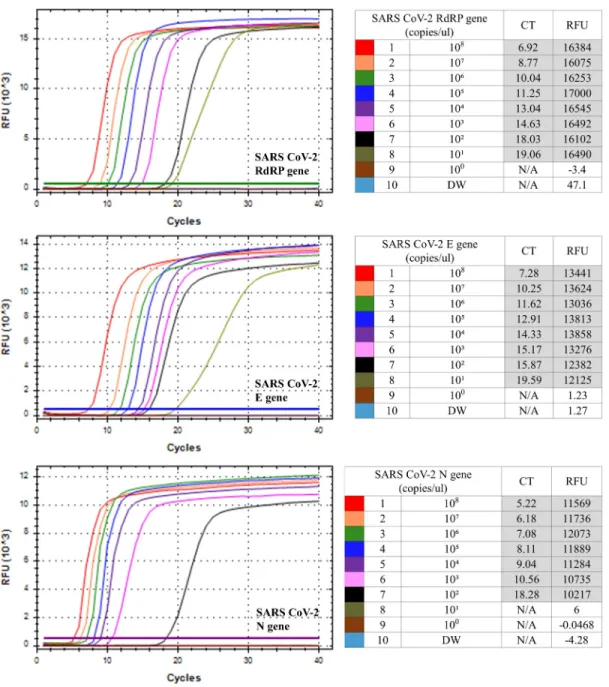
The sensitivity of the SARS CoV-2 RdRP, E and N gene RT-LAMP was evaluated by testing synthetic plasmid standards, including synthetic partial RdRP, E and N genes ranging from 10
8to 10
0copies/μL, respectively (Fig 1). The limits of detection for the RdRP gene E gene and N gene were 1x10
1copies/μL, 1x10
1copies/μL and 1x10
2copies/μL, respectively. For multiplex SARS CoV-2 RT-LAMP in one tube, four combination of RdRP (FAM)/E (Hex), RdRP (FAM)/N (Cy5), E (Hex)/N (Cy5) and RdRP (FAM)/E (Hex)/N (Cy5) were tested using strand-displaceable probes. For optimization of four multiplex SARS CoV-2 RdRP/E, RdRP/
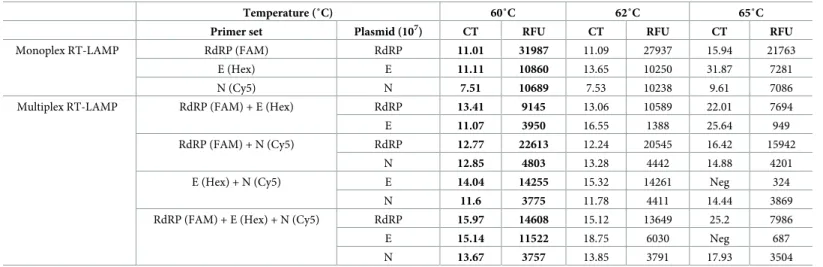
N, E/N and RdRP/E/N LAMP assays, different ratios (1:1, 1:0.5, 1:1.5 or 1:1:1, 0.8:1:0.5, 1:1:0.5) of primers for the RdRP/E, RdRP/N, E/N and RdRP/E/N were tested, using synthetic RdRP, E and N gene plasmids (Table 2). Among the three ratios of both the RdRP/N primer set and E/
N primer set, a ratio of 1:0.5 showed faster Ct values (12.64/12.03 and 14.04/11.6, respectively) and the most stable graph. In the case of the RdRP/E primer set and RdRP/E/N primer set, the ratio of 1:1 and 0.8:1:0.5 showed faster Ct values (13.41/11.07 and 14.48/17.22/15.99, respec- tively). Next, temperature-gradient tests (60, 62 and 65˚C) showed that the optimum tempera- ture was 60˚C (Table 3), which is early Ct values of all four combination LAMP primer sets (RdRP/E: 13.41/11.07, RdRP/N: 12.77/12.85, E/N: 14.04/11.6, RdRP/E/N: 15.97/15.14/13.67).
Comparison of detection limits of the multiplex SARS CoV-2 RT-LAMP assay with two commercial RT-qPCR assays for SARS CoV-2 clinical samples
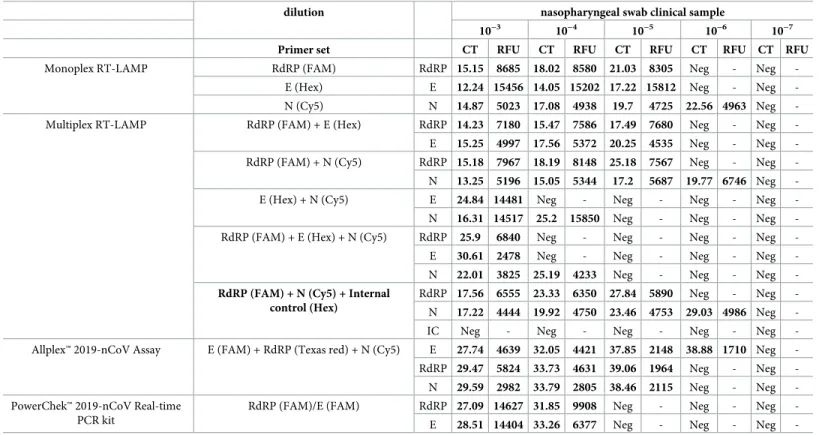
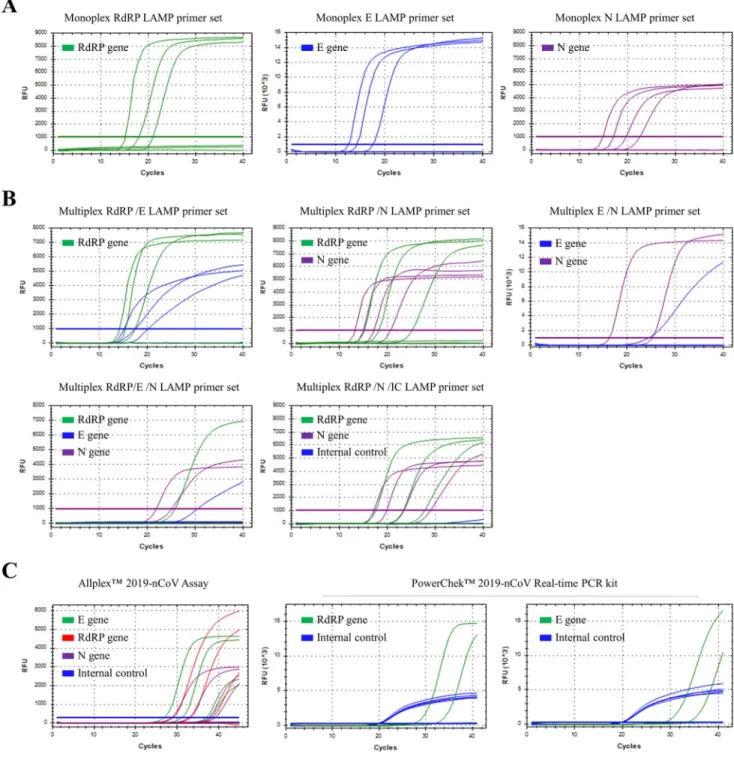
The detection limits of monoplex SARS CoV-2 LAMP primer sets were compared to those of two commercial RT-qPCR kits (Allplex™ 2019-nCoV Assay and PowerChek™ 2019-nCoV Real-time PCR kit) for 10-fold serial dilutions of SARS CoV-2 NP samples (range of 10
−3– 10
−7) (Table 4 and Fig 2). Monoplex RdRP, E and N RT-LAMP primer sets showed detection limits of 10
−5, 10
−5and 10
−6. The combination of RdRP/E and RdRP/N primer sets showed detection limits of 10
−5/10
−5and 10
−5/10
−6, respectively, whereas combination of E/N and RdRP/E/N primer sets showed detection limits of 10
−3/10
−4and 10
−3/10
−3/10
−4, respectively.
In addition, the multiplex SARS CoV-2 RdRP (FAM)/N (Cy5)/ internal control (IC, actin
beta, HEX) RT-LAMP assay is also developed to confirm the success of the extraction step.
Adding internal control (actin ß) LAMP primer set to RdRP and N (ratio of RdRP/N/
IC = 1:0.5:0.5) LAMP assay did not affect the detection limits of RdRP and N LAMP assay.
The SARS CoV-2 RdRP (FAM)/N (Cy5)/ IC (Hex) RT-LAMP assay showed the detection limit of 10
−5/10
−6for RdRP and N (Table 4 and Fig 2C) but signal of IC was not detected.
Although the signal of IC in SARS CoV-2 RdRP (FAM)/N (Cy5)/ IC (Hex) RT-LAMP is unsta- ble in SARS CoV-2 clinical samples, signal of IC in the RT-LAMP assay was specifically detected until 10
−2diluted samples for non-infected clinical samples (S1 Fig). Among five combination LAMP primer sets, the multiplex SARS CoV-2 RdRP/N/IC RT-LAMP assay
Fig 1. Limit of detection for the monoplex SARS CoV-2 RT-LAMP assay. The limit of detection for the monoplex SARS CoV-2 RdRP (A), E (B) and N (C) RT-LAMP assay was tested with synthetic RdRP, E and N plasmid ranging from 108to 100 copies/μL, respectively. Numbers (1–10) indicated plasmid copy numbers/μL (1.0 × 10⁸–1.0× 100copies/μL) and negative control (distilled water (DW) as non-template control).
https://doi.org/10.1371/journal.pone.0248042.g001
showed the lowest detection limits. Furthermore, the multiplex SARS CoV-2 RdRP/N/IC RT-LAMP assay showed comparable sensitivities with those of the Allplex™ 2019-nCoV Assay and lower detection limits than those of the PowerChek™ 2019-nCoV Real-time PCR kit.
Thus, the multiplex SARS CoV-2 RdRP/N/IC RT-LAMP assays were further tested with SARS CoV-2 clinical samples.
Comparison of the clinical performance of the multiplex SARS CoV-2 RdRP/N/IC RT-LAMP assay with that of Allplex ™ 2019-nCoV Assay, and PowerChek ™ 2019-nCoV Real-time PCR kit using clinical samples
To confirm the clinical performance of the multiplex SARS CoV-2 RdRP/E and RdRP/N/IC RT-LAMP, the sensitivities and specificities of the assays were compared to those of the All- plex™ 2019-nCoV Assay, and PowerChek™ 2019-nCoV Real-time PCR kit for 130 clinical sam- ples from 91 SARS CoV-2 patients and 162 NP specimens from individuals with (72) and without (90) viral respiratory infections (Table 5). For the SARS CoV-2 clinical samples
Table 2. Different concentration ratios of the SARS CoV-2 RdRP/E, RdRP/N, E/N and RdRP/E/N primer sets (1:1, 1:0.5 and 1:1.5, respectively) for the synthetic SARS CoV-2 RdRP, E and N gene plasmids.
ratios of primers 1:1 (1:1:1) 1:0.5 (0.8:1:0.5) 1:1.5 (1:1:0.5)
Primer set Plasmid (107) CT RFU CT RFU CT RFU
Monoplex RT-LAMP RdRP (FAM) RdRP 10.73 31987
E (Hex) E 11.11 10860
N (Cy5) N 7.51 10689
Multiplex RT-LAMP RdRP (FAM) + E (Hex) RdRP 13.41 9145 24.16 9333 27.09 603
E 11.07 3950 28.06 888 21.96 2547
RdRP (FAM) + N (Cy5) RdRP 19.05 18554 12.64 22613 35.74 14778
N 7.23 10383 12.03 4803 6.12 16188
E (Hex) + N (Cy5) E 29.21 10780 14.04 14255 54.28 1484
N 7.39 8410 11.6 3775 6.76 11479
RdRP (FAM) + E (Hex) + N (Cy5) RdRP 13.84 16578 14.48 14187 17.53 11088
E 35.13 1546 17.22 7820 18.51 8421
N 9.39 7877 15.99 2907 21.19 2038
https://doi.org/10.1371/journal.pone.0248042.t002
Table 3. Temperature gradient tests (60, 62 and 65˚C) of the four multiplex combination RT-LAMP assay.
Temperature (˚C) 60˚C 62˚C 65˚C
Primer set Plasmid (107) CT RFU CT RFU CT RFU
Monoplex RT-LAMP RdRP (FAM) RdRP 11.01 31987 11.09 27937 15.94 21763
E (Hex) E 11.11 10860 13.65 10250 31.87 7281
N (Cy5) N 7.51 10689 7.53 10238 9.61 7086
Multiplex RT-LAMP RdRP (FAM) + E (Hex) RdRP 13.41 9145 13.06 10589 22.01 7694
E 11.07 3950 16.55 1388 25.64 949
RdRP (FAM) + N (Cy5) RdRP 12.77 22613 12.24 20545 16.42 15942
N 12.85 4803 13.28 4442 14.88 4201
E (Hex) + N (Cy5) E 14.04 14255 15.32 14261 Neg 324
N 11.6 3775 11.78 4411 14.44 3869
RdRP (FAM) + E (Hex) + N (Cy5) RdRP 15.97 14608 15.12 13649 25.2 7986
E 15.14 11522 18.75 6030 Neg 687
N 13.67 3757 13.85 3791 17.93 3504
https://doi.org/10.1371/journal.pone.0248042.t003
(n = 130), the sensitivities of the Allplex™ 2019-nCoV Assay for RdRP, E, and N gene were all 100%, excepted for Internal control (IC, 97.69%) and those of PowerChek™ 2019-nCoV Real- time PCR kit for RdRP, E and RdRP/E were 92.31%, 93.85% and 95.38%, respectively. The sen- sitivities of the multiplex SARS CoV-2 RdRP/N/IC RT-LAMP were 93.85% in the RdRP chan- nel (FAM), 94.62% in the N channel (Cy5), 50.77% in the internal control channel (HEX) and 96.92% in RdRP or N channels. The specificities of two assays for SARS CoV-2 negative clini- cal samples (n = 162) were 100%, excepted for PowerChek™ 2019-nCoV Real-time PCR kit (99.38%) (Table 5). The sensitivity of the internal control channel of the multiplex SARS CoV- 2 RdRP/N/IC RT-LAMP assay, Allplex™ 2019-nCoV Assay, and PowerChek™ 2019-nCoV Real-time PCR kit for SARS CoV-2 negative clinical samples was 100%. Overall, the sensitivity for SARS CoV-2 clinical samples were the highest in the test of the Allplex™ 2019-nCoV Assay, followed by the multiplex SARS CoV-2 RdRP/N/IC RT-LAMP assay and finally the Power- Chek™ 2019-nCoV Real-time PCR kit.
Cross-reactivity tests of the multiplex SARS CoV-2 RdRP/N/IC RT-LAMP, Allplex ™ 2019-nCoV Assay and PowerChek™ 2019-nCoV Real-time PCR kit with other respiratory viruses
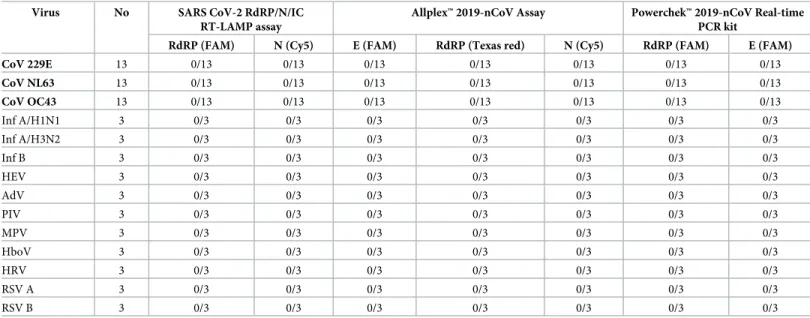
To confirm the absence of cross-reactivity with other common respiratory viruses, NP swabs from 72 patients with known infections with 39 Coronavirus (229E, NL63 and OC43), 6 influ- enza virus A/ B, 6 RSV A/ B, 3 adenovirus, 3 PIV, 3 HBoV, 3 HEV, 3 HRV and 3 MPV were tested by the multiplex SARS CoV-2 RdRP/N/IC RT-LAMP assay, Allplex™ 2019-nCoV Assay (Seegene, Inc., Seoul, South Korea) and PowerChek™ 2019-nCoV Real-time PCR kit
Table 4. Limit of detection (LOD) tests of the monoplex and multiplex RT-LAMP assay, Allplex™ 2019-nCoV Assay and PowerChek™ 2019-nCoV Real-time PCR kit for clinical SARS CoV-2 NP sample (range of 10−3–10−7).
dilution nasopharyngeal swab clinical sample
10−3 10−4 10−5 10−6 10−7
Primer set CT RFU CT RFU CT RFU CT RFU CT RFU
Monoplex RT-LAMP RdRP (FAM) RdRP 15.15 8685 18.02 8580 21.03 8305 Neg - Neg -
E (Hex) E 12.24 15456 14.05 15202 17.22 15812 Neg - Neg -
N (Cy5) N 14.87 5023 17.08 4938 19.7 4725 22.56 4963 Neg -
Multiplex RT-LAMP RdRP (FAM) + E (Hex) RdRP 14.23 7180 15.47 7586 17.49 7680 Neg - Neg - E 15.25 4997 17.56 5372 20.25 4535 Neg - Neg - RdRP (FAM) + N (Cy5) RdRP 15.18 7967 18.19 8148 25.18 7567 Neg - Neg - N 13.25 5196 15.05 5344 17.2 5687 19.77 6746 Neg -
E (Hex) + N (Cy5) E 24.84 14481 Neg - Neg - Neg - Neg -
N 16.31 14517 25.2 15850 Neg - Neg - Neg -
RdRP (FAM) + E (Hex) + N (Cy5) RdRP 25.9 6840 Neg - Neg - Neg - Neg -
E 30.61 2478 Neg - Neg - Neg - Neg -
N 22.01 3825 25.19 4233 Neg - Neg - Neg -
RdRP (FAM) + N (Cy5) + Internal control (Hex)
RdRP 17.56 6555 23.33 6350 27.84 5890 Neg - Neg - N 17.22 4444 19.92 4750 23.46 4753 29.03 4986 Neg -
IC Neg - Neg - Neg - Neg - Neg -
Allplex™ 2019-nCoV Assay E (FAM) + RdRP (Texas red) + N (Cy5) E 27.74 4639 32.05 4421 37.85 2148 38.88 1710 Neg - RdRP 29.47 5824 33.73 4631 39.06 1964 Neg - Neg - N 29.59 2982 33.79 2805 38.46 2115 Neg - Neg - PowerChek™ 2019-nCoV Real-time
PCR kit
RdRP (FAM)/E (FAM) RdRP 27.09 14627 31.85 9908 Neg - Neg - Neg -
E 28.51 14404 33.26 6377 Neg - Neg - Neg -
https://doi.org/10.1371/journal.pone.0248042.t004
(Kogenebiotech, Seoul, Korea) (Table 6). As a result, all three molecular diagnostic tests showed no cross-reactivity with other infectious viruses. Particularly, the multiplex SARS CoV-2 RdRP/
N/IC RT-LAMP assay do not cross-react with human coronavirus 229E, NL63 and OC43.
Fig 2. Limit of detection (LOD) tests of the monoplex and multiplex RT-LAMP assay, Allplex™ 2019-nCoV Assay and PowerChek™ 2019-nCoV Real- time PCR kit for clinical SARS CoV-2 NP sample (range of 10−3–10−7). (A) Detection limits of monoplex SARS CoV-2 RdRP (left), E (middle) and N (right) LAMP primer sets. (B) Detection limits of the multiplex SARS CoV-2 RdRP/E (upper left), RdRP/N (upper middle), E/N (upper right), RdRP/E/N (lower left) and RdRP/N/IC (lower middle) LAMP primer sets (C) Detection limits of Allplex™ 2019-nCoV assay (Left) and PowerChek™ 2019-nCoV Real- time PCR kit (Right).
https://doi.org/10.1371/journal.pone.0248042.g002
Discussion
SARS CoV-2 (family Coronaviridae, genus Betacoronavirus) is a positive-sense, single- stranded RNA virus [17], and it represents the seventh coronavirus known to infect humans, the others being 229E, NL63, OC43, HKU1, Middle East respiratory syndrome coronavirus
Table 5. Comparison of clinical performance of the multiplex SARS CoV-2 RT-LAMP assay with Allplex™ 2019-nCoV Assay and Powerchek™ 2019-nCoV Real- time PCR kit for SARS CoV-2 in clinical samples.
Clinical samples 2019-nCoV (n = 130) Non-infection (n = 162)
P/N Sensitivity P/N Sensitivity Specificity
Allplex™ 2019-nCoV Assay E (FAM) 130/0 100% 0/162 100%
RdRP (Texas red) 130/0 100% 0/162 100%
N (Cy5) 130/0 100% 0/162 100%
IC (Hex) 127/3 97.69% 162/0 100%
E/RdRP/N 130/0 100% 0/162 100%
SARS CoV-2 RdRP/N/IC RT-LAMP assay RdRP (FAM) 122/8 93.85% 0/162 100%
N (Cy5) 123/7 94.62% 0/162 - 100%
IC (Hex) 66/64 50.77% 162/0 100%
RdRP/N 126/4 96.92% 0/162 - 100%
Powerchek™ 2019-nCoV Real-time PCR kit RdRP (FAM) 120/10 92.31% 0/162 - 100%
IC (Hex) 130/0 100% 162/0 100% -
E (FAM) 122/8 93.85% 1/161 - 99.38%
IC (Hex) 130/0 100% 162/0 100% -
RdRP/E 124/6 95.38% 1/161 99.38%
Sensitivity and specificity were calculated by taking Allplex™ 2019-nCoV Assay as standard. P/N: Positive/negative ratio.
https://doi.org/10.1371/journal.pone.0248042.t005
Table 6. Cross-reactivity of the multiplex SARS CoV-2 RdRP/N/IC RT-LAMP assay with Allplex™ 2019-nCoV Assay and Powerchek™ 2019-nCoV Real-time PCR kit for SARS CoV-2 against other human infectious viruses.
Virus No SARS CoV-2 RdRP/N/IC
RT-LAMP assay
Allplex™ 2019-nCoV Assay Powerchek™ 2019-nCoV Real-time PCR kit
RdRP (FAM) N (Cy5) E (FAM) RdRP (Texas red) N (Cy5) RdRP (FAM) E (FAM)
CoV 229E 13 0/13 0/13 0/13 0/13 0/13 0/13 0/13
CoV NL63 13 0/13 0/13 0/13 0/13 0/13 0/13 0/13
CoV OC43 13 0/13 0/13 0/13 0/13 0/13 0/13 0/13
Inf A/H1N1 3 0/3 0/3 0/3 0/3 0/3 0/3 0/3
Inf A/H3N2 3 0/3 0/3 0/3 0/3 0/3 0/3 0/3
Inf B 3 0/3 0/3 0/3 0/3 0/3 0/3 0/3
HEV 3 0/3 0/3 0/3 0/3 0/3 0/3 0/3
AdV 3 0/3 0/3 0/3 0/3 0/3 0/3 0/3
PIV 3 0/3 0/3 0/3 0/3 0/3 0/3 0/3
MPV 3 0/3 0/3 0/3 0/3 0/3 0/3 0/3
HboV 3 0/3 0/3 0/3 0/3 0/3 0/3 0/3
HRV 3 0/3 0/3 0/3 0/3 0/3 0/3 0/3
RSV A 3 0/3 0/3 0/3 0/3 0/3 0/3 0/3
RSV B 3 0/3 0/3 0/3 0/3 0/3 0/3 0/3
CoV 229E: Human coronavirus 229E, CoV NL63: Human coronavirus NL63, CoV OC43: Human coronavirus OC43, Inf A/H1N1: Influenza A type H1N1, Inf A/
H3N2: Influenza A type H3N2, Inf B: Influenza B, HEV: Human enterovirus, AdV: Adenovirus, PIV: Parainfluenza virus, MPV: Human metapneumovirus, HboV:
Human bocavirus, HRV: Human rhinovirus, RSV A: Respiratory syncytial virus A, RSV B: Respiratory syncytial virus B.
https://doi.org/10.1371/journal.pone.0248042.t006
(MERS CoV) and severe acute respiratory syndrome coronavirus (SARS CoV) [18,19]. The genome of SARS CoV-2 consists of approximately 30,000 bases [20,21]. A phylogenetic analy- sis revealed that genome sequences of SARS CoV-2 from different patients were extremely similar (with 99.98% identity) and that SARS CoV-2 was closely related (with 88% identity) to two bat-derived SARS-like coronaviruses, bat-SL-CoVZC45 and bat-SL-CoVZXC21, collected in 2018 in Zhoushan, in eastern China [22].
Commercial SARS CoV-2 diagnostic RT-PCR kits detect 2–3 genes to produce a more accu- rate diagnosis of SARS CoV-2. Since the sensitivity of each primer set in clinical samples may be different, it is diagnosed as a positive sample when 2–3 genes are all positive, and if only one is identified, it is re-tested with another kit. Therefore, the multiplex primer set to detect two more genes is important in developing the SARS CoV-2 LAMP kit. Currently, several SARS CoV-2 LAMP primer sets were reported [23–26]. They were mostly developed with fast colorimetric detection of one or two genes suitable for on-site diagnosis [27–30]. However, it has disadvan- tages in not producing diagnose with multiplex testing and having to test each primer set individ- ually. In particular, the LAMP assay has been reported to be highly susceptible to contamination [31,32], and the recently reported SARS CoV-2 RT-LAMP assay has also pointed out such a problem [33]. Therefore, if an RT-LAMP test for one clinical sample is performed with three or four LAMP primer sets (including internal control) individually, the degree of contamination may also increase. In addition, when conducting clinical tests in large quantities, the number of clinical trials more than doubles, and the advantage of a rapid diagnosis of the LAMP assay may be diluted. Therefore, the multiplex SARS CoV-2 RdRP/N/IC RT-LAMP assay developed in this study has an advantage in minimizing the contamination and enabling a mass diagnosis.
In this study, we have developed the multiplex SARS CoV-2 RT-LAMP assay, including an internal control (actin beta, IC) to detect detection the RdRP and N gene of SARS CoV-2 using strand-displaceable probes. In sensitivity test for SARS CoV-2 clinical samples, the mul- tiplex SARS CoV-2 RdRP/N/IC RT-LAMP assay showed RdRP: 93.85%, N:94.62% and RdRP/
N: 96.92% for SARS CoV-2 clinical samples (n = 130). This result is comparable to that (100%) of the commercial Allplex™ 2019-nCoV Assay (Seegene, Inc., Seoul, South Korea) and superior to that (RdRP: 92.31%, E: 93.85% and RdRP/E: 95.38%) of the PowerChek™ 2019-nCoV Real- time PCR kit (Kogenebiotech, Seoul, South Korea). Furthermore, the detection limits for the multiplex SARS CoV-2 RdRP/N/IC RT-LAMP was similar to that of the Allplex™ 2019-nCoV Assay (Seegene, Inc., Seoul, South Korea) and superior to that of the commercial PowerChek™
2019-nCoV Real-time PCR kit (Kogenebiotech, Seoul, South Korea).
Finally, the multiplex SARS CoV-2 RdRP/N/IC RT-LAMP assay showed 100% specificity, with no cross reactivity for NP samples from patients infected with other respiratory viruses (including Coronavirus 229E, NL63 and OC43) and from uninfected healthy controls. Unfor- tunately, the multiplex SARS CoV-2 RdRP/N/IC RT-LAMP assay was not tested for cross reac- tivity against SARS CoV or other bat-derived SARS-like coronaviruses.
While the two types of RT-qPCR kit take 2 hours and 30 minutes of assay time, the multi- plex SARS CoV-2 RdRP/N/IC RT-LAMP assay is very fast and produces results within 40 min- utes, so if we use a 15-minute nucleic acid auto-extractor, it is possible to finish an assay within 1 hour. Therefore, if used with multi-channel isothermal equipment, such as a T16-ISO Instru- ment (Axxin, Australia), it will be useful for airports, ports, emergency rooms, and drive thru type SARS CoV-2 testing systems.
Here, we have developed a multiplex SARS CoV-2 RdRP/N/IC RT-LAMP assay capable of
detecting RdRP, N genes and IC (actin beta, IC) in a single tube. Since the multiplex SARS
CoV-2 RdRP/N/IC RT-LAMP assay takes less time (approximately 40 min), compared to the
commercial Allplex™ 2019-nCoV Assay and PowerChek™ 2019-nCoV Real-time PCR kit (usu-
ally 2–3 hours), it shows promise for deployment as an on-site molecular diagnostic test.
Supporting information
S1 Fig. Limit of detection of the multiplex SARS CoV-2 RdRP/N/IC RT-LAMP assay for non-infected clinical samples (ranging from 1 to 10
−3copies/μL). Numbers (1–5) indicated diluted samples/μL (1.0–1.0 × 10
−3copies/μL) and negative control (distilled water (DW) as non-template control).
(DOCX)
Author Contributions
Conceptualization: Woong Sik Jang, Jung Yoon, Jeonghun Nam, Nam-Hee Ryoo, Chae Seung Lim.
Data curation: Woong Sik Jang, Ahran Kim, Richard Yanagihara, Nam-Hee Ryoo, Chae Seung Lim.
Formal analysis: Woong Sik Jang, Bo Kyeung Jung, Nam-Hee Ryoo, Chae Seung Lim.
Funding acquisition: Chae Seung Lim.
Investigation: Da Hye Lim, Minsup Lim, Sook-Won Ryu, Nam-Hee Ryoo.
Methodology: Da Hye Lim, Minsup Lim.
Project administration: Chae Seung Lim.
Resources: Nam-Hee Ryoo.
Supervision: Chae Seung Lim.
Validation: Nam-Hee Ryoo.
Writing – original draft: Woong Sik Jang.
Writing – review & editing: Jung Yoon, Jeonghun Nam, Richard Yanagihara, Nam-Hee Ryoo, Chae Seung Lim.
References
1. Chan JF-W, Yuan S, Kok K-H, To KK-W, Chu H, Yang J, et al. A familial cluster of pneumonia associ- ated with the 2019 novel coronavirus indicating person-to-person transmission: a study of a family clus- ter. The Lancet. 2020; 395(10223):514–23.https://doi.org/10.1016/S0140-6736(20)30154-9PMID:
31986261
2. Corman VM, Landt O, Kaiser M, Molenkamp R, Meijer A, Chu DK, et al. Detection of 2019 novel corona- virus (2019-nCoV) by real-time RT-PCR. Euro surveillance: bulletin Europeen sur les maladies trans- missibles = European communicable disease bulletin. 2020; 25(3). Epub 2020/01/30.https://doi.org/10.
2807/1560-7917.Es.2020.25.3.2000045PMID:31992387; PubMed Central PMCID: PMC6988269.
3. Hui DS, E IA, Madani TA, Ntoumi F, Kock R, Dar O, et al. The continuing 2019-nCoV epidemic threat of novel coronaviruses to global health—The latest 2019 novel coronavirus outbreak in Wuhan, China. Int J Infect Dis. 2020; 91:264–6. Epub 2020/01/19.https://doi.org/10.1016/j.ijid.2020.01.009PMID:
31953166.
4. Wan Y, Shang J, Graham R, Baric RS, Li F. Receptor recognition by novel coronavirus from Wuhan: An analysis based on decade-long structural studies of SARS. J Virol. 2020. Epub 2020/01/31.https://doi.
org/10.1128/JVI.00127-20PMID:31996437.
5. Wassenaar TM, Zou Y. 2019_nCoV/SARS-CoV-2: rapid classification of betacoronaviruses and identi- fication of Traditional Chinese Medicine as potential origin of zoonotic coronaviruses. Lett Appl Micro- biol. 2020. Epub 2020/02/16.https://doi.org/10.1111/lam.13285PMID:32060933.
6. Xiao SY, Wu Y, Liu H. Evolving status of the 2019 novel coronavirus infection: Proposal of conventional serologic assays for disease diagnosis and infection monitoring. J Med Virol. 2020. Epub 2020/02/08.
https://doi.org/10.1002/jmv.25702PMID:32031264.
7. Chen ZM, Fu JF, Shu Q, Chen YH, Hua CZ, Li FB, et al. Diagnosis and treatment recommendations for pediatric respiratory infection caused by the 2019 novel coronavirus. World J Pediatr. 2020. Epub 2020/
02/07.https://doi.org/10.1007/s12519-020-00345-5PMID:32026148.
8. Pang J, Wang MX, Ang IYH, Tan SHX, Lewis RF, Chen JI, et al. Potential Rapid Diagnostics, Vaccine and Therapeutics for 2019 Novel Coronavirus (2019-nCoV): A Systematic Review. J Clin Med. 2020; 9 (3). Epub 2020/03/01.https://doi.org/10.3390/jcm9030623PMID:32110875.
9. Notomi T, Okayama H, Masubuchi H, Yonekawa T, Watanabe K, Amino N, et al. Loop-mediated iso- thermal amplification of DNA. Nucleic Acids Res. 2000; 28(12):E63. Epub 2000/06/28.https://doi.org/
10.1093/nar/28.12.e63PMID:10871386; PubMed Central PMCID: PMC102748.
10. Nagamine K, Hase T, Notomi T. Accelerated reaction by loop-mediated isothermal amplification using loop primers. Mol Cell Probes. 2002; 16(3):223–9. Epub 2002/07/30.https://doi.org/10.1006/mcpr.
2002.0415PMID:12144774.
11. Baek YH, Cheon HS, Park SJ, Lloren KKS, Ahn SJ, Jeong JH, et al. Simple, Rapid and Sensitive Porta- ble Molecular Diagnosis of SFTS Virus Using Reverse Transcriptional Loop-Mediated Isothermal Ampli- fication (RT-LAMP). J Microbiol Biotechnol. 2018; 28(11):1928–36. Epub 2018/10/03.https://doi.org/
10.4014/jmb.1806.06016PMID:30270605.
12. Ghosh DK, Warghane A, Biswas KK. Rapid and Sensitive Detection of Citrus tristeza virus Using Reverse Transcription Loop-Mediated Isothermal Amplification (RT-LAMP) Assay. Methods Mol Biol.
2019; 2015:143–50. Epub 2019/06/22.https://doi.org/10.1007/978-1-4939-9558-5_10PMID:31222701.
13. Dhama K, Karthik K, Chakraborty S, Tiwari R, Kapoor S, Kumar A, et al. Loop-mediated isothermal amplification of DNA (LAMP): a new diagnostic tool lights the world of diagnosis of animal and human pathogens: a review. Pak J Biol Sci. 2014; 17(2):151–66. Epub 2014/05/03.https://doi.org/10.3923/
pjbs.2014.151.166PMID:24783797.
14. Singh R, Singh DP, Savargaonkar D, Singh OP, Bhatt RM, Valecha N. Evaluation of SYBR green I based visual loop-mediated isothermal amplification (LAMP) assay for genus and species-specific diag- nosis of malaria in P. vivax and P. falciparum endemic regions. J Vector Borne Dis. 2017; 54(1):54–60.
Epub 2017/03/30. PMID:28352046.
15. Banoo S, Bell D, Bossuyt P, Herring A, Mabey D, Poole F, et al. Evaluation of diagnostic tests for infec- tious diseases: general principles. Nature reviews Microbiology. 2006; 4(12):S20–32. Epub 2007/03/
21.https://doi.org/10.1038/nrmicro1570PMID:17366684.
16. Poon LL, Leung CS, Chan KH, Lee JH, Yuen KY, Guan Y, et al. Detection of human influenza A viruses by loop-mediated isothermal amplification. Journal of clinical microbiology. 2005; 43(1):427–30. Epub 2005/01/07.https://doi.org/10.1128/JCM.43.1.427-430.2005PMID:15635005; PubMed Central PMCID: PMC540134.
17. Meo SA, Alhowikan AM, Al-Khlaiwi T, Meo IM, Halepoto DM, Iqbal M, et al. Novel coronavirus 2019- nCoV: prevalence, biological and clinical characteristics comparison with SARS-CoV and MERS-CoV.
Eur Rev Med Pharmacol Sci. 2020; 24(4):2012–9. Epub 2020/03/07.https://doi.org/10.26355/eurrev_
202002_20379PMID:32141570.
18. Schwartz DA, Graham AL. Potential Maternal and Infant Outcomes from (Wuhan) Coronavirus 2019- nCoV Infecting Pregnant Women: Lessons from SARS, MERS, and Other Human Coronavirus Infec- tions. Viruses. 2020; 12(2). Epub 2020/02/14.https://doi.org/10.3390/v12020194PMID:32050635.
19. Chu DKW, Pan Y, Cheng SMS, Hui KPY, Krishnan P, Liu Y, et al. Molecular Diagnosis of a Novel Coro- navirus (2019-nCoV) Causing an Outbreak of Pneumonia. Clin Chem. 2020. Epub 2020/02/08.https://
doi.org/10.1093/clinchem/hvaa029PMID:32031583.
20. Ceraolo C, Giorgi FM. Genomic variance of the 2019-nCoV coronavirus. J Med Virol. 2020. Epub 2020/
02/07.https://doi.org/10.1002/jmv.25700PMID:32027036.
21. Wu A, Peng Y, Huang B, Ding X, Wang X, Niu P, et al. Genome Composition and Divergence of the Novel Coronavirus (2019-nCoV) Originating in China. Cell Host Microbe. 2020. Epub 2020/02/09.
https://doi.org/10.1016/j.chom.2020.02.001PMID:32035028.
22. Lu R, Zhao X, Li J, Niu P, Yang B, Wu H, et al. Genomic characterisation and epidemiology of 2019 novel coronavirus: implications for virus origins and receptor binding. The Lancet. 2020; 395 (10224):565–74.https://doi.org/10.1016/S0140-6736(20)30251-8PMID:32007145
23. Lamb LE, Bartolone SN, Ward E, Chancellor MB. Rapid detection of novel coronavirus/Severe Acute Respiratory Syndrome Coronavirus 2 (SARS-CoV-2) by reverse transcription-loop-mediated isothermal amplification. PloS one. 2020; 15(6):e0234682. Epub 2020/06/13.https://doi.org/10.1371/journal.pone.
0234682PMID:32530929; PubMed Central PMCID: PMC7292379.
24. Yan C, Cui J, Huang L, Du B, Chen L, Xue G, et al. Rapid and visual detection of 2019 novel coronavirus (SARS-CoV-2) by a reverse transcription loop-mediated isothermal amplification assay. Clin Microbiol Infect. 2020; 26(6):773–9. Epub 2020/04/11.https://doi.org/10.1016/j.cmi.2020.04.001PMID:
32276116; PubMed Central PMCID: PMC7144850.
25. Park GS, Ku K, Baek SH, Kim SJ, Kim SI, Kim BT, et al. Development of Reverse Transcription Loop- Mediated Isothermal Amplification Assays Targeting Severe Acute Respiratory Syndrome Coronavirus 2 (SARS-CoV-2). J Mol Diagn. 2020; 22(6):729–35. Epub 2020/04/11.https://doi.org/10.1016/j.jmoldx.
2020.03.006PMID:32276051; PubMed Central PMCID: PMC7144851.
26. Jiang M, Pan W, Arasthfer A, Fang W, Ling L, Fang H, et al. Development and Validation of a Rapid, Single-Step Reverse Transcriptase Loop-Mediated Isothermal Amplification (RT-LAMP) System Poten- tially to Be Used for Reliable and High-Throughput Screening of COVID-19. Frontiers in cellular and infection microbiology. 2020; 10:331. Epub 2020/07/07.https://doi.org/10.3389/fcimb.2020.00331 PMID:32626666; PubMed Central PMCID: PMC7313420.
27. El-Tholoth M, Bau HH, Song J. A Single and Two-Stage, Closed-Tube, Molecular Test for the 2019 Novel Coronavirus (COVID-19) at Home, Clinic, and Points of Entry. ChemRxiv: the preprint server for chemistry. 2020. Epub 2020/06/09.https://doi.org/10.26434/chemrxiv.11860137.v1PMID:32511284;
PubMed Central PMCID: PMC7251958.
28. Lu R, Wu X, Wan Z, Li Y, Jin X, Zhang C. A Novel Reverse Transcription Loop-Mediated Isothermal Amplification Method for Rapid Detection of SARS-CoV-2. Int J Mol Sci. 2020; 21(8). Epub 2020/04/25.
https://doi.org/10.3390/ijms21082826PMID:32325642; PubMed Central PMCID: PMC7216271.
29. Baek YH, Um J, Antigua KJC, Park JH, Kim Y, Oh S, et al. Development of a reverse transcription-loop- mediated isothermal amplification as a rapid early-detection method for novel SARS-CoV-2. Emerg Microbes Infect. 2020; 9(1):998–1007. Epub 2020/04/21.https://doi.org/10.1080/22221751.2020.
1756698PMID:32306853; PubMed Central PMCID: PMC7301696.
30. Dao Thi VL, Herbst K, Boerner K, Meurer M, Kremer LP, Kirrmaier D, et al. A colorimetric RT-LAMP assay and LAMP-sequencing for detecting SARS-CoV-2 RNA in clinical samples. Science translational medicine. 2020; 12(556). Epub 2020/07/29.https://doi.org/10.1126/scitranslmed.abc7075PMID:
32719001.
31. Hsieh K, Mage PL, Csordas AT, Eisenstein M, Soh HT. Simultaneous elimination of carryover contami- nation and detection of DNA with uracil-DNA-glycosylase-supplemented loop-mediated isothermal amplification (UDG-LAMP). Chem Commun (Camb). 2014; 50(28):3747–9. Epub 2014/03/01.https://
doi.org/10.1039/c4cc00540fPMID:24577617.
32. Kil EJ, Kim S, Lee YJ, Kang EH, Lee M, Cho SH, et al. Advanced loop-mediated isothermal amplifica- tion method for sensitive and specific detection of Tomato chlorosis virus using a uracil DNA glycosy- lase to control carry-over contamination. J Virol Methods. 2015; 213:68–74. Epub 2014/12/09.https://
doi.org/10.1016/j.jviromet.2014.10.020PMID:25483127.
33. Huang WE, Lim B, Hsu CC, Xiong D, Wu W, Yu Y, et al. RT-LAMP for rapid diagnosis of coronavirus SARS-CoV-2. Microb Biotechnol. 2020; 13(4):950–61. Epub 2020/04/26.https://doi.org/10.1111/1751- 7915.13586PMID:32333644; PubMed Central PMCID: PMC7264870.