소규모 건축공사 중점안전관리항목에 관한 연구
고성석 † ․ 송도흠 * ․ 장윤라 *
전남대학교 건축학부⋅*전남대학교 대학원 건축공학과 (2013. 6. 11. 접수 / 2013. 9. 17. 채택)
A Study on the Intensive Safety Management Items of Small-Sized Construction Sites
Seong-Seok Go † ․Do-Heom Song * ․Yun-Ra Jang * School of Architecture, Chonnam National University
*Department of Architectural Engineering, Graduate School, Chonnam National University (Received June 11, 2013 / Accepted September 17, 2013)
Abstract : Almost accidents in construction sites are occurred by unsafe work conditions and failure making safe environment. As recent construction projects become more complex, various and diversified, So the potential of construction-related accidents is increased as well.
Comparing the frequency of construction-related accidents in large-sized construction sites, small-sized construction sites are more vulnerable because of lack of workforce and less effective technology system. Furthermore, the absence of safety committee, poor financial condition leads to lack of safety education, installation of safety facilities, and provision of individual protective equipment, which indicates difficulties handling even basic safety management. Therefore, in order to lower the hazard rate at small-Sized construction sites, it is necessary to proceed with more structural and thorough actions for preventing accidents. In other words, it is necessary to analyze the causes of the accidents at small-sized construction sites, set criteria for safety management, and suggest safety management items according to work classification by evaluating the relative importance of the items.
Key Words : small-sized construction sites, safety management, safe environment, construction-related accidents
†
Corresponding Author: Seong-Seok Go, Tel: +82-62-530-1643, E-mail: [email protected]
1. 서 론
1.1.
연구의 배경 및 목적최근 건축공사가 복합화, 다양화, 다변화됨에 따라 재해 발생가능성이 더욱 높아지고 있다. 이러한 현상은 대규모 건설현장과 비교하여 상대적으로 안전관리인력 및 기술체 계가 미흡한 소규모 건설현장에서 더 취약한 실정으로, 소 규모 건설현장은 안전조직의 부재, 열악한 자금사정 등에 따라 재해예방을 위한 안전교육, 안전시설물의 설치, 개인보 호구 착용 등의 기본적인 안전관리도 자체적으로 해결하기 어려운 상황에 있다. 특히 소규모 건설현장은 수행되는 작 업의 대부분이 시공자의 경험을 토대로 주관적인 판단에 의해 이루어지고 있고, 관련규정에 대한 인식 부족 및 안전 의식 결여 등으로 재해예방의 사각지대에 노출되어 있는 현 실이다1). 실제로 건설현장의 재해발생현황을 분석해 보면 소규모 건설현장에서 평균 재해율 이상의 재해가 발생되고 있고2), 사망재해를 비롯한 중대재해의 발생분포율도 더 높 게 나타나고 있다. 안전보건공단에서 발표한 2010년도 재 해발생현황에 따르면 건설업에서 발생된 재해 가운데 3~
20억원 미만의 소규모 건설현장에서 발생된 재해가 전체 의 84%에 이르고 있으며, 사망자수 또한 가장 높은 비중
을 차지하고 있다. 따라서 소규모 건축공사의 재해예방을 위해서는 현장 규모 특성에 적합한 재해발생형태의 원인 을 분석하고 적합한 중점 안전관리 항목을 선정하여 공종별 안전점검항목에 따른 안전관리를 하여야 된다고 판단된 다3,4).또한, 최근의 국내 건설시장은 다세대, 원룸, 근린생 활시설 등의 소규모 건설공사가 활성화되는 추세이다. 따 라서 소규모 건축공사에 대한 재해예방의 필요성이 더욱 강조되고 있으며, 건설현장에서 발생되는 전체적인 재해 율의 저감을 도모하기 위해서는 소규모 건설현장에 대한 체계적이고 철저한 재해예방조치가 선행되어야 한다5,6).
이와 같은 관점에서 본 연구는 소규모 건설사업장의 특 성에 적합한 관리적․기술적 측면에서 효율적인 중점 안전 관리항목을 선정하고, 중요도를 평가 분석하여 일선 현장의 안전관리활동에 실질적으로 적용이 가능한 공정별 위험 요소에 따른 중점안전점검항목을 제시하고자 한다.
1.2.
연구의 범위 및 방법건설현장 중에서 안전관리가 가장 취약한 현장으로 안전 보건공단에서 민간 위탁 사업 기술지원 대상으로 구분하는 공사금액 3억 원 미만(전기․통신공사는 1억 원 미만)의 영세규모 공사현장과 안전관리책임자 선임의무가 없는 공
Fig. 1. Flow chart.
사금액 20억원 미만을 소규모 건축공사로 본 논문의 범위를 정하였다.
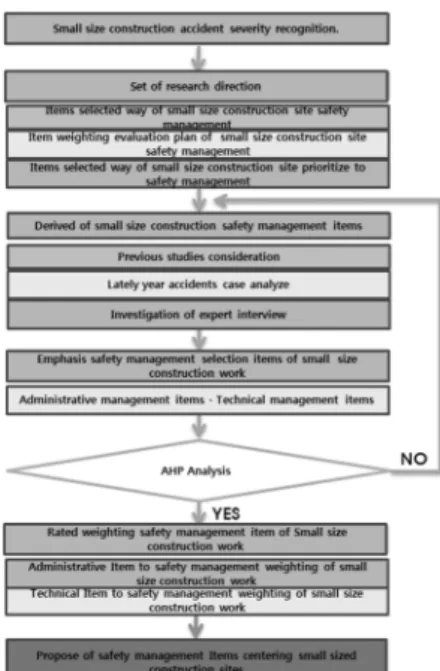
이러한 소규모 건축공사 현장에서 현실적으로 필요한 안전관리 개선방안 도출을 위해 Fig. 1과 같은 순서로 연구 를 진행하였다.
첫째, 건설재해와 관련된 자료조사를 통해 소규모 건축 공사에서 발생되는 재해의 심각성을 인지하고, 개선방안을 제시하기 위한 전체적인 연구방안을 계획한다.
둘째, 소규모 건축공사에서 발생되는 재해의 세부적인 현 황을 파악하기 위해 자료를 다각적으로 분석하고, 국가 차 원에서 정책적으로 시도되는 제도파악 후 최종적인 연구결 과를 도출하는데 필요한 통계기법을 고찰한다.
셋째, 본 연구와 유관된 목적으로 수행된 선행연구와 실 제 발생한 재해사례 분석 및 전문가 면담조사를 토대로 소 규모 건축공사의 안전관리시 요구되는 점검항목을 도출한다.
넷째, 도출된 안전관리 항목을 토대로 유경험자와의 설문 조사를 실시하여 소규모 건축공사에 필요한 중점안전관리 항목을 선정한다.
다섯째, 선정된 소규모 건축공사 안전관리 항목의 효율적 인 안전관리에 요구되는 점검항목별 우선순위를 평가하기 위해 AHP 분석방법에 의거하여 중요도를 평가한다.
여섯째, 세부적인 범위 및 항목 간 중요도가 평가된 안전 관리항목을 토대로 실제 현장의 안전관리활동에 활용이 가 능하도록 우선순위안전관리항목을 제시한다.
2. 건설현장 재해에 대한 이론적 고찰
2.1.
규모별 재해발생 현황우리나라는 국가적인 차원에서 건설현장의 안전관리를 전 담하는 기관으로 안전보건공단을 지정하고 있으며, 안전보
건공단에서는 건설현장의 재해예방을 위한 지도․점검과 더불어 발생되는 재해의 세부적 현황 및 원인을 년 단위로 분석하여 발표하고 있다. 안전보건공단, ‘2010년 산업재해 현황분석(2011)’7)에서는 건설사업장의 규모를 상시근로자 수와 공사금액에 따라 분류하는데 상시근로자수의 경우 5 인 미만에서부터 1,000인 이상까지 9단계로 구분하고 있으 며, 공사금액은 3억 미만부터 120억 이상까지 4단계로 분 류하고 있다. 그 내용을 분석한 결과, 2010년도에 공사가 진 행된 건설현장의 사업장 수는 221,617개소이며, 근로자수는 3,200,645명에 이르는 것으로 분석되었다. 재해자수는 전 체 22,504명 가운데 5인 미만 사업장에서 7,998명, 5인~10 인 미만 사업장 4,151명, 10인~30인 미만 사업장 4,975명, 30~
50인 미만 사업장 1,716명, 50~100인 미만 사업장 1,584명, 100~300인 미만 사업장 1,328명, 300~500인 미만 사업장 347명, 500~1,000인 미만 사업장 231명, 1,000인 이상 사업 장에서 174명이 발생한 것으로 분석되었다. 따라서 전체 적인 발생현황을 고려할 때 상시근로자수에 따른 건설재 해는 소규모 사업장에서 발생빈도가 매우 높은 특성이 나 타나는 것으로 확인되었다. 공사금액에 따른 공사규모의 분 류는 3억 미만(영세규모)부터 3억~20억 미만(소규모), 20억~
120억 미만(중규모), 120억 이상(대규모)까지 4단계로 분 류하고 있으며, 세부적인 발생현황은 Fig. 2와 같다.
공사금액별 재해발생현황을 분석한 결과, 재해율은 3억 미만에서 2.41%, 3억~20억 미만에서 1.28%, 20억~120억 미만에서 0.59%, 120억 이상에서 0.1% 로 나타났고, 사망 자수의 경우 3억 미만에서 173명, 3억~20억 미만에서 135 명, 20억~120억 미만에서 97명, 120억 이상에서 170명 인 것으로 분석되었다. 재해자수는 3억 미만에서 9,564명, 3 억~20억 미만에서 6,532명, 20억~120억 미만에서 3,385명, 120억 이상에서 1,230명으로 재해율 및 사망자수와 재해 자수까지 대규모 건설현장에 비해 소규모 건설현장에서 모두 높은 분포를 차지하는 것으로 분석되었다.
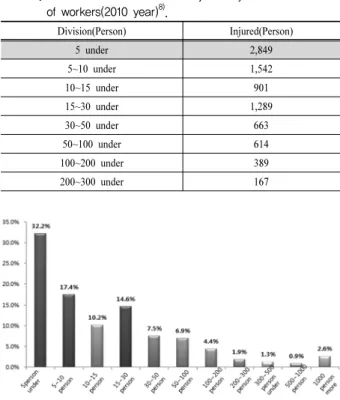
상시근로자수에 부상자현황을 분석한 결과는 Table 1 이며, 이를 분포에 따라 분석한 결과는 Fig. 3과 같다.
전체 부상자수를 기준으로 5인 미만 사업자에서 32.2%, 5인~10인 미만 사업장 17.4%, 10인~15인 미만 사업장 10.2%, 15인~30인 미만 사업장 14.6%, 30 ~50인 미만 사업장 7.5%, 50~100인 미만 사업장 6.9%, 100~200인 미만 사업장 4.4%, 200~300인 미만 사업장 1.9%, 300~500인 미만 사업장 1.3%,
Fig. 2. Construction work by amount accidents(2010 year).
Table 1. Occurrence of construction injuries by at all time number of workers(2010 year)
8).
Division(Person) Injured(Person)
5 under 2,849
5~10 under 1,542
10~15 under 901
15~30 under 1,289
30~50 under 663
50~100 under 614
100~200 under 389
200~300 under 167
Fig. 3. Construction industry at all times the number of workers injured another distribution(2011 year)
8).
500~1,000인 미만 사업장 0.9%, 1,000인 이상 사업장에서 2.6% 발생한 것으로 분석되었다.
건설현장의 규모에 따른 재해발생현황의 종합적인 분석 결과를 고려할 때, 공사금액 20억원 미만으로 상시근로자수 5인 미만인 소규모 건설현장에서 발생되는 재해의 비율이 월등하게 높게 나타나 이에 따른 집중적인 안전관리가 수반 되어야 할 것으로 판단된다.
2.2.
발생형태별 재해발생 현황Table 2. Status of construction of disaster the injured by type (2010 year).
Division Injured(person)
inversion․overturn 2,261
collide․contact 2,066
narrowness․windingness 1,565
crash 1,339
falling․flying 800
Exposure to hazardous substances, contact 301
Body reaction 265
Fire, explosion 69
collapse 67
Act of violence 59
Electric current contact 48
Ect 1
Total 8,841
건설현장에서 발생되는 재해의 유형은 상황 및 특성에 따라 다양하게 분류할 수 있으나, 직접적으로 확인이 가 능한 상태를 기준으로 크게 넘어짐, 부딪힘, 끼임, 떨어짐, 맞음, 화학물질 누출․접촉, 신체 반응, 폭발․파열, 무너짐, 폭력행위, 감전, 기타로 구분할 수 있다. 2010년도에 건설 현장에서 재해로 인한 부상자를 형태별로 구분하여 분석 한 결과는 Table 2와 같다.8)
발생형태별 부상자 현황을 분석한 결과, 총 8,841명의 부상자 가운데 넘어짐에서 2,261명, 부딪힘 2,066명, 끼임 1,565명, 떨어짐 1,339명, 맞음 800명, 화학물질 누출․접촉 301명, 신체 반응 265명, 폭발․파열 69명, 무너짐 67명, 폭 력행위 59명, 감전 48명, 기타에서 1명인 것으로 분석되어, 넘어짐으로 인해 발생된 재해가 가장 많은 것으로 파악되 었다.
3. 소규모 건축공사 중점안전관리항목 분석
3.1.
소규모 건축공사 중점안전관리 항목 선정중점안전관리항목은 관리적 측면과 기술적 측면으로 나누어 총 3단계에 걸쳐 진행하였으며 다음 Fig. 4는 중점 안전관리항목 절차를 도식화하여 나타낸 것이다.
1단계는 안전보건공단 ‘공사종류별 안전점검시리즈 및 건설현장 안전관리 가이드북(2010)’9)을 통해 관리적 측면 13 개, 기술적 측면 70개 항목을 도출하였고 2단계에서는 재 해사례분석을 통해 관리적 측면 12개, 기술적 측면 24개 항목을 추가적으로 도출하였다. 이를 3단계에서는 전문가
Fig. 4. intensive safety items selection procedures.
Table 3. Intensive on managerial aspects safety items.
Management Areas Management items
Safety and health management organizations, and
educational (3)
- specify and safety manager
- Implementation of health and safety education - Recording the results of Education, conservation Occupational
Safety and Health Expenses
(3)
- Proper safety management appropriate - Safety management appropriate enforcement - Itemized proper ratio
Provide personal protective equipment
(4)
- Provide personal protective equipment - Wear personal protective equipment - Inside the tunnel workers wear dust masks - Protective equipment purchase to eligibility products
Other safety measures
(5)
- Hazardous prevent the plan submission and fulfillment
- Hazardous materials management measures
- Establishment of fire protection countermeasures
- Sign installation, such as danger, caution, warning
- Materials in the workplace tidy and secure safe passage
Table 4. Intensive on technical aspects of safety management items.
Technical
field Management items
Earth work (8)
- Geology and geological conditions
- Underground utilities and ground utilities action - Slope or sheathing timbering risk of collapse - Effects due to excavation work adjacent facilities - Drainage management
- Soil and rock fall risk
- Earthy material transport route safety conditions - Placement of Construction Machinery signal man
Foundation work
(9)
- Construction Machinery fall prevention measures - Pile driving workers around workplace control
- Checking the boring when the oil tank and water transmission pipeline
- Driving pile machine lifting wire rope condition - Foundation file safety status
- Pile driving vibration and noise management - Rebar bending the ground state
- Workers assemble reinforced ensure safe passage - Concrete pump car fall prevention measures
Reinforced concrete
work (8)
- Reviewing and assembling structural adequacy formwork Shore - Risk of collapse of formwork upper materials
- Payments and personal protective equipment for workers - State workers wear personal protective equipment - Status of the installation work plate
- End of the slab opening protective measures - Flared shieldin Status of the installation - Risk of collapse formwork Shore
Masonry work
(7)
- Materials (brick, block) carrying method
- Masonry construction work plate Status of the installation - Brick and block the collapse the risk
- Opening a protected
- Material of cutting sccater object safety measures - Joint Injection safety work bench
- State workers wear personal protective equipment
Plasterwork (8)
- Materials of cement, stone and sand transport methods - Material handling workers and materials falling crash risk - The appropriateness of using scaffolding
- Opening a protected
- State workers wear personal protective equipment - work plate Status of the installation to plaster's work - Operation and secured passage
- Risk of electric shock hypothesis
Waterproof ing work
(10)
- Material Handling Method adequacy - Risk of falling materials
- Material storage area ventilation and isolation - Waterproof construction work plate installation status - Opening a protected
- Fire and explosion hazards of volatile materials - State workers wear personal protective equipment
- In the water when working in confined spaces choking hazard - Waterproof workplace lighting conditions
- Temporary electrical shock risk
Window
& door work
(7)
- Material handling equipment and materials of the crash risk of falling
- Windows scaffold safety conditions for construction work - State workers wear personal protective equipment - Glass cock crashed in operation preventive measures - Portable electric machine
- apparatus of the insulation measures - Rope installation status
- Heavy construction frame installation safety precautions
Table 4. Intensive on technical aspects of safety management items (continued).
Technical
field Management items
Painting work
(8)
- Material handling equipment and materials of the crash risk of falling
- Coating materials for surrounding fire unattended - Hanging scaffold support ropes fixed state - Rope installation status
- Workers wear personal protective equipment - Hanging scaffold support ropes and life rope safety - Painters working with scaffolding safety conditions - The risk of scattering of paint coating
Electric machinery
work (7)
- Material handling equipment and materials of the crash risk of falling
- Electrical and mechanical equipment for construction work plate safe state
- Power cut Safety compliance work
- State workers wear personal protective equipment - Working methods elevator installation procedure - Elevator pit opening fall protection measures - Elevator pit fall inside the operator preventive measures
Exterior finish work
(8)
- Whether conduct safety checks before starting work
- High place operation car worker wearing safety equipment status - Tools and materials arrangement state
- Displays live load carrier
- Whether carrier with a protective rubber front - Work location after the carrier
- Crane disabled of bad weather
- High place operation car 6 months / restraint tests conducted at least once
면담조사를 통한선별과정을 실시하여 관리적 측면 15개, 기술적 측면 80개 중점안전관리항목을 최종적으로 선정하 였다. 위 항목을 살펴보면 관리적 분야는 “안전보건 관리 조직 및 교육”, “산업안전 보건관리비”, “개인보호구 지급”,
“기타 안전대책”으로 구분하고, 기술적 분야는 “토공사”,
“기초공사”, “철근콘크리트공사”, “미장공사”, “창호공사”,
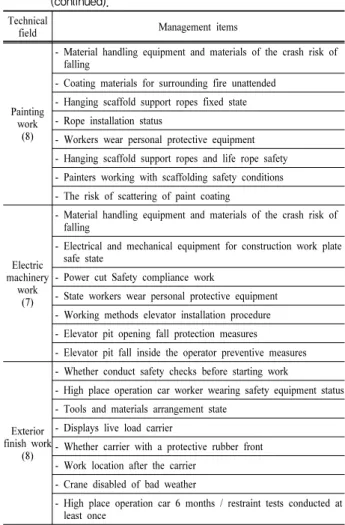
“전기․기계 설비공사”, “조적공사”, “방수공사”, “도장공 사”, “외부마감공사”로 구분하여 각각의 세부항목을 도출 한 후 다음 Table 3, Table 4와 같이 정리하였다.
3.2.
소규모 건축공사 중점안전관리 항목 설문조사3.2.1. 조사개요 및 방법
소규모 건축공사 현장에서 보다 실질적으로 필요한 안 전관리항목의 도출을 위해 3.1절에서 선정한 중점안전관 리항목을 토대로 체크리스트를 작성하고, 20억 원 미만의 소규모 건설현장에 근무하고 있는 현직 관리자를 대상으로 설문조사를 실시하여 그 결과를 토대로 계층별 쌍대비교 (AHP) 분석을 진행함으로서 각 항목의 중요도를 산출하였 다. 그런 다음 각 항목의 중요도를 비교 분석하여 우선순위 중점안전관리항목을 선정고자 하였다. 다음 Table 5는 설
Table 5. Configure the questionnaires.
Division Investigation
item
Basics - 3
Assessment Items by
pairwise comparison
Managerial items
Safety and health management organizations, and educational 3 Occupational Safety and Health
Expenses 3
Provide personal protective
equipment 4
Other safety measures 5
Technical Items
Earth work 8
Foundation work 9
Reinforced concrete Work 8
Plaster work 8
Window & door work 7 Electric, machinery work 7
Masonry work 7
Waterproofing work 10
Painting work 8
Exterior finish work 8
sub-total 95
Total 98
status respondents on career status respondents fields of work
문조사개요를 정리해 놓은 표이다.
2012년 8월 한 달 동안의 설문기간 동안 총 100부의 설 문지를 배포하여 62부가 회수됨으로써 62%의 회수율을 기 록하였고, 회수된 설문지의 사전검토 결과 13부의 설문지가 응답자 계층 간 일관성이 결여되는 것으로 파악되어 이를 제외한 49부의 설문지를 선정하여 분석하였다.
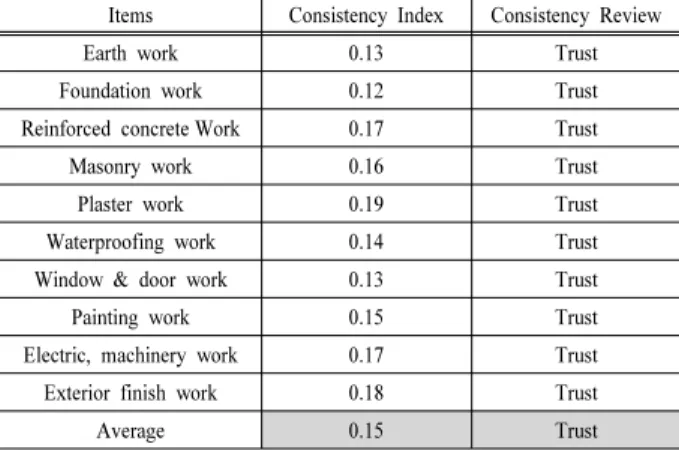
본 설문조사를 통한 평가항목별 쌍대비교 결과 값의 일 관성을 검증하기 위하여 AHP 전문 프로그램인 Expert Choice Ec11 Model을 활용하여 검토를 실시하였고, 일관성 지수 에 대한 평가기준은 지수가 0에 가까울수록 가장 좋은 값 으로 보고, 0.1이하이면 높게 신뢰할 수 있고, 0.2이하가 되면 기준 혹은 대안을 비교할 때 일관성 일탈이 크게 문 제되지 않으며, 0.2를 초과하면 일관성은 신뢰할 수 없는 것으로 분류한다10). 검토결과 일관성 지수는 다음 Table 6,7 과 같이 전체적으로 0.2 이하의 값을 보인 바, 이는 신뢰할 수 있는 일관성 지수를 확보한 것으로 분석되었다.
설문조사 결과의 신뢰성을 확보하기 위한 신뢰도 검토는 한글 SPSS 12.0K for Windows를 사용하여 신뢰도 척도인 Cronbach 알파계수를 도출하였다. 이 계수는 0~1의 값을 갖
Table 6. Items consistent managerial review results
Items Consistency
Index
Consistency Review Safety and health management organizations,
and educational 0.15 Trust
Occupational Safety and Health Expenses 0.13 Trust Provide personal protective equipment 0.18 Trust
Other safety measures 0.11 Trust
Average 0.14 Trust
Table 7. Items consistent technical review results
Items Consistency Index Consistency Review
Earth work 0.13 Trust
Foundation work 0.12 Trust
Reinforced concrete Work 0.17 Trust
Masonry work 0.16 Trust
Plaster work 0.19 Trust
Waterproofing work 0.14 Trust
Window & door work 0.13 Trust
Painting work 0.15 Trust
Electric, machinery work 0.17 Trust
Exterior finish work 0.18 Trust
Average 0.15 Trust
Table 8. Item reliability and managerial review results.
Division Number of
items
Cronbach Alpha coefficient Safety and health management organizations,
and educational 3 0.985
Occupational Safety and Health Expenses 3 0.805 Provide personal protective equipment 4 0.864
Other safety measures 5 0.951
All 15 0.90
Table 9. Item reliability and technical review results.
Items Number of
items
Cronbach Alpha coefficient
Earth work 8 0.843
Foundation work 9 0.733
Reinforced concrete Work 8 0.806
Masonry work 7 0.917
Plaster work 8 0.926
Waterproofing work 10 0.847
Window & door work 7 0.815
Painting work 8 0.862
Electric, machinery work 7 0.969
Exterior finish work 8 0.915
All 80 0.863
는데, 값이 높을수록 신뢰도가 높다고 보고, 보통 0.8~0.9의 값이면 신뢰도가 매우 높은 것으로 보며, 0.7이상이면 바
람직한 것으로 본다. 위와 같은 방법으로 전체항목에 대한 신뢰도와 각 단계별 항목들에 대한 신뢰도로 구분하여 실 시 한 결과, Table 8,9에서와 같이 전체적인 Cronbach 알파 계수는 0.8이상으로 본 설문조사는 높은 신뢰도를 갖는 것으로 검증되었다.
3.2.2. 관리적 측면의 중점안전관리항목 도출
각각의 중점안점관리항목의 중요도를 산출하기 위한 설 문조사의 일관성과 신뢰도를 검토하고 그 객관성을 검증한 후 이를 토대로 AHP 분석을 실시하였다.
다음 Fig. 5는 4개 분야로 12개 세부항목으로 구성 된 관리적 항목의 분야별 쌍대비교 분석 결과를 나타낸 것이다.
관리적 항복 분야별 쌍대비교 분석결과는 “안전보건 관리조직 및 교육” 분야가 “산업안전보건관리비” 분야와 비교하여 8.27배, “개인보호구 지급” 분야와 비교하여 1.23배, “기타 안전대책” 분야와 비교하여 1.73배 중요한 것으로 분석되었고, “산업안전보건관리” 분야가 “개인보 호구 지급” 분야와 비교하여 -2.79배, “기타 안전대책” 분 야와 비교하여 -3.15배 중요하게 나타났으며, “개인보호구 지급” 분야는 “기타 안전대책”과 비교하여 5.9배의 중요 도를 갖는 것으로 파악되었다. 위의 평가분야별 쌍대비교 에 의한 상호중요도를 기하평균으로 산출하여 전체 분야 에서 해당계층이 가지는 개별적 중요도 정도를 분석한 결 과는 다음 Fig. 6과 같다.
관리적 상위항목 분야의 개별적 중요도를 분석한 결과,
“개인보호구 지급” 분야(3-3)가 0.400, “안전보건 관리조직 및 교육” 분야(3-1)가 0.383, “기타 안전대책” 분야(3-4)가 0.147,
“산업안전 보건관리비” 분야가 0.069인 것으로 분석되었다.
그 결과 “개인보호구 지급”분야에 대한 중요도가 가장 높은 반면에 “산업안전 보건관리비”분야에 대한 중요도는 가장 낮은 수치를 나타냈다.
상기와 같은 방법으로 관리적 항목의 분야별 세부항목 의 개별적 중요도를 분석하기 위해 안전보건 관리조직 및
Fig. 5. Pairwise comparison analysis sector managerial topics area.
Fig. 6. Importance of individual sector analysis and managerial items.
Table 10. Item Details items individually managerial importance analysis.
Division Management items criticality Ranking
Safety and health management organizations, and educational
Specify safety manager 5.84 2
Implementation of health and safety
education 6.63 1
Recording the results of Education,
conservation 5.17 3
Occupational Safety and Health Expenses
Proper safety management appropriate 5.38 2 Safety management appropriate enforcement 6.36 1 Itemized proper ratio 4.29 3
Provide personal protective equipment
Provide personal protective equipment 5.10 2 Wear personal protective equipment 5.62 1 Inside the tunnel workers wear dust masks 3.72 4 Protective equipment purchase to eligibility
products 4.09 3
Other safety measures
Hazardous prevent the plan submission and
fulfillment 5.45 1
Hazardous materials management measures 4.27 3 Establishment of fire protection
countermeasures 3.85 4
Sing installation, such as danger, caution,
warning 5.14 2
Materials in the workplace tidy and secure
safe passage 3.79 5
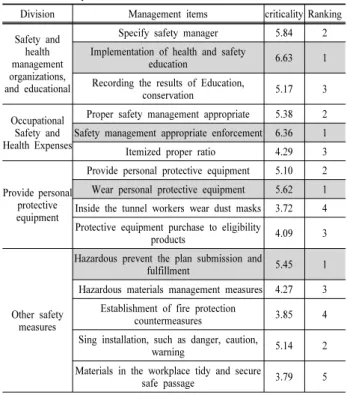
교육 분야에서 3회, 산업안전 보건관리비 분야에서 3회, 개인보호구 지급분야에서 6회, 기타 안전대책 분야에서 10 회로 총 22회의 AHP 쌍대비교를 실시하였으며, 이를 통해 도출된 세부항목의 개별적 중요도 분석결과는 Table 10와 같다.
관리적 항목 세부항목 개별적 중요도 분석 결과, 각 분야 별 우선순위 세부항목으로 “안전보건교육실시”, “안전관리 비 적정 집행”, “개인보호구 착용”, “위해․위험 방지계획서 제출 및 이행”의 안전관리가 가장 중요한 항목인 것으로 확인되었다.
위의 관리적 측면의 중점안전관리항목 중요도 결과를 종 합하여 분석해보면, 소수의 노무자로 구성 된 소규모 현 장의 특성 상, 팀 전체를 위한 간접적인 관리의 중요성 인식 보다는 개인의 직접적인 관리 즉, “개인보호구 지급분야”를 비롯한 세부적 항목으로 “개인보호구 착용” 등의 관리가 필 요하다고 판단된다. 더 나아가 “안전보건교육 실시”와 “안 전관리비 적정 집행” 또한 직접적인 관리에 일환으로 그 중요성이 높다고 볼 수 있다. 그리고 기타안전대책 분야 에서 가장 높은 수치를 보여준 “유해 위험 방지계획서 제출 및 이행” 항목은 안전사고를 미연에 방지하기 위한 노력의 중요성을 나타내는 결과라고 판단된다.
3.2.3. 기술적 측면 중점안전관리항목 도출
기술적 측면의 중요도 분석으로 10개 상위항목들로 분야 별 쌍대비교 분석을 한 결과는 다음 Fig. 7과 같고, 이를 통 해 산출된 개별적 중요도 분석결과는 Fig. 8과 같다.
쌍대비교 결과를 토대로 기술적 항목의 분야별 중요도
Fig. 7. Technical topics are pairwise comparison sector analysis.
Fig. 8. Technical item More sector individually importance analysis.
값을 기하평균으로 산출하여 전체 계층을 기준으로 해당 계층이 갖는 개별적 중요도를 분석한 결과, “토공사”
0.057, “기초공사” 0.092, “철근콘크리트공사” 0.092, “조적 공사” 0.083, “미장공사” 0.068, “방수공사” 0.073, “창호공 사” 0.064, “도장공사” 0.073, “전기계설비공사” 0.065, “외 부마감공사” 0.111인 것으로 분석되었다. 분석 결과 외부 마감공사의 중요도가 다른 분야에 비해 상당히 높은 수치 를 나타냈는데, 이는 고소작업으로 인한 떨어짐 재해 위 험요소가 높은 분야로 외부마감공사의 특성에 따른 안전 관리계획의 중요성을 나타내는 결과라 판단된다.
다음으로 세부항목의 개별적 중요도를 분석하기 위해 상 기와 같은 방법으로 토공사 분야에서 28회, 철근콘크리트 공사 분야에서 28회, 미장공사 분야에서 28회, 창호공사 분 야에서 21회, 전기․기계 설비공사 분야에서 21회, 기초공사 분야에서 36회, 조적공사 분야에서 21회, 방수공사 분야 에서 45회, 도장공사 분야에서 28회, 외부마감공사분야에서 28회로 총 94회의 AHP 쌍대비교를 실시하였다. 다음 Table 11은 기술적 항목 세부항목 개별적 중요도 분석 결과를 그 래프로 나타낸 것 이다.
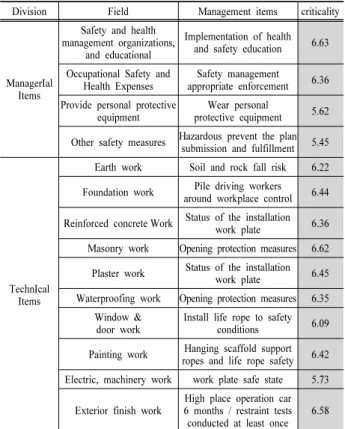
기술적 항목 세부항목 개별적 중요도 분석 결과, 각각 토 공사-토사 및 암반 맞음 위험, 기초공사-항타작업 주변에 근로자 통제, 철근콘크리트공사-작업발판설치상태, 조적 공사-개구부 방호조치, 미장공사-작업발판 설치상태, 방 수공사-개구부 방호조치, 창호공사-구명로프 설치 안전 상태, 도장공사-달비계 지지로프 고정 안전상태, 전기기계 설비공사-작업발판 안전상태, 외부마감공사-고소작업 차 6개월/1회 이상 자체검사가 다른 항목에 비해 현저히 높은 수치를 나타냄으로서 가장 우선시 되어야 하는 항목 으로 선정되었다. 분석결과 각 항목의 공통적 안전관리 사항은 분야별 중요도 분석에서도 나타났듯이 고소작업 으로 인한 떨어짐 사고로 기인할 수 있는 위험요소를 강 조하고 있음을 알 수 있다. 이는 작업발판설치, 개구부 방
Table 11. Importance of technical analysis individual items details.
Earth work Foundation work
Reinforced concrete Work Masonry work
Plaster work Waterproofing work
Window & door work Painting work
Electric, machinery work Exterior finish work
Table 12. Small selection of construction safety management prio- rities focus on the result table.
Division Field Management items criticality
ManagerIal Items
Safety and health management organizations,
and educational
Implementation of health and safety education 6.63 Occupational Safety and
Health Expenses
Safety management appropriate enforcement 6.36 Provide personal protective
equipment
Wear personal
protective equipment 5.62 Other safety measures Hazardous prevent the plan
submission and fulfillment 5.45
TechnIcal Items
Earth work Soil and rock fall risk 6.22 Foundation work Pile driving workers
around workplace control 6.44 Reinforced concrete Work Status of the installation
work plate 6.36
Masonry work Opening protection measures 6.62 Plaster work Status of the installation
work plate 6.45
Waterproofing work Opening protection measures 6.35 Window &
door work
Install life rope to safety
conditions 6.09
Painting work Hanging scaffold support ropes and life rope safety 6.42 Electric, machinery work work plate safe state 5.73
Exterior finish work
High place operation car 6 months / restraint tests conducted at least once
6.58
호조치, 구명로프 설치, 달비계 지지로프 설치, 고소작업 차 자체 검사와 같은 안전장비관리와 떨어짐에 대한 안전 의식교육, 작업 현장 안전관리활동의 집행 및 감독 등이 열악한 소규모 건설공사현장의 건설안전 환경에 기인한 것 으로 이를 보안하기 위해 소규모 건설현장 안전관리책임자 선임 규정(20억 미만의 현자의 경우 안전관리책임자 선임 의무규정이 없음)강화와 같은 근원적 개선방안이 필요한 시점이라고 판단된다.
앞서 진행한 관리적 측면과 기술적 측면 중점안전관리 항목 중요도 분석결과를 토대로 소규모 건축공사 현장에서 보다 우선적으로 관리활동을 진행해야하는 중점관리항목을 선정하여 다음 Table 12와 같이 제시하였다
4. 결 론
대규모 건설현장과 비교하여 상대적으로 안전관리인력 및 기술체계가 취약한 소규모 건축현장에서 실질적으로 필요 한 중점안전관리항목을 제시하기 위해, 선정된 자료와 설문 조사 결과를 AHP기법을 사용하여 분석한 결과로 다음과 같 은 결론을 도출하였다.
1) 소규모 건축공사의 안전관리 항목과 관련된 선행연구 분석 및 현업에 종사하는 실무자 면담조사를 토대로 선정 된 안전보건 관리조직 및 교육, 산업안전보건관리비, 개인보 호구 지급, 기타 안전대책 관리 분야에서 15가지의 관리적 항목과 소규모 건축공사의 재해다발 공종을 기준으로 10개 분야에서 80개의 기술적 항목을 도출하였으며 이를 토대 로 중점안전관리항목을 제시하였다.
2) 소규모 건축공사 중점안전관리항목의 상대적 중요도 를 평가를 위한 설문조사 결과, 평균 일관성은 관리적 항목 0.14, 기술적 항목 0.15, 평균 신뢰도의 경우 관리적 항목 0.90, 기술적 항목 0.863으로 나타나, 신뢰도와 일관성 측면에서 유효하였다.
3) 관리적 상위항목 분야의 개별적 중요도를 분석한 결과,
“개인보호구 지급” 0.400, “안전보건 관리조직 및 교육” 0.383,
“기타 안전대책” 0.147, “산업안전 보건관리비” 0.069인 것 으로 분석되었다. 관리적 항목 세부항목 개별적 중요도 분 석 결과는 각 분야별 우선순위 세부항목으로 “안전보건교 육실시”, “안전관리비 적정 집행”, “개인보호구 착용”, “위해․
위험 방지계획서 제출 및 이행”의 안전관리가 가장 중요한 항목인 것으로 확인되었다. 즉, 소수의 노무자로 구성 된 소 규모 현장의 특성 상, 팀 전체를 위한 간접적인 관리의 중요 성 인식 보다는 개인의 직접적 관리가 필요하다고 판단된다.
4) 기술적 상위항목 분야의 개별적 중요도를 분석한 결과,
“토공사” 0.057, “기초공사” 0.092, “철근콘크리트공사” 0.092,
“조적공사” 0.083, “미장공사” 0.068, “방수공사” 0.073, “창 호공사” 0.064 “도장공사” 0.073, “전기계설비공사” 0.065,
“외부마감공사” 0.111인 것으로 분석되었고, 세부항목 개별적 중요도 분석 결과, 각각 “토사 및 암반 맞음 위험”,
“항타작업 주변에 근로자 통제”, “작업발판설치상태”, “개 구부 방호조치”, “작업발판 설치상태”, “개구부 방호조치”,
“구명로프 설치 안전상태”, “달비계 지지로프 고정 안전상 태”, “작업발판 안전상태”, “고소작업차 6개월/1회 이상 자체검사” 가 다른 항목에 비해 현저히 높은 수치를 나타냄 으로서 가장 우선시 되어야 하는 항목으로 선정되었다.
이는 고소작업으로 인한 떨어짐 사고로 기인할 수 있는 위 험요소에 대한 예방의 중요성 알 수 있고, 소규모 건축공 사현장의 사전 위험요소에 대한 예방대책활동의 활성화를 위해 안전관리책임자 선임의무규정 등 법적규제를 강화하 여 근로자의 안전의식 고취, 안전전보건관리비 적정사용 등을 도모해야함을 보여주는 결과이다.
References
1) J. S. Chae, D. H. Lee and S. Lee, “Improving Self-control Safety & Management Ability of the Domestic Construction Sites”, Korean Society of Civil Engineers, Vol. 2000, No. 4, pp. 295~296, 2000.
2) G. T. Lee, “A Study on the Efficient Technical Assistance for Small-sized Construction Sites”, The Korean Society of Safety, Vol. 21, No. 5, pp. 73~74, 2006.
3) D. S. Park and W. Kim, “The Improvement of the Effecti- veness of the Safety Management System for Construction Calamity Prevention”, Korean Society of Civil Engineers, Vol. 25, No. 4, pp. 569~570, 2005.
4) H. C. Lee, D. H. Song and S.S. Go, “A Study on the Safety Management Items for Preventing Accidents of Aged Con- struction Workers”, The Korean Society of Safety, Vol. 24, No. 1, pp. 53~55, 2009.
5) J. B. Lee and S. R.Chang, “Measurement of Severity of Hazards and Investment in Occupational Safety & Health According to Ship Types using Analytic Hierarchy Process”, The Korean Society of Safety, Vol. 27, No. 1, pp. 107, 2012.
6) D. H. Song, S. K. Yeo and S. S. Go, “Safety Management Priority Classified by Participants in Planning & Design Sta- ges”, The Korean Society of Safety, Vol. 25, No. 1, pp.
55~56, 2010.
7) Korea occupational Safety & Health Agency, “Analysis of Industrial Accidents”, 2010.
8) Occupational Safety & Health Research Institute, “Industrial Accident Cause Investigation Report”, 2010.
9) Korea occupational Safety & Health Agency, “Small-size Construction Safety Management Guide Book”, 2010.
10) T. L Saaty, “Multicriteria Decision making: The Analytic Hierachy Process”, pp. 17~21, 1990.