1) 교신저자: Kim, Eun Jeung, 692, Ilwon dong, Gangnam Gu, Seoul, 135-946, Republic of Korea Tel: 070-7092-9341, Fax: 02-445-9882, E-mail: [email protected]
자유학기제 도입에 따른 기술·가정 교과통합 진로교육 운용 방안 - 가정 교과 영역을 중심으로 -
김은정*1)
중동중학교*
Career Education in Technology·Home Economics Education and Application Plan in Free Learning Semester
- Focus on Home Economics education Unit -
Kim, Eun Jeung*
1) Joongdong Middle School*Abstract
This study aimed to investigate the validity and appropriate way of career education according to the integration of home economics subjects, as a way of revitalization of career education in technology and home economics subjects, after the implementation of free semester system. For this goal, the meaning and trend of free semester system, trend of subject-integrated career education, analysis of curriculum in technology·home economics education subject, and trend of research about career education in home economics were investigated.
The result was as in the following. First, in spite of the ambiguity of the meaning of free semester, the career
education will be expanded as the importance of lifelong career education was more and more required. Second,
the career paths separated from subjects had problem in its effectiveness, therefore, subject-integrated career
education emphasizing on school subjects will become more crucial. Third, it was presented that extracting core
achievement standard in subject-integrated career education in technology·home economics education according to
core achievement standard was critical. For these reasons, the objective and model of career education in home
economics education under free semester system were illustrated.
Key words: 자유학기제(free learning semester), 교과통합 진로교육 (subjects-integrated career education), 핵심역량 (core achievement standard), 가정교과통합진로교육(Home Economics subjects-integrated career education)
Ⅰ. 서 론
현대 사회는 지식을 기반으로 한 사회로 전환되면서, 직업 의 세계가 빠른 속도로 변화하고 있다. 이러한 사회적인 변 화는 학교 교육에서 ‘교사의 지식 전달과 학생의 학습’이라 는 기존의 교사․학생의 역할의 변화를 요구하고 있다. 즉 교사는 단순한 지식의 전달자가 아닌 학습자의 지식 획득 과 정에서 지식과 정보를 제공함과 동시에 재조직하여 지원하는 역할을 담당할 것을 요구한다. 학습자는 수동적인 학습자로 서의 역할이 아니라 전 생애 과정에서 지식을 탐구하는 자세 와 이를 통한 개인의 진로 인식․진로 탐색․진로 준비․진 로 유지 및 개선의 과정을 경험하게 된다. 이 과정에서 학교 교육에서의 진로교육은 진로 발달 단계에 따라 체계적으로 이루어지는 것이 필요하며 이를 위한 제도적인 준비가 요구 된다고 하겠다.
이러한 시대적인 요구에 따라 현 정부에서는 진로탐색 활 동에 집중할 수 있는 교육과정으로서의 자유학기제를 제안하 였고, 2013년 2학기부터 시범학교를 중심으로 실제 적용되기 에 이르렀다. 그러나 2013~2014년 시범학교 운영 및 2016년 전국 중학교에서의 시행이 고시된 상황에서도 학교에서 이를 운영하는 방안과 운영 주체에 대한 논의는 지속적으로 이루 어지고 있다. 이는 진로진학상담교사를 2014년에 모든 학교 에 배치하도록 하여 이들에게 진로진학과 관련한 교무행정적 인 역할을 담당하도록 하는 것과 맥을 같이 하고 있다. 그러 나 학교교육에서 한 학기의 진로교육을 진로진학담당교사 1 인이 추진․운영․관리하는 것에는 한계가 있으며, 이를 극 복하기 위해서 진로교육에 대한 기본적인 지식을 갖춘 각 교 과 담당 교사가 학생들의 진로교육 탐색 활동의 주체로 참여 해야 할 필요가 있다. 이러한 진로교육에 대한 거대한 흐름 과 더불어 교육과정에 진로교육이 내포되어 있는 「기술․가
정」교과에서 자유학기제에 따른 진로교육 활성화 방안과 교 과의 역할에 대한 합의가 이루어질 필요가 있다. 이는 진로 교육이 교과 단원에 포함되어 있음에도 불구하고 선택 교과 인 「진로와 직업」의 수업이 이루어지고 있는 현실은 기술․
가정 교과에서의 ‘진로교육’의 방향에 대한 논의를 요구한다.
따라서 본 연구는 자유학기제의 의미와 교과통합 진로교육 과 기술․가정 교과 중 가정교과 영역에서의 진로교육의 동 향을 탐색하고자 한다. 더불어 자유학기제 도입에 따른 기술·
가정교과의 진로교육 방향을 기술·가정교과통합 진로교육적 관점으로 접근하고, 이 과정에서 교과통합진로교육에서의 핵 심성취기준의 추출과 이를 반영한 교수․학습 과정 모형을 제시하는데 그 목적이 있다.
Ⅱ. 선행 연구 고찰
1. 자유학기제의 의미와 동향
자유학기제
2)란 학생들이 시험 부담에서 벗어나 행복한 학 교생활 속에서 스스로 꿈과 끼를 찾고 창의성, 인성, 자기주 도 학습능력 등 미래사회가 요구하는 역량을 배양하는 것을 목적으로 한다. 이는 제18대 대통령직 인수위원회에서 꿈과 끼를 키울 수 있는 학교교육 정상화 추진의 일환으로 제안된 교육정책이었다. 이는 학생들의 진로 설계를 위해 한 학기 동안 탄력성 있고 유동적인 교육과정을 운영하는 방식이다.
자유학기제의 근본 취지는 학생 각자가 성장 후 자신이 하고 싶어 하는 것, 잘 할 수 있는 것, 원하는 것이 어떤 것인가 에 대해 필요한 정보와 경로를 알도록 돕는 진로활동 위주의 학습 패러다임으로 전환하려는 것이다(Kwak, 2013).
2) 우리나라의 자유학기제는 아일랜드의 (Transition Year)과 영국․덴마크의 갭이어(Gap Year) 두 제도는 학생들의 리더십, 사회기술, 자신감, 팀 관리, 대인관계 기술과 같은 ‘소프트 스킬’을 계발하기 위한 기회를 제공한다는 측면에서 자유학기제의 개념과 비교할 수 있다(Andrew, 2013; Gerry, 2013).
Expanding experience/ participatory programs that inspire interest and curiosity
Career exploration activity Club activity
․ (Learning) Reflecting career education on school curriculum, Integrated subject management related to career, etc.
․ (Counselling․Test) Prior placement of career counselling teachers, Free career test, Practical use of career counselling application (4 types), etc.
․ (experience) full-time experiences more than 2 days, self-oriented experience planned by students and acknowledged as school attendance, career camp, special lectures from celebrities, etc.
․ (Management) Describing the e reasons and visions of students’ career plan on student record, constructing career portfolio by accumulating the results of student counselling and experiences, etc.
․ Opening club activities according to students’ desires, and reinforcement of connected activities between clubs.
․ Encouraging participation into youth organization(scout, RCY, etc.) and expanding support from local education office.
Art․Sports activity
․ Ensuring internal stability of art and sports education by expert instructors of culture, art, and sports from the Ministry of Culture and Sports.
․ Vitalization of integrated programs between art/sports and Korean language/English language/math/social studies/science
Optional program activity
․ Periodic demand survey and personal offer of educational activities according to the result.
․ Development and supply of long-term and short-term programs such as drama and culture, media and communication, and etc.
Note. Source: Ministry of education's Press, 2013. 05. 29.
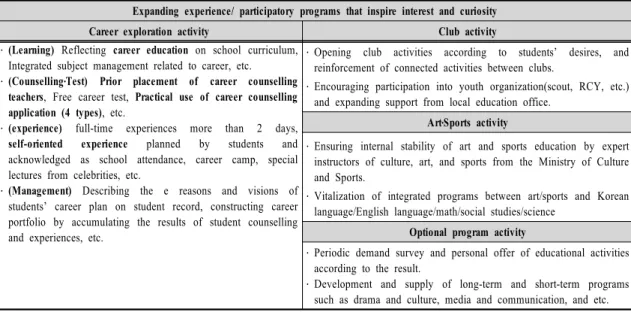
Table 1. Overview of curriculum construction and implementation of curriculum of free learning semester 자유학기제의 교육과정 편성․운영 방안으로는 <Table 1>
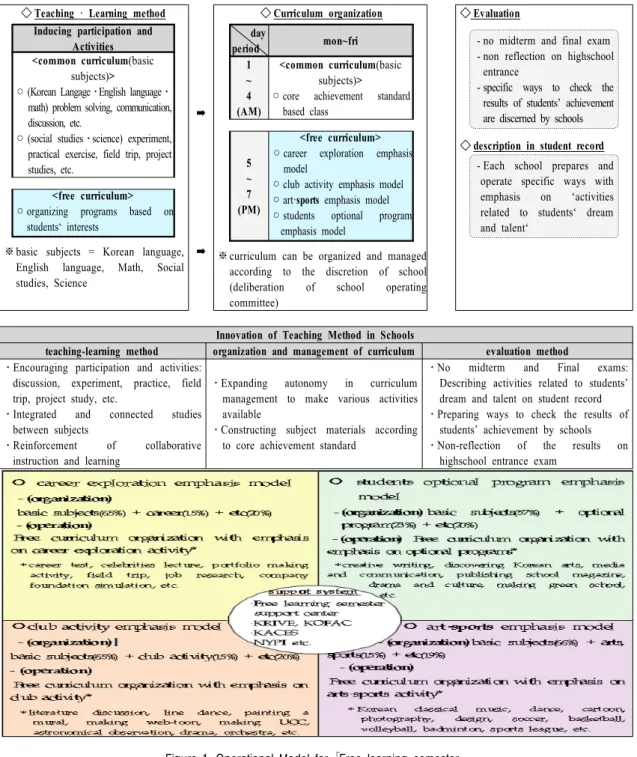
과 같이 국․영․수 등 공통 과정이 줄이고, 그 공백은 진로 탐색 활동, 동아리 활동, 예술·체육 활동, 선택 프로그램 활 동 등으로 구성된 자율과정으로 채워진다. 학생들의 참여와 활동을 유도하기 위한 교수․학습 방법과 과목 간 융합․연 계 교육, 협동교수-협력학습을 강화하며, 다양한 활동이 가능 하도록 교육과정의 자율성을 확대하며, 핵심 성취 기준을 중 심으로 교육 내용을 구성한다. 또한 이 기간 동안에는 중간·
기말고사를 실시하지 않으나 활동 상황에 대해서는 학생부에 기록하며, 학생 성취 결과를 확인하는 방안을 마련하도록 하 였다(Ministry of education's Press, 2013).
진로학습과 관련해서는 국․영․수․사․과 등 기본교과 에서 이미 개발된 ‘학교 진로교육 성취기준 및 성취지표’를 교육내용에 반영할 뿐 아니라, 진로와 연관된 다양한 ‘교과통 합 진로교육과정’ 운영을 활성화할 것을 제안하고 있다. 그리 고 2012년 교과통합 진로교육 지도서의 개발 완료된 국어, 수학, 과학, 사회, 기술․가정, 미술 등 중학교 6개 교과에서 를 통한 진로교육과정 운영 활성화를 제시하고 있다. 그리고 교수 학습 방법에서 사회·역사·도덕·과학·기술·가정 등의 교 과는 실험·실습·체험학습을 강화하고, 스스로 탐구할 수 있는 개인 및 조별 프로젝트 학습을 확대할 것을 제시하고 있다.
이에 따라 현재 중학교의 주당 수업시수인 33시간(공통과정 (기본교과) 30시간+창의적 체험활동 3시간)은 자유학기제 시 범학교에서는 공통과정이 20시간 안팎으로 줄고 창의적 체험 활동 중심의 ‘자율과정’이 13시간 안팎으로 늘게 된다 (Ministry of education's Press, 2013). 이렇게 운영할 때는
<Figure 1>과 같이 오전에 국어와 영어, 수학 등 수업을 마 치고, 오후에 다양한 참여·활동형 수업을 할 수 있다. 자율과 정은 직업체험을 통한 진로탐색과 각종 예술· 체육· 동아리 활동, 선택 프로그램 활동 등을 할 수 있으며, 이를 위한 지 원으로 진로진학상담교사를 배치하고, 한국직업능력개발원의 진로심리검사를 무료로 지원하는 등의 교육 지원 체계를 만 들어 나갈 것을 제안하고 있다.
이렇듯 진로탐색 활동에 집중하는 자유학기제는 2013년 9 월부터 중학교의 한 학기 동안 시범운영을 한 뒤 2014년 초~2015년 말에 희망학교의 신청을 받아 운영하고, 2015년 전면시행이 결정되면 2016년 3월부터 전국 모든 중학교에 도입된다는 취지이다(Jeong, Kim, Seo, & Cho, 2012). 그러 나 자유학기제의 전면 시행과 관련하여 ‘자유학기제’에서의
‘자유’의 의미, 한 학기에 학생들의 꿈과 끼를 찾고 미래사회
가 요구하는 역량을 배양하는 것을 달성할 수 있는 것이 가
능한지에 대한 논의가 있다. 또한 공교육의 저해와 함께 사
◇Teaching · Learning method Inducing participation and
Activities
<common curriculum(basic subjects)>
◦
(Korean Langage․
English language․
math) problem solving, communication, discussion, etc.◦
(social studies․
science) experiment, practical exercise, field trip, project studies, etc.<free curriculum>
◦
organizing programs based on students‘ interests※basic subjects = Korean language, English language, Math, Social studies, Science
➡
➡
◇Curriculum organization day
period mon~fri
1
~ 4 (AM)
<common curriculum(basic subjects)>
◦
core achievement standard based class5
~ 7 (PM)
<free curriculum>
◦
career exploration emphasis model◦
club activity emphasis model◦
art·sports emphasis model◦
students optional program emphasis model※curriculum can be organized and managed according to the discretion of school (deliberation of school operating committee)
◇Evaluation
- no midterm and final exam - non reflection on highschool
entrance
- specific ways to check the results of students’ achievement are discerned by schools
◇description in student record - Each school prepares and
operate specific ways with emphasis on ‘activities related to students‘ dream and talent‘
Innovation of Teaching Method in Schools
teaching-learning method organization and management of curriculum evaluation method
․
Encouraging participation and activities:discussion, experiment, practice, field trip, project study, etc.
․
Integrated and connected studies between subjects․
Reinforcement of collaborative instruction and learning․
Expanding autonomy in curriculum management to make various activities available․
Constructing subject materials according to core achievement standard․
No midterm and Final exams:Describing activities related to students’
dream and talent on student record
․
Preparing ways to check the results of students’ achievement by schools․
Non-reflection of the results on highschool entrance examFigure 1. Operational Model for 「Free learning semester」
Note. Source: Ministry of education's Press. 2013. 05. 29.
교육의 확장, 진로교육을 위한 인프라 부족, 자유학기제에 대 한 합의와 담론의 부재, 운영 주체인 교사 역할의 모호성 등
으로 인한 운영상의 어려움이 제기되고 있는 상황이다. 이러
한 문제점에도 불구하고 자유학기제의 전면 시행 및 제도 마
련이 구체화되고 있는 상황이므로 교과에서의 준비가 필요한 상황이다.
따라서 다양한 교과에서의 노력 중의 하나로 교과통합 진 로교육을 제시할 수 있다. 즉 기술·가정교과와 진로교육을 분 리하여 실천할 것이 아니라 교과 내에서 진로교육을 실시하 여, 자유학기제의 개념에서 제시하고 있는 ‘학생 스스로 꿈과 끼를 찾고, 자신의 적성과 미래에 대해 탐색·고민·설계하는 경험을 통해 지속적인 자기성찰 및 발전 기회의 제공’이라는 취지를 달성하게끔 하는 노력이 필요하다. 이는 기존의 교과 내에서 진로교육을 실천해 온 기술·가정 교과에서 변화하는 교육과정에 입각한 진로교육의 방향을 탐색할 수 있는 방법 중 하나가 될 것이다.
2. 교과통합 진로교육의 동향
진로(career)란 개인이 취업준비에서부터 은퇴에 이르기까 지 삶의 과정에서 겪게 되는 위치, 일, 직업의 연속성을 의미 하며, 진학, 졸업, 취업, 직장 적응, 직업 전환, 은퇴 준비 등 생애 전반에 걸친 일을 의미하는 동시에 일에 대한 열망, 기 대, 가치, 요구 등을 포함하기도 한다(교육과학기술부, 한국직 업능력개발원, 2011 p. 3). 이때 개인의 삶의 과정을 통해 진 로를 선택하고, 주어진 기회와 목표를 환경과의 조율을 하는 과정에서 진로는 발달하게 되며, 이러한 진로발달과정을 지 원하는 체계적․계획적․의도적인 교육활동을 진로교육이라 할 수 있다(Lee, 2012).
우리나라에서 진로교육은 1970년대에 도입된 이후, 1993 년 한국진로교육학회의 출발로 진로교육 연구는 활성화되었 다(Lee & Lee, 2003). 그 이후 학교교육과정에서의 진로교 육은 제7차 교육과정부터 재량활동이나 특정 교과에 포함되 어 학습되어졌으나, 이로 인해 학생들의 자발적인 진로개발 역량을 계발하는 것에는 한계가 있다는 반성과 함께 진로교
육의 방향의 전환이 필요하게 되었다(Lim, 2009). 이러한 필 요성에 따라 한국직업능력개발원에서는 2008년~2010년까지 의 3차 년도에 걸쳐 진로교육의 목표를 명료화하고, 역량 중 심 통합 교과 진로교육 모델을 개발하여 제시하여(Jung et al., 2010), 학교 현장에서 진로교육의 활성화를 위한 방법과 진로교육 역량에 대한 논의와 더불어 교과통합진로교육으로 서의 방향성을 제안하였다. 그럼에도 불구하고 현존하는 교 육과정의 틀 속에서의 교과통합진로교육으로의 방향 전환은 한계를 드러내게 되었다.
그런데 학교 진로교육
3)을 활성화하기 위해 교육부에서는 전문적인 진로교육 실행자로서의 역할을 할 수 있는 진로진 학상담교사를, 2014년까지 모든 중등학교에 최소 1명씩 배치 하도록 하였다. 이들은 학교 진로교육을 총괄하며, 진로교육 과정 기획, 창의적 체험활동(주당 10시간 이내), 진로․직업 정보 수집 및 제공, 진로설계 지원, 진로체험 운영을 하고, 진학지도에서는 입시정보 수집, 담임 등 일반교사와 입시정 보 공유, 입학사정관제 준비 지원, 진학 상담(주당 평균 8시 간 이상) 등의 역할을 수행하게 된다(Kim, Bang, & Jeong, 2012).
더욱이 2016년부터 모든 중학교에서 자유학기제 운영과 진 로교육의 과제가 주어진 상황에서 진로진학상담교사의 역할은 더 확대될 가능성이 있다. 그러나 자유학기제가 이루어지는 한 학기 동안 교육과정 운영 및 진로교육은 1인의 역할에 한 정하기에는 어려움이 있다. 즉 자유학기제에서의 진로교육을 학교의 현실에 맞추어 실천하기 위해서는 교사 상호간의 합의 와 교육 방법에 대한 전문성이 필요하게 될 것이다.
자유학기제의 올바른 정착과 진로교육의 활성화를 이루기 위한 방안으로 교과통합 진로교육을 제시할 수 있다. 교과통 합 진로교육은 진로교육이라는 학습 내용과 역량을 추출하여 모든 교과목에 통합하여 교육과정을 구성함과 동시에 개별 교과목의 특성이 거의 그대로 남아있는 교육과정의 큰 구조 속에서 개별 교과목 수업 시간에 운영되는 교육과정을 구성
3) 2012년 한국직업능력개발원에서 조사한「학교진로교육지표」에는 중․고등학교의 진로교육 운영 유형을 아래와 같이 제시하고 있다. 이는 중․고등학교에서 ‘진로 와 직업’ 교과 수업 이외에 일반교과 수업 중 진로교육이 이루어지고 있는 경우가 많음을 나타내준다(복수 응답).
Career & Occupation Subject career camp career education among general subjects
Middle school 1,586(50.8) 1,042(33.4) 944(30.2)
High school 1,094(48.3) 972(42.9) 945(41.7)
Note. Source: Oh, Kim, Seo, Kim, & Hong (2012), pp. 82, 86
competency explanation
1. self-understanding and positive self-concept and attitude
Understanding one’s interest, aptitude, and values, understanding one’s role in various situation(home, school, society), knowing oneself through interaction with others, and building up positive self-concept and attitude.
∙
self-understanding and positive self-concept∙
autonomous and active attitude∙
positive interaction with others 2. understanding of the world ofwork and a formation of positive value and attitude
Exploring and understanding various world of work, understanding the value of work in life, and forming positive and active attitude toward jobs
∙
Understanding of various world of work∙
Positive value and attitude toward work/Destroying stereotypes on gender role and jobs 3. investigation, interpretation,application of accurate and reliable career information
Collecting necessary informations for career planning through various ways, evaluating the reliability of the information, and using the information
∙
Investigation, interpretation and application of accurate and reliable career information4. establishment, management, practice of a career path
Establishment, management, and practice of a career path according to the resonable decision principle when building up plans such as one’s study and job by considering the balance of roles in one’s life and change of job world according to the social and economic change
∙
Awareness of necessity of balance between various roles in life (leisure, participation in community, study, home, job, etc.)∙
Establishing career plan based on reasonable decision 5. participation in thelifelong study for achieving an individual's career and life's purpose
Understanding academic background and licenses required to achieve the career and personal goal, and participating in study to acquire them
∙
Acquiring academic background and license required to career path and personal goal∙
Awareness of the importance of lifelong study and participation Note. Source: Jung et al., 2011b, pp. 3~4Table 2. Career development competency
한다는 특징이 있다. 이는 창의적체험활동 시간이나 진학 상 담 등을 통해 진로교육을 할 때 가질 수 있는 한계 즉 교육 의 연속성 단절, 일부 학생을 위한 프로그램 진행 등의 문제 점을 극복할 수 있는 대안적인 진로교육이라고 할 수 있다.
교과통합 진로교육은 실생활 맥락에서 유용한 진로개발역 량 및 기술을 습득하고, 개인의 삶에 있어 자기-주도성을 기 르는 것을 목적으로 두는 실용주의적․경험주의적․구성주의 적 철학을 근간으로 하고 있다. 이를 위한 실천으로는 학교 교육과정상에서 독립적으로 운영되고 있는 교과(국어, 수학, 기술·가정, 과학, 미술 등)와 진로교육을 통합하여 운영하는 것을 의미한다.
교과의 통합 방식은 교과의 내용 속에 포함되어 있는 진로 교육적 요소를 보다 선명하게 부각하여 교과 및 진로교육의 목표인 학생의 진로개발 역량 계발을 이루도록 하는 것을 의 미한다(Jung et al., 2011b). 교과통합 진로교육의 목표는 학 생의 학습 동기를 촉진하여 보다 능동적으로 학습과정에 참
여하고 실생활에서 활용할 수 있는 학습내용에 우선적인 가 치를 두고, 각 교과의 목표와 진로개발역량 함양이라는 진로 교육의 목표를 통합하여 함께 달성하는 데 있다(Lee et al., 2009).
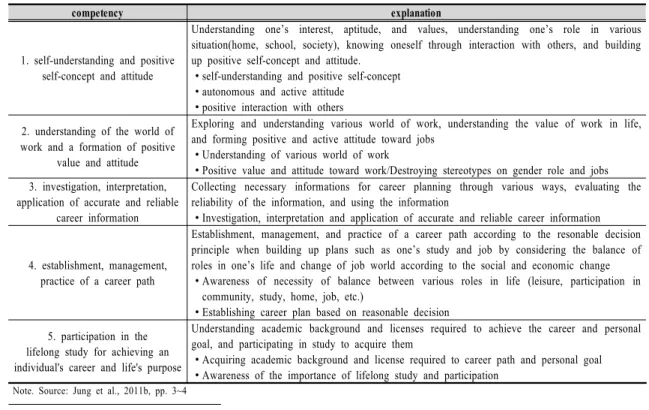
이러한 진로개발역량은 진로를 개척할 수 있는 역량으로서 개인이 일생 동안 수행하는 다양한 역할과 경험을 자기 주도 적이면서 합리적으로 선택․준비․비교 및 평가하며 관리할 수 있는 지식, 기술(skill) 및 태도를 의미한다. 진로개발역량 은 <Table 2>와 같이 ‘자기 이해 및 긍정적 자아개념과 태 도 형성, 직업세계의 이해 및 긍정적 가치․태도 형성, 정확 하고 신뢰성 있는 진로정보 탐색․해석․활용, 진로계획의 수립․관리․실천, 진로 및 개인 삶의 목표달성을 위한 평생 학습 참여’의 5가지로 구분할 수 있다(Jung et al., 2011b).
따라서 교과통합 진로교육은 모든 교과에서 실시할 수 있 으며
4), 특히 진로교육의 내용을 교육과정과 성격에 내포하고 있는 가정교과(Lee, Kim, Oh, & Kwon, 2009)에서 실행할
4) Kim, Jeong과 Choi(2009)는 취업, 진학, 취업과 진학의 병행 등 다양한 진로대안이 존재하는 전문계 고등학교 교사를 대상으로 한 연구에서 독립교과를 통 한 진로교육의 경우 자칫 형식적인 교육으로 변질될 수 있음을 제안하고 있다. 또한 교과통합형 진로교육의 경우는 효율적이지만 교과 담당교사들의 끊임없 는 노력과 아이디어가 필요하다고 밝히고 있다.
Subject area and contents elements related career development competency related level
Family Life
Ⅰ
. Understanding adolescents 3. Self management of adolescents∙
self-understanding and positive self-concept∙
autonomous and active attitude∙
understanding various world of work∙
positive value and attitude on work / Destroying stereotypes on gender role and jobs1
Integrated educational goal
∙
Be able to understand how to better adapt to the world of work in the future, through the management of time, leisure and stress in adolescent period.Achievement standard
∙
Managing time and leisure of oneself, exemplifying having a job of one‘s favorite work, and introducing one‘s dream∙
Understanding the influences of stress management on building relationship with others, and explaining the relationship between job and stressTeaching-learning method
∙
video, mind-map, interview simulation, career counselling, presentation Note. Source : Jung et al., 2011b, p. 70Table 3. The subject area, contents elements, and related career development competency 때 그 효과는 극대화될 수 있을 것이다.
3. 교과통합 진로교육의 동향
한국직업능력개발원에서 2008년부터 진행된 교과통합 진로 교육의 방향은 각 교과의 내용에서 진로교육의 요소를 추출 하고, 이 요소와 진로개발 역량과의 상관관계를 보는 것으로 시작하였다. 이 과정에서 진로교육 교과는 각 단원별로 2개 이상의 진로개발 역량과 관련되어 있는 것으로 분석되었으며, 진로교육 교과의 경우는 모든 중단원 수준에서 교과통합 진 로교육이 가능한 것으로 제시되었다(Lim et al., 2008). 이 연구에서는 진로교육 교과는 개인과 가정생활, 산업 및 기술 세계와 연계된 내용 구성상의 특징과 다양한 체험 활동이 가 능한 실천교과의 특성이 강하다는 점을 나타낸다. 그 후 Lee 외(2009)의 「교육과정과 연계된 진로교육 운영모델 구축Ⅱ」
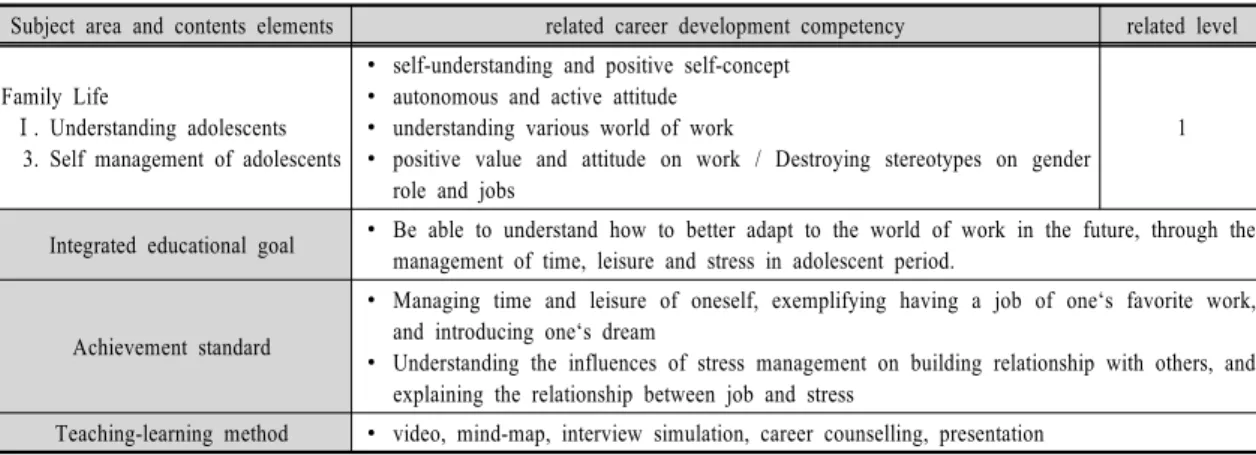
에서는 진로개발역량을 5개 영역(Table 2 참조)으로 정립하 고, 진로교육 교과와 진로교육을 통합하여 가르치기 위한 교 과 영역 및 내용 요소와 관련 진로개발역량을 고려하여 통합 교육목표, 성취기준, 교수․학습 방법 등을 <Table 3>과 같 이 제시하고 있다(Jung et al., 2011b).
이때 관련 수준은 교과목표와 진로개발 역량 요소가 정확 하게 일치하는 경우는 ‘1’로, 부분적으로 관련성이 있는 경우 는 ‘2’, 관련성이 약한 경우는 ‘3’으로 표시하였는데, 가정교
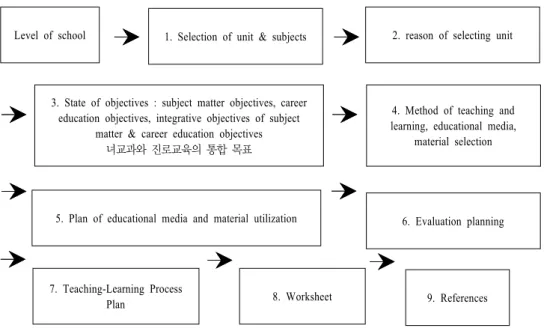
과의 교육과정 영역 및 내용 요소에서 진로개발 역량 요소와 의 관련 수준은 ‘1’ 혹은 ‘2’의 수준으로 분석되었다. 이는 가정교과의 내용을 통한 진로교육이 활발하게 이루어질 수 있음을 증명하는 연구결과이다. 그리고 가정교과통합 교육목 표 및 성취기준은 단원의 내용 구성과 통합가능성 등을 고려 하여 단원에 따라 중단원 수준 또는 소단원 수준에서 제시하 였다. 특히 통합교육 목표는 교육과정에 명시한 내용 영역의 교육목표를 달성하면서 진로교육 목표를 균형 있게 통합하여 제시 가능한 수준에서 기술하였다. 이를 기초로 하여 진로교 육 교과 진로교육 교수․학습 자료를 각 학년별 중단원 하나 씩 개발하여 제시하였다. 자료 개발 체계는 <Figure 2>와 같 다. 우선 학교 급을 설정하고, 단원 및 주제 선정, 단원 설정 의 이유, 교과 목표, 진로교육 목표, 교과와 진로교육의 통합 목표 등의 목표 진술, 교수․학습 방법, 매체, 자료 선정, 매 체와 자료 활용 계획, 평가 계획, 교수․학습 과정안 작성, 학생 활동지 제시, 참고자료 순으로 자료를 개발하였다(교육 과학기술부, 한국직업능력개발원, 2011의 내용 재구성).
이렇게 개발된 자료를 토대로 하여 연구학교를 중심으로
교과통합진로교육을 적용하였을 때, 교과에 통합된 진로교육
을 경험한 학생들은 전반적으로 수업에 만족하고 있었으며,
특히 교과에 진로교육의 내용 요소를 포함하고 있는 진로교
육 교과에 통합된 진로교육에 대한 만족도가 높게 형성되고
있음을 밝히고 있다. 또한 단편적인 직업 세계의 소개 등의
수업 방법보다는 학생들의 동기를 유발하고 관심을 지속할
Level of school 1. Selection of unit & subjects 2. reason of selecting unit
3. State of objectives : subject matter objectives, career education objectives, integrative objectives of subject
matter & career education objectives 녀교과와 진로교육의 통합 목표
4. Method of teaching and learning, educational media,
material selection
5. Plan of educational media and material utilization 6. Evaluation planning
7. Teaching-Learning Process
Plan 8. Worksheet 9. References
Figure 2. Reorganization of materials development system
Note. Source: 교육과학기술부, 한국직업능력개발원 2011, pp. 87~108.수 있는 다양한 전략을 마련하는 노력이 필요함을 제안하고 있다(Jung et al., 2010).
이러한 연구들은 자유학기제에 ‘진로교육’을 활성화한 방 안으로서 교과통합진로교육이 효과가 있음을 드러내준다. 따 라서 모든 중학교에서 공히 시행되는 자유학기제에서의 진로 교육을 모든 교사가 동참하도록 하는 교과통합 진로교육의 방향을 제시할 수 있도록 하는 연구가 필요할 것이다. 이를 위해 본 연구는 진로교육 교과통합 진로교육의 방향을 탐색 하고, 이를 반영한 교수․학습 과정 모형을 제시하고자 한다.
Ⅲ. 연구 방법
본 연구는 자유학기제에 따른 진로교육의 활성화 방침에 따라 기술․가정 교과 중 가정교과 영역에서의 진로교육 활 성화 방안을 탐색하는 것에 목적이 있다. 본 연구를 위한 구 체적인 분석 내용과 연구 내용은 다음과 같다.
첫째, 가정교과에서의 진로교육의 동향을 살펴보기 위해 포털사이트에서 ‘가정교과에서 진로교육’을 검색한 총 240편
을 분석하였다. 이중 ‘학위논문과 학술지 내용 중복, 학술발 표자료, 기술교과 내용, 실과내용, 2000년대 이전 내용’을 제 외하고 총 11편의 논문을 분석하였다. 이때 기술․가정 교과 에서의 진로교육의 연구들은 교과에서의 진로교육의 관심을 드러낸다고 판단하였기 때문이다.
둘째, 핵심 성취기준에 따른 교육과정 편성의 필요성이 제 기되는 시점에서 기술․가정 교과통합 진로교육에서의 핵심 성취기준을 추출하여 이를 토대로 교육 내용을 구성하고자 하였다. 핵심 성취기준을 설정하기 위해 교과전문가 2인의 검증을 받아, 한국직업능력개발원에서 제시한 진로개발역량과 실과(기술․가정)교육과정에 반영된 핵심 역량, 그리고 교육 과정에 제시된 성취기준의 내용을 통합하여 제시하였다.
셋째, 교수․학습과정 모형은 한국직업능력개발원에서 연 구된 교과통합 진로교육을 토대로 하여 핵심성취기준과 함께 교과통합 진로교육 모형을 제시하였다. 구체적인 주제는 중 학교 1~3학년군 기술․가정의 ‘청소년의 생활’(대단원) 중
‘옷차림과 자기표현’(중단원)의 내용을 선택하였다. 이때 학생
들이 자발적으로 자신의 진로를 탐색할 수 있도록 하는 프로
젝트 수업을 진행하는 방안으로 제시하였다.
Ⅳ. 자유학기제 도입에 따른 기술·가정 교과 중 가정생활 영역의 진로교육 방향
1. 실과(기술․가정) 교과에서의 진로교육 동향
기술․가정 교과는 교과의 목표, 교과의 내용 측면에서 진 로교육을 내포하고 있다. 2009년 개정 교육과정에 따르면, 실과(기술․가정)는 교과의 성격상 학습과 일상생활에 필요 한 기초 능력 배양 및 일에 대한 이해, 다양한 분야의 경험 과 지식을 통한 진로 탐색하며, 급변하는 가정생활과 산업 기술 환경에서 주도적인 삶을 영위하는데 필요한 가치관과 다양한 능력을 배양하는 데 도움을 주는 실천교과임을 명시 하고 있다. 즉 실과의 경우는 교과 간 통합적 접근 교육과 진로 탐색 기회 및 진로개발능력을 기르며, 중학교에서는 전 생애 설계를 통한 생활의 자립 및 진로 탐색 및 설계에 학습 의 지향점을 두고 있다(교육과학기술부, 2011).
이러한 가정교과에서의 진로교육의 연구 동향에 대해 연구 한 Lee(2012)는 총 13편의 연구논문을 통해, 진로교육의 관 점이 1990년대에는 ‘직업’, 2000년대 이후는 ‘진로교육’, 2008년 이후에는 ‘생애 관점의 진로교육’이 주를 이루고 있 음을 밝히고 있다. 그리고 가정교과에서의 진로교육의 방향 은 청소년들의 삶과 연계된 생애 관점의 진로교육 즉 전 생 애적 관점으로 자신의 교육, 직업, 결혼, 가정생활, 자녀교육, 노후생활까지를 포함하는 ‘생활과 연계’되어야 함을 제안하고 있다(Kawasaki, 2000, 재인용 p. 131). 이는 직업에 연계된 진로교육에 초점을 둔 「진로와 직업」교과목에 비해, 삶의 과 정에서 겪게 되는 위치, 일, 직업의 연속성 측면과 생애 전반 에 걸친 일을 의미하는 ‘진로’를 실현할 수 있는 교과임을 증명하고 있다.
반면 진로교육의 성격과 내용을 다루고 있는 가정교과교육 에서의 진로교육 관련 연구의 동향을 살펴보면 <Table 4>와 같다. 포털 사이트에서 ‘가정교과에서 진로교육’을 검색하여
나온 총 240편 중 ‘학위논문과 학술지 내용 중복, 학술발표 자료, 기술교과 내용, 실과내용, 2000년대 이전 내용’을 제외 하고 분류하였을 때 총 11편의 논문을 찾을 수 있었다.
<Table 4>의 연구들은 가정교과에서 진로와 관련한 프로그 램 개발 연구 3편(A), 수업을 통한 진로 수준의 변화와 관련 한 연구 5편(B), 교과서 내용 분석 2편(C), 진로교육 방향성 1편(D)으로 분류할 수 있다. 이를 통해 알 수 있는 것은 2000년대 이후 교육 현장에서의 진로교육과 가정교과 교육과 정에서의 진로교육 강조에도 불구하고, 관련 연구가 활발하 게 이루어지지 못했음을 나타내준다. 이는 자유학기제의 시 행에 따른 교과통합 진로교육에 대한 요구가 있는 현 상황에 서 구체적인 준비가 필요함을 반증해 준다.
2. 자유학기제에서의 기술․가정교과 중 가정교과 영역의 핵심 성취기준 설정
자유학기제에 적용하기 위한 방안으로 핵심성취기준의 추 출과 이를 기반으로 한 다양한 교수학습방법이 제시되어야 할 것이다. 이때 핵심 성취기준이란 기존 성취기준 중에서도 반드시 알아야 내용을 선별한 것을 의미하며, 이를 중심으로 교과 교육과정을 재구성하면 자유학기제에서 토론, 프로젝트 수업, 협동학습 등 다양한 수업을 할 수 있도록 할 수 있다 고 제안하고 있다(한국교육신문, 2013).
이를 위해 중학교 1~3학년군 기술․가정의 ‘청소년의 생 활’(대단원) 중 ‘옷차림과 자기표현’(중단원)의 내용을 중심으 로 하여 교과통합 진로교육에서의 핵심 성취기준을 설정하였 다. 이를 위해 한국직업능력개발원에서 제시한 진로개발역량 (<Table 1>)과 실과(기술․가정)교육과정에 반영된 핵심 역 량
5)(Choi, Kang, Yoo, Moo과 Choi, 2010), 그리고 교육과 정에 제시된 성취기준의 내용을 통합하는 방법을 사용하였다.
5) Choi, Kang, Yoo, Moo과 Choi(2010)는 2007 개정 실과(기술․가정) 교육과정에 제시된 핵심 역량은 중 창의력, 문제해결능력, 자기관리 능력, 대인관계능력, 기초학습능력, 시민의식, 진로개발능력의 7가지 핵심 역량이 명시되어 있으며, 이중 문제해결능력, 창의력, 자기관리능력, 진로개발능력이 강조되어 있음을 제 시하고 있다. 이에 따라 교육과정과 수업 전략에 핵심 역량을 반영하여 수업을 설계하고 수행하거나 대영역 안에 핵심역량을 반영하여 재구조화하는 방안과 수업 전략에 핵심 역량을 반영하여 수업을 설계하고 수행하는 방안을 제안하고 있다. 이는 가정교과통합진로교육에서 핵심 역량에 따른 성취기준을 설정하기 위한 시사점을 제공하고 있다고 하겠다.
Year Auther Title Source
2004
(B) Lee, Y. M.
The effect of student activity centered career exploring program on the career maturity level in the unit
『
The choice of career and job morals』
of the 9th grade technology and home economicsUnpublished master's thesis, Gyeongsang national university, Gyeongsangnam-do, Korea.
2009
(A) Choi, Y. H.
The development of a PBL based career education program model : focusing on the career exploration unit in high school home economics textbook
Unpublished master's thesis, Busan university, Busan, Korea.
2009
(C) Son, H. H.
A content analysis on career education in home economics textbook of the secondary school developed by the 7th educational process
Unpublished master's thesis, Ewha womans university, Seoul, Korea.
2010 (B)
Kim, Y. S. &
Lee, Y. S.
The effect of library assisted practical problem-based home economics instruction on student's consciousness and attitude of
‘life and career planning’
Journal of Korean home economics education association, 22(2), 61-79.
2010 (A)
Lee, H. S., Kim, H. J., Yun, S. H.,
& Cheon, S. M.
Design and application of career education program related to the subject manual training and home economics of middle school
The journal of vocational education research, 29(3), 247-263.
2011 (B)
Choi, M. J., Park, M. J., & Chae, J.
H.
Middle school home economics teachers' stages of concern and levels of use about career education : Based on CBAM(the concerns based adoption model)
Journal of Korean home economics education association, 23(4) 49-65.
2011
(C) Kang, K. S. A content analysis of career education in high school home economics textbook
Journal of the Korean home economics association, 49(8), 113-124.
2011
(B) Kim, J. Y. (An) content analysis on career education in home economics education and the usefulness in choosing career as interests
Unpublished master's thesis, Hanyang university, Seoul, Korea.
2012 (A)
Kim, N. Y., Yu, H. K., & Cho, Y.
S.
The development of group counseling program related with home economy & technology subject to improve career maturity of middle school student
The journal of vocational education research, 31(2), 167-193.
2012
(D) Lee, S. H. An exploratory study on the life career education in home economics education across the life span
Journal of Korean home economics education association, 24(3), 123-142.
2012
(B) Nam, S. H.
Effect of integrated career education of technology·home economics subject using broadcast program on career maturity and job values of middle school students in Korea : Focused on Ilsan, Gyeonggi-do
Unpublished master's thesis, Kongju national university, Chungnam, Korea.
Note. Source: Of the 240’ specialized information resources and academic dissertation data and related of home economics education and career education
Table 4. Career education of home economics education
1) 교육과정 및 성취 기준 내용
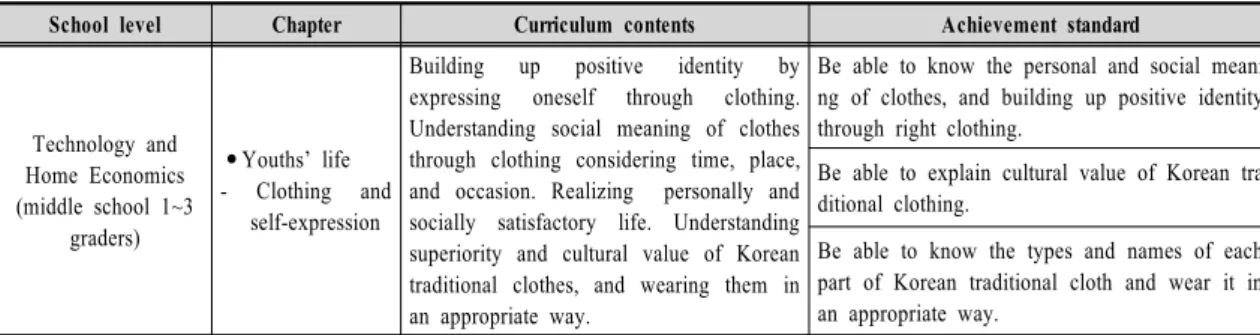
‘청소년의 생활’대단원에서 ‘옷차림과 자기표현’단원에 대 한 2009 개정교육과정(교육과학기술부, 2011, p.14) 내용과 한국교육과정평가원(2012, p.125)에서 제시한 성취기준은
<Table 5>와 같다.
2) 가정교과통합 진로교육 핵심성취기준
6)의 설정
<Table 6>은 단원의 성취기준에서 가장 근접한 진로개발 역량을 추출하고, 이 내용을 중심으로 핵심 역량을 토대로 하여 핵심 진로성취기준을 설정하였다. 이때 진로개발 역량 은 (<Table 2> 참조)은 성취기준에서 가장 대표적인 진로개 발 역량을 추출하였으며, 핵심 역량은 기술․가정에서 제시 하고 있는 4가지 중에서 선택하였다. 이를 토대로 각각의 내
6) Ministry of education's Press(2013)에서는 핵심 성취기준을 각 교과목에서 학습을 통해 성취해야 할 지식, 기능, 태도의 능력과 특성을 보다 명확히 구조화 한 것을 의미한다고 발표하였다.
achievement standard career development
competency core competency core achievement standard Be able to know the personal an
d social meaning of clothes, and building up positive identity thro ugh right clothing.
1. self-understanding and establishing positive
self-concept
self management ability
Be able to understand the meaning of clothes and ways of self-expression according to clothing, build up positive self-concept and self management ability through it, and explore career path related to it.
Be able to explain cultural value of Korean traditional clothing.
2. understanding of the world of work and a formation of positive
value and attitude
career development
ability
Be able to find the meaning of traditional clothing and historical changes, explore various career paths related to traditional clothing according to communi cate with careerman, and practically use them.
Be able to know the types and names of each part of Korean tr aditional cloth and wear it in an appropriate way.
3. investigation, interpretation, application of accurate
and reliable career information
problem solving ability
Be able to reinterpret traditional clothes in a moder n meaning, reconstruct them to give convenience as well as maintain tradition, and through this, conside ring the possibility of creating new job cluster, and develop ability to establish, manage, and realize the career paths related to this.
Note. Source: 한국교육과정평가원, 2012, p.125; Jung et al., 2011b, pp. 3~4
Table 6. Example of core achievement standard of subjects-integrated career education
School level Chapter Curriculum contents Achievement standard
Technology and Home Economics (middle school 1~3
graders)
•
Youths’ life - Clothing andself-expression
Building up positive identity by expressing oneself through clothing.
Understanding social meaning of clothes through clothing considering time, place, and occasion. Realizing personally and socially satisfactory life. Understanding superiority and cultural value of Korean traditional clothes, and wearing them in an appropriate way.
Be able to know the personal and social meani ng of clothes, and building up positive identity through right clothing.
Be able to explain cultural value of Korean tra ditional clothing.
Be able to know the types and names of each part of Korean traditional cloth and wear it in an appropriate way.
Note. Source: 교육과학기술부, 2011, p.14; 한국교육과정평가원, 2012, p.125
Table 5. School level and chapter and achievement standard
용적 요소를 중심으로 핵심성취기준을 제시하였다.
우선 첫 번째 성취기준의 진로개발 역량은 ‘1. 자기 이해 및 긍정적 자아개념 형성’, 핵심 역량은 ‘자기관리 능력’으로 선정하였다. 이를 토대로 하여 ‘옷의 의미와 옷차림에 대한 이해를 토대로 긍정적인 자아 개념과 자기관리 능력을 형성 할 수 있으며, 이와 관련된 진로에는 무엇이 있는지 탐색할 수 있다’는 것으로 핵심성취기준을 기술하였다.
두 번째 성취기준의 진로개발 역량은 ‘2. 대인 관계 및 의 사소통 역량 개발’, 핵심 역량은 ‘진로개발능력’으로 선정하 였다. 그리고 핵심성취기준으로 ‘전통 옷차림의 의미와 이와 관련한 시대적․역사적 변화를 발견하기 위해 다양한 역사적 사실을 발견하고, 이 과정에서 전통 옷차림과 관련한 다양한 진로를 선택한 사람들과의 의사소통을 하며, 이를 종합하여
활용할 수 있음’으로 서술하였다.
세 번째 성취기준의 진로개발 역량은 ‘3. 정확하고 신뢰성 있는 진로정보 탐색․해석․활용’으로, 핵심 역량은 ‘문제해 결능력’을 선정하였다. 그리고 핵심성취기준은 ‘전통적인 한 복을 현대적인 의미로 재해석하고 전통을 유지하면서도 생활 의 편리를 줄 수 있도록 한복을 재구성하며, 이를 통해 새로 운 직업군이 만들어질 수 있음을 고려하여 이와 관련한 진로 를 수립, 관리, 실천할 수 있는 능력을 기를 수 있음’으로 서 술하였다.
이러한 핵심 성취기준의 설정을 통해 교과통합진로교육을
통해 학생들의 프로젝트 수업, 토론 수업 등의 수업 방법의
다양화를 추구할 수 있도록 할 수 있을 것이다.
Subject Home Economics (MS 1~3graders)
Career development competency
•
Exploration, interpretation, and application of accurate and reliable career information ChapterⅡ
. Youths’ life2. Clothing and self-expression
2-4. Appropriate way of wearing Korean traditional clothes study topic
•
Be able to explain cultural value of Korean traditional clothes.subject-integrated academic goal according to the core
achievement standard
•
Be able to find the meaning of traditional clothing and historical changes, explore various career p aths related to traditional clothing, and practically use them.material
•
tools to make a newspaper(glue, ruler, magazine, 4 sheets of newspaper-sized paper풀), Computer s ystem for students’ presentation, Sound system for video clips related to career and jobs studylevel contents Teaching
․
Learning Activitytime material(
◈
) remarks(※
)teacher students
introduc tion
motiva tion
◉
Ask students how they feel when they see the material about characteristics and meanings of traditional clothing.◉
Let students think about the differences between traditional clothing and modern clothing.•
Talk about the characteristics and meanings of traditional clothing.5‘
◈
material( p r e s e n t i n g materials about Korean traditional clothing)
develop ment
making groups
◉
Ask students to make groups according to the characteristics of traditional clothing according to the period (the period of Three Kingdoms, Korea dynasty, Chosun, the time of enlightenment, modern times)•
Make groups according to the historical period, and arrange roles of each members.3‘
※
When making groups, it's possible to appoint the leaders first, and let them make their own groups.※
When collecting data, it's possible to interview people whose jobs are included in each clusters through SNS makingnewspaper
◉
Let students play a role of reporters and make a newspaper by reporting one part of Korean traditional clothes(skirt, pants, accessories, shoes, etc.) each.◉
Check whether all the members take part in the project, and every things go well.◉
Let students present their newspaper.•
Members collect data according to their own role, and make a newspaper from them.•
Members have an editorial meeting, and complete the frame of a newspaper.•
Add data to the frame and write articles to complete a newspaper.•
Supplement any deficiency through discussion.•
Present the newspaper.20‘
closing wrap up
◉
Explain students that they can understand the historical change of traditional clothing through <newspaper making> activity and various career paths from interviewing with people who have jobs related to traditional clothing.•
Check up students' worksheets and let them talk about what they feel from exploration into career paths related to traditional clothing.5‘
※
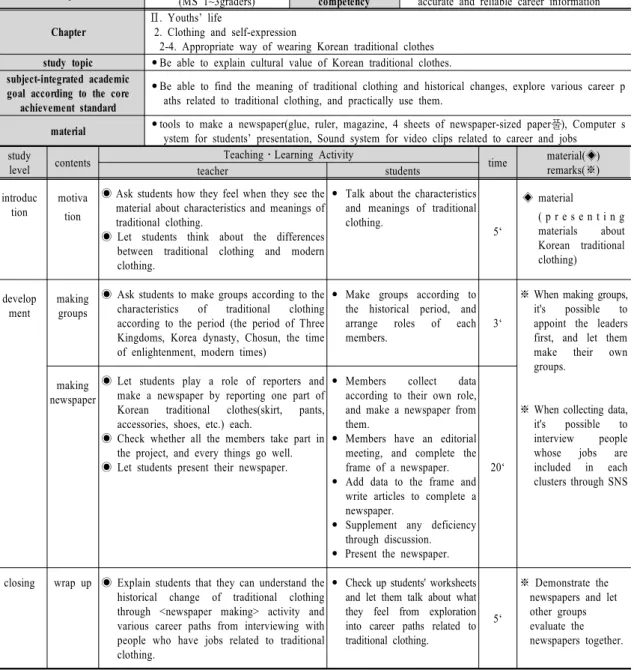
Demonstrate the newspapers and let other groups evaluate the newspapers together.Table 7. Teaching and learning plan of subject-integrated career education 3. 기술․가정교과 중 가정교과 영역의 교과통합 진로교육
교수․학습 과정 모형
가정교과통합 진로교육 핵심성취기준을 포함하여 설정한
교수․학습 과정안은 다음과 같다. 교수․학습 과정안의 내 용은 <Table 7>과 같다. 이 과정안은 진로개발역량에 따른 교과통합핵심성취기준의 내용을 토대로 하여 내용을 구성하 였다.
이때 교수․학습의 목표인 학생들의 전통 옷차림의 생활
Achievement standard
•
Do they discover the meaning of traditional clothing and historical changes related to it, explore variou s career paths related to traditional clothing, and make newspapers connected to the career paths?method tool process Evaluation standard
making
newspaper newspapers development
good
•
Discover the meaning of traditional clothing and historical changes relate d to it, AND explore various career paths related to traditional clothing, and make newspapers connected to the career pathsfair
•
Discover the meaning of traditional clothing and historical changes relate d to it, OR explore various career paths related to traditional clothing, a nd make newspapers connected to the career paths.poor
•
Show insufficient result both in discovering the meaning of traditional cl othing and historical changes related to it, and exploring various career paths related to traditional clothing, and make newspapers connected to t he career paths.Table 8. Evaluation Plan
Understanding traditional clothing & making career search portfolio
Characteristic of clothing according to Age Career of related to traditional clothing
historical background Transition traditional clothing element Interview and Portfolio making
Figure 3. Manufacturing tree
문화적 가치 탐색’을 학생들의 프로젝트 학습을 가능하도록 전통 의복에 대한 이해와 진로 탐색 포트폴리오를 신문의 형 태로 제작’하도록 하며 그 흐름을 제안하면 <Figure 1>과 같 다. 이때 교과에서의 내용인 ‘시대별 전통 의복의 특징’은 역 사적인 관점에서의 시대별 전통 의복과 요소의 변화를 탐색 하도록 한다. 더불어 전통 의복 관련 진로를 선택한 사람들 에 대한 자료 수집과 인터뷰 등을 통해 진로교육의 핵심성취 기준을 충족하도록 한다.
이렇게 이루어진 교수․학습 과정의 최종 단계로 학습자들 의 제작물을 평가하기 위한 방안은 <Table 8>과 같다. 평가 는 핵심성취기준에 도달했는지에 따라 상․중․하로 구분하 였다.
평가 기준에서 ‘상’은 전통 옷차림의 의미와 이와 관련한 시대적․역사적 변화를 발견하고, 전통 옷차림과 관련한 다 양한 진로를 탐색․종합하여 진로․직업과 연관된 신문 만들 기를 하였을 때의 수준이다. ‘중’은 전통 옷차림의 의미와 이 와 관련한 시대적․역사적 변화를 발견하고, 전통 옷차림과 관련한 다양한 진로를 탐색․종합하여 진로․직업과 연관시 킨 신문 만들기 중 하나에만 치중하여 신문 만들기를 하였을
때의 수준이다. ‘하’는 전통 옷차림의 의미와 이와 관련한 시 대적․역사적 변화를 발견하고, 전통 옷차림과 관련한 다양 한 진로를 탐색․종합하여 진로․직업과 연관시킨 신문 만들 기 모두 미흡하였 때의 수준이다. 이때 학생들은 개인 활동 뿐 아니라 협동 학습을 통해 서로의 진로 탐색에 도움이 되 며, 진로개발역량을 계발할 수 있는 기회를 획득할 수 있을 것이다.
이상의 교과통합 진로교육 교수․학습 과정 모형은 가정교
과와 역사교과, 진로와의 통합을 통해 학생들의 적극적인 활
동을 통해 꿈과 끼를 키울 수 있도록 하는 것에 목적을 두고
있다. 이는 자유학기제에서의 교과에서의 진로교육 접근 방
안의 하나로, 이전의 기술․가정 교과에서의 진로교육적 요
소를 더 부각시키고, 더불어 교과통합 진로교육 핵심역량을
성취하도록 핵심 성취기준을 설정하는 것이 중요함을 강조하
였다.
Ⅴ. 논의 및 제언
학생들의 꿈과 끼를 키울 수 있는 학교교육과정으로서의 자유학기제의 시행은 학생들이 자기 주도적으로 진로를 탐색 하므로 미래 상황을 주도할 수 있는 역량을 갖추도록 하는 것에 목적이 있다. 이를 위해 교육과정 운영의 변화를 통해 학생의 체계적인 진로탐색 기회 확대, 학생의 관심과 흥미를 불러오는 체험․참여형 프로그램 강화, 학생의 참여와 활동 중심으로 교수․학습방법 다양화, 자유학기제의 취지에 맞는 평가방법 등이 필요하게 되었다.
이때 교과적인 차원에서의 진로교육 접근 방법에 대한 논 의가 필요한데, 기존의 교과 내에서의 진로교육에서 확장된 개념으로서의 진로교육 즉 ‘교과통합 진로교육’을 제안할 수 있다. 특히 교육과정과 교과의 성격에 진로교육의 요소가 포 함된 ‘기술․가정’교과에서의 진로교육의 활성화 방안을 살 펴보기 위한 본 연구 결과는 다음과 같다.
첫째, 가정교과에서의 진로교육의 동향을 살펴보기 위해 포털사이트에서 ‘가정교과에서 진로교육’을 검색한 총 240편 중‘학위논문과 학술지 내용 중복, 학술발표자료, 기술교과 내 용, 실과내용, 2000년대 이전 내용’을 제외하고 총 11편의 논문을 분석한 결과 진로와 관련한 프로그램 개발 연구(3편), 수업을 통한 진로 수준의 변화와 관련한 연구(5편), 교과서 내용 분석 (2), 진로교육 방향성(1편)으로 분류할 수 있었다.
이는 교육과정에 진로교육적 요소가 강조되고 있는 기술․가 정의 가정교과 영역에서 진로와 관련한 연구가 활발하게 이 루어지지 못했음을 나타내준다.
둘째, 기술․가정 교과통합 진로교육에서의 핵심 성취기준 을 추출하여 이를 토대로 교육 내용을 구성하였다. 이를 위 해 한국직업능력개발원에서 제시한 진로개발역량과 기술․가 정 교육과정에 반영된 핵심 역량, 그리고 교육과정에 제시된 성취기준의 내용을 통합하여 제시하였다.
셋째, 한국직업능력개발원에서 연구된 교과통합 진로교육 을 토대로 하여 핵심성취기준과 함께 교과통합 진로교육 모 형을 제시하였다. 구체적인 주제는 중학교 1~3학년군 기술․
가정의 ‘청소년의 생활’(대단원) 중 ‘옷차림과 자기표현’(중단 원)의 내용을 선택하였다. 이때 학생들이 자발적으로 자신의
진로를 탐색할 수 있도록 교과통합진로교육의 내용을 프로젝 트 수업으로 진행할 수 있는 모형을 제안하였다.
이 연구의 한계점은 다음과 같다.
우선 실과(기술․가정) 중 가정교과 영역에 대해서 이루어 진 진로교육 현황에 대한 논문 분석이 주를 이루어져 있어, 초등 실과와 기술 영역에서의 진로교육적 요소를 분석하지 못했다는 한계가 있다. 이는 초등 실과와 중등 기술․가정에 서의 교과 내에서의 통합적 관점으로 진로교육을 다루지 못 했다는 한계가 있으므로 추후 연구에서의 보완이 필요할 것 이다. 둘째로 자유학기제에서 교과 내에서의 진로교육을 활 성화하기 위한 방안으로서 핵심성취기준이 제안되고 있는데, 이를 본 연구에서 연구자의 관점으로 교과 성취기준과 진로 개발역량과 교과의 핵심역량을 중심으로 핵심성취기준 도출 하였으므로 이에 대한 전문가의 합의된 핵심성취기준 도출이 필요하다고 할 것이다. 셋째, 자유학기제에서는 교수․학습 과정과 평가에 있어서 변화를 추구하므로, 이를 반영한 교 수․학습 과정 모형과 포트폴리오 제작 활동 흐름도, 평가 계획을 제안하였으나 이에 대한 현장 검증을 거치지 못했다 는 한계가 있다. 따라서 추후 현장 검증과 다양한 내용의 개 발을 통해 기술․가정 교과에서의 통합진로교육이 더 활발하 게 이루어져 진로교육의 교과 주체로서 자리매김하도록 하는 것이 필요할 것이다.
이 연구의 한계점에도 불구하고 본 연구는 아직 시행하기 이전의 ‘자유학기제’시행에 따른 교과에서의 진로교육의 방향 을 탐색하며, 가정과교육이 진로교육을 담당하기에 적합한 교과임 드러내고 있다는 점에서 의의가 있을 것이다. 더불어 자유학기제에 시행에 대한 다양한 논의에도 불구하고, 가정 교과 내에서의 진로교육을 지속적으로 실천한다면 교과로서 의 영역의 확대를 이룰 수 있으리라 기대한다.
참고문헌
Andrew, J. (2013). Reflecting on the UK Gap Year: Insights for South Korea's 'free learning semester'.
Proceedings of the 2013 International Forum Of