38(10), 1331~1335(2009) DOI: 10.3746/jkfn.2009.38.10.1331
약용식물 물 추출물이 Goto-Kakizaki 흰쥐의 간 세포액에서 당대사 관련효소 활성에 미치는 영향
김대중1․정미자2․유진균1․서동주1․김정미3․최 면1†
1
강원대학교 식물생명공학전공
2
강원대학교 BK21사업단(뉴트라슈티컬바이오)
3
보리나라 기업부설 연구소
Effect of Medicinal Plant Water Extracts on Glucose-regulating Enzyme Activities in Goto-Kakizaki Rat Liver Cytosol
Dae-Jung Kim1, Mi Ja Chung2, Jin-Kyoun You1, Dong-Joo Seo1, Jeong-Mi Kim3, and Myeon Choe1†
1Dept. of Plant Biotechnology, Division of Biotechnology, School of Bioscience and Biotechnology, and
2The Nutraceutical Bio Brain Korea 21 Project Group, Kangwon National University, Gangwon-do 200-701, Korea
3Borinara Co., Ltd., Gangwon-do 200-870, Korea
Abstract
We have studied the anti-diabetic effects of medicinal plant water extracts on hepatic glucose-regulating enzymes such as glucokinase (GK) and acetyl-CoA carboxylase (ACC). α-Glucosidase inhibitor is usually used to prevent and treat type Ⅱ diabetes; thus, anti-α-glucosidase activity of medicinal plant water extracts was assayed. The hepatic cytosol faction of a type Ⅱ diabetic animal (Goto-Kakizaki rat) was used in GK and ACC activity assays. The medicinal plants were Lycium chinense (JGP), Discorea japonica Thunb. (SY), Pyrus pyrifolia (YSB), Cornus officinalis (SSY), Paeonia suffruticosa ANDR. (MDP), Cordyceps militaris (DCH), and Acanthopanax senticosus (GSO). JGP, SY, YSB, and SSY water extracts increased the hepatic GK activity and all medicinal plant water extracts led to an increase in hepatic ACC activity. YSB, SSY, MDP, and GSO water extracts showed significantly higher anti-α-glucosidase activity than control samples. The highest anti-α- glucosidase activity was observed in GSO water extract and the anti-α-glucoside activity was higher than that of Acarbose (reference α-glucosidase inhibitor). We suggest that JGP, SY, YSB, and SSY water extracts may exert an anti-diabetic effect by enhancing the glucose metabolism and that YSB, MDP and GSO may be used as natural α-glucosidase inhibitors in type Ⅱ diabetic conditions. Increased ACC activity by plant water extracts may provide additional anti-diabetic effect.
Key words: anti-diabetic effects, medicinal plant, glucokinase, acetyl CoA carboxylase, α-glucosidase
†
Corresponding author. E-mail: [email protected]
†
Phone: 82-33-250-8645, Fax: 82-33-250-7451
서 론
최근 우리나라는 급격한 경제 성장과 전반적인 생활수준의 향상으로 식생활이 서구화되고 가공식품의 섭취가 증대하는 양상을 보이고 있으며, 이러한 식생활의 변화와 함께 암, 심장 병, 고혈압, 당뇨병 등으로 인한 사망률이 높아지고 있다(1).
그중 국내 당뇨병의 대부분은 중년 이후에 유발되는 인슐 린 비의존성 당뇨로, 30대 이상 인슐린 비의존성 당뇨환자가 1998년의 6.6%에서 2005년의 8.1%로 증가되었다(2). 만성적 인 대사성 질환의 일환인 당뇨병은 인슐린 분비 및 작용의 감소로 생체 내 대사 조절기능의 이상이 초래되어 고혈당 및 요 중으로의 당 배설을 나타내는 질환으로 적절한 치료와
식생활 관리가 요구된다(3).
당뇨병의 90% 이상을 차지하는 제2형 당뇨병은 근육, 간
그리고 지방조직에서 다양한 요인에 의해 인슐린 작용이 저
하되어 인슐린 저항성이 나타날 때 췌장의 베타세포가 인슐
린 저항성을 극복할 수 있을 만큼 인슐린을 분비하지 못하여
상승된 혈당을 제거하지 못하여 높은 혈중 포도당 농도가
지속될 때 당뇨병이 유발된다(4). 이와 같은 당뇨에 인한 만
성적인 고혈당은 당뇨병성 망막병증, 신장 기능 장애 및 동
맥경화증 등 급․만성 합병증을 유도하는 것으로 알려져 있
으나 아직까지 근원적으로 치료할 수 있는 약물을 개발하지
못하고 있는 실정이다(5). 당뇨병은 치료하기 어려운 질병으
로 약물치료와 함께 식이요법이 절대적으로 필요하며 기존
의 인슐린이나 경구용 혈당강하제의 투여로는 근원적 치료 에 한계가 있고 경제적 부담과 부작용의 위험도 수반하고 있어 근래에 와서는 오랫동안 민간약용으로 쓰여 온 야생식 물의 혈당강하효과에 대한 관심이 증대되고 이 분야에 대한 많은 연구가 국내외적으로 활발히 이루어지고 있다(6-8).
Glucokinase(GK)는 해당 작용의 첫 단계 주요 조절 효소 로 glucose를 glucose-6-phosphate로 전환하여 세포내로 흡수된 당의 이용 속도를 증가시킨다(9). Acetyl-CoA car- boxylase(ACC)는 아세틸 CoA가 지방산 합성에 있어 첫 번 째 중간체로 작용하는 말로닐-CoA로 전환하는 것을 촉매 한다. 인슐린 민감제로 알려져 있는 항 당뇨 약제인 Thiazolidiones가 간 ACC를 활성화시켰다는 보고(10)가 있 는 반면에 최근에는 ACC 저해제가 비만과 당뇨와 같은 대 사성 질환을 개선하여 줄 것이라는 많은 보고들이 있다 (11-13). α-Glucosidase 저해제는 α-glucosidase를 저해하 므로 이당류인 maltose 분해를 억제하여 탄수화물의 소화와 흡수를 지연시켜 혈당을 효율적으로 감소시킬 수 있으므로 당뇨 개선과 치료에 이용되고 있다(14).
따라서 본 연구에서는 항당뇨에 효능이 있다고 알려진 단 삼(
Salvia miltiorrhiza), 지골피(
Lycium chinense), 산약 (
Discorea japonicaThunb.), 야생배(
Pyrus pyrifolia), 산수 유(
Cornus officinalis), 목단피(
Paeonia suffruticosaANDR.), 동충하초(
Cordyceps militaris), 가시오가피(
Acanthopanax senticosus)의 물 추출물들이 세포내 당 이용을 증가시킬 수 있거나 당 흡수를 지연시키는 효소들의 활성 능력을 검토하 여, 천연소재 물 추출물을 이용하여 당뇨 증상을 개선해 줄 수 있는 천연 기능성 소재를 탐색하는데 그 목적이 있다.
재료 및 방법
재료 및 추출물의 제조
실험 시료는 춘천 소재 재료상으로 제공받아 건조하였다.
건조된 시료를 분쇄한 후 10.7배의 증류수를 첨가한 다음 60
oC shaking incubator에서 24시간 추출하여 원심분리한 후 상층액을 취하였다. 여과한 상층액을 동결 건조시킨 후 이들 고형분을 재 용해하여 최종 농도가 10 mg/mL가 되도 록 조정한 다음 실험에 사용하였다.
Tissue fraction 분리
당대사 관련 주요 효소 활성 측정을 위해서 GK 흰쥐 (Goto-Kakizaki)로부터 간을 적출한 후 생리식염수에 세척 하였고, 완충액(20 mM HEPES, 140 mM KCl, pH 7.4)을 넣고 균질한 후 4
oC에서 3,000 rpm으로 10분 동안 원심분리 하여 상층액을 얻었다. 얻은 상층액을 4
oC에서 15분 동안 10,000 rpm으로 원심분리 하여 상층액과 침전물을 얻었으 며, 그중 상층액은 다시 4
oC에서 38,000 rpm으로 1시간 동안 초원심분리(Beckman, USA)하여 상층액인 간 세포액 (cytosol)을 얻었다(6).
Glucokinase 활성도 측정
Sharma 등(7)의 방법을 이용하여 glucokinase 활성도를 측정하였다. 44 mM sodium glycylglycinate(pH 7.4), 3 mM NADP
+, 30 mM MgCl
2, 30 mM ATP, 0.2 unit glu- cose-6-phosphate dehydrogenase, 500 mM glucose을 첨가 하여 28
oC에서 incubation 한 뒤 소재 추출물과 간 세포액 (cytosol)을 넣은 뒤 340 nm에서 3분간 측정하여 NADPH의 산화 정도로 glucokinase의 활성을 측정하였다.
Acetyl CoA carboxylase 측정
Acetyl-CoA carboxylase는 spectrophotometric 방법을 이용하여 활성도를 측정하였다(8). 250 mM Tris-HCl(pH 7.5), 50 mM MgCl
2, 18.75 mM glutathione, 0.625 mM(pH 8.0), NADH, 0.625 mM acetyl-CoA, 2.5 mM potassium phosphoenolpyruvate, 10 unit lactate dehydrogenase, 10 unit pyruvate kinase와 추출소재, cytosol을 첨가하여 37
oC 에서 1분간 incubation 시킨 후 37.5 mM ATP와 250 mM KHCO
3을 넣고 340 nm에서 2분간 측정하여 NADH가 NAD
+로 환원되는 정도를 통해 acetyl CoA carboxylase의 활성을 측정하였다.
α -Glucosidase 저해 활성 측정
α -Glucosidase 저해 활성 측정은 synthetic substrate인 2.5 mM
p-nitrophenyl α-D-glucospyranoside를 phosphate buffer(pH 6.8)에 첨가한 후 시료를 넣고 그 혼합액에 en- zyme solution을 첨가 후 37
oC에서 20분간 반응시키고 0.1 M NaOH를 첨가하여 반응을 종결시켜 substrate인
p-ni- trophenyl α-D-glucospyranoside로부터 유리되어 나오는 반응 생성물인
p-nitrophenol을 405 nm에서 측정하여 α- glucosidase 활성의 억제정도를 측정하였다(15,16).
통계처리
실험에서 얻어진 결과의 통계적 유의성은 GraphPad InStat(GraphPad InStat Version 3.00, 2003) 동계 package 를 이용하여 실험군당 평균±표준편차로 표시하였고, 각 농 도의 평균차의 통계적 유의성을 p<0.05 수준에서 Tukey- Kramer multiple comparisons test에 의해 검정하였다.
결 과
약용식물 물 추출물들이 세포내 glucokinase와 acetyl CoA carboxylase 활성에 미치는 영향
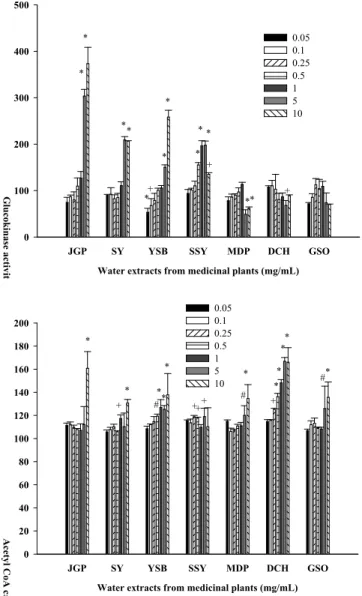
지골피(JGP), 산약(SY), 야생배(YSB), 산수유(SSY), 목단 피(MDP), 동충하초(DCH) 그리고 가시오가피(GSO)의 물 추 출물들이 GK의 활성에 미치는 영향은 Fig. 1에 나타내었다.
대조군을 100%로 했을 때 10 mg/mL 지골피(JGP) 물 추출물
처리에 의해 GK 활성이 373.3%로 증가하였고, 이들 증가율은
7개의 소재 물 추출물들 중 가장 높았다. 산약(SY) 그리고
야생배(YSB)의 물 추출물 5와 10 mg/mL 처리에 의해 대조
Water extracts from medicinal plants (mg/mL)
JGP SY YSB SSY MDP DCH GSO
G lu co k in a se a ct iv it y ( % o f c o n tr o l)
0 100 200 300 400 500
0.05 0.1 0.25 0.5 1 5 10
*
*
* *
* +
*
*
*
* * +
**
+
Fig. 1. Glucokinase activity (%) of the water extracts from medicinal plants. Data values are expressed as mean±SD of triplicate determinations. Significant differ- ences were compared with control at
*p<0.001 vs. control,
+
p<0.01 vs. control. JGP (Lycium chinense), SY (Discorea japonica Thunb.), YSB (Pyrus pyrifolia), SSY (Cornus offici- nalis), MDP (Paeonia suffruticosa ANDR.), DCH (Cordyceps militaris), GSO (Acanthopanax senticosus).
Water extracts from medicinal plants (mg/mL)
JGP SY YSB SSY MDP DCH GSO
Acetyl CoA carboxylase activity (% of control)
0 20 40 60 80 100 120 140 160 180 200
0.05 0.1 0.25 0.5 1 5 10
*
+
*
#
**
*
+++ #
* +
*
*
*
*
#*
Fig. 2. Acetyl-CoA carboxylase activity (%) of the water extracts from medicinal plants. Data values are expressed as mean±SD of triplicate determinations. Significant differ- ences were compared with control at
*p<0.001 vs. control,
#
p<0.05 vs. control,
+p<0.01 vs. control. JGP (Lycium chi- nense), SY (Discorea japonica Thunb.), YSB (Pyrus pyr- ifolia), SSY (Cornus officinalis), MDP (Paeonia suffruticosa ANDR.), DCH (Cordyceps militaris), GSO (Acanthopanax senticosus).
군과 비교하여 현저하게 증가하였다. 산수유(SSY) 물 추출 물은 0.5, 1 그리고 5 mg/mL 처리까지는 대조군과 비교하여 유의적으로 증가하는 경향을 보여 주었다. 10 mg/mL에서는 5 mg/mL 처리보다는 감소하였으나 여전히 대조군과 비교하 여 유의적으로 증가하였다. 그러나 목단피(MDP) 물 추출물 5와 10 mg/mL는 대조군에 비교하여 GK 활성이 유의적으로 낮았고(p<0.001), 동충하초(DCH)와 가시오가피(GSO) 물 추출물들은 GK 활성에 영향을 미치지 않았다(Fig. 1).
7개의 약용식물 물 추출물들이 ACC 활성에 미치는 영향 을 Fig. 2에 나타내었다. ACC의 활성은 모든 처리군에서 대조군과 비교하여 유의적으로 증가하였다. 동충하초(DCH) 물 추출물 5 mg/mL와 지골피(JGP) 물 추출물 10 mg/mL 처리에 의해 ACC 활성이 대조군과 비교하여 각각 166.4%와 160.8%로 유의적으로 증가하였다(p<0.001). 동충하초(DCH) 물 추출물은 ACC 활성을 농도 의존적으로 증가시켰다.
2형 당뇨는 당대사와 관련된 효소의 활성을 작용하는데 필요한 인슐린을 분비하는 췌장의 β-cell의 기능 저하로 특 정 지어지는 질환이다. 특히, GK는 당대사 항상성 유지에
관여하고 insulin에 의해 조절되며, 특히 당뇨병에 있어서 GK 활성 감소가 특징적으로 나타나며, 활성 감소 시 당대사 이용률을 저하시킨다(17). 포도, 땅콩, 오디에서 많이 발견되 는 항산화 물질인 resveratrol은 제2형 당뇨를 유발시킨 rat 에게 일정기간 섭취시켰을 경우 대조군에 비해 GK의 활성이 현저하게 증가시켰다고 보고하였다(18). 또한 streptozotocin 유발 당뇨쥐에 금전초(
Glechoma hederaceaLINNAEUS) 추출물을 투여하였을 때 간 조직내 glucokinase의 활성은 증가하였고 또한 혈당 강하로 이어졌다고 보고하였다(19).
GK가 활성화 되면 혈당은 에너지 생산을 위해 사용되거나 간에 글리코겐으로 저장되기 때문에 혈당이 감소하게 되는 것으로 알려져 있다(20). 따라서 본 연구 결과 지골피(JGP), 산약(SY), 야생배(YSB) 그리고 산수유(SSY) 물 추출물들 은 GK를 활성화시켜 당뇨증상을 개선해 줄 수 있는 천연 기능성 소재들인 것으로 생각된다.
Joo 등(21), Joo와 Kim(22)과 Lee 등(23)은 홍삼 사포닌 성
분의 혈당 강하작용이 당뇨로 저하된 glucokinase, acetyl CoA
carboxylase, glucose-6-phosphate dehydrogenase, 6-phos-
α-Glucosidase inhibition activity (%)
-20 0 20 40 60 80 100
0.05 0.1 0.25 0.5 1
JGP SY YSB SSY MDP DCH GSO Acarbose
Water extracts from medicinal plants (mg/mL)
**
*
*
*
***** ***
*
**
*
*
*
***# **
*
*
***
*
*
* +
#
Fig. 3. α-Glucosidase inhibition activity (%) of the water extracts from medicinal plants. Data compared with control at
*p<0.001 vs. control,
#p<0.05 vs. control,
+p<0.01 vs. control.
JGP (Lycium chinense), SY (Discorea japonica Thunb.), YSB (Pyrus pyrifolia), SSY (Cornus officinalis), MDP (Paeonia suffruticosa ANDR.), DCH (Cordyceps militaris), GSO (Acanthopanax senticosus).
phogluconate dehydrogenase 및 glycogen synthetase 활성을 유의적으로 증가시키고 상승된 G6Pase 활성을 낮추는 효과 가 있음을 보고하였고, 항당뇨 약제인 Triglitazone이 ace- tyl-CoA carboxylase 활성을 증가시켰다는 보고가 있다 (10). 따라서 본 연구에서 ACC를 활성화시킨 7종류의 천연 소재(지골피, 산약, 야생배, 목단피, 동충하초, 가시오가피) 물 추출물이 당뇨 개선을 위해 항 당뇨 소재로 사용될 수 있을 가능성을 제시하고 있다. 그러나 최근 많은 보고에서 ACC 활성 저해가 비만과 당뇨와 같은 대사성 질환을 개선하여 줄 것이라고 주장하고 있어(11-13) ACC 활성과 당뇨의 상관 관계에 대한 더 심도 있는 연구가 진행되어져야 할 것이다.
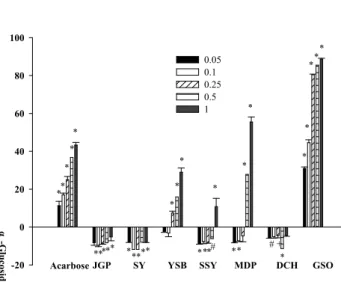
약용식물 물 추출물들의 α-glucosidase 저해 활성 약용식물 물 추출물이 α-glucosidase의 저해 활성에 미치 는 영향은 Fig. 3에 나타내었다. 본 실험에 positive control로 사용한 아카보스(acarbose)는 전분 가수분해 효소인 α- glucosidase의 저해제로서 탄수화물이 소장에서 분해, 흡수 되는 속도를 지연시켜 줌으로써(24) 인슐린 내성환자의 당 뇨병 발생을 억제하거나 당뇨병 환자의 증상을 개선시키기 위해서 사용되는 효과적인 약품 가운데 하나이다. 야생배 (YSB), 목단피(MDP) 그리고 가시오가피(GSO) 물 추출물 들은 농도 의존적으로 α-glucosidase 저해 활성이 증가하였 고, 0.1 mg/mL 농도의 가시오가피(GSO) 물 추출물의 α -glucosidase 억제율은 43.3%로 아카보스 1 mg/mL와 비슷 하였다. 지골피(JGP), 산약(SY) 그리고 동충하초(DCH)의 물 추출물들은 모든 농도에서 α-glucosidase 활성을 오히려 증가시켰고, 야생배(YSB), 산수유(SSY) 그리고 목단피 (MDP) 물 추출물들은 저농도에서는 α-glucosidase 활성을 증가시켰으나 고농도에서는 저해효과를 나타내었다.
α -Glucosidase는 식이 중의 탄수화물을 분해하여 포도당 으로 전환시키는 효소로, α-glucosidase 저해제는 탄수화물 의 소화와 흡수를 지연시켜 식후 혈당 증가를 완화시키므로 경구혈당강하제로 사용되고 있다(25). 현재 acarbose와 vo- glibose와 같은 α-glucosidase 저해제가 판매되고 있으나 복 부팽만감, 구토 등 부작용을 나타낼 수 있어, 천연물로부터
부작용 없는 α-glucosidase 저해활성이 큰 소재를 개발하려 는 연구들이 진행되고 있다(26). 가지(eggplant)의 폴리페놀 성분이
in vitro에서 α-glucosidase의 저해활성이 높다고 보 고되었으며(27), 뽕잎에서도 저해활성이 있음이 보고되었다 (28). Chen 등(14)은 중국의 전통적인 청국장(Chinese tra- ditionally fermented soybean)이 α-glucosidase 저해 활성 을 나타낸다고 보고하였다. 본 연구에서는 야생배(YSB), 목 단피(MDP), 가시오가피(GSO) 물 추출물들이 α-glucosi- dase 활성 저해 효과를 나타내었고, 가시오가피 물 추출물의 모든 농도에서 acarbose보다 높은 α-glucosidase 저해 활성 을 나타내었으므로 가시오가피는 강력한 α-glucosidase 활 성 저해에 의해 항 당뇨 효과를 나타낼 수 있을 것으로 추정 되는 천연 소재였다.
요 약
본 연구에서는 유전적으로 제2형 당뇨를 가진 Goto-
Kakizaki 흰쥐의 간 세포액에 함유된 당 이용 대사 관련 주
요 효소인 glucokinase(GK)와 acetyl CoA carboxylase
(ACC)에 약용 식물 물 추출물들이 어떤 영향을 미치는지
알아보았다. α-Glucosidase 저해제는 제2형 당뇨 치료와 예
방을 위해 사용되어져 오고 있다. 따라서 약용식물 물 추출
물들의 α-glucosidase 저해 활성을 알아보았다. Goto-
Kakizaki 흰쥐의 간 세포액 분획물을 GK과 ACC 활성을
알아보기 위해 사용하였다. 본 실험에 사용된 약용 식물들은
Lycium chinense(JGP),
Discorea japonicaThunb.(SY),
Pyrus pyrifolia(YSB),
Cornus officinalis(SSY),
Paeonia suffruticosaANDR.(MDP),
Cordyceps militaris(DCH) 그
리고
Acanthopanax senticosus(GSO)였다. 지골피(JGP), 산
약(SY), 야생배(YSB) 그리고 산수유(SSY) 물 추출물들은
GK 활성을 증가시켰고, 실험에 사용된 모든 약용식물 물
추출물들은 간 ACC 활성을 증가시켰다. 야생배(YSB), 산수
유(SSY), 목단피(MDP) 그리고 가시오가피(GSO) 물 추출
물들은 대조군보다 현저히 높은 α-glucosidase 활성 억제를
보여주었다. α-Glucosidase 활성을 가장 억제시킨 것은
GSO 물 추출물이었고, 그 억제율은 α-glucosidase 치료제 인 acarbose보다 높았다. 따라서 제2형 당뇨에서 지골피 (JGP), 산약(SY), 야생배(YSB) 그리고 산수유(SSY) 물 추 출물들은 글루코스 대사과정을 활성화시켜 항당뇨 효과를 나타내는 천연 소재일 것으로 생각되고 야생배(YBS), 목단 피(MDP) 그리고 가시오가피(GSO)는 천연 α-glucosidase 저 해제로써 사용될 수 있을 것이다. 약용식물 물 추출물에 의한 증가된 ACC 활성은 더해진 항당뇨 효과를 나타낼 것이다.
감사의 글
교육과학기술부, 지식경제부, 노동부의 출연금으로 수행 한 산학협력중심대학육성사업의 연구결과이며, 강원대학교 BK21 뉴트라슈티컬사업단의 일부지원에 감사드립니다.
문 헌