DOI: https://doi.org/10.3339/jkspn.2020.24.1.14 ISSN 2384-0250 (online)
Diagnosis and Management of Chronic Kidney Disease- Mineral Bone Disease in Children
Chronic kidney disease–mineral bone disorder (CKD–MBD) is a systemic disorder of mineral and bone metabolism caused by CKD. Patients with early-stage CKD who present with disordered regulation of bone and mineral metabolism may be asymptomatic. However, if untreated, the condition can be a significant barrier in achieving optimal bone strength, linear growth, and cardiovascular health in pediatric patients with CKD. Thus, the current study evaluated the definition, pa- thogenesis, diagnosis, and management of pediatric CKD-MBD.
Key words: Chronic kidney disease, Mineral Bone Disorder, Children, Growth
Jin-Soon Suh, M.D., Ph.D.
Department of Pediatrics, Bucheon St.
Mary's Hospital, College of Medicine, The Catholic University of Korea, Seoul, Republic of Korea
Corresponding author:
Jin-Soon Suh, M.D, Ph.D.
Department of Pediatrics, Bucheon St.
Mary’s Hospital, College of Medicine, The Catholic University of Korea, 327, Sosa- ro, Bucheon-si, Gyeonggi-do, 14647, Republic of Korea
Tel: +82-32-340-7047 Fax: +82-32-340-2673 E-mail: [email protected] Received: 11 March 2020 Revised: 27 March 2020 Accepted: 24 April 2020
This is an open-access article distributed under the terms of the Creative Commons Attribu tion Non-Commercial License (http://
crea tivecom mons.org/licenses/by-nc/4.0/) which permits unrestricted non-commercial use, distribution, and reproduction in any medium, provided the original work is properly cited.
Copyright © 2020 The Korean Society of Pediatric Nephrology
Introduction
Chronic kidney disease (CKD) is defined as the presence of either structural or functional kidney damage, with or without a decrease in glomerular filtra
tion rate (GFR) or a GFR <60 mL/min/1.73 m
2, and with or without signs of kidney damage for >3 months
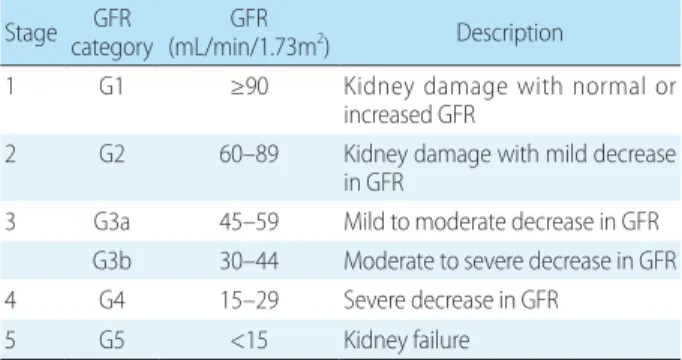
1). To stratify the risk of CKD progression and its complications, the condition was classified into five stages on the basis of GFR levels (Table 1). Children with stage 1–2 CKD are commonly asympto
matic and should be followedup for the deterioration of renal function. By contrast, children with more advanced stages of CKD experience CKDasso
ciated complications, including fluid and electrolyte disorders, hypertension, anemia, growth impairment, and mineral bone disorder (MBD)
2). The current study focused on the diagnosis and management of CKDMBD.
Definition of CKD-MBD
Dysregulation in mineral metabolism and abnormal bone structure are common findings among pediatric CKD patients, and they contribute to high morbidity and mortality
3). CKDMBD is defined as the presence of one or more of the following problems: (1) abnormalities in calcium, phosphorus, and parathyroid hormone (PTH) levels or vitamin D metabolism; (2) pro
blems in bone turnover, mineralization, linear growth, or strength; and 3)
vascular or other soft tissue calcifications
4). Children with CKD who present
with CKDBMD may develop significant complications, including fractures
and bone pain, similar to those observed in adult CKD pa
tients; complica tions, such as growth failure and skeletal deformities are unique among children. The term renal osteodystrophy specifically refers to abnormal bone lesions, which are iden tified through bone biopsy.
Pathogenesis of CKD-MBD
The pathogenesis of CKDMBD involves an interplay among the kidney, bone, and parathyroid glands. In the early stages of CKD, fibroblastic growth factor 23 (FGF23) levels increase, and serum phosphate and PTH levels re
main within normal ranges
5). With the progression of CKD, phosphate retention caused by decreased renal phosphorus excretion increases the levels of phosphaturic hormones, FGF23, and PTH, which is a mechanism that maintains serum phosphorus concentration
6,7). In addition, phosphate retention results in a decrease in 1,25dihydroxyvitamin D levels to reduce enteral phosphate absorption
7). Elevated FGF23 levels further decrease 1,25dihydroxyvitamin D levels by inhibiting 1hydroxylase activity in the kidney, and this leads to a reduction in 1,25dihydroxyvitamin D levels caused by decreased 1hydroxylation of 25hydroxy
vitamin D levels
8). Phosphate retention and 1,25dihydro
xyvitamin D deficiency decrease calcium levels, and low 1,25dihydroxyvitamin D levels and hypocalcemia contri
bute to secondary hyperparathyroidism
8). Increased PTH activity in the bone results in high bone turnover and re
sorption, which weakens the bones and increases both cal
cium and phosphate levels––this mechanism may promote vascular calcification
9).
Screening and monitoring of CKD-MBD
The Kidney Disease: Improving Global Outcomes (KDIGO) and the Kidney Disease Outcomes Quality Ini
tiative (K/DOQI) guidelines recommend that the serum calcium, phosphate, and PTH levels and the alkaline pho
sphatase activity should be monitored in children with stage 2 CKD
2,10). The reasonable monitoring intervals are summarized in Table 2. Moreover, the frequency of mea
surements for children treated for CKDMBD should be increased to monitor treatment efficacy and side effects.
The PTH level is negatively correlated with renal function, although the optimal PTH levels of pediatric CKD patients have not been identified
11). The K/DOQI guideline shows that the recommended target PTH concentrations at each stage of CKD are as follows: 35–70 pg/mL in stages 2–3, 70–110 pg/mL in stage 4, and 200–300 pg/mL in stage 5
2). The KDIGO guideline recommends maintaining PTH levels within approximately 2–9 times the upper normal limit for patients on dialysis. If the PTH level is progressively increasing or persistently above the upper limit of the nor
mal value, patients who are not on dialysis should be eva
luated for modifiable risk factors, including hyperphospha
temia, hypocalcemia, and vitamin D deficiency
10). A modest increase in PTH levels indicates an appropriate adaptive re
sponse to declining kidney function in patients with stage 2–5 CKD, with consideration of the potential adverse effects of reducing PTH values with the use of active vitamin D or calcimimetics. Thus, recently, several experts have shown that maintaining PTH levels within the normal range may be harmful in children with CKD
1214). Moreover, PTH values that are 1–2 times the upper normal limit may be acceptable in children with stage 23 CKD, and PTH levels
Table 1. Stages for Chronic Kidney Disease by Glomerular Filtration Rate (GFR) Categories
Stage GFR
category GFR
(mL/min/1.73m
2) Description
1 G1 ≥90 Kidney damage with normal or
increased GFR
2 G2 60–89 Kidney damage with mild decrease in GFR
3 G3a 45–59 Mild to moderate decrease in GFR G3b 30–44 Moderate to severe decrease in GFR
4 G4 15–29 Severe decrease in GFR
5 G5 <15 Kidney failure
Table 2. Recommended Monitoring Intervals of Serum Calcium, Phosphate and Parathyroid Hormone Levels in CKD Patients CKD Stage K/DOQI guideline
2)KDIGO guideline
10)Serum Ca/P PTH Serum Ca/P PTH
2 yearly yearly NA NA
3 6 months 6 months 6–12 months 6 months*
4 3 months 3 months 3–6 months 6–12 months 5 monthly 3 months 1–3 months 3–6 months
*The intervals can be adjusted based on the baseline PTH level and the rate of CKD progression.
Abbreviations: CKD, chronic kidney disease; K/DOQI, the Kidney Disease
Outcomes Quality Initiative; KDIGO, The Kidney Disease: Improving
Global Outcomes; Ca, calcium; P, phosphate; PTH, parathyroid hormone.
that are 1.7–5 times the upper normal limit may be optimal in those with stage 4–5 CKD
12). Thus, further studies must be conducted to define the optimal PTH level according to the CKD stage in children
12,15).
Treatment of CKD-MBD
The therapeutic goal of pediatric CKDMBD is to prevent or minimize complications in the growing skeleton, achieve adequate growth, and prevent vascular calcification by ma
naging hyperphosphatemia, vitamin D deficiency, and se
condary hyperparathyroidism
3,16). The options for achie
ving the therapeutic goal include dietary modification, use of pharmacological agents, and surgical treatment. To date, to provide better treatment options for pediatric patients with CKDMBD, several randomized controlled trials (RCTs) have compared the efficacy and safety between dif
ferent treatment modalities, such as calciumbased phosp
hate binders versus calciumfree phosphate binders, vi
tamin D versus placebo, and calcimimetics versus placebo
13,17,18)