Citation: Jeong YD, Lee S, Kim DW, Kim YM, Min YJ, Yu DJ, Kim YH. 2017. Effects of mating age at first parity of sows on backfat thickness, litter performance and weaning-to-estrus interval over three consecutive parities. Korean Journal of Agricultural Science 44:519-524.
DOI: https://doi.org/10.7744/kjoas.20170072
Editor: Jung Min Heo, Chungnam National University, Korea
Received: September 13, 2017
Revised: December 4, 2017
Accepted: December 8, 2017 Copyright: © 2017 Korean Journal of Agricultural Science.
This is an Open Access article distributed under the terms of the Creative Com- mons Attribution Non-Commercial License (http:
//creativecommons.org/licenses/by-nc/4.0/) which permits unrestricted non-commercial use, distribution, and reproduction in any medium, provided the original work is properly cited.
OPEN ACCESS
ANIMAL
Effects of mating age at first parity of sows on backfat thickness, litter performance and weaning- to-estrus interval over three consecutive parities
Yong Dae Jeong
1†, Suhyup Lee
2†, Doo Wan Kim
1, Yong Min Kim
1, Ye Jin Min
1, Dong Jo Yu
1, Young Hwa Kim
1*1
Swine Division, National Institute of Animal Science, Rural Development Administration, Cheonan 31000, Korea
2
Department of Swine and Poultry, Korea National College of Agriculture and Fisheries, Jeonju 54874, Korea
*Corresponding author: [email protected]
†
These authors contributed equally to this work as the first authors.
Abstract
The present study investigated the impacts of mating age of gilts (A1, < 230 days; A2, 230 - 249 days and A3, 250 ≤ days) on reproductive performance and litter size of sows at farrowing to weaning. A total of 102 crossbred gilts (Yorkshire × Landrace; average days old, 90 days) were purchased from a commercial breeding company. After identification of third estrus, the gilts were artificially inseminated using semen of Duroc boars. Pregnant pigs were allotted to one of three groups including A1, A2, and A3. Experimental diets and water were fed ad libitum during each experimental period which included the first, second, and third parities. Backfat thickness (BFT) of sows was higher in A3 at farrowing in the first parity than in others. At weaning time in the second parity, sows in A3 group showed a numerically higher BFT than those in A1. There was no effect of mating age on the total number of piglets born and total weaned piglets. There was a tendency to decrease the wean-to estrus-interval in the first parity as age increased at mating. Results obtained in the present study indicate that the first mating age does not affect the subsequent parites’
reproductive performance; however, weaned to estrus interval tended to decrease in A2 at the first parity.
Keywords: mating age, backfat thickness, reproductive performances, gilts
Introduction
One of the most critical factors affecting the reproductive performance and lifetime production of gilts is the selection of a correct time for first mating (Wilson and Ward, 2008). Moreover, increased liter size by continued selection for high production sows for several decades changed the response of gilts to management factors such as body weight gain and backfat thickness,.
According to report of Patterson et al. (2010), culling rate in reproductive productivity of sows is a
50% per every year, because a large number of sows only have a litter size between 30 to 40 piglets in their lifetime.
This longevity of sows includes appropriate litter size in the first parity as well as appropriate reproduction rate in the whole lifetime. It is considered economical to have at least 3 parities before the sow is culled (Engblom et al., 2007).
Furthermore, a short life-span requires more numbers of replacement gilts (Serenius and Stalder, 2004). Therefore, a change in reproductive performance and longevity of gilts seems necessary to achieve the highest efficiency.
Selecting the best mating time is directly attributed to age at puberty (Koketsu et al., 1999). The best mating time is important for ensuring the long-term productivity associated with the greater longevity in the sows. Whittemore (1996) reported that younger replacement gilts are more in danger of puberty disorder as early maturity and estrous cycle. Several studies indicate that the selection of gilts against early puberty enhances production traits (Evans and O’Doherty, 2001; Slevin and Wiseman, 2003). Moreover, Koketsu et al. (1999) recommended that gilts with low 230 days old at mating are not bred or older will be mated as soon as possible for reproductive performances. Lifetime performance is decreased according to over 260 days of first mating age in gilts (Young et al., 2008). Therefore, the treatments in the current study were designed to test the hypothesis that reproductive performance of gilts is influenced by a change in the mating age. The objective of this study was to determine the relationship of a gilt’s first mating age on the subsequent parities’ reproductive performance.
Materials and methods Animals, diets and management
Records were collected for a total of 102 developer gilts from Yorkshire × Landrace sows. Developer gilts were divided into three groups on the basis of age (A1, < 230 days; A2, 230 - 249 days and A3, 250 ≤ days) at mating time.
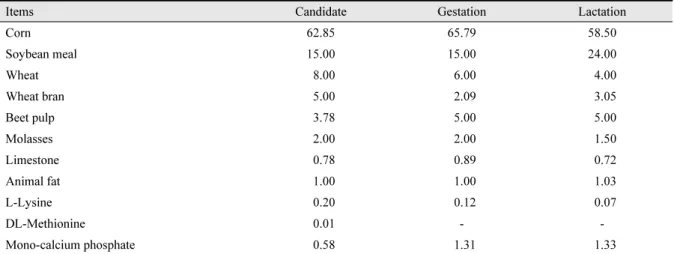
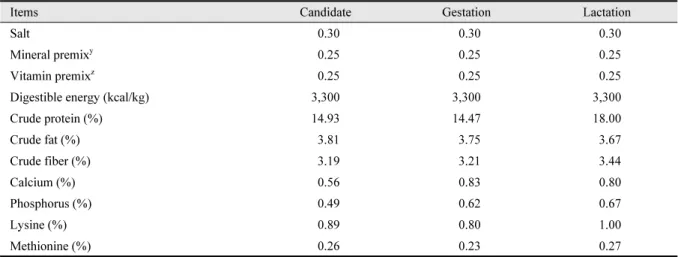
All sows were fed with commercial diets as shown in Table 1. During gestation, sows housed in individual stalls for the 109 days after breeding were moved to farrowing rooms, and individually housed in fully slatted farrowing crates followed by a wash and their body weight and backfat thickness (BFT) being recorded. Each crate had a single feeder, and water was always available through a nipple drinker. The farrowing room temperature was maintained at approximately 18 to 20°C. Rooms were mechanically ventilated. A heat lamp and mat were provided for newborn piglets in each crate. After weaning, sows were returned to their gestation housing systems.
Table 1. Chemical composition of the experimental diets.
Items Candidate Gestation Lactation
Corn 62.85 65.79 58.50
Soybean meal 15.00 15.00 24.00
Wheat 8.00 6.00 4.00
Wheat bran 5.00 2.09 3.05
Beet pulp 3.78 5.00 5.00
Molasses 2.00 2.00 1.50
Limestone 0.78 0.89 0.72
Animal fat 1.00 1.00 1.03
L-Lysine 0.20 0.12 0.07
DL-Methionine 0.01 - -
Mono-calcium phosphate 0.58 1.31 1.33
Table 1. Chemical composition of the experimental diets (Continued).
Items Candidate Gestation Lactation
Salt 0.30 0.30 0.30
Mineral premix
y0.25 0.25 0.25
Vitamin premix
z0.25 0.25 0.25
Digestible energy (kcal/kg) 3,300 3,300 3,300
Crude protein (%) 14.93 14.47 18.00
Crude fat (%) 3.81 3.75 3.67
Crude fiber (%) 3.19 3.21 3.44
Calcium (%) 0.56 0.83 0.80
Phosphorus (%) 0.49 0.62 0.67
Lysine (%) 0.89 0.80 1.00
Methionine (%) 0.26 0.23 0.27
y
Provided the following quantities per kg of complete diet: Cu, 87.5 mg as copper sulfate; Fe, 125 mg as iron sulfate; I, 1.0 mg as potassium iodate; Mn, 75 mg as manganese sulfate; Se, 0.25 mg as sodium selenite; and Zn, 60 mg as zinc oxide.
z
Provided the following quantities per kg of complete diet: vitamin A, 12,500 IU; vitamin D3, 1,000 IU; vitamin E, 125 IU; vitamin K3, 6.3 mg; thiamin, 6.3 mg; riboflavin, 25.0 mg; pyridoxine, 12.5 mg; vitamin B12, 0.1 mg; pantothenic acid, 100 mg; folic acid, 7.5 mg; niacin, 225 mg; and biotin, 0.5 mg.
Data collection and measurements
Sows were weighed, introduced to their lactation diets beginning from day 109 of gestation, and provided with 2.5 kg of feed per day until parturition. Cross-fostering was encouraged within the first 2 days of farrowing. After farrowing, feed was gradually increased through day 5, and then sows were allowed ad libitum intake until weaning (day 24). Sows were fed twice daily at 07:30 and 16:30 h and allowed ad libitum access to feed and water. The quantity of feed provided per sow was recorded daily from day 1 to 24. Feed refusals were weighed and recorded at weaning. No creep feed was provided to suckling piglets. Ultrasonic backfat depth at the P2 position and body weight (BW) of sows were measured on day 109 of gestation and at weaning (day 24). Loss of BW and backfat thickness during lactation was calculated by subtracting the values at weaning from values at day 109 of gestation. Litters were weighed on days 1 and 24. Parity of the sow and litter size at birth and weaning was also collected. Total piglets born alive until 3 parities were calculated, with consideration of sow retention rate, by summing the number piglets produced for all gilts that were initially artificially inseminated (Patterson et al., 2010). If a sow did not produce a litter in any parity, total piglets born alive to the sow was recorded as 0 for the current parity.
Statistical analysis
Data were analyzed statistically via GLM procedure of the SAS/STAT9.2 software (SAS Institute, 2008), for a completely randomized design. Differences among all treatments were assessed by the Tukey’s range test. Variability in the data was expressed as the pooled SE, and P values of < 0.05 were considered to indicate statistical significance.
Results
Effect of mating age at first parity of sows on backfat thickness, litter performance, and weaning-to-estrus interval
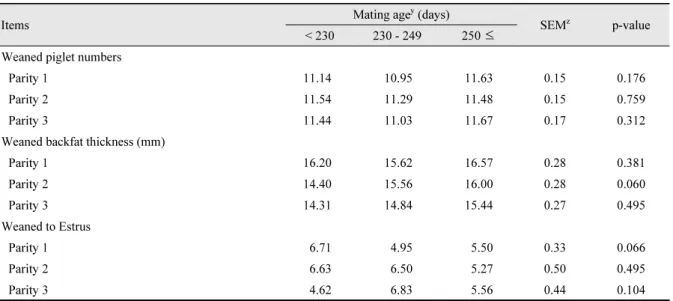
over three consecutive parities are shown in Table 2 and 3. The present study showed that the age of gilts at first
mating influenced their farrowing backfat thickness in the first parity (Table 2, p < 0.05), however, no difference was observed among the groups in second and third parity (p > 0.05). Differences between mating age for total born piglets rate and weaned piglets number were not detected in any of parities. For weaning time, there was no difference (p >
0.05) in backfat thickness among the groups in all the parities (Table 3). Although weaning-to-estrus interval was not significantly influenced by mating age, the interval showed a decreasing tendency according to increasing age (p = 0.066, Table 3).
Table 2. Effects of mating age at first parity of sows on farrowing backfat thickness and litter size over three consecutive parities.
Items Mating age
y(days)
SEM
zp-value
< 230 230 - 249 250 ≤ Farrowing backfat thickness (mm)
Parity 1 18.51a 17.89a 19.47b 0.22 0.013
Parity 2 17.91 17.92 18.90 0.23 0.142
Parity 3 18.00 18.03 18.14 0.27 0.976
Total litter size
Parity 1 10.49 10.32 11.40 0.30 0.302
Parity 2 11.51 12.53 11.83 0.31 0.389
Parity 3 12.94 13.32 12.86 0.32 0.821
a, b: Means within a row without a common superscript letter differ (p < 0.05).
y
Average mating ages of < 230, 230 - 249 and 250 ≤ are 220, 238 and 263 days, respectively.
z
Standard error of the means.
Table 3. Effects of mating age at first parity of sows on litter performance and weaning-to-estrus interval over three consecutive parities.
Items Mating age
y(days)
SEM
zp-value
< 230 230 - 249 250 ≤ Weaned piglet numbers
Parity 1 11.14 10.95 11.63 0.15 0.176
Parity 2 11.54 11.29 11.48 0.15 0.759
Parity 3 11.44 11.03 11.67 0.17 0.312
Weaned backfat thickness (mm)
Parity 1 16.20 15.62 16.57 0.28 0.381
Parity 2 14.40 15.56 16.00 0.28 0.060
Parity 3 14.31 14.84 15.44 0.27 0.495
Weaned to Estrus
Parity 1 6.71 4.95 5.50 0.33 0.066
Parity 2 6.63 6.50 5.27 0.50 0.495
Parity 3 4.62 6.83 5.56 0.44 0.104
y
Average mating ages of < 230, 230 - 249 and 250 ≤ are 220, 238 and 263 days, respectively.
z