52
한 국 균학 회지
The Korean Journal of Mycology
PCR 기법을 이용한 Phoma glomerate 의 특이검출
윤여홍
1·서동연
1·김현주
2·김성환
1*
1단국대학교 미생물학과, 2농림수산검역검사본부 인천공항지역본부 시험분석과
Specific and Sensitive Detection of Phoma glomerata Using PCR Techniques
Yeo Hong Yun
1, Dong Yeon Suh
1, Hyun Ju Kim
2and Seong Hwan Kim
1*
1Department of Microbiology, Dankook University, Cheonan, Chungnam 330-714, Korea
2Experiment & Analysis Division, Animal, Plant and Fisheries Quarantine & Inspection Agency, Incheon International Airport Regional Office 400-718, Korea
ABSTRACT : Phoma glomerata (Corda) Wollenw. & Hochapfel is a pathogenic fungus causing spot diseases of plant leaves and fruits. This fungus is important in plant quarantine of seedlings and fruits in Korea. The aim of this study was to develop a sensitive and effective diagnostic method for P. glomerata detection in imported plants. The fungal species-specific PCR primers were designed based on the nucleotide sequences of the translation elongation factor 1 alpha gene and their specificity and sensitivity were tested. The designed primers named as PhoGlo-F and PhoGlo-R amplified specifically a 170 bp sized DNA band of the target gene from the genomic DNA of P. glomerata. No amplicon was produced from genomic DNAs of 16 other Phoma spp. and reference fungal species tested. Moreover, PhoGlo-F/PhoGlo-R primers successfully worked with real-time PCR technique. The detection limit of DNA content by conventional and real-time PCR were 10 pg and 1pg of the genomic DNA of P. glomerata, respectively. We believed that the developed makers would be very useful for P. glomerata detection.
KEYWORDS : Phoma glomerata, Plant quarantine, Translation elongation factor 1 alpha
Phoma속은 약 2,000종 이상이 보고되었고, 이들 중 부생 균을 포함하여 식물병원균으로는 약 200종이 알려져 있다 (Sutton, 1980). Boerema 등(2004)은 약 200개의 Phoma 분류 군을 정의하면서 Phoma 속을 9개의 section 즉 Phoma, Phyllostictiodes, Heterodera, Peyronellaea, Macrophoma, Pleospora, Plenodomus, Sclerophomella, Paraphoma로 나누 었다. 이 중에서 Phoma glomerata는 Ascomycota 문,
Dothideomycetes 강에 속해 있는 곰팡이다. 이 곰팡이는 Vitis vinifera, Citrus spp., Coniferae, Lycopersicon esculentum, Malluspumila, Solanum tuberosum 그리고 Phragmites australis 등에서 분리보고가 되어 있으며, 공기, 해수, 토양 등 다양한 환경에 존재한다(Morgan-Jones, 1967). 식물병원균으로서 이 곰팡이는 포도의 마름병, 밀 의 잎 반점, 침염수의 모잘록병, 복숭아 나무의 궤양병 그 리고 사과 열매 반점 등을 일으키는 것으로 보고되어 있다 (White and Morgan-Jones, 1987; Thomidis et al., 2011).
국내에서는 벼 이삭마름병에 관여하는 Phoma sorghina (Shim et al., 2005), 유채 줄기 궤양병을 일으키는 Leptosphaeria biglobosa (Hong et al., 2009) 등이 보고되 었다. 그러나 P. glomerata에 의한 병은 아직까지 보고되지 않았다. 현재 P. glomerata(Corda) Woll. & Hoch., P.
exigua var. foveata(Foister) Boerema, P. exigua var. exigua (Foister), P. destructive var. destructive 그리고 P. andina Turkensteen 이 농림수산검역검사본부의 관리병 목록에 등록되어 있다. P. glomerata는 감염된 식물이나 과일을 검 역할 때 균을 분리하더라도 앞서 기술한 것처럼 균학적으 로 뿐만 아니라 분자적으로도 동정이 쉽지 않은 실정이다.
Kor. J. Mycol. 41(1): 52-55 (2013) http://dx.doi.org/10.4489/KJM.2013.41.1.52 pISSN 0253-651X
©The Korean Journal of Mycobiology
*Corresponding author E-mail : [email protected] Received March 13, 2013 Revised March 14, 2013 Accepted March 15, 2013
This is an Open Access article distributed under the terms of the Creative Commons Attribution Non-Commercial License (http://
creativecommons.org/licenses/by-nc/3.0/) which permits unrestricted non-commercial use, distribution, and reproduction in any medium, provided the original work is properly cited.
Research Note
Detection of Phoma glomerata by PCR
53
이에 따라 좀 더 신속히 균을 동정할 수단이 요구되고 있다. 최근 PCR 은 여러 가지 형태로 식물병원성 진균을 신속히 동정하고 검출하는데 응용되고 있다(Schots et al., 1994; Gherbawy and Voigt, 2010). 따라서 본 연구에서는 짧은 시간에 고감도로 P. glomerata 균을 검출할 수 있는 DNA 마커를 개발하고, 일반적으로 사용되는 기존의 PCR 방법과 real-time PCR 방법을 이용하여 검출 가능 농도를 조사하였다.
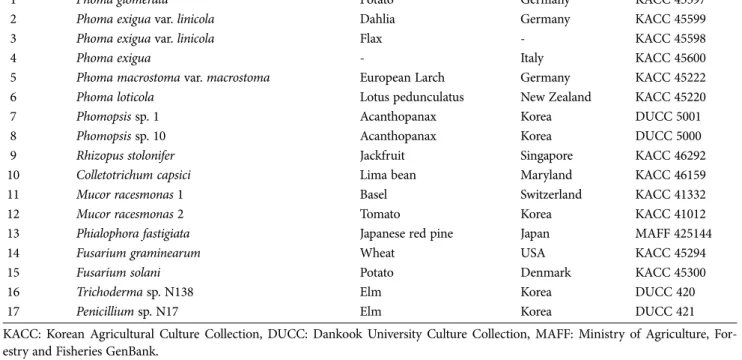
본 실험에 사용된 균주는 Table 1에 제시되었다. 분양을 받은 균주는 PDA 배지에 올려 25oC 배양기에서 5일간 배 양을 하였다. 배양된 균주 중 마커 프라이머를 제작하기 위한 염기서열을 얻기 위해 glass bead방법(Richard et al., 2002)을 이용하여 Phoma속에 속하는 5 균주(KACC45220, KACC45222, KACC45599, KACC45598, KACC45597)의 genomic DNA를 추출하였다. PCR 반응물은 EmeraldAmp®
GT PCR Master Mix(Takara, Japan)에 얻어진 template DNA(10 ng) 및 EF1F과 EF2R 프라이머(10 pmol)을 이용 하여 총 20 µL로 만든 후 Jacobs et al. (2004) 등의 방법에 따라PCR을 수행 함으로서 translation elongation factor 1-alpha를 코딩하는 tef1-α 유전자 부분을 증폭하였다. 증 폭한 PCR산물은 1% agarose gel 전기영동을 실시하여 ethidium bromide로 염색한 다음 증폭된 DNA밴드를 확 인 후 PCR 산물 정제키트(Roche, Germany)를 이용하여 분리 정제하였다. 정제된 PCR 산물은 마크로젠사에 의뢰하 여 염기서열을 분석하였다. 얻어진 염기서열은 GenBank DNA database (http://www.ncbi.nlm.nih.gov/genbank) 검 색을 통하여 tef1-α 유전자 염기서열임을 확인하였다. 이에
따라 Clustal W프로그램(http://www.clustal.org/clustal2/)을 이용하여 서열을 나열한 후 유사성을 비교 분석하였고 종 간 차이가 나는 부분을 염기서열 부분을 바탕으로 하여 Phoma glomerata 검출마커 프라이머인 PhoGlo-F(5’TGC GCA ATA CTC TTG CTT CA 3’)와 PhoGlo-R(5’AGC GAT GTG ATG TTG GAT G 3’)를 디자인하였다(Fig. 1).
디자인된 프라이머의 특이성을 확인하기 위해 다시 Gen Bank DNA database 상에 존재하는 유전자들에 대하여 BlastN검색을 해 본 결과, PhoGlo-F와 완전히 일치하는 DNA염기서열은 존재하지 않았고 PhoGlo-R은 Nectria haematococca 와만 일치하였다. 제작된 프라이머의 염기서 Table 1. Fungal isolates used in this study
Fungal species Host Country Culture collection
1 Phoma glomerata Potato Germany KACC 45597
2 Phoma exigua var. linicola Dahlia Germany KACC 45599
3 Phoma exigua var. linicola Flax - KACC 45598
4 Phoma exigua - Italy KACC 45600
5 Phoma macrostoma var. macrostoma European Larch Germany KACC 45222
6 Phoma loticola Lotus pedunculatus New Zealand KACC 45220
7 Phomopsis sp. 1 Acanthopanax Korea DUCC 5001
8 Phomopsis sp. 10 Acanthopanax Korea DUCC 5000
9 Rhizopus stolonifer Jackfruit Singapore KACC 46292
10 Colletotrichum capsici Lima bean Maryland KACC 46159
11 Mucor racesmonas 1 Basel Switzerland KACC 41332
12 Mucor racesmonas 2 Tomato Korea KACC 41012
13 Phialophora fastigiata Japanese red pine Japan MAFF 425144
14 Fusarium graminearum Wheat USA KACC 45294
15 Fusarium solani Potato Denmark KACC 45300
16 Trichoderma sp. N138 Elm Korea DUCC 420
17 Penicillium sp. N17 Elm Korea DUCC 421
KACC: Korean Agricultural Culture Collection, DUCC: Dankook University Culture Collection, MAFF: Ministry of Agriculture, For- estry and Fisheries GenBank.
Fig. 1. Sequence alignment of tef-1α genes of Phoma spp.
used in this study. Boxed sequences indicate the position of the designed primers PhoGlo-F (upper box) and PhoGlo-R (lower box). KACC45220, Phoma loticola; KACC45222, P.
macrostoma var. macrostoma; KACC45599, P. exigua var.
linicola; KACC45598, P. exigua var. linicola; KACC45597, P.
glomerata.
54
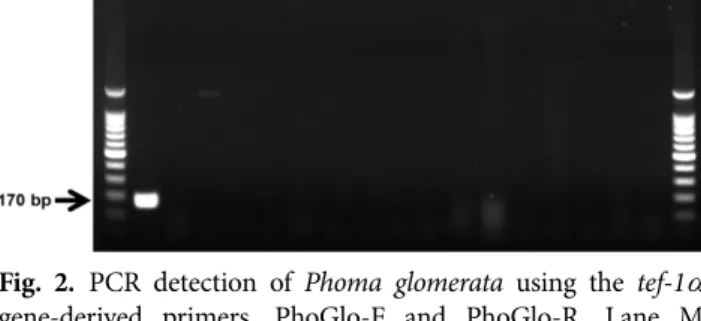
윤여홍·서동연·김현주·김성환열은 Phoma 속에 속하는 다른 종들 및 Phoma 이외의 다 른 균들의 tef1-α 염기서열과는 90% 이하의 상동성을 보 였다. 이는 제작된 프라이머가 P. glomerata 균 특이적일 가능성을 보여준다. 따라서 디자인한 프라이머는 바이오 니아사(대전)에 의뢰하여 합성 제작하였다. 제작된 프라이 머의 특이성은 6개 Phoma균주와 더불어11개 다른 종의 균주에 대해 수행하였다(Table 1). 특이성 확인을 위한 PCR 반응 조건은 initial denaturation 94oC에서 3분, denaturation 94oC에서 20초, annealing 52oC에서 20초, extention 72oC에서 30초 순으로 30회 반복하였다. 그리고 마지막으로 72oC에서 10분 동안 증폭 한 후 4oC에서 보관 하였다. PCR 산물은 1% agarose gel 전기영동을 통해 증폭 이 되었는지 확인하였다. 그 결과 P. glomerata의 genomic DNA에서만 170 bp크기의 밴드가 증폭되었고 다른 균주에 서는 밴드가 증폭되지 않았다(Fig. 2). 이는 제작한 프라이 머가 P. glomerata에 특이적임을 나타낸다.
또한 만들어진 프라이머의 민감성을 알아보기 위한 실 험을 수행하였다. 민감성 실험은 일반 PCR방법과 real time PCR방법 둘 다 이용하였다. 일반 PCR은 P. glomerata의 genomic DNA 함량을 측정하여 20 µL 반응액에 5 ng, 1 ng, 200 pg, 100 pg, 50 pg, 20 pg, 10 pg, 5 pg, 1 pg씩 담 도록 첨가하였다. 각각 첨가된 template DNA를 대상으로 PhoGlo-F/R 프라이머를 앞서 서술한 PCR 반응조건과 같 은 반응조건에서 PCR을 수행하였다. PCR 수행으로 얻어 진 반응산물을 1% agarose gel에 전기영동하여 분석한 결 과 template DNA 10 pg까지는 강하게 증폭된 DNA 밴드 를 볼 수 있었고 5 pg과 1 pg에서도 희미하지만 육안으로 식별 가능한 DNA밴드가 보이는 것으로 보아 적은 양의 template DNA로도 P. glomerata의 검출이 가능한 것을 알 수 있었다(Fig. 3). 한편, 검출 검출감도를 평가하기 위해 Real time PCR을 이용하여 민감성 실험을 수행하였다. 이
를 위해 P. glomerata의 genomic DNA 양을 10 ng부터 100 fg까지 10배 단위로 줄인 후 SYBR Premix Extaq (Takara)에 각각 첨가하여 총 25 µL의 PCR 반응액을 조제 하였다. Real time PCR 반응은 95oC에서 30초 반응 후 95oC에서 5초와 52oC에서 30초를 40회 반복하는 과정으로 Takara Thermal Cycler Dice Real Time System TP800을 이용하여 Real time PCR을 수행하였다. DNA 양에 따른 real time PCR 반응산물을 모니터링한 결과 1 pg 수준까지 는 30 cycle 내에 증폭되었다. 100 fg 수준에서는 34 cycle 에서 증폭이 되기 시작했지만 PCR 증폭량이 다른 DNA 농도보다 많이 낮은 것을 볼 수 있었다. 이러한 결과는 일 반 PCR보다 real time PCR 방법이 민감성면에서 10배 정 도 높음을 보여준다. 표준 커브를 보면 slope가 −3.312 이 나왔고, PCR efficiency 값은 100.4%, R2 값은 0.99가 나왔다. Dissociation temperature 분석에서는 84.5oC로 표 시되었다(Fig. 4). 이러한 수치는 real time PCR이 적절히 수행되었음을 보여준다. 이상의 결과를 보면 일반 PCR 방 법과 real time PCR 방법 모두 제작된 PhoGlo-F/R 프라 Fig. 2. PCR detection of Phoma glomerata using the tef-1α
gene-derived primers, PhoGlo-F and PhoGlo-R. Lane M :100bp ladder marker, Lanes 1-17; 1: P. glomerata, 2: P.
exigua var. linicola, 3: P. exigua var. linicola, 4: P. exigua, 5: P.
macrostoma var. macrostoma, 6: P. loticola, 7: Phomopsis sp.1, 8: Phomopsis sp. 10, 9: Rhizopus stolonifer, 10: Colletotrichum capsici, 11: Mucor racesmonas 1, 12: M. racesmonas 2, 13:
Phialophora fastigiata, 14: Fusarium graminearum, 15: F.
solani, 16: Trichoderma sp. N138, 17: Penicillium sp. N17.
Fig. 3. PCR detection of different amounts of Phoma glomerata DNA using the primers PhoGlo-F and PhoGlo-R.
M: 100 bp ladder marker, 1:5 ng, 2:1 ng, 3:200 pg, 4:100 pg, 5:50 pg, 6:20 pg, 7:10 pg, 8:5 pg, 9:1 pg.
Fig. 4. Real-time PCR with SYBR Green for the quantitative amplification of Phoma glomerata. A: Amplification plot, B:
Standard curve, C: Melting-curve analysis. Lanes 1:10 ng, 2:1 ng, 3:100 pg, 4:10 pg, 5:1 pg, 6:100 fg.
Detection of Phoma glomerata by PCR
55
이머을 사용하였을 경우 1 pg까지는 무리 없이 특이적으 로 증폭할 수 있음을 알 수 있었고 Real time PCR 방법을 사용시 좀 더 감도 있게 검출이 가능함을 볼 수 있었다.
Phoma 균주의 경우 기존에 P. exigua와 P. foveata를 PCR-RFLP 방법을 이용하여 분류하는 것이 보고된 적이 있다(Macdonald et al., 2000). 그러나 분자적 방법을 이용 한 P. glomerata의 직접 검출은 아직 국내외적으로 보고된 바가 없다. 따라서 본 논문은 P. glomerata를 검출하는 방 법을 보고하는 첫 번째 논문이며 이 방법을 이용하여 국내 에 식물과 과일을 수입할 때 분리된 Phoma 균으로부터 P. glomerata를 신속히 동정 검출하는데 이용 할 수 있을 것으로 기대된다.
적 요
Phoma glomerata는 식물 잎이나 열매에 병을 일으키는 식물병원균으로 알려져 있다. 국내에서는 아직 피해사례 가 없기 때문에 P. glomerata는 국내의 식물검역균으로 관 리되고 있다. 본 연구는 국내에 들어오는 목재나 과일에 P.
glomerata를 검출할 수 있는 방법 개발코자 수행되었다.
Phoma 균주들의 translation elongation factor 1 alpha 유 전자 염기서열에 기초하여 P. glomerata 특이적 PCR 프라 이머를 디자인 하였고 그 특이성을 검정하였다. PCR 수행 결과 P. glomerata에서만 170 bp 크기의 밴드가 증폭되 었고, 다른 비교 균주에서는 밴드가 증폭되지 않았다. 검 출 감도를 평가하기 위해 기존 PCR방법과 real time PCR 방법을 이용하여 실험한 결과 최소 10 pg과 1 pg까지 각각 검출 할 수 있었다. 본 연구결과는 디자인된 PCR 프라이 머가 P. glomerata를 특이적으로 검출하는데 유용 할 것 임 을 보여준다.
감사의 글
본 연구는 농림수산식품부 농림기술개발연구사업(309015- 04) 및 농산물수출검역지원사업에 의해 이루어진 것임.
참고문헌
Boerema, G. H., Gruyter, G. H., Noordeloos, M. E. and Hamers, M. E. C. 2004. Phoma identification manual: differentiation of specific and infra-specific taxa in culture. CABI Publishing, 470 pp.
Gherbawy, Y. and Voigt, K. 2010. Molecular identification of Fungi. Springer, New York.
Hong, S. K., Kim, W. G., Shin, D. B, Choi, H. W., Lee, Y. K. and Lee, S. Y. 2009. Occurrence of stem canker on rape caused by Leptosphaeria biglobosa in Korea. Plant Pathol. J. 25:294-298.
Jacobs, K., Bergdahl, D. R., Wingfield, M. J., Halik, S., Seifert, K.
A., Bright, D. E. and Wingfield, B. D. 2004. Leptographium wingfieldii introduced into North America and found associated with exotic Tomicus piniperda and native bark beetles. Mycol.
Res. 108:411-418.
Macdonald, J. E., White, G. P. and Cote, M. J. 2000. Differentiation of Phoma foveata from P. exigua using a RAPD generated PCR-RFLP marker. Eur. J. Plant Pathol. 106:67-75.
Morgan-Jones, G. 1967. Phoma glomerata. [Descriptions of Fungi and Bacteria]. IMI Descriptions of Fungi and Bacteria 14:
Sheet 134.
Richard, A. H., Nichole, B. and Stephen, J. V. 2002. Evaluation of rapid DNA extraction methods for the quantitative detection of fungi using real-time PCR analysis. J. Microbiol. Methods.
50:319-323.
Schots, A., Dewey, F. M. and Oliver, R. 1994. Modern assays for plant pathogenic fungi: identification, detection and quanti- fication. CAB International.
Shim, H. S., Hong, S. G., Hong, S. J., Kim, Y. K., Ye, W. H. and Sung, J. M. 2005. Detection of fungi associated with rice ear blight from rice seeds in Korea. Res. Plant Dis. 11:93-97.
Sutton, B. C. 1980. The Coelomycetes. Fungi Imperfecti with Pycnidia, Acervuli and Stromata. Commonwealth Mycological Institute Kew 696 pp.
Thomidis, T., Michailides, T. J. and Exadaktylou, E. 2011. Phoma glomerata (corda) Wollenw & Hochapfel a new threat causing cankers on shoots of peach trees in Greece. Eur. J. Plant Pathol. 131:171-178.
White Jr, J. F. and Morgan-Jones, G. 1987. Studies in the genus Phoma. VII. Concerning Phoma glomerata. Mycotaxon 28:437-445.