Received: May 16, 2018 Revised: May 25, 2018 Accepted: May 25, 2018
Ⓒ The Korean Society of Mycology
This is an Open Access article distributed under the terms of the Creative Commons Attrib- ution Non-Commercial License (http://creative- commons.org/licenses/by-nc/4.0/) which permits unrestricted non-commercial use, distribution, and reproduction in any medium, provided the original work is properly cited.
Kor. J. Mycol. 2018 June, 46(2): 186-192 https://doi.org/10.4489/KJM.20180021
pISSN : 0253-651X eISSN : 2383-5249
OPEN ACCESS
RESEARCH ARTICLE
토마토 탄저병균 Colletotrichum coccodes 신속 검출 분자 마커
김준영1,3, 장시운1,3, 김현주2, 김성환1,3*
1
단국대학교 자연과학대학 미생물학과,
2농림축산검역본부,
3단국대학교 생물다양성 연구소
Molecular Markers for the Rapid Detection of Colletotrichum coccodes, an Anthracnose Pathogen of Tomato
Jun Young Kim
1,3, Jang Si Woon
1,3, Hyun Ju Kim
2, Seong Hwan Kim
1,3*1
Department of Microbiology, Dankook University, Cheonan 31161, Korea
2
Animal and Plant Quarantine Agency, Gimcheon 39660, Korea
3
Institute of Biodiversity, Dankook University, Cheonan 31161, Korea
*Corresponding author: [email protected]
ABSTRACT
Rapid and accurate detection methods for Colletotrichum coccodes, an anthracnose pathogen of pepper and tomato, were developed using PCR. A specific primer set, coccoTef-F/coccoTef-R, which was constructed by analyzing tef-1 α genes from 13 species and 22 strains of Colletotrichum, could specifically detect C. coccodes at a level of 10 ng by conventional PCR method and at 10 pg by real-time PCR. The PCR-based methods were also capable of detecting C. coccodes in pepper and tomato seeds artificially infected with the pathogen. The developed PCR methods can be applied for rapid and accurate inspection of C. coccodes in the seeds intended for export or import.
Keywords: Anthracnose, Colletotrichum coccodes, Molecular marker
서 론
Colletotrichum 속 진균이 일으키는 탄저병은 식물의 줄기, 잎, 과실 등에 발생 할 수 있으며, 궤양과 부패 등의 증상을 유발한다[1]. 이 균류는 다양한 채소와 과수 등에 폭 넓게 병을 일으 키고 경제적으로 많은 피해를 준다[2]. 주요 탄저병균 중 Colletotrichum coccodes는 고추와 토마토 등에 병을 일으키고[3], C. orbiculare는 박과 작물에 병을 일으키며 C. circinans는 양 파에 병을 일으킨다[4, 5]. 현재 우리나라 채소종자 수출은 2008년 2,000만 US 달러에서
년 현재 5,093만 US 달러로 매우 빠르게 성장하고 있다[6]. 주요 수출 종자로는 고추
균의 전파 및 발병 가능성이 있는 채소종자들을 규제하고 있다. 이에 따라 본 연구는 수출하 고 있는 채소종자에서 C. coccodes가 감염된 종자를 신속하고 정확히 검출할 수 있는 분자 마 커를 개발하고자 수행되었다.
재료 및 방법
공시 균주 및 배양 조건
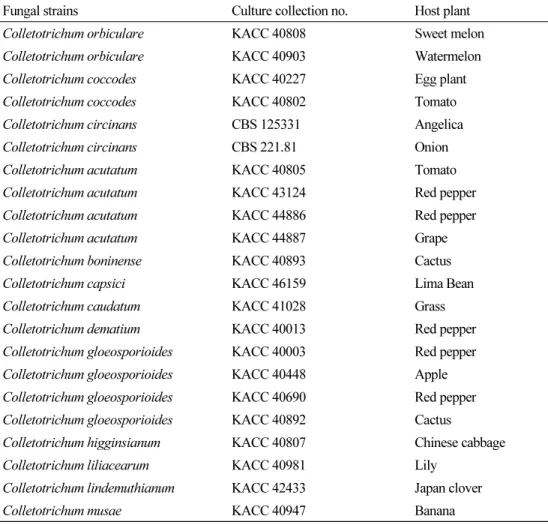
C. coccodes 2 균주를 포함하여 Colletotrichum속에 속하는 13종 22개 균주와 토마토와 고추 에 부생균으로 흔하게 존재하는 Alternaria sp., Aspergillus sp., Cladosporium sp., Fusarium sp., Penicillium sp., Trichoderma sp. 등의 균주를 한국농업미생물자원센터(KACC)와 Centraalbureau voor Schimmelcultures- Royal Netherlands Academy of Arts and Sciences Collections (CBS-KNAW) 에서 분양 받아 사용하였다(Table 1). 모든 균주는 potato dextrose agar (PDA) 배지에서 25°C, 10~12일간 배양하였다.
Table 1. Colletotrichum strains used in this study
Fungal strains Culture collection no. Host plant
Colletotrichum orbiculare KACC 40808 Sweet melon
Colletotrichum orbiculare KACC 40903 Watermelon
Colletotrichum coccodes KACC 40227 Egg plant
Colletotrichum coccodes KACC 40802 Tomato
Colletotrichum circinans CBS 125331 Angelica
Colletotrichum circinans CBS 221.81 Onion
Colletotrichum acutatum KACC 40805 Tomato
Colletotrichum acutatum KACC 43124 Red pepper
Colletotrichum acutatum KACC 44886 Red pepper
Colletotrichum acutatum KACC 44887 Grape
Colletotrichum boninense KACC 40893 Cactus
Colletotrichum capsici KACC 46159 Lima Bean
Colletotrichum caudatum KACC 41028 Grass
Colletotrichum dematium KACC 40013 Red pepper
Colletotrichum gloeosporioides KACC 40003 Red pepper Colletotrichum gloeosporioides KACC 40448 Apple Colletotrichum gloeosporioides KACC 40690 Red pepper Colletotrichum gloeosporioides KACC 40892 Cactus
Colletotrichum higginsianum KACC 40807 Chinese cabbage
Colletotrichum liliacearum KACC 40981 Lily
Colletotrichum lindemuthianum KACC 42433 Japan clover
Colletotrichum musae KACC 40947 Banana
KACC, Korean Agricultural Culture Collection; CBS, Centraalbureau voor Schimmelcultures.
염기서열 분석
Genomic DNA 는 균주를 PDA 배지에 25°C에서 10일간 암조건에서 배양한 후 DNeasy Plant mini kit (Qiagen, Germantown, MD, USA) 를 사용하여 추출하였다[7, 8]. PCR을 이용 한 translation elongation factor 1 alpha (TEF-1α) 유전자 증폭은 TEF728 (5'-CAT CGA GAA GTT CGA GAA G-3') 과 TEF1 (5'-GCC ATC CTT GGA GAG ATA CCA GC-3') primer 를 사용하였다[9, 10]. 증폭한 PCR 산물은 Macrogen (Seoul, Korea)에 의뢰하여 염기 서열을 분석하였고 GenBank DNA database (http://www.ncbi.nlm.nih.gov/genbank)에서 유전자 염기서열을 확인하였다.
분자 진단 마커 발굴 및 개발
분석한 염기서열은 Clustal Omega 프로그램(https://www.ebi.ac.uk/Tools/msa/clustalo/)을 사용하여 염기서열을 나열하고 유사성을 비교 분석한 후, 종 간 차이가 나타나는 염기서열 부 분에서 219 bp 크기의 C. coccodes TEF-1α 유전자를 특이적으로 증폭할 수 있는 프라이머 coccoTef-F (5'-CAG TAG CTA ACG TTC ATC TTA GCC G-3') 와 coccoTef-R (5'-ATT TTG CGC CCC AAG ATT GG-3') 을 디자인하였다.
일반 PCR 방법을 이용한 분자 진단 마커의 특이성 검정
제작된 primer의 특이성 검정은 Table 1에 있는 모든 균주를 대상으로 수행하였다(Table 1).
그리고 표면에 오염될 확률이 높은 부생균으로 존재하는 6개 속의 진균인 Alternaria sp., Aspergillus sp., Cladosporium sp., Fusarium sp., Penicillium sp., Trichoderma sp. 에 대해 서 수행하였다. 특이적 검출을 위한 PCR 반응은 initial denaturation 95°C에서 3분, denaturation 95°C 에서 30초, annealing 58°C에서 30초, extension 72°C에서 30초 순서로 25 회 반복 수행하고 마지막으로 72°C에서 5분 반응하여 증폭하고 4°C에서 보관하였다. 증 폭된 PCR 산물은 1.5% agarose gel에서 100 V로 25분간 전기영동하여 DNA band를 확인 하였다.
일반 PCR 방법과 real-time PCR 방법을 이용한 검출 감도 분석
검출 감도를 측정하고자 정량된 C. coccodes의 DNA를 50 µL PCR 반응액에 10 ng, 1 ng,
100 pg, 10 pg, 1 pg, 100 fg, 10 fg, 1 fg 의 농도로 각각 만들어 주형으로 사용하였다. 일반
PCR 분석은 EmeraldAmp GT PCR Master Mix (Takara Bio, Kusatsu, Japan)에 앞의 DNA
를 주형으로 전체 50 µL로 앞서 서술한 PCR 반응조건으로 PCR을 수행하였다. 증폭산물은
1.5% agarose gel 에서 100 V로 25분간 전기영동하여 DNA 밴드를 확인하였다. Real-time
PCR 분석은 일반 PCR 방법에 사용한 DNA template를 SYBR Premix Extaq (Takara Bio)
에 각각 첨가하여 총 25 µL의 반응액을 조제하였다[11]. Real-time PCR은 95°C에서 30초 반
응 후, 95°C에서 5초와 58°C에서 30초를 40회 반복하여 Takara Thermal Cycler Dice Real
Time System TP800 을 사용하여 3회 반복 실험을 수행하였다. 분석은 TaKaRa Dice Real
C. coccodes 감염 종자에서의 검출능 확인
검역 현장에 적용하기 위해 C. coccodes가 병을 일으키는 고추와 토마토 종자를 대상으로 실 험을 진행하였다. 종자는 표면에 소독제가 코팅되어 있으므로 멸균 증류수를 이용하여 깨끗 하게 씻고 0.25% 차아염소산나트륨으로 표면 살균하였다. 다시 멸균 증류수로 2회 세척하여 남은 차아염소산나트륨을 제거하고 사용하였다. C. coccodes는 PDA 배지에 25°C 암조건에 14 일간 배양하여 실험에 사용하였다. PD broth에 전 배양한 C. coccodes 균사디스크 10개와 앞서 준비한 고추와 토마토 종자 100개씩 각각 첨가하여 3일간 25°C, 200 rpm으로 배양 후, 4 일간 정치배양하였다. 같이 배양한 종자를 꺼내 육안으로 탄저병 종자감염을 확인할 수 있는 감염된 고추와 토마토 종자를 선별하여 실험에 사용하였다. 감염된 종자는 DNeasy Plant mini kit 를 사용하여 DNA 추출하였고 앞서 수행하였던 일반 PCR 방법과 real-time PCR 방 법을 이용하여 검출능을 검정하였다.
결과 및 고찰
C. coccodes 마커의 특이성 검정
C. coccodes 2 균주와 Colletotrichum속의 13종 22개 균주의 DNA를 주형으로 제작한 primer set (coccoTef-F/coccoTef-R) 를 사용하여 PCR을 수행한 결과 C. coccodes의 genomic DNA 에서만 219 bp 크기의 DNA band가 증폭되었고 다른 Colletotrichum종의 DNA에서는 증폭 되지 않았다(Fig. 1). C. coccodes DNA는 또한 부생균으로 빈번히 존재하는 6개 속의 진균
Fig. 1. Specificity test of the primer coccoTef-F/coccoTef-R against diverse fungal DNAs. Lane M, 1 kb DNA ladder; Lane 1, Colletotrichum coccodes KACC 40227; Lane 2, C. coccodes KACC 40802; Lane 3, C. orbiculare KACC 40808; Lane 4, C.
orbiculare KACC 40903; Lane 5, C. circinans CBS 125331; Lane 6, C. circinans CBS 221.81; Lane 7~22, Other Colletotrichum
spp. as listed in Table 1; Lane 23, DNA mixture of C. coccodes KACC 40802 and common six kinds of molds (Alternaria sp.,
Aspergillus sp., Cladosporium sp., Fusarium sp., Penicillium sp., Trichoderma sp.); Lane 24, DNA mixture of common six kinds of
molds.
DNA 와 섞여 있어도 증폭이 가능하였다(lane 23). 반면에, 부생균 6개 속 진균의 DNA mixture 에서는 증폭되지 않았다(lane 24). 이러한 결과로 본 연구에서 제작한 primer set가 C.
coccodes 에 대한 높은 특이성을 보임을 알 수 있다.
일반 PCR 방법과 real-time PCR 방법을 이용한 검출 감도 측정
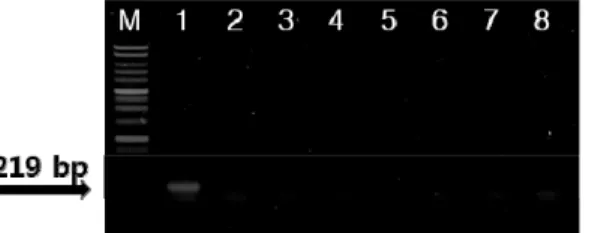
제작한 primer set의 검출 감도를 측정하고자 C. coccodes DNA 10 ng, 1 ng, 100 pg, 10 pg, 1 pg, 100 fg, 10 fg, 1 fg 의 농도로 각각 일반적인 PCR을 수행하고 전기영동하여 확인한 결과 10 ng 의 DNA를 증폭한 시료까지 확인할 수 있었다(Fig. 2). Real-time PCR 방법에서는 Threshold cycle (Ct) 값은 거의 동일하게 나타났고 반응산물을 모니터링한 결과 10 pg 수준 까지 30 cycle 이내에서 peak가 존재함을 확인하였다(Fig. 3). 산출된 표준 곡선의 PCR efficiency 는 114.6%, 기울기는 ‑ 3.016이었으며 상관계수 R2값은 0.984이었다. 이러한 수 치들은 real-time PCR 방법이 신뢰도가 높은 수준임을 나타낸다.
탄저병 감염 종자에서 C. coccodes 검출
수출 종자인 고추와 토마토 종자에 검역 대상 탄저병균인 C. coccodes가 감염된 것을 확인하 고 선별하여 DNA를 추출하고 일반 PCR 방법과 real-time PCR 방법으로 C. coccodes를 검 출하였다. 일반 PCR의 경우 coccoTef-F/coccoTef-R primer 증폭 크기인 219 bp에 band가
Fig. 2. Conventional PCR amplification of different amounts of Colletotrichum coccodes DNA with the primer coccoTef-F/
coccoTef-R. Lane M, 1 kb ladder marker; Lane 1, 10 ng; Lane 2, 1 ng; Lane 3, 100 pg; Lane 4, 10 pg; Lane 5, 1 pg; Lane 6, 100 fg;
Lane 7, 10 fg; Lane 8, 1 fg.
형성되어 감염된 종자에서 검출이 가능한 것을 알 수 있었다(Fig. 4). 또한 real-time PCR 방 법에서도 이전의 결과와 같은 melting peak가 확인 되어 동일하게 증폭되는 것이 관찰되었다 (Fig. 5). 이러한 결과는 일반 PCR 방법과 real-time PCR 방법 모두 감염된 종자에서 제작한 coccoTef-F/coccoTef-R primer 를 사용하여 C. coccodes의 검출이 가능하다는 것을 보여준다.
본 연구에서는 TEF-1α 유전자를 타겟으로 coccoTef-F/coccoTef-R primer set를 제작하 여 다른 Colletotrichum종에서 비특이적인 검출 결과가 발생할 가능성을 최소화하였고 증폭 산물의 크기도 219 bp로 이전 연구된 크기보다 작아 PCR 반응시간도 단축할 수 있어 검출 시 간을 더욱 절약할 수 있다. 따라서 국내외로 채소 및 채소종자를 수출하거나 수입하기 위한 식물검역 작업 시, C. coccodes의 감염 유무를 신속히 파악할 수 있을 것으로 기대된다.
적 요
PCR 기술을 이용하여 고추와 토마토의 탄저병을 일으키는 Colletotrichum coccodes 균을 빠 르고 정확하게 검출하는 방법을 개발하였다. Colletotrichum 13종 22개 균주로 부터 translation elongation factor 1 alpha 유전자를 분석하여 C. coccodes에 특이적인 coccoTef-F/cocco Tef-R primer set 를 제작하였다. 제작된 primer를 사용한 결과 일반 PCR 방법으로 10 ng, Fig. 4. Detection of Colletotrichum coccodes by conventional PCR in DNA from infected seeds using the primer set coccoTef-F/coccoTef-R. Lane M, 1 kb ladder marker; Lane 1, Infected tomato seed; Lane 2, Infected red pepper seed; Lane 3, Uninfected tomato seed; Lane 4, Uninfected red pepper seed.
Fig. 5. Detection of Colletotrichum coccodes by real-time PCR in DNA from infected tomato seeds using the primer set
coccoTef-F/coccoTef-R. A, Amplification plot; B, Melting peak analysis.
real-time PCR 방법으로는 10 pg 수준에서 C. coccodes가 특이적으로 검출이 가능하였다.
인공적으로 C. coccodes에 감염시킨 고추와 토마토 종자에서도 일반 PCR 방법과 real-time PCR 방법 모두 C. coccodes검출이 가능하였다. 본 연구에서 개발한 PCR 방법은 수출입되는 종자에서 신속하고 정확하게 탄저병균 C. coccodes를 특이적으로 검출하는데 활용될 수 있 을 것이다.
ACKNOWLEDGEMENTS
This study was supported by the Animal and Plant Quarantine Agency.
REFERENCES