Res. Plant Dis. 17(3) : 369−375 (2011) © The Korean Society of Plant Pathology
종 특이 primer를 이용한 옥수수 오염 Fusarium verticillioides의 PCR 검출
강미란·김지혜·이승호1·류재기1·이데레사1·윤성환*
순천향대학교 의료생명공학과, 1농촌진흥청 국립농업과학원 유해생물과
Detection of Fusarium verticillioides Contaminated in Corn Using a New Species-specific Primer
Mi Ran Kang, Ji-Hye Kim, Seung-Ho Lee1, Jae-Gee Ryu1, Theresa Lee1 and Sung-Hwan Yun* Department of Medical Biotechnology, Soonchunhyang University, Asan 336-745, Korea
1Microbial Safety Division, National Academy of Agricultural Science, Rural Development Administration, Suwon 441-707, Korea
(Received on October 27, 2011; Revised on November 21, 2011; Accepted on November 22, 2011)
Fusarium verticillioides (teleomorph: Gibberella moniliformis), a member of the Gibberellea fujikuroi species complex, causes rots of corn stalks and ears, and produces a group of mycotoxins known as fumonisins that are harmful to animals and humans. Here, we focus on the development of a species-specific PCR primer set for differentiating F. verticillioides from other fumonisin-producing Fusarium species belonging to the species complex, such as F. proliferatum, F. fujikuroi, and F. subglutinans that are frequently associated with corn.
The specific primers (RVERT1 and RVERT2) derived from the nucleotide sequences of RNA polymerase II beta subunit (RPB2) gene amplified a 208 bp-DNA fragment from only F. verticillioides isolates among the potential fumonisin-producing species examined; all of these isolates were shown to carry FUM1 required for fumonisin biosynthesis. The PCR detection limit using this specific primer set was approximately 0.125 pg/µl genomic DNA of F. verticillioides. In addition, the F. verticillioides-specfic fragment was successfully amplified from genomic DNAs of corn samples contaminated with Fusarium spp. This primer set would provide a useful tool for the detection and differentiation of potential fumonisin-producing F. verticillioides strains in cereal samples.
Keywords : Corn ear and stalk rot, Gibberella, Fumonisin, RNA polymerase II subunit
Gibberella fujikuroi 종 복합체(species complex)는 Fusa- rium을 불완전세대로 갖는 사상성 자낭균 곰팡이집단으 로서 벼, 옥수수, 수수, 기장 등을 비롯한 각종 곡물에 광 범위하게 오염되어 주요 병해를 일으키는 식물병원균이 다(Leslie 등, 1990; Leslie와 Summerell, 2006). 이 집단에 속한 종들은 형태학적 특징만으로 정확히 구분되기 어렵 기 때문에 균주 사이의 교배 여부에 따른 mating population (MP)으로 나뉘기도 하였으나(Leslie 등, 2007; Leslie와 Summerell, 2006) 무성세대로만 존재하는 종들의 구분은 여전히 명확하지 않았다. 이를 극복하기 위하여 DNA 염 기서열의 비교분석을 통해 지금까지 집단 내 최소 40여
종 이상의 계통발생학적 종(phylogenetic species)이 동정 되었다(O’Donnell 등, 1998). 이들 중 일부 종은 식물병 뿐 아니라 이병 또는 오염식물 내 fumonisins이라는 polyketide 계통의 곰팡이독소(mycotoxin)를 생성하여 사 람과 가축에 심각한 중독증을 일으키기도 한다(Marasas, 2001; Marasas 등, 1988; Munkvold와 Desjardins, 1997;
Nelson 등, 1993). 특히 사람의 경우, fumonisin 오염곡물 의 섭취와 식도암 발생 사이의 병역학적 연관관계가 대 두되면서 발암물질 후보로서 더욱 많은 관심을 얻게 되 었다(Marasas, 2001; Yoshizawa 등, 1994).
Fusarium verticillioidess(완전세대: G. moniliformins, MP A)는 G. fujikuroi 종 복합체에 속하는 종으로서 전세계적 으로 옥수수에 자주 발생하여 줄기나 이삭에 뿌리썩음병 을 일으킬 뿐 아니라 다량의 fumonisins을 생산하는 것으
*Corresponding author
Phone) +82-41-530-1288, Fax) +82-41-530-3085 Email) [email protected]
http://dx.doi.org/10.5423/RPD.2011.17.3.369 Note Open Access
로 알려졌다(Jurjevic 등, 2005). 하지만 옥수수에 빈번히 오염되는 G. fujikuori 종 복합체 중에는 F. verticillioides 뿐 아 니라 F. proliferatum(G. intermedia, MP D), F. subglutinas (G. subglutinans, MP E), F. fujikuroi(G. fuji kuroi, MP C) 등 의 다른 종들도 fumonisin을 생성한다(Jurjevic 등, 2005).
곡물 시료 내 이들 fumonisin 생성 균주들의 검출과 동정 은 fumonisin 생합성에 필수적인 polyketide synthase 유 전자인 FUM1(Proctor 등, 1999)의 PCR 증폭 여부로 쉽 게 가능하나(Baird 등, 2008; Bezuiden hout 등, 2006), fumonisin 생성 균주 내 정확한 종 동정은 여전히 계통발 생학적 분석으로만 가능하다. 이를 극복하기 위해 rDNA 의 intergenic spacer(IGS), internal spacer(ITS) 부위, 또는 calmodulin 유전자의 염기서열을 이용하여 F. verticillioides, F. proliferatum, F. subglutinans의 특이적인 검출을 위한 primer 조합의 개발이 시도되었다(Mulè 등, 2004; Patiño 등, 2004; Sreenivasa 등, 2008; Yazeed 등, 2011). 한편 국 내 친환경 농법의 확산과 농산물의 안전성에 대한 관심 이 커지면서 옥수수를 비롯한 곡물시료 내 이들 fumonisin 생성 균주들의 오염 여부를 신속하게 검정할 수 있는 기 술의 필요성은 더욱 부각되고 있다. 따라서 본 연구의 목 적은 우리나라 옥수수에서 발생하는 F. verticillioides 균 주를 다른 fumonisin 생성 추정G. fujikuroi 종 복합체 소 속 균주들과 구별할 수 있는 신규 특이 primer 조합을 개 발하고, 이들 primer의 특이성과 검출한계 등을 분석하며, 곡물시료로부터 F. verticillioides 검출 여부를 검정하는 것
이다.
균주 수집. 본 연구에서 사용된 G. fujikuroi 종 복합체 들은 2009-2010년 동안 우리나라 옥수수와 벼로부터 분 리한 균주로서 농촌진흥청 국립농업과학원 유해생물과로 부터 분양받아 eukaryotic translation elgongation factor 1- alpha(EF1A) 유전자 염기서열을 이용한 계통발생학 분석 으로 동정된 균주들(Kim 등, unpublished data, 2011년 추 계 한국식물병리학회발표)과 농업유전자원센터(Korean Agricultural Culture Collection, KACC)로부터 분양받은 균 주들이다(Table 1). 이외 다른 종의 Fusarium 속 곰팡이 는 Fusarium Research Center(USA) 와 KACC로부터 분 양받았다(Table 1).
RPB2 유전자의 증폭 및 염기서열 정렬 수집된 균주 들의 게놈 DNA 추출을 위하여 감자한천배지(PDA)에서 3일간 배양한 각 균주의 agar block을 감자한천 액체배지 (Potato Dextrose Broth, Difco, USA)에 접종하여 3일 동 안 24oC에서 진탕 배양하였다. 균체로부터 Chi 등(2009) 이 보고한 방법에 따라 게놈 DNA를 추출한 후 F.
verticillioides 14주, F. proliferatum 8주, F. fujikuroi 5주, F.
subglutinas 4주의 게놈 DNA로부터 fRPB2-7cF과 fRPB2- 11aR의 primer(Table 2)를 이용하여 RNA polymerase II beta subunit(RPB2) 유전자를 증폭하였다. 본 연구에서 사 용한 모든 PCR 증폭용 primer는 Bioneer사(Korea)에서 제 작하였으며, PCR 반응을 위해 총량 50 µl 반응액에 50 ng 의 주형 DNA, 1 × PCR buffer, 각각의 dNTP 0.2 mM, 각
Table 1. Fusarium spp. used in this study and PCR amplification using species–specific primers
Species Isolate Host Source a (origin) Primer pairsb
PRO1/2 VER1/2 rp32/ 33 RVER1/2
F. fujikuroi
K44021 rice KACC +c –d + –
K44019 rice KACC + – + –
K44017 rice KACC + – + –
K44015 rice KACC + – + –
K44010 rice KACC + – + –
K44009 rice KACC + – + –
K44004 rice KACC + – + –
K42687 rice KACC + – + –
K42686 rice KACC + – + –
OS5 corn Kim et al.e – – + –
OS6 corn Kim et al. + – + –
OS8 corn Kim et al. – – + –
OS11 corn Kim et al. – – + –
OS25 corn Kim et al. + – + –
Table 1. Continued-2
Species Isolate Host Source a (origin) Primer pairsb
PRO1/2 VER1/2 rp32/ 33 RVER1/2
F. proliferatum
K44025 rice KACC + – + –
K44024 rice KACC + – + –
K42694 – KACC + – + –
K42693 – KACC + – + –
K42692 – KACC (China) + – + –
OS17 corn Kim et al. – – + –
OS18 corn Kim et al. – – + –
OS30 corn Kim et al. – – + –
OS32 corn Kim et al. + – + –
OS46 corn Kim et al. + – + –
OS58 corn Kim et al. + – + –
OS65 corn Kim et al. + – + –
OS66 corn Kim et al. + – + –
F. verticilliodes
K42699 – KACC – + + +
K42698 – KACC (China) – + + +
K41321 – KACC – + + +
OS9 corn Kim et al. + + + +
OS14 corn Kim et al. + + + +
OS20 corn Kim et al. – + + +
OS21 corn Kim et al. – + + +
OS24 corn Kim et al. – + + +
OS26 corn Kim et al. + + + +
OS34 corn Kim et al. – + + +
OS35 corn Kim et al. – + + +
OS40 corn Kim et al. – + + +
OS44 corn Kim et al. – + + +
OS45 corn Kim et al. – + + +
OS48 corn Kim et al. – + + +
F. subglutinans
OS12 corn Kim et al. – – + –
OS13 corn Kim et al. – – + –
OS23 corn Kim et al. – – + –
OS47 corn Kim et al. – + + –
F. oxysporum
K41087 cymbidium KACC – – – –
K40236 carnation KACC – – – –
O1565 banana FRC (Taiwan) – – – –
O1566 banana FRC (Honduras) – – – –
O1567 banana FRC (Australia) – – – –
F. oxysporum f. sp. radi- cis–lycopersici
O1090 tomato FRC (Canada) – – – –
O1092 tomato FRC (Canada) – – – –
O1097 tomato FRC (Canada) – – – –
primer 10 mM, 1.25 U ExTaq polymerase(Takara Bio- medicals, Japan)을 첨가하였다. RPB2 유래 primer 조합 (fRPB2-7cF과 fRPB2-11aR) (Table 2)을 이용한 PCR 증 폭은 다음과 같은 조건으로 수행하였다. 94oC 2분의 변 성 이후 94oC, 30초, 58oC, 30초, 72oC, 1분 반응의 조건 으로 30 cycle의 증폭을 수행한 후 72oC에서 10분 동안 extension 반응을 수행하여 완료하였다. 전기영동을 통하 여 단일한 크기(~970 bp)의 PCR 증폭을 확인한 후 PCR purification kit(NucleoGen, Korea)를 이용하여 해당 증폭 DNA를 정제하였다. 증폭 DNA의 염기서열을 결정하기 위하여 증폭 DNA를 주형으로, PCR 증폭용 primer 조합 을 염기서열 결정용 primer로 사용하는 direct sequencing 방법을 사용하였다. 하지만 염기서열의 결과가 명확하지 않을 경우, 해당 증폭 DNA를 이미 보고된 방법(Hong 등, 2010)에 따라 pGEMT- Easy Vector System (Promega, USA)에 cloning한 후 T7과 SP6 primer 조합으로 염기서 열을 결정하였다. 증폭 유전자의 최종 염기서열을 확정하
기 위하여 양 방향 primer에 의해 결정된 염기서열을 DNASTAR사(USA)의 SEQMAN 프로그램으로 비교하였 으며, 이후 증폭 유전자 염기서열들을 DNASTAR MEGALIGN 프로그램 내 Clustal W 방법(Thompson 등, 1994)을 사용하여 정렬하였다. 증폭된 RPB2 유전자들의 염기서열은 NCBI(The National Center for Biotechnology Information, USA)에 이미 기탁되어 있는 해당 Fusarium 종의 RPB2 유전자와 99−100% 수준에서 상동성을 보였 다. 본 연구에서 얻은 서열 중 일부는 NCBI의 GenBank 에 기탁하였다(GenBank accession numbers: JN968201- JN968212).
종 특이 primer의 제작. F. verticillioies의 종 특이 primer 를 제작하기 위하여 수집 균주의 EF1A 유전자 (Kim 등, unpublished data)와 본 연구에서 증폭한 RPB2 유전자 염기서열을 사용하였다. 약 680 bp 크기의 EF1 유 전자 염기서열을 균주별로 정렬하였을 경우, 3종의 G.
fujikuroi species complex 균주 내에서 총 68 bp의 염기서 Table 1. Continued-3
Species Isolate Host Source a (origin) Primer pairsb
PRO1/2 VER1/2 rp32/ 33 RVER1/2
F. graminearum
PH–1 wheat FRC (USA) – – – –
Z03643 wheat FRC (USA) – – – –
GZ3639 wheat FRC (USA) – – – –
SCK04 barley KACC – – – –
aKACC: Korean Agricultural Culture Collection, Suwon, Korea. KACC without parenthesis indicates the fungal isolates from Korea.
FRC: Fusarium Research Center, University Park, PA, USA.
bPrimer pairs used in PCR amplification. Refer to Table 2.
c+: amplification of a specific DNA fragment
d–: no amplification
eunpublished data
Table 2. PCR primers used in this study
Primer name Sequence (5'→3') Reference
fRPB2-7cF ATGGG(C/T)AA(A/G)CAAGC(C/T)ATGGG
Liu et al., 1999 fRPB2-11aR GC(A/G)TGGATCTT(A/G)TC(A/G)TC(C/G)ACC
PRO1 CTTTCCGCCAAGTTTCTTC
Mulé et al., 2004
PRO2 TGTCAGTAACTCGACGTTGTTG
VER1 CTTCCTGCGATGTTTCTCC
Mulé et al., 2004
VER2 AATTGGCCATTGGTATTATATATCTA
rp32 ACAAGTGTCCTTGGGGTCCAGG
Proctor et al., 2004
rp33 GATGCTCTTGGAAGTGGCCTACG
RVER1 CCTTAACTACACTGAAATCTTTG
This study
RVER2 TATCACGACGTTGATGCGAC
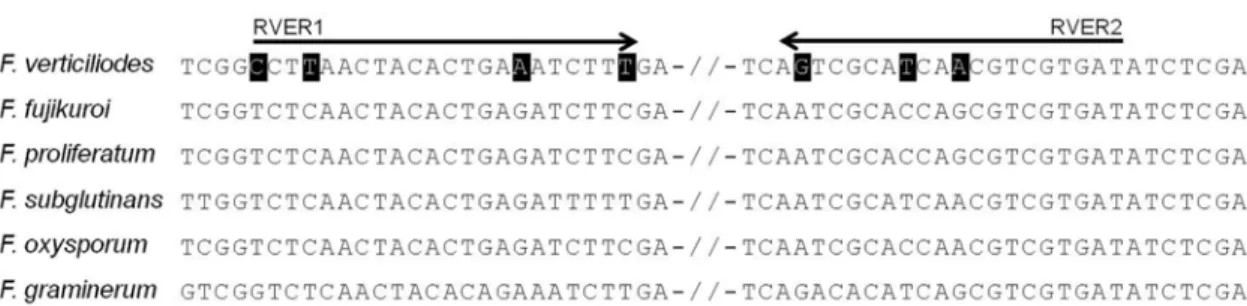
열의 변이를 확인할 수 있었다. 하지만 이들 변이 부위는 증폭된 EF1A 유전자에 골고루 분포하고 있었기 때문에 F. verticillioides 균주에 특이적인 primer를 제작할 정도의 연속적인 변이 부위를 찾기 어려웠다. 실제로 변이 부위 로부터 제작한 primer 조합을 사용하여 PCR 증폭을 한 결과, F. verticillioides 균주 특이적 증폭양상을 관찰할 수 없었다(data not shown). 반면, ~970 bp 크기의 RPB2 유 전자 염기서열의 정렬을 통해 약 50 bp의 변이 서열을 확 인하였으며, 이들 부위로부터 RVER1과 RVER2를 특이 primer 후보 조합으로 제작할 수 있었다(Fig. 1). 이들 primer 는 모두 RPB2 유전자의 coding region에 위치하였다.
F. verticillioides 특이 primer를 이용한 PCR 증폭. RVER1 과 RVER2 조합을 이용한 PCR 증폭(조건은 위의 RPB2 증폭조건과 같으며, annealing 온도로 55oC 사용) 결과, 3종의 fumonisin 생성 G. fujikuroi species complex 수집 균 주들 중 오직 F. verticillioides의 게놈 DNA로부터 208 bp 의 DNA 절편이 특이적으로 증폭되었다(Table 1, Fig. 2).
이들 primer의 특이성을 좀 더 검정하기 위하여 이들 3종 외 다른 Fusarium 속 곰팡이(F. oxysporum, F. gra- minearum 등) (Fig. 2)와 옥수수에서 자주 발생하는 Fusarium 속 외 다른 곰팡이(Cochliobolus heterostrophus, C. carbonum, 등) (data not shown)의 게놈 DNA를 주형 으로 PCR을 수행한 결과, 특이적 DNA 절편이 전혀 검 출되지 않았다. 이를 통해 RVER1과 RVER2 primer의 종 특이성이 확인되었다. 한편 fumonisin 생합성에 필수적인 polyketide 유전자인 FUM1 유전자로부터 유래한 rp32와 rp33 primer로 PCR을 수행한 결과, 모든 F. verticillioides 균주의 게놈 DNA로부터 약 680 bp의 DNA 절편이 증폭 되었다(Table 1, Fig. 2). FUM1 특이 절편이 증폭된 F.
verticillioides 균주 모두가 실제 쌀배지에서 fumonisin을 생성하였다는 보고(Baird 등, 2008) 의 결과를 참조할 경 우, 본 연구에서 조사한 모든 균주는 fumonisin을 생성할 가능성이 높다고 판단된다. 하지만 FUM1 증폭용 primer
조합은 F. verticillioides 뿐 아니라 fumonisin 고생산 균주 로 알려진 F. proliferatum과 심지어 저생산 또는 미생산 균주로 알려진 F. fujikuroi와 F. subglutinans 균주로부터 도 같은 크기의 DNA를 증폭하였다(Table 1, Fig. 2). 한 편, F. verticillioides 증폭용 primer 조합(VER1과 VER2, Table 2)을 사용하였을 경우에도, 분석대상 곰팡이 균주 중 오직 F. verticillioides 균주의 DNA로부터만 특이 절 편이 증폭되어(Table 1), 본 연구에서 개발된 primer들의 특이성이 최소한 기존 개발 primer와 비슷함을 알 수 있 었다. 그러나 본 연구에서 개발된 특이 primer는 지금까 지 시도되지 않았던 RPB2 유전자로부터 제작되었기 때 문에 calmodulin 유전자(Mulé 등, 2004), EF-1 유전자 (Bezuidenhout 등, 2006), intergenic spacer sequence(IGS) 부위(Patiño 등, 2004; Sreenivasa 등, 2008), RAPD 표지 인자(Yazeed 등, 2011) 등으로부터 유래된 기존 특이 primer 조합들과 달리 신규성을 갖는다고 할 수 있다. 한편 기존 Fig. 1. Alignment of partial nucleotide sequences of RPB2 from the representative isolates of Fusarium spp. used in this study. The location of primers RVER1 and RVER2 are indicated by black arrows, and variable nucleotides within the primer sequences among the species are filled with black rectangles. // represents discontinuity of the nucleotide sequences. F. verticillioides: RPB2 from isolate OS9, F. fujikuroi: OS5, F. proliferatum: OS17, F. subglutinans: OS12, F. oxysporum: K41087, F. graminearum: PH-1.
Fig. 2. PCR amplification from the Fusarium spp. used in this study using the primers RVER1 and RVER2 (A), and rp32 and rp33 (B), respectively. (A) Lanes 1-10 and 18: F. verticilloides isolates; 11-15: F. fujikuori, 16-17: F. subglutinans, 19-27: F.
proliferatum, 28-34: other Fusarium spp. M: a 100-bp ladder.
(B) Lanes 1-8: F. verticillioides, 9-15: F. proliferatum, 16-21: F.
fujikuroi, 22-23: F. subglutinans.
에 발표된 F. proliferatum 특이 primer 조합(Mulé 등, 2004) 을 본 연구에서 수집한 G. fujikuroi 종 복합체 균주 집단 에 적용한 결과, 종 특이적 양상의 PCR 검출이 관찰되지 않았다(Table 1). 따라서 이들 F. proliferatum 특이 primer 로는 옥수수 발생 fumonisin 고생산 균주인 F. proliferatum 과 F. verticillioides를 구분할 수 없었다. 오히려 본 연구 에서 개발한 F. verticillioides primer 조합(혹은 기존 primer 조합 추가)을 rp32와 rp33조합과 함께 사용할 경우, fumonisin 생성 가능 F. verticillioides 균주의 신속하고 보 다 정확한 종 동정이 가능할 것으로 예상된다. 그리고 RVER1과 RVER2 primer의 검출 한계를 검정하기 위하여 F. verticillioides 균주 게놈 DNA를 125 ng/µl의 농도로부 터 10배씩 희석하여 PCR을 수행한 결과, 0.125 pg/µl 수 준의 곰팡이 DNA로부터도 특이 primer를 증폭할 수 있 었다(Fig. 3). 한편, 여러 곡물 시료로부터 F. verticillioides 의 PCR 검출 여부를 검정하기 위하여, 200 mg의 벼와 옥 수수 시료로부터 Food Kit(NucleoSpin® Food, Germany) 를 이용하여 게놈 DNA를 추출한 후, 위에서 언급한 조 건으로 PCR을 수행하였다. 실험 결과, 총 5종의 옥수수 시료 중 3종에서 특이 절편이 검출되었으며(Fig. 4), 총 10종의 벼 시료로부터는 특이 절편이 증폭되지 않았다.
이와 같은 결과는 우리나라의 경우, F. verticiliioides가 옥 수수와 달리 벼에서는 거의 발생하지 않는다는 결과 (Kim 등, unpublished data)를 뒷받침한다. 따라서 우리나라 볍 씨와 각종 도정미 시료에서 자연발생하는 미량의 fumonisin (Lee 등, unpublished data)은 F. verticillioides가 아니라 대 부분 F. proliferatum에 의한 것으로 추정할 수 있다. 하지 만 우리나라 외 다른 아시아나 아프리카 지역에서는 벼 에서도 F. verticillioides가 발생된다는 보고가 있기 때문 에(Amoah 등, 1995; Desjardin 등, 2000), 우리나라의 경 우도 F. verticillioides에 의한 벼의 fumonisin 오염가능성 에 주의하여야 할 것이다. 한편, 곡물 내 F. verticillioides 의 오염 여부 뿐 아니라 정량적인 오염량 분석은 quantitative real-time PCR(qRT-PCR)을 통해 가능할 것이다. 본 연구 에서 개발된 RVER1과 RVER2 primer 조합은 이들에 의 해 증폭된 DNA 절편의 크기(208 bp)를 고려할 때 qRT- PCR에 직접 사용되기 적당할 것으로 예상된다. 또한 이 들 primer는 옥수수나 벼 뿐 아니라 다른 곡물에서도 F.
verticillioides의 오염과 이에 따른 fumonisin 발생위험 정 도를 예측하는 데에도 유용하게 활용될 수 있을 것이다.
특히 화학농약 사용을 최소화하는 친환경농법으로 재배 된 농산물 내 곰팡이 오염분석에 중요하게 활용될 수 있 을 것이다. 이를 위해서는 곡물 내 F. verticillioides 오염 률과 fumonisin 발생량 사이의 보다 정밀한 상관관계 규
명이 필요할 것이다.
요 약
Fusarium verticillioides(완전세대: Gibberella moniliformis) 는 Gibberellea fujikuroi 종 복합체에 속하는 식물병원균으로 서 옥수수의 줄기와 이삭에 썩음병을 일으킬 뿐 아니라 인 축에 중독증을 일으키는 fumonisin 곰팡이 독소를 생산한 다. 본 연구의 목적은 옥수수에 주로 발생하는 fumonisin 생성가능 G. fujikuori 종 복합체 소속 Fusarium 곰팡이 중 F. verticillioides와 그 외 F. proliferatum, F. fujikuori 등 을 서로 구별할 수 있는 종 특이적 PCR primer 조합을 개발하는 것이다. RNA polymerase II beta subunit 유전 자(RPB2)의 염기서열로부터 제작된 특이 primer 조합 (RVERT1와 RVERT2)은 우리나라 옥수수에서 분리한 잠 재적인 fumonisin 생성 G. fujikuori 종 복합체 균주 중 오 직 F. verticillioides로부터 208 bp 크기의 단일 DNA 절편 을 증폭하였다. 한편 F. verticillioides를 포함한 모든 조사 균주는 fumonisin 생합성에 필수적인 FUM1 유전자를 포 함하고 있었다. 개발된 특이 primer 조합의 검출한계는 분 석 곰팡이 DNA 0.125 pg/µl 수준이었다. 한편, 같은 primer 조합으로 Fusarium spp.에 오염된 옥수수 시료의 게놈 DNA로부터 F. verticillioides 특이 DNA 절편이 증폭되었 다. 이와 같은 결과를 종합할 때, 본 연구에서 개발된 primer 조합은 여러 곡물 시료에 오염되어 있는 F.
Fig. 3. Amplification of RPB2 from Fusarium verticillioides genomic DNA using RVER1 and RVER2. M: a 100-bp ladder;
Lane 1: fungal genomic DNA at 0.125 mg/ml; lanes 2-6: 10- fold serial dilutions of the genomic DNA in lane 1.
Fig. 4. Amplification of the Fusarium verticillioides-specific DNA fragment from genomic DNAs of corn samples using the primers RVER1 and RVER2. M: a 100-bp ladder; Lanes 1-5:
corn genomic DNAs, lane 6: genomic DNA of F. verticillioides.
verticillioides 균주의 검출과 종 동정에 유용하게 사용될 것이다.
Acknowledgements
This study was carried out with the support of
“Cooperative Research Program for Agricultural Science
& Technology Development (Project No. PJ007340)”, Rural Development Administration, Republic of Korea, and a grant from the Korea Institute of Planning and Evaluation for Technology of Food, Agriculture, Forestry and Fisheries (No. 309015-04).
References
Amoah, B. K., Rezanoor, H. N., Nicholson, P. and McDonald, M. V.
1995. Variation in the Fusarium section Lesiola: pathogencity and genetic studies of Fusarium moniliforme Sheldon from different hosts in Ghana. Plant Pathol. 44: 563–572.
Baird, R., Abbas, H. K., Windham, G., Williams, P., Baird, S., Ma, P., Kelley, R., Hawkins, L. and Scruggs, M. 2008. Identi- fication of select fumonisin forming Fusarium species using PCR applications of the polyketide synthase gene and its relationship to fumonisin production in vitro. Int. J. Mol. Sci.
9: 554–570.
Bezuidenhout, C. C., Prinsloo, M. and Van der Walt, A. M. 2006.
Multiplex PCR-based detection of potential fumonisin- producing Fusarium in traditional African vegetables. Environ.
Toxicol. 21: 360–366.
Chi, M. H., Park, S. Y. and Lee, Y. H. 2009. A quick and safe method for fungal DNA extraction. Plant Pathology J. 25: 108–111.
Desjardin, A. E., Manandhar, H. K., Plattner, R. D., Manandhar, G. G. Poling, S. M. and Maragos, C. M. 2000. Fusarium species from Nepalese rice and production of mycotoxins and gibberellic acid by selected species. Appl. Environ. Microbiol.
66: 1020–1025.
Hong, S.-Y., Kang, M.-R., Cho, E.-J., Kim, H.-K. and Yun, S.-H.
2010. Specific PCR detection of four quarantine Fusarium species in Korea. Plant Pathology J. 26: 409–416.
Jurjevic, Z., Wilson, D. M., Wilson, J. P., Geiser, D. M., Juba, J.
H., Mubatanhema, W., Widstrom, N. W. and Rains, G. C.
2005. Fusarium species of the Gibberella fujikuroi complex and fumonisin contamination of pearl millet and corn in Georgia, USA. Mycopathologia 159: 401−406.
Leslie, J. F., Anderson, L. L., Bowden, R. L. and Lee, Y. W. 2007.
Inter- and intra-specific genetic variation in Fusarium. Int. J.
Food. Microbiol. 119: 25–32.
Leslie, J. F., Pearson, C. A. S., Nelson, P. E. and Toussoun, T. A. 1990.
Fusarium spp. from corn, sorghum, and soybean fields in the
central and eastern United States. Phytopathology 80: 343–350.
Leslie, J. F. and Summerell, B. A. 2006. The Fusarium lab manual, Blackwell, Ames, Iowa, USA.
Liu, Y. L., Whelen, S. and Hall, B. D. 1999. Phylogenetic relationships among ascomycetes: evidence from an RNA polymerase II subunit. Mol. Biol. Evol. 16: 1799–1808.
Marasas, W. F. O. 2001. Discovery and occurrence of the fumonisins: a historical perspective. Environ. Health Perspect.
109: 239–243.
Marasas, W. F. O., Kellerman, T. S., Gelderblom, W. C. A., Coetzer, J. A. W., Thiel, P. G. and Vanderlugt, J. J. 1988.
Leukoencephalomalacia in a horse induced by fumonisin-B1 isolated from Fusarium moniliforme. J. Vet. Res. 55: 197–203.
Mulè, G., Susca, A., Stea, G. and Moretti, A. 2004. A species- specific PCR assay based on the calmodulin partial gene for identification of Fusarium verticillioides, F. proliferatum and F. subglutinans. Eur. J. Plant Pathol. 110: 495–502.
Munkvold, G. P. and Desjardins, A. E. 1997. Fumonisins in maize:
can we reduce their occurrence? Plant Dis. 81: 556–565.
Nelson, P. E., Desjardins, A. E. and Plattner, R. D. 1993.
Fumonisins, mycotoxins produced by Fusarium species:
biology, chemistry, and significance. Annu. Rev. Phytopathol.
31: 233–252.
O’Donnell, K., Cigelnik, E. and Nirenberg, H. I. 1998. Molecular systematics and phylogeography of the Gibberella fujikuroi species complex. Mycologia 90: 465–493.
Patiño, B., Mirete, S., González-Jaén, M., Mulé, G., Rodríguez, M. T. and Vázquez, C. 2004. PCR detection assay of fumonisin-producing Fusarium verticillioides strains. J. Food Prot. 67: 1278–1283.
Proctor, R. H., Desjardins, A. E., Plattner, R. D. and Hohn, T. H.
1999. A polyketide synthase gene required for biosynthesis of fumonisin mycotoxins in Gibberella fujikuroi mating population A. Fungal Genet. Biol. 27: 100–112.
Proctor, R. H., Platter, R. D., Brown, D. W., Seo, J.-A. and Lee.
Y.-W. 2004. Discontinuous distribution of fumonisin biosynthetic genes in the Gibberella fujikuroi species complex. Mycol. Res.
108: 815–822.
Sreenivasa, M. Y., González-Jaén, M. T., Dass, R. S., Raj, A. P. C.
and Janardhana, G. R. 2008. A PCR-based assay for the detection and differentiation of potential fumonisin-producing Fusarium verticillioides isolated from Indian maize kernels.
Food Biotechnol. 22: 160–170.
Thompson, J. D., Higgins, D. G. and Gibson, T. J. 1994.
CLUSTAL W: improving the sensitivity of progressive multiple sequence alignment through sequence weighting, position-specific gap penalties and weight matrix choice.
Nucleic Acids Res. 22: 4673–4680.
Yazeed, H. A. E., Hassan, A., Moghaieb, R. E. A., Hamed, M. and Refai, M. 2011. Molecular detection of fumonisin-producing Fusarium species in animal feeds using polymerase chain reaction (PCR). J. Appl. Sci. Res. 7: 420–427.
Yoshizawa, T., Yamashita, A. and Luo, Y. 1994. Fumonisin occurrence in corn from high- and low-risk areas for human
esophageal cancer in China. Appl. Environ. Microbiol. 60:
1626–1629.