www.earticle.net
칡소와 흑우에서 MC4R gene SNP C1786T과 경제형질과의 연관성 분석
이영섭
1․박새롬
1․김 훈
1․김진우
1․최소영
1․이지연
1․이준섭
1․김기범
2․박종운
2․송영한
1․이학교
3․이성진
1*강원대학교 동물생명과학대학1, 축산물품질평가원2, 한경대학교 생명공학과3
A C1786T SNP of the MC4R gene Association with Economic Traits in Korean Native Brindle and Black Cattle
Young-Sub Lee
1, Sairom Park
1, Hun Kim
1, Jin-woo Kim
1, So-Young Choi
1, Ji-Yeon Lee
1, Jun-Seop Lee
1, Ki-Beom Kim
2, Jong-Woon Park
2, Young-Han Song
1, Hak-Kyo Lee
3and Sung-Jin Lee
1*1College of Animal Life Science, Kangwon National University,
2Korea Institute for Animal Products Quality Evaluation,
3Dept. of Biotechnology, Hankyong National University
ABSTRACT
1)Themelanocortin receptor type 4 (MC4R) gene is expressed in the hypothalamus and regulates energy intake and body weight. Recently, it has been reported that obesity and energy balance in human were also regulated by theMC4R gene. Therefore the objective of this study was to identify the polymorphism on the MC4R gene SNP C1786T and its association with economic traits in Korean native cattle (brindle and black cattle) by PCR-RFLP. A total of 125 cattle from the two breeds were tested for economic traits (meat quality index, backfat, thickness, carcass weight, longissimus muscle area and marbling score) and data was analyzed using SAS program. In the results, C allele had highest frequency than G allele frequency in the both breeds and the gene was significantly associated with meat quantity index and backfat thickness in brindle cattle breed.
However, in black cattle, the gene was significantly associated with longissimus muscle area (p<0.05). These results suggest that C1786T SNP of theMC4R gene may be useful as a genetic marker for economic traits in the brindle and black cattle.
(Key words: PCR-RFLP, SNP, Economic trait, Marbling, MC4R)
Ⅰ. 서론
쇠고기의 육질(meat quality)을 결정하는 주된 요인은 연 도, 조직감, 육색 그리고 고기에 함유된 지방의 조성과 분포 도 등 다양한 형질에 의해 결정된다(De Vol 등, 1988). 최종 적으로 쇠고기의 품질을 판정하는 소비자들의 생활수준의
향상과 서구화된 식생활로 인하여 쇠고기의 소비가 날로 증 가하고 있으며 고급육에 대한 요구 또한 증가 하는 추세이다. 소비자의 선호도를 충족시키기 위한 고급육 개발 및 지역 브 랜드의 차별화는 반드시 필요한 과제이며 한국 축산업의 큰 발전과 더불어 한우의 경쟁력 향상의 주요 척도가 될 것이 다. 최근 EU, 미국, 호주 등과의 FTA(free trade agreement)
* Corresponding author: Sung-Jin Lee, Dept. of Animal Biotechnology, College of Animal Life Sciences, Kangwon National University, Chuncheon 200-701, Korea. Tel: +82-33-250-8636, E-mail: [email protected]
This is an Open Access journal distributed under the teams of the Creative Commons Attribution Non-Commercial License (http://creativecommons.org/licenses(by-nc/3.0) which permits unrestricted non-commercial use, and reproduction in any medium, provided the original work is properly cited.
[Provider:earticle] Download by IP 118.70.52.165 at Monday, December 20, 2021 8:01 PM
www.earticle.net
로 인한 한국의 쇠고기 시장의 완전개방으로 수입쇠고기의 유통이 활발해 지면서 우리나라 축산을 대표하는 한우산업 에 큰 위협이 되고 있지만 아직까지 뚜렷한 대응방안은 제 시되고 있지 않다. 때문에 수입쇠고기와는 완전히 다른 소 비영역을 확보할 수 있도록 한우의 고유 유전자원의 식별, 유지, 보존 및 개량을 위한 첨단 기술 개발의 필요성이 절 실히 요구되고 있다.
최근 분자 생물학적 기법이 다양하게 발달하면서 다양한 분야에서 활용되고 있다. 가축에서 경제형질에 영향을 미치 는 주요 유전자(Quantitative trait locus, QTL)의 특성에 관 한 연구가 가속화 되면서 분자 육종에 의한 가축 개량이 점 차 확대되고 있으며(Lee 등, 2007), SNP(Single nucleotide polymorphism)에 의해 개체간의 형질이 다르게 나타나는 유전적인 변이에 대한 관심이 높아지고 있다(Lee 등, 2004;
Cheong 등, 2007; Cho 등, 2008; Kim 등, 2009). 이미 선진 국에서는 가축에서 육질 및 도체형질에 영향을 주는 후보 유전자(Candidate gene)와 이들과 관련된 유전자의 DNA Marker 개발에 관한 연구가 적극적으로 추진되어 근내지방 도(Marbling), 연도(Tenderness), 육색 및 지방색(Meat and fat color) 등과 같은 육질형질에 대한 유전적 표지인자 (Gene marker)와 양적형질좌위간의 연관성에 관한 연구가 상당히 진행되어왔다(Beever 등, 1990; Andersson 등, 1994;
Bishop 등, 1995; Bovenhuis 등, 1997). 따라서 한국의 축산 업을 대표하는 전통가축(한우, 칡소, 흑우)에서 유전적인 다 형성과 구성의 이해는 차후 우수한 유전능력 검증과 품종 개량을 위해서 반드시 필요하다. Melanocortin-4 receptor (MC4R) 유전자는 G-protein coupled membrane receptor 의 일종으로 영양섭취 및 에너지 대사와 관련한 신호전달 (signal transduction)을 중재하며, leptin 호르몬과 반응하 여 인간을 비롯한 척추동물에서 비만과 연관된 유전자 중 하나로 알려져 있다(Gantz 등, 1993; Huszar 등, 1997; Ho 와 MacKenzie, 등, 1999; Farooqi 등, 2003; Qiu 등, 2006).
최근까지 많은 선행연구를 통하여 인간에 있어서 MC4R 유 전자와 에너지 대사작용 및 지방축적과 연관성이 보고되었 으며(Kim 등, 1999), 가축에 있어서도 MC4R 유전자는 가축 의 경제형질(체중, 성장률, 근내 지방도 및 등지방 두께), 생 체 에너지 대사 및 지방대사와 관련하여 많은 연구가 진행 되어 왔다(Kim 등, 2004). 또한, Liu 등, 2010; Zhang 등, 2009; 등 연구결과에서 중국의 Qinchuan cattle과 Nanyang cattle으로 연구한 MC4R 유전자의 다형성 연구에서 경제형 질(도체중, 생체중, 지방두께, 일당증체량 및 근내지방도)과 성장형질(일당증체량, 생체중) 사이의 연관성 결과가 보고
되었으며, 최근 보고 된 Seong 등, 2011의 연구에서 한우의 MC4R 유전자와 경제형질(Backfat, Marbling sore)과의 연 관성을 확인하였다. 하지만 지금까지 칡소와 흑우를 대상으 로 MC4R 유전자가 어떠한 경제형질에 영향을 미치는지에 대한 연구는 보고되지 않았다. 따라서 본 실험은 총 125 마 리의 칡소와 흑우에서 MC4R 유전자 2번째 인트론 부위에 존재하는 SNP C1786T 변이와 경제형질(등지방 두께, 평균 일당증체량 및 근내지방도, 도체중) 사이의 연관성을 확인 하는 것이다.
Ⅱ. 재료 및 방법
1. 공시재료
본 연구에서 사용된 공시재료는 생후 24~36개월 사이의 소들로 축산물품질평가원에서 조직시료를 제공받았다. 경 제형질 조사 항목으로는 배최장근단면적(longissimus muscle area), 등지방두께(backfat thickness), 근내지방도 (marbling), 도체중(carcass weight), 육량지수(meat quantity index) 등 5개의 항목에 기록된 측정치를 사용하였 으며, 각 개체의 도축정보와 개체정보는 축산물품질평가원 과 종축개량협회, 농협의 축산정보 홈페이지에서 제공되는 정보를 활용하였다.
2. Genomic DNA 추출
공시축의 조직시료로부터 25 mg을 떼어내고 파쇄기를 이용하여 분쇄하였으며 I-genomic CTB DNA Extraction Mini kit(Intron Biotechnology, Korea)를 이용하여 제시한 protocol에 따라서 DNA를 추출하였다. 추출한 genomic DNA는 1.5%의 아가로스 겔에서 전기영동을 사용하여 확 인하였으며 분광광도계를 사용한 다음 PCR의 주형으로 이 용하였다.
3. MC4R 유전자 Primer 및 설계
한우 MC4R 유전자의 SNP 실험을 위해 기존에 보고된 (Seong 등, 2011)의 논문에서 SNP C1786T의 Primer sequence를 확인하여 Genebank(Accession No. AC_
000159.1)에서 확인하였으며, 실험에 이용된 SNP C1786T primer 쌍의 염기서열 정보는 Table 1에 제시한 바와 같다.
[Provider:earticle] Download by IP 118.70.52.165 at Monday, December 20, 2021 8:01 PM
www.earticle.net
Table 1. Primer information for SNP identification of MC4Rgene in brindle and black cattle
SNP Primer sequences Product
(bp) Annealing
Tm (℃) Location
1786C>T F: 5'-TCCACATCACAGGTTATAGGCAC-3'
477
56.4 Exon1
R: 5'-TCCCAAATTGCCTGTGAGAA-3'
Table 2. Restriction enzymes for PCR-RFLP of the MC4Rgene SNP C1786T
Restriction enzyme Identification Reaction condition
Unit Temp (℃) Hour
TaaⅠ ACN▼GT 10 65 1
4. MC4R 유전자의 PCR 증폭
두 집단에서 MC4R 유전자의 SNP C1786T 실험을 하기 위하여 Table 1에 제시된 프라이머를 사용하여 총 125개의 DNA sample을 PCR 실험 하였다. PCR 반응에는 GeneAmp PCR System 9700(Applied Biosystem, USA)을 사용하였으 며 PCR 반응액 조성은 다음과 같다. DNA 50 ng, Taq polymerase 0.5 U, dNTP / PCR buffer은 각 0.25 mM /10X(MgCl2)로 사용하였으며, D.W.를 포함한 총 볼륨 (volume)은 20 ㎕으로 하였다. PCR cycle 조건(condition) 은 최초 94℃에서 4분간 pre-denaturation을 한 다음 94℃
에서 30초 denaturation, 56.4℃에서 30초간 annealing, 7 2℃에서 30초 extension, 마지막으로 72℃에서 10분간 final extention을 35 cycle 수행하였다. 예상된 allele size가 존재 하는지, PCR 조건의 적정성 여부를 확인하기 위하여 1.5%
TBE agarose gel로 UV상에서 전기영동 하여 477 bp 크기 의 증폭 산물을 확인하였다.
5. 유전자형 분석
MC4R gene SNP C1786T의 절단부위(allele)를 결정하기 위하여 제한효소(TaaI)를 사용하였다. 총 볼륨 20 ㎕에 제한 효소(TaaI) 0.5 U를를를 첨가하여 65℃에서 1시간동안 처리한 다음 1.5% agarose gel에 전기영동을 실시하여 유전자형을 결정하였다(Table 2).
6. 통계분석
PCR-RFLP를 통하여 MC4R 유전자 SNP C1786T가 한우 (거세우)의 주요 경제형질과의 영향을 미치는 효과를 규명 하기 위하여 후보유전자와 경제형질간의 상관관계를 SAS
9.2 Pakage(SAS institute, Inc. Cary, NC, USA)를 이용하여 PROC GLM 방식으로 통계분석 하였다. SNP 유전자형 효 과의 유의성이 나타난 형질에 대해서는 Duncan’s multiple range test에 의한 유전자형별 유의성 검정을 실시하였다.
통계분석에 이용한 모형은 다음과 같다. Yij= µ + Gi + eij
위 식에서,
Yij = 육종가 추정치 µ = 각 육종가의 평균
Gi = I 번째 SNP 유전자형의 효과 eij =임의오차
Ⅲ. 결론 및 고찰
1. MC4R gene SNP C1786T의 genotyping
MC4R 유전자에 대한 PCR-RFLP(Polymerase chain reaction-restriction fragment length polymorphism) 분석 을 위해 MC4R SNP C1786T의 염기서열을 포함하는 Primer를 이용하여 PCR과정을 수행한 후 1.5% agarose gel 에서 전기영동하여 PCR product를 확인하였으며, 확인된 PCR product에 제한효소 TaaI를 사용하여 절단한 후 1.5%
agarose gel에 전기영동 하여 절단부위의 존재여부에 따라 유전자형을 확인하였다(Fig. 1).
Table 3은 칡소와 흑우에서 PCR-RFLP를 사용하여 집단 내 SNP 유전자형 출현율과 대립유전자 빈도를 조사한 결 과를 제시하였다. 본 연구에서는 칡소 104마리, 흑우 21마 리를 사용하여 실험하였으며, 칡소의 genotype 비율은 CC 45.2%로 가장 높은 빈도를 나타냈으며, CT(42.3%), TT
[Provider:earticle] Download by IP 118.70.52.165 at Monday, December 20, 2021 8:01 PM
www.earticle.net
Fig. 1. Agarose gel (1.5%) electrophoresis of TaaI PCR-RFLP. TT genotype shows one fragments (404 bp), CT genotype shows three fragments (404, 279, 125 bp) and CC genotype shows two fragments (279, 125 bp).
Table 3. Genetic characteristics, genotype and allele frequencies of 1786C>T SNP in the MC4Rgene in Korean brindle and black cattle
Breed
Genotype frequency
(n/%) Allele frequency
(n/%) He1) Ho2) PIC3)
CC CT TT C T
Brindle 47/45.19 44/42.31 13/12.50 0.663 0.337 0.449 0.423 0.347
Black 8/38.10 10/47.60 3/14.30 0.619 0.381 0.483 0.476 0.360
1) expected heterozygosity;2) observed heterozygosity;3) polymorphic information contents
(12.5%) 순으로 나타났다. 칡소의 결과와 대조적으로 흑우 의 genotype 빈도는 CT가 47.60%로 가장 높게 나타났으며, TT(38.10), CC(14.30) 순의 빈도를 보였다.
한우를 이용한 Seong 등(2011)의 선행연구에 따르면 CC, CT, TT genotype에서 각각 57.6%, 39.3%, 3.1%순으로 흑우 의 결과와 빈도적인 차이는 있었지만 칡소의 결과와는 유 사한 패턴을 보였다. 본 실험에 사용된 칡소와 흑우 집단의 1786C>T SNP genotype에 대한 기대이형질성(expected heterozygosity; Exp.)은 칡소에서는 0.499, 흑우에서는 0.483으로 나타났고, 관찰이형질성(observed heterozygosity Obs.)은 칡소에서 0.423, 흑우에서 0.476였다. 다형성의 정 보량을 보여주는 PIC(polymorphic information contents)값 은 칡소와 흑우가 각각 0.347과 0.360로 나타났다.
2. 칡소와 흑우의 MC4R 유전자 SNP와 경제형질과의 관 련성 분석
MC4R 유전자 SNP C1786T와 경제형질과 관련성을 분석 하기 위해 개체별로 측정된 총 125마리의 칡소와 흑우의 육 질 및 도체형질은 축산물 품질평가원 홈페이지를 참고하였 으며 분석에 이용된 공시재로의 도체형질의 최대값과 최소 값을 Table 4에 제시하였다.
근내지방도(MS)는 1-9까지 등급사이의 측정치를 나타냈 으며 평균 측정치는 칡소(5.86), 흑우(4.90)으로 나타났다.
등지방두께(BF)의 평균값은 칡소 9.86 mm, 흑우 14.43 mm 의 수치를 보였으며, 평균 등심단면적(LMA)은 칡소 79.41 cm2, 흑우 82.05 cm2 이었다. 육량지수(MQI)는 68.184- [0.625×등지방두께(mm)]+[0.130×배최장근단면적(㎠)]- [0.024×도체중량(㎏)](단, 한우 도체는 3.23 가산)으로 산출 하였으며, 칡소의 평균치는 67.56, 흑우 63.75였다. 도체중 (CW)의 최소값와 최대값은 각각 칡소 232 kg에서 525 kg, 흑우 282 kg에서 509 kg 범위였고, 평균치는 각각 333.68 kg, 387.71 kg로 였다.
[Provider:earticle] Download by IP 118.70.52.165 at Monday, December 20, 2021 8:01 PM
www.earticle.net
Table 4. Means, standard error (SE) and extreme values of phenotypic values measured on carcass and meat quality trait in Korean bridle and black cattle
Breed Traits Means±SE Minimum Maximum
Brindle
MS (1-9) 5.86±0.40 1.00 9.00
BF (cm) 9.86±0.86 3.00 26.00
LMA (cm2) 79.41±2.51 48.00 112.00
MQI 67.56±0.64 55.38 73.08
CW (kg) 333.68±11.03 232.00 525.00
Black
MS (1-9) 4.90±0.48 2.00 9.00
BF (cm) 14.43±1.00 8.00 23.00
LMA (cm2) 82.05±2.15 57.00 96.00
MQI 63.75±0.73 57.74 68.58
CW (kg) 387.71±10.44 282.00 509.00
MS, marbling score; BF, backfat thickness; LMA, longissimus muscle area; MQI, meat quantity index; CW, carcass weight
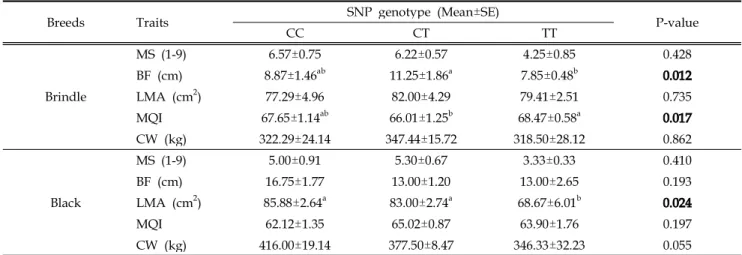
Table 5. Least square mean and standard error for economic traits of the MC4Rin brindle and black cattle
Breeds Traits SNP genotype (Mean±SE)
P-value
CC CT TT
Brindle
MS (1-9) 6.57±0.75 6.22±0.57 4.25±0.85 0.428
BF (cm) 8.87±1.46ab 11.25±1.86a 7.85±0.48b 0.012
LMA (cm2) 77.29±4.96 82.00±4.29 79.41±2.51 0.735
MQI 67.65±1.14ab 66.01±1.25b 68.47±0.58a 0.017
CW (kg) 322.29±24.14 347.44±15.72 318.50±28.12 0.862
Black
MS (1-9) 5.00±0.91 5.30±0.67 3.33±0.33 0.410
BF (cm) 16.75±1.77 13.00±1.20 13.00±2.65 0.193
LMA (cm2) 85.88±2.64a 83.00±2.74a 68.67±6.01b 0.024
MQI 62.12±1.35 65.02±0.87 63.90±1.76 0.197
CW (kg) 416.00±19.14 377.50±8.47 346.33±32.23 0.055
MS, marbling score; BF, backfat thickness; LMA, longissimus muscle area; MQI, meat quantity index; CW, carcass weight
총 125마리의 칡소와 흑우에서 MC4R SNP C1786T와 주 요 도체형질에 미치는 영향을 확인하기 위하여 연관분석을 하였고 그 결과를 Table 5에 제시하였다.
칡소의 SNP과 도체형질간의 연관분석 결과, 등지방두께 (BF), 육량지수(MQI)와 유의적인 차이를 확인하였다 (p<0.05). 등지방 두께(BF)는 CT genotype에서 평균 11.25 cm로 다른 유전자형들에 비해 높게 나타났으며, CC 8.87cm, TT 7.85 cm 순이었다. 육량지수(MQI)에서는 TT genotype이 평균 68.47로 나타나 CT 66.01, CC 67.65보다 높았다. 칡소에서의 결과와는 다르게 흑우에서는 등심단면 적(LMA)에서 유의적인 차이를 보였으며, CC genotype에 서 평균 85.88 cm2로 CT 83 cm2, TT 68.67 cm2 에 비해 높 았다(p<0.05). 유의적인 차이는 나타나지 않았지만, 칡소에
서 등심단면적(LMA)과 도체중(CW)은 CT genotype에서 높은 평균치를 보였고, 근내지방(MS)은 CC genotype에서 높은 평균치를 보였다. 흑우 또한 유의적인 차이는 나타나 지 않았지만, 근내지방(MS)와 육량지수(MQI)가 CT genotype에서 높은 평균치를 보였고, 등지방두께(BF)와 도 체중(CW)은 CC genotype에서 높은 평균치가 나타났다.
(Seong 등, 2012)의 선행연구에서 한국을 대표하는 한우 (황우)에서 MC4R gene과의 경제형질(BF, MS)과의 연관성 을 확인하였다. 하지만, 칡소와 흑우에서 MC4R gene의 SNP과 경제형질과의 연관성은 본 실험에서 처음으로 보고 하는 것이다. 따라서 본 연구의 결과는 MC4R gene SNP C1786T 이 칡소에서 등지방두께(BF)와 연관성을 발견할 수 있었으며, 흑우에서는 등심단면적(LMA)과 연관성을 확인
[Provider:earticle] Download by IP 118.70.52.165 at Monday, December 20, 2021 8:01 PM
www.earticle.net
할 수 있었다. 현재 칡소와 흑우는 복원사업이 진행 중이며, 또한 일정 지역에서만 사육되고 있어서 sample 확보에 큰 어려움이 있다. 때문에 추후 더욱 많은 개체군을 통한 추가 적인 경제형질과의 연관성을 찾는 연구가 기대되며,MC4R 유전자 SNP 1786C>T는 칡소 및 흑우를 선발함에 있어 중 요한 후보유전자 마커로 사용될 것으로 사료된다.
Ⅳ. 요약
MC4R(melanocortin-4 receptor)은 에너지 중심 조절에 중요한 G-protein 쌍의 receptor를 중심으로 발현하며 에너 지 항상성과 음식 섭취의 조절에 중추적인 역할을 하고 있 으며, 또한 사료 섭취량과 체중 그리고 체 구성물질 사이에 연관을 가지고 있는 것으로 보고되고 있다. 본 연구는 기존 에 보고된 MC4R 유전자 SNP C1786T와 한우의 경제형질 과의 연관성을 기초로 PCR-RFLP를 이용하여 칡소와 흑우 에서 경제형질과의 연관성을 분석하였다.
총 125마리 칡소와 흑우에서 MC4R 유전자 SNP C1786T 을 genotyping 하였으며, CC, CT, TT의 유전자형을 확인하 였다. 칡소의 유전자형(genotyping) 출현빈도는 CC가 45.19%로 가장 높았고 CT 42.31%, TT 12.50%였으며, C와 T의 allele의 비율은 각각 0.663%, 0.337%였다. 흑우의 genotyping 결과는 CT에서 47.60%로 가장 높은 빈도를 보 였으며, CC 38.10%, TT 14.30% 패턴을 보였고, allele의 비 율은 C allele 0.619, T allele 0.381로 나타났다. 경제형질과 연관성을 분석한 결과 칡소에서 BF(backfat thickness) MQI(meat quantity index)와의 연관성을 나타냈으며, 등지 방두께(BF)에서 CC genotype이 평균 8.87 ㎝로 가장 높았 고 육량지수(MQI)에서는 TT genotype에서 평균 68.47로 가장 높은 수치를 보였다. 본 연구의 결과가 칡소와 흑우에 서 경제적 형질을 선발하는 마커로 사용되기까지 추후 더 욱 많은 개체군을 통한 연구가 요구되나 MC4R gene C1786T SNP은 칡소와 흑우의 도체형질을 위한 선발마커로 서 활용할 수 있을 것으로 사료되어 진다.
사사
본 연구는 농촌진흥청 차세대 바이오그린21 사업(과제번 호: PJ008196, PJ008028)으로 이루어 졌으며 이에 감사드립 니다.
Ⅴ. References
1. Andersson, L., Haley, C. S., Ellegren, H., Knott, S. A., Johansson, M., Andersson, K., Andersson-Eklund, L., Edfors-Lilja, I., Fredholm, M., Hansson, I. and Lundstrom, K. 1994. Genetic mapping of quantitative trait loci for growth and fatness in pigs. Science Mar.
25;263(5154):1771.
2. Beever, J. E., George, P. D., Fernando, R. L., Stormont, C. J. and Lewin, H. A. 1990. Associations between genetic markers and growth and carcass traits in a parental halfsib familiy of Angus cattle. J. Anim. Sci.
68:337.
3. Bishop, M. D., Hawkins, G. A. and Keeler, C. L. 1995.
Use of DNA markers in animal selection.
Theriogenology. 43:61.
4. Bovenhuis, H., van Arendonk, J. A. M., Davis, G., Elsen, J. -M., Haley, C. S., Hill, W. G., Baret, P. V., Hetzel, D. J. S. and Nicholas, F. W. 1997. Detection and mapping of quantitative trait loci in farm animals.
Livestock Production Science. 52:135.
5. Cheoung, H. S., Yoon, D., Kim, L. H., Park, B. L., Lee, H. W., Han, C. S., Kim, E. M., Cho, H., Chung, E. R., Cheong, I. and Shin, H. D. 2007. Titin-cap (TCAP) polymorphisms associated with marbling score of beef.
Meat Sci. 77:257-263.
6. Cho, S., Park, T. S., Yoon, D., Cheong, H. S., Namgoong, S., Park, B. L., Lee, H. W., Han, C. S., Kim, E. M., Cheong, I. C., Kim, H. and Shin, H. D.
2008. Identification of genetic polymorphisms in FABP3 and FABP4 and putative association with back fat thickness in Korean native cattle. BMB reports.
41:29-34.
7. De Vol, D. L. E., Mckeith, F. K., Bechtel, P. I., Novakofski, J., Shanks, R. D. and Carr, T. R. 1988.
variation in composition and palatability traits and relationships between muscle characteristics and palatability in a random sample of pork carcasses. J.
Anim. Sci. 66:385-395.
8. Farooqi, I. S., Keogh, J. M,, Yeo, G. S., Lank, E. J., Cheetham, T. and O'Rahilly, S. 2003. Clinical spectrum of obesity and mutations in the melanocortin 4
[Provider:earticle] Download by IP 118.70.52.165 at Monday, December 20, 2021 8:01 PM
www.earticle.net
receptor gene. N. Engl. J. Med. 348:1085-1095.
9. Gantz, I., Miwa, H., Konda, Y., Shimoto, Y., Tashiro, T., Watson, S. J., DelValle, J. and Yamada, T. 1993.
Molecular cloning, expression, and gene localization of a fourth melanocortin receptor. J. Biol. Chem. 268:
15174-15179.
10. Huszar, D., Lynch, C. A., Fairchild-Huntress, V., Dunmore, J. H., Fang, Q., Berkemeier, L. R., Gu, W., Kesterson, R. A., Boston, B. A., Cone, R. D., Smith, F.
J., Campfield, L. A., Burn, P. and Lee, F. 1997.
Targeted disruption of the melanocortin-4 receptor results in obesity in mice. Cell. 10:131-141.
11. Ho, G. and MacKenzie, R. G. 1999. Functional characterization of mutations in melanocortin-4 receptor associated with human obesity. J. Biol.
Chem. 274:35816-35822.
12. Kim, K. S., Reecy, J. M., Hsu, W. H., Anderson, L. L.
and Rothschild, M. F. 2004. Functional and phylogenic analyses of a melanocortin-4 receptor mutation in domestic pig. Domestic Animal endocrinology. 26:75-86.
13. Kim, K. S., Larson, N. and Rothschild, M. F. 1999.
Rapid Communication : linkage and physical mapping of the porcine melanocortin 4 receptor (MC4R) gene. J. Anim. sci. 78:791-792.
14. Liu, H., Tian, W., Zan, L., Wang, H. and Cui, H.
2010. Mutation of MC4R gene and its association with economic traits in Qinchun cattle. Mol. Biol. Rep.
37(1):535-540.
15. Lee, J. Min., Song, G. C., Lee, J. Y., and Kim, Y. B.
2007. Analysis of single nucleotide polymorphisms of leptin gene in Hanwoo (Korean Cattle). J. Anim. Sci.
49(3):295-302.
16. Lee, H. J., Lee, S. H., Cho, Y. M., Yoon, H. B., Jeon, B. K., Oh, S. J., Kwon, M. S., and Yoon, D. H. 2004.
Association between the polymorphism on intron 5 of the lipoprotein lipase gene and carcass traits in Hanwoo (Korean cattle). J. Anim. Sci. 46:947-956.
17. Kim, N. K., Kim, G. S., Jung, Y. S., Moon, H. J., Cho, Y. M., and Yoon, D. H. 2009. Association study between polymorphisms of inositol 1,4,5-triphosphate receptor type 1(IP3R1) gene and carcass traits in
Korean cattle (Hanwoo). J. Anim. Sci. 51(4):289-294.
18. Korea institute for animal products quality evaluation.
Available: http://www.apgs.co.kr/
19. Seong, J., Suh, D., Park, K., Lee, H. and Kong, H.
2012. Identification and analysis of MC4R polymorphisms and their association with economic traits of korean cattle (Hanwoo). Mol. Biol. Rep. 39(4):
3597-601.
20. Qiu, X., Li, N., Deng, X., Zhao, X., Meng, Q. and Wang, X. 2006. The single nucleotide polymorphisms of chicken melanocortin-4 receptor (MC4R) gene and their association analysis with carcass traits. Sci.
China C. Life Sci. 49:560-566.
21. Zhang, C. L., Wang, Y. H., Chen, H., Lan, X. Y., Lei, C. Z. and Fang, X. T. 2009. Association between variants in the 50-untranslated region of the bovine MC4R gene and two growth traits in Nanyang cattle.
Mol. Biol. Rep. 36:1839-1843.
(투고일: 2013.02.01. 수정일: 2013.03.19. 판정일: 2013.03.20.)
[Provider:earticle] Download by IP 118.70.52.165 at Monday, December 20, 2021 8:01 PM