.1)
† To whom correspondence should be addressed.
Wetlands Research Team, Wetland Center, National Institute of Ecology, Korea E-mail: [email protected]
∙ Kwang-Jin Cho Wetlands Research Team, Wetland Center, National Institute of Ecology, Korea / Team Manager ([email protected])
∙ Jeoncheol Lim Wetlands Research Team, Wetland Center, National Institute of Ecology, Korea / Senior Researcher ([email protected])
∙ Changsu Lee Wetlands Research Team, Wetland Center, National Institute of Ecology, Korea / Junior Researcher ([email protected])
∙ Yeounsu Chu Wetlands Research Team, Wetland Center, National Institute of Ecology, Korea / Junior Researcher ([email protected])
습지보호지역 버드나무림의 식물군락 특성
조광진・임정철・이창수・추연수
†
국립생태원 습지센터
Characteristics of Plant Community of Willow Forest in the Wetland Protection Areas of Inland Wetlands
Kwang-Jin Cho・Jeoncheol Lim・Changsu Lee・Yeounsu Chu † Wetlands Research Team, Wetland Center, National Institute of Ecology, Korea
(Received : 05 April 2021, Revised : 08 June 2021, Accepted : 08 June 2021)요 약
내륙습지에서 생태적, 환경적으로 중요한 역할을 하고 생태복원의 주요 재료가 되는 버드나무림에 대한 식물사회학적 연구가 수행되었다. 습지보호지역에 발달하는 버드나무림을 대상으로 Z.-M.(Zürich-Montpellier)학파의 방법에 따 라 총 61개의 식생자료가 수집되었고 식물군락과 종조성적 특성이 밝혀졌다. 총 237분류군을 포함한 9개의 식물군락 이 구분되었다. 높은 상대기여도(r-NCD) 값을 나타내는 버드나무류는 키버들, 왕버들, 선버들, 갯버들, 버드나무로 확인되었다. 종조성 분석결과, 벼과, 국화과, 미나리과, 마디풀과, 콩과 순으로 출현빈도가 높게 나타났으며, 생활형은 일년생식물(휴면형), 단립식물(지하기관형), 중력산포형(산포방법), 직립형(생육형)을 가지는 식물종의 출현율이 높아 Th-R
5
-D4
-e로 특징지어졌다. 귀화식물은 12과 24종, 생태계교란 생물은 3과 4종이 관찰되었으며, 귀화율은 10.1%, 교란지수는 41.4%로 분석되었다. NMDS 서열법(non-metric multidimensional scaling)에 의한 식물종과 조사지점 간의 경향성 분석 결과, 조사지점의 해발고도와 습지의 유형이 식물군락의 공간적 분포를 결정하는 주요한 요소인 것 으로 밝혀졌다. 비교적 해발고도가 높은 산지형 습지에서 다양성 지수와 균등도 지수가 높게 나타났으며, 해발고도가 낮은 하천형과 호수형 습지에서는 교란지수, 귀화율, 일년생식물 출현비율이 높았다.핵심용어 : 식물사회학적 조사, 식물군락, 상대기여도, 습지보호지역, 버드나무림
Abstract
In wetland protection areas, a phytosociological research was conducted on willow forests, which plays an important ecological and environmental role and is the main material for ecological restoration. A total of 61 relevés were collected according to the Z-M(Zürich-Montpellier) school's method and the characteristics of plant communities and the composition of the species were identified. A total of 9 plant communities including 237 taxa were differentiated. Willow species showing the high r-NCD(relative net contribution degree) value in study areas were Salix koriyanagi, Salix chaenomeloides, Salix triandra subsp. nipponica, Salix gracilistyla and Salix pierotii. Poaceae was the most diverse in species, followed by Asteraceae, Apiaceae, Polygonaceae and Fabaceae. Life form type of willow forests in wetland protection areas was determined to be Th(therophytes)-R
5
(non-clonal form)-D4
(clitochores)-e(erect form) type. The naturalized plants and invasive alien species were identified as 24 taxa and 4 taxa, respectively. Naturalized and disturbance indices were 10.1% and 41.4%, respectively.The results of the site-species ordination by Non-Metric Multidimensional Scaling(NMDS), wetland types and altitude gradient were the main ecological factors determining the spatial distribution of plant communities. Diversity index and evenness index were high in mountainous palustrine wetlands with relatively high altitude, and the disturbance index, naturalized index and appearance rate of annual plant were high in riverine and lacustrine wetlands with low altitude.
Key words : Phytosociological research, Plant community, Relative net contribution degree, Wetland protection area, Willow forest
1. 서 론
버드나무류(
Salix
spp.)는 홍수와 침식, 퇴적의 교란을 겪는 서식지에서 성장할 수 있는 많은 특성을 지니고 있으며 (Karrenberg et al., 2002) 특히 퇴적물을 빠르게 안정화시킬 수 있는 거대한 뿌리 시스템의 활발한 성장률과 생산성 (Grissinger and Bowie, 1984; Hupp, 1992; Van Splunder et al., 1996; Shields et al., 1995; Anonymous, 2005)으로 하천 과 같은 유수역 및 유수역과 인접한 배후습지에 군락을 형성 한다(Lee, 2004; Kim et al., 2009).국내에는 37종의 버드나무류가 분류되어 있으며(BKP, 2021) 하변 연목림에는 하천유역, 입지 안정성, 수위 등에 따 라 버드나무류가 우점하는 13개의 식물군락이 발달하고 있다 (Lee, 2004). 이러한 버드나무류의 식물군락은 곤충, 어류, 포 유류 등 다양한 분류군의 서식지가 되며(Lee et al., 2007;
Park et al., 2013; Kim et al., 2017) 영양번식이 가능하고 척 박한 토양에서도 가지와 뿌리의 생장이 빨라 신속히 토양을 안정화하는 특성이 있어 하천복원을 위한 주요 식물재료가 된 다(Bentrup and Hoag, 1998; Kim and Lee, 1998).
국내 버드나무류에 생태적 연구는 간척지, 매립지, 하천복 원을 위한 재료로서의 활용성을 목적으로 다양한 환경 속에서 나타나는 생육특성을 규명하기 위한 연구(Koo et al., 2006;
Yeo et al., 2007; Yeo et al., 2010; Kim et al., 2014)와 현장 조사를 기반으로 특정습지에 발달하고 있는 버드나무류의 공 간적 분포, 군락특성 등에 관한 연구가 이루어져 있다(Chun et al., 1998; Lee, 2004; Song, 2001; Song, 2008; Park et al., 2013). 다만, 인위적인 영향으로 습지가 소실되고 생태계 의 기능이 저하되고 있는 상황(Yi and Choi, 2001; Shim et al., 2019)에서 습지보호지역에 분포하고 있는 버드나무류로 대표되는 하변 연목림에 대한 생태적 연구는 미진한 실정이다.
본 연구에서는 습지보호지역에 발달하고 있는 버드나무림 을 대상으로 군락유형을 구분하고 종조성적 특성을 밝혀 보호 지역 관리를 위한 기초자료를 제공하고자 한다.
2. 연구방법
2.1 군락분류
습지보호지역에 발달하고 있는 버드나무림의 군락특성을 파악하기 위해 습지보전법 따라 수행된 습지보호지역 정밀조 사 식생자료(ME, 2011b; NIER, 2016, 2018; NIE, 2019)를 활용하였다. 식생조사는 식물사회의 종조성을 강조하는 Z.-M.학파의 방법에 따랐으며(Braun-Blanquet, 1964; Kim and Lee, 2006) 피도계급은 수리분석이 용이하도록 1~9개 등 급의 변환통합우점도(Westhoff and van der Maarel, 1973)를 활용하였다(ME, 2011a). 식물군락을 구성하는 출현 식물종의 기여도는 양적, 질적 평가를 통합하여 백분율로 환산한 상대기 여도(r-NCD; relative net contribution degree)로 표기하였다 (Kim and Manyko, 1994; Kim and Lee, 2006).
군락분류를 위해 R 환경(R Core Team, 2021)의 Vegan package (Oksanen et al., 2021)에서 ‘hclust’ 함수를 사용하 여 계층적 군집분석(hierarchical cluster analysis)을 수행하였 다(R Core Team, 2021). 군락별 유사도 거리는 ‘Horn’ 계수 를 이용하여 비가중산술결합(unweighted pair group method using arithmetic algorithm, UPGMA)방식으로 분류하였다 (Sneath and Sokal, 1973).
2.2 생태식물상 분석
분류된 식물군락에서 출현한 식물종은 국가생물종목록(BKP, 2021)에 따라 정리하였고 귀화식물은 Lee et al.(2011)과 Ryu et al.(2017)을 참고하였다. 버드나무림을 구성하는 식물종의 생 태적 특성을 파악하고자 생활형을 분석하였다. 생활형은 Lee(1996)을 참고하여 휴면형, 번식형, 생육형으로 정리하였다.
식물군락별 교란강도를 확인하고자 교란지수(Di, disturbance index, Benabdelmoumence et al., 2014; Kim et al., 2019a) 와 귀화율(Ni, naturalized index, Numata, 1975)을 분석하였 다. 교란지수의 산출식은 (Ch
i
+Thi
)/Si
×100으로 i지역의 지표 식물 종수(Chi
)와 일년생식물 종수(Thi
)의 합을 i지역에 출현 한 식물종수(Si
)로 나누어 백분율로 나타내었다. 귀화율은 Si
/Ni
×100으로 i지역에 출현한 귀화식물 종수(Si
)를 i지역에 출 현한 식물종수(Ni
)로 나누어 백분율로 산출하였다. 교란지수 분 석 시 지표식물과 일년생식물은 Lee(1996)의 휴면형(dormancy form)을 참고하였다.각 조사지점에서 식물군락의 종다양성을 분석하기 위하여, 종 별 피도값을 사용하여 다양도 지수 (H'; Shannon and Weaver, 1949)와 종균등도 지수 (E'; Pielou, 1975)를 산출하였다. 또한, 식물군락의 종조성과 조사지점별 관계를 서열법(ordination)으 로 분석하기 위하여 R 환경(R Core Team, 2021)의 Vegan package(Oksanen et al., 2021)에서 ‘metaMDS’ 함수를 사용하 여 비계량형다차원척도법(non-metric multidimensional scaling, NMDS)을 실시하였다(Kruscal, 1964). 군락구조의 조사지점 사 이 거리는 Bray-Curtis 방식(Bray and Curtis, 1957)으로 산출 하였다. 식물종 특성 및 환경 요인과 2차원으로 도식화된 NMDS 결과의 상관관계를 분석하기 위하여 Vegan package(Oksanen et al., 2021)의 ‘envfit’ 함수를 사용하여 상관 계수와 유의 수준을 산출하였다.
3. 결과 및 고찰
3.1 군락분류
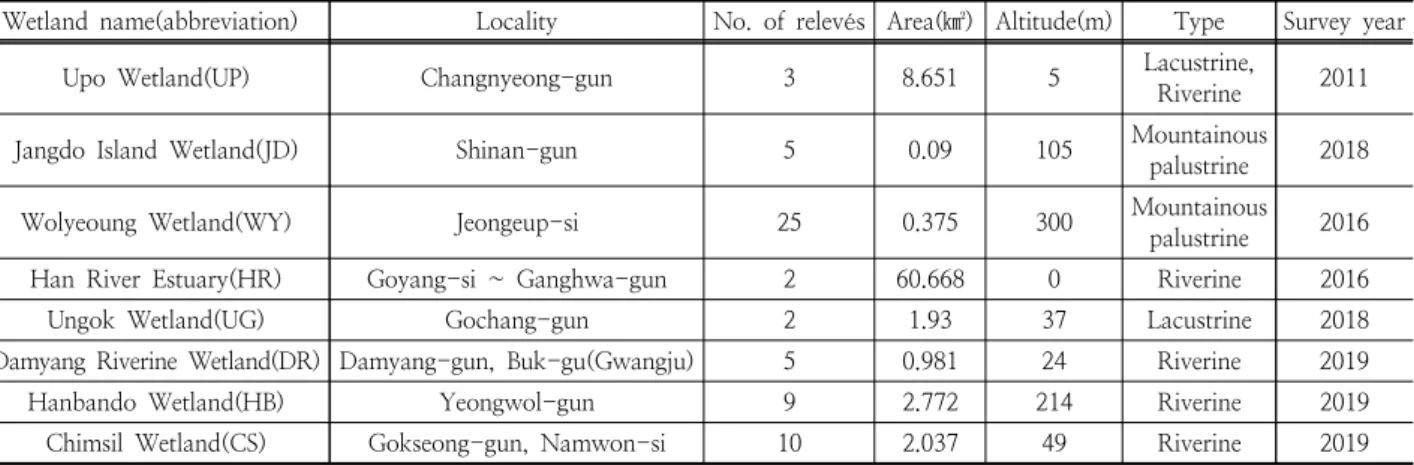
연구 대상지역은 환경부 지정 습지보호지역 25개소 중 우포 늪, 한강하구, 장도습지, 한반도습지, 침실습지, 담양습지, 운곡 습지, 영월습지 8개소로 버드나무림과 관련한 61개의 식생자 료를 활용하였다(Table 1). 이들 식생조사표를 군집분석한 결과, 키버들, 왕버들, 선버들, 갯버들, 버드나무가 우점하는 9개의 식물군락(키버들군락, 선버들-쇠별꽃군락, 버드나무- 융단사초군락, 선버들-산조풀군락, 왕버들-선버들군락,
Fig. 1. Cluster dendrogram classified 61 sampled stations into 9 plant communities(Ⅰ: Sk, Ⅱ: SaSt, Ⅲ: CmSp, Ⅳ: CeSt, Ⅴ: StSc,
Ⅵ: PaSc, Ⅶ: MvSp, Ⅷ: PtSp Ⅸ: Sg). The abbreviation for plant community is shown in table 4.
왕버들-갈풀군락, 버드나무-나도바랭이새군락, 버드나무-고 마리군락, 갯버들군락)이 구분되었다(Fig. 1 and Appendix 1).
키버들군락(Ⅰ: Sk,
Salix koriyanagi
community)은 영월 한반도습지에서 확인되었고 3개 지점에서 총 37분류군(평균 17.3분류군)이 출현하였다. 주로 자갈이 섞인 모래가 퇴적된 입지의 수변부를 따라 띠형태로 분포하고 있었다. 2층구조로 서 수위가 증가함에 따라 범람과 일시적인 정체가 일어나는 입지에 발달하였고 유속의 영향을 더 받는 입지에는 갯버들 (r-NCD 25.00, 이하 r-NCD 생략)과 달뿌리풀(25.00)이 나 타났다.선버들-쇠별꽃군락(Ⅱ: SaSt,
Stellaria aquatica
-Salix triandra
subsp.nipponica
community)은 한반도습지 내 집중 강우 시 범람을 경험하는 하천 고수부지부의 점토와 가는 모래가 섞인 입지에서 관찰되었다. 5개 지점에서 총 62분류군(평균 24.0분 류군)이 확인되었고 선버들과 쇠별꽃에 의해 구분되었다. 본 군락의 진단종인 쇠별꽃은 간섭빈도가 높은 밭, 과수원에 고빈 도로 출현하는 식물로서(Kim et al., 2019b; Lee et al., 2015;Lee et al., 2017), 분포입지가 평창강과 주천강의 합류부의 특 성과 강우로 인해 물리적 변화를 빈번하게 겪는 장소라는 것 을 간접적으로 나타낸다고 볼 수 있다. 3층구조로 교목층에 선 버들이 우점하고 버드나무가 혼생하고 있었고 초본층의 우점 식물은 장마 전후로 종조성의 변화가 관찰되었다. 장마 이전에 는 개밀(57.89), 융단사초(12.63)와 같은 벼과 식물이 고빈도 로 출현하였고 장마 이후에는 생태계교란 생물인 가시박 (60.53), 환삼덩굴(47.37) 등의 덩굴성 식물이 넓은 면적을 차 지하고 있어 이에 대한 관리가 필요해 보였다(NIE, 2019).
버드나무-융단사초군락(Ⅲ: CmSp,
Carex miyabei
-Salix pierotii
community)은 교목층의 버드나무와 초본층 융단사초 에 의해 구분되며 관목층에는 뽕나무(44.44), 초본층에는 환삼 덩굴(88.89), 개밀(66.67), 애기똥풀(33.33) 등이 빈도 높게 관 찰되었다. 한반도습지 고수위대의 두텁게 퇴적된 고운 모래입 지에 발달하고 있었다. 제방권 가까이에 위치하면서 토지이용 에 따라 서식처가 변형되어 몇몇 장소에 잔존하는 식물군락으 로 기재되었다(NIE, 2019).선버들-산조풀군락(Ⅳ: CeSt,
Calamagrostis epigeios
-Salix triandra
subsp.nipponica
community)은 한강하구의 장항습 지 내 유속이 느린 고수부지부의 퇴적입지에서 관찰되었다. 본 군락은 2개 지점에서 총 21분류군(평균 12.5분류군)이 확인되 었고 선버들과 산조풀에 의해 구분되었다. 교목층에 버드나무 가 혼생하고 들깨(62.50), 며느리배꼽(43.75), 강아지풀(21.88) 등의 일년생초본이 빈도 높게 출현하였다. 집중 강우 시 침수 를 경험하며 주변 경작활동에 의해 물리적인 교란을 받는 것 으로 보인다.왕버들-선버들군락(Ⅴ: StSc,
Salix triandra
subsp.nipponica
-Salix chaenomeloides
community)은 우포늪, 침실 습지, 담양습지, 운곡습지에서 관찰되었다. 16개 지점에서 총 88분류군(평균 14.1분류군)이 조사되었고 2~3층 구조를 나타 내었다. 왕버들과 선버들에 의해 구분되며 환삼덩굴(28.76), 버 드나무(22.48), 물억새(18.82), 갈풀(16.93), 달뿌리풀(13.33), 쇠무릎(11.76) 등이 높은 빈도로 출현하였다. 본 군락은 수변 부, 고수부지부, 하중도 등 넓은 영역에 걸쳐 발달하고 있으며 선버들, 왕버들을 표징종으로 하고 갈풀을 구분종으로 하는 선 버들-왕버들군집과 분포입지가 유사하였다(Lee, 2004).Table 1. The status of the study wetlands
Wetland name(abbreviation) Locality No. of relevés Area(㎢) Altitude(m) Type Survey year
Upo Wetland(UP) Changnyeong-gun 3 8.651 5 Lacustrine,
Riverine 2011
Jangdo Island Wetland(JD) Shinan-gun 5 0.09 105 Mountainous
palustrine 2018
Wolyeoung Wetland(WY) Jeongeup-si 25 0.375 300 Mountainous
palustrine 2016
Han River Estuary(HR) Goyang-si ~ Ganghwa-gun 2 60.668 0 Riverine 2016
Ungok Wetland(UG) Gochang-gun 2 1.93 37 Lacustrine 2018
Damyang Riverine Wetland(DR) Damyang-gun, Buk-gu(Gwangju) 5 0.981 24 Riverine 2019
Hanbando Wetland(HB) Yeongwol-gun 9 2.772 214 Riverine 2019
Chimsil Wetland(CS) Gokseong-gun, Namwon-si 10 2.037 49 Riverine 2019
왕버들-갈풀군락(Ⅵ: PaSc,
Phalaris arundinacea
-Salix chaenomeloides
community)은 섬진강 침실습지의 전역에 분 포하는 대표식생으로 왕버들, 갈풀, 큰사상자에 의해 구분되었 다. 4개 지점에 총 33분류군(평균 14.5분류군)이 확인되었고 2~3층 구조를 나타내었다. 아교목층의 발달이 빈약하고 초본 층에 쇠별꽃(19.29), 갈퀴덩굴(17.14), 소리쟁이(15.00), 살갈퀴 (12.86) 등이 높은 빈도로 출현하였다. 본 군락은 Lee(2004)가 기재한 왕버들-갈풀군집의 분포입지와 출현종이 유사하였으나 표징종으로서 제시하고 있는 버드나무는 관찰되지 않았다.버드나무-나도바랭이새군락(Ⅶ: MvSp,
Microstegium vimineum
-Salix pierotii
community)은 장도습지의 습지 중 심부를 기준으로 산지 인접부까지 넓게 분포하고 있었다. 3층 구조로서 아교목층과 관목층의 버드나무와 초본층의 나도바랭 이새에 의해 구분되며 질소성분이 많은 곳에서 나타나는 고마 리(41.86), 쑥(30.23), 미꾸리낚시(34.88), 흰꽃여뀌(32.56) (Choung and Lee, 2001, Lee, 2004, Lim et al., 2005)와 산 지 임연군락을 대표하는 찔레나무(37.21), 칡(16.74), 인동 (11.16), 예덕나무(9.77), 댕댕이덩굴(8.37) 등이 혼생하고 있 었다(Jung and Kim, 1998).버드나무-고마리군락(Ⅷ: PtSp,
Persicaria thunbergii
-Salix pierotii
community)은 월영습지의 연목림을 대표하는 식물군 락으로 확인되었다. 23개 지점에서 총 105분류군(평균 16.7분 류군)이 확인되었다. 교목층 또는 아교목층의 버드나무와 초본 층의 고마리에 의해 구분되며 미나리(15.60), 쇠뜨기(12.17), 삿갓사초(10.22) 등이 빈도 높게 출현하였다. 토양환경은 모래 또는 실트의 함량이 높은 입지에 분포하는 경향이 있었다.갯버들군락(Ⅸ: Sg,
Salix gracilistyla
community)은 정읍 월영습지의 해발고도 약 290m 산지 정상부 곡저분지에 좁은 면적으로 분포하고 있었다. 2개 지점에 총 14분류군(평균 9.0 분류군)의 식물종이 관찰되었다. 본 군락은 갯버들로 특징지어 지며 고마리(41.18), 미나리(41.18), 바랭이새(35.29) 등이 높 은 상대기여도를 나타내었다. 갯버들은 하천 상류역의 고수부 지와 수변부의 모래와 자갈이 혼재하는 입지에 발달하는 연목 림을 대표하며(Lee, 2004; Song, 2001) 월영습지와 같이 휴경 작지에 형성된 묵논형태의 산지습지에도 우점하는 경향이 있 다(Kim, 2009).3.2 생태식물상
습지보호지역의 버드나무림에서는 총 70과 170속 237분류 군(미동정 5분류군 제외)이 확인되었다. 버드나무림 내 가장 빈번하게 출현한 과(family)는 벼과(12.7%, 30분류군)로 확인 되었으며 다음은 국화과 8.9%(21분류군), 마디풀과 5.5%(13 분류군), 미나리과 5.5%(13분류군), 콩과 5.1%(12분류군) 등 순으로 나타났다(Table 2). 생활형은 Th-R
5
-D4
-e으로 특징 지어졌고 밭경작지 주변부에 생육하는 식물의 생활형과 동일 하였다(Kim et al., 2015). 세부적으로 휴면형(Dormancy form)은 일년생식물(therophyte)이 86분류군(36.3%)이며, 번 식형 중 지하기관형(radicoid form)은 지하나 지상으로 기는 줄기, 뿌리 등과 같은 연결체를 만들지 않는 R5
식물이 132분Table 2. The main families of willow forest in the wetland protection areas
Family No. of taxa Ratio(%)
Poaceae 벼과 30 12.7
Asteraceae 국화과 21 8.9
Apiaceae 미나리과 13 5.5
Polygonaceae 마디풀과 13 5.5
Fabaceae 콩과 12 5.1
Rosaceae 장미과 11 4.6
Cyperaceae 사초과 9 3.8
Lamiaceae 꿀풀과 9 3.8
Brassicaceae 십자화과 8 3.4
Salicaceae 버드나무과 8 3.4
Others(60 families) 103 43.3
류군(55.7%), 산포방법(disseminule form)은 중력산포형(D
4
) 이 102분류군(43.1%), 생육형(Growth form)은 직립형(e)이 85분류군(35.9%)로 분석되었다(Table 3).귀화식물은 미국가막사리, 선개불알풀, 망초, 갓 등 12과 24 종, 생태계교란 생물은 돼지풀, 단풍잎돼지풀, 가시박, 환삼덩 굴로 3과 4종이 관찰되었다(Appendix 1). 귀화율은 10.1%, 교란지수는 41.4%로 분석되었다(Table 4). 귀화율은 인위적인 간섭이 매우 빈번한 밭(18.4%~23.7%, Cho et al., 2014;
Cho et al., 2015; Kim et al., 2020), 과수원(18.2%, Kim et al., 2019a)보다는 낮게 분석되었으나 자연성이 높은 국립공원 (3.8%~7.2%, Lee, 2020; Lim et al., 2006a; Jang et al., 2007), 산림유전자원보호지역(2.3%~8.5%, Byeon et al., 2013; Byeon et al., 2014; Byeon et al., 2017) 보다는 높게 나타났다. 교란지수는 밭 주변부가 55.0%(Kim et al., 2015), 논 58.6%(Kim et al., 2019a), 과수원 47.0%(Kim et al., 2019a)인 것을 고려하면 습지보호지역 내 버드나무림은 귀화 율 분석결과와 유사하게 인위적인 간섭이 빈번한 경작지보다 는 서식처가 안정되어 있다고 판단되었다. 습지보호지역은 농 경지 및 시가지와 같은 주변 토지이용에 의한 교란 등 인간의 접근이 용이하며, 홍수에 의한 범람 등 물리·화학적 영향을 많 이 받는다(Cho et al., 2020). 이로 인해 하층 식생의 교란이 빈번하여 식생발달 초기에 적응성이 높은 일년생식물과 귀화 식물의 출현율이 산림보다 상대적으로 높은 것으로 보인다.
귀화율을 식물군락별로 살펴보면 왕버들-갈풀군락이 21.2%
로 가장 높았고 다음으로 왕버들-선버들군락(17.0%), 선버들 -쇠별꽃군락(14.5%) 순이었으며 산지습지에 분포하는 갯버들 군락과 버드나무-나도바랭이새군락에서는 귀화식물이 관찰되 지 않았다. 귀화식물은 도로, 경작지와 같이 간섭과 교란이 빈 번한 곳에서 출현율이 높고 자연식생에서는 출현율이 낮은 점 을 고려할 때, 습지보호지역 내 귀화식물의 출현빈도가 높은 식물군락의 관리를 위해 귀화식물을 물리적으로 제거하는 것 이 가장 효과적이지만 자연식생 복원차원에서 장기적인 관리 방안을 모색하는 것도 중요하다고 할 수 있다(Lim and Hwang, 2006b; Lim et al., 2009). 교란지수 또한 귀화율과
유사한 양상을 보였다. 다만 선버들-산조풀군락의 경우, 귀화 식물의 출현빈도는 낮았으나 일년생식물의 출현빈도가 높아 귀화율과 비교해 교란지수가 높게 나타났다. 식물상 정보를 토 대로 서식처의 안정성을 간접적으로 평가할 경우 귀화식물, 식 물의 생활형 등을 종합적으로 고려할 필요가 있었다.
3.3 군락특성
습지보호지역에서 조사된 식생자료를 바탕으로 군락특성을 비교하기 위하여 비모수다차원척도법(NMDS)을 활용하였다 (Kruskal, 1964) (stress value 0.1842; Fig. 2). 1축의 우측으 로는 월영습지(WY)와 신안 장도습지(JD)에서 조사된 방형구
가 배열되었으며 버드나무-고마리군락(PtSp)과 버드나무-나도 바랭이새군락(MvSp)으로 분류되었다(Fig. 2a). 버드나무(Sa.pi), 고마리(Pe.th), 미나리(Oe.ja), 갈대(Ph.au), 골풀(Ju.de), 쇠뜨기 (Eq.ar), 찔레나무(Ro.mu), 돌콩(Gl.so) 등의 식물종이 위치하 였다(Fig. 2b). 1축의 좌측으로는 침실습지(CS), 담양하천습지 (DY), 우포늪(UP), 한반도습지(HB) 등에서 조사된 방형구가 배열되었으며, 왕버들-선버들군락(StSc), 왕버들-갈풀군락 (PaSc), 선버들-쇠별꽃군락(SaSt), 선버들-산조풀군락(CeSt) 으로 분류되며 우측에 비해 넓게 분산된 것을 확인할 수 있었 다. 이에 따라 왕버들(Sa.ch), 선버들(Sa.tr), 환삼덩굴(Hu.ja), 소리쟁이(Ru.cr), 갈풀(Ph.ar), 물억새(Mi.sa), 개밀(El.ts), 쇠
Table 3. Life form of vascular plants in willow forest of the wetland protection areas
Life form Types
DoF * Perennial Annual
Ch G H HH M MM N Th HH(Th)
No. of taxa 12 35 38 23 13 14 16 74 12
Ratio (%) 5.1 14.8 16 9.7 5.5 5.9 6.7 31.2 5.1
RaF ** R1-2 R2-3 R3 R4 R5
No. of taxa 2 38 44 21 132
Ratio (%) 0.8 16.0 18.6 8.9 55.7
DiF *** D 1 D 1,2 D 1,4 D 2 D 2,4 D 3 D 3,2 D 4 D 4,1 D 4,2 D 5,4
No. of taxa 40 2 16 39 8 19 1 102 6 2 2
Ratio (%) 16.9 0.8 6.8 16.5 3.4 8 0.4 43.1 2.5 0.8 0.8
GrF **** b b-l b-p b-ps e e,b l l-b n,r p p-b p-l p-ps pr ps ps-b r t t-p
No. of taxa 13 6 9 3 85 3 21 7 2 3 1 1 2 10 31 2 4 31 3
Ratio (%) 5.5 2.5 3.8 1.3 35.9 1.3 8.9 2.9 0.8 1.3 0.4 0.4 0.8 4.2 13.1 0.8 1.7 13.1 1.3
**** Dormancy form: Ch: Chamaephyte, G: Geophyte, H: Hemicryptophyte, HH: Hydatophyte, M: Microphanerophyte, MM:
Megaphanerophyte, N: Nanophanerophyte, Th: Therophyte
**** Radicoid form: R 1-2 : plant with rhizomatous mutation of R 1 (widest extent of rhizomatous growth) and R 2 (moderate extent of rhizomatous growth), R 2-3 : plant with rhizomatous mutation of R 2 and R 3 , R 3 : narrowest extent of rhizomatous growth, R 4 : clonal growth by stolons and struck roots, R 5 : non-clonal growth
**** Disseminule form: D 1 : disseminated widely by wind or water, D 2 : disseminated attaching with or eaten by animals and man, D 3 : disseminated by mechanical propulsion of dehiscence of fruits, D 4 : having no special modification for dissemination, D 5 : not producing seeds, D 1,2 : plant with D 1 and D 2 , D 1,4 : plant with D 1 and D 4 , D 2,4 : plant with D 2 and D 4 , D 3,2 : plant with D 3 and D 2 , D 4,1 : plant with D 4 and D 1 , D 4,2 : plant with D 4 and D 2 , D 5,4 : plant with D 5 and D 4
**** Growth form: b: branched form, b-l: b form with liane stem, b-p: b form with procumbent stem, b-ps: b form with pseudo-rosette, e: erect form, l: liane form, l-b: l form with branched form, p: procumbent form, p-b: p form with branched form, p-l: p form with liane form, p-ps: p form with pseudo-rosette, pr: partial-rosette form, ps: pseudo-rosette form, ps-b: ps form with branched form, r: rosette form, t: tussock form, t-p: t form with procumbent stem, e,b: e form and/or b form, n,r: floating form in HH and/ or rosette form
Table 4. Eco-floristic characteristics of willow forest in the wetland protection areas
Community * Sk SaSt CmSp CeSt StSc PaSc MvSp PtSp Sg Total
No. of taxa 37 62 19 21 88 33 32 105 14 237
No. of naturalized plant 5 9 1 1 15 7 0 4 0 24
No. of therophyte 16 28 5 12 48 21 6 20 4 86
No. of chamaephyte 2 3 1 0 2 1 4 9 0 12
Naturalized index(%) 13.5 14.5 5.3 4.8 17.0 21.2 0.0 3.8 0.0 10.1
Disturbance index(%) 48.6 50.0 31.6 57.1 56.8 66.7 31.3 27.6 28.6 41.4
* Sk: Salix koriyanagi community, SaSt: Stellaria aquatica-Salix triandra subsp. nipponica community, CmSp: Carex miyabei-Salix pierotii
community, CeSt: Calamagrostis epigeios-Salix triandra subsp. nipponica community, StSc: Salix triandra subsp. nipponica-Salix
chaenomeloides community, PaSc: Phalaris arundinacea-Salix chaenomeloides community, MvSp: Microstegium vimineum-Salix pierotii
community, PtSp: Persicaria thunbergii-Salix pierotii community, Sg: Salix gracilistyla community
(a)
(b)
Fig, 2. Biplots of nonmetric multidimensional scaling (NMDS) using vegetation data in the wetlands. (a) arrangement of all quadrats (CS, Chimsil Wetland; UP, Upo Wetland; JD, Jangdo Island Wetland; HR, Han River Estuary; WY, Wolyeoung Wetland; UG, Ungok Wetland; HB, Hanbando Wetland; DY, Damyang Riverine Wetland). (b) Distribution of all species (Ac.bi,
Achyranthes bidentata; Ar.in,
Artemisia indica; Bi.fr,
Bidens frondosa; Bo.is,
Bothriochloa ischaemum; Ca.di,
Carex dispalata; Ca.ep,
Calamagrostis epigeios; Ca.mi,
Carex miyabei; El.ts,
Elymus tsukushiensis; Eq.ar,
Equisetum arvense; Ga.sp,
Galium spurium; Gl.so
Glycine soja; Hu.ja,
Humulus japonicus; Im.te,
Impatiens textori; Ju.de,
Juncus decipiens; Li.ob,
Ligustrum obtusifolium; Mi.sa,
Miscanthussacchariflorus
; Mi.vi,
Microstegium vimineum; Oe.ja,
Oenanthe javanica; Pe.hy;
Persicaria hydropiper; Pe.pe,
Persicaria perfoliata
; Pe.sa,
Persicaria sagittata; Pe.th,
Persicaria thunbergii; Ph.ar,
Phalaris arundinacea; Ph.au,
Phragmites australis; Ph.ja,
Phragmites japonica; Ro.mu,
Rosa multiflora; Ru.cr,
Rumex crispus; Sa,ch,
Salix chaenomeloides; Sa.gr,
Salix gracilistyla; Sa.ko,
Salix koriyanagi; Sa.pi,
Salix pierotii; Sa.tr,
Salix triandra; Si.an,
Sicyos angulatus; St.aq,
Stellaria aquatica
).
별꽃(St.aq) 등의 식물종이 위치하였다. 그리고 2축의 아래쪽 으로는 키버들군락(Sk)과 갯버들군락(Sg)으로 분류되는 방형 구가 배열되었다.
비모수다차원척도법의 결과와 유의한 식물종 특성 및 환경 요인은 고도(AT) (
r 2
= 0.62,P
= 0.001), 일년생식물 출현비 율(An) (r 2
= 0.49,P
= 0.001), 귀화율(NI) (r 2
= 0.47,P
= 0.001), 교란지수(DI) (r 2
= 0.36,P
= 0.001), 균등도지수(J’) (r 2
= 0.24,P
= 0.001), 종다양성 지수(H’) (r 2
= 0.49,P
= 0.031)이었다. 이 중 종다양성 지수와 균등도지수 그리고 고도 는 월영습지와 신안 장도습지에서 조사된 버드나무-고마리군 락과 버드나무-나도바랭이새군락에서 높은 것으로 나타났다.이는 고도가 상대적으로 높은 산지형 습지이기 때문에 생태계 가 안정적으로 유지되어 종다양성 및 균등도지수가 높은 것으 로 판단된다(Chatanga and Sieben, 2019). 반면 교란지수, 귀 화율, 일년생식물 출현비율은 침실습지, 우포늪, 담양하천습지 등에서 조사된 왕버들-선버들군락, 왕버들-갈풀군락에서 높 았다. 이러한 군락은 저지대의 하천 및 담수에 발달하고 있어 자연적으로 발생하는 교란뿐만 아니라 정비사업, 도로를 통한 종자의 유입 및 확산, 관광객들의 접근 등에 의해 인위적인 교 란이 지속해서 발생하기 때문으로 판단된다(Bunn and Arthington, 2002; Airoldi et al., 2005).
4. 결 론
본 연구 결과에 따르면, 8개 습지보호지역의 버드나무림에 서 총 70과 170속 237분류군이 확인되었다. 이 중 벼과, 국화 과, 마디풀과 순으로 출현빈도가 높게 나타났으며, 생활형은 밭경작지 주변부에 생육하는 식물과 유사한 Th-R
5
-D4
-e로 특징지어졌다. 귀화식물은 12과 24종, 생태계교란 생물은 3과 4종이 관찰되었으며, 귀화율은 10.1%, 교란지수는 41.4%로 분석되었다. 습지보호지역 내 버드나무림은 국립공원과 산림 유전자원보호지역보다는 자연성이 다소 낮은 것으로 분석되었 으나, 인위적인 간섭이 빈번한 경작지보다는 서식처가 안정된 것으로 판단되었다. 식물상 정보를 토대로 서식처의 안정성을 간접적으로 평가할 경우 귀화식물, 식물의 생활형 등을 종합적 으로 고려할 필요가 있다.습지보호지역 버드나무림의 식물군락은 키버들, 왕버들, 선 버들, 갯버들, 버드나무가 우점하는 9개(키버들군락, 선버들- 쇠별꽃군락, 버드나무-융단사초군락, 선버들-산조풀군락, 왕 버들-선버들군락, 왕버들-갈풀군락, 버드나무-나도바랭이새 군락, 버드나무-고마리군락, 갯버들군락)로 구분되었다. 이 중 버드나무-고마리군락과 버드나무-나도바랭이새군락은 월영습 지와 신안 장도습지에서 주로 확인되었으며, 버드나무, 고마 리, 미나리, 갈대, 골풀 등이 우점하고 있었다. 또한 종다양성 지수와 균등도지수가 높게 나타난 것은, 고도가 상대적으로 높 은 산지에 위치하고 있어 인위적인 접근에 따른 영향이 낮기 때문으로 판단된다. 반면 왕버들-선버들군락, 왕버들-갈풀군 락, 선버들-쇠별꽃군락, 선버들-산조풀군락은 침실습지, 담양 하천습지, 우포늪, 한반도습지 등에서 확인되며, 왕버들, 선버
들, 환삼덩굴, 갈풀, 물억새, 개밀, 쇠별꽃 등이 우점하였다. 해 당습지는 교란지수, 귀화율, 일년생식물 출현비율이 높았는데, 지대가 낮을수록 외래식물의 종풍부도가 증가하며 주변에 도 로와 같은 선형 구조의 밀도가 높아, 이러한 경관의 위치가 분 산경로 및 교란 요인과 상호작용한 것으로 판단된다. 결론적으 로 습지보호지역 버드나무림의 식물군락은 환경 및 특성이 반 영된 습지의 유형에 따라 구분이 되었으며, 각 습지의 생태적 특성을 고려한 보전 및 복원계획 수립이 요구되었다. 즉, 왕버 들-갈풀군락, 왕버들-선버들군락, 선버들-쇠별꽃군락 등 해 당 군락에서 귀화율이 높고 생태계교란 생물이 발견된 경우 해당 군락뿐만 아니라 습지보호지역 경계를 따라 전반적으로 외래생물 제거 작업을 고려하여 보전계획을 수립하는 것이 타 당할 것으로 판단된다. 이러한 연구 결과는 향후 습지보호지역 보전계획 수립 및 습지생태계 변화양상을 모니터링하기 위한 기초자료로 활용될 것으로 기대된다.
감사의 글
본 연구는 국립생태원 “내륙습지 정밀조사(’21) NIE-법정연 구-2021-19”의 지원을 받아 수행되었으며, 조사에 참여하신 모든 분과 관계자분들께 감사드립니다.
References
Airoldi, L, Abbiati, M, Beck, MW, Hawkins, SJ, Jonsson, PR, Martin, D, Moschella, PS, Sundelof, A, Thompson, RC and Aberg, P (2005). An ecological perspective on the deployment and design of low-crested and other hard coastal defence structures,
Coastal Engineering
, 52(10-11), pp. 1073-1087. [DOI:https://doi.org/10.1016/j.coastaleng.2005.09.007]
Anonymous (2005). Streambank soil bioengineering,
technical Note 14-I: NRCS draft stream restoration design handbook
, U.S. Department of Agriculture Natural Resources Conservation Service, Washington, DC.Benabdelmoumence, F, Benabadji N, Benchenafi, S and Benmensour, D (2014). Research of the eco-floristic data in to the contribution of groups to halophyte, Hammam Boughrara Area West Algeria,
Eur. Sci. J.
, 10(29), pp.296-307.
Bentrup, G and Hoag, JC (1998).
The practical streambank bioengineering guide: Interagency riparian/wetland plant development project
, SDA-Natural Resources Conservation Service, Plant Materials Center, Aberdeen.Biodiversity on the Korean Peninsula (BKP) (2021).
https://species.nibr.go.kr.
Bunn, SE and Arthington, AH (2002). Basic principles and ecological consequences of altered flow regimes for aquatic biodiversity,
Environmental Management
30(4), pp.492-507. [DOI: 10.1007/s00267-002-2737-0]
Braun-Blanquet, J (1964).
Pflanzensoziologie 3rd ed
, Springer-Verlag, Wien‧New York.Bray, JR and Curtis, JT (1957). An ordination of the upland forest communities of southern Wisconsin,
Ecological Monographs
, 27(4), pp. 326-349. [DOI:https://doi.org/10.2307/1942268]
Byeon, JG, Jang, JW, Yang, JC, Lee, YM, Jung, SY, Ji, SJ, Jang, J, Lee, HJ, Hwang HS and Oh, SH (2013). The flora of vascular plants in Mt. Gariwang Protected Area for forest genetic resource conservation,
South Korea, Korean J. Plant Res.
, 26(5), pp. 566-588. [Korean Literature] [DOI:https://doi.org/10.7732/kjpr.2013.26.5.566]
Byeon, JG, Oh, SH, Lee, KS, Yun, JE, Jang, JW, Jeong, JB, Yang, JC and Kim, HJ (2014). The flora of vascular plants in Mt. Galjeongok-bong Protected Area for forest genetic resource conservation, Baekdudaegan, Korea,
Korean J.
Plant Res.
, 27(5), pp. 477-484. [Korean Literature][DOI:https://doi.org/10.7732/kjpr.2014.27.5.477]
Byeon, JG, Shin, JK, Jung SY and Kim, DK (2017). The flora of protected area for forest genetic resource conservation in the National Yonghyeon Natural Recreation Forest, South Korea,
Korean J. Plant Res.
, 30(2), pp. 219-239.[Korean Literature] [DOI:https://doi.org/10.7732/kjpr.
2017.30.2.219]
Chatanga, P and Sieben, EJ. (2019). Ecology of palustrine wetlands in Lesotho: Vegetation classification, description and environmental factors,
Koedoe,
61(1), pp. 1-16.[DOI:https://doi.org/10.4102/koedoe.v61i1.1574]
Cho, KJ, Kim, MH, Kim MK, Na, YE, Oh, YJ and Choe, LJ (2014). Ecological characteristics of vascular plants by habitat types of dry field in Jeolla-do, Korea,
Korean J.
Environ. Agric.
, 33(2), pp. 86-102. [Korean Literature][DOI:https://doi.org/10.5338/KJEA.2014.33.2.86]
Cho, KJ, Oh, YJ, Lee, WJ, Choi, JO, Sohn, SI, Kim, MH, Yang, DW and Kim, CS (2015). Ecological characteristics of weed species on dry field in the Eastern Region of Korea,
Weed&Turfgrass Science
, 4(3), pp. 188-198. [Korean Literature] [DOI:https://doi.org/10.5660/WTS.2015.4.3.188]
Cho, KJ, Lim, J, Lee, C, Yoon, J, Kim, M and Chu, Y (2020).
Characteristics of naturalized plants in the wetland protection areas of inland wetlands.
Ecology and Resilient Infrastructure,
7(4), pp. 374-387. [Korean Literature][DOI:https://doi.org/10.17820/eri.2020.7.4.374]
Choung, HL and Lee, HJ (2001). Syntaxonomy and distribution characteristics of the herbaceous vegetation on running waterside in the main stream of Geumho River, Daegu and Gyeongsanbuk-do, Korea.
Korean J. Environ. Biol.
, 19(4), pp. 239-247. [Korean Literature]Chun, SH, Hyun, JY and Choi, JK (1998). A study on the distribution patterns of
Salix gracilistyla
andPhragmistes japonica
communities according to micro-landforms and substrates of the stream corridor,Journal of the Korean Institute of Landscape Architecture
, 27(2), pp. 58-68.[Korean Literature]
Grissinger, EH and Bowie, AJ (1984). Material and site controls of stream bank vegetation,
American Society of Agricultural and Biological Engineers
, 27(6), pp. 1829-1835.[DOI:10.13031/2013.33053]
Hupp, CR (1992). Riparian vegetation recovery patterns following stream channelization: A geomorphic perspective,
Ecology
, 73, pp. 1209-1226. [DOI: https://doi.org/10.2307/1940670]
Jang, CG, Kim, YY, Ji, SJ, Ko, EM, Yang, JC, Jang, CS, Eom, JA, Yoon, CY, Chang, CS, Lee, CH, Kim KS and Oh, BU (2007). The Floristic study of Chirisan National Park in Korea,
Korean Journal of Plant Taxonomy
, 37(2), pp.155-196.
Jung, YK and Kim, W (1998). Distributional characteristics of mantle communities,
Journal of Ecology and Environment
, 21(1), pp. 7-13. [Korean Literature]Karrenberg S., Edwards, PJ and Kollmann, J (2002). The life history of Salicaceae living in the active zone of floodplains,
Freshwater Biol.
, 47, pp. 733-748. [DOI:https://doi.org/10.1046/j.1365-2427.2002.00894.x]
Kim MH, Eo J, Kim MK and Oh YJ (2020). Floristic features of upland fields in South Korea,
Korean J. Environ. Biol.
, 38(4), pp. 528-553. [Korean Literature]Kim, DH (2009).
A study on the vegetation characteristics and functional assessment of mountain type abandoned paddy field wetland
, Master’s Thesis, Chonbuk National University, Jeonju, Korea. [Korean Literature]Kim, EJ, Kang, JG, Yeo, HK, and Kim, JT (2014). Study on flooding tolerance of
Salix
species for ecological restoration of the river,Journal of Wetlands Research
, 16(4), pp.327-333. [DOI:https://doi.org/10.17663/JWR.2014.16.
4.327]
Kim, HJ and Lee, JH (1998). A study on the
Salix
’s Biotechnical application,Journal of the Korean Institute of Landscape Architecture
, 71(3), pp. 143-151. [Korean Literature]Kim, HS, Yoon, JD, Yang, H, Choi, HS and Lee, JH (2017).
Reproductive characteristics of
Rhodeus pseudosericeus
(Pisces: Acheilognathinae) in the Heukcheon, Namhangang (River), Korea,Korean Journal of Ichthyology
, 29(4) pp. 235-243. [Korean Literature]Kim, JW and Lee, YK (2006).
Classification and assessment of plant communities
, Worldscience Press. [Korean Literature]Kim, JW and Manyko, YI (1994). Syntaxonomical and synchorological characteristics of the cool-temperate
mixed forest in the southern Sikhote Alin, Russian Far East,
Korean Journal of Ecology
, 17(4), pp. 391-413.Kim, JW, Ryu, SW, Lee, KJ, Park, JW, Lee, YK, Shim, JH, Kang, YH, Kim, SK, Joo, GJ, Kim, GY, Lee, CW and Yoon, JK (2009).
Stream Ecology and the Nakdong River
, Keimyung University Press. [Korean Literature]Kim, MH, Cho, KJ, Oh, YJ, Yang, D, Park, S, Han, D, Choi, SK, Kim, MK, Choe, LJ, Lee, WJ, Hong, SC, Jung, GB and Na, YE (2015). Characteristics of flora on dry field margins in Korean Peninsula,
Korean J. Environ. Agric.
, 34(2), pp. 77-90. [Korean Literature] [DOI:https://doi.org/10.5338/KJEA.2015.34.2.11]
Kim, MH, Eo, J, Song, YJ and Oh, YJ (2019a). Floristic features of paddy fields in South Korea,
Korean J. Environ. Biol.
, 37(4), pp. 690-706. [Korean Literature] [DOI:https://doi.org/10.11626/KJEB.2019.37.4.690]
Kim, MH, Nam, HK, Eo, J and Song, YJ (2019b). Floristic features of orchards in South Korea,
Korean J. Environ.
Biol.
, 37(4), pp. 447-466. [Korean Literature][DOI:https://doi.org/10.11626/KJEB.2019.37.4.447]
Koo, YB, Woo, KS, Yeo, JK and Kim, YS (2006). Selection of superior poplar and willow clones in growth performance and adaptation abilities at Sudokwon Landfill Site,
Journal of Korean Forest So`ciety
, 95(6), pp. 743-750. [Korean Literature]Kruskal, JB. (1964). Non-metric multidimensional scaling: a numerical method,
Psychometria
, 29, pp. 115-129.Lee, CY, Park, JS, Kim, EJ, Lee, HD, Hong, EY and Woo, SH (2015). Occurrence and distribution of weeds on upland crop fields in Chungbuk Province of Korea.
Weed Tur.
Sci.
, 4(3), pp. 209-218. [Korean Literature][DOI:https://doi.org/10.5660/WTS.2015.4.3.209]
Lee, IY, Oh, YJ, Hong, SH, Heo, SJ, Lee, CY, Park, KW, Cho, SH, Kwon, OD, Im, IB, Kim, SK, Seong, DG, Chung, YJ, Kim, CS, Lee, J and Seo, HA (2017). Occurrence of weed flora and changes in weed vegetation in orchard fields of Korea,
Weed Tur. Sci.
, 6(1), pp. 21-28. [Korean Literature] [DOI:https://doi.org/10.5660/WTS.2017.6.1.21]Lee, WT (1996).
Lineamenta florae Koreae
, Academy Press.[Korean Literature]
Lee, YK (2004).
Syntaxonomy and synecology of the riparian vegetation in South Korea
, Doctoral Thesis, Keimyung University. [Korean Literature]Lee, YK, Kwon, SG and Baek, HM (2007). The riparian vegetation characteristics in habitats of
Cottus koreanus
(Cottidae: Osteichthyes),Korean Journal of Environment and Ecology
, 21(5), pp. 390-399. [Korean Literature]Lee, YM, Park, SH, Jung, SY, Oh, SH and Yang, JC (2011).
Study on the current status of naturalized plants in South Korea,
Korean Journal of Plant Taxonomy
, 41(1), pp.87-101. [Korean Literature]
Lee, YS (2020).
A Study on the flora of Bukhansan National Park
, Master’s Thesis, Kongju National University, Kongju, Korea. [Korean Literature]Lim, DO, Youn MR and Hwang, IC (2005). Comparison both physicochemical environment and distribution of hydrophytes in rivers of downtown Gwangju Metropolitan City,
Korean J. Environ. Biol.
, 23(2), pp. 120-128. [Korean Literature]Lim, DO, Kim, YS and Hwang, IC (2006a). Flora and conservation of Weolchulsan National Park,
Kor. J. Env.
Eco.
, 20(2), pp. 130-142. [Korean Literature]Lim, DO and Hwang, IC, (2006b). Exotic plants and conservation in Gayasan National Park,
Kor. J. Env. Eco.
, 20(3), pp. 281-288. [Korean Literature]Lim, DO, Kim, HS and Park, MS, (2009). Distribution and management of naturalized plants in the northern area of Jeolla Province, Korea,
Kor. J. Env. Eco.
, 23(6), pp.506-515. [Korean Literature]
Ministry of Environment (ME) (2011a).
National wetland survey protocol
, 11-1480000-001174-01, Ministry of Environment. [Korean Literature]Ministry of Environment (ME) (2011b).
Survey on the wetland protected areas (2011)
, 11-1480000-001216-10, Ministry of Environment. [Korean Literature]National Institute of Ecology (NIE) (2019).
The 3rd Intensive Survey on the Wetland Protected Areas(’19)
, NIE-Legal Research-2019-13, National Institute of Ecology. [Korean Literature]National Institute of Environmental Research (NIER) (2016).
Survey on the wetland protected areas (2016)
, 11-1480523-003015-01, National Institute of Environmental Research. [Korean Literature]National Institute of Environmental Research (NIER) (2018).
Survey on the wetland protected areas (2018)
, 11-1480523-0033594-01, National Institute of Environmental Research. [Korean Literature]Numata, M (1975).
Naturalized plants
, Dai Nippon printing Co., Tokyo, Japan. [Japanese Literature]Oksanen, J, Blanchet, FG, Kindt, R, Legendre, P, Minchin, PR, O’Hara, RB, Simpson, GL, Solymos, P, Stevens, MHH and Wagner, H (2021). Package ‘vegan’, Community Ecology Package. http://vegan.rforge.r-project.org.
Park, JH, Kim, KH and Lee, SB (2013). Analysis of characteristics of plant, soil physical and chemical of
Salix
ssp. on the environment of Namgang Dam Reservoir,Journal of Korean Forest Socity
, 102(2), pp. 161-169. [Korean Literature]Pielou, CE (1975).
Ecology Diversity
. Wiley, New York, USA.R Core Team (2021). R: A Language and Environment for Statistical Computing. Vienna, Austria. http://www.
Rproject.org.
Ryu, TB, Kim, JW and Lee, SE (2017). The exotic flora of Korea: actual list of neophytes and their ecological characteristics,
Korean Journal of Environment and Ecology
, 31(4), pp. 365-380. [Korean Literature][DOI:https://doi.org/10.13047/KJEE.2017.31.4.365]
Sneath, PHA and Sokal, RR (1973).
Numerical Taxonomy the Principles and Practice of Numerical Classification
. W.H. Freeman and Co., San Francisco, USA.Shannon, CE and Weaver, W (1949).
The Mathematical Theory of Communication
. University of Illinois Press, Urbana.[DOI:10.1002/j.1538-7305.1948.tb01338.x]
Shields, FD, Cooper, CM and Knight, SS (1995). Experiment in stream restoration. J. Hydraulic Eng., 121, pp. 494-502.
Shim, YJ, Hong, JP and Lee, GS (2019). Prioritizing land purchase in Hwapocheon Wetland Protection Area - Based on habitat suitability index for flagship species -,
Journal of the Korean Society of Environmental Restoration Technology
, 22(2), pp. 59-71. [Korean Literature][DOI:https://doi.org/10.13087/kosert.2019.22.2.59]
Song, JS (2001). A phytosociological study of the shrubby and herbaceous vegetation of the riverside in the upper stream of Nak-dong River, Korea,
Kor. J. Env. Eco.
, 15(2), pp.104-117. [Korean Literature]
Song, JS (2008). A Synecological Study of the Riverside Vegetation of the Upper Stream of Nakdong River, Korea1a - I. Forest and Shrub Vegetation -,
Korean journal of environment and ecology
, 22(4), pp. 443-452. [Korean Literature]Van Splunder, I, Voesenek, LACJ, Coops H, Vries, XJAD and Blom, CWPM (1996). Morphological responses of seedlings of four species of Salicaceae to drought,
Can.
J. Bot.
, 74, pp. 1988-1995. [DOI:https://doi.org/10.1139/b96-238]
Westhoff, V and van der Maarel, E (1973). The Braun-Blanquet approach.
Classification of Plant Communities
, Whittaker RH (eds), Dr. W Junk by Publisher, Hague‧Boston‧London.pp. 167-726.
Yeo, JK, Park, JH, Koo, YB, Kim, HC and Shin, H (2010).
Effects of NaCl concentration on the growth of native willow species collected in a coastal reclaimed land,
Korean Journal of Soil Science and Fertilizer
, 43(2), pp. 124-131.[Korean Literature]
Yeo, JK, Woo, KS, Koo, YB and Kim, YS (2007). Growth performance and adaptability of three-year-old poplar and willow clones in a riparian area,
Journal of the Korea Society of Environmental Restoration Technology
, 10(5), pp. 40-50. [Korean Literature]Yi, GC and Choi, Y (2001). Toward coastal conflicts resolution based on several case studies of wetland conversion disputes in Korea,
Journal of Wetlands Research
, 3(1), pp. 39-48.[Korean Literature