1. Introduction
Pill is made from diluting agents such as honey and grass. As powdered medicine it has merits of easy absorption of medical component for the treatment of
chronic diseases, storage and deliverance compared to decoction[1]. According to the regulations of supply/
demand of medicinal herbs and management of distribution[2], medicinal herbs are divided into raw material medicines and medicinal herbs for food and
Study on the Assessment of PAHs Content and Risk Exposure of Convergence Herbal Pills
Ga-Yeon Kim1, Hyo-Jin Kim2, Sung Deuk Lee3, Young Ki Lee4, Young Sam Yuk4*
1Department of Dental Hygiene, Dankook University
2Department of Dental Hygiene, Kyungdong University
3Department of Public Health, Graduate School, Dankook University
4Department of Biomedical Laboratory Science, Dankook University
융합 환제의 PAHs 함량 및 위해성 노출 평가에 대한 연구
김가연1, 김효진2, 이성득3, 이영기4, 육영삼4*
1단국대학교 치위생학과, 2경동대학교 치위생학과, 3단국대학원 보건학과, 4단국대학교 임상병리학과
Abstract This study investigated the pollution status of polycyclic aromatic hydrocarbons (PAHs) such as benzopyran, which is a harmful substance, in convergence herbal pills distributed in Seoul. During 2010 ~ 2013, 31 items and 93 samples were collected from the herbal medicines vendors in Seoul, and the samples were extracted, filtered, concentrated, and then spun out with SPE (Sep-pak florisil) and concentrated again and analyzed by liquid chromatography. The results of the analysis showed that the average contents of PAHs were below 10 ㎍ / ㎏, and the PAHs were lower than those of daily life exposure, and MOEs was evaluated as safe to a negligible level. In the future, comparative fusion studies on the harmful substances of medicinal pills and food pills are needed.
Key Words :Polycyclic aromatic hydrocarbon, Convergence herbal pills, Liquid chromatography, Risk assessment, Margin of exposures
요 약 본 연구는 서울에서 유통되는 식품용 융합 환제에 대하여 위해물질인 벤조피렌 등의 PAHs (polycyclic aromatic hydrocarbons) 오염실태를 조사하고 위해도를 평가하였다. 2010~2013년 서울약령시 한약재 판매업소 등에서 31종 93건의 환제를 수집한 후 시료를 추출, 여과, 농축하여 SPE (Sep-pak florisil)로 유출시킨 후 다시 농축하여 액체크로마토그래프로 분석하였다. 분석한 결과 총 8종 PAHs 평균 함량은 10 ㎍/㎏ 이하이었고, PAHs 위해성 평가 결과 초과발암위해도는 일상 생활에서의 노출에 의한 것보다 낮았고, 노출안전역(MOEs)은 대부분의 시료가 위해를 무시할 만한 수준으로 안전한 것으 로 평가되었다. 향후 의약용 환제와 식품용 환제의 위해물질에 대한 비교 융합연구가 필요하다.
주제어 : PAHs, 융합 환제, 액체크로마토그래프, 위해성 평가, 노출안전역(MOE)
*Corresponding Author : Young Sam Yuk([email protected]) Received January 3, 2018
Accepted April 20, 2018
Revised March 5, 2018 Published April 28, 2018
drug which are commonly used for food and medical products[3]. Generally, except for pills made in Chinese medicine hospitals, medicinal herbs used as raw materials for pills are herbs for food and drug, and the pills made through these herbs are categorized as other processed goods.
Medicinal plants and seaweeds, raw materials for pills, can be exposed to PAHs pollution in the process of pill compounding, plant cultivation and drying.
Different processing techniques like grilling or heating contribute towards PAHs formation[4]. In terms of cancer occurrence of PAHs, in 1775, Brown[5] reported for the first time the occurrence of testicular cancer by chimneys weepers, caused from soot, and Siegmann[6] in 1996 detected many PAHs including benz[a]anthracene with genetic toxicity of vegetable oil. Benson et al[7]
reported more than one hundred PAHs congeners have been identified in environmental matrices, including air, soil, water, and food. IARC[8] is using benzo[a]pyrene(BaP) of PAHs as a standard for cancer risk, and EU.ESFA[9] suggests PAH4 (benzo[a]pyrene;
BaP, chrysene; Chry, benz[a]anthracene; BaA, andbenzo[k]fluoranthene; BkF) rather than benzo[a]
pyrene(BaP) as an accurate standard for carcinogenic toxicity and the PAHs occurrence.
According to the Korean food standard code[10] the regulated BaP standard for edible oil, smoked and marine products should be lower than 1.0~10.0 ㎍/㎏, while the korean pharmacopoeia[11] regulated BaP standard for rehmannia and rehmannia root should be lower than 5.0 ㎍/㎏. However, BaP was detected in monitoring results[12] among recently -examined medicinal herbs, and in response to it, the legislation of benzopyrene standard and testing methods for all of medicinal herbs except of mineral herb medicines below 5 ㎍/㎏ was announced in Dec 2009[10], while this treatment is confined to medicinal herbs, it may not be applicable to medicinal herbs commonly used for food and drug. As such, pills utilizing medicinal herbs commonly used for food and drug can not avoid the risk of PAHs pollution including BaP. Therefore, this
study researched pollution status of 8 class PAHs among pills categorized as other processed goods and evaluated risks including cancer and the margin of exposure.
2. Materials and methods
2.1 Testing material
During 2010~2013, 93 pills (31 items×3 pills) categorized as other processed goods and on sale in medicinal herbs stores of Yangnyeongsi, Seoul were collected and used as testing materials.
According to main materials, epidermis 2 class (acanthopanax, rootlet), nuts 7 class(cactus, boxthorn, berries, five fruits [rubus coreanus fruit, boxthorn, schizandra, dodder, and four pills], pomegranate, Sansuyu, and other plants [malt, dried orange peel, hawthorn, Changchul, Baekbongnyeong, licorice], 8 types of leaf(mulberry leaves, Siberian chrysanthemum, motherwort, mugwort, dandelion, green tea, saururus, and pine needles), 8 types of root (kudzu, balloon flower, black plant [balloon flower, hasuo, black bean, and black sesame], milk vetch root, turmeric, garlic, hasuo, and angelica gigas nakai), 2 types of seeds (ginkgo nut, safflower seed), 3 types of seaweed (kelp, salicornia herbacea, and fusiformis), others (fermented soybeans) were categorized as 1 class. Collected pills were used as testing materials by processing them into powders below 100 mesh through mixers (Daesung artlon DA338, Seoul, Korea) for homogenization and storing them in a freezer (-20℃).
2.2 Testing material and equipment
For the PAHs extraction, hexane (J. T. Baker Inc., Phillipsburg, USA), sodium sulfate anhydrous (Tedia Co. Inc., Fairfield, name of state, USA), Sep-pak florisil vac cartridge(Waters, Milford, MI, USA), dichloromethane (Fisher Scientific Co., Pittsburgh, USA) were used.
And PAHs(Supelco Inc, Bellefonte, PA, USA) was utilized as a standard form, and 3-methylcholanthrene
(Chem service, West Chester, USA) was used as internal standard solution. High speed liquid chromatography used Agilent 1100 series(Agilent Technologies, Santa Clara, CA, USA) and fluorometric detector, and analysis column used Supelcosil LC-PAH (Supelco Inc, Bellefonte, PA, USA) (4.6 × 250 ㎚, 5㎛).
PAHs picked up benz[a]anthracene (BaA), chrysene (Chry), benzo[b]fluoranthene (BbF), benzo[k]fluoranthene (BkF), benzo[a]pyrene (BaP), dibenzo[a,h]anthracene (DBahA), benzo[g,h,i]perylene (BghiP), indeno[1,2,3-c,d]
pyrene (IP) with the value of Toxic equivalence factors (TEFs) of over 0.01 according to cancer risk of BaP suggested by Nisbet et al[11] among 16 categories of PAHs designated as a carcinogen by U.S.EPA and IARC.
2.3 Compounding of testing solution
According to the standard and testing method 9 of benzopyrene (BaP) of herb medicines such as official test methods, water, hexane, and 3-methylcholanthrene
internal standard solution were put in to a sample, distracted and enriched through ultra sonic waves. The solution was distracted and enriched again by the use of cartridge, the mixed solution of hexane and dichloromethane before melting and filtering it with acetonitrile to make it in to a testing solution. PAHs standard form was diluted in to 100 ㎍/㎏ to make standard solution, and internal standard substance was made to be 50 ㎍/㎏. In addition, the recovery rate test used each standard solution of PAHs and analyze them by three times with the same method toward samples to calculate the recovery rate.
2.4 Device analysis
The PAHs was measured using high performance liquid chromatograph with fluorescence detector to inject standard and testing solution and compare staying time and area. Moving phase set flow velocity into 1 mL per minute by using 100% acetonitrile. In addition, wavelengths of excitation and emission were 254 and 390 nm, respectively for the first time and showed 294 and 404 nm after 7.5 min. It demonstrated 260, 460 nm after 14.2 min.
2.5 Risk evaluation
The statistical value of exposure evaluation found out amounts of intake per day according to a single number. Additionally, the amount of intake of sample wrapping papers, and the average weight of 64 kg between men’s weight (69.6 kg) and women’s weight (56.4 kg) suggested by Korean agency for technology and standards[13] in 2005 was used. According to the 2009 data from the statistical agency[14], the average life expectancy of men and women was 80.4 (77 for men and 83.8 for women)
Excessive cancer risks of PAHs calculated TEQBaP, BaP conversion concentration, by applying TEFs to each concentration of PAHs congener based on the BaP cancer potency suggested by Nisbet et al[15] and daily average amount of intake using body exposure evaluation methods of carcinogen.
5 g sample
Extraction
Added 100 mL water Shaked for 90 min Added 100 mL hexane and 1 mL 3-methylcolant Shaked for 30 min Extraction
Added 50 mL hexane×2 Clean up
Added 50 mL water Filteration
15 g sodium sulfate anhydrous in separate funnel
Evaporation 45℃ water bath Take 2 mL hexane
Sep-pak florisil vac cartridge
Hexane : Dichloromethane (3 : 1) 20 mL
Eluant evaporation
Mass up 1 mL acetonitrile Filteration
0.45 ㎛ filter Analysis of HPLC Fig. 1. Analytical method of PAHs
×
TEQBaP: BaP conversion concentration with the application of toxicity equivalency TEFi: relative toxicity coefficient of congener(i)
based on BaP cancer potency
㎍㎏ ×
× ×
TEQBaP: Concentration of PAHs, IRi: Ingestion rate (g/day) ED: Exposure duration(year) BW: Body weight (㎏) AT: Averaging time (year)
Excessive cancer risk was obtained by multiplying chronic daily exposures by BaP cancer potency 7.3
㎎/㎏/day of U.S.EPA’s Integrated risk information system[16].
×
Moreover, the reference standard point of the margin of exposure applied 0.10 ㎎/㎏ bw/day, while the minimum value of Benchmark dose lower bound confidence limit of tumor-bearing mice’s coal tar mixtureⅠwas suggested by World Health Organization (WHO). And it was obtained by carrying out an
exposure evaluation through the use of intake and pollution level by food groups and weight, and dividing BMDL with the amount of exposures[17]
Exp
×
exp Exp
CBi: Concentration of BaP (㎎/㎏) IRi: Ingestion rate (g/day) BW: Body weight (㎏)
BMDL10: Benchmark dose lower bound confidence limit (10%)
The statistical analysis of data was obtained from the correlation of PAHs samples using SAS package (version 9.2), and the difference of content tested the significance at the level of α=0.05 through Duncan’s multiple range test after ANOVA TEST and variance analysis.
3. Results
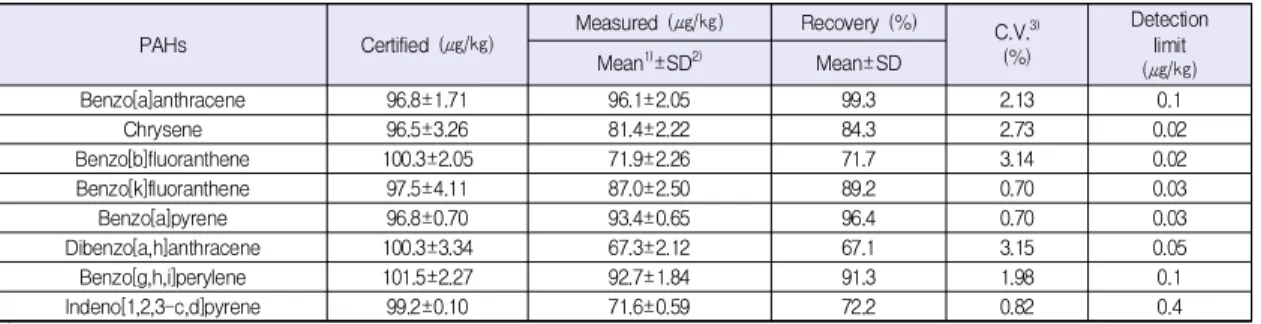
As shown in table 1, Each recovery rate of PAHs (%) was BaA 99.3, Chry 84.3, BbF 71.7, BkF 89.2 BaP 96.4, DBahA 67.1, BghiP 91.3, and IP 72.2, and detection limit (㎍/㎏) was between 0.02 and 0.4.
PAHs Certified (㎍/㎏) Measured (㎍/㎏) Recovery (%) C.V.3)
(%)
Detection limit (㎍/㎏) Mean1)±SD2) Mean±SD
Benzo[a]anthracene 96.8±1.71 96.1±2.05 99.3 2.13 0.1
Chrysene 96.5±3.26 81.4±2.22 84.3 2.73 0.02
Benzo[b]fluoranthene 100.3±2.05 71.9±2.26 71.7 3.14 0.02
Benzo[k]fluoranthene 97.5±4.11 87.0±2.50 89.2 0.70 0.03
Benzo[a]pyrene 96.8±0.70 93.4±0.65 96.4 0.70 0.03
Dibenzo[a,h]anthracene 100.3±3.34 67.3±2.12 67.1 3.15 0.05
Benzo[g,h,i]perylene 101.5±2.27 92.7±1.84 91.3 1.98 0.1
Indeno[1,2,3-c,d]pyrene 99.2±0.10 71.6±0.59 72.2 0.82 0.4
1)Mean : value of three measurements
2)SD : standard deviation
3)C.V. : coefficient of variation.
Table 1. The certified concentration of PAHs
The average PAHs content of 8 samples (㎍/㎏) was 8.94. By parts, the average PAHs content of 8 samples (㎍/㎏) were surface 10.08, nut 8.93, leaf 9.57, root 7.19,
seed 7.76, seaweed 11.15, and others 8.96 with a small difference of PAHs.
As shown in table 2, the item with the average
Sample name BaA Chry BbF BkF BaP DBahA BghiPer IP Total
Ogapihwan 1.651) (1.55~1.77)2
2.10 (0.84~3.57)
0.43 (0.26~0.76)
0.12 (0.05~0.17)
0.48 (0.29~0.81)
0.21 (ND~0.36)
9.01
(4.01~14.12) ND3) 14.00 (ND~14.12)
Yugunpihwan 1.20
(1.10~1.30) 1.38 (0.97~1.81)
0.86 (0.22~1.32)
0.27 (0.20~0.34)
0.58 (0.29~0.83)
0.16 (ND~0.36)
7.16
(2.89~14.16) ND 11.61 (ND~14.16) Baeyunchohwan 0.66
(0.16~1.27) 1.48 (0.79~2.61)
1.31 (0.99~1.75)
0.29 (0.21~0.37)
0.68
(0.46~0.88) ND 2.68
(ND~5.01) ND 7.10 (ND~5.01)
Gugijahwan 1.72
(0.69~3.60) 1.53 (1.23~1.88)
1.76 (0.67~2.80)
0.26 (0.09~0.52)
0.81 (0.56~1.22)
0.41 (0.26~0.62)
4.32
(2.55~5.22) ND 10.81 (0.09~5.22)
Hukgaehwan 1.57
(0.39~3.01) 1.26 (0.91~1.60)
1.43 (0.52~2.81)
0.27 (0.16~0.33)
0.61 (0.45~0.89)
0.22 (0.14~0.39)
5.51
(1.11~10.38) ND 10.87 (0.14~10.38)
Ojahwan 1.68
(0.54~3.62) 1.34 (0.66~2.10)
0.39 (ND~0.94
0.16 (ND~0.28)
0.33 (0.18~0.42)
0.10 (ND~0.15)
2.27
(ND~4.32) ND 6.27 (ND~4.32)
Seokruhwan 1.28
(0.09~3.60) 1.53 (1.15~1.88)
1.99 (1.42~2.80)
0.36 (0.24~0.52)
0.82 (0.56~1.22)
0.09 (ND~0.26)
3.55
(2.54~5.20) ND 9.62 (ND~5.20)
Sokpyunhwan 0.25
(0.68~0.47) 1.38 (0.94~1.90)
0.20 (ND~0.41)
0.27 (0.23~0.33)
0.09 (ND~0.17)
2.59 (2.28~3.11)
1.01
(ND~1.96) ND 5.79 (ND~3.11)
Sansujuhwan 1.36
(0.65~2.24) 2.49 (1.71~3.70)
1.11 (0.80~1.29)
0.29 (0.14~0.38)
0.73 (0.45~1.02)
0.30 (0.17~0.43)
2.96
(1.77~3.79) ND 9.24 (ND~3.70)
Bbongiphwan 0.87
(0.24~1.96) 2.85 (1.30~5.86)
1.14 (ND~3.42)
0.18 (ND~0.53)
0.42 (ND~1.27)
0.23 (ND~0.53)
5.76
(3.02~8.00) ND 11.45 (ND~8.00) Gujeolchohwan 1.42
(0.62~2.40) 1.24 (0.81~1.65)
1.24 (ND~2.27)
0.17 (ND~0.49)
0.46 (0.09 ~0.75)
0.21 (ND
~0.36)
4.23
(3.56~5.27) ND 8.97 (ND~5.27)
Ikmochohwan 1.96
(1.69~2.46) 1.83 (1.19~3.05)
1.69 (ND~2.87)
0.32 (ND~0.55)
0.67 (0.32~1.02)
0.08 (ND~0.16)
6.75
(5.70~8.54) ND 13.30 (ND~8.54) Injinssokhwan 2.38
(1.02~4.46) 5.59 (1.55~8.57)
3.06 (0.97~6.11)
0.55 (0.11~1.18)
0.92 (0.18~1.30)
0.98 (0.19~2.37)
7.16
(4.22~12.03) ND 20.64 (0.11~12.03) Mindlrehwan 0.83
(0.08~1.79) 1.36 (1.07~1.69)
1.30 (1.13~1.43)
0.24 (0.22~0.26)
0.51 (0.44~0.62)
0.15 (ND~0.22)
1.31
(ND~2.89) ND 5.70 (ND~2.89)
Nokchahwan 0.91
(0.22~2.24) 2.10 (1.11~3.97)
1.58 (1.24~1.87)
0.27 (0.21~0.30)
0.76 (0.32~1.38)
0.22 (ND~0.67)
2.65
(ND~5.37) ND 8.49 (ND~5.37) Sambaekchohwan 0.21
(0.11~0.38) 1.13 (0.70~1.67)
0.18 (ND~0.53)
0.08 (ND~0.24)
0.19 (0.11~0.33)
0.25 (ND~0.74)
0.83
(ND~2.50) ND 2.87 (ND~2.50)
Soliphwan 1.50
(0.60~3.26) 1.39 (0.99~1.84)
1.24 (0.86~1.65)
0.30 (0.21 0.44)
0.63 (0.55~0.71)
0.06 (ND~0.14)
3.76
(1.68~6.68) ND 8.88 (ND~6.68)
Chikhwan 2.25
(1.41~3.48) 1.71 (0.97~2.17)
0.61 (ND~1.52)
0.06 (ND~0.10)
0.15 (0.12~0.19)
0.39 (0.14~0.51)
4.57
(3.73~5.59) ND 9.74 (ND~5.59)
Dorajihwan 0.90
(0.45~1.36) 1.34 (0.91~2.13)
2.7 (ND~6.18)
0.04 (ND~0.11)
0.18 (0.13~0.25)
0.16 (ND~0.49)
4.15
(3.59~4.64) ND 9.53 (ND~6.18)
Hookmohwan 0.49
(0.07~1.22) 1.10 (0.74~1.67)
0.55 (ND~1.44)
0.15 (ND~0.30)
0.28
(0.11~0.50) ND 2.54
(ND~5.06) ND 5.11 (ND~5.06)
Hwanggihwan 0.55
(0.08~1.39) 0.63
(0.35~1.00) ND ND ND ND 1.82
(ND~3.61) ND 3.00 (ND~3.61)
Kanhwanghwan 0.41 (0.15~0.74)
1.06 (0.89~1.16)
3.92 (0.23~0.63)
0.10 (ND~0.15)
0.25 (0.17~0.29)
0.53 (ND~1.44)
1.85
(ND~2.84) ND 8.12 (ND~2.84)
Manulhwan 1.09
(0.47~1.40) 2.32 (1.20~4.25)
0.57 (ND~1.70)
0.03 (ND~0.05
0.40 (0.10~0.92)
0.46 (0.15~1.09)
2.73
(ND~4.33) ND 7.60 (ND~4.33)
Hasuohwan 1.85
(1.04~3.18) 1.20 (0.95~1.40)
0.74 (0.23~1.05)
0.21 (ND~0.32)
0.39 (0.24~0.47)
0.09 (ND~0.28)
2.75
(0.43~4.94) ND 7.23 (ND~4.94)
1)Mean: value of three measurements,2)Range,3)ND: Not Detected, BaA: benzo[a]anthracene, Chry : chrysene, BbF: benzo[b]fluoranthene, BkF:
benzo[k]fluoranthene, BaP: benzopyrene, DBahA: dibenzo[a,h]anthracene, BghiP: benzo[g,h,i]perylene, IP: indeno[1,2,3-c,d]pyrene.
Table 2. Contents of PAHs in herbal pills (㎍/㎏)
PAHs content of 8 samples (㎍/㎏) below 30 was an item of mugwort pills, and the items with that of below 20 were acanthopanax, rhizodermis, lycium, mulberry leaves, kelp, hovenia, motherwort, and fusiformis pills.
And the items with the content below 10 were 22 while mugwort and saururus pills showed the highest level and the lowest level, respectively.
The average contents (㎍/㎏) by PAHs of 8 samples were BaA 1.32, Chry 1.58, BbF 1.20, BkF 0.19, BaP 0.44, DBahA 0.30, BghiP 3.91, and IP 0.00 with the highest level of BghiP. By part, a high level of BaA was found in seaweed, and a high level of BkF and BaP was detected in nuts and leaves. In other parts, the level of BaP was low. On surfaces, BghiP was high, and the level of BghiP was low in nuts, seeds and roots.
Moreover, there has been no difference in Chry, BbF and p<0.01), BghiP (r=0.504, p<0.01), and that of Chry was BbF (r=0.323, p<0.01), BkF (r=0.501, p<0.01), BaP (r=0.530, p<0.01), DBahA (r=0.384, p<0.01), BghiP (r=0.335, p<0.01). And the correlation of BbF demonstrated BkF (r=0.371, p<0.01), BaP (r=0.338, p<0.01), and that of BkF was shown to be BaP
(r=0.712, p<0.01), BghiP (r=0.296, p<0.05), and that of BaP was BghiP (r=0.352, p<0.01), showing a meaningful definition correlation. Based on the samples, it was found that there was a high level of BaA in sea tangle pills, Chry in mugwort pills, BbF in turmeric pills, BghiP and DBahA in pills. The smallest amount of BkF was detected among PAHs of 8 kinds, and IP was below quantization limit, which was not detected in any samples. A high level of BaP was detected in mugwort pills, and low level was detected in milk vetch root pills. A content of BaP in all samples was below 1.0 ㎍/㎏. Excessive carcinogenesis risk of pills by parts was surface 4.00×10⁻⁶, nut 1.09×10⁻⁵, leaf 7.56×10⁻⁶, root 5.46×10⁻⁶, seed and 4.06×10⁻⁶, seaweed 4.71×10⁻⁶, other 8.03×10⁻⁶, with the average risk of 7.09×10⁻⁶.
Furthermore, excessive carcinogenesis risk of stomach cancer on it supper part, caused by intake of pills is at the level of 7 in a million. In addition, excessive carcinogenesis risk by samples was in the range between 2.93×10⁻⁵and 2.93×10⁻⁷based on table 3.
Sample name TEQBaP
Lifetime average daily intake
Excess
cancer risk Sample name TEQBaP
Lifetime average daily intake
Excess cancer risk
Ogapihwan 1.86 3.06×10⁻⁴ 2.23×10⁻⁶ Soliphwan 1.29 5.50×10⁻⁴ 4.02×10⁻⁶
Yugunpihwan 1.70 8.42×10⁻⁴ 6.15×10⁻⁶ Chikhwan 2.45 7.98×10⁻⁴ 5.83×10⁻⁶
Baeyunchohwan 0.95 8.47×10⁻⁴ 6.18×10⁻⁶ Dorajihwan 1.40 7.91×10⁻⁴ 5.77×10⁻⁶
Gugijahwan 3.29 4.98×10⁻⁴ 3.64×10⁻⁶ Hookmohwan 0.44 7.43×10⁻⁴ 5.43×10⁻⁶
Hukgaehwan 2.10 1.29×10⁻³ 9.38×10⁻⁶ Hwanggihwan 0.08 1.78×10⁻⁴ 1.30×10⁻⁶
Ojahwan 1.09 9.49×10⁻⁴ 6.93×10⁻⁶ Kanhwanghwan 3.37 4.01×10⁻⁵ 2.93×10⁻⁷
Seokruhwan 1.68 4.67×10⁻⁴ 3.41×10⁻⁶ Manulhwan 2.92 1.56×10⁻³ 1.14×10⁻⁵
Sokpyunhwan 13.14 7.41×10⁻⁴ 5.41×10⁻⁶ Hasuohwan 1.16 1.23×10⁻³ 8.96×10⁻⁶
Sansujuhwan 2.56 4.02×10⁻³ 2.93×10⁻⁵ Dangguihwan 0.89 4.49×10⁻⁴ 3.28×10⁻⁶
Bbongiphwan 1.88 1.05×10⁻³ 7.63×10⁻⁶ Eunhanghwan 2.19 3.58×10⁻⁴ 2.61×10⁻⁶
Gujeolchohwan 1.68 9.85×10⁻⁴ 7.19×10⁻⁶ Honhwasihwan 0.73 7.02×10⁻⁴ 5.13×10⁻⁶
Ikmochohwan 1.55 7.12×10⁻⁴ 5.20×10⁻⁶ Dasimahwan 2.18 2.82×10⁻⁴ 2.06×10⁻⁶
Injinssokhwan 6.55 7.29×10⁻⁴ 5.32×10⁻⁶ Hamchohwan 1.68 9.49×10⁻⁴ 6.93×10⁻⁶
Mindlrehwan 1.52 3.04×10⁻³ 2.22×10⁻⁵ Tothwan 2.27 7.42×10⁻⁴ 5.42×10⁻⁶
Nokchahwan 2.18 5.48×10⁻⁴ 4.00×10⁻⁶ Chunggukjanghwan 1.68 1.10×10⁻³ 8.03×10⁻⁶
Sambaekchohwan 1.51 8.84×10⁻⁴ 6.45×10⁻⁶ Average 2.266 9.71×10⁻⁴ 7.09×10⁻⁶
1)TEQBaP: Toxic equivalent.
Table 3. The estimated lifetime average daily intake(㎍-TEQBaP1)/㎏/day) of PAHs from herbal pills
4. Discussion
EU.EFSA[9] reported that as the main intake circuit of PAHs, food intake for non-smokers accounts for more than 70% for the intake of PAHs, while Kobayashi, et al[18] found that PAHs in plants results from the intake of grains and vegetables except for the intake of lots amounts of grilled meat, due to complicated factors such as heating temperature. DE Vos[19] reported that according to the PAHs level in
food, benzo[b]fluoranthene, fluoranthene and benzo[k]
fluoranthene were frequently detected. However, chrysene was the most commonly detected PAHs.
While the total intake of PAHs was 5-17 ㎍/day, Kim et al[20] and Hu et al[21] reported based on the examinat ion of the total PAHs content of 8 types (㎍/㎏) that its level of grains, pulse crops, root and tuber crops and processed food was 1.11, whereas that of fruits and vegetables and processed food was 0.19.
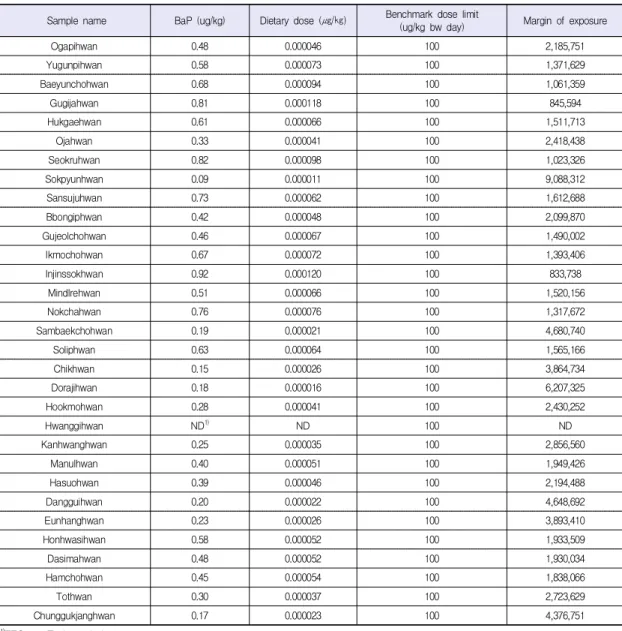
Sample name BaP (ug/kg) Dietary dose (㎍/㎏) Benchmark dose limit
(ug/kg bw day) Margin of exposure
Ogapihwan 0.48 0.000046 100 2,185,751
Yugunpihwan 0.58 0.000073 100 1,371,629
Baeyunchohwan 0.68 0.000094 100 1,061,359
Gugijahwan 0.81 0.000118 100 845,594
Hukgaehwan 0.61 0.000066 100 1,511,713
Ojahwan 0.33 0.000041 100 2,418,438
Seokruhwan 0.82 0.000098 100 1,023,326
Sokpyunhwan 0.09 0.000011 100 9,088,312
Sansujuhwan 0.73 0.000062 100 1,612,688
Bbongiphwan 0.42 0.000048 100 2,099,870
Gujeolchohwan 0.46 0.000067 100 1,490,002
Ikmochohwan 0.67 0.000072 100 1,393,406
Injinssokhwan 0.92 0.000120 100 833,738
Mindlrehwan 0.51 0.000066 100 1,520,156
Nokchahwan 0.76 0.000076 100 1,317,672
Sambaekchohwan 0.19 0.000021 100 4,680,740
Soliphwan 0.63 0.000064 100 1,565,166
Chikhwan 0.15 0.000026 100 3,864,734
Dorajihwan 0.18 0.000016 100 6,207,325
Hookmohwan 0.28 0.000041 100 2,430,252
Hwanggihwan ND1) ND 100 ND
Kanhwanghwan 0.25 0.000035 100 2,856,560
Manulhwan 0.40 0.000051 100 1,949,426
Hasuohwan 0.39 0.000046 100 2,194,488
Dangguihwan 0.20 0.000022 100 4,648,692
Eunhanghwan 0.23 0.000026 100 3,893,410
Honhwasihwan 0.58 0.000052 100 1,933,509
Dasimahwan 0.48 0.000052 100 1,930,034
Hamchohwan 0.45 0.000054 100 1,838,066
Tothwan 0.30 0.000037 100 2,723,629
Chunggukjanghwan 0.17 0.000023 100 4,376,751
1)TEQBaP: Toxic equivalent.
Table 4. Margin of exposure of herbal pills
Hossain et al[22] reported that the level of tomato, cabbage, and apple were 9. 50, 8. 86, and 4.05 ㎍/㎏, respectively. Rosentale et al[23] reported the benzopyrene content in seasonings ranged from no-detectable levels to 6.60 ㎍/㎏. In addition, EU.EFSA[9] has recently studied BaP contents (㎍/㎏) of various foods. As a result, it was reported that BaP was detected in 47% of the foods, and 13.4% of it exceeds 1, with 2.3% surpassing 10. Baek[10] reported in the study of BaP (㎍/㎏) that the level of medicinal herbs was between 0.00 and 62.81, with pills ranging from 0.0 to 5.8 and medicinal decoction yet to be detected. Lee et al[24] and Jo et al[25] studied not only the average of the BaP content in medicinal herbs, 0.77
㎍/㎏, but also its range between 0.0 and 89.27. The content of BaP (㎍/㎏) in this study was between 0.17 and 0.65, which means the level was lower than the results studied by EU.EFSA[9] and lower by 5 than the Bap standard level of medicinal herbs by the food and drug agency.
The levels of BghiP, BaP, DBahA were similar in the results of PAHs relative concentration of air, water and food examined by WHO[26], but the IP was different. According to the comparison by EU.ESFA[9]
between proportions of BaP and PAHs in food, it was found that BaA was 1.8 with Chry (2.4), BbF (0.5), DBahA (0.1), BghiP (0.8), IP (0.5). In these results, the IP was not detected, and there was a difference by PAHs based on the fact of BaA 3.0, Chry 3.6, BbF 2.7, DBahA 0.7, BghiP 8.9. Wickstrom et al[27] found that the amount of PAHs biosynthesis in plants was mediocre, mostly resulting from the environment, while Tfouni et al[28] found that PAHs concentration in plants raised in highly polluted regions was high.
Kapustka[29] studied that the concentration is influenced by photooxidation activities, soil concentration, types of plants, and microbial distribution of regions.
Tripathy et al[30] reported that low molecular weight PAHs were found as the dominant contaminants.
Therefore, there is a difference in PAHs concentration, depending on plant inhabitation areas, and it can be
expected that plants raised in highly air- and soil-polluted regions can be polluted by PAHs through their leaves and roots.
Ahn et al[31] found BaP with the amount of over 5
㎍/㎏ was generated excessively by smoke through high temperature combustion and incomplete combustion of fossil fuel such as briquette based on the fact that 14.62 ㎍/㎏ (through fired combustion) 〉14.30
㎍/㎏ (through high temperature combustion) 〉5.18
㎍/㎏ (through coal smoke exposures) 〉1.74 ㎍/㎏
(dryness in dry season with the temperature of 60℃, straw smoke exposure) in benzopyrene induction research. Bansal et al[32] presented the risk factors of PAH exposure are mainly posed by human activities which pose threats to all types of plant resources and the methods of approaches involved in processing.
Therefore, to prevent risks of PAHs by intake of pills, plants should not be collected in pollutant regions, and the use of high temperature should be avoided in the making process of pills.
According to the 2009 evaluation result by the Environment department[33], excessive carcinogenesis risk by PAHs exposures in the environment such as indoor air, outdoor air, dust and soil was found to be 3.54×10⁻⁵, and carcinogenes is risk resulting from breathing in Europe was 8.7×10⁻⁵~3.6×10⁻⁴ with a low cancer incidence caused by the daily environment. Kim et al[34] regarded excessive carcinogenesis risk through eating habits among adults as 6.4×10⁻⁵, and the intake of pills was found to be smaller than the amount of PAHs intake through daily diet. In addition, MOE was surface 1,778,690, nut 2,508,776, leaf 1, 862,594, root 3,382,415, seed 2,913,459, other 4,376,751, and the level of all samples as 1,885,580 was evaluated as safe with negligible concern (>1,000,000) according to MOE banding suggested by FSA(US.EPA). Moreover, like in table 4, MOE in all samples demonstrated its level as more than 1,000,000, except for samples with negligible concern with action minimizing future exposure (>100,000) such as boxthorn pills (845,594) and mugwort pills (833,738).
5. Conclusion
Taken together, these results indicate that the majority of samples except for a few samples were safe.
REFERENCES
[1] Y. I. Lee. (1998). Studies on the research and development of new dosage form of oriental medicine - Study on preparation and evaluation of lonicerae caulis tablet. Korea institute of oriental medicine report.
[2] Ministry of health, welfare and family affairs. (2010).
Regulation of supply and distribution management of herbal medicine, Notice No. 2010-43.
[3] Korea Food & Drug Administration. (2011). Korean food standards codex, Common standard and specifications for food 2-2-2.
[4] L. Singh, JG. Varshney & T. Agarwal. (2016). Polycyclic aromatic hydrocarbons formation and occurrence in processed food. Food Chemistry, 199(5), 768-781.
[5] J. R. Brown & J. L. Thornton. (1957). Percivall Pott (1714-1788) and chimney sweeper's cancer of the scrotum. British J. of industrial medicine, 14(1), 68-70.
[6] K. Siegmann & K. Sattler. (1996). Aerosol from hot cooking oil, a possible health hazard. J. of aerosol science, 27(1), 493-494.
[7] N. U. Benson et al. (2018). Concentrations, sources and risk characterisation of polycyclic aromatic hydrocarbons (PAHs) in green, herbal and black tea products in Nigeria. Journal of Food Composition and Analysis, 66(3), 13-22.
[8] International agency for research on cancer. (2010).
IARC monographs on the evaluation of carcinogenic risks to humans. Some non-heterocyclic polycyclic aromatic hydrocarbons and some related exposures 92.
[9] European food safety agency. (2008). Findings of the EFSA data collection on polycyclic aromatic hydrocarbons in food. EFSA/ DATEX/002.
[10] Korea Food & Drug Administration. (2009). Criteria and method of benzopyrene for herbal. Notice No. 2009.
[11] Korea Food & Drug Administration. (2013). The Korean pharmacopoeia. Notice No. 103.
[12] W. S. Baek. (2009). The monitoring of benzo(a)pyrene`s content on the herbal medicines. Korea Food & Drug Administration Report.
[13] Korean agency for technology and standards, Size Korea
Report 2004.
[14] Statistics Korea. Mortality table 2009.
[15] C. Nisbet & P. Lagoy (1992). Toxic equivalency factors(TEFs) for polycyclic aromatic hydrocarbons (PAHs). Regulatory Toxicology and Pharmacology, 16(3), 290-300.
[16] S Environmental protection agency. (2015). Integrated risk information system. Benzo[a]pyrene(BaP). (CASRN 50-32-8).
[17] Korea Food & Drug Administration. Guide of risk assessment of genotoxicity carcinogen 2011.
[18] R. Kobayashi, R. A. Okamoto, R. L. Madalena & N. Y.
Kado. (2008). Polycyclic aromatic hydrocarbons in edible grain: A pilot study of agricultural crops as a human exposure pathway for environmental contaminants using wheat as a model crop. Environmental research, 107(2), 145-151.
[19] R. H. DeVos, W. Dokkum, A. Schouten & P.
Jong-Berkhout. (1990). Polycyclic aromatic hydrocarbons in Dutch total diet samples (1984-1986). Food and chemical toxicology, 28(4), 263-268.
[20] H. Y. Kim, S. Y. Chung, Y. S. Sho & S. S. Park (2005).
Concentration of polycyclic aromatic hydrocarbons in cereals, pulses, potatoes and their product. Food Science and Biotechnology, 37(4), 537-541.
[21] S. J. Hu, N. S. Oh, S. Y. Kim & H. M. Lee. (2006).
Determining of polycyclic aromatic hydrocarbons in domestic vegetables and fruits. Analytical Science &
Technology, 19(5), 415-421.
[22] M. A. Hossain & M. Z. Hoque. (2011). Polycyclic aromatic hydrocarbons in Bangladeshi vegetables and fruit. Food and chemical toxicology, 49(1), 244-247.
[23] I. Rozentale, A. Y. Lun, D. Zacs & V. Bartkevics. (2018).
The occurrence of polycyclic aromatic hydrocarbons in dried herbs and spices. Food Control, 83(1), 45-53.
[24] M. Y. Lee, S. M. Jung & G. W. Lee. (2012). Monitouring on benzo(a)pyrene content in oriental medicine. J. of Digital Convergence, 10(7), 201-206.
[25] S. A. Jo, S. D. Lee, D. G. Kim & H. K. Lee. (2011).
Analysis of benzo(a)pyrene content in medicinal herbs.
The report of Seoul metropolitan government research institute of public health and environment, 47, 94-102.
[26] World Health Organization. (2000). Air quality guidelines for Europe, 2nd edition. WHO regional publications, European series, No. 91.
[27] K. Wickstrom, H. Pyysalo, S. P. Heikkila & J. Tuominen.
(1986). Polycyclic aromatic compounds (PAC) in leaf lettuce. Zeitschrift für Lebensmittel-Untersuchung und
Forschung, 183(3), 182-185.
[28] A. V. Tfouni, N. G. Souza, M. B. Neto, S. D. Loredo, F.
M. Leme & P. Z. Furlani. (2009). Polycyclic aromatic hydrocarbons (PAHs) in sugarcane juice. Food chemistry, 116(1), 391-394.
[29] L. A. Kapustka. (2004). Establishing Eco-SSLs for PAHs: lessons revealed from a review of literature on exposure and effects to terrestrial receptors. HERA, 10(2), 185-205.
[30] V. Tripathy, B. B. Basak, TS. Varghese and A. Saha.
(2015). Residues and contaminants in medicinal herbs—
A review. Phytochemistry, 14(12), 67-78.
[31] T. J. Ahn, Y. S. Ahn, M. Hu & C. G. Park. (2013). Study on the new process for the control of benzopyrene formation in herbal products. Rural development administration, Report No PJ007594.
[32] V. Bansal & K. H. Kim (2015). Review of PAH contamination in food products and their health hazards.
Environment International, 84(11), 26-38.
[33] Ministry of environment. The results of risk assessment for the project in 2008. Press release 2009-4.
[34] Y. H. Kim, C. H. Lee, E. K. Yoon & H. M. Lee. (2004).
Exposure Assessment for Polycyclic Aromatic Hydrocarbons in the Model Menu System of Korean. J.
Food Hygiene safety, 19(4), 176-184.
김 가 연(Ga-Yeon Kim) [정회원]
▪2005년 2월 : 고려대학교 보건대 학원(보건학석사)
▪2012년 2월 : 단국대학교 보건대 학원(보건학박사)
▪2015년 3월 ~ 현재 : 단국대학교 치위생학과 교수
▪관심분야 : 구강미생물학, 환경보건학, 항생제내성
▪E-Mail : [email protected]
김 효 진(Hyo-Jin Kim) [정회원]
▪2005년 8월 : 가천대학교 보건대 학원 구강보건학과(보건학석사)
▪2012년 2월 : 원광대학교 일반대 학원 보건학과(보건학박사)
▪2014년 9월 ~ 현재 : 경동대학교 치위생학과 부교수
▪관심분야 : 구강보건학, 임상치위생학
▪E-Mail : [email protected]
이 성 득(Sung-Deuk Lee) [정회원]
▪1996년 2월 : 서울대학교 보건대 학원 환경보건학과 (보건학석사)
▪2011년 8월 : 단국대학교 일반대 학원 보건학과 (보건학박사)
▪2013년 3월 ~ 현재 : 단국대학교 일반대학원 보건학과 연구원
▪관심분야 : 환경보건학, 식품위생학
▪E-Mail : [email protected]
이 영 기(Young Ki Lee) [정회원]
▪1993년 3월 : 단국대학교 일반대 학원 미생물학(이학석사)
▪2000년 8월 : 단국대학교 일반대 학원 미생물학(이학박사)
▪2005년 ~ 현재 : 단국대학교 보건 과학대학 임상병리학과 교수
▪관심분야 : 환경미생물, 항생제내성, 보건위생학
▪E-Mail : [email protected]
육 영 삼(Young Sam Yuk) [정회원]
▪1994년 8월 : 단국대학교 일반대 학원 미생물학(이학석사)
▪2016년 8월 : 단국대학교 보건대 학원(보건학박사)
▪2016년 8월 ~ 현재 : 단국대학교 임상병리학과 교수
▪관심분야 : 일반미생물, 유전학, 공중보건학
▪E-Mail : [email protected]