online©ML Comm
0
CLINICAL ARTICLE
0Copyright ⓒ 2009 Journal of Korean Neurotraumatology Society
1
J Kor Neurotraumatol Soc 2009;5:1-4 ISSN 1738-8708
중증 급성 경막하혈종의 예후
순천향대학교 의과대학 천안병원 신경외과학교실
오재상·이경석·김라선·도재원
Outcome of the Severe Acute Subdural Hematoma
Jae-Sang Oh, MD, Kyeong-Seok Lee, MD, Ra-Sun Kim, MD and Jae-Won Doh, MD
Department of Neurosurgery, College of Medicine, Soonchunhyang University, Cheonan Hospital, Cheonan, Korea
Objective: Acute subdural hematoma (ASDH) is one of the worst post-traumatic mass lesions. Early aggressive manage-
ment may reduce the mortality rate, while it may cause unbearable sequelae or disabilities. Traditionally a surgical decision is made by the surgeon on the critical victim without delay. However, it is necessary to inform the relatives or family not only the possibility of survival, but also the quality of life after surgery, especially for the comatose victims with ASDHs.
We investigate the outcome of the comatose (Glascow coma scale 3-8) patients with ASDH. Methods: From January 2005 to December 2006, we managed 141 patients with ASDH. In 52 patients, their initial Glasgow coma score (GCS) was 3- 8. We examined the age, initial GCS, size and reflex of pupils, method of treatment, and the outcome at discharge. We also in- vestigated the amount the hematoma, degree of midline shift, and status of the basal cisterns in computed tomographic scans.
Statistical significance was tested using the chi-square test. It was considered significant, when p<0.05. Results: The over- all outcome was poor; death in 29, vegetative in 12, severe disability in 10, and moderate disability in 1. There was no good recovery, at all. The outcome was dependent on the initial GCS and pupil. The outcome was independent on the age, amount of the hematoma, degree of midline shift, and method of treatment. However, the age was the only significant factor in de- ciding not to operate. Conclusion: In severe head injuries, even though we could save the life, the quality of life is too poor to bother not only the victims, but also their family and society. In this situation, it is never sufficient to explain that an im- mediate surgery is the only way to save the life. We should provide the information on the outcome of the severe head in- juries after surgery.
(J Kor Neurotraumatol Soc 2009;5:1-4)KEY WORDS: Acute subdural hematoma·Craniocerebral trauma·Decision making·Treatment outcome.
서 론
급성 경막하혈종은 두개강내 혈종 중에서도 발생빈도가 비교적 높고, 사망률이 높으며 생존을 하더라도 후유장애를 많이 남기는 등 예후가 나쁜 병소로 알려져 있다.
13,14,23)조 기에 적극적인 치료를 하면 사망자를 줄이고 치료 결과를 좋게 할 수 있다는 보고
2,26)도 있지만, 치료 결과가 좋지 않
으면 삶의 질을 나쁘게 할 위험이 있다는 주장
3)도 있다. 시 간적인 여유가 없는 응급 상황에서 치료결과가 불확실한 수술을 결정하기는 쉽지 않다. 전통적으로 응급 상황에서는 생명구제가 최우선 목표가 되어 삶의 질을 고려할 틈 없이 수술이 결정되어 왔다.
5)특히 응급 상황에서는 환자나 보 호자의 동의가 없어도 수술을 할 수 있으며, 그 결과가 좋 지 않은 경우에도 의료진한테 그 책임을 묻지 않았다. 그러 나 최근에는 환자의 권리에 대한 관심이 많아지면서 특정 환자의 치료방법이나 결과에 대해 환자나 보호자한테 설명 해야 하며, 환자나 보호자도 알 권리를 주장하게 되었다.
응급 수술이 필요한 경우, 시간적 여유는 없지만, 어떠한 치료를 어떤 목적으로 하고, 그 결과가 어떠한지에 대한 설 명은 치료방향을 결정하는 데 매우 중요하다. 특히 치료결 Received:
January 14, 2009 /Revised:
May 11, 2009Accepted:
May 11, 2009Address for correspondence:
Kyeong-Seok Lee, MD Department of Neurosurgery, College of Medicine, Soonchunhyang University, Cheonan Hospital, Soonchunhyang 2-gil 8, Dongnam-gu, Cheonan 330-721, KoreaTel: +82-41-570-3652, Fax: +82-41-572-9297 E-mail: [email protected]
Outcome of the Severe Acute Subdural Hematoma
2
J Kor Neurotraumatol Soc 2009;5:1-4과나 자연경과에 대한 정확한 통계자료를 제공해야 할 것 이다. 치료방침을 결정하는 데 도움을 주기 위해서는 일반 적이고 통계적인 정보를 제공하여 치료 결정에 환자나 보호 자가 참여할 수 있도록 해야 할 것이다. 의식이 나쁜 급성 경막하혈종 환자의 치료결과에 대한 통계적 정보를 제공 하기 위해 이러한 환자를 대상으로 한 임상 소견과 치료 결과를 조사하고, 문헌고찰과 함께 보고한다.
대상 및 방법
2005년 1월부터 2006년 12월까지 2년 동안 본 병원 신 경외과에서 입원하여 치료를 받았던 두부외상 환자 718명 중 내원 당시 시행한 두부 전산화단층촬영 결과 급성 경막 하혈종이 발견되었던 환자는 141명이었다. 이 중 응급실 내원 당시 의식이 글라스고우 혼수계수(Glasgow coma score: GCS)로 3~8인 환자는 52명 (36.9%)이었다. GCS 3~8인 급성 경막하혈종 환자 52예를 대상으로 하여 임상 소견과 CT소견, 그리고 치료결과를 조사하였다. 수술을 한 경우 (31예)와 수술을 하지 않은 경우 (21예)로 나누어 두 군의 치료결과와 치료결정에 영향을 주는 요인을 비교하 였다. 수술은 감압두개골절제술이 23예, 개두술이 8예였다.
임상소견으로는 나이와 성별, 내원할 때의 GCS, 동공반응, 그리고 환자의 치료결과 (Glasgow outcome score: GOS) 를 조사하였다. 환자의 치료결과는 퇴원할 때의 상태에 따 라 분류하였고, 통계학적 비교를 할 때에는 사망과 생존으 로 구분하여 분석하였다. 동공은 부동공 또는 광반사의 상 실을 비정상으로 판단하였다. CT소견으로는 혈종의 크기, 정중선 이동, 그리고 뇌조의 폐쇄여부를 조사하였다. 혈종 의 크기는 두께 (T)와 길이 (L) 그리고 높이 (H)를 이용해 3.14/ 6×T×L×H의 공식을 이용해 산출하였다. 이들 중 7예는 CT 필름을 분실하여 CT소견을 분석할 때는 대 상에서 제외하였다.
통계학적 검정은 chi-square 검정을 이용하였고, p<
0.05일 때 유의하다고 평가하였다.
결 과
남자가 40예, 여자가 12예로 남자에 많았고, 60세 이하 가 32예, 60세 이상이 20예였다. 내원 당시의 의식 상태는 GCS 3~5점이 34예, 6~8점이 18예였다. 동공은 14예가 정상이었고, 38예는 비정상이었다. 혈종량은 30 cc 이하 가 20예, 30~60 cc가 11예, 그리고 60 cc 이상이 14예였 다. 정중선 이동은 5 mm 이하가 10예, 5~10 mm가 17예,
그리고 10 mm 이상이 18예였다. 뇌조는 정상이 15예, 폐 쇄된 경우가 30예였다.
퇴원할 때의 치료결과는 사망 29예, 식물 상태 12예, 중 증장애 10예, 그리고 중등도장애가 1예였고, 회복은 없었다.
사망 예의 평균 생존기간은 6일 (표준편차 8.7일)이었고, 생 존 예의 평균 입원기간은 41일 (표준편차 63.7일)이었다.
수술 군과 보존 군의 비교
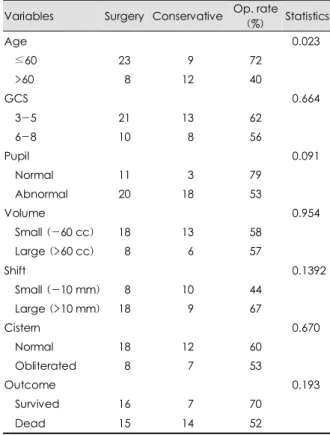
의식, 동공, 혈종량, 정중선 이동, 뇌조의 상태, 그리고 치료결과는 수술을 한 경우와 수술을 하지 않은 경우의 사 이에 통계학적으로 유의한 차이가 없었다 (Table 1). 나이 만이 수술 결정에 큰 영향을 주었는데, 60세 이하에서는 수술률이 72%인데 비해 60세 이상일 때는 수술률이 40%
로 낮았다.
치료결과에 따른 비교
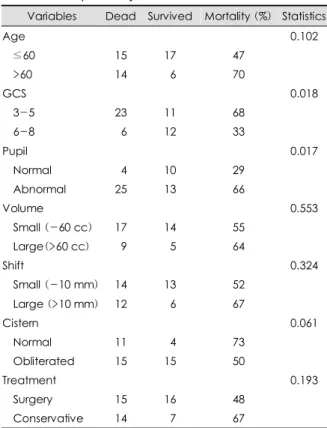
60세 이전의 사망률에 비해 60세 이후의 사망률이 더 높 았으나 이 차이가 통계학적으로 유의하지는 않았다 (Table 2). GCS가 3~5인 경우가 6~8인 경우보다 사망률이 더 높았고, 동공이 비정상일 때가 동공이 정상일 때보다 사망 률이 더 높았는데, 이 차이는 통계학적으로도 유의하였다.
TABLE 1. Comparison by the methods of treatment Variables Surgery Conservative Op. rate
(%) Statistics
Age 0.023
≤60 23 09 72
>60 08 12 40
GCS 0.664
3-5 21 13 62
6-8 10 08 56
Pupil 0.091
Normal 11 03 79
Abnormal 20 18 53
Volume 0.954
Small (-60 cc) 18 13 58
Large (>60 cc) 08 06 57
Shift 0.1392
Small (-10 mm) 08 10 44
Large (>10 mm) 18 09 67
Cistern 0.670
Normal 18 12 60
Obliterated 08 07 53
Outcome 0.193
Survived 16 07 70
Dead 15 14 52
GCS: Glasgow coma score
Jae-Sang Oh, et al.
www.neurotrauma.or.kr
3 그러나 혈종량이나 정중선 이동, 뇌조의 상태, 그리고 치
료방법은 치료결과에 통계학적으로 유의한 영향을 주지는 않았다.
고 찰
퇴원할 때의 중증 급성 경막하혈종의 치료결과는 사망 29 예, 식물 상태 12예, 중증장애 10예, 그리고 중등도장애가 1예였고, 회복은 없었다. 급성 경막하혈종의 예후는 두개강 내 종괴병소 중 가장 나쁘며, 수술 사망률은 30~80%로, 대부분이 50%가 넘는 사망률을 보고하고 있다.
4,6,7,9-14,16)특히 수술 전 GCS 3~5인 경우 사망률은 70~90%로 의 식이 나쁠수록 사망률이 높다. 급성 경막하혈종의 예후에 영향을 주는 요인들로는 나이, 손상정도 (손상정도계수; in - jury severity score: ISS), 두개강내압, 지주막하출혈 여 부, 내원 당시 GCS, 그리고 수술까지의 시간 등이라고 한 다.
6,7,13,16,18)제뇌경직이 있을 때는 없을 때보다 사망률이 높아 77~89%에 이르며, 특히 제뇌경직이 있고 동공이 양 쪽 모두 산대(mydriasis)되면 사망률이 95%라고 한다.
13)또한 불완전 측마비(hemiparesis)가 있으면 사망률 35%, 측마비(hemiplegia)가 있으면 48%, 모두 이완된(flaccid) 때는 사망률이 93%라고 한다.
13)동공의 상태도 예후에 영
향을 주는데, 동공이 부동이며 광반사가 남아 있을 때는 사 망률 50%, 광반사가 없을 때는 58%, 양안이 모두 산대되 면 80%를 넘는다고 한다.
13)급성 경막하혈종의 높은 사 망률은 뇌좌상이나 종창과 같은 뇌의 일차적 손상과 자주 동반되기 때문이라고 한다.
22)CT에서 혈종의 두께가 10 mm 이상이거나 정중전이가 5 mm 이상인 급성 경막하혈종은 의식을 불문하고 수술을 하라는 권고가 있고,
4)양쪽 동공이 모두 산대된 환자라도 1년이 지난 뒤 25%가 기능적 회복이 가능했다는 보고
21)나 102세와 103세의 나이에 발생한 급성 경막하혈종도 수 술로 제거하여 생명을 연장할 수 있었다는 보고
25)가 있으 나, 생존 가능성이 낮은 중증 두부외상 환자의 수술 여부를 결정하는 일은 결코 쉬운 일이 아니다.
5)특히 급성 두부외 상일 경우에는 예후추정과 함께 법이나 윤리적 문제를 고 려할 시간적 여유가 많지 않다.
이 연구에서는 의식, 동공, 혈종량, 정중선 이동, 뇌조의 상태, 그리고 치료결과는 수술을 한 경우와 수술을 하지 않 은 경우 사이에 통계학적으로 유의한 차이가 없었다. 나이 만이 수술 결정에 큰 영향을 주었는데, 60세 이하에서는 수 술률이 72%인데 비해 60세 이상일 때는 수술률이 40%
로 낮았다. 나이는 두부외상의 예후에 나쁜 영향을 주는 요 인으로 잘 알려져 있는데,
12,15,24)사망 또는 나쁜 예후일 가 능성이 10년마다 40~50% 증가하며, 60세가 분기점이 라고 한다.
8)사망률만이 아니라 장애율도 높고, 뒤늦게 상 태가 나빠지는 경우도 많아서 이로 인한 비용이 커진다고
한다.
16,17)결국 이런 요소들을 고려하여 의식이 나쁜 노인
의 수술을 포기한 결과 수술률이 낮은 것으로 본다.
이 연구에서는 일반적으로 예후에 영향을 주는 요인으로 알려진 혈종량이나 정중선 이동, 뇌조의 상태, 그리고 치료 방법이 치료결과에 통계학적으로 유의한 영향을 주지 않았 다. 이는 뇌 자체에 대한 손상의 정도가 너무 심하여 예후 에 영향을 줄 수 있는 다른 요인들의 영향을 받지 않고도 사망에 이를 정도였기 때문이라고 본다. 특히 GCS가 3~
8인 중증 급성 경막하혈종 환자의 예후는 수술방법이나 시 기보다도 두부외상의 정도에 의해 거의 결정된다고 한다.
7)수술은 감압두개골절제술이 23예, 개두술이 8예였다. 감 압두개골절제술은 사망률과 이환율이 높고 악영향을 줄 가 능성이 있기 때문에 효과적인 수술방법은 아니라는 보고
19)도 있지만, 감압두개골절제술은 사망위험이 높은 악성 두 개강내압 항진인 경우에 생명을 구할 수 있고, 1년 뒤 25%
에서 사회적 재활이 가능했다는 보고
1)도 있다. 하지만 성 인에서 중증 두부외상과 악성 두개강내압 항진의 치료에 감압두개골절제술을 항상 적용함이 유리하다는 객관적 근
TABLE 2. Comparison by the outcome
Variables Dead Survived Mortality (%) Statistics
Age 0.102
≤60 15 17 47
>60 14 06 70
GCS 0.018
3-5 23 11 68
6-8 06 12 33
Pupil 0.017
Normal 04 10 29
Abnormal 25 13 66
Volume 0.553
Small (-60 cc) 17 14 55
Large(>60 cc) 09 05 64
Shift 0.324
Small (-10 mm) 14 13 52
Large (>10 mm) 12 06 67
Cistern 0.061
Normal 11 04 73
Obliterated 15 15 50
Treatment 0.193
Surgery 15 16 48
Conservative 14 07 67
GCS: Glasgow coma score
Outcome of the Severe Acute Subdural Hematoma
4
J Kor Neurotraumatol Soc 2009;5:1-4거는 없다고 한다.
20)중증 두부외상의 치료결과는 어렵게 생명을 구한 경우라 도 삶의 질이 낮아 환자 자신과 그 가족, 그리고 사회에 큰 고통을 주기도 한다. 수술만이 생명을 구할 유일한 방법 이고, 지금 하지 않으면 기회조차 없다는 설명만으로는 충 분하다고 하기 어렵다. 수술 여부의 결정은 의사가 하지만, 환자 가족의 의견도 매우 중요하다. 따라서 수술 후 치료결 과에 대한 자세한 정보를 가족한테 제공해야 하리라 본다.
결 론
의식이 나쁜 (GCS 8 이하) 급성 경막하혈종 52예의 사 망률은 20예 (56%), 도움 없이 살기 어려운 상태가 22예 (42%), 그리고 중등도장애는 1예였고, 회복은 없었다. 의 식이 나쁜 급성 경막하혈종의 수술을 결정할 때는 수술 후 치료결과에 대한 자세한 정보를 가족한테 제공해야 하리 라 본다.
중심 단어: 급성 경막하혈종·두뇌외상·치료결정·치료 결과.
REFERENCES
1) Albanése J, Leone M, Alliez JR, Kaya JM, Antonini F, Alliez B, et al. Decompressive craniectomy for severe traumatic brain injury:
evaluation of the effects at one year. Crit Care Med 31:2535-2538, 2003
2) Becker DP, Miller JD, Ward JD, Greenberg RP, Young HF, Sakalas R. The outcome from severe head injury with early diagnosis and in- tensive management. J Neurosurg 47:491-502, 1977
3) Britt RH, Hamilton RD. Large decompressive craniectomy in the treatment of acute subdural hematoma. Neurosurgery 2:195-200, 1978
4) Bullock MR, Chesnut R, Ghajar J, Gordon D, Hartl R, Newell DW, et al. Surgical management of acute subdural hematomas. Neurosur- gery 58:S16- S24. 2006
5) Choi I, Choi WR, Lee KS, Shim JJ. Deciding not to operate in head injuries and legal considerations. J Korean Neurosurg Soc 42:135 -140, 2007
6) D’Amato L, Piazza O, Alliata L, Sabia G, Zito G, Frassanito L, et al.
Prognosis of isolated acute post-traumatic subdural haematoma. J Neurosurg Sci 51:107-111, 2007
7) Dent DL, Croce MA, Menke PG, Young BH, Hinson MS, Kudsk KA, et al. Prognostic factors after acute subdural hematoma. J Trau- ma 39:36-42; discussion 42-43, 1995
8) Hukkelhoven CW, Steyerberg EW, Rampen AJ, Farace E, Habbema
JD, Marshall LF, et al. Patient age and outcome following severe traumatic brain injury: an analysis of 5,600 patients. J Neurosurg 99:
666-673, 2003
9) Jang HS, Lee YB, Chung C, Lee KC, Park YS, Mok JH. Acute sub- dural hematoma: an analysis of 244 operated cases. J Korean Neu- rosurg Soc 25:111-118, 1996
10) Kim KT. Traumatic acute subdural hematoma: prognosis and oper- ative timing. J Korean Soc Emerg Med 11:563-569, 2000 11) Kim ST, Lee JS, Kwon IS, Hong SK, Moon MS. Clinical survey of
intracranial acute subdural hematoma. J Korean Neurosurg Soc 19:
70-78, 1990
12) Lee K, Lee KS, Bae HG, Yun IG, Lee IS. Characteristics of head injury in the aged. J Korean Neurosurg Soc 19:1001-1008, 1990 13) Lee KS, Bae HG, Yun IG. Acute subdural hematoma: analysis of
183 operated cases. J Korean Neurosurg Soc 21:983-989, 1992 14) Lee SW, Kim OL, Woo BG, Kim SH, Bae JH, Choi BY, et al.
Prognostic factors in patients with severe head injury. J Korean Neurosurg Soc 28:1288-1292, 1999
15) Marquez de la Plata CD, Hart T, Hammond FM, Frol AB, Hudak A, Harper CR, et al. Impact of age on long-term recovery from trau- matic brain injury. Arch Phys Med Rehabil 89:896-903, 2008 16) Massaro F, Lanotte M, Faccani G, Triolo C. One hundred and twenty-
seven cases of acute subdural hematoma operated on. Correlation between CT scan findings and outcome. Acta Neurochir (Wien) 138:185-191, 1996
17) Mosenthal AC, Lavery RF, Addis M, Kaul S, Ross S, Marburger R, et al. Isolated traumatic brain injury: age is an independent predic- tor of mortality and early outcome. J Trauma 52:907-911, 2002 18) Ono J, Yamaura A, Kubota M, Okimura Y, Isobe K. Outcome pre-
diction in severe head injury: analyses of clinical prognostic factors.
J Clin Neurosci 8:120-123, 2001
19) Park JK, Lee KS, Doh JW, Bae HG, Yun IG, Lee IS. Results of decompressive craniectomy in severe head injury. J Korean Neu- rosurg Soc 20:161-166, 1991
20) Sahuquillo J, Arikan F. Decompressive craniectomy for the treat- ment of refractory high intracranial pressure in traumatic brain in- jury. Cochrane Database Syst Rev 25:CD003983, 2006 21) Sakas DE, Bullock MR, Teasdale GM. One-year outcome follow-
ing craniotomy for traumatic hematoma in patients with fixed dilat- ed pupils. J Neurosurg 82:961-965, 1995
22) Sawauchi S, Abe T. The effect of haematoma, brain injury, and sec- ondary insult on brain swelling in traumatic acute subdural haemor- rhage. Acta Neurochir (Wien) 150:531-536; discussion 536, 2008 23) Taussky P, Widmer HR, Takala J, Fandino J. Outcome after acute traumatic subdural and epidural haematoma in Switzerland: a single- centre experience. Swiss Med Wkly 138:281-285, 2008
24) Thompson HJ, McCormick WC, Kagan SH. Traumatic brain injury in older adults: epidemiology, outcomes, and future implications. J Am Geriatr Soc 54:1590-1595, 2006
25) Vyas NA, Chicoine MR. Extended survival after evacuation of sub- dural hematoma in a 102-year-old patient: case report and review of the literature. Surg Neurol 67:314-316; discussion 317, 2007 26) Wilberger JE Jr, Harris M, Diamond DL. Acute subdural hematoma:
morbidity and mortality related to timing of operative intervention.
J Trauma 30:733-736, 1990