Printed in the Republic of Korea
http://dx.doi.org/10.5012/jkcs.2013.57.3.377
Production of Biodiesel from Yellow Oleander ( Thevetia peruvian) Oil and its Biodegradability
Chindo Istifanus Yarkasuwa*, Danbature Wilson†, and Emmanuel Michael† Chemistry Programme, Abubakar Tafawa Balewa University, Bauchi, Nigeria
*E-mail: [email protected]
†Department of Chemistry, Gombe State University, Gombe, Nigeria.
(Received January 28, 2013; Accepted May 18, 2013)
ABSTRACT. Thevetia peruviana (Yellow Oleander) seed oil was extracted with n-hexane in a soxhlet extractor. The ethanol- ysis and methanolysis of the oil were carried out with 50% of potassium hydroxide in ethanol and methanol respectively by weight of oil, as catalyst. The biodiesel was tested for biodegradability using E. coli. The percentage yield of the FAEE and FAME were 84.8% and 91.6% respectively. The biodegradability values of 81.4% and 86.2% were obtained for FAEE and FAME respectively after a period of 28 days. Other fuel quality parameters determined are the cetane index of 47.19 (FAEE) and 58.97 (FAME), flash point of 198oC (FAEE) and 175oC (FAME), kinematic viscosity at 40oC of 5.21 mm2s−1 (FAEE) and 5.10 mm2s−1(FAME), pour point of 4oC (FAEE) and −2oC (FAME) and a cloud point of 6oC (FAEE) and 3oC (FAME).
Thus, Thevetia peruviana oil has a high potential for use in production of environmentally friendly biodiesel.
Key words: Yellow Oleander, Biodiesel, Transesterification, Biodegradability
INTRODUCTION
Pioneering work in Europe and South Africa by research- ers such as Martin Mittelbach furthered development of the biodiesel fuel industry in the early 1990s, with the U.S.
industry coming on more slowly, due to lower prices for petroleum diesel.1 Pacific Biodiesel became one of the first biodiesel plants in the United States in 1996, estab- lishing a biodiesel production operation to recycle used cooking oil into biodiesel on the island Maui in Hawaii.2 The biodiesel industry became a household name in the U.S. after the terrorist attacks of 9/11/2001 resulted in his- torically high oil prices and an increased awareness of energy security.3,4 As of 2005, worldwide biodiesel pro- duction had reached 1.1 billion gallons, with most fuel being produced in the European Union, although biodie- sel projects worldwide have been on the rise due to rising crude oil prices and concerns over global warming.2
Due to its clean emissions profile, ease of use, and many other benefits, biodiesel is quickly becoming one of the fastest growing alternative fuels in the world. With mini- mal subsidy biodiesel is cost competitive with petroleum diesel, and millions of users have found and enjoyed the benefits of the fuel.5−7 The future of biodiesel lies in the world’s ability to produce renewable feedstocks such as vegetable oils and fats to keep the cost of biodiesel com- petitive with petroleum, without supplanting land neces-
sary for food production, or destroying natural ecosystems in the process.5,7 Creating biodiesel in a s ustainable manner, will allow this clean, renewable, and cost effective fuel to help ease the world through increasing shortages of petro- leum, while providing economic and environmental bene- fits well into the 21st century.1,2 In addition, a valuable by-product, glycerin (glycerol), may be used in the soap, pharmaceutical, and cosmetic industries.8
Owing to their availability, various oils have been in use in different countries as feedstocks for biodiesel pro- duction. Rapeseed and sunflower oils in Europe, soybean oil in U.S., palm oil in Malaysia and Indonesia and coco- nut oil in Philippines are being used for biodiesel pro- duction. Also, the seed oils of jatropha tree (Jatropha curcas), karanja (Pongamia pinnata) and mahua (M. indica) are used as major biodiesel fuel sources in India.9 In spite of this, biodiesel production from conventional vegetable oils (soybean, sunflower, safflower, palm, rapeseed etc.) has progressively stressed food uses, price, production and availability of these oils.10 Consequently, this has ignited the search for additional regional biodiesel raw materials.
With 350 oil-bearing crops having been identified, recent studies on biodiesel from less common or unconventional oils include Moringa oleifera,10 Michelia champaca and Garcinia indica,11 pumpkin,12 sea mango13 and desert date oils.14
The prices of fuel are going up day after day in the world.
So, ways and means have been sought for many years to be able to produce oil-substitute fuel.
Biodiesel extracted from vegetable oil is one such renew- able alternative under consideration. The production of biodiesel would be cheap as it could be extracted from non edible oil sources.
Thevetia peruviana, also known as Yellow Oleander, is a non-edible oil-bearing and drought-evergreen tropical shrub that belongs to the Apocynaceae family.15 The main objective of the present study was to investigate the suit- ability of the seed oil of “Yellow Oleander” as a feedstock for biodiesel production. The biodegradability of the biodie- sels from this seed oil was also investigated.
EXPERIMENTAL
Chemicals
All commercial reagents and solvents were used with- out further purification unless otherwise specified. The oil used for the transesterification (production of the fatty acid methyl and ethyl esters) was obtained from the seeds of Thevetia peruviana (Yellow Oleander) by soxhlet extrac- tion using n-hexane as solvent. The n-hexane, methanol, ethanol and other solvents used were obtained from Sigma Aldrich. The catalysts used KOH was from BDH Lab Sup- plies with 98% purity.
Sampling and Sample Treatment
Oil seed samples were hand – picked from the plant of Thevetia peruviana in a Botanical garden of Biological Science Department of Gombe State University. The sample seeds of Thevetia peruviana were cracked man- ually using a stone. The seeds were then ground using mortar and pestle to increase the surface area of the sam- ple. The ground seed sample (100 g) was wrapped in a filter paper and put into a soxhlet extractor. The extrac- tion was carried out at 70oC using normal hexane as the extracting solvent for 4 hrs. After exhaustive extraction the solvent was recovered using a rotary evaporator, leaving the oil behind. The above procedure was repeated several times until a reasonable quantity of the oil was obtained.
Chemical Analysis of the Raw Thevetia peruviana Oils The free fatty acid (FFA), iodine value and the saponi- fication value of the raw oil were determined based on ASTM D5555, ASTM D1959 and ASTM D464 respec- tively, while the peroxide value was determined based on European Pharmacopoeia 1/2005:20505.16
Preparation of Biodiesel from Thevetia peruviana Oils Biodiesel was prepared with ethanol and methanol at the same reaction conditions. The transesterification was conducted using an alcohol to potassium hydroxide (KOH) molar ratio of 5:1, at a temperature of 40oC and the reac- tion time of 20 minutes. Potassium hydroxide (9.0 g) was dissolved in 250 cm3 of ethanol and methanol to form potassium ethoxide and potassium methoxide respectively.
Yellow Oleander oil (20 g) was placed in a beaker and heated to the temperature of 40oC, using a temperature controlled heating mantle with continuous stirring using a magnetic stirrer. The alcoholic/KOH solution (as catalyst) was then added to the warmed oil and stirred (vigorously at first and later slowly) for about 20 minutes until a homoge- nous mixture was formed. The mixture was then transferred into a separating funnel and allowed to stand overnight.
After this period of time, the product separates into two layers. The lower layer contains a mixture of unreacted oil, potassium hydroxide, alcohol and glycerine, was drained off through the tap. The upper layer (biodiesel) was then washed with warm distilled water until the product was clear and neutral to litmus. The biodiesel was then heated at 100oC to remove any water that might be present in the product. The end product, biodiesel was obtained as a clear amber-yellow liquid.
Determination of Physical and Chemical Properties of Biodiesel
The cetane index of biodiesel, flash point, pour point, cloud point, kinematic viscosity, specific gravity and the calorific value were determined by ASTM D.613, ASTM D.93, ASTM D.97, ASTM D.2500, ASTM D.445, ASTM D.1298 and ASTM D.2015 methods17 respectively.
Procedure for Biodegradation of the Biodiesel The method employed for the biodegradability test was the respirometric method using E. colli bacteria. The innoc- ulum was prepared by modifying the method reported by Andriano, et al. (2008).18
Preparation of innoculum:
To 500 ml of de-ionized water, 0.5 g of organic matter rich soil, 1.0 ml of aerated sewage mixed liquor, 25 ml of raw domestic sewage water, 25 mg/L of yeast extract and E. coli bacteria were added respectively.18 The mixture was then allowed to stand for 14 days. At day 14, the inoc- ulum was filtered and was ready for use.
Procedure for biodegradation:
The determinations of the ethyl and methyl esters bio- degradability were carried out in a corked conical flask
system. To the corked conical flask, 50 ml inoculums, 450 ml of de-ionized and distilled water; and 5.0 ml of biodiesel were added and mixed throughly. The conical flask was connected via delivery tube to another well corked 50 ml conical flask containing 10 ml of calcium hydroxide solu- tion to trap the evolved CO2. A similar but blank setup was used as a control. After inoculation, the flask were sealed and incubated with shaking in a dark cabinet. After every seven (7) days, the 10 ml of Ca(OH)2 solution plus 30 ml of rinsing water was removed for CO2 measurement by titrating with 0.1 M HCl with phenolphthalein as indicator.
Each time the reservoir was refilled with fresh Ca(OH)2 solution. The CO2 was determined at time zero and four other times to allow biodegradation plot for the test sample. The same periodic determination of % CO2 was carried out for the blank set up. The percentage CO2 evolved was obtained based on the following formula:18
% CO2 evolution =
Where;
TF = volume of 0.1 M HCl required to titrate Ca(OH)2 sample from the test flask.
CF = volume of 0.1 M HCl required to titrate Ca(OH)2 from the control flask.
C = A constant which is equal to the amount of 0.1 M HCl required to titrate all the CO2 evolved from metab- olizing total carbon in the test sample by bacteria, for example 10 mg of carbon = 16.67 of 0.1 M HCl.
RESULTS AND DISCUSSION
The results of the free fatty acid content, moisture con- tent, iodine value, saponification value, acid value and oil content of Thevetia peruviana are shown in Table 1.
In Table 1, it is observed that the seed contains about 2.0% of moisture. The moisture content of seed is a deter- mining factor for the maximum length of time the seeds
can be stored.19 The standard average moisture content of food varies between 8 and 22%.20 Seeds of high moisture content are subjected to rapid deterioration from mold growth, sprouting, heat and insect damage.19 This leads to the hydrolysis of the triglycerides to free fatty acids (FFA), which is costly to refine.21 A moisture content of 2% in Yellow Oleander suggests that the seed can be stored for a long period of time without affecting the oil quality.
The oil content of a seed determines whether the seed can be harnessed for commercial purpose, this very factor is the first to be considered among others when a large scale extraction of the oil is to be considered. And any seed with a percentage oil content which ranges from 40% and above is considered promising for commercial purpose.22 The oil content (67%) of the seeds of Yellow Oleander obtained is considered promising and higher than that reported by Sahoo et al. (62%)23 and exceeded the value for Jatropha curcas seed oil with 33–53.2%.24
Since the production of biodiesel physically implies the reduction of the viscosity of the oil, therefore, for an oil to be considered good for the purpose of biodiesel produc- tion, it is required that it has a manageable viscosity. This will help to reduce the time it will take for the complete transesterification process. A drastic reduction in viscos- ity (at 40oC) from the seed oil (47 mm2/s) to the FAEE (5.10 mm2/s) and FAME (5.21 mm2/s) of Thevetia peru- viana was observed.
A higher FFA value (2.4%) of Yellow Oleander seed oil is observed compared to those reported by Sahoo et al.
(1.35%)22 and Oseni et al. (1.96%),26 perhaps due to geo- graphical differences.
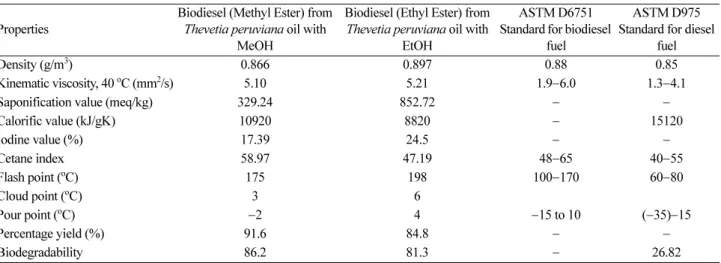
In Table 2, the percentage yield, which is the percentage of the oil that was trans-esterified to ethyl ester, was 84.8%. This result shows that the oil of the seed of The- vetia peruviana can be harnessed for the commercial pro- duction of biodiesel. Both methanolysis and ethanolysis reaction of the seed oils of Thevetia peruviana gave biodiesel yields of 91.6 and 84.8 (%) respectively, which are higher than that of the seed oil of Jatropha curcas ethyl ester, 69.52%.24 Thus, seed oil of Thevetia peruviana is a prom- ising feedstock for biodiesel production.
The cetane index also obtained as indicated in Table 2, is 47.19% for ethyl ester. The value was obtained by calcula- tion using the formula:
Cetane index = 46.3 + ( ) – 0.225 × Iv
Where; Sv = Saponification value and Iv = Iodine value This value falls within the range stipulated for biodiesel TF CF–
--- 100C ×
5458 ---Sv Table 1. Analysis of chemical properties of Thevetia peruviana oil
Quality Parameter Value
Free fatty acid (%) Peroxide value (meq/kg) Iodine value (%)
Saponification value (meq/kg) Density at 30 oC (gcm−3) Acid value (%) Viscosity at 40oC
Oil content of seed cake (%) Moisture content of seed cake (%)
2.4 30.0 12.6 412.3 0.921 4.7
47 67 2.2
by American standard (46–70).27 The value for the pour point and cloud point of the ethyl ester produced (Table 2), falls within the recommended range of −15 to 13oC and
−14 to 16oC by the Department of Energy, USA.17,26 The flash point for FAEE (198oC) obtained from the seed oil of Thevetia peruviana falls within the range (> 60.5 or 37.8oC — depending upon the standard being applied) for combustible liquids16 and hence, its tendencies to cause any fire hazard are low.
The biodegradability obtained for FAEE and FAME after a period of four weeks is shown in Fig. 1. From the graph, it is found that the biodiesel from the seeds of Yellow Ole- ander is environmentally friendly, such that after spillage, it may only take about 28 days for about 81.3 and 86.2%
of FAEE and FAME respectively to be totally degraded. It is not like petrodiesel which will take longer time to degrade to a maximum of 26.82%.15 Zhang et al. (1998)25 explain that biodiesel is more easily metabolized than die- sel because the former is a natural product consisting of pure fatty acids that are hydrocarbon chains with two oxy-
gen atoms attached at one end, which are very biologi- cally active, being recognized and attacked immediately by enzymes such as acetyl-CoA dehydrogenase.
CONCLUSION
It is concluded that biodiesel quality parameters such as flash point (175 and 198oC), saponification value (239.24 and 852.72 Meq/kg), iodine value (17.39 and 24.5%) and kinematic viscosity at 40oC (5.10 and 5.21 mm2/s) for the seed oil of Thevetia peruviana FAME and FAEE respec- tively are in strong agreement with those of ASTM stan- dards. Also the fatty acid esters are biodegradable and thus the seed oil of Thevetia peruviana may be viable feedstock for good fuel which may cause only little effect to the environment in cases of spillage.
Acknowledgments. We wish to appreciate the Chemistry Department of Gombe State University for providing the working space for this research and also for furnishing us with all the reagents used for this research. And we also wish to appreciate the Biology Department of Gombe State University for providing the seeds of Thevetia peruviana Table 2. The quality parameters of Thevetia peruviana oil biodiesel in comparison with those of petro-diesel
Properties
Biodiesel (Methyl Ester) from Thevetia peruviana oil with
MeOH
Biodiesel (Ethyl Ester) from Thevetia peruviana oil with
EtOH
ASTM D6751 Standard for biodiesel
fuel
ASTM D975 Standard for diesel
fuel
Density (g/m3) 0.866 0.897 0.88 0.85
Kinematic viscosity, 40oC (mm2/s) 5.10 5.21 1.9−6.0 1.3−4.1
Saponification value (meq/kg) 329.24 852.72 − −
Calorific value (kJ/gK) 10920 8820 − 15120
Iodine value (%) 17.39 24.5 − −
Cetane index 58.97 47.19 48−65 40−55
Flash point (oC) 175 198 100−170 60−80
Cloud point (oC) 3 6
Pour point (oC) −2 4 −15 to 10 (−35)−15
Percentage yield (%) 91.6 84.8 − −
Biodegradability 86.2 81.3 − 26.82
Figure 1. Biodegradability curve of FAEE and FAME after 28 days.
Table 3. Degradability of biodiesel from Thevetia peruviana oil after 28 days
S/No Days TF % CO2 Evolution
FAEE FAME FAEE FAME
1 0 0.0 0.0 0.00 0.00
2 7 49.0 49.2 20.1 21.2
3 14 51.8 55.6 37.2 59.8
4 21 57.3 58.6 70.1 78.9
5 28 59.15 60.0 81.3 86.2
(Yellow Oleander) for this research work. And the pub- lication cost of this paper was supported by the Korean Chemical Society.
REFERENCES
1. Amigun, B.; von Blottnitz, H. Size Optimization of a Biodiesel Processing Plant: Environmental Process Engi- neering group, University of Cape Town: South Africa, 2005.
2. Pacific Biodiesel. http://www.biodiesel.com/index.php/biodie- sel/history_of_biodiesel_fuel (accessed April 29, 2013).
3. Virgo, J. M. Atlantic Economic Journal 2001, 29, 4.
4. Weller, C. E.; Singleton, L. Economic Policy Institute.
2001, http://www.epi.org/content/fmm/issuebriefs_ib166.
5. Meher, L. C.; Sagar, D. V.; Naik, S. N. Renewable & Sus- tainable Energy Reviews 2006, 10(3), 248–268.
6. Van Gerpen, J. Fuel Process. Technol. 2005, 86, 1097–
1107.
7. Ramadhas, A. S.; Muraleedharan, C.; Jayaraj, S. Renewable Energy 2005, 30, 1789–1800.
8. Lewis, R. J. Sr. Hawley’s condensed chemical dictionary, 12th ed.; Van Nostrand Reinhold Company: New York, 1993.
9. Demirbas, A. Renewable & Sustainable Energy Reviews 2009, 50, 14–34.
10. Rashid, U.; Answar, F.; Moser, B. R. Bioresour. Technol.
2008, 99, 8175–8179.
11. Hosamani, K. M.; Hiremath, V. B.; Keri, R. S. Biomess &
Bioenergy 2009, 33, 267–270.
12. Schinas, P.; Karavalakis, G.; Davaris, C.; Anastopoulos, G.; Karonis, D.; Zannikos, F.; Stournas, S.; Lois, E. Bio- mass & Bioenergy 2009, 33, 44–49.
13. Kansedo, J.; Lee, K. T.; Bhatia, S. Fuel 2009, 88, 1148–
1150.
14. Chapagain, B. P.; Yehoshua, Y.; Wiesman, Z. Bioresour.
Technol. 2009, 100, 1221–1226.
15. Missouri Botanical Garden. www.mobot.org/gardeninghelp (2011) (accessed January 20, 2012), Thevetia peruviana.
16. European Pharmacopoeia 1/2005:2050518.
17. Sahoo, N. K.; Naik, M. K.; Pradhan, S.; Naik, S. N.; Das, L. M. Journal of Biobased Materials and Bioenergy 2012, 6, 3.
18. Adriano, P. M.; Richard, C. T.; Luciano, M. O.; Jonas, C.;
Dejanira, F. A. African Journal of Biotechnology 2008, 7(9), 1323.
19. TNAU Agritech Portal. 2008, www.agritech.tnau.ac.in/seed_
certification (accessed Feb 23, 2012).
20. Robertson, J. A.; Chapman, G. W.; Wilson, R. L. J. Am.
Oil Chem. Soc. 1981, 4(61), 768.
21. Reece, D. L.; Peterson, L. C. A Report on the Idaho Road Vehicle Test with RME and Near Rapeseed Oil as an Alter- native to Diesel Fuel. International summer meeting, Spo- kane, Washington, 1993; SAE paper 93, 5018.
22. Bioenergy Washington. http://www.bioenergy.wa.gov/oil- seed.aspx (accessed May 21, 2012).
23. Sahoo, N. K.; Naik, M. K.; Pradhan, S.; Naik, S. N.; Das, L. M. Journal of Biobased Materials and Bioenergy 2012, 6, 3.
24. Berchman, H. J.; Hirata, S. Bioresour. Technol. 2007, 99, 171.
25. Zhang, X.; Peterson, C. L.; Reece, D.; Haws, R.; Moller, G. Trans. ASAE. 1998, 41, 1423−1430.
26. Oseni, M. I.; Obetta, S. E.; Orukotan, F. V. American Journal of Scientific and Industrial Research 2012, 3(2), 62−68.
27. Biodiesel WWW Encyclopedia. www.bdpedia.com (2006):
Accessed June 11, 2012.