Printed in the Republic of Korea
http://dx.doi.org/10.5012/jkcs.2012.56.2.251
Synthesis and Antidiabetic Evaluation of Benzothiazole Derivatives
Mariappan G*, Prabhat P, Sutharson L, Banerjee J, Patangia U, and Nath S Department of Medicinal Chemistry, Himalayan Pharmacy Institute, Majhitar, Rangpo,
East Sikkim-737136, India. *E-mail: [email protected] (Received February 18, 2012; Accepted March 27, 2012)
ABSTRACT. A novel series of benzothiazole derivatives were synthesized and assayed in vivo to investigate their hypogly- cemic activity by streptozotocin-induced diebetic model in rat. These derivatives showed considerable biological efficacy when compared to glibenclamide, a potent and well known antidiabetic agent as a reference drug. All the compounds were effective, amongst them 3d showed more prominent activity at 100 mg/kg p.o. The experimental results are statistically sig- nificant at p<0.01 and p<0.05 level.
Key words: Benzothiazole, Hypoglycemic activity, Riluzole, Antitumor activity, Diabetes
INTRODUCTION
Benzothiazole ring system is present in various marine and terrestrial natural compounds, which have useful biological activities.1-4 2-Aminobenzothiazoles are highly reactive compounds and extensively utilized as reac- tants or reaction intermediates since the NH2 and endocyclic N functions are suitably situated to enable reactions with various reactants to form a variety of fused heterocyclic compounds. Medicinal chemist atten- tion was drawn to this series when the pharmacological profile of Riluzole5 was observed as clinically available anticonvulsant drug. These derivatives are reported in the literature for the treatment of epilepsy,6-12 inflam- mation,13,14 analgesia,15,16 amyotrophic lateral sclerosis,17 and viral infections.18 They also exhibit antitumour,19-33 antitubercular,34,35 antibacterial,36 antifungal,37 antima- larial,38 antihelmintic.39 2-aryl substituted benzothiazoles have emerged in recent years as an important pharma- cophore in non-invasive diagnosis of alzheimer’s dis- ease.40 Benzothiazole derivatives have been evaluated as potential amyloid-binding diagnostic agents in neuro- degenerative disease41,42 and selective fatty acid amide hydrolase inhibitors.43 They are broadly found in bio organic and medicinal chemistry with applications in drug discovery and development for the treatment of dia- betes.44-52 Diabetes has become an increasing concern to the world’s population. In view of these literatures, it was of considerable interest to synthesize the title com- pound with a hope to obtain potent biologically active and safe oral anti diabetic agents.
RESULT AND DISCUSSION
Chemistry
A congeneric series of benzothiazole derivatives were synthesized as illustrated in Scheme 1. The starting mate-
Scheme 1. Synthesis of benzothiazole derivatives.
Compd. No. -NR1R2 Compd. No. -NR1R2 3a dimethylamino 3f 4- fluoroanilino 3b diethylamino 3g 3-chloroanilino 3c diethanolamino 3h 4-pyridino
3d morpholino 3i 2-pyridino
3e piperidino 3j 4-sulfanilido
rial 2-amino-5-chloro benzothiazole 1 was prepared by the reaction of 4-chloro aniline and potassium thiocyan- ate in glacial acetic acid. The compound 1 was refluxed with chloroacetyl chloride in presence of potassium car- bonate and chloroform to yield 2-chloroacetamido-5- chloro-benzothiazole 2. The condensation of compound 2 with various primary and secondary amines in absolute alcohol and HCl afforded the final compounds 3 (a-j).
Their structures have been elucidated from UV, IR, 1H NMR, mass spectral data and elemental analysis. The physicochemical data of the synthesized compounds are given in Table 1.
Spectral Analysis
A sharp singlet at 2.52-3.40 ppm ascertained the pres- ence of CH2 proton (aliphatic) and a characteristic signal at 7.14-7.60 ppm is assigned to NH proton (benzothiaz- ole) in all the synthesized compounds. A multiplet observed at 6.52-8.15 ppm indicated the presence of aromatic pro- ton in all the compounds. In addition to this, two OH pro- ton of compound 3c exhibited a sharp singlet at 2.48 ppm.
The two sharp singlet signals of morpholine were observed at 2.52 and 3.55 ppm corresponding to two types of CH2
proton in compound 3e. The appearance of signals at 1.53 ppm and 2.50 ppm ascertained the presence of CH2 of pip- eridine. A sharp singlet at 4.06 ppm, 4.46 ppm and 4.49 ppm demonstrated the existence of NH proton (benzene) for the compounds 3f, 3g and 3j respectively. The NH- proton of pyridine ring in 3h and 3i are assigned by sin- glet at 3.37 and 4.47 ppm respectively. Hence, the com- pounds synthesized were in conformity with the structures postulated.
Antidiabetic Evaluation
The LD50 values of the synthesized compounds were estimated to be in the range of 100-1000 mg/kg b.w. STZ
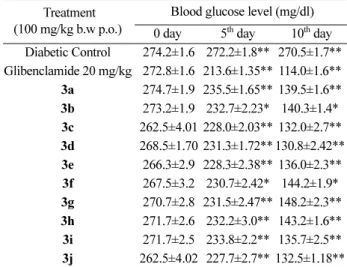
causes diabetes by the rapid depletion of β-cells and thereby bring about a reduction of insulin release4. The results summarized in Table 2 revealed that all the syn- thesized compounds exhibited anti diabetic response at the end of ten-day experimental period. From Table 2, it has been found that oral administration of synthesized compounds 3c, 3d, 3e and 3j caused a more significant reduction in blood glucose than other compounds in dia- betic rats. However, the compound 3d at 100 mg/kg b.w.
exerted maximum glucose lowering effects whereas 3g showed minimum glucose lowering effects. The maxi- mum glucose lowering effects of compound 3d may be due to the presence of heterocyclic amine (morpholine).
The fundamental mechanism underlying hyperglyce- mia in diabetes mellitus involves over-production and decreased utilization of glucose by the tissues. The plau- sible mechanism by which benzothiazole derivatives brought about its hypoglycemic action in diabetic rats might be by potentiating the effect of insulin in plasma by increasing either the pancreatic secretion of insulin from existing beta cells or by its release from bound form. In STZ induced diabetes, induction of diabetes with STZ is associated with characteristic loss of body weight, which is due to increased muscle wasting in diabetes.5 The present study has indicated the fact that benzothiazole derivatives have anti diabetic property and further exploitation of benzothiazole core may afford a safe anti diabetic drug.
Pharmacological Evaluation Acute toxicity studies:
Groups of six albino mice, weighing 20-25 g were fasted Table 1. Physical data of the synthesized compounds 3(a-j)
Comp. No Yield (%) M.P (ºC)
3a 80 196-199
3b 73 190-192
3c 85 201-202
3d 83 156-158
3e 77 193-195
3f 67 198-200
3g 61 193-195
3h 68 190-193
3i 61 167-169
3j 69 204-206
Table 2. Effect of synthesized test compounds 3(a-j) on dia- betic rats
Treatment (100 mg/kg b.w p.o.)
Blood glucose level (mg/dl) 0 day 5th day 10th day Diabetic Control 274.2±1.6 272.2±1.8** 270.5±1.7**
Glibenclamide 20 mg/kg 272.8±1.6 213.6±1.35** 114.0±1.6**
3a 274.7±1.9 235.5±1.65** 139.5±1.6**
3b 273.2±1.9 232.7±2.23* 140.3±1.4*
3c 262.5±4.01 228.0±2.03** 132.0±2.7**
3d 268.5±1.70 231.3±1.72** 130.8±2.42**
3e 266.3±2.9 228.3±2.38** 136.0±2.3**
3f 267.5±3.2 230.7±2.42* 144.2±1.9*
3g 270.7±2.8 231.5±2.47** 148.2±2.3**
3h 271.7±2.6 232.2±3.0** 143.2±1.6**
3i 271.7±2.5 233.8±2.2** 135.7±2.5**
3j 262.5±4.02 227.7±2.7** 132.5±1.18**
All the values were expressed as m±S.E.M (n=6). *p<0.05 and
**p<0.01
overnight and treated per orally with test compounds. The dosage was varied from 100 to 1000 mg kg-1 body weight.
The animals were observed for 24 h for any signs of acute toxicity such as increased or decreased motor activity, tremors, convulsion, sedation, lacrimation etc. No such signs, symptoms and mortality were observed even after 24 h. Hence the LD50 cut off value of the test compounds was fixed at 100 mg/kg. b.w and the same dose was con- sidered for evaluation of anti diabetic activity. All the ani- mal experiments were conducted by the approval of Institutional Animal Ethics Committee, Himalayan Phar- macy Institute, East Sikkim, India. During the study period, guidelines of Committee for the Purpose of Control and Supervision of Experiments on Animals (CPCSEA), Institutional Animal Ethics Committee (IAEC) were fol- lowed for the maintenance of animals.
Antidiabetic Activity
Induction of experimental diabetes by Streptozoto- cin (STZ):
The rats were injected intraperitoneally with streptozo- tocin dissolved in sterile normal saline at a dose of 60 mg kg-1 b.w. The animals showing blood glucose range of 200-300 mg dL-1 were used for the experiment and the hyperglycemia was confirmed after 72 hours of strepto- zotocin injection.
Experimental Design
Animals were divided into 12 groups of 6 animals in each (n=6). Group 1 diabetic animals received 0.5% car- boxy methyl cellulose (CMC) (1 ml); Group 2 diabetic animals received glibenclamide 20 mg/kg. Groups (3-12) diabetic animals received compounds 3a-3j in a single dose of 100 mg/kg b.w p.o respectively for 7 days con- tinuously.
Blood Glucose Measurement
Blood was withdrawn from the tail vein each time. At the end of 0, 3rd, 7th and 10th day, blood sample was with- drawn from a tail vein by snipping the tip of the tail and the blood glucose level was measured by Accu Sure Blood Glucose Monitoring System (Dr. Gene Health & Wellness).
Statistical Analysis
Values are expressed as mean ± SEM. Data were ana- lyzed using analysis of variance and group means were compared with Tukey-Kramer Post ANOVA test. The values were considered to be significant at p<0.05 and p<0.01 level.
EXPERIMENTAL SECTION
All the chemicals were of synthetic grade and commer- cially procured from Qualigen, Mumbai, India. Melting points were determined in open capillary method and are uncorrected. IR spectra were recorded on FT-IR8400S, Fourier Transform (Shimadzu) Infrared Spectrophotom- eter using KBr disc method. The 1H-NMR were recorded on BRUKER ADVANCE-II 400 NMR spectrophotome- ter in DMSO-d6 as a solvent and TMS as an internal stan- dard. Mass spectra were recorded on a PEP-SCIUX-APIQ pulsar (electron pre-ionisation) mass spectrometer. Ele- mental analyses were performed on Perkin-Elmer EAL- 240 elemental analyzer.
General procedure for the synthesis of 6-chloro-1, 3- benzothiazol-2-amine 1
To a required amount of chilled glacial acetic acid, KSCN and 4-chloroaniline were added and placed in freezing mixture. The solution was stirred mechanically with dropwise addition of Br2 in glacial acetic acid at such a rate that temperature does not rise above 5oC. The stir- ring was continued for an additional 3 hr at 0-10oC and the separated hydrochloride salt was filtered, washed with acetic acid and dried. It was dissolved in hot water and neutralized with aqueous ammonia solution (25%). The resulting precipitate was filtered, washed with water and recrystallized from methanol to obtain pure 6-chloro-1, 3- benzothiazol-2-amine.
Synthesis of 2-chloro-N-(6-chlorobenzothiazol-2-yl) acetamide 2
Equimolar quantity of compound 1 and chloroacetyl chloride in sufficient quantity of chloroform was refluxed in the presence of K2CO3 for about 10 hours. Excess sol- vent was removed in vacuum and the residue thus obtained was washed with 5% NaHCO3 and subsequently with water. The resulting crude product was dried and recrystallized from ethanol to furnish white crystal.
Synthesis of N-(6-chlorobenzothiazol-2-yl)-2-(substi- tuted amino) acetamide 3(a-j)
To a solution of compound 2 (0.01 mol) in 25 ml of absolute alcohol was added different secondary and pri- mary amine (0.01 mol). The mixture was refluxed on water bath for 4-6 hours and the completion of reaction was checked by TLC. The crude product thus obtained was filtered, dried and recrystallized from aqueous alco- hol.
N-(6-chlorobenzo[d]thiazol-2-yl)-2-(dimethylamino) acetamide (3a):
Colorless crystal; UV (nm) 225; IR (KBr, cm-1) 3460 (N-H), 3063 (C-H str of CH2), 1531 (C=O), 1444(C=N);
1HNMR (400Hz, DMSO-d6): δ 7.61(s, 1H, NH), δ 2.50 (s, 2H, CH2), δ 3.37(s, 6H, (CH3)2), δ 7.19-7.76 (m, 3H, Ar-H); Mass (m/z) 269; Ana. Calcd. C11H12ClN3OS C, 48.98; H, 4.48; N, 15.58, found C, 49.38; H, 4.58; N, 15.
48%.
N-(6-chlorobenzo[d]thiazol-2-yl)-2-(diethylamino) acetamide (3b):
Colorless crystal; UV (nm) 225; IR (KBr, cm-1) 3456 (N-H), 3091 (CH str of CH2), 1637 (C=O), 1533(C=N);
1H NMR (400 Hz, DMSO-d6): δ 7.61 (s, IH, NH), δ 2.50 (s, 4H, (CH2)2), δ 3.38(s, 6H, (CH3)2) 7.19-7.76 (m, 3H, Ar-H); Mass (m/z) 298; Ana. Calcd. C13H16ClN3OS C, 52.43; H, 5.42; N, 14.11, found C, 52.83; H, 5.12; N, 14.51%.
N-(6-chlorobenzo[d]thiazol-2-yl)-2-(bis (2-hydroxyethyl) amino) acetamide (3c):
Colorless crystal; UV (nm) 226; IR (KBr, cm-1) 3458 (O-H), 3271(N-H), 3093 (C-H str of CH2), 1637 (C=O), 1533(C=N); 1H NMR (400 Hz, DMSO-d6): δ 7.60 (s, 1H, NH), δ 3.39 (s, 2H, CH2), δ 2.49 (s, 8H, 2×(CH2)2), δ 2.48 (s, 2H, 2×OH), δ 7.17-7.74 (m, 3H, Ar-H); Mass (m/z) 329; Ana. Calcd. C13H16ClN3O3S C, 47.34; H, 4.89; N, 12.74; found C, 47.74; H, 4.99; N, 12.64%.
N-(6-chlorobenzo[d]thiazol-2-yl)-2-morpholinoaceta- mide (3d):
Colorless crystal; UV (nm) 215; IR (KBr,cm-1) 3329 (N-H), 3080 (C-H str of CH2),1695 (C=O), 1599 (C=N);
1H NMR (400 Hz, DMSO-d6): δ 7.14(s, 1H, NH), δ 3.62 (s, 2H, CH2), δ 2.52 (s, 4H, 2×CH2 of morpholine), δ 3.55 (s, 4H, 2×CH2 of morpholine), δ 7.42-8.12 (m, 3H, Ar-H); Mass (m/z) 312; Ana. Calcd. C13H14ClN3O2S C, 50.08; H, 4.53; N, 13.48; found C, 50.48; H, 4.83; N, 13.28%.
N-(6-chlorobenzo[d]thiazol-2-yl)-2-(piperidin-1-yl) acetamide (3e):
Pale yellow powder; UV (nm) 224; IR (KBr, cm-1) 3460 (N-H), 3265 (C-H str of CH2), 1639 (C=O), 1433 (C=N),
1H NMR (400 Hz, DMSO-d6): δ 7.60 (s,1H, NH), δ 3.35 (s, 2H, CH2), δ 1.53 (s, 8H, 4×CH2 of piperidine), δ 2.50 (s, 2H, CH2 of piperidine), δ 7.19-7.77 (m, 3H, Ar-H);
Mass (m/z) 309; Ana. Calcd. C14H16ClN3OS C, 54.27; H, 5.21; N, 13.56; found C, 54.67; H, 4.81; N, 13.76%.
N-(6-chlorobenzo[d]thiazol-2-yl)-2-(4-fluoropheny- lamino) acetamide (3f):
Colorless powder; UV (nm) 218; IR (KBr, cm-1) 3365
(N-H), 3178 (C-H str of CH2), 1600 (C=O), 1521 (C=N);
1H NMR (400Hz, DMSO-d6): δ 8.13 (s, 1H, NH), δ 3.36 (s, 2H, CH2), 4.06 (s, 1H, Ar-NH), δ 6.55-8.13 (m, 3H, Ar-H), δ 7.73-7.43 (m, 4H, Ar-H); Mass (m/z) 336; Ana.
Calcd. C15H11ClFN3OS C, 53.65; H, 3.30; N, 12.51; found C, 53.25; H, 3.6; N, 12.91%.
N-(6-chlorobenzo[d]thiazol-2-yl-2-(3-chloropheny- lamino) acetamide (3g):
Colorless powder; UV (nm) 282; IR (KBr, cm-1), 3379 (N-H), 3176 (C-H str of CH2), 1668 (C=O), 1541 (C=N);
1H NMR (400 Hz, DMSO-d6): δ 7.73 (s, 1H, NH), δ 4.04 (s, 2H, CH2), δ 4.46 (s, IH, Ar-NH), δ 6.52-8.14 (m, 7H, Ar-H); Mass (m/z) 352; Ana. Cald. C15H11Cl2N3OS C, 51.15; H, 3.15; N, 11.93; found C, 51.05; H, 3.45; N, 11.73%.
N-(6-chlorobenzo[d]thiazol-2-yl)-2-(pyridin-4-ylamino) acetamide (3h):
Colorless crystal; UV (nm) 224; IR (KBr, cm-1), 3456 (N-H), 3269 (C-H str of CH2), 1637 (C=O), 1533 (C=N);
1H NMR (400 Hz, DMSO-d6): δ 7.61 (s, 1H, NH), δ 2.51 (s, 2H, CH2), δ 3.37 (s, 1H, pyridine-NH), δ 7.19-7.22 (m, 3H, Ar-H), δ 7.28-7.77 (m, 4H, Het. Ar-H); Mass (m/z) 318; Ana. Cald. C14H11ClN4OS C, 52.75; H, 3.48; N, 17.58; found C, 51.43; H, 3.52; N, 17.43%.
N-(6-chlorobenzo[d]thiazol-2-yl)-2-(pyridin-2-ylamino) acetamide (3i):
Brick red powder; UV (nm) 224; IR (KBr, cm-1), 3454 (N-H), 3416 (C-H str of CH2), 1699 (C=O), 1535 (C=N);
1H NMR (400 Hz, DMSO-d6): δ 7.60 (s, 1H, NH), δ 3.36 (s, 2H, CH2), δ 4.47 (s, 1H, pyridine-NH), δ 7.19-7.31 (m, 3H, Ar-H), δ 7.46-8.15 (m, 4H, Het. Ar-H); Mass (m/z) 318; Ana. Cald C14H11ClN4OS C, 52.75; H, 3.48; N, 17.58;
found C, 52.43; H, 3.48; N, 17.43%.
N-(6-chlorobenzo[d]thiazol-2-yl)-2-(4-sulfanilido) aceta- mide (3j):
Colorless crystal; UV (nm) 281; IR (KBr, cm-1), 3180 (N-H), 2993 (C-H str of CH2), 1668 (C=O), 1541 (C=N);
1H NMR (400 Hz, DMSO-d6): δ 8.15 (s, 1H, NH), δ 3.38 (s, 2H, CH2), δ 4.49 (s, 1H, NH), δ 7.46 (m, 2H, SO2NH2), δ7.75-8.15 (m, 7H, Ar-H); Mass (m/z) 397; Ana. Cald C15H13ClN4O3S2 C, 45.40; H, 3.30; N, 14.12; found C, 45.43; H, 3.44; N, 14.22%.
Acknowledgements. The authors are thankful to the Dr. H.P.Chhetri, Director, Himalayan Pharmacy Insti- tute, Majhitar, East Sikkim, India who provided the facilities to carry out the research work. The authors are also grateful to Director, IICB for providing spectral data.
REFERENCES
1. Geewananda, G. P.; Shigeo, K.; Sarath, P. G.; Oliver, J.
M.; Frank, E. K. J. Am. Chem. Soc. 1988, 110(14), 4856.
2. Geewananda, G. P.; Shigeo, K.; Neal, S.B. Tetrahedron Lett. 1989, 30, 4359.
3. Gunawardana, G. P.; Koehn, F. E.; Lee, A. Y.; Clardy, J.;
He, H. Y.; Faulkenr, J. D. J. Org. Chem. 1992, 57(5), 523.
4. Carroll, A. R.; Scheuer, P. J. J. Org. Chem. 1990, 55(14), 4426.
5. Bryson, M.; Fulton, B.; Benfield, P. Drugs. 1996, 52, 549.
6. Chopade, R. S.; Bahekar, R. H.; Khedekar, P. B.; Bhusari, K. P.; Rao, A.R.R. Arch. Pharm. Pharm. Med. Chem.
2002, 8, 381.
7. Yogeeswari, P.; Srisam, D.; Suniljit, L.; Kumar, S.; Sta- bles, J. Eur. J. Med. Chem. 2002, 37, 231.
8. Yogeeswari, P.; Sriram, D.; Mehta, S.; Nigam, D.; Kumar, M.; Murugesan, S. J. Stables II, Farmaco. 2005, 60, 1.
9. Siddiqui, N.; Pandeya, S.; Khan, S.; Stables, J.; Rana, A.;
Alam, M.; Arshad, M.; Bhat, M. Bioorg. Med. Chem. Lett.
2007, 17, 255.
10. Siddiqui, N.; Rana, A.; Khan, S.; Bhat, M.; Haque, S.
Bioorg. Med. Chem. Lett. 2007, 17, 4178.
11. Hays, S. J.; Rice, M. J.; Ortwine, D. F.; Johnson, G.;
Schwartz, R. D.; Boyd, D. K.; opeland, L. F.; Vartanian, M. G.; Boxer, P. A. J. Pharm. Sci. 1994, 83, 1425.
12. He, Y.; Benz, A.; Fu, T.; Wang, M.; Covey, D. F.; Zorum- ski, C. F.; Mennick, S. Neuropharmacology 2002, 42, 199.
13. Gurupadayya, B. M.; Gopal, M.; Padmashali, B.; Vaidya, V. P. Int. J. Heterocyclic Chem. 2005, 15, 169.
14. Sawhney, S. N.; Arora, S. K.; Singh, J. V.; Bansal, O. P.;
Singh, S. P. Indian J. Chem. 1978, 16B, 605.
15. Foscolos, G.; Tsatsas, G.; Champagnac, A.; Pommier, M.
Ann. Pharm. Fr. 1977, 35, 295.
16. (a) Siddiqui, N.; Alam, M.; Siddiqui, A. A. Asian. J.
Chem. 2004, 16, 1005. (b) Bensimon, G.; Lacomblez, L.;
Meininger, V. New Engl. J. Med. 1994, 330, 585.
17. Bensimon, G.; Lacomblez, L.; Meininger, V. New Engl. J.
Med. 1994, 330, 585.
18. Paget, C. J.; Kisner, K.; Stone, R. L.; Delong, D. C. J.
Med. Chem. 1969, 12, 1016.
19. Vicini, P.; Gernonikaki, A.; Incerti, M.; Busonera, B.;
Poni, G.; Cabras, C. A.; Colla, P. L. Bioorg. Med. Chem.
2003, 11, 4785.
20. Caleta, I.; Kralj, M.; Branimir Bertosa, B.; Sanja Tomic, S.; Pavlovic, G.; Pavelic, K.; Karminski-Zamola, G. J.
Med. Chem. 2009, 52, 1744.
21. Chung, Y.; Shin, Y. K.; Zhan, C. G.; Lee, S.; Cho, H.
Arch. Pharmacol. Res. 2004, 27, 893.
22. Yoshida, M.; Hayakawa, I.; Hayashi, N.; Agatsuma, T.;
Oda, Y.; Tanzawa, F.; Iwasaki, S.; Koyama, K.; Furukawa, H.; Kurakata, S. Bioorg. Med. Chem. Lett. 2005, 15, 3328.
23. Bradshaw, T. D.; Stevens, M. F. G.; Westwell, A. D. Curr.
Med. Chem. 2001, 8, 203.
24. Chua, M. S.; Shi, D. F.; Wrigley, S.; Bradshaw, T. D.; Hutch-
inson, I.; Shaw, P. N.; Barrett, D. A.; Stanley, L. A.; Stevens, M. F. G. J. Med. Chem. 1999, 42, 381.
25. O’Brien, S. E.; Browne, H. L.; Bradshaw, T. D.; Westwell, A. D.; Stevens, M. F. G.; Laughton, C. A. Org. Biomol.
Chem. 2003, 1, 493.
26. Bradshaw, T. D.; Wrigley, S.; Shi, D. F.; Schulz, R. J.; Paull, K. D.; Stevens, M. F. G. Br. J. Cancer 1998, 77, 745.
27. Kashiyama, E.; Hutchinson, I.; Chua, M. S.; Stinson, S.
F.; Phillips, L. R.; Kaur, G.; Sausville, E. A.; Bradshaw, T.
D.; Westwell, A. D.; Stevens, M. F. G. J. Med. Chem.
1999, 42, 4172.
28. Hutchinson, I.; Chua, M. S.; Browne, H. L.; Trapani, V.;
Bradshaw, T. D.; Westwell, A. D.; Stevens, M. F. G. J. Med.
Chem. 2001, 44, 1446.
29. Shi, D. F.; Bradshaw, T. D.; Wrigley, S.; McCall, C. J.;
Lelieveld, P.; Stevens, M. F. G. J. Med. Chem. 1996, 39, 3375.
30. Lion, C. J.; Matthews, C. S.; Wells, G.; Bradshaw, T. D.;
Stevens, M. F. G.; Westwell, A. D. Bioorg. Med. Chem.
Lett. 2006, 16, 5005.
31. Mortimer, C. S.; Wells, G.; Crochard, P. J.; Stone, E. L.;
Bradshaw, T. D.; Stevens, A. D.; Westwell, M. F. G. J.
Med. Chem. 2006, 49, 179.
32. Wells, G.; Berry, J. M.; Bradshaw, T. D.; Burger, A. M.;
Seaton, A.; Wang, B.; Westwell, A. D.; Stevens, M. F. G.
J. Med. Chem. 2003, 46, 532.
33. Hutchinson, I.; Jennings, S. A.; Vishnuvajjala, B. R.;
Westwell, A. D.; Stevens, M. F. G. J. Med. Chem. 2002, 45, 744.
34. Khadse, B. G.; Sengupta, S. R. Indian J. Chem. 1993, Sec-B, 407.
35. Palmer, F. J.; Trigg, R. B.; Warrington, J. V. J. Med.
Chem. 1971, 14, 248.
36. Gurupadaiah, B. M.; Jayachandran, E.; ShivaKumar, B.;
Nagappa, A. N.; Nargund, L. V. G. Indian J. Heterocycl.
Chem. 1998, 7, 213.
37. Gopkumar, P.; Shivakumar, B.; Jayachandran, E.; Nagappa, A. N.; Nargund, L. V. G.; Gurupadaiah, B. M. Indian J.
Heterocycl. Chem. 2001, 11, 39.
38. Burger, A.; Sawhey, S. N. J. Med. Chem. 1968, 11, 270.
39. Jayachandran, E.; Bhatia, K.; Naragud, L. V. G.; Roy, A.
Indian Drugs 2003, 40, 408.
40. Weekes, A. A.; Westwell, A. D. Curr. Med. Chem. 2009, 16, 2430.
41. Henriksen, G.; Hauser, A. I.; Westwell, A. D.; Yousefi, B.
H.; Schwaiger, M.; Drzega, A.; Wester, H. J. J. Med. Chem.
2007, 50, 1087.
42.Mathis, C. A.; Wang, Y.; Holt, D. P.; Haung, G. F.; Deb- nath, M. L.; Klunk, W. E. J. Med. Chem. 2003, 46, 2740.
43. Wang, X.; Sarris, K.; Zhang, K. Kage, D.; Brown, S. P.;
Kolasa, T.; Surowy, C.; ElKouhen, O. F.; Muchmore, S.
W.; Brioni, J. D.; Stewart, A. O. J. Med. Chem. 2009, 52, 170.
44. Suter, H.; Zutter, H. Helv. Chim. Acta 1967, 50, 1084.
45. Diaz, H. M.; Molina, R. V.; Andrade, R. O.; Coutino, D.
D.; Franco, L. M.; Webster, S. P.; Binnie, M.; Soto, S. E.;
Barajas, M. I.; Rivera, I. L.; Vazquez, G. N. Bioorg. Med.
Chem. Lett. 2008, 18, 2871.
46. Nitta, A.; Fujii, H.; Sakami, S.; Nishimura, Y.; Ohyama, T.; Satoh, M.; Nakaki, J.; Satoh, S.; Inada, C.; Kozono, H.; Kumagai, H.; Shimamura, M.; Fukazawa, T.; Kawai, H. Bioorg. Med. Chem. Lett. 2008, 15, 5435.
47. Vazquez, G. N.; Paoli, P.; Rivera, I. L.; Molina, R. V.; Franco, J. L. M.; Andrade, R. O.; Soto, S. E.; Camici, G.; Coutiño, D. D.; Ortiz, I. G.; Mayorga, K. M.; Díaz, H. M. Bioorg.
Med. Chem. Lett. 2009, 17, 3332.
48. Su, X.; Vicker, N.; Ganeshapillai, D.; Smith, A.; Purohit, A.; Reed, M. J.; Potter, B. V. Mol. Cell Endocrinol. 2006,
248, 214.
49. Barf, T.; Vallgarda, J.; Emond, R.; Haggstrom, C.; Kurz, G.; Nygren, A.; Larwood, V.; Mosialou, E.; Axelsson, K.;
Olsson, R.; Engblom, L.; Edling, N.; Ronquist-Nii, Y.; Ohman, B.; Alberts, P.; Abrahmsen, L. J. Med. Chem. 2002, 45, 3813.
50. Fujieda, H.; Usui, S.; Suzuki, T.; Nakagawa, H.; Ogura, M.; Makishima, M.; Miyata, N. Bioorg. Med. Chem. Lett.
2007, 17, 4351.
51. Jeon, R.; Kim, Y. J.; Cheon, Y.; Ryu, J. H. Arch. Phar- macal Res. 2006, 29, 394.
52. Pattan, S. R.; Suresh, C.; Pujar, V. D.; Reddy, V. V. K.;
Rasal, V. P.; Koti, B. C. Indian. J. Chem. 2005, 44B, 2404.