신규 한천분해세균 Maribacter sp. SH-1의 분리 및 효소 특성조사
이창은1, 이솔지2, 이동근2, 이상현1,2*
1신라대학교그린화학융합공학과
2신라대학교바이오과학과
Received: November 11, 2015 / Revised: April 14, 2016 / Accepted: May 2, 2016
서 론
한천(agar)은홍조류에서추출한친수콜로이드로바다에
서식하는대형홍조류인우뭇가사리, 해지누아리, 석무및꼬 시래기등의주요세포벽구조성분이다[2, 5, 7, 21]. 한천은 agarose와 agaropectin으로 구성되어 있으며, agarose는 1→3 결합으로연결된β-D-galactopyranose와 1→4 결합으 로연결된 3,6-anhydro-α-L-galactose가교대로결합된중합 체이다. Agaropection에는 agarose와달리 sulfoxy, methoxy 및 pyruvate 잔기 등에 의해서 수식된 3,6-anhydro-α-L-
galactose가존재한다[22, 23].
한천분해효소인 agarase에의한분해생성물인한천올리고 당은생리활성이높아화장품, 의약품및건강기능성식품에 널리사용되고있으며, 당뇨병, 난소화성, 비만, 변비등의예 방과치료에도효과가있다고알려져있다[6, 10, 12, 21]. 고 부가가치소재로서의활용가능성이높은한천올리고당을 생산하기위한 방법으로는산가수분해법과한천분해효소 (agarase)를이용하는효소적가수분해법이있는데[8], 산가 수분해법은무작위로한천을분해하므로, 한천올리고당의기 능성및안정성이확보되기어렵고, 효소적가수분해법은선 택적으로한천을분해하므로활성형올리고당을생산하는데
유용한것으로알려져왔다[10]. 한천분해효소는한천의α-
1, 3 결합을 끊어 agarooligosaccharides를 생산하는 α- agarase와β-1, 4 결합을끊어 neoagarooligosaccharides를 Isolation of a New Agar Degrading Bacterium, Maribacter sp. SH-1 and Characterization of its Agarase
Chang-Eun Lee1, Sol-Ji Lee2, Dong-Geun Lee2, and Sang-Hyeon Lee1,2*
1Department of Green-Chemistry Convergence Engineering, 2Department of Bioscience, Graduate School, Silla University, Busan 46958, Republic of Korea
In this study, we isolated a new agar-degrading marine bacterium and characterized its agarase. An agar- degrading marine bacterium SH-1 was isolated from seawater, collected from the seashore of Namhae in Gyeongnam province, Korea, and cultured in marine agar 2216 media. It was identified as Maribacter. sp.
SH-1 by phylogenetic analyses, based on 16S rRNA gene sequence. The extracellular agarase was extracted from culture media of Maribacter sp. SH-1 and characterized. Its relative activities were 56, 62, 94, 100, and 8% at 20, 30, 40, 50, and 60°C, respectively, whereas 15, 100, 60, and 21% relative activities were observed at pH 5, 6, 7, and 8, respectively. Its extracellular agarase exhibited maximum activity (231 units/l) at pH 6.0 and 50°C, in 20 mM Tris-HCl buffer. Therefore, this agarase would be applicable as it showed the maximum activity at the temperature at which the agar is in a sol state. Furthermore, the agarase activities remained over 90% at 20, 30, and 40°C after 0.5 h exposure at these temperatures. Thin layer chromatography analysis suggested that Maribacter sp. SH-1 produces extracellular β-agarase, as it hydrolyzes agarose to produce neoagarooligosaccharides, such as neoagarohexaose (34.8%), neoagarotetraose (52.2%), and neoagarobiose (13.0%). Maribacter sp. SH-1 and its β-agarase would be useful for the production of neoagarooligosaccha- rides, which shows functional properties, like skin moisturizing, skin whitening, inhibition of bacterial growth, and delay in starch degradation.
Keywords: Agar-degrading bacterium, β-agarase, marine bacterium, Maribacter sp. SH-1, neoagarooligosaccharides
*Corresponding author
Tel: +82-51-999-5624, Fax: +82-51-999-5636 E-mail: [email protected]
© 2016, The Korean Society for Microbiology and Biotechnology
생산하는 β-agarase로 나뉜다. α-agarase가 생산하는 agarooligosaccharides는항산화효과와항암활성을가지고 있으며, β-agarase가생산하는 neoagarooligosaccharides는 세균성장억제, 전분노화방지, 대식세포활성화, 보습효과 및미백효과를가지므로, 의약품, 건강기능식품등에이용될 수있다[3, 7, 12].
따라서고기능성인한천분해산물의생산을위해한천분해 효소를생산하는균주에대한연구들이많이이루어지고있
으며특히β-agarase에관한연구가최근까지많이보고되
고 있다. 지금까지 보고된 균주로는 Cellvibrio 속[3], Alteromonas 속[4], Microbulbifer 속[11], Pseudoalteromonas 속[14, 20], Flammeovirga 속[8], Glaciecola 속[17], Thalassomonas 속[16], Neiella 속[18] 등이있으며, 이균주
들이생산하는β-agarase의효소학적특성규명이두드러지
게연구되고있는상태이다.
한편, 기질이고체보다는액체상태그리고 gel 상태보다는
sol 상태일때효소에의한반응이원활히일어난다. 한천은
45oC 이상의온도에서 sol 상태에있다[8]. 따라서 45oC 이 상의고온에서활성이있는한천분해효소를생산하는균주 를탐색하는것은중요하다.
본연구에서는 45oC 이상의온도에서활성이우수한한천 분해효소를생산하는미생물을분리하기위하여국내연안 의해수로부터한천분해세균을분리하고동정하였으며이 세균이생산하는한천분해효소의생화학적특성을조사하였 고산업적적용가능성이높을것으로판단하였다.
재료 및 방법
한천분해 균주의 분리 및 동정
경상남도남해군미조면연안에서한천분해활성을가지는 세균의 분리를 위한 시료를 채취하였으며, Marine broth 2216 (Difco, USA) 배지에 한천을 첨가한 Marine agar 2216 배지에시료액을도말한후 30oC에서배양하면서한천 분해활성으로 Marine agar 2216 배지를함몰시키는 SH-1 균주를 3차례이상순수분리하여선별하였다. 순수분리된균 체로부터 Wizard Genomic DNA Isolation Kit (Promega, WI, USA)를 사용하여 genomic DNA를 획득하고, 16S
rDNA 유전자단편을증폭하기위한 PCR 반응의주형으로
사용하였다. PCR primer로는 27F (5'-AGA GTT TGA TCM TGG CTC AG-3')와 1492R (5'-TAC GGH TAC CTT GTT ACG ACT T-3')를사용하였으며, 증폭된 DNA 단편은 PCR/Gel Combo Kit (NucleoGen, Korea)로 정제하였다. DNA 염기서열분석은 Cosmo Genetech (Korea)에서수행하 였다. 분석된염기서열은 BLAST를사용하여보고된균주들 과유사도를검토하였으며, Clustal 프로그램(ClustalW2)을
이용하여 다중염기배열(multiple alignment)을 수행한 후 Neighbor-joining method와 Bootstrap method (n = 1,000) 로분석하여계통분류학적위치를파악하였다.
한천분해 균주의 배양
Marine broth 2216 배지 4 ml에순수분리한 SH-1 균주를 접종한후진탕배양기를이용하여 30oC, 250 rpm에서하룻 동안 진탕배양한 후, 0.2% (w/v)의 agar가 첨가된 Marine broth 2216 배지 50 ml가들어있는삼각플라스크에서진탕 배양기를이용하여 30oC, 250 rpm에서 3일동안진탕배양 하였다.
배양시간에 따른 한천분해 균주의 생육과 효소활성 측정 Marine broth 2216 배지 100 ml에 0.2% (w/v)의 agar를 첨가한후 SH-1 균주를접종하여 30oC, 250 rpm에서진탕 배양하였고, 12시간마다일부배양액을수득하여시간에따 른한천분해균주의생육과효소의활성을측정하였다. 조효소액의 제조
배양액을원심분리하여(3,000 ×g, 4oC, 15 min) 균체를제 거한 후 얻어진 상층액 15 ml를 Snake Skin Dialysis Tubing (Thermo Scientific, USA)에넣고 l L 비커에 20 mM Tris-HCl (pH 7.0)를 900 ml 첨가하고, 4oC인냉장실에서 2시간마다 20 mM Tris-HCl (pH 7.0)를갈아주는것을 2번 반복한후 3번째에는 12시간이상투석을시행하였다. 투석 이완료된조효소액은 membrane filter (0.45 μm, Milipore, USA)를통과시킨후에 4oC에서냉장보관하였다.
효소활성 측정
Agarase 활성은 DNS법을이용하여측정하였다. DNS법 은 3,5-dinitrosalicylic acid method의변형법[4]으로환원당 을측정하는방법이다. DNS solution은 NaOH 13.2 g, 3,6- dinitrosalicylic acid 7.07 g, sodium sulfate 5.53 g, potassium tartrate (Rochelle salt) 204 g, phenol 5.07 g을증류수 1 L 에녹여서제조하였다. 1 ml의효소반응액에 3 ml의 DNS solution을첨가하여 100oC에서 10분간가열한후 550 nm 의파장에서 흡광도를측정하였다. 표준적정곡선으로 D- galactose를 사용하였다. 한천분해 효소의 활성은 1분당 1μM의 galactose를생산하는한천분해효소의양을 1 unit (U)으로나타내었다.
pH에 따른 한천분해 효소의 활성측정
pH에 따른 한천분해 효소의 활성을 측정하기 위하여
20 mM sodium acetate 완충용액(pH 4.0−5.0), 20 mM Tris- HCl 완충용액(pH 5.0−8.0), 20 mM GTA (3,3-dimethyl-
glutamic acid, Tris (hydroxymethyl)-aminomethane, 2- amino-2-methyl-1,3-propanediol) 완충용액(pH 8.0−9.0)을 이용하였다. 0.2% (w/v)의 agarose가포함된모든완충용액 을중탕가열한후 40oC를유지하면서완충용액 1 ml에조
효소액 0.5 ml을첨가하여 30분간반응시킨후효소활성을
측정하였다.
반응온도에 따른 한천분해 효소의 활성측정
조효소액을이용하여온도에따른한천분해효소의활성을 비교하였다. 표준기질용액으로는 0.2% (w/v)의 agarose가 포함된 20 mM Tris-HCl (pH 6.0) 완충용액을이용하였다. 기질용액을중탕가열한후 20−70oC의온도별로냉각하였 다. 기질용액 1.0 ml에조효소액 0.5 ml를첨가하여각온도 에서 30분간반응시킨후효소활성을측정하였다.
한천분해 효소의 열안정성 측정
조효소액을이용하여온도에따른한천분해효소의활성을 비교하였다. 표준기질용액으로는 0.2% (w/v)의 agarose가 포함된 20 mM Tris-HCl (pH 6.0) 완충용액을이용하였다. 조효소액 0.5 ml를첨가하여각온도별로 30분열처리한후, 기 질용액 1.0 ml를첨가하여 30분간반응시켰다. 측정된효소 활성은열처리전의효소활성과비교하였다.
한천가수분해산물의 thin-layer chromatography (TLC) 분석
효소액을이용한 agarose의분해산물을 TLC로분석하였
다. 조효소액과 0.2% (w/v)의 agarose가 포함된 20 mM Tris-HCl (pH 6.0) 완충용액을 50oC에서 0, 0.25, 0.5, 1.5, 6, 13시간 반응시킨 후, Silica Gel 60 TLC Plate (Merck,
Germany)로분석을수행하였다. n-Butanol/acetic acid/H2O (2/1/1 (v/v/v))를이용하여전개시켰고, 10% (v/v) H2SO4로 가시화시켰다. 표준물질로는 D-galactose (Sigma) 및 neoagarooligosaccharides [15]를사용하였다. TLC에서나 타난가수분해산물의농도를계산하기위하여 Image J 1.44 (Wayne Rasband, USA)를이용하여측정하였다.
결과 및 고찰
한천분해균주의 분리 및 동정
경상남도남해군미조면연안의해수시료를 Marine agar
2216 배지에도말하여한천분해능이우수한균주를선별하
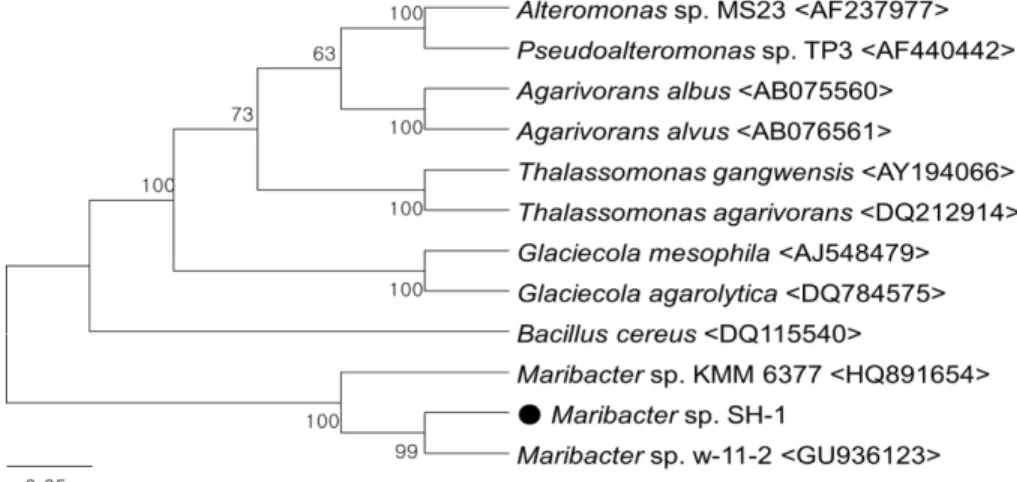
였다. 함몰이일어난부위의균을멸균된백금이를이용하여 Marine agar 2216 배지에 3차례이상 streaking하여균주를 순수분리하였다. 분리된한천분해능 SH-1 균주의 16S rDNA 염기서열분석결과 1,465 bp의염기서열을얻었고, BLAST 탐색으로 Maribacter sp. KMM 6377 및 Maribacter sp. w- 11-2와 99%의가장높은상동성을나타냈으므로, 분리균주 를 Maribacter sp. SH-1으로명명하였다. 본연구와 Genbank 에서획득한 16S rDNA 염기서열을 Neighbor-joining method 와 Bootstrap method (n = 1,000)로분석하여나타난본연 구균주의계통분류학적위치를 Fig. 1에나타냈다.
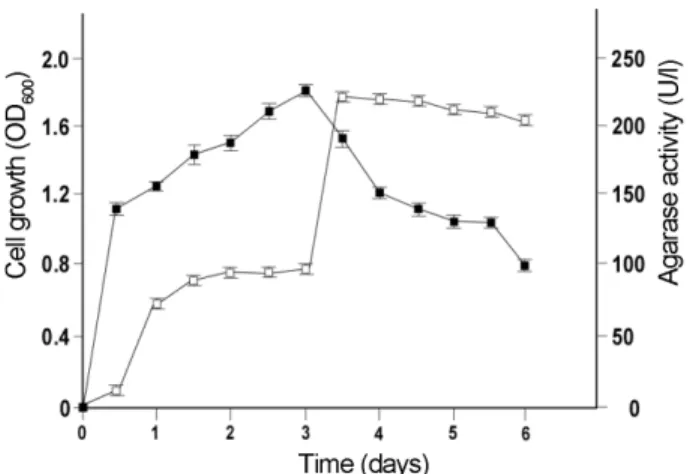
시간에 따른 한천분해 균주의 생육과 효소활성 측정 Marine broth 2216 배지 100 ml에 0.2% (w/v)의 agar를 첨가한후 SH-1 균주를접종하여 30oC, 250 rpm에서진탕 배양하였을때나타나는생육양상과효소활성을 Fig. 2에나 타냈다. 시간에따른한천분해균주의생육과효소활성의측 정결과를살펴보면, 72시간까지균의수가증가하는대수기
Fig. 1. Phylogenetic tree based on almost complete 16S rDNA sequence comparing isolated Maribacter sp. SH-1 strain with other bacteria. The numbers at the branch node are percentages of bootstrap values (n = 1,000) and numbers in parenthesis are num- bers in GenBank.
로나타났으며, 이후성장이지체되었다. 배양시간에따른 배양액으로외분비된 agarase의활성도를측정한결과, 배양 12시간이후부터균증식속도와비례적으로활성도가증가 하며 배양 72시간까지 최대의 활성을 보여 주었다. Maribacter sp. SH-1 균주의한천분해효소는성장의존성산 물로확인되었고, 이후의연구에서는 72시간까지진탕배양 하여생성된효소액을활성측정에이용하였다.
pH에 따른 한천분해효소의 활성
각 pH에서의한천분해효소의활성을 Fig. 3에나타냈다. 사용한 완충용액과 pH 중 최고의 활성을 나타내는 것은 pH 6.0의 20 mM Tris-HCl 완충용액으로나타났다. 또한,
20 mM Tris-HCl 완충용액으로활성을측정하였을때 pH
7.0에서한천분해상대활성이 pH 6.0에서의최고활성에비
해 60% 이상이었다. 균주에따른한천분해효소의활성에있
어서의 최적 pH는 Pseudoalteromonas sp. CY-24의 경우 pH 6.5이었고[20], Microbulbifer sp. SD-1의경우 pH 6.0 이었으며[11], Bacillus cereus ASK202의경우 pH 7.8 [6], Agarivorans albus YKW-34 [5], Glaciecola sp. SL-12 [17]와 Thalassomonas sp. SL-5 [16] 및 Sphingomonas paucimobili AS-1 [10], 해양성 SH-1 균주[18]와 Alteromonas macleodii subsp. GNUM08120 [4]의경우는모두 pH 7.0으로균주에 따른한천분해효소의다양한최적 pH가보고되어있다. 온도에 따른 한천분해효소의 활성
최적 pH인 pH 6.0의 20 mM Tris-HCl 완충용액을사용하 였을때각온도에서의한천분해효소의활성을 Fig. 4에나 타냈다. 본효소는 50oC에서최고활성을보였으며배양액에 서구한활성은 231 U/l로나타났다. 가장높은활성을나타 낸 50oC의반응온도에서나타난효소활성을 100%로하였을 때, 40oC에서 94%, 30oC에서 62%의상대활성을갖는것으 로나타났다(Fig. 4). 이러한결과로 Maribacter sp. SH-1가 생산하는한천분해효소는비교적높은온도인 50oC에서가 장활성이높았다. 균주에따른한천분해효소의온도별최 적활성은 Glaciecola sp. SL-12 [17], Agarivorans albus YKW-34 [5]와 Microbulbifer sp. SD-1 [11]는 30oC에서, 해양성 SH-1 균주[18], A. macleodii subsp. GNUM08120 [4], Pseudoalteromonas sp. CY-24 [20], Thalassomonas sp. SL-5 [16]와 Sphingomonas paucimobili AS-1 [10]는 Fig. 2. Cell growth and agarase activity of Maribacter sp. SH-
1. (■ agarase activity [units/l], □ cell growth [OD600]).
Fig. 3. Effect of pH on agarase activity. (■ 20 mM sodium acetate, pH 4.0−5.0; Δ 20 mM Tris-HCl, pH 5.0−8.0; ● 20 mM GTA, pH 8.0−9.0). The reactions were carried out at 30oC in 1 ml of corresponding buffer containing 0.2% agar and 0.5 ml of enzyme solution for 30 min. The values obtained at pH 6.0 were taken to be 100%. All data shown are mean values from at least three replicate experiments.
Fig. 4. Effect of reaction temperature on agarase activity. The reactions were carried out at 20, 30, 40, 50, 60 and 70oC in 1 ml of 20 mM Tris-HCl (pH 6.0) buffer containing 0.2% agar and 0.5 ml of enzyme solution for 30 min. The values obtained at 50°C were taken to be 100%. The relative activities are the averages from three independent experiments.
40oC에서나타났는데, 본연구에서분리한 Maribacter sp.
SH-1 균주유래의한천분해효소는이들보다는 5−15oC 정도 높은온도에서최적활성을나타내는것을알수있었다. 고 체한천을가열하여녹인한천용액은 45oC 이하의온도에서 는 gel이 되는데[8], Bannikova 등[1]은 고온성세균인 Thermoanaerobacter와 Caldoanaerobacter 속세균이 50oC 이상에서한천분해활성이우수한효소를생산한다고보고하 였다. 하지만이들은혐기성세균으로다량의효소를혐기적 으로생산하는데어려움이있으며한천분해유전자의재조합 발현에 대한 보고도 아직 없다. 한편 무작위 돌연변이 (random mutagenesis)와부위특이적돌연변이(site-directed
mutagenesis)를통해한천분해효소의최적온도와열안정성
을상승시킨보고도있었다[9, 19].
본연구의 Maribacter sp. SH-1 유래의한천분해효소는 45oC 이상의온도에서도높은활성을나타내므로기질인한
천이 sol 상태의조건에서분해반응을수행할수있어보다
효율적인한천분해공정의개발이가능할것으로기대된다. 또한, 한천분해활성의강도에있어서도 Maribacter sp. SH- 1 유래한천분해효소의최고활성이 231 U/l로 Thalassomonas sp. SL-5 [16]의 363 U/l보다는낮지만 Glaciecola sp. SL- 12 [17]의 233 U/l와비슷한활성을나타내는것을확인할수 있었다.
한천분해효소의 열안정성
Maribacter sp. SH-1 유래 한천분해효소의 열안정성을 Fig. 5에나타냈다. 20, 30, 40oC에서는 30분의열처리를하 여도열처리하지않은효소에비해 90% 이상의상대활성을
유지하였지만 50oC에서는 30분간열처리를하였을때열처
리하지않은효소활성에비해 50% 이상의상대활성을보였
다. 돌연변이법을통해열안정성을향상시킨다면산업적활 용가치를더욱높일수있을것이다[9, 19].
한천가수분해산물의 TLC 분석
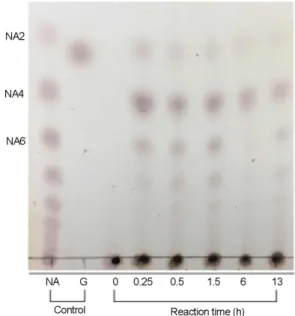
Maribacter sp. SH-1 균주를 3일간배양하여제조된조효 소액에 0.2% (w/v)의 agarose를기질로첨가하여시간별로 반응시킨후 TLC로분석한결과를 Fig. 6에나타냈다. 한천 혹은 agarose를기질로사용하면β-agarase는 neoagarohexaose, neoagarotetraose 및 neoagarobiose 등의 neoagarooligo- saccharides를생성할수있으며, α-agarase는 agaropentose 및 agarotriose등의 agarooligosaccharides를 생성할 수 있다 [7]. Maribacter sp. SH-1 균주가생산하는한천분해효소의 가수분해산물을 TLC로분석한결과, 주로 neoagarotetraose (NA4) 및 neoagarohexaose (NA6)를생산하고, neoagarobiose
(NA2)도일부생산하는것으로나타났다. 시간에따른가수
분해산물의농도를측정한결과, 0.25시간의반응에서이미 NA2, NA4, NA6 등의산물이형성되었고 6시간째에 NA6 이상의산물이줄어드는것으로나타났지만 13시간째를보면 다시 NA6 이상의산물이증가하였다(Fig. 6). 각시간에서생 산된가수분해산물의합을 100%로하여 NA2, NA4 등의상 대비율을보면가수분해산물은비슷한비율로농도가유지되
Fig. 5. Heat stability of agarase activity. The enzyme solutions were pre-incubated at 20, 30, 40, 50, 60 and 70oC for 0, 0.5, 1.0, 1.5 and 2.0 h. The reactions were then carried out at 50oC in 1 ml of 20 mM Tris-HCl (pH 6.0) buffer containing 0.2% agar and 0.5 ml of heat-treated enzyme solution for 30 min. The agarase activ- ities were remained over 90% at 20, 30 and 40oC after 0.5 h expo- sure at that temperatures.
Fig. 6. TLC analysis of the hydrolyzed products of agarose by agarase. The reactions were carried out at 50oC in 20 mM Tris- HCl (pH 6.0) buffer containing 0.2% agar and 0.5 ml of enzyme solution for 0, 0.25, 0.5, 1.5, 6 and 13 h. The reaction mixtures were developed by TLC. (G, D-galactose; NA, neoagarooligosac- charides; NA2, neoagarobiose; NA4, neoagarotetraose; NA6, neoagarohexaose).
었으며, 평균적으로 neoagrotetraose (52.2%) neoagrohexaose (34.8%), 및 neoagarobiose (13.0%) 순으로생산되었다. 따라 서, Maribacter sp. SH-1 균주의한천분해효소는일정한비 율로 neoagarooligosaccharides에 속하는 neoagarobiose, neoagarotetraose 및 neoagarohexaose를생산하는것으로 보아본효소가β-agarase임을알수있었다[18]. 본연구의 결과들로파악하면 Maribacter sp. SH-1 균주와한천분해효 소를이용하여보습및미백효과, 세균성장억제, 전분노화 방지및대식세포활성화기능을가진소재의개발과이용 이가능할것으로판단된다[13, 15].
요 약
본연구에서는신규해양성한천분해균을분리하고, 이균 주가생성하는한천분해효소의특성을조사하였다. 경상남
도 남해군 미조면 연안에서 채취한 해수를 Marine agar
2216 배지에도말하여한천분해세균을선별하였다. 선택된
한천분해균주는 16S rDNA 염기서열분석을통해 Maribacter 속세균과 99% 유사하여 Maribacter sp. SH-1으로명명하 였다. 세포외로분비되는 agarase는 Maribacter sp. SH-1 균주배양액에서획득하였으며, 이를이용하여특성을조사 하였다. Maribacter sp. SH-1 균주의 한천분해효소는 20, 30, 40, 50 및 60oC에서각각 56, 62, 94, 100, 8%의상대활 성을 나타냈으며, pH 5, 6, 7 및 8에서 각각 15, 100, 60, 21%의상대활성을나타냈다. 세포외 agarase는 50oC, pH 6 인 20 mM Tris-HCl buffer를사용하는조건에서최대활성 (231 units/l)을보였다. 한천이 sol 상태로존재하는 50oC에 서최적활성을보여이효소는응용가능성이높다고할것 이다. 효소활성은 20, 30 및 40oC에서 30분동안열처리하 였을때약 90% 이상의상대활성을보였다. TLC 분석결과, Maribacter sp. SH-1 균주의한천분해효소는한천올리고당 인 neoagarohexaose (34.8%), neoagarotetraose (52.2%) 및 neoagarobiose (13.0%)를 생성하는 것으로 보아 β- agarase로확인되었다. 따라서 Maribacter sp. SH-1 균주와 이균주가생산하는β-agarase는보습효과, 미백효과, 세균 성장억제혹은전분노화방지등의기능을가지는한천올 리고당의생산에유용할것으로기대된다.
References
1. Bannikova GE, Lopatin SA, Varlamov VP, Kuznetsov BB, Kozina IV, Miroshnichenko ML, et al. 2008. The thermophilic bacteria hydrolyzing agar: characterization of thermostable agarase. J.
Biol. Chem. Microbiol. 44: 366−369.
2. Cha JA. 2009. Isolation and enzymatic properties of agarolytic bacteria. M.S. Dissertation. Chungnam National University,
Dajeon, Korea.
3. Cha JA, Kim YJ, Seo YB, Yoon MH. 2009. Isolation of an agarolytic bacteria, Cellvibrio mixtus SC-22 and the enzymatic properties.
J. Appl. Biol. Chem. 52: 157−162.
4. Chi WJ, Lim JH, Park DY, Kim MC, Kim CJ, Chang YK, et al. 2013.
Isolation and characterization of a novel agar degrading bacte- rium, Alteromonas macleodii subsp. GNUM08120, from red macroalgae. Korean J. Microbiol. Biotechnol. 41: 8−16.
5. Fu XT, Pan CH, Lin H, Kim SH. 2009. Gene cloning, expression, and characterization of a beta-agarase, agaB34, from Agariv- orans albus YKW-34. J. Microbiol. Biotechnol. 19: 257−264.
6. Hong JH, Lee JJ, Choi HS, Hur SH, Kong JY. 2000. Antibacterial activity of agarooligosaccharides produced by β-agarase from Bacillus cereus ASK 202. J. Fd. Hyg. Safety. 15: 277−281.
7. Hou Y, Chen X, Chan Z, Zeng R. 2015. Expression and character- ization of a thermostable and pH-stable β-agarase encoded by a new gene from Flammeovirga pacifica WPAGA1. Process Bio- chem. 50: 1068−1075.
8. Jang HJ, Lee DG, Lee SW, Jeon MJ, Chun WJ, Kwon KK, et al.
2011. Isolation of a marine-derived Flammeovirga sp. mbrc-1 strain and characterization of its agarase. Korean Soc. Biotech- nol. Bioeng. J. 26: 552−556.
9. Jang MK, Lee SW, Lee DG, Kim NY, Yu KH, Jang HJ, et al. 2010.
Enhancement of the thermostability of a recombinant beta- agarase, AgaB, from Zobellia galactanivorans by random muta- genesis. Biotechnol. Lett. 32: 943−949.
10. Jung IS. 2007. Purification and characterization of agarase pro- duced from marine bacterium, Sphingomonas paucimobilis AS-1 and Aligibacter lectus AS-3. M.S. Dissertation. Silla University, Busan, Korea.
11. Kim DK, Jang YR, Kim KH, Lee MN, Kim AR, Jo EJ, et al. 2011. Isola- tion and culture properties of a thermophilic agarase-producing strain, Microbulbifer sp. SD-1. Fish Aquat. Sci. 14: 186−191.
12. Kim YJ. 2010. Properties of the agarase and its gene isolated from a marine bacterium, Tamlana agarivorans. M.S. Dissertation.
Chungnam National University, Taejon, Korea.
13. Kim YN. 2011. Isolation and purification of new agarase from marine bacterium. M.S. Dissertation. Kyungsang National Univer- sity, Jinju, Korea.
14. Kim YN, Jeong YK, Kim MC, Kim SB, Chang YK, Chi WJ, et al. 2012.
Isolation and identification of agarose-degrading bacterium, Pseudoalteromonas sp. GNUM08122. Korean J. Microbiol. Biotech- nol. 40: 1−9.
15. Lee DG, Jang MK, Lee OH, Kim NY, Ju SA, Lee SH. 2008. Over-pro- duction of a glycoside hydrolase family 50 β-agarase from Aga- rivorans sp. JA-1 in Bacillus subtilis and the whitening effect of its product. Biotechnol. Lett. 30: 911−918.
16. Lee DG, Kim NY, Jang MK, Lee OH, Lee SH. 2007. Isolation and characterization of a marine bacterium Thalassomonas sp. SL-5 producing β-agarase. J. Life Sci. 17: 70−75.
17. Lee DG, Lee OH, Jang JH, Jang MK, Yoo KH, Lee SH. 2008. Isola- tion and characterization of a marine derived bacterium Gla- ciecola sp. SL-12 producing β-agarase. J. Life Sci. 18: 58−62.
18. Lee JH, Lee SY. 2014. Isolation and characterization of marine bacterial strain SH-1 producing agar-degrading enzymes.
Korean J. Microbiol. Biotechnol. 42: 324−330.
19. Lee SW, Lee DG, Jang MK, Jeon MJ, Jang HJ, Lee SH. 2011.
Improvement in the catalytic activity of β-agarase AgaA from Zobellia galactanivorans by site-directed mutagenesis. J. Micro- biol. Biotechnol. 21: 1116−1122.
20. Lu X, Chu T, Wu Q, Gu Y, Han F, Yu W. 2009. Cloning, expression and characterization of a new agarase-encoding gene from marine Pseudoalteromonas sp. Biotechnol. Lett. 31: 1565−1570.
21. Song T, Cao Y, Wu H, Zhang W, Fei B, Qiao D, et al. 2014. Purifica- tion and characterization of a novel β-agarase of Paenibacillus sp. SSG-1 isolated from soil. J. Biosc. Bioeng. 118: 125−129.
22. Suzuki H, Sawai Y, Suzuki T, Kawai K. 2003. Purification and char- acterization of an extracellular β-agarase from Bacillus sp. MK03.
J. Biosc. Bioeng. 95: 328−334.
23. Yang M, Mao X, Liu N, Qiu Y, Xue Y. 2014. Purification and charac- terization of two agarase from Agarivorans albus OAY02. Process Biochem. 49: 905−912.