Petrous Carotid Aneurysm Causing Pulsatile Tinnitus: Case Report and Review of the Literature
Seong-Mook Kim, Chang-Hyun Kim, Chang-Young Lee
Department of Neurosurgery, Dongsan Medical Center, Keimyung University School of Medicine, Daegu, Korea
We present the case of a patient who developed pulsatile tinnitus that was found to be associated with a petrous carotid aneurysm. The aneur- ysm was successfully obliterated using stent-assisted coiling, after which the patient was symptom-free. Although aneurysms arising from the pet- rous segment of the internal carotid artery are rare, this pathology must be considered as a causative factor in patients with pulsatile tinnitus.
Endovascular treatment appears to have been successful in resolving the symptoms associated with this pathology.
J Cerebrovasc Endovasc Neurosurg.
2018 March;20(1):35-39 Received : 22 December 2016 Revised : 21 September 2017 Accepted : 7 January 2018 Correspondence to Chang-Young Lee Department of Neurosurgery, Dongsan Medical Center, Keimyung University School of Medicine, 56 Dalseong-ro, Jung-gu, Daegu 41931, Korea Tel : 82-53-250-7730
Fax : 82-53-250-7356 E-mail : [email protected]
ORCID : https://orcid.org/0000-0001-8444-7317
This is an Open Access article distributed under the terms of the Creative Commons Attribution Non- Commercial License (http://creativecommons.org/li- censes/by-nc/3.0) which permits unrestricted non- commercial use, distribution, and reproduction in any medium, provided the original work is properly cited.
Keywords Pulsatile tinnitus, Aneurysm, Coil embolization
INTRODUCTION
Pulsatile tinnitus is an annoying symptom. Patients presenting with this symptom frequently suffer from insomnia as well; this significantly deteriorates their quality of life.9)10)15) Thus, an accurate diagnosis of the etiology and identification of the proper treatment are important. Jugular bulb diverticula, sigmoid sinus stenosis, dural arteriovenous fistula (AVF), or arterio- venous malformations (AVM) draining into the trans- verse and sigmoid sinuses have all been reported as common causes of pulsatile tinnitus.5)18)19)21-25)
However, a petrous carotid aneurysm causing pulsa- tile tinnitus is extremely rare.5) Therefore, given the limited number of reported cases and an lack of long-term outcomes, the ideal treatment for this rare lesion has not yet been well. We describe an interest- ing case of pulsatile tinnitus related to a petrous car-
otid aneurysm that was treated successfully using stent-assisted coiling. We also discuss the treatment methods employed in the cases previously reported in literature.
CASE REPORT
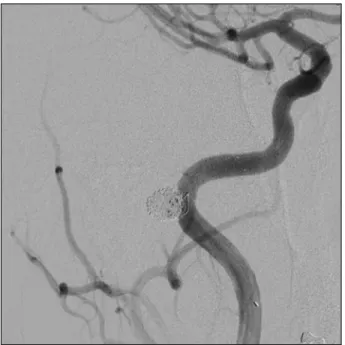
A 41-year-old woman was hospitalized when she visited the Otorhinolaryngology department com- plaining of a headache and a drumming sound in her right ear. Otolaryngologic examination did not reveal any pathological findings. The patient was referred to our department after brain imaging including mag- netic resonance angiography (MRA) revealed a pet- rous carotid aneurysm (Fig. 1). A digital subtraction angiogram (DSA) was performed for further evalua- tion; it confirmed an 8-mm- saccular aneurysm with a 6-mm-wide neck (Fig. 2). The patient was prescribed
A B
Fig. 1. (A) Vascular enlargement bulging into the middle ear (white arrow). (B) MRA revealed an approximately 0.8-cm-sized petrous carotid aneurysm of the right ICA. MRI = magnetic resonance imaging; MRA = magnetic resonance angiography; ICA = internal car- otid artery.
Fig. 2. DSA confirmed a petrous carotid aneurysm of the right ICA. DSA = digital subtraction angiogram; ICA = internal carotid artery.
aspirin (200 mg/day) and clopidogrel (75 mg/day) for 7 days as premedication. Femoral artery puncture
was performed and 5,000 units of intravenous heparin sodium were administered. A microcatheter was placed within the aneurysm using the jailing technique. To ensure that the coils stay in the aneur- ysm, a stent was deployed in the right petrous in- ternal carotid artery (ICA) in front of the aneurysm neck. Next, coil embolization was performed using the jailed microcatheter. The final DSA revealed a slight remnant of the neck and almost complete ob- literation of the aneurysm with right ICA patency (Fig. 3). After the procedure, both the tinnitus and the headache completely subsided without any neuro- logical deficits. The symptoms heave not recurred during a follow-up period of 4 years.
DISCUSSION
Around 10% of adults suffer from tinnitus. It often causes insomnia and depression, affecting the quality of life of the affected individuals.10)15) Tinnitus can be classified into pulsatile and non-pulsatile forms, with
Fig. 3. Stent-assisted coil embolization was performed on the petrous carotid aneurysm of the right ICA. There was a slight remnant of the aneurysmal neck andan almost complete ob- literation was achieved with right ICA patency. ICA = internal carotid artery.
the former accounting for 10% of all the tinnitus cases.5)15)24)
Pulsatile tinnitus mostly stems from vascular le- sions; its pathophysiological mechanism can be de- scribed as follows: 1) vessel stenosis or increased blood flow near the inner ear brings about turbulent blood flow, which causes the noise. 2) Bony con- ductive changes in the inner ear cause the sound of the normal blood flow to be perceived as louder.5)15)25) Pulsatile tinnitus could originate from arteries, veins, AVFs, or tumors.5)15)18)21)23)25) Causes of arterial origin include ICA stenosis, fibromuscular dysplasia (FMD), dissecting ICA, persistent stapedial artery, arterial compressive cochlear nerve, dural AVF, carotid-cav- ernous fistula (CCF), AVM, cerebral aneurysm, and increased cardiac output have been reported as causes of arterial origin.5)18) These predominantly induce arte- rial turbulence, which directly exerts a force on the nerves and structures of the adjacent inner ear, result- ing in pulsatile tinnitus. Causes of venous origin in- clude high jugular bulb, jugular bulb diverticulum, in-
tracranial hypertension, sigmoid sinus anomaly, and emissary veins.5)7)15)21-23) Transverse sinus stenosis has also been reported to cause pulsatile tinnitus.23)25)
According to Hofmann et al.5), the leading cause of pulsatile tinnitus is ICA stenosis, which accounts for 18% of cases. The second most frequent cause is intra- cranial hypertension (16%), followed by high jugular bulb (12%). Dural arteriovenous fistula is fourth (7%), followed by vascular flow-rich tumors (6%). Tinnitus caused by an aneurysm is rare and accounted for on- ly 1% of the cases. In the case of aneurysm, tinnitus is caused by the turbulent flow that directly exerts force on the cochlear nerve and structures in the inner ear.13)15)19)
The petrous ICA is anatomically related with vari- ous structures such as the tensor tympani muscle, Eustachian tube, cochlea, etc.11)13) Thus, lesions in this region can cause pulsatile tinnitus and/or hearing loss.13)19) In our case, magnetic resonance imaging (MRI) revealed vascular bulging from the petrous in- ternal carotid (petrous aneurysm) into the Eustachian tube, which is thought to induce pulsatile tinnitus due to either the turbulent flow in the aneurysmal sac or the hammer effect of the aneurysm (Fig. 1A).
Although some studies have reported that a petrous carotid aneurysm may result from trauma, infection, radiation, or a congenital anomaly, the exact cause is unclear.13) In our case, the cause of the petrous carotid aneurysm was unclear.
If no abnormality is seen on an otorhinolaryngology examination in a case of pulsatile tinnitus, there are several probable diagnoses that need to be ruled out.
CT angiography (CTA), MRI, or MRA can be used to diagnose pulsatile tinnitus to differentiate intracranial vascular diseases.
A petrous carotid aneurysm causing pulsatile tinni- tus is extremely rare.5) Therefore, the right treatment for this rare lesion has not yet been well established due to the limited number of cases and a lack of long-term outcomes.
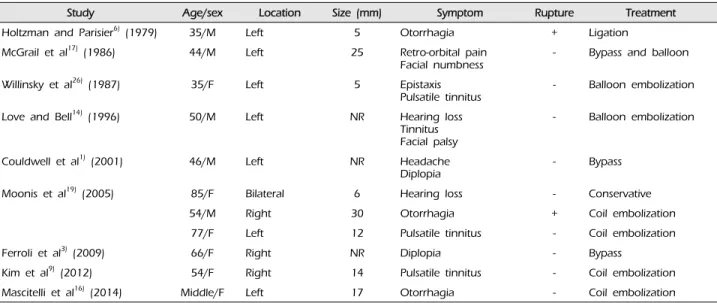
Based on previous reports, the most common treat-
Study Age/sex Location Size (mm) Symptom Rupture Treatment
Holtzman and Parisier6) (1979) 35/M Left 5 Otorrhagia + Ligation
McGrail et al17) (1986) 44/M Left 25 Retro-orbital pain
Facial numbness - Bypass and balloon Willinsky et al26) (1987) 35/F Left 5 Epistaxis
Pulsatile tinnitus - Balloon embolization Love and Bell14) (1996) 50/M Left NR Hearing loss
Tinnitus Facial palsy
- Balloon embolization
Couldwell et al1) (2001) 46/M Left NR Headache
Diplopia - Bypass
Moonis et al19) (2005) 85/F Bilateral 6 Hearing loss - Conservative
54/M Right 30 Otorrhagia + Coil embolization
77/F Left 12 Pulsatile tinnitus - Coil embolization
Ferroli et al3) (2009) 66/F Right NR Diplopia - Bypass
Kim et al9) (2012) 54/F Right 14 Pulsatile tinnitus - Coil embolization Mascitelli et al16) (2014) Middle/F Left 17 Otorrhagia - Coil embolization M = male; F = female; NR = not report.
Table 1. Summary of cases of petrous carotid aneurysms and their treatment
ment methods for the petrous carotid aneurysm are summarized in Table 1: conservative management, endovascular balloon occlusion, aneurysm trapping, and revascularization with bypass, and endovascular coil embolization with or without stent placement.1-3)6)9)14)16)17)19)26) Recently, a method using a flow diverter was reported.4) While surgical ap- proaches such as trapping with bypass surgery are ef- fective in relieving the symptoms, they are more diffi- cult to perform, risky, and require a long recovery period.1)3)13)17)20) Recent advances in endovascular tech- nology and devices have resulted in endovascular treatments showing results similar to those of surgical treatment.9)11)13)16)19) Particularly, the efficacy of endo- saccular coil embolization while preserving the parent artery was comparable to that of endovascular bal- loon occlusion with scarification of the parent artery.8)12)19)
In our case, pulsatile tinnitus was thought to be re- mitted by decreasing the hammer effect and eliminat- ing turbulent flow in the sac through stent as- sisted-endosaccular coiling. Therefore, after consider- ing the difficulty of the surgical approaches, the lower invasiveness of endovascular approaches and the sim- ilar efficacies of surgical and endovascular approaches
in relieving the symptoms, endovascular coil treat- ment with/without stent placement may be preferred in the treatment of petrous carotid aneurysms causing pulsatile tinnitus.9)13)16)
CONCLUSION
Although a petrous carotid aneurysm is extremely rare, it should be considered in the differential diag- nosis of pulsatile tinnitus. Endovascular treatment while preserving the parent artery can be the least in- vasive and the most optimal course of treatment in relieving the symptoms.
Disclosure
The authors report no conflict of interest concerning the materials or methods used in this study or the findings specified in this paper.
REFERENCES
1. Couldwell WT, Zuback J, Onios E, Ahluwalia BS, Tenner M, Moscatello A. Giant petrous carotid aneur- ysm treated by submandibular carotid-saphenous vein bypass. Case report. J Neurosurg. 2001 May;94(5):806-10.
2. Debrun G, Lacour P, Caron JP, Hurth M, Comoy J,
loon techniques in the treatment of cerebral vascular lesions. J Neurosurg. 1978 Nov;49(5):635-49.
3. Ferroli P, Bisleri G, Miserocchi A, Albanese E, Polvani G, Broggi G. Endoscopic radial artery harvesting for U-clip high-flow EC-IC bypass: technical report. Acta Neurochir (Wien). 2009 May;151(5):529-35; discussion 535.
4. Gross BA, Moon K, Ducruet AF, Albuquerque FC. A rare but morbid neurosurgical target: petrous aneurysms and their endovascular management in the stent/flow diverter era. J Neurointerv Surg. 2017 Apr;9(4):381-383.
5. Hofmann E, Behr R, Neumann-Haefelin T, Schwager K.
Pulsatile tinnitus: imaging and differential diagnosis.
Dtsch Arztebl Int. 2013 Jun;110(26):451-8.
6. Holtzman RN, Parisier SC. Acute spontaneous otorrhagia resulting from a ruptured petrous carotid aneurysm.
Case report. J Neurosurg. 1979 Aug;51(2):258-61.
7. Houdart E, Chapot R, Merland JJ. Aneurysm of a dural sigmoid sinus: a novel vascular cause of pulsatile tinnitus. Ann Neurol. 2000 Oct;48(4):669-71.
8. Kawakami K, Kayama T, Kondo R, Kureyama H, Maruya J, Nakai O, et al. A case of mycotic ICA pet- rous portion aneurysm treated with endovascular surgery. No Shinkei Geka. 1996 Mar;24(3):253-7.
9. Kim DK, Shin YS, Lee JH, Park SN. Pulsatile tinnitus as the sole manifestation of an internal carotid artery aneurysm successfully treated by coil embolization. Clin Exp Otorhinolaryngol. 2012 Sep;5(3):170-2.
10. Langguth B, Hund V, Busch V, Jurgens TP, Lainez JM, Landgrebe M, et al. Tinnitus and headache. Biomed Res Int. 2015;2015:797416.
11. Lee SH, Jang JH, Kim KH, Kim YZ. Stent-assisted coil embolization of petrous ICA in a teenager with neurofibromatosis. J Cerebrovasc Endovasc Neurosurg.
2015 Sep;17(3):252-6.
12. Lempert TE, Halbach VV, Higashida RT, Dowd CF, Urwin RW, Balousek PA, et al. Endovascular treatment of pseudoaneurysms with electrolytically detachable coils. AJNR Am J Neuroradiol. 1998 May;19(5):907-11.
13. Liu JK, Gottfried ON, Amini A, Couldwell WT.
Aneurysms of the petrous internal carotid artery: anat- omy, origins, and treatment. Neurosurg Focus. 2004 Nov;17(5):E13.
14. Love MH, Bell KE. Case report: giant aneurysm of the intrapetrous carotid artery presenting as a cer-
ebellopontine angle mass. Clin Radiol. 1996 Aug;51(8):
587-8.
15. Marsot-Dupuch K. Pulsatile and nonpulsatile tinnitus: a systemic approach. Semin Ultrasound CT MR. 2001 Jun;22(3):250-70.
16. Mascitelli JR, De Leacy RA, Oermann EK, Skovrlj B, Smouha EE, Ellozy SH, et al. Cervical-petrous internal carotid artery pseudoaneurysm presenting with otor- rhagia treated with endovascular techniques. BMJ Case Rep. 2014 Jun 30;2014:bcr2014011286.
17. McGrail KM, Heros RC, Debrun G, Beyerl BD.
Aneurysm of the ICA petrous segment treated by bal- loon entrapment after EC-IC bypass. Case report. J Neurosurg. 1986 Aug;65(2):249-52.
18. Miller TR, Serulle Y, Gandhi D. Arterial abnormalities leading to tinnitus. Neuroimaging Clin N Am. 2016 May;26(2):227-36.
19. Moonis G, Hwang CJ, Ahmed T, Weigele JB, Hurst RW.
Otologic manifestations of petrous carotid aneurysms.
AJNR Am J Neuroradiol. 2005 Jun-Jul;26(6):1324-7.
20. Park YH, Kwon HJ. Awake embolization of sigmoid si- nus diverticulum causing pulsatile tinnitus: simultaneous confirmative diagnosis and treatment. Interv Neuroradiol.
2011 Sep;17(3):376-9.
21. Reardon MA, Raghavan P. Venous abnormalities leading to tinnitus: imaging evaluation. Neuroimaging Clin N Am. 2016 May;26(2):237-45.
22. Signorelli F, Mahla K, Turjman F. Endovascular treat- ment of two concomitant causes of pulsatile tinnitus:
sigmoid sinus stenosis and ipsilateral jugular bulb diverticulum. Case report and literature review. Acta Neurochir (Wien). 2012 Jan;154(1):89-92.
23. Sismanis A. Pulsatile tinnitus. A 15-year experience. Am J Otol. 1998 Jul;19(4):472-7.
24. Sonmez G, Basekim CC, Ozturk E, Gungor A, Kizilkaya E. Imaging of pulsatile tinnitus: a review of 74 patients.
Clin Imaging. 2007 Mar-Apr;31(2):102-8.
25. Waldvogel D, Mattle HP, Sturzenegger M, Schroth G.
Pulsatile tinnitus--a review of 84 patients. J Neurol. 1998 Mar;245(3):137-42.
26. Willinsky R, Lasjaunias P, Pruvost P, Boucherat M.
Petrous internal carotid aneurysm causing epistaxis: bal- loon embolization with preservation of the parent vessel.
Neuroradiology. 1987;29(6):570-2.