Long-term Prognosis of Paroxysmal Atrial Fibrillation and Predictors for Progression to Persistent or Chronic Atrial Fibrillation in the Korean Population
Little is known about the long-term prognosis of or predictors for the different clinical types of atrial fibrillation (AF) in Korean populations. The aim of this study was to validate a risk stratification to assess the probability of AF progression from paroxysmal AF (PAF) to persistent AF (PeAF) or permanent AF. A total of 434 patients with PAF were consecutively enrolled (mean age; 71.7 ± 10.7 yr, 60.6% male). PeAF was defined as episodes that are sustained > 7 days and not self-terminating, while permanent AF was defined as an ongoing long-term episode. Atrial arrhythmia during follow-up was defined as atrial premature complex, atrial tachycardia, and atrial flutter. During a mean follow-up of 72.7 ± 58.3 months, 168 patients (38.7%) with PAF progressed to PeAF or permanent AF.
The mean annual AF progression was 10.7% per year. In univariate analysis, age at diagnosis, body mass index, atrial arrhythmia during follow-up, left ventricular ejection fraction, concentric left ventricular hypertrophy, left atrial diameter (LAD), and severe mitral regurgitation (MR) were significantly associated with AF progression. In multivariate analysis, age at diagnosis (P = 0.009), atrial arrhythmia during follow-up (P = 0.015), LAD (P = 0.002) and MR grade (P = 0.026) were independent risk factors for AF progression.
Patients with younger age at diagnosis, atrial arrhythmia during follow-up, larger left atrial chamber size, and severe MR grade are more likely to progress to PeAF or permanent AF, suggesting more intensive medical therapy with close clinical follow-up would be required in those patients.
Keywords: Paroxysmal Atrial Fibrillation; Progression; Korean Populations Sung II Im,1 Kwang Jin Chun,2
Seung-Jung Park,2 Kyoung-Min Park,2 June Soo Kim,2 and Young Keun On2
1Cardiology, Kosin University Gospel Hospital, Kosin University College of Medicine, Busan; 2Cardiology, Heart Vascular and Stroke Institute, Samsung Medical Center, Sungkyunkwan University School of Medicine, Seoul, Korea
Received: 10 October 2014 Accepted: 17 February 2015 Address for Correspondence:
Young Keun On, MD
Cardiology, Heart Vascular and Stroke Institute, Samsung Medical Center, Sungkyunkwan University School of Medicine, 81 Irwon-ro Gangnam-gu, Seoul 135-710, Korea
Tel: +82.2-3410-3420, Fax: +82.2-3410-3849 E-mail: [email protected]
http://dx.doi.org/10.3346/jkms.2015.30.7.895 • J Korean Med Sci 2015; 30: 895-902
INTRODUCTION
Atrial fibrillation (AF) is the most common clinically significant arrhythmia in clinical practice. AF is associated with increased morbidity and mortality that primarily occur as a result of com- plications, such as thromboembolic events and heart failure (1, 2).
In clinical practice, one should distinguish between the AF clinical types: paroxysmal AF (PAF): episodes of the arrhythmia that terminate spontaneously; persistent AF (PeAF): episodes that are sustained 7 days or more and are not self-terminating;
permanent AF: ongoing long-term episodes (3), which will af- fect the individual treatment strategy for each patient (4).
AF usually starts as PAF and transforms into PeAF (5). The mechanism of PAF consists of initiating factors. The role of the maintenance factors is less important, but becomes more im- portant in association with progression of AF to PeAF or per- manent AF (6, 7). This seems particularly to be a concern in pa- tients with PeAF or permanent AF, whose higher incidence of events from cardiac and non-cardiac origins can affect long-term
outcomes (8).
In previous studies, Canadian Registry of Atrial Fibrillation (CARAF) investigators found that underlying heart disease and age were independently associated with progression of AF.
The Euro Heart Survey (EHS) on AF presents a unique over- view of AF management in a large group of patients in several European countries (4, 9, 10). Significant interest also has been directed to factors predicting the progression of PAF to PeAF or permanent AF. Recently, the HATCH score, which is an acronym for hypertension, age ≥ 75 yr, transient ischemic attack (TIA) or stroke (2 points), chronic obstructive pulmonary disease (COPD) and heart failure (2 points), was proposed as a simple clinical tool to identify patients who are likely to progress PeAF or per- manent AF (4, 11). However, available data on the progression rate of PAF to PeAF or permanent AF and predictors for progres- sion are relatively limited in Korean populations.
The aim of this study was to evaluate the prognosis of patients with AF progression and validate a risk stratification to assess the probability of AF progression in Korean populations.
Cardiovascular Disorders
MATERIALS AND METHODS Study populations
In our study, total 2,413 patients with AF were reviewed for 18 yr. The patients were excluded if they had one of the following conditions; including a recent history of acute infection or in- flammatory disease, age > 80 yr old, a history of cardiomyopa- thy, or valvular (defined as ≥ moderate mitral regurgitation, aortic regurgitation, aortic stenosis or a presence of prosthetic heart valve or history of repair) or congenital heart disease, he- patic or renal disease, an acute cardiovascular or cerebrovascu- lar event within the preceding 3 months, any major trauma or surgery within the preceding 3 months, hyperthyroidism, un- controlled hypertension, malignancy, connective tissue disease, or any acute or chronic inflammatory disease.
Finally, a total 434 patients with PAF were enrolled and we retrospectively analyzed those 434 non-valvular PAF patients (mean age: 71.7 ± 10.7 yr, 60.6% male) consecutively. Patients with a history of PAF documented by a standard electrocardio- gram (ECG) or Holter-ECG were enrolled. The flow chart is shown in Fig. 1. The baseline characteristics of the patients are present- ed in Table 1.
Data collection
After ECG and chest radiograph, cardiovascular status was eval- uated for each patient using echocardiography, an exercise test, 24-hr Holter recordings, and blood laboratory data from the initial visit, as determined by the attending physicians. From the database, the following information was collected: 1) pa- tient data, including sex, age, height, and weight; 2) cardiovas- cular risk factors, including hypertension (use of antihyperten- sive agents, systolic blood pressure ≥ 140 mmHg, or diastolic
blood pressure 90 mmHg on admission) and diabetes mellitus (use of oral hypoglycemic agents or insulin, or glycosylated he- moglobin ≥ 6.5%); 3) cardiovascular disease status, including Table 1. Baseline clinical charactersistics in patients with PAF depending on the pro- gression to persistent or permanent AF
Parameters PAF or SR
group (n = 253)
Progression to PeAF or permanent AF group (n = 168)
P value
Age (yr) 63.8 ± 11.2 61.2 ± 10.7 0.019
Gender (Male, %) 152 (60.1) 104 (61.9) 0.760
DM (%) 47 (18.6) 34 (20.2) 0.706
HTN (%) 147 (58.1) 95 (56.5) 0.764
CHF (%) 8 (3.2) 6 (3.6) 0.790
Hyperlipidemia (%) 51 (20.2) 30 (17.9) 0.614
BMI (%) 24.6 ± 3.0 25.2 ± 2.8 0.042
CVA (%) 30 (11.9) 21 (12.5) 0.879
Renal failure (%) 4 (1.6) 6 (3.6) 0.207
CHADS2 1.3 ± 1.2 1.2 ± 1.1 0.372
CHA2DS2 VASc 2.0 ± 1.4 1.8 ± 1.4 0.151
HATCH score 1.1 ± 1.0 1.0 ± 1.0 0.537
CAD (%) 28 (11.1) 20 (11.9) 0.876
PAD (%) 13 (5.1) 5 (3.0) 0.333
CMP (%) DCMP (%) HCMP (%) ICMP (%) SCMP (%)
5 (2.0) 3 (1.2) 0 (0) 2 (0.8) 0 (0)
9 (5.4) 5 (3.0) 3 (1.8) 0 (0) 1 (0.6)
0.131
Alcohol (%) 78 (30.8) 57 (33.9) 0.524
Smoking (%) 36 (14.2) 21 (12.5) 0.664
Medications Anti-arrhythmics (%)
Amiodarone (%) 13 (5.1) 21 (12.5) 0.010
Dronedarone (%) 1 (0.4) 0 (0) 1.000
Propafenone (%) 41 (16.2) 17 (10.1) 0.084
Flecainide (%) 7 (2.8) 1 (0.6) 0.153
Soltalol (%) 5 (2.0) 5 (3.0) 0.529
Beta-blocker (%) 67 (26.5) 47 (28.0) 0.738
Calcium channel blocker (%) 86 (34.0) 61 (36.3) 0.676
ARB (%) 58 (22.9) 32 (19.0) 0.396
ACEi (%) 16 (6.3) 15 (8.9) 0.344
Statins (%) 42 (16.6) 21 (12.5) 0.267
Aspirin (%) 137 (54.2) 90 (53.6) 0.921
Clopidogrel (%) 11 (4.3) 10 (6.0) 0.498
Warfarin (%) 56 (22.1) 39 (23.3) 0.813
Rivaroxaban (%) 0 (0) 0 (0) 1.000
Dabigatran (%) 1 (0.4) 0 (0) 1.000
Values are mean ± SD (range). PAF indicates paroxysmal atrial fibrillation; PeAF, per- sistent atrial fibrillation; AF, atrial fibrillation; SR, sinus rhythm; DM, diabetes mellitus;
HTN, hypertension; CHF, congestive heart failure; BMI, body mass index; CVA, cere- brovascular accident; CHADS2 score, 1 point for congestive heart failure, hypertension, age [ ≥ 75 yr], diabetes mellitus, and 2 points for history of stroke or transient isch- emic attack; CHA2DS2 VASc score, 1 point for congestive heart failure, hypertension, diabetes mellitus, vascular disease (previous myocardial infarction, complex aortic plaque, and peripheral artery disease [PAD]), age [65-74 yr] and 2 points for history of stroke or transient ischemic attack, age [ ≥ 75 yr]; HATCH score, 1 point for hyper- tension, age ≥ 75 yr, chronic obstructive pulmonary disease and 2 points for transient ischemic attack or stroke, heart failure (2 points); CAD, coronary artery disease; PAD, peripheral artery disease; CMP, cardiomyopathy; DCMP, dilated cardiomyopathy; HCMP, hypertrophic cardiomyopathy; ICMP, ischemic cardiomyopathy; SCMP, stress cardio- myopathy; ARB, angiotensin II receptor blocker; ACEi, angiotensin converting enzyme inhibitor.
A total of 434 patients with paroxysmal atrial fibrillation (PAF) from September 1994 to July 2012 in Samsung Medical Center
Patients were excluded if they had one of the following conditions:
Age > 80 yr; a history of valvular or congenital heart disease; hepatic disease;
an acute cardiovascular or cerebrovascular event within the preceding three months; any major trauma or surgery within the preceding three months; hyper
thyroidism; uncontrolled hypertension; malignancy; connective tissue disease;
or any acute or chronic inflammatory disease. Those who might have been un
able to produce elevated serologic markers were also excluded, such as patients undergoing immunosuppressive therapy and those with leukopenia of any etiology.
13 patents were excluded.
→ A total of 421 patients with PAF were finally enrolled.
253 patients with PAF or Sinus rhythm
168 patients with progression into persistent AF or permanent AF Fig. 1. Patient selection procedure.
structural heart disease, congestive heart failure, or a history of a disabling cerebral infarction or TIA; and 4) use of medication.
Body mass index (BMI) was calculated as weight in kilograms divided by the square of height in meters.
Definitions of atrial fibrillation, atrial arrhythmia, and clinical events
In the present study, paroxysmal AF at the initial visit was de- fined as sinus rhythm on ECG and previous diagnosis of parox- ysmal AF by referring physicians. Patients whose AF was esti- mated to continue for ≥ 7 days after the initial visit were con- sidered to have persistent AF originally and were excluded from the analysis. Permanent AF was defined as an ongoing long-term episode. Asymptomatic AF was defined as AF documented on 12-lead ECG during a visit, in the absence of any new symptoms such as palpitations, tachycardia, fatigue, malaise, shortness of breath on exertion, dyspnea, chest pain, syncope, or pre-synco- pe related to AF or other illnesses. During the follow-up period, the onset of persistent AF was defined as the first time in which all ECGs indicated AF after ≥ 3 consecutive ECGs at intervals of
≥ 1 week after the initial examination, and permanent AF was defined as AF that was present for at least 6 months without in- tervening spontaneous episodes of sinus rhythm for which car- dioversion was unsuccessful and subsequently not attempted (12). When an ECG could not be obtained thrice during the pe- riod, the physicians made a clinical judgment regarding the on- set time of AF progression. When electrical cardioversion was performed after > 7 days from AF onset, it was also considered as AF progression. We calculated the CHADS2score (congestive heart failure, hypertension, age [≥ 75 yr], diabetes mellitus, and history of stroke or TIA; 2 points). The CHA2DS2-VASc score was also determined, which also includes vascular disease (previous myocardial infarction, complex aortic plaque, and peri pheral artery disease [PAD]), age 65-74 (13, 14). Atrial arrhythmia dur- ing follow-up was assumed based on recurrence of any symp- toms ECG showing atrial premature complex, atrial tachycar- dia, or atrial flutter.
Re-admission was defined as any hospitalization of cardiac causes including AF symptoms related admission, embolic events, anticoagulation, others (percutaneous coronary intervention, coronary angiogram, permanent pacemaker insertion, etc.).
Definition of HATCH score
The HATCH score has been proposed as predictive of AF progres- sion in pharmacologically treated AF patients (4). The HAT CH acronym stands for hypertension (1 point), age ≥ 75 yr (1 point), transient ischemic attack or stroke (2 points), chronic obstruc- tive pulmonary disease (1 point), and heart failure (2 points).
Transthoracic echocardiography
All enrolled subjects underwent 2-dimensional transthoracic
echocardiography (TTE). All examinations were performed us- ing a commercially available Vivid 7TM (GE Medical System, Ving- med, Horten, Norway) ultrasound system. All recorded echo- cardiograms were measured and interpreted with clinical in- formation blinded using a computerized off-line analysis sta- tion (EchopacTM 6.3.4; GE Medical System).
All measurements were derived from 3 consecutive cardiac cycles and averaged. The left ventricular (LV) dimensions, wall thicknesses and left atrial dimensions (LAD) were determined in the parasternal long-axis view with the M-mode cursor posi- tioned just beyond the mitral leaflet tips perpendicular to the long axis of the ventricle according to the recommendations of the American Society of Echocardiography (15). The LV ejection fraction (LVEF) was obtained via the modified biplane Simpson method from the apical 4- and 2-chamber views.
Statistical analysis
All continuous variables are expressed as either mean ± stan- dard deviation (SD) or median (25th, 75th interquartile range), depending on the distribution. For continuous data, statistical differences were evaluated using Student’s t-test or the Mann- Whitney U test, depending on the data distribution. Categorical variables are presented as frequencies (percent) and were ana- lyzed using the chi-square test. To determine whether any of the variables were independently related to early recurrence of AF, a multivariate analysis of variables with a P value < 0.05 in the univariate analysis was performed using linear logistic re- gression analysis. All correlations were calculated using Spear- man’s rank correlation test. All statistical analyses were conduct- ed using SPSS statistical software, version 19.0 (SPSS Inc., Chi- cago, IL, USA), and statistical significance was set at P < 0.05 (two- sided).
Ethics statement
This study protocol was reviewed and approved by the institu- tional review board of Samsung Medical Center (IRB No. SMC 2014-04-046). Informed consent was waived by the board.
RESULTS
The baseline demographics for both groups are listed in Table 1.
This study consisted of 168 subjects with progression to PeAF or permanent AF and 253 subjects without AF progression. Base- line characteristics were not statistically different between the AF progression subjects and the non-AF progression subjects, except for age at diagnosis (P = 0.019), BMI (P = 0.042), and amio- darone medications (P = 0.010). In our study, there was no dif- ference in HATCH scores between the groups (P = 0.537), which is known as a modest predictor of progression to sustained AF (4).
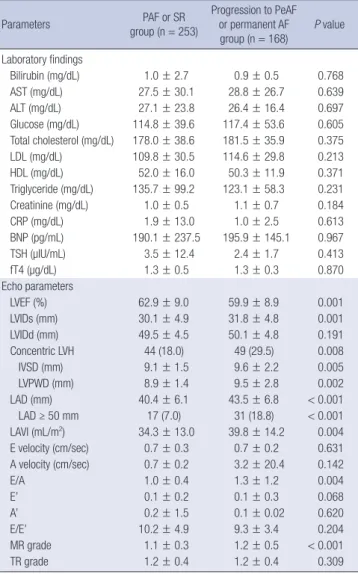
Table 2 shows the laboratory and echocardiographic findings in patients with PAF at baseline. LVEF was lower in the AF pro-
gression subjects compared with the non-AF progression sub- jects (P = 0.001). Left atrial chamber size (LAD, P < 0.001; LAD
≥ 50 mm, P < 0.001; left atrial volume index [LAVI], P = 0.004), concentric left ventricular hypertrophy (LVH, P = 0.008), and mitral regurgitation (MR) grade (P < 0.001) were higher in AF progression subjects compared with non-AF progression sub- jects as determined by TTE.
The clinical outcomes in patients with PAF at the 6-yr follow- up are shown in Table 3. The incidences of any event (P < 0.001), re-admission rate (P = 0.001), arrhythmic events (P = 0.021) and
DC cardioversion rate for rhythm control (P < 0.001) were high- er in AF progression subjects compared with non-AF progres- sion subjects.
In univariate analysis, age at diagnosis, BMI, atrial arrhythmia during follow-up, LVEF, concentric LVH, LAD, and MR grade were significantly associated with AF progression. In multivari- ate analysis, age at diagnosis (P = 0.009), atrial arrhythmia dur- ing follow-up (P = 0.015), LAD (P = 0.002) and MR grade (P = 0.026) were independent risk factors for AF progression from PAF to PeAF or permanent AF (Table 4) at the long-term follow-up.
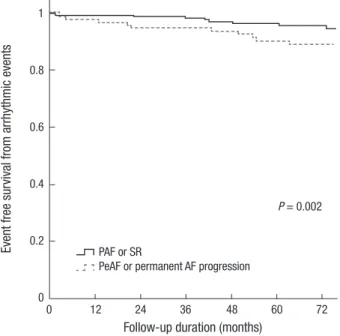
Kaplan-Meier curves show that the event free survivals of to- tal mortality, thromboembolic events, arrhythmic events and hospitalizations (P < 0.001; Fig. 2) and event free survivals of ar- rhythmic events (P = 0.002; Fig. 3) are lower in AF progression subjects compared with non-AF progression subjects at the 6-yr follow-up. Fig. 4 shows that mean annual AF progression rate from PAF to PeAF or permanent AF in Korean populations was 10.7% at the 6-yr follow-up.
DISCUSSION
In this study, we show that the mean annual AF progression rate from PAF to PeAF or permanent AF in Korean populations was 10.7% at 6-yr follow-up and the patients with larger left atrial chamber size and severe MR grade were more likely to experi- ence such progression, suggesting that underlying diseases might cause chronic stretching and atrial dilation, which seem to be important stimuli for chronic atrial structural remodeling. This is consistent with a previous study (16) that found chronic struc- tural changes with cellular hypertrophy, fibroblast proliferation, and tissue fibrosis enables maintenance of AF. Younger patients at diagnosis and the patients with atrial arrhythmia during fol- low-up were also more likely to have experience progression of PAF to PeAF or permanent AF in our study. Considering the longer duration from the first diagnosis of PAF and in view of the fact that younger patients are associated with higher chanc- es to make more substrates that might be arrhythmogenic foci, the age at diagnosis of PAF might be a good correlate to predict AF progression. And atrial arrhythmia during follow-up might be a clue for the progression of chronic atrial remodeling as ar- rhythmogenic substrates. Therefore, in these patients, intensive medical therapy with close clinical follow up is required.
This is the first study to evaluate the prognosis of patients with AF progression and validate a risk stratification to assess the probability of AF progression in Korean populations. Various factors were associated with AF progression, including valvular disease, alcohol consumption, age, left atrial dimension and enlargement over time, stroke, and heart failure. In our study, age at diagnosis, atrial arrhythmia during follow-up, LAD and MR grade were associated with AF progression.
Aging is associated with an increase in the prevalence of AF.
Table 2. Baseline laboratory and echocardiographic findings in patients with PAF de- pending on the progression to persistent or permanent AF
Parameters PAF or SR
group (n = 253)
Progression to PeAF or permanent AF
group (n = 168) P value Laboratory findings
Bilirubin (mg/dL) 1.0 ± 2.7 0.9 ± 0.5 0.768
AST (mg/dL) 27.5 ± 30.1 28.8 ± 26.7 0.639
ALT (mg/dL) 27.1 ± 23.8 26.4 ± 16.4 0.697
Glucose (mg/dL) 114.8 ± 39.6 117.4 ± 53.6 0.605
Total cholesterol (mg/dL) 178.0 ± 38.6 181.5 ± 35.9 0.375
LDL (mg/dL) 109.8 ± 30.5 114.6 ± 29.8 0.213
HDL (mg/dL) 52.0 ± 16.0 50.3 ± 11.9 0.371
Triglyceride (mg/dL) 135.7 ± 99.2 123.1 ± 58.3 0.231
Creatinine (mg/dL) 1.0 ± 0.5 1.1 ± 0.7 0.184
CRP (mg/dL) 1.9 ± 13.0 1.0 ± 2.5 0.613
BNP (pg/mL) 190.1 ± 237.5 195.9 ± 145.1 0.967
TSH (µIU/mL) 3.5 ± 12.4 2.4 ± 1.7 0.413
fT4 (µg/dL) 1.3 ± 0.5 1.3 ± 0.3 0.870
Echo parameters
LVEF (%) 62.9 ± 9.0 59.9 ± 8.9 0.001
LVIDs (mm) 30.1 ± 4.9 31.8 ± 4.8 0.001
LVIDd (mm) 49.5 ± 4.5 50.1 ± 4.8 0.191
Concentric LVH 44 (18.0) 49 (29.5) 0.008
IVSD (mm) 9.1 ± 1.5 9.6 ± 2.2 0.005
LVPWD (mm) 8.9 ± 1.4 9.5 ± 2.8 0.002
LAD (mm) 40.4 ± 6.1 43.5 ± 6.8 < 0.001
LAD ≥ 50 mm 17 (7.0) 31 (18.8) < 0.001
LAVI (mL/m2) 34.3 ± 13.0 39.8 ± 14.2 0.004
E velocity (cm/sec) 0.7 ± 0.3 0.7 ± 0.2 0.631
A velocity (cm/sec) 0.7 ± 0.2 3.2 ± 20.4 0.142
E/A 1.0 ± 0.4 1.3 ± 1.2 0.004
E’ 0.1 ± 0.2 0.1 ± 0.3 0.068
A’ 0.2 ± 1.5 0.1 ± 0.02 0.620
E/E’ 10.2 ± 4.9 9.3 ± 3.4 0.204
MR grade 1.1 ± 0.3 1.2 ± 0.5 < 0.001
TR grade 1.2 ± 0.4 1.2 ± 0.4 0.309
Values are mean ± SD (range). PAF indicates paroxysmal atrial fibrillation; SR, sinus rhythm; PeAF, persistent atrial fibrillation; AF, atrial fibrillation; AST, aspartate amino- transferase; ALT, alanine aminotransferase; LDL, low density lipoprotein; HDL, high density lipoprotein; CRP, C-reactive protein; BNP, B type natriuretic peptide; TSH, thy- roid stimulating hormone; fT4, free thyroxine; LVEF, left ventricular ejection fraction;
LVIDd, left ventricular diastolic diameter; LVIDs, left ventricular systolic diameter; LVH, left ventricular hypertrophy; IVSD, interventricular septal diameter; LVPWD, left ven- tricular posterior wall diameter; LAD, left atrial diameter; LAVI, left atrial volume index;
E, peak mitral flow velocity of the early rapid filling wave; A, peak velocity of the late filling wave due to atrial contraction; E’, early diastolic mitral annular velocity; A’, late diastolic mitral annular velocity; MR, mitral regurgitation; TR, tricuspid regurgitation.
The fibrosis in promoting the perpetuation of AF in aging hearts and age related development of collagenous septa have been described in human histological studies (4, 10, 17). In our study, patients with AF progression also were older than those with- out AF progression. This relationship between aging and atrial fibrosis is probably the major explanation of progression to per- manent AF.
It is of interest that the patients with AF progression were youn- ger at diagnosis, suggesting that AF duration was longer in the AF progression group. This finding is consistent with previous reports that as PAF lasted longer, progression to PeAF became more likely, which led to the adoption of the now oft-quoted adage “AF begets AF” (18-20).
In our study, LAD and MR grade were independent risk fac- Table 3. Clinical outcomes in patients with PAF at 6-year follow-up
Outcomes PAF or SR group (n = 253) Progression to PeAF or permanent AF group (n = 168) P value
Follow-up duration (months) 76.8 ± 60.0 66.4 ± 55.3 0.076
Total patients, (%) : follow-up duration > 6 yr 82 (32.4) 56 (33.3) 0.916
Total any events (%) 123 (48.6) 119 (70.8) < 0.001
Re-admission (%) 85 (33.6) 85 (50.6) 0.001
Causes of admission
AF symptoms related admission (%) 67 (26.5) 66 (39.3)
Embolic events (%) 1 (0.4) 3 (1.8)
Anticoagulation (%) 2 (0.8) 3 (1.8)
Others (PCI, CAG, PPM etc., %) 15 (5.9) 13 (7.7)
Total death (%) 3 (1.2) 1 (0.6) 1.000
Cardiac death (%) 2 (0.8) 1 (0.6)
Non-cardiac death (%) 1 (0.4) 0 (0)
Total thromboembolic events (%) 6 (2.4) 6 (3.6) 0.436
CVA (new onset, %) 5 (2.0) 6 (3.6)
Peripheral thromboembolism (%) 1 (0.4) 0 (0)
Bleeding complications (%) 26 (10.3) 18 (10.7) 0.872
Arrhythmic events (%) 15 (5.9) 21 (12.5) 0.021
APC or ATach (%) 8 (3.2) 8 (4.8)
Atrial flutter (%) 4 (1.6) 7 (4.2)
VPC (%) 0 (0) 2 (1.2)
AV block (%) 3 (1.2) 4 (2.4)
Treatment of AF
DC cardioversion for rhythm control (%) 10 (4.0) 33 (19.6) < 0.001
RFCA (%) 10 (4.0) 14 (8.3) 0.084
Follow-up echo parameters, No (%) 156 (61.7) 128 (76.2) 0.002
LVEF (%) 61.7 ± 9.6 60.1 ± 10.1 0.181
LVIDs (mm) 30.4 ± 5.5 31.4 ± 5.1 0.319
LVIDd (mm) 50.5 ± 5.0 50.1 ± 4.6 0.595
Concentric LVH (%) 18 (11.5) 22 (17.2) 0.230
IVSD (mm) 9.0 ± 1.2 9.1 ± 1.5 0.759
LVPWD (mm) 8.8 ± 1.2 8.9 ± 1.2 0.343
LAD (mm) 43.1 ± 7.8 47.6 ± 8.1 < 0.001
LAVI (mL/m2) 48.2 ± 30.9 58.1 ± 31.3 0.010
E velocity (cm/sec) 0.7 ± 0.3 0.9 ± 0.3 0.001
A velocity (cm/sec) 0.8 ± 0.2 0.6 ± 0.4 0.012
E/A 0.9 ± 0.5 1.7 ± 1.2 < 0.001
E’ 0.1 ± 0.1 0.1 ± 0.8 0.142
A’ 0.1 ± 0.1 0.1 ± 0.02 0.202
E/E’ 11.2 ± 6.1 11.3 ± 6.2 0.910
MR grade 1.2 ± 0.5 1.4 ± 0.6 0.019
Moderate or severe MR 28 (17.9) 36 (28.1) 0.046
TR grade 1.3 ± 0.6 1.5 ± 1.7 0.001
Moderate or severe TR 33 (21.2) 52 (40.6) < 0.001
Values are mean ± SD (range). PAF indicates paroxysmal atrial fibrillation; SR, sinus rhythm; PeAF, persistent atrial fibrillation; AF, atrial fibrillation; PCI, percutaneous coronary intervention; CAG, coronary angiography; PPM, pacemaker insertion; CVA, cerebrovascular accidents; APC, atrial premature complex; ATach, atrial tachycardia; VPC, ventricular premature complex; RFCA, radiofrequency catheter ablation; LVEF, left ventricular ejection fraction; LVIDd, left ventricular diastolic diameter; LVIDs, left ventricular systolic diam- eter; LVH, left ventricular hypertrophy; IVSD, interventricular septal diameter; LVPWD, left ventricular posterior wall diameter; LAD, left atrial diameter; LAVI, left atrial volume in- dex; E, peak mitral flow velocity of the early rapid filling wave; A, peak velocity of the late filling wave due to atrial contraction; E’, early diastolic mitral annular velocity; A’, late diastolic mitral annular velocity; MR, mitral regurgitation; TR, tricuspid regurgitation.
Table 4. Univariate and multivariate Cox analyses for progression from paroxysmal atrial fibrillation to persistent or permanent atrial fibrillation at 6-year follow-up Variables
Total patients Patients with complete follow-up ( ≥ 6 yr)
Univariate analysis Multivariate analysis Univariate analysis Multivariate analysis
OR (95% CI) P value OR (95% CI) P value OR (95% CI) P value OR (95% CI) P value
Age at diagnosis 0.979 (0.961-0.997) 0.020 0.973 (0.954-0.993) 0.009 1.000 (0.966-1.035) 0.994
BMI 1.071 (1.002-1.145) 0.043 0.978 (0.877-1.091) 0.691
Atrial arrhythmia* 2.258 (1.330-3.834) 0.003 2.022 (1.149-3.557) 0.015 3.040 (1.498-6.171) 0.002
LVEF 0.962 (0.941-0.985) 0.001 0.988 (0.952-1.025) 0.525
Concentric LVH 1.913 (1.200-3.050) 0.006 1.350 (0.504-3.617) 0.551
LAD 1.079 (1.044-1.116) < 0.001 1.058 (1.020-1.098) 0.002 1.067 (1.011-1.126) 0.019 1.075 (1.017-1.137) 0.011
LAD ≥ 50 mm 3.076 (1.640-5.768) < 0.001 3.042 (1.051-8.803) 0.040
MR grade 2.394 (1.450-3.952) 0.001 1.93 (1.079-3.324) 0.026 2.114 (0.635-7.041) 0.223
*Atrial arrhythmia indicates atrial arrhythmia during follow-up including atrial premature complex, atrial tachycardia and atrial flutter. OR, odds ratio; CI, confidence interval; BMI, body mass index; LVEF, left ventricular ejection fraction; LVH, left ventricular hypertrophy; LAD, left atrial diameter; MR, mitral regurgitation.
Event free survival from total mortality, thromboembolic events, arrhythmic events and hospitalization
Followup duration (months)
0 12 24 36 48 60 72 1
0.8
0.6
0.4
0.2
0
P < 0.001
PAF or SR
PeAF or permanent AF progression
Fig. 2. Kaplan-Meier analysis for event free survival from total mortality, thromboem-
bolic events, arrhythmic events and hospitalizations in both study groups. Fig. 3. Kaplan-Meier analysis for event free survival from arrhythmic events in both study groups.
Event free survival from arrhythmic events
Followup duration (months)
0 12 24 36 48 60 72 1
0.8
0.6
0.4
0.2
0
P = 0.002
PAF or SR
PeAF or permanent AF progression
Fig. 4. Progression rates from PAF to PeAF or permanent AF. *Mean annual progres- sion rate for 6 yr-10.7%/yr.
Years
1 2 3 4 5 6 7 180
160 140 120 100 80 60 40 20 0
Progression rate from PAF to PeAF or permanent AF
Annual progression (patients) Total progression (patients) Annual progression (%)
1 yr 2 yr 3 yr 4 yr 5 ry 6 ry > 7 yr
Annual progression (patients) 24 18 30 11 11 14 60
Total progression (patients) 25 42 72 83 94 108 168
Annual progression (%) 14.3 10.7 17.9 6.5 6.5 8.3 35.7
tors for predicting AF progression at long-term follow-up. The Framingham Heart Study demonstrated a 42% increased risk for development of AF with every 5 mm increment in left atrial size and the CARAF study demonstrates an increased risk of progressing to permanent AF with LADs in the upper range of normal or minimally enlarged (40-45 mm), a risk that increases further with larger diameters (9, 21). In our study, LAD (P < 0.001) and larger LAD ≥ 50 mm (P < 0.001) also were associated with AF progression in univariate analysis and LAD in logistic analy- sis (OR 1.071 [1.002-1.145], P = 0.044) was an independent risk factor for prediction of AF progression in multivariate analysis.
Mitral regurgitation grade was associated with an increased probability of AF progression in our study. This finding is con- sistent with previous studies (9, 22) that have found that valvu- lar lesions, such as moderate to severe mitral regurgitation and aortic stenosis, increase left atrial pressure and stretching and
increase the propensity of AF.
There are higher incidences of total any events, including re- admission, arrhythmic events and DC cardioversion rate for rhythm control in patients with AF progression to PeAF or per- manent AF at 6-yr follow-up, which supports the need to pre- dict AF progression.
Previous studies have shown that a considerable number of patients with AF also develop clinically relevant sinus node dys- function and AV block requiring permanent pacemakers (23, 24). In our study, there was a higher incidence of AV block in patients with AF progression (Table 3), which likely reflects an underlying atrial remodeling progression that may be involved as a substrate of AF both functionally and anatomically.
Arrhythmic events including atrial premature complex, atrial tachycardia (AT) and atrial flutter were also higher in patients with AF progression. This finding is consistent with a previous study (25) that found that patients destined to convert to PeAF were more likely to have AT/AF on any particular day and had a higher mean and median AT/AF burden that also increased pro- gressively with time.
In our study, BMI was higher in patients with AF progression.
This finding is consistent with the previous studies that showed the relationship among electromechanical remodeling and met- abolic syndrome and that obesity and overweight are risk fac- tors for incident AF (26, 27).
The rate of AF progression described in past studies varied between 8% and 22% after 1 yr of follow-up, depending on the rhythm monitoring methods used and definitions (9, 28). In our study, the mean annual AF progression rate was 10.6% (Fig. 4).
Based on the predictors of AF progression, a risk stratification rule to estimate the probability of AF progression in patients with PAF, the HATCH score, was developed (4, 29, 30). The premise of the HATCH score is early selection of patients for rhythm con- trol therapy in an effort to prevent disease progression (4). How- ever, in our study, there was no difference in HATCH score be- tween groups.
Our study is the first to demonstrate a younger age at diagno- sis-consistent with longer duration of AF, atrial arrhythmia dur- ing follow-up, left atrial chamber size, severe MR grade-impor- tant factors of electrical and structural remodeling. Those fac- tors are associated with AF progression from PAF to PeAF or per- manent AF in Korean populations.
There are some limitations to our study. First, this study was a single-center, retrospective study derived from a real world practice with inherent limitations. Hence the results of our study should be considered as hypothesis generating, and future pro- spective studies are warranted to confirm our results. Second, the definition of AF progression that we selected is arbitrary. In clinical practice, it is extremely difficult to determine the pro- gression from PeAF to permanent AF because of the lack of a firm end point. Therefore, we defined AF progression to be from
PAF to PeAF or permanent AF. Third, using the CARAF defini- tions, non-differential misclassification of PeAF and permanent AF is possible. To adjust for this, we required 2 consecutive an- nual visits with ECG evidence of permanent AF before the pa- tient was designated as permanent for the analysis, making it likely that most patients with permanent AF would fit the newer definition (9, 31, 32). Fourth, patients with potentially reversible causes were excluded from the study. Therefore, the results of this study cannot be transferred to other patient populations with first detected PAF. Finally, according to current guidelines, catheter ablation was performed only in the few patients who had drug-refractory AF or who were intolerant to antiarrhyth- mic drug therapy.
In conclusion, the patients with younger age at diagnosis, atrial arrhythmia during follow-up, larger left atrial chamber size and severe MR grade are more likely to progress to PeAF or permanent AF, suggesting more intensive medical therapy with close clinical follow up would be required in those patients.
DISCLOSURE
The authors declared no potential conflicts of interest.
AUTHOR CONTRIBUTION
Conception and coordination of the study: On YK, Im SI. De- sign of ethical issues: Park KM, On YK, Kim JS. Acquisition of data: Im SI, On YK. Data review: Im SI, On YK. Statistical analy- sis: Im SI, Park SJ, Huh J, On YK. Manuscript preparation: Im SI, On YK. Manuscript approval: all authors
ORCID
Sung II Im http://orcid.org/0000-0003-2544-2422 Young Keun On http://orcid.org/0000-0003-1025-7283 REFERENCES
1. Jahangir A, Murarka S. Progression of paroxysmal to persistent atrial fi- brillation factors promoting the HATCH score. J Am Coll Cardiol 2010;
55: 732-4.
2. Senoo K, Suzuki S, Otsuka T, Sagara K, Matsuno S, Kano H, Uejima T, Oikawa Y, Yajima J, Nagashima K, et al. Progression to the persistent form in asymptomatic paroxysmal atrial fibrillation. Circ J 2014; 78: 1121-6.
3. January CT, Wann LS, Alpert JS, Calkins H, Cigarroa JE, Cleveland JC Jr, Conti JB, Ellinor PT, Ezekowitz MD, Field ME, et al.; American College of Cardiology/American Heart Association Task Force on Practice Gui- delines. 2014 AHA/ACC/HRS guideline for the management of patients with atrial fibrillation: a report of the American College of Cardiology/
American Heart Association Task Force on Practice Guidelines and the Heart Rhythm Society. J Am Coll Cardiol 2014; 64: e1-76.
4. de Vos CB, Pisters R, Nieuwlaat R, Prins MH, Tieleman RG, Coelen RJ,
van den Heijkant AC, Allessie MA, Crijns HJ. Progression from paroxys- mal to persistent atrial fibrillation clinical correlates and prognosis. J Am Coll Cardiol 2010; 55: 725-31.
5. Kato T, Yamashita T, Sagara K, Iinuma H, Fu LT. Progressive nature of paroxysmal atrial fibrillation. Observations from a 14-year follow-up study. Circ J 2004; 68: 568-72.
6. Fujiki A. Progression of atrial fibrillation from paroxysmal to persistent.
Circ J 2014; 78: 1058-60.
7. Wyse DG, Gersh BJ. Atrial fibrillation: a perspective: thinking inside and outside the box. Circulation 2004; 109: 3089-95.
8. Chiang CE, Naditch-Brûlé L, Murin J, Goethals M, Inoue H, O’Neill J, Silva-Cardoso J, Zharinov O, Gamra H, Alam S, et al. Distribution and risk profile of paroxysmal, persistent, and permanent atrial fibrillation in routine clinical practice: insight from the real-life global survey evalu- ating patients with atrial fibrillation international registry. Circ Arrhythm Electrophysiol 2012; 5: 632-9.
9. Kerr CR, Humphries KH, Talajic M, Klein GJ, Connolly SJ, Green M, Boone J, Sheldon R, Dorian P, Newman D. Progression to chronic atrial fibrilla- tion after the initial diagnosis of paroxysmal atrial fibrillation: results from the Canadian Registry of Atrial Fibrillation. Am Heart J 2005; 149:
489-96.
10. Nieuwlaat R, Prins MH, Le Heuzey JY, Vardas PE, Aliot E, Santini M, Cob- be SM, Widdershoven JW, Baur LH, Lévy S, et al. Prognosis, disease pro- gression, and treatment of atrial fibrillation patients during 1 year: fol- low-up of the Euro Heart Survey on atrial fibrillation. Eur Heart J 2008;
29: 1181-9.
11. Potpara TS, Stankovic GR, Beleslin BD, Polovina MM, Marinkovic JM, Ostojic MC, Lip GY. A 12-year follow-up study of patients with newly di- agnosed lone atrial fibrillation: implications of arrhythmia progression on prognosis: the Belgrade Atrial Fibrillation study. Chest 2012; 141: 339-47.
12. Pappone C, Radinovic A, Manguso F, Vicedomini G, Ciconte G, Sacchi S, Mazzone P, Paglino G, Gulletta S, Sala S, et al. Atrial fibrillation progres- sion and management: a 5-year prospective follow-up study. Heart Rhy- thm 2008; 5: 1501-7.
13. Gage BF, Waterman AD, Shannon W, Boechler M, Rich MW, Radford MJ. Validation of clinical classification schemes for predicting stroke: re- sults from the National Registry of Atrial Fibrillation. JAMA 2001; 285:
2864-70.
14. Lip GY, Nieuwlaat R, Pisters R, Lane DA, Crijns HJ. Refining clinical risk stratification for predicting stroke and thromboembolism in atrial fibril- lation using a novel risk factor-based approach: the euro heart survey on atrial fibrillation. Chest 2010; 137: 263-72.
15. Lang RM, Bierig M, Devereux RB, Flachskampf FA, Foster E, Pellikka PA, Picard MH, Roman MJ, Seward J, Shanewise J, et al.; Nomenclature and Standards Committee; Task Force on Chamber Quantification; Ameri- can College of Cardiology Echocardiography Committee; American Heart Association; European Association of Echocardiography, Euro- pean Society of Cardiology. Recommendations for chamber quantifica- tion. Eur J Echocardiogr 2006; 7: 79-108.
16. Andalib A, Brugada R, Nattel S. Atrial fibrillation: evidence for geneti- cally determined disease. Curr Opin Cardiol 2008; 23: 176-83.
17. Kubota T, Kawasaki M, Takasugi N, Imai H, Ishihara Y, Okubo M, Taka- hashi S, Sato H, Nishigaki K, Takemura G, et al. Left atrial pathological degeneration assessed by integrated backscatter transesophageal echo- cardiography as a predictor of progression to persistent atrial fibrillation:
results from a prospective study of three-years follow-up. Cardiovasc Ul- trasound 2012; 10: 28.
18. Lu Z, Scherlag BJ, Lin J, Niu G, Fung KM, Zhao L, Ghias M, Jackman WM, Lazzara R, Jiang H, et al. Atrial fibrillation begets atrial fibrillation: au- tonomic mechanism for atrial electrical remodeling induced by short- term rapid atrial pacing. Circ Arrhythm Electrophysiol 2008; 1: 184-92.
19. Rostock T, Steven D, Lutomsky B, Servatius H, Drewitz I, Klemm H, Mül- lerleile K, Ventura R, Meinertz T, Willems S. Atrial fibrillation begets atri- al fibrillation in the pulmonary veins on the impact of atrial fibrillation on the electrophysiological properties of the pulmonary veins in humans.
J Am Coll Cardiol 2008; 51: 2153-60.
20. Wijffels MC, Kirchhof CJ, Dorland R, Allessie MA. Atrial fibrillation be- gets atrial fibrillation. A study in awake chronically instrumented goats.
Circulation 1995; 92: 1954-68.
21. Benjamin EJ, Levy D, Vaziri SM, D’Agostino RB, Belanger AJ, Wolf PA.
Independent risk factors for atrial fibrillation in a population-based co- hort. The Framingham Heart Study. JAMA 1994; 271: 840-4.
22. DE Sisti A, Leclercq JF, Halimi F, Fiorello P, Bertrand C, Attuel P. Evalua- tion of time course and predicting factors of progression of paroxysmal or persistent atrial fibrillation to permanent atrial fibrillation. Pacing Clin Electrophysiol 2014; 37: 345-55.
23. Gomes JA, Kang PS, Matheson M, Gough WB Jr, El-Sherif N. Coexistence of sick sinus rhythm and atrial flutter-fibrillation. Circulation 1981; 63:
80-6.
24. van den Berg MP, van Gelder IC. Atrial fibrillation and sinus node dys- function. J Am Coll Cardiol 2001; 38: 1585-6.
25. Homoud MK, Estes M 3rd. Shedding new light on the pathophysiology of conversion of paroxysmal atrial fibrillation into persistent atrial fibril- lation. Am Heart J 2007; 154: 801-4.
26. Huxley RR, Misialek JR, Agarwal SK, Loehr LR, Soliman EZ, Chen LY, Alonso A. Physical activity, obesity, weight change, and risk of atrial fi- brillation: the Atherosclerosis Risk in Communities study. Circ Arrhythm Electrophysiol 2014; 7: 620-5.
27. Hung CL, Chao TF, Lai YH, Yen CH, Wang KL, Tsao HM, Lin YJ, Chang SL, Lo LW, Hu YF, et al. The relationship among atrium electromechani- cal interval, insulin resistance, and metabolic syndrome. Can J Cardiol 2013; 29: 1263-8.
28. Gianfranchi L, Brignole M, Menozzi C, Lolli G, Bottoni N. Determinants of development of permanent atrial fibrillation and its treatment. Euro- pace 1999; 1: 35-9.
29. Barrett TW, Self WH, Wasserman BS, McNaughton CD, Darbar D. Eval- uating the HATCH score for predicting progression to sustained atrial fi- brillation in ED patients with new atrial fibrillation. Am J Emerg Med 2013; 31: 792-7.
30. Schmidt EU, Schneider R, Lauschke J, Wendig I, Bänsch D. The HATCH and CHA2DS 2-VASc scores. Prognostic value in pulmonary vein isola- tion. Herz 2014; 39: 343-8.
31. Skanes AC, Krahn AD, Yee R, Klein GJ, Connolly SJ, Kerr CR, Gent M, Thorpe KE, Roberts RS; Canadian Trial of Physiologic Pacing. Progres- sion to chronic atrial fibrillation after pacing: the Canadian Trial of Phys- iologic Pacing. CTOPP Investigators. J Am Coll Cardiol 2001; 38: 167-72.
32. Humphries KH, Kerr CR, Connolly SJ, Klein G, Boone JA, Green M, Shel- don R, Talajic M, Dorian P, Newman D. New-onset atrial fibrillation: sex differences in presentation, treatment, and outcome. Circulation 2001;
103: 2365-70.