The Different Effect of VEGF Polymorphisms on the Prognosis of Non-Small Cell Lung Cancer according to Tumor Histology
Vascular endothelial growth factor (VEGF) contributes to tumor angiogenesis. The role of VEGF single nucleotide polymorphisms (SNPs) in lung cancer susceptibility and its prognosis remains inconclusive and controversial. This study was performed to investigate whether VEGF polymorphisms affect survival outcomes of patients with early stage non-small cell lung cancer (NSCLC) after surgery. Three potentially functional VEGF SNPs (rs833061T>C, rs2010963G>C, and rs3025039C>T) were genotyped. A total of 782 NSCLC patients who were treated with surgical resection were enrolled. The association of the SNPs with overall survival (OS) and disease free survival (DFS) was analyzed. In overall population, none of the three polymorphisms were significantly associated with OS or DFS. However, when the patients were stratified by tumor histology, squamous cell carcinoma (SCC) and
adenocarcinoma (AC) had significantly different OS (Adjusted hazard ratio [aHR] = 0.76, 95% CI = 0.56-1.03 in SCC; aHR = 1.33, 95% CI = 0.98-1.82 in AC; P for
heterogeneity = 0.01) and DFS (aHR = 0.75, 95% CI = 0.58-0.97 in SCC; aHR = 1.26, 95% CI = 1.00-1.60 in AC; P for heterogeneity = 0.004) according to the rs833061T>C genotypes. Our results suggest that the prognostic role of VEGF rs833061T>C may differ depending on tumor histology.
Keywords: Non-Small Cell Lung Cancer; Survival; Angiogenesis; Polymorphisms;
Histology
Soyeon Lee,1* Hyo-Gyoung Kang,2,3*Jin Eun Choi,2,3 Jang Hyuck Lee,2 Hyo Jung Kang,3 Sun Ah Baek,3 Eungbae Lee,4 Yangki Seok,4 Won Kee Lee,5 Shin Yup Lee,1,6 Seung Soo Yoo,1,6 Jaehee Lee,1 Seung-Ick Cha,1 Chang Ho Kim,1 Sukki Cho,7 and Jae Yong Park1,2,6
1Department of Internal Medicine, School of Medicine, Kyungpook National University, Daegu, Korea; 2Department of Biochemistry and Cell Biology, School of Medicine, Kyungpook National University, Daegu, Korea; 3Cell and Matrix Research Institute, School of Medicine, Kyungpook National University, Daegu, Korea; 4Department of Thoracic Surgery, School of Medicine, Kyungpook National University, Daegu, Korea; 5Department of Biostatistics Center, School of Medicine, Kyungpook National University, Daegu, Korea; 6Lung Cancer Center, Kyungpook National University Medical Center, Daegu, Korea; 7Department of Thoracic and Cardiovascular Surgery, Seoul National University School of Medicine, Seoul, Korea
* So Yeon Lee and Hyo-Gyoung Kang contributed equally to this work.
Received: 15 March 2016 Accepted: 23 July 2016 Address for Correspondence:
Jae Yong Park, MD
Lung Cancer Center, Kyungpook National University Medical Center, 807 Hoguk-ro, Buk-gu, Daegu 41404, Korea E-mail: [email protected]
Funding: This study was supported by the R&D program of MKE/KEIT (10040393, Development and commercialization of molecular diagnostic technologies for lung cancer through clinical validation).
http://dx.doi.org/10.3346/jkms.2016.31.11.1735 • J Korean Med Sci 2016; 31: 1735-1741
INTRODUCTION
Lung cancer is the most common cause of cancer-related mortality worldwide (1). The best available prognostic index for non-small cell lung cancer (NSCLC) is the TNM staging. However, there are wide variations in prognosis within the same stage group.
This indicates that other factors may account for prognostic heterogeneity.
Angiogenesis is crucial for development, growth, and metastasis of tumors and a va- riety of growth factors have been shown to stimulate tumor angiogenesis (2). Among them, vascular endothelial growth factor (VEGF) is the most important mediator of angiogenesis. High VEGF expression has been associated with poor prognosis in many cancers (3-5). In NSCLC, higher VEGF expression was reported in tumor tissue than their adjacent normal lung tissue (6,7), and high VEGF expression has been closely as- sociated with poor survival outcome after surgery (6,8-10). In these studies (6,7), tumor- al VEGF expression level was different according to histology: adenocarcinomas (ACs) showed higher VEGF expression than squamous cell carcinomas (SCCs).
VEGF expression may be influenced by single nucleotide polymorphisms (SNPs) in
VEGF gene. Several studies have reported the association between VEGF polymorphismsand survival outcomes in various carcinomas including NSCLC, and suggested that DNA sequence variations in VEGF may modulate the prognosis of tumors by altering VEGF expression (11-13). Among the potentially functional VEGF SNPs, the rs833061 T>C, rs2010963G>C, and rs3025039C>T are important polymorphisms located in the promotor region, 5´-untranslated region, and 3´-untranslated region, respectively, and have been most commonly investigated in relation to lung cancer prognosis (14-16).
However, there were no clear conclusions due to inconsistent results in each study.
Oncology & Hematology
Hypoxia is a common feature in most of the solid tumors in- cluding lung cancer, and hypoxic condition is the most impor- tant stimulating factor for the expression of VEGF (17-19). Ei- lertsen et al. (20) reported that AC and SCC of the lung exhibit- ed different VEGF response to hypoxia. In AC, VEGF expression was significantly higher in hypoxic condition compared to nor- moxic condition. In contrast, SCC showed no significant change of VEGF expression in response to hypoxia. Difference in VEGF expression between SCC and AC of the lung suggests that VEGF may exert differential effect on the prognosis of SCC and AC.
Therefore, it is possible that VEGF polymorphisms may affect the prognosis of NSCLC differentially depending on tumor his- tology. Nevertheless, no studies have categorized tumor histol- ogy when evaluating this relationship.
In the current study, we analyzed the association between the three VEGF SNPs (rs833061 T>C, rs2010963G>C, and rs3025039 C>T) and survival outcome of surgically resected NSCLC pa- tients. In addition, we evaluated the effect of VEGF SNPs on the prognosis of NSCLC patients according to tumor histology.
MATERIALS AND METHODS
Study populationThis study included 782 patients with stage I, II, or IIIA NSCLC who underwent surgical resection; 354 patients at Kyungpook National University Hospital (KNUH, Daegu, Republic of Ko- rea) from December 1997 to January 2010 and 428 patients at Seoul National University Hospital (Seoul, Korea) from June 2006 to May 2012. The histologic types of lung cancers were as follows: 341 SCCs (43.6%), 425 ACs (54.3%) and 16 large cell carcinomas (2%). The pathologic staging of the tumors, which was determined according to the International System for Stag- ing Lung Cancer (21), was as follows: stage I (n = 378, 48.3%) and stage II + IIIA (n = 404, 51.6%). All of the patients included in this study were ethnic Koreans.
VEGF genotyping
The three SNPs (rs833061T>C, rs2010963G>C, and rs3025039 C>T) were genotyped using a polymerase chain reaction (PCR)- restriction fragment length polymorphism assay. The primer sequences and annealing temperature for the PCR analysis and the restriction enzymes are shown in Supplementary Table 1.
Genotyping analysis was performed blind with respect to the subjects. Approximately 5% of the samples were randomly se- lected to be genotyped again by a different investigator, and the results were found to be 100% concordant.
Statistical analysis
Demographic and clinical information were compared using chi-square tests for categorical variables. The Hardy-Weinberg equilibrium was tested by comparing the observed and expect-
ed genotype frequencies using a goodness-of-fit χ
2test. The pri- mary outcomes used for the present study were overall survival (OS) and disease-free survival (DFS). OS was measured from the day of surgery until the date of death or to the date of the last follow-up. DFS was calculated from the day of surgery until recurrence or death from any cause. The differences in OS and DFS across different genotypes were compared using the log- rank test. Hazard ratios (HRs), 95% confidence intervals (CIs) and corresponding P values were calculated using multivariate Cox proportional hazard models, adjusted for age (≤ 65 years vs. > 65 years), gender (female vs. male), smoking status (nev- er-smokers vs. ever-smoker), tumor histology (squamous vs.
non-squamous), pathologic stage (I vs. II-IIIA), and adjuvant therapy (yes vs. no). A homogeneity test was performed to com- pare the difference between genotype-related HRs of the differ- ent group. All analyses were performed using Statistical Analy- sis System for Windows, version 9.2 (SAS Institute, Cary, NC, USA).
Ethics statement
This study was approved by the institutional review board of the Kyungpook National University Hospital. The board exempted informed consent because of the retrospective nature of this study.
RESULTS
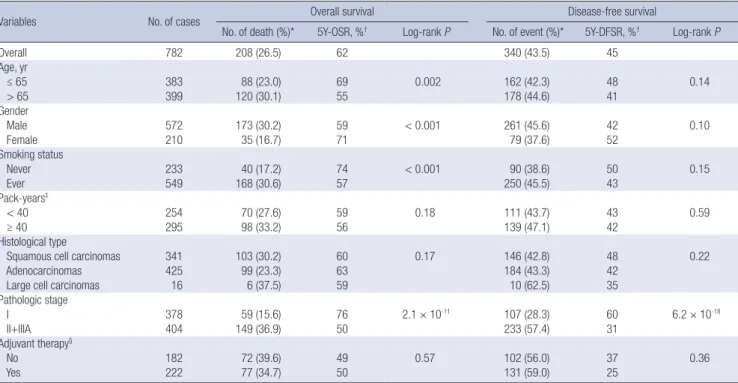
The clinical and pathologic characteristics of the patients and their association with OS and DFS are shown in Table 1. There were total 208 deaths (26.5%) and the estimated 5-year OS and DFS for all patients were 62% (95% CI = 0.57-0.68) and 45% (95%
CI = 0.40-0.49), respectively. Pathologic stage was significantly associated with both OS and DFS. Age, gender and smoking status were significantly associated with OS, but not with DFS in univariate analysis. There were no significant differences in survival outcome by histologic type and adjuvant therapy.
In overall patients’ analyses, the rs833061T>C, rs2010963G>C,
and rs3025039C>T were not significantly associated with OS
and DFS (Table 2). Interestingly, however, when the patients
were stratified by tumor histology, the rs833061 T>C had a sig-
nificantly different effect on survival outcomes between SCC
and AC (Tables 3 and 4). The rs833061 T>C was associated with
better OS in SCC and worse OS in AC under a codominant mod-
el, although marginally significant (adjusted HR [aHR] = 0.76,
95% CI = 0.56-1.03 in SCC; aHR = 1.33, 95% CI = 0.98-1.82 in
AC; P for heterogeneity = 0.01). In addition, the rs833061T>C
was significantly associated with better DFS in SCC and worse
DFS in AC under a codominant model (aHR = 0.75, 95% CI =
0.58-0.97 in SCC; aHR = 1.26, 95% CI = 1.00-1.60 in AC; P for
heterogeneity = 0.004).
DISCUSSION
In the present study, we evaluated the association between po- tentially functional VEGF polymorphisms (rs833061T>C, rs2010 963G>C, and rs3025039C>T) and survival outcomes of NSCLC
patients after surgery in a Korean population. Although none of the three genetic variants were significantly associated with OS and DFS in overall patient population, the rs833061T>C showed differential effect on the prognosis of patients when the subjects were stratified by tumor histology. The SNP was associated with
Table 1. Univariate analysis for overall survival and disease-free survival by age, gender, smoking status, histological type, pathologic stage, and adjuvant therapyVariables No. of cases Overall survival Disease-free survival
No. of death (%)* 5Y-OSR, %† Log-rank P No. of event (%)* 5Y-DFSR, %† Log-rank P
Overall 782 208 (26.5) 62 340 (43.5) 45
Age, yr
≤ 65 383 88 (23.0) 69 0.002 162 (42.3) 48 0.14
> 65 399 120 (30.1) 55 178 (44.6) 41
Gender
Male 572 173 (30.2) 59 < 0.001 261 (45.6) 42 0.10
Female 210 35 (16.7) 71 79 (37.6) 52
Smoking status
Never 233 40 (17.2) 74 < 0.001 90 (38.6) 50 0.15
Ever 549 168 (30.6) 57 250 (45.5) 43
Pack-years‡
< 40 254 70 (27.6) 59 0.18 111 (43.7) 43 0.59
≥ 40 295 98 (33.2) 56 139 (47.1) 42
Histological type
Squamous cell carcinomas 341 103 (30.2) 60 0.17 146 (42.8) 48 0.22
Adenocarcinomas 425 99 (23.3) 63 184 (43.3) 42
Large cell carcinomas 16 6 (37.5) 59 10 (62.5) 35
Pathologic stage
I 378 59 (15.6) 76 2.1 × 10⁻¹¹ 107 (28.3) 60 6.2 × 10⁻¹⁸
II+IIIA 404 149 (36.9) 50 233 (57.4) 31
Adjuvant therapy§
No 182 72 (39.6) 49 0.57 102 (56.0) 37 0.36
Yes 222 77 (34.7) 50 131 (59.0) 25
*Row percentage; †Five year-overall survival rate (5Y-OSR) and 5 year-disease free survival rate (5Y-DFSR), proportion of survival derived from Kaplan-Meier analysis; ‡In ever- smokers; §In pathologic stage II + IIIA : 182 cases received p aclitaxel-cisplatin, 11 cases received radiotherapy, and 27 cases received chemotherapy and radiotherapy.
Table 2. Overall survival and disease-free survival according to genotypes in patients with non-small cell lung cancer SNP Genotypell No. of
cases (%)*
Overall survival Disease-free survival
No. of deaths (%)†
5Y-OSR,
%‡
Log-rank P
HR
(95% CI)§ P§ No. of
events (%)†
5Y-DFSR,
%‡
Log-rank P
HR
(95% CI)§ P§
rs833061 TT 353 (46.5) 94 (26.6) 66 0.32 1.00 - 151 (42.8) 45 0.79 1.00 -
CT 312 (41.1) 75 (24.0) 63 - 0.77 (0.57-1.04) 0.09 131 (42.0) 47 - 0.86 (0.68-1.08) 0.19
CC 94 (12.4) 29 (30.9) 55 - 1.13 (0.74-1.72) 0.58 41 (43.6) 45 - 1.06 (0.75-1.51) 0.74
Dominant 406 (53.5) 104 (25.6) 61 0.65 0.84 (0.64-1.12) 0.24 172 (42.4) 46 0.71 0.90 (0.72-1.12) 0.33 Recessive 665 (87.6) 169 (25.4) 64 0.23 1.27 (0.85-1.90) 0.24 282 (42.4) 46 0.67 1.14 (0.82-1.59) 0.43
Codominant - - - 0.81 0.97 (0.79-1.19) 0.76 - - 0.95 0.97 (0.82-1.15) 0.72
rs2010963 CC 148 (19.2) 34 (23.0) 71 0.34 1.00 - 58 (39.2) 51 0.57 1.00 -
CG 380 (49.4) 107 (28.2) 59 - 1.25 (0.84-1.86) 0.26 172 (45.3) 41 - 1.13 (0.84-1.53) 0.42
GG 242 (31.4) 63 (26.0) 62 - 1.16 (0.76-1.78) 0.48 102 (42.2) 48 - 1.07 (0.77-1.48) 0.68
Dominant 622 (80.8) 170 (27.3) 60 0.15 1.22 (0.84-1.77) 0.31 274 (44.1) 43 0.34 1.11 (0.83-1.47) 0.49 Recessive 528 (68.6) 141 (26.7) 62 0.87 0.99 (0.73-1.34) 0.94 230 (43.6) 44 0.93 0.98 (0.77-1.24) 0.85
Codominant - - - 0.36 1.06 (0.87-1.29) 0.60 - - 0.63 1.02 (0.87-1.19) 0.79
rs3025039 CC 517 (66.6) 137 (26.5) 61 0.71 1.00 - 224 (43.3) 45 0.62 1.00 -
CT 235 (30.3) 59 (25.1) 66 - 0.92 (0.68-1.25) 0.60 96 (40.9) 47 - 0.91 (0.72-1.16) 0.44
TT 24 (3.1) 9 (37.5) 62 - 0.92 (0.47-1.83) 0.82 14 (58.3) 34 - 0.93 (0.54-1.60) 0.78
Dominant 259 (33.4) 68 (26.3) 65 0.66 0.92 (0.69-1.24) 0.59 110 (42.5) 46 0.58 0.91 (0.72-1.15) 0.43 Recessive 752 (96.9) 196 (26.1) 62 0.58 0.95 (0.48-1.87) 0.87 320 (42.6) 45 0.53 0.95 (0.56-1.64) 0.86
Codominant - - - 0.85 0.94 (0.73-1.20) 0.61 - - 0.79 0.93 (0.77-1.13) 0.47
SNP = single nucleotide polymorphism.
*Column percentage; †Row percentage; ‡Five year-overall survival rate (5Y-OSR) and 5 year-disease free survival rate (5Y-DFSR), proportion of survival derived from Kaplan-Meier analysis; §Hazard ratios (HRs), 95% confidence intervals (CIs) and corresponding P values were calculated using multivariate Cox proportional hazard models, adjusted for age, gender, smoking status, tumor histology, pathologic stage and adjuvant therapy; llGenotype failure: 23 cases for the rs833061, 12 cases for the rs2010963 and 6 cases for the rs3025039.
Table 3. Overall Survival according to the rs833061, rs2010963 and rs3025039 genotypes by tumor histology SNP Geno typell
SCC AC
PHll
No. of
cases (%)* No. of deaths (%)† 5Y-OSR
(%)‡ Log-
rank P HR
(95% CI)‡ P§ No. of
cases (%)* No. of
deaths (%)† 5Y-OSR (%)‡ Log-
rank P HR
(95% CI)‡ P§ Overall survival
rs833061
TT 164 (49.3) 58 (35.4) 58 0.05 1.00 - 183 (44.6) 33 (18.0) 74 0.10 1.00 - -
CT 127 (38.1) 30 (23.6) 63 - 0.51 (0.33-0.80) 0.004 181 (44.2) 44 (24.3) 64 - 1.26 (0.80-1.98) 0.33 - CC 42 (12.6) 13 (31.0) 65 - 0.84 (0.46-1.54) 0.57 46 (11.2) 14 (30.4) 38 - 1.84 (0.97-3.50) 0.06 - Dominant 169 (50.8) 43 (25.4) 63 0.03 0.58 (0.39-0.87) 0.01 227 (55.4) 58 (25.6) 59 0.06 1.36 (0.88-2.09) 0.17 0.005 Recessive 291 (87.4) 88 (30.2) 60 0.78 1.10 (0.61-1.97) 0.76 364 (88.8) 77 (21.2) 69 0.14 1.63 (0.91-2.91) 0.10 0.35
Codominant - - - 0.15 0.76 (0.56-1.03) 0.08 - - - 0.03 1.33 (0.98-1.82) 0.07 0.01
rs2010963
CC 59 (17.5) 16 (27.1) 69 0.73 1.00 - 86 (20.6) 17 (19.8) 72 0.35 1.00 - -
CG 175 (51.9) 54 (30.9) 59 - 1.04 (0.59-1.84) 0.883 199 (47.7) 50 (25.1) 60 - 1.60 (0.91-2.81) 0.10 - GG 103 (30.6) 32 (31.1) 57 - 1.25 (0.68-2.30) 0.48 132 (31.7) 29 (22.0) 65 - 1.14 (0.62-2.09) 0.68 - Dominant 278 (82.5) 86 (30.9) 58 0.52 1.11 (0.65-1.91) 0.70 331 (79.4) 79 (23.9) 62 0.20 1.38 (0.81-2.36) 0.24 0.58 Recessive 234 (69.4) 70 (29.9) 62 0.52 1.21 (0.79-1.85) 0.39 285 (68.4) 97 (23.5) 64 0.86 0.82 (0.53-1.28) 0.39 0.22
Codominant - - - 0.43 1.13 (0.84-1.53) 0.42 0.54 1.02 (0.77-1.34) 0.91 0.62
rs3025039
CC 236 (69.4) 69 (29.2) 60 0.50 1.00 - 273 (65.0) 65 (23.8) 61 0.71 1.00 - -
CT 94 (27.7) 29 (30.9) 60 - 1.04 (0.67-1.61) 0.867 133 (31.7) 27 (20.3) 71 - 0.81 (0.52-1.28) 0.37 - TT 10 (2.9) 5 (50.0) 56 - 1.59 (0.64-3.96) 0.32 14 (3.3) 4 (28.6) 67 - 0.54 (0.19-1.50) 0.23 - Dominant 104 (30.6) 34 (32.7) 59 0.77 1.10 (0.72-1.66) 0.67 147 (35.0) 31 (21.1) 71 0.41 0.77 (0.50-1.19) 0.24 0.24 Recessive 330 (97.1) 98 (29.7) 60 0.24 1.58 (0.64-3.89) 0.33 406 (96.7) 92 (22.7) 64 0.82 0.57 (0.21-1.59) 0.29 0.14
Codominant - - - 0.53 1.13 (0.80-1.60) 0.49 - - - 0.44 0.78 (0.54-1.11) 0.16 0.14
SNP = single nucleotide polymorphism, SCC = squamous cell carcinoma, AC = adenocarcinoma.
*Column percentage; †Row percentage; ‡Five year-overall survival rate (5Y-OSR) and 5 year-disease free survival rate (5Y-DFSR), proportion of survival derived from Kaplan-Meier analysis; §Hazard ratios (HRs), 95% confidence intervals (CIs) and corresponding P values were calculated using multivariate Cox proportional hazard models, adjusted for age, gender, smoking status, tumor histology, pathologic stage and adjuvant therapy; llP value of test for homogeneity.
Table 4. Disease-Free Survival according to the rs833061, rs2010963 and rs3025039 genotypes by tumor histology SNP Genotype§
SCC AC
PH§
No. of cases (%)*
No. of events (%)†
5Y-DF- SR (%)†
Log- rank P
HR
(95% CI)† P‡ No. of cases (%)*
No. of events (%)†
5Y-DF- SR (%)†
Log- rank P
HR (95% CI)† P‡ Disease free survival
rs833061
TT 164 (49.3) 77 (47.0) 45 0.14 1.00 - 183 (44.6) 69 (37.7) 47 0.22 1.00 - -
CT 127 (38.1) 50 (39.4) 50 - 0.64 (0.44-0.92) 0.02 181 (44.2) 80 (44.2) 44 - 1.12 (0.81-1.56) 0.48 - CC 42 (12.6) 15 (35.7) 58 - 0.68 (0.39-1.18) 0.17 46 (11.2) 22 (47.8) 32 - 1.78 (1.09-2.90) 0.02 - Dominant 169 (50.8) 65 (38.5) 52 0.05 0.65 (0.46-0.91) 0.01 227 (55.4) 102 (44.9) 42 0.12 1.22 (0.90-1.66) 0.20 0.01 Recessive 291 (87.4) 127 (43.6) 47 0.37 0.82 (0.48-1.41) 0.47 364 (88.8) 149 (40.9) 45 0.21 1.67 (1.06-2.65) 0.03 0.05
Codominant - - - 0.07 0.75 (0.58-0.97) 0.03 - - - 0.08 1.26 (1.00-1.60) 0.05 0.004
rs2010963
CC 59 (17.5) 22 (37.3) 55 0.83 1.00 - 86 (20.6) 33 (38.4) 51 0.45 1.00 - -
CG 175 (51.9) 78 (44.6) 45 - 1.08 (0.67-1.74) 0.75 199 (47.7) 91 (45.7) 36 - 1.25 (0.83-1.87) 0.29 - GG 103 (30.6) 43 (41.8) 50 - 1.07 (0.63-1.80) 0.80 132 (31.7) 55 (41.7) 46 - 1.13 (0.73-1.75) 0.58 - Dominant 278 (82.5) 121 (43.5) 47 0.55 1.08 (0.68-1.71) 0.75 331 (79.4) 146 (44.1) 40 0.27 1.20 (0.82-1.76) 0.36 0.73 Recessive 234 (69.4) 100 (42.7) 48 0.95 1.01 (0.70-1.45) 0.97 285 (68.4) 124 (43.5) 41 0.86 0.97 (0.71-1.34) 0.85 0.87
Codominant - - - 0.71 1.03 (0.80-1.32) 0.84 - - - 0.61 1.04 (0.85-1.28) 0.69 0.95
rs3025039
CC 236 (69.4) 98 (41.5) 48 0.59 1.00 - 273 (65.0) 120 (43.96) 43 0.50 1.00 - -
CT 94 (27.7) 41 (43.6) 50 - 1.11 (0.77-1.60) 0.58 133 (31.7) 51 (38.4) 45 - 0.81 (0.58-1.13) 0.21 - TT 10 (2.9) 6 (60.0) 35 - 1.42 (0.62-3.26) 0.40 14 (3.3) 8 (57.1) 38 - 0.71 (0.34-1.47) 0.36 - Dominant 104 (30.6) 47 (45.2) 48 0.64 1.14 (0.80-1.62) 0.46 147 (35.0) 59 (40.1) 44 0.26 0.79 (0.58-1.09) 0.15 0.13 Recessive 330 (97.1) 139 (42.1) 48 0.32 1.38 (0.61-3.14) 0.44 406 (96.7) 171 (42.1) 43 1.00 0.76 (0.37-1.57) 0.46 0.29
Codominant - - - 0.47 1.14 (0.85-1.54) 0.38 - - - 0.35 0.82 (0.63-1.07) 0.15 0.11
SCC = squamous cell carcinoma, AC = adenocarcinoma.
*Column percentage; †Five year-overall survival rate (5Y-OSR) and 5 year-disease free survival rate (5Y-DFSR), proportion of survival derived from Kaplan-Meier analysis; ‡Haz- ard ratios (HRs), 95% confidence intervals (CIs) and corresponding P values were calculated using multivariate Cox proportional hazard models, adjusted for age, gender, smok- ing status, tumor histology, pathologic stage and adjuvant therapy; §P value of test for homogeneity.
worse OS and DFS in AC, whereas it was associated with better OS and DFS in SCC. Our results suggest that the prognostic role of VEGF rs833061T>C may differ depending on tumor histology.
This is the first study evaluating the relationship between
VEGF polymorphisms and prognosis of NSCLC patients ac-cording to tumor histology. Several studies have evaluated the relationship between potentially functional VEGF polymorphi- sms and the outcome of NSCLC patients, but the results were inconsistent (14-16). For instance, Heist et al. (14) evaluated the relationship between VEGF SNPs and OS among patients with stage I and II NSCLC treated with surgical resection and report- ed that the rs833061T>C was not significantly associated with OS. Guan et al. (15) reported rs833061 TC or CC genotypes were associated with better survival among Caucasian patients with locally advanced NSCLC. In contrast, Masago et al. (16) found that the rs833061T>C was associated with worse survival in Jap- anese NSCLC patients.
The
VEGF gene is located on chromosome 6p21.3 and con-sists of 8 exons and 7 introns (22). Previous studies found that this gene has at least 30 SNPs (23). Among them, rs833061T>C, rs2010963G>C, and rs3025039C>T are putatively functional SNPs which may influence levels of VEGF expression. It has been re- ported that the rs833061T>C may be associated with increased
VEGF promoter activity and plasma levels (24,25).In our study, the rs833061 T>C was associated with better survival outcomes in SCC but worse survival outcomes in AC.
The reason for this finding remains unclear, but our results may be explained by a different VEGF expression and angiogenesis depending on tumor histology. Hypoxia is an important feature of tumors and induces hypoxia-inducible factor-1 which regu- lates various mediators including VEGF, activating angiogenesis (26). In addition, hypoxia induces variant tumor cells which adapt to survive and to proliferate under hypoxic condition by various mechanisms (15,16). These variant tumor cells are se- lected through clonal expansion and aggravate tumor hypoxia by increasing the structurally and functionally disturbed angio- genesis (15,16). This vicious cycle contributes to the poor out- come including development of aggressive phenotype with high metastatic rate, resistance to treatment, and higher tumor re- currence rates (17-19). In previous studies, the degree of VEGF expression and tumor angiogenesis in response to hypoxia was different according to tumor histology: AC showed more prom- inent VEGF expression and microvessel formation than SCC (6,20,27,28). Taken together, it is possible that VEGF mediated tumor angiogenesis is a more important determinant of the prognosis in AC compared to SCC. This may partially explain the different prognostic effect of VEGF rs833061T>C according to tumor histology. In this study, the rs833061T>C, associated with increased VEGF expression (24,25), could predict worse prognosis only in AC. However, the VEGF may not have a criti- cal role in determining the prognosis in SCC. Instead, a possible
alternative explanation is that another angiogenic factor might contribute to the angiogenesis and prognosis in SCC. Recent advances in the molecular biology of lung cancer have led to the understanding that NSCLC is a heterogeneous disease: dif- ferent pathogenesis and clinical features, as well as markedly different genetic alterations between SCC and AC (29,30). Fur- ther research is warranted on the mechanism of different prog- nostic role of VEGF rs833061T>C between SCC and AC, which may lead to better understanding of the pathogenesis of lung cancer.
Antiangiogenic drugs such as bevacizumab, a monoclonal antibody to VEGF, are currently available in selected patients with advanced stage AC (31). Several clinical studies have inves- tigated the benefit of bevacizumab as an adjuvant or a neoadju- vant therapy in early stage AC (32-34). In early stage NSCLC, adjuvant therapy is considered for patients who have risk factors for poor outcome (e.g. vascular invasion, tumors > 4 cm, vis- ceral pleural involvement) (35). In addition to these factors, the rs833062T>C may help select AC patients with poor prognosis who may benefit from adjuvant antiangiogenic drug therapy.
In conclusion, the rs833061T>C may be a useful prognostic marker for patients with surgically resected NSCLC, which has dissimilar roles in different tumor histology. Consequently, test- ing for the presence of the rs833061T>C may help identify pa- tients with high risk of poor disease outcome, thereby helping to refine therapeutic decisions. However, because this study is the first trial to investigate the association between VEGF poly- morphisms and survival outcome according to NSCLC tumor histology, additional studies are required to confirm the find- ings in diverse ethnic populations.
DISCLOSURE
The authors have no potential conflicts of interest to disclose.
AUTHOR CONTRIBUTION
Conception and design: Lee S, Kang HG, Park JY. Drafting of the manuscript: Lee S, Kang HG. Acquisition, analysis and inter- pretation of clinical data: Lee S, Lee E, Seok Y, Yoo SS, Lee J, Cha SI, Kim CH, Cho S. Acquisition, analysis and interpretation of experimental data: Choi JE, Lee JH, Kang HJ, Baek SA. Statisti- cal analysis: Lee WK. Study coordination: Park JY. Final approv- al: all authors.
ORCID
Soyeon Lee http://orcid.org/0000-0002-1868-7715
Hyo-Gyoung Kang http://orcid.org/0000-0003-0600-227X
Jin Eun Choi http://orcid.org/0000-0001-7833-2257
Jang Hyuck Lee http://orcid.org/0000-0001-5537-3013
Hyo Jung Kang http://orcid.org/0000-0002-0011-2542 Sun Ah Baek http://orcid.org/0000-0002-8088-9764 Eungbae Lee http://orcid.org/0000-0002-1727-5380 Yangki Seok http://orcid.org/0000-0001-8212-109X Won Kee Lee http://orcid.org/0000-0003-4217-5792 Shin Yup Lee http://orcid.org/0000-0002-2121-7335 Seung Soo Yoo http://orcid.org/0000-0002-7309-9254 Jaehee Lee http://orcid.org/0000-0001-8111-7320 Seung-Ick Cha http://orcid.org/0000-0002-7246-0909 Chang Ho Kim http://orcid.org/0000-0002-1550-5752 Sukki Cho http://orcid.org/0000-0002-9309-8865 Jae Yong Park http://orcid.org/0000-0001-7993-4495
REFERENCES
1. Siegel RL, Miller KD, Jemal A. Cancer statistics, 2015. CA Cancer J Clin 2015; 65: 5-29.
2. Weis SM, Cheresh DA. Tumor angiogenesis: molecular pathways and therapeutic targets. Nat Med 2011; 17: 1359-70.
3. Des Guetz G, Uzzan B, Nicolas P, Cucherat M, Morere JF, Benamouzig R, Breau JL, Perret GY. Microvessel density and VEGF expression are prog- nostic factors in colorectal cancer. Meta-analysis of the literature. Br J Cancer 2006; 94: 1823-32.
4. Chen J, Li T, Wu Y, He L, Zhang L, Shi T, Yi Z, Liu M, Pang X. Prognostic significance of vascular endothelial growth factor expression in gastric carcinoma: a meta-analysis. J Cancer Res Clin Oncol 2011; 137: 1799-812.
5. Chen M, Cai E, Huang J, Yu P, Li K. Prognostic value of vascular endothe- lial growth factor expression in patients with esophageal cancer: a sys- tematic review and meta-analysis. Cancer Epidemiol Biomarkers Prev 2012; 21: 1126-34.
6. Yuan A, Yu CJ, Chen WJ, Lin FY, Kuo SH, Luh KT, Yang PC. Correlation of total VEGF mRNA and protein expression with histologic type, tumor angiogenesis, patient survival and timing of relapse in non-small-cell lung cancer. Int J Cancer 2000; 89: 475-83.
7. Yuan A, Yu CJ, Luh KT, Chen WJ, Lin FY, Kuo SH, Yang PC. Quantification of VEGF mRNA expression in non-small cell lung cancer using a real-time quantitative reverse transcription-PCR assay and a comparison with quan- titative competitive reverse transcription-PCR. Lab Invest 2000; 80: 1671- 80.
8. O’Byrne KJ, Koukourakis MI, Giatromanolaki A, Cox G, Turley H, Steward WP, Gatter K, Harris AL. Vascular endothelial growth factor, platelet-de- rived endothelial cell growth factor and angiogenesis in non-small-cell lung cancer. Br J Cancer 2000; 82: 1427-32.
9. Han H, Silverman JF, Santucci TS, Macherey RS, d’Amato TA, Tung MY, Weyant RJ, Landreneau RJ. Vascular endothelial growth factor expression in stage I non-small cell lung cancer correlates with neoangiogenesis and a poor prognosis. Ann Surg Oncol 2001; 8: 72-9.
10. Shimanuki Y, Takahashi K, Cui R, Hori S, Takahashi F, Miyamoto H, Fuku- rchi Y. Role of serum vascular endothelial growth factor in the prediction of angiogenesis and prognosis for non-small cell lung cancer. Lung 2005;
183: 29-42.
11. Lu H, Shu XO, Cui Y, Kataoka N, Wen W, Cai Q, Ruan ZX, Gao YT, Zheng W. Association of genetic polymorphisms in the VEGF gene with breast cancer survival. Cancer Res 2005; 65: 5015-9.
12. Hefler LA, Mustea A, Könsgen D, Concin N, Tanner B, Strick R, Heinze G, Grimm C, Schuster E, Tempfer C, et al. Vascular endothelial growth fac- tor gene polymorphisms are associated with prognosis in ovarian cancer.
Clin Cancer Res 2007; 13: 898-901.
13. Bradbury PA, Zhai R, Ma C, Xu W, Hopkins J, Kulke MJ, Asomaning K, Wang Z, Su L, Heist RS, et al. Vascular endothelial growth factor polymorphisms and esophageal cancer prognosis. Clin Cancer Res 2009; 15: 4680-5.
14. Heist RS, Zhai R, Liu G, Zhou W, Lin X, Su L, Asomaning K, Lynch TJ, Wain JC, Christiani DC. VEGF polymorphisms and survival in early-stage non- small-cell lung cancer. J Clin Oncol 2008; 26: 856-62.
15. Guan X, Yin M, Wei Q, Zhao H, Liu Z, Wang LE, Yuan X, O’Reilly MS, Ko- maki R, Liao Z. Genotypes and haplotypes of the VEGF gene and survival in locally advanced non-small cell lung cancer patients treated with chem- oradiotherapy. BMC Cancer 2010; 10: 431.
16. Masago K, Fujita S, Kim YH, Hatachi Y, Fukuhara A, Nagai H, Irisa K, Ichi- kawa M, Mio T, Mishima M. Effect of vascular endothelial growth factor polymorphisms on survival in advanced-stage non-small-cell lung can- cer. Cancer Sci 2009; 100: 1917-22.
17. Höckel M, Vaupel P. Tumor hypoxia: definitions and current clinical, bio- logic, and molecular aspects. J Natl Cancer Inst 2001; 93: 266-76.
18. Vaupel P. The role of hypoxia-induced factors in tumor progression. On- cologist 2004; 9 Suppl 5: 10-7.
19. Vaupel P, Harrison L. Tumor hypoxia: causative factors, compensatory mechanisms, and cellular response. Oncologist 2004; 9 Suppl 5: 4-9.
20. Eilertsen M, Pettersen I, Andersen S, Martinez I, Donnem T, Busund LT, Bremnes RM. In NSCLC, VEGF-A response to hypoxia may differ between squamous cell and adenocarcinoma histology. Anticancer Res 2012; 32:
4729-36.
21. Postmus PE, Brambilla E, Chansky K, Crowley J, Goldstraw P, Patz EF Jr, Yokomise H; International Association for the Study of Lung Cancer In- ternational Staging Committee; Cancer Research and Biostatistics; Ob- servers to the Committee, et al. The IASLC lung cancer staging project:
proposals for revision of the M descriptors in the forthcoming (seventh) edition of the TNM classification of lung cancer. J Thorac Oncol 2007; 2:
686-93.
22. Vincenti V, Cassano C, Rocchi M, Persico G. Assignment of the vascular endothelial growth factor gene to human chromosome 6p21.3. Circula- tion 1996; 93: 1493-5.
23. Tu J, Wang S, Zhao J, Zhu J, Sheng L, Sheng Y, Chen H, Tian J. rs833061 and rs699947 on promoter gene of vascular endothelial growth factor (VEGF) and associated lung cancer susceptibility and survival: a meta- analysis. Med Sci Monit 2014; 20: 2520-6.
24. Chen MH, Tzeng CH, Chen PM, Lin JK, Lin TC, Chen WS, Jiang JK, Wang HS, Wang WS. VEGF− 460T→ C polymorphism and its association with VEGF expression and outcome to FOLFOX-4 treatment in patients with colorectal carcinoma. Pharmacogenomics J 2011; 11: 227-36.
25. Stevens A, Soden J, Brenchley PE, Ralph S, Ray DW. Haplotype analysis of the polymorphic human vascular endothelial growth factor gene pro- moter. Cancer Res 2003; 63: 812-6.
26. Hoeben A, Landuyt B, Highley MS, Wildiers H, Van Oosterom AT, De Bruijn EA. Vascular endothelial growth factor and angiogenesis. Pharmacol Rev 2004; 56: 549-80.
27. Ferah E, Ferda A, Sevinç B, Zuhal K, Ali A. Microvessel density as a mark- er of tumor angiogenesis in nonsmall cell lung cancer. Turk Respir J 2000;
1: 5-8.
28. Yuan A, Yang PC, Yu CJ, Lee YC, Yao YT, Chen CL, Lee LN, Kuo SH, Luh KT. Tumor angiogenesis correlates with histologic type and metastasis in non-small-cell lung cancer. Am J Respir Crit Care Med 1995; 152: 2157- 62.
29. Sekido Y, Fong KM, Minna JD. Molecular genetics of lung cancer. Annu Rev Med 2003; 54: 73-87.
30. Herbst RS, Heymach JV, Lippman SM. Lung cancer. N Engl J Med 2008;
359: 1367-80.
31. Sandler A, Gray R, Perry MC, Brahmer J, Schiller JH, Dowlati A, Lilenbaum R, Johnson DH. Paclitaxel-carboplatin alone or with bevacizumab for non- small-cell lung cancer. N Engl J Med 2006; 355: 2542-50.
32. Rizvi N, Rusch V, Zhao B, Senturk E, Schwartz L, Fury M, Downey R, Rizk N, Krug L, Kris MG. Single agent bevacizumab and bevacizumab in com-
bination with docetaxel and cisplatin as induction therapy for resectable IB-IIIA non-small cell lung cancer. J Clin Oncol 2007; 25: 18045.
33. Schettino C, Bareschino MA, Rossi A, Maione P, Castaldo V, Mazzeo N, Sacco PC, Ferrara ML, Palazzolo G, Ciardiello F, et al. The potential role of bevacizumab in early stages and locally advanced non-small cell lung cancer. Ther Adv Med Oncol 2009; 1: 5-13.
34. Wozniak AJ, Gadgeel SM. Adjuvant therapy for resected non-small cell lung cancer. Ther Adv Med Oncol 2009; 1: 109-18.
35. National Comprehensive Cancer Network (US). NCCN clinical practice guidelines in oncology: non-small cell lung cancer (version 5.2015) [In- ternet]. Available at http://www.nccn.org/professionals/physician_gls/
pdf/nscl.pdf [accessed on May 2015].