719 Korean Chem. Eng. Res., 54(5), 719-721 (2016)
http://dx.doi.org/10.9713/kcer.2016.54.5.719 PISSN 0304-128X, EISSN 2233-9558
단 신
Formatotrophic Production of Poly-β-hydroxybutyric Acid (PHB) from Methylobacterium sp.
using Formate as the Sole Carbon and Energy Source
Dae Haeng Cho, Min Gee Jang and Yong Hwan Kim†
Department of Chemical Engineering, Kwangwoon University, 53, Gwangun-ro 6-gil, Nowon-gu, Seoul, 01899, Korea (Received 29 March 2016; Received in revised form 1 July 2016; accepted 17 August 2016)
Abstract − Formate has been considered as an environmentally sustainable feedstock that can be used to accelerate the production of valuable chemicals. This study presents brief results of the formatotrophic production of poly-β-hydroxy- butyric acid (PHB) by Methylobacterium sp. To evaluate the production of PHB, five species of Methylobacteria were tested using formate as the sole carbon and energy source. Methylobacterium chloromethanicum CM4 exhibited the highest productivity of PHB, which showed 1.72 g/L PHB production, 32.4% PHB content, and 0.027 g-PHB/g-for- mate PHB yield. These results could be used for the formatotrophic production of PHB with the concurrent reduction of CO2 to formate.
Key words: Poly-β-hydroxybutyric acid (PHB), Formatotrophy, Formate, Methylobacterium chloromethanicum CM4, For- mate dehydrogenase (FDH)
The demand for a significant reduction in carbon dioxide (CO2) emission has intensified due to increasing attention to global warm- ing and climate change. As an alternative strategy for the sequestra- tion of CO2, the chemical or electro-chemical reduction of CO2 to useful organic compounds, such as formate, methane, carbon mon- oxide, and ethylene, has been investigated [1]. Among these prod- ucts, formate has been researched as a fuel alternative to methanol or hydrogen in fuel cells [2,3]. In addition, the National Research Council of the National Academies of the USA has suggested for- mate, along with methane and CO2, as an economically feasible and environmentally sustainable feedstock for accelerating the produc- tion of fuels and high-volume chemicals via bio-processing [4].
The electrochemical reduction of CO2 can produce formic acid at low overpotential and with high faradic efficiency [5]. In addition, an exceptionally higher capability to synthesize formate by the electro- biocatalytic reduction of CO2 has been reported using an oxygen-sta- ble whole-cell biocatalyst [6]. Therefore, there is an urgent demand to find a new route for the production of more valuable compounds using formate as a carbon source.
Formate can be used by living cells as a carbon and energy source [7,8]. Formate is one of the best electron mediators that have good electron carrier criteria, such as stability, non-toxicity, permeability through the cell membrane, and low volatility [9]. Pink facultative methylotrophs, non-pigmented pseudomonads, facultative autotro- phs or phototrophs, and Hyphomicrobia are able to grow on formate
through the serine pathway or the ribulose monophosphate (RuMP) pathway [10]. However, these studies are focused on the genetic, metabolic, and physiologic point of view rather than on the perspec- tive for the production of a valuable product. In this study, we report a brief study for the formatotrophic production of poly-β-hydroxy- butyric acid (PHB) from Methylobacterium sp. using formate as the sole carbon and energy source.
The microbial genus of Methylobacteria, including Methylobacte- rium extorquens AM1 (ATCC 14718), M. chloromethanicum (KCTC 32005), M. suomiense (KCTC 12963), M. platani (KCTC 12901), and M. tarhaniae (KCTC 23615), was obtained from KCTC (Korean Collection for Type Cultures) and ATCC (American Type Culture Collection). The culture medium contained (NH4)2SO4 (1.0 g/L), KH2PO4 (1.3 g/L), Na2HPO4·7H2O (0.45 g/L), CaCl2·2H2O (3.3 mg/
L), FeSO4·7H2O (1.3 mg/L), MnSO4·H2O (100 µg/L), ZnSO4·7H2O (130 µg/L), CuSO4·5H2O (40 µg/L), Na2MoO4·2H2O (40 µg/L), CoCl2·6H2O (40 µg/L), and H3BO3 (30 µg/L) [11]. For formatotro- phic PHB production, sodium formate (25 mM) was added initially as the sole carbon and energy source. The cultures for the PHB pro- duction were performed using a 250-mL vessel that was equipped with a pH control system. To maintain a pH of 7.0 and a continuous supply of formate, a pH-static formic acid feeding system was used.
Then, 10 N formic acid was fed as a pH titrant and carbon source using a pH controller and peristaltic pump. Filter-sterilized air was supplied at a flow rate of 1 vvm, and agitation was performed with a magnetic bar at a rate of 500 rpm. Temperature (30 °C) and stirring were controlled in a personal organic synthesizer ChemiStation (Eyela, Tokyo, Japan). Samples were collected periodically to determine cell growth, residual formate, and PHB production.
The dry cell weight (DCW) was measured after washing and dry- ing the culture samples. The PHB concentration was determined using
†To whom correspondence should be addressed.
E-mail: [email protected]
‡This article is dedicated to Prof. Choon Han on the occasion of his retirement from Kwangwoon University.
This is an Open-Access article distributed under the terms of the Creative Com- mons Attribution Non-Commercial License (http://creativecommons.org/licenses/by- nc/3.0) which permits unrestricted non-commercial use, distribution, and reproduc- tion in any medium, provided the original work is properly cited.
720 Dae Haeng Cho, Min Gee Jang and Yong Hwan Kim
Korean Chem. Eng. Res., Vol. 54, No. 5, October, 2016
a gas chromatographic method as previously described [12]. A gas chromatograph (Agilent Technology 6890 GC System) that was equipped with an HP-INNOWax column (30 m×250 μm×0.25 μm, Agilent Technologies, CA, USA) and flame ionized detector was used. The oven temperature was programmed to increase from 50 °C to 170 °C at a rate of 1 °C/min. The injector and detector tempera- tures were set to 250 °C. Helium was used as a carrier gas with a flow rate of 1.0 mL/min. The concentration of formate was deter- mined by HPLC (Agilent 1200 series) with an Aminex HPX-87H column (300 mm × 7.8 mm, Bio-Rad, Hercules, CA) and a refractive index detector (RID) at 35 °C. The mobile phase was 5 mM H2SO4 at a flow rate of 0.6 mL/min.
To evaluate the formatotrophic production of PHB, a total of five species of Methylobacteria were tested using formate as the sole car- bon and energy source. As shown in Table 1, among the tested bacte- ria, M. chloromethanicum CM4 showed the highest productivity of PHB compared to the other strains. M. chloromethanicum CM4 pro- duced 1.72 g/L PHB, and the PHB content was 32.4%. These values are much higher than those of M. extorquens AM1 (1.08 g/L and 22.46%, respectively). PHB yields relative to the total formate con- sumed (g-PHB/g-formate) were in the range of 0.003~0.027. M.
chloromethanicum CM4 showed the highest PHB yield (0.027), fol- lowed by M. extorquens AM1 (0.018).
PHB accumulation is a growth-associated process, so that the bio- mass yield from the carbon and energy source is critical. The molar yield values (g-DCW/mol of substrate utilized) of several bacteria that utilize C1-compounds via the RuMP pathway and the serine pathway have been reported [7]. When using the serine pathway, the yield values of methanol and formate were 0.31~0.41 g-DCW/g- methanol and 0.07~0.15 g-DCW/g-formate, respectively. It means that the yield values decreased as increase of oxidation level of C1 substrate. In this study, the biomass yield value of M. chloromethanicum CM4 was 0.084 g-DCW/g-formate, which agrees with previous reports.
The methanol-based PHB yields from a high-cell-density culture of M. extorquens AM1 and the phosphate-limited fed-batch culture of M. organophilum were 0.20~0.22 g/g-methanol and 0.19 g/g-metha- nol, respectively [13,14]. These values are approximately seven times higher than those of M. chloromethanicum CM4 on formate in this study. The theoretical yields of PHB from methanol and formate were estimated to 0.54 (g-PHB/g-methanol) and 0.13 (g-PHB/g-for- mate), respectively [15]. It means that the result of this study (0.027 g-PHB/g-formate) on formate is about 20% of the theoretical value.
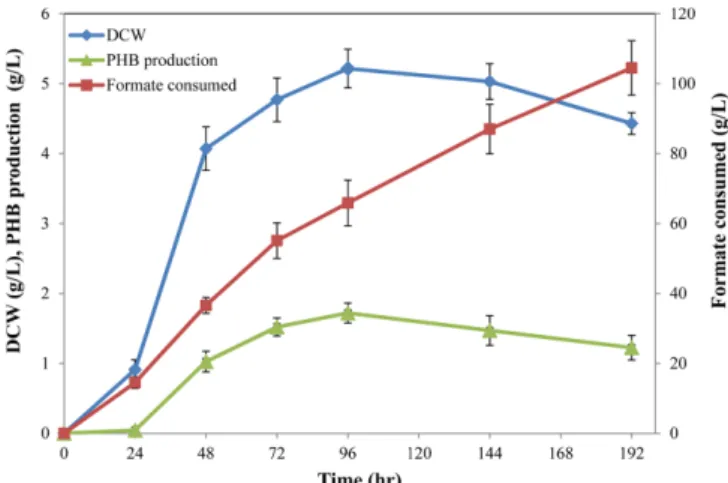
As shown in Fig. 1, PHB production showed a growth-associated
pattern. Cell growth and PHB production peaked at 96 hr of culture and then decreased slowly. However, formate was continuously con- sumed until the end of culture. In addition, the formate consumption rate was maintained almost constant throughout the culture time, meaning that formate supply and consumption occurred continu- ously despite the cessation of growth. This result could be due to two reasons. First, the consumed formate was used to maintain cells rather than to support cell growth and PHB production. Second, formate could be oxidized by formate dehydrogenase (FDH).
In methylotrophic metabolism, formate serves as the main branch point between assimilatory and dissimilatory metabolism [16]. For- mate can either be oxidized to CO2 for energy generation or be con- verted to methylene-H4F into biomass via the serine cycle. Formate oxidation to CO2 is carried out by four known FDH enzymes in M. extorquens AM1 [17]. Therefore, some of the consumed formate after the stationary growth phase could be attributable to the oxida- tion of formate by FDHs. In fact, in the experiment of formate oxida- tion by resting cells of M. chloromethanicum CM4, 30 mM of formate was totally disappeared within 20 hr (data not shown).
Although M. Chloromethanicum CM4 exhibited the greatest abil- ity to produce PHB, the yield value was not high compared to that of methanol. Nevertheless, the formatotrophic production of PHB has an advantage if it is connected with the process of the concurrent reduction of CO2 to formate. In addition, this production is suited for the current demand of the use of formate as a feed stock instead of sugars for the production of valuable products through microbial fer- mentation.
Fig. 1. Time course of PHB production by M. chloromethanicum CM4 using formate as the sole carbon and energy source.
Table 1. Formatotrophic production of PHB by Methylobacterium sp*
PHB content (%) PHB production (g/L) PHB yield (g-PHB/g-formate) Biomass yield (g-DCW/g-formate)
M. chloromethanicum CM4 32.40 1.72 0.027 0.084
M. extorquens AM1 22.46 1.08 0.018 0.080
M. platani 15.42 0.59 0.009 0.059
M. suomiense 3.59 0.19 0.003 0.116
M. tarhaniae 11.61 0.94 0.013 0.087
*The data were obtained after 96 hr of culture. All of the measurements were performed in triplicate, and the values were averaged
Formatotrophic Production of PHB from Methylobacteria 721
Korean Chem. Eng. Res., Vol. 54, No. 5, October, 2016
Acknowledgments
This research was supported by a grant from the Korea CCS Research
& Development Center (KCRC) (2014M1A8A1049296) and a KETEP grant (20133030000300, 2014030091040).
References
1. Whipple, D. T. and Kenis, P. J. A., “Prospects of CO2 Utiliza- tion via Direct Heterogeneous Electrochemical Reduction,” J.
Phys. Chem. Lett., 1, 3451-3458(2010).
2. Enthaler, S., von Langermann, J. and Schmidt, T., “Carbon Dioxide and Formic Acid-the Couple for Environmental-friendly Hydro- gen Storage?,” Energy Environ. Sci., 3, 1207-1217(2010).
3. Joó, F., “Breakthroughs in Hydrogen Storage-Formic Acid as a Sustainable Storage Material for Hydrogen,” ChemSusChem., 1, 805-808(2008).
4. Thomas, M. C., Michelle, C. C., Lionel, C., Andrew, D. E., Richard, A. J., Jay, D. K., Stephen, S. L., Pilar, O., Kristala, L. J.
P., Reshma, P. S., Christopher, A.V. and Humin, Z., Industrialization of Biology: A Roadmap to Accelerate the Advanced Manufactur- ing of Chemicals. National Academies Press. (2015).
5. Kortlever, R., Peters, I., Koper, S. and Koper, M. T. M., “Elec- trochemical CO2 Reduction to Formic Acid at Low Overpotential and with High Faradaic Efficiency on Carbon-Supported Bime- tallic Pd-Pt Nanoparticles,” ACS Catal., 5, 3916-3923(2015).
6. Hwang, H., Yeon, Y. J., Lee, S., Choe, H., Jang, M. G., Cho, D.
H., Park, S. and Kim, Y. H., “Electro-biocatalytic Production of Formate from Carbon Dioxide Using an Oxygen-stable Whole Cell Biocatalyst,” Bioresour. Technol., 185, 35-39(2015).
7. Goldberg, I., Rock, J. S., Ben-Bassat, A. and Mateles, R. I.,
“Bacterial Yields on Methanol, Methylamine, Formaldehyde, and Formate,” Biotechnol. Bioeng., 18, 1657-1668(1976).
8. Large, P. J., Peel, D. and Quayle, J. R., “Microbial Growth on
C(1) Compounds. 2. Synthesis of Cell Constituents by Methanol- and Formate-grown Pseudomonas AM1, and methanol-grown Hyphomicrobium vulgare,” Biochem. J., 81, 470-480(1961).
9. Bar-Even, A., Noor, E., Flamholz, A. and Milo, R., “Design and Analysis of Metabolic Pathways Supporting Formatotrophic Growth for Electricity-dependent Cultivation of Microbes,” Bio- chim. Biophys. Acta, Bioenergetics., 1827, 1039-1047(2013).
10. Anthony, C. The Biochemistry of Methylotrophs. Academic Press.
(1982).
11. Choi, J. H., Kim, J. H., Daniel, M. and Lebeault, J. M., “Opti- mization of Growth Medium and Poly-β-hydroxybutyric Acid Production from Methanol in Methylobacterium organophilum,”
Kor. J. Appl. Microbiol. Bioeng., 17, 392-396(1989).
12. Braunegg, G., Sonnleitner, B. and Lafferty, R. M., “A Rapid Gas Chromatographic Method for the Determination of Poly-β- hydroxybutyric Acid in Microbial Biomass,” Eur. J. Appl. Micro- bio. Biotechnol., 6, 29-37(1978).
13. Bourque, D., Pomerleau, Y. and Groleau, D., “High-cell-density Production of Poly-β-hydroxybutyrate (PHB) from Methanol by Methylobacterium extorquens: Production of High-molecular-mass PHB,” Appl. Microbiol. Biotechnol., 44, 367-376(1995).
14. Kim, S., Kim, P., Lee, H. and Kim, J., “High production of Poly- β-hydroxybutyrate (PHB) from Methylobacterium organophilum Under Potassium Limitation,” Biotechnol Lett., 18, 25-30(1996).
15. Yamane, T., “Yield of Poly-d-3-hydroxybutyrate from Various Carbon Sources: a Theoretical Study,” Biotechnol. Bioeng., 41, 165-170(1993).
16. Crowther, G. J., Kosály, G. and Lidstrom, M. E., “Formate as the Main Branch Point for Methylotrophic Metabolism in Methylo- bacterium extorquens AM1,” J. Bacteriol., 190, 5057-5062(2008).
17. Chistoserdova, L., Crowther, G. J., Vorholt, J. A., Skovran, E., Portais, J.-C. and Lidstrom, M. E., “Identification of a Fourth Formate Dehydrogenase in Methylobacterium extorquens AM1 and Confirmation of the Essential Role of Formate Oxidation in Methylotrophy,” J. Bacteriol., 189, 9076-9081(2007).