416 https://doi.org/10.9713/kcer.2018.56.3.416
PISSN 0304-128X, EISSN 2233-9558
Kinetics and Optimization of Dimethyl Carbonate Synthesis by Transesterification using Design of Experiment
Kilwoo Lee and Kye Sang Yoo†
Department of Chemical & Biomolecular Engineering, Seoul National University of Science & Technology, 232 Gongneung-ro, Nowon-gu, Seoul, 01811, Korea
(Received 13 November 2017; Received in revised form 8 December 2017; accepted 15 December 2017)
Abstract − A comprehensive kinetic study has been conducted on dimethyl carbonate synthesis by transesterification reaction of ethylene carbonate with methanol. An alkali base metal (KOH) was used as catalyst in the synthesis of DMC, and its catalytic ability was investigated in terms of kinetics. The experiment was performed in a batch reactor at atmo- spheric pressure. The reaction orders, the activation energy and the rate constants were determined for both forward and backward reactions. The reaction order for forward and backward reactions was 0.87 and 2.15, and the activation energy was 12.73 and 29.28 kJ/mol, respectively. Using the general factor analysis in the design of experiments, we analyzed the main effects and interactions according to the MeOH/EC, reaction temperature and KOH concentration. DMC yield with various reaction conditions was presented for all ranges using surface and contour plot. Furthermore, the optimal conditions for DMC yield were determined using response surface method.
Key words: Dimethyl carbonate synthesis, Transesterification reaction, design of experiment, Response surface method
1. Introduction
Dimethyl carbonate (DMC) is a versatile and nontoxic chemical substance that is an important chemical material in the current chem- ical industry and in the motor fuel industry. It has been proposed as a methylating agent for aromatic compounds, to replace methyl halides and dimethyl sulfate, which are both toxic and corrosive, and as an intermediate in the synthesis of polycarbonates and isocya- nates, thereby avoiding the need to use phosgene. DMC is also a can- didate for replacing methyl tertiary butyl ether (MTBE) as an oxygen- containing additive for gasoline because it has high oxygen content, a good blending octane, low toxicity, and quick biodegradation [1].
A number of DMC synthesis processes have been suggested and some processes have already been commercialized. The classic route to DMC involves the use of phosgene. This route is disadvantaged by the safety problem of handling highly toxic phosgene and the environmental problem of disposing of sodium chloride. Overall transesterification reaction of ethylene carbonate (EC) with metha- nol (MeOH) can be written as follows:
There are two kinds of transesterification for DMC synthesis: het- erogeneous and homogeneous. Tatsumi et al. [2] introduced a hetero- geneous catalyst and suggested that a solid base catalyst was excellent for the synthesis of DMC. Watanabe et al. [3] reported that hydrotal- cite-type catalysts have good catalytic ability for DMC synthesis.
Moreover, several classes of catalysts for DMC synthesis were stud- ied through the transesterification reaction [4,5]. The homogeneous transesterification method is featured by a high reaction rate and is most likely to be commercialized. Moreover, a cheap alkali, such as KOH, can be used as homogeneous catalyst. Accordingly, a detailed study on this method is imperative for an industrially acceptable DMC synthesis process.
Besides kinetic study, the optimization of catalytic reaction pro- cess is an essential step in developing industrial chemical plant. As the synthesis process becomes more diverse and complex, the num- ber of experiments to find optimal synthesis conditions increases exponentially. Especially, it is difficult to find an optimal synthesis condition by using trial and error method in the case of expensive raw materials or long reaction time. To overcome this problem, there is a growing interest in research using statistical experimental design methods. In general, the experimental design method is designed to obtain maximum information at a low cost in an experiment. The experiment consists of a design step, an analysis step of the experi- mental data, and an optimization step [6]. In the design stage of the experiment, the selection of the experiments and the randomization, which is the order of the experiment, are determined to achieve the purpose of the experiment efficiently and practically. In the analysis stage, an appropriate model for the experimental data including screening of the key factors and the interaction effects is searched. In the optimization stage, the optimum conditions of the parameters suitable for the experimental purpose are found and the reproducibil- ity is confirmed [7].
In this work, we proposed kinetic performance of KOH catalyst and estimated the rate constants and the reaction orders in DMC syn-
†To whom correspondence should be addressed.
E-mail: [email protected]
This is an Open-Access article distributed under the terms of the Creative Com- mons Attribution Non-Commercial License (http://creativecommons.org/licenses/by- nc/3.0) which permits unrestricted non-commercial use, distribution, and reproduc- tion in any medium, provided the original work is properly cited.
thesis, for both forward and backward reactions. Moreover, the effects of reaction conditions and their interactions on the catalytic performance were studied simultaneously on the responses using design of experiments. The obtained experimental data have been used to predict the optimum values of process parameters and their interactions for optimization by statistical approach under response surface methodology (RSM).
2. Experimental
All experiments were performed in a stainless-steel autoclave (200 ml) at atmospheric pressure. For mixing in the reaction, a mag- netic stirrer was used. Reaction temperature was maintained con- stantly with a temperature controller. Starting materials used in this work were methanol (purity ≥ 99.5%) produced by Daejung Chemi- cals & Metals Co., and ethylene carbonate (≥ 98% from Aldrich), dimethyl carbonate (≥ 99%, Acros) and ethylene glycol (EG) (≥ 99%, Daejung) without further purification. The molar ratio of the initial reactants for forward reaction (MeOH:EC) was in the range of 8:1- 15:1, while for backward reaction the molar ratio between DMC and EG was changed from 1:10 to 10:1. Potassium hydroxide, soluble in methanol and EG, was used as catalyst for both reactions. Catalyst concentration was 0.05~0.2 wt%. The reaction temperature was var- ied from 30oC to 60oC and from 30oC to 80oC for forward and backward reaction, respectively. The products were analyzed by using an on-line gas chromatograph (Agilent 6890) with FID detector. Col- umn was installed with GS-Q (Agilent, capillary 30 m × 0.32 mm).
Minitab 17 was used to perform the statistical experimental design using experimental data.
3. Results and Discussion
The transesterification reaction as shown in Scheme 1 composed of two reactions, that are forward and backward reaction. The rate of reaction of ethylene carbonate (EC) can be expressed as follows:
(1)
When only forward reaction is regarded, Equation (1) can be rear- ranged to Equation (2) since a high concentration of MeOH was used in the reactant for this reaction.
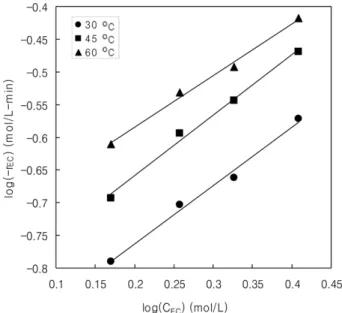
(2) The reaction rate of EC with various initial concentrations is illus- trated in Fig. 1 at different reaction temperature. The molar ratio of MeOH to EC was maintained at higher than 8 and the amount of cat-
alyst was 0.2 wt%. The preliminary work [5] found that there was no considerable effect of KOH more than 0.1 wt% to reaction rate of EC conversion, while below this amount the catalyst concentration had considerable effect on the reaction rate of EC conversion. So, the cat- alyst amount used in this work was maintained at 0.2 wt%. From the data of Fig. 2, the reaction order was determined by regression based on Equation (3) and presented in Table 1.
(3) rEC
– =kforwardCMeOHa CECb –kbackwardCDMCc CEGd
r
–EC=kforwardCMeOHa CECb =kforwardCECb
log(–rEC) logk= forward* +blogCEC
Fig. 1. The plot to determine the forward reaction order and con- stant in DMC synthesis.
Scheme 1
Fig. 2. Relationship of k with temperature.
Korean Chem. Eng. Res., Vol. 56, No. 3, June, 2018
The effect of reaction temperature on the reaction rate of EC was investigated by various reaction temperature and the results are plot- ted in Fig. 2, 3. As shown in Fig. 2, the reaction rate increased with reaction temperature. The k values calculated at various tempera- tures were correlated by Equation (4) and shown in Fig. 3. The acti- vation energy and rate constant were determined and illustrated in Table 1.
(4) Regarding backward reaction, Equation (1) can be rearranged to Equation (5).
(5) For equal concentrations of DMC and EG, Equation (5) becomes
(6) and taking logs this gives
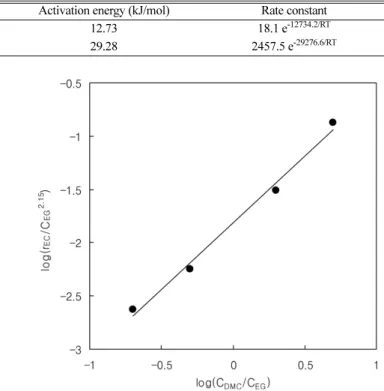
(7) The overall order of backward reaction was determined by Equa- tion (7) as shown in Fig. 4. Knowing the overall order, the reaction order with respect to each component was estimated with the follow- ing manipulation:
(8) Taking logs and using the value of overall order determined, the reaction order of individual component was calculated with Equa-
tion (9). In Fig. 5, the correlation of experiment data to determine the reaction order was well fitted and the values calculated are illus- trated in Table 1.
(9)
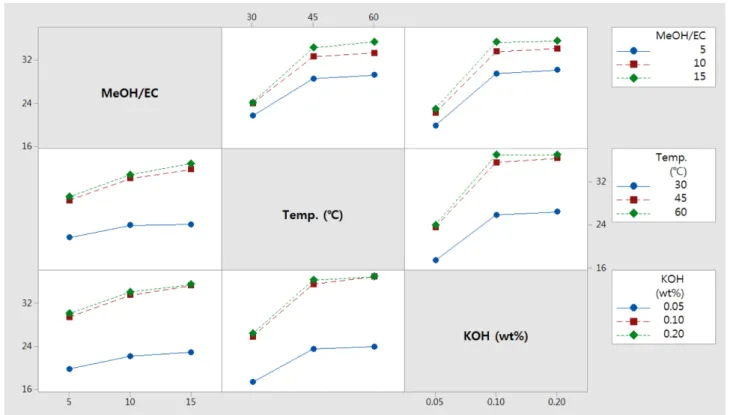
To analyze the main effects and interactions of the reaction condi- tions in the synthesis of DMC, the MeOH/EC molar ratio, reaction temperature, and KOH concentration were used as experimental parameters. First, we performed Minitab 17 using the general facto- rial method, which is used when the level of all the factors is not 2 level. The main effect of factor level changes on DMC yield is pre- sented in Fig. 5. All main factors show some effect to determine DMC yield. Especially, the effect of reaction temperature and KOH k
ln lnko Ea RT--- –
=
rEC=kbackwardCDMCc CEGd
rEC
– =kbackwardCDMCc CEGd =kbackwardCc dDMC+ =kbackwardCDMCc
log r( EC) logk= backward+nlogCDMC
rEC=kbackwardCDMCc CEGd =kbackwardCDMCc CEGn d– kbackwardCEGn CDMC
CEG ---
⎝ ⎠
⎛ ⎞c
=
logrEC CEG2.15
--- logkbackward clogCDMC CEG --- +
= Table 1. Estimated value of reaction orders and rate constants
Reaction Reaction order Activation energy (kJ/mol) Rate constant
Forward b = 0.87 12.73 18.1 e-12734.2/RT
Backward c = 1.25, d = 0.9 29.28 2457.5 e-29276.6/RT
Fig. 3. The plot to determine the backward overall reaction order
and rate constant in DMC synthesis. Fig. 4. The plot to determine the backward individual reaction order in DMC synthesis.
Fig. 5. Main effect plot for DMC yield (%) over various reaction conditions.
concentration on DMC yield was significant. Furthermore, the inter- action which is the effect of one factor depending on the level of the other factor is illustrated in Fig. 6. The interaction effect was higher in the condition where the main effect degree of each factor was small.
The second-order polynomial equation was selected to predict the yield of DMC according to the reaction conditions. When the vari- able corresponding to the reaction condition was larger than the third term, the prediction result was not affected. For that reason, the equa- tion derived here is limited to the quadratic equation. The correlation coefficient was calculated by the nonlinear regression method (using Minitab 17 program) as Equation (10).
Y = -41.24 + 0.662 X1 + 1.671 X2 + 397.0 X3 - 0.0440 X12 - 0.01741 X22 - 1460.7 X32 + 0.01233 X1 X2 + 1.229 X1 X3
+ 0.743 X2 X3 (10)
In this equation, Y is the yield of DMC, X1 is the molar ratio of
MeOH to EC, X2 is the reaction temperature and X3 is the weight concentration of the catalyst, KOH. The R2 value of the model equation derived from the analysis of variance was 0.985, which was found to be close to the experimental result.
To derive the optimal synthesis conditions for the DMC yield using second-order response surface morphology, the optimal condi- tions are shown using contour plots. As shown in Fig. 7, the optimal synthesis conditions for DMC yields are presented in all ranges. An experiment was then performed using the reaction conditions opti- mized by the design of experiment. The experimental value compares well with response surface model equation as listed in Table 2. The percentage error is only 2.2%. Therefore, the optimal synthesis con- dition prediction using the response surface analysis method, which is one of the statistical experimental design methods, can be regarded as a meaningful result.
Fig. 6. Interaction plot for DMC yield (%) over various reaction conditions.
Fig. 7. Contour plots of the optimum reaction conditions with various DMC yield.
Korean Chem. Eng. Res., Vol. 56, No. 3, June, 2018
4. Conclusion
The reaction kinetics and the experimental studies of transesterifi- cation reaction of EC with methanol were investigated. From the experimental and calculated results, the reaction order for forward and backward reactions was 0.87 and 2.15, respectively. The activa- tion energy was 12.73 and 29.28 kJ/mol, and the rate constant was 18.1 e-12734.2/RT and 2457.5 e-29276.6/RT for forward and backward reactions, respectively. The results will be informative for develop- ing the reaction process of DMC synthesis. In this study, the optimum reaction process for synthesizing DMC was proposed using experi- mental design method. In the analysis using general factorial experi- ments, MeOH / EC, reaction temperature and catalyst concentration were found to be major factors. Also, the interactions among the major factors were calculated to be large. In addition, the optimal reaction process according to the DMC yield can be presented in all ranges using the reaction surface analysis method. In this way, it is possible to optimize the synthesis process more reliably by trial and error.
Especially, as the major factors participating in the synthetic reaction increase, the effect of the statistical approach will be further increased.
Acknowledgement
This study was supported by the Research Program funded by the SeoulTech (Seoul National University of Science and Technology).
References
1. Pacheco, M. A. and Marshall, C. L., “Review of Dimethyl Car- bonate (DMC) Manufacture and Its Characteristics as a Fuel Additive,” Energ. Fuels, 11, 2-29(1997).
2. Tatsumi, T., Watanabe, Y., Koyano, K. A., “Synthesis of Dimethyl Carbonate from Ethylene Carbonate and Methanol Using TS-1 as Solid Base Catalyst,” Chem. Commun, 19, 2281-2282(1996).
3. Watanabe, Y., Tatsumi, T., “Hydrotalcite-type Materials as Cat- alysts for the Synthesis of Dimethyl Carbonate from Ethylene Carbonate and Methanol,” Micropor. Mesopor. Mater., 22, 399- 407(1998).
4. Knifton, J. F., Duranleau, R. G., “Ethylene Glycol-dimethyl Car- bonate Cogeneration,” J. Mol. Catal., 67, 389-399(1991).
5. Han, M. S., Lee, B. G., Ahn, B. S., Park, K. Y. and Hong, S. I.,
“Kinetics of Dimethyl Carbonate Synthesis from Ethylene Car- bonate and Methanol using Alkalimetal Compounds as Cata- lysts,”React. Kinet. Catal. Lett., 73, 33-38(2001).
6. Walpole, R. E., Ye, K. E., Raymond, H. M. and Myers, S. L., Probability and Statistics for Engineers and Scientists, 9th ed., 639-652, Prentice Hall, Boston, USA(2012).
7. Mason, R. L., Gunst, R. F. and Hess, J. L., Statistical Design and Analysis of Experiments, with Applications to Engineering and Science, 2nd ed., 568-597, Wiley-Interscience, New Jer- sey, USA (2003).
Table 2. Predicted and Experimental DMC yield at the optimum conditions for model validation Reaction Condition
Predicted yield (%) Experimental yield
(%) Error (%)
MeOH/EC Temp. (oC) KOH (wt%)
15 55 0.15 43.8 42.8 2.2