• 검색 결과가 없습니다.

Nucleotide Sequence and Characterization of ptsG Gene Encoding Glucose-specific Enzyme II of Phosphotransferase System from Brevibacterium flavum

N/A
N/A
Protected

Academic year: 2021

Share "Nucleotide Sequence and Characterization of ptsG Gene Encoding Glucose-specific Enzyme II of Phosphotransferase System from Brevibacterium flavum"

Copied!
4
0
0

로드 중.... (전체 텍스트 보기)

전체 글

(1)

Agric. Chem. Biotechnol. 48 (4), 218-221 (2005) Note

Nucleotide Sequence and Characterization of ptsG Gene Encoding Glucose-specific Enzyme II of Phosphotransferase System from

Brevibacterium flavum

Ki-Hong Yoon*

School of Food Science & Biotechnology, Woosong University, Daejeon 300-718, Korea

Received November 4, 2005; Accepted December 8, 2005

Nucleotide sequence of Brevibacterium flavum ptsG gene capable of complementing Escherichia coli ZSC113 mutations defective to glucose permease activity of phosphotransferase system was completely determined, and the gene product was compared with other glucose-specific enzyme II (EII

Glc

). A ptsG gene of B. flavum consisted of open reading frame of 2,025 nucleotides putatively encoding polypeptide of 675 amino acid residues and TAA stop codon. Deduced amino acid sequence of B. flavum EII

Glc

had high homology with EIIs

Glc

of Corynebacterium glutamicum, C. efficiens , and B. lactofermentum . Arrangement of structural domains, IIBCA, of B . flanum EII

Glc

protein was identical to that of EIIs belonging to glucose-phosphotransferase system.

Key words: Brevibacterium flavum , phosphotransferase system, glucose permease gene, nucleotide sequence, comparison

In bacteria, the phosphoenolpyruvate:carbohydrate phospho- transferase system (PTS) is responsible for the uptake and phosphorylation of a number of carbohydrates.

1)

The cytoplasmic phosphoproteins, enzyme I (EI) and histidine-containing phosphocarrier protein (HPr), sequentially transfer a phosphoryl group from a phosphoenolpyruvate (PEP) to a membrane- bound EII, which catalyzes the concomitant transport and phosphorylation of the carbohydrates. The EIIs contain three or four structural domains IIA, IIB, IIC, and IID,

2)

and are divided into four classes

3)

according to their amino acid sequence similarities. Among them, EII proteins, specific to glucose, sucrose or β -glucoside, and belonging to the glucose- PTS class, contain three domains IIA, IIB, and IIC. The domain IIA, which interacts with a phosphorylated-HPr, exists as a separate protein or as another domains-linked protein. The IIC domain comprises between six and eight putative transmembrane segments showing high hydrophobicity.

The Gram-positive corynebacteria, including Brevibacterium lactofermentum, B. flavum , Corynebacterium glutamicum , C.

efficiens , and B. ammoniagenes, have been used for industrial production of various amino acids and nucleotides. The presence of two PTS systems specific for glucose or fructose was reported in B. flavum

4)

and C. glutamicum ,

5)

from which the genes encoding glucose-specific EII (EII

Glc

) were recently characterized. The EIIs

Glc

of B. ammoniagenes ,

6)

B. lactofermentum ,

7)

and C. glutamicum

8)

contained IIA, IIB, and IIC domains in a single polypeptide with an arrangement of structural domains,

IIBCA, belonging to the sucrose/ β -glucoside subgroup of the glucose-PTS class on the basis of their amino acid sequence alignments. The ptsG gene encoding EII

Glc

was previously cloned from B. flavum into Escherichia coli .

9)

This work describes the sequencing of a complete B. flavum ptsG gene that codes for EII

Glc

, and compares its deduced amino acid sequence with those of other bacterial strains.

Materials and Methods

Bacterial strains, plasmids and media. E. coli XL-1 blue ( supE 44 hsdR 17 recA 1 endA 1 gyrA4 6 relA 1 thi lac

F'[ proAB

+

lacI

q

lacZ M15 Tn10( tet

r

)]) was used as a host for subcloning experiments, and plasmid pUC19 was used for all cloning and sequencing experiments. MacConkey agar was used to select the E. coli transformant carrying recombinant plasmid. E. coli was cultured at 37

o

C in LB broth (10 g tryptone, 5 g yeast extract, 10 g NaCl per liter, pH 7.0). Ampicillin (50 g/m l ) was used for the selection of transformants of E. coli .

DNA sequencing and computer analysis. The standard procedures of Sambrook et al.

10)

were used for DNA manipulation. Restriction endonucleases, protease, and RNase obtained from Boehringer Mannheim (Manheim, Germany), and T4 DNA ligase from Solgent Co. (Deajeon, Korea), were used as recommended by the manufacturers. Restriction endonuclease-generated DNA fragments of the cloned B.

flavum chromosomal DNA

9)

were subcloned into pUC19. The nucleotide sequences of the fragments were determined with a DNA sequencer (ABI Prism 377, Perkin Elmer Co., Foster, CA, USA). The DNA and protein sequences were analyzed using the DNASIS (Hitachi Software Engineering, Tokyo, Japan) program.

*Corresponding author

Phone: 82-42-630-9742, Fax: 82-42-636-2676

E-mail: [email protected]

(2)

Glucose Permease Gene of Brevibacterium flavum 219 Results and Discussion

Nucleotide sequence of the B. flavum ptsG gene. The ptsG gene of B. flavum had been previously cloned into pUC19 to form a recombinant plasmid pBFT93 by in vivo comple- mentation of an E. coli mutant strain lacking EII

Glc

. For sequencing the B. flavum ptsG gene of pBFT93, various restricted fragments were subcloned into pUC19. The 2.9-kb B. flavum DNA fragment of pBFT93 was completely sequenced.

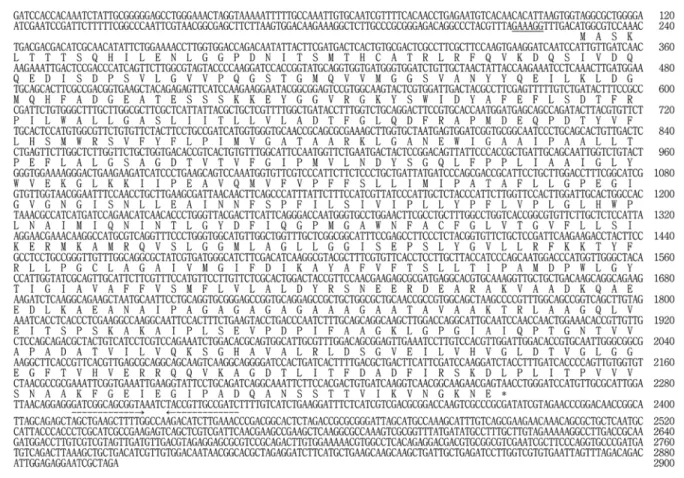
The 2,025-nucleotide ptsG , beginning at position 228 by an ATG codon and terminating at position 2,255 by the ochre stop codon TAA, was identified in the nucleotide sequence (Fig. 1). The ptsG encodes a polypeptide of 675 residues with a calculated M

r

of 71,982. The codon usage of ptsG exhibited an overall GC content of 52.1%, and a wobble-position GC content of 55.5%. The base composition of a B. flavum ptsG gene was similar to those of C. glutamicum ptsG (total GC content, 52.3%; wobble-position GC content, 54.6%)

8)

and B.

lactofermentum ptsG (total GC content, 52.7%; wobble- position GC content, 55.5%).

7)

GC contents of 34 genes from B. lactofermentum and C. glutamicum ranged from 50 to 62%.

11)

The ptsG gene of C. efficiens had a total GC content of 63.9%, with 83.1% GC content at the third base of the codon.

12)

The gene showed high preference for G or C

residues at the third base of the codons. C . efficiens can grow at temperature 10

o

C higher than other strains including B.

flavum , B. lactofermentum , and C. glutamicum , and GC content of its total genome is greater than that of C.

glutamicum genome.

13)

The GAAAGG sequence element, six bases upstream from the first ATG start codon at nucleotide position 216-221, could be the ribosome-binding site for the mRNA. There is a 14-bp palindrome beginning 37 nucleotides downstream of the TAA stop codon. This element could be involved in the rho-independent termination of the ptsG gene transcription.

Based on the hydropathy of the deduced amino acid sequence calculated using the method of Kyte and Doolittle

14)

(data not shown). EII

Glc

was predicted to contain a hydrophobic region (IIC domain) corresponding to amino acid residues from 120 to 465 and consisting of six sub-regions with an average hydropathy exceeding 1.0, each comprised of 20 amino acid residues capable of spanning the cytoplasmic membrane. The amino-terminal part (6-84 aa) of the protein was relatively hydrophilic (IIB domain), and the carboxy- terminal part (526-649 aa) was relatively hydrophobic (IIA domain), indicating that the EII

Glc

of B . flavum has an arrangement of IIBCA domains identical to those of EII

Glc

from B. lactofermentum ,

7)

C. glutamicum ,

8)

and B. ammoniagenes .

6)

Fig. 1. Nucleotide sequence of 2,900-nucleotide B. flavum DNA fragment and deduced amino acid sequence. The underlined

sequence preceding the ATG start codon of ptsG gene is a putative ribosome-binding site. The TAA stop codon is indicated with

asterisks below the sequences. The inverted repeat is underlined by horizontal arrows. Numbers at the end of each line correspond to

the nucleotide position. The sequence data have been submitted to the GenBank nucleotide sequence database under accession num-

ber DQ267153.

(3)

220 Yoon, Ki-Hong

Comparison of the B. flavum EII

Glc

sequence with other EII sequences. Comparison of the deduced amino acid sequence of the B. flavum EII

Glc

with those of other EIIs in the NCBI database using the BLAST search program

15)

revealed the present EII

Glc

was homologous to those belonging to glucose-PTS. The phylogenetic relationships based on amino acid sequences of B. flavum EII

Glc

and other EII of glucose- PTS were investigated using CLUSTAL W software. The B.

flavum EII

Glc

exhibited high homologies with C. glutamicum EII

Glc

(97%), B. lactofermentum EII

Glc

(88.3%), and C.

efficiens EII

Glc

(81.6%). It was also homologous with the EIIs

Glc

of Propionibacterium acnes (47.4% similarity), B.

ammoniagenes (44.5% similarity), C. diphtheriae (44.3%

similarity), and Bifidobacterium longum (38.1% similarity).

The EII

Glc

was also similar to the β -glucoside-specific EIIs of Bacillus halodurans (32.2% similarity), B. licheniformis (32.6% similarity), Lactobacillus acidophilus (31.7%

similarity), and L. plantarum (31.3% similarity). Amino acid sequence of the B. flavum EII

Glc

was aligned with those of three EIIs

Glc

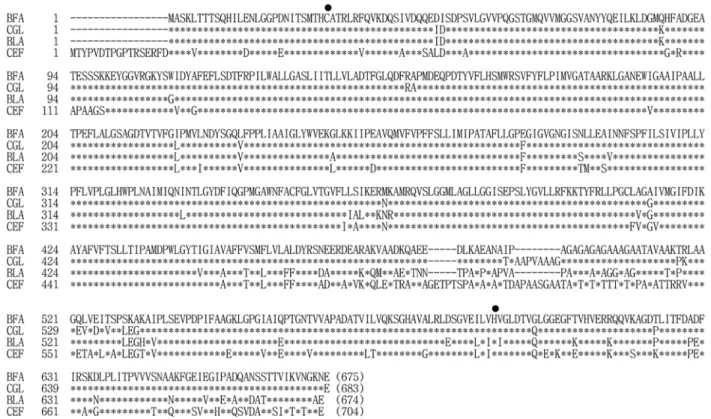
showing high homologies. Amino acid sequences of the linker region connecting IIA domain and IIB domain exhibited the lowest similarities among the EIIs

Glc

(Fig. 3). The linker region of B. flavum EII

Glc

consisted of Gly-Ala repeats (495-509), while IIA domain of the other EII

Glc

was connected to the IIB domain by a PA linker consisting of Pro-Ala repeats.

The B. flavum EII

Glc

contained two amino acid residues, which mediate phosphate transfer from phospho-HPr to glucose.

One was a histidyl residue at position 594, homologous to the active site, His, of E. coli EIIA

Glc

, which was phosphorylated by the phospho-HPr protein.

16)

The other was assumed to be a cystidyl residue (28 aa) in the IIB domain of the protein. The

Fig. 3. Comparison of B. flavum EII

Glc

(BFL) with C. glutamicum EII

Man

(CGL), B. lactofermentum EII

Glc

(BLA), and C. effi- ciens EII

Glc

(CEF). The amino acid sequences of the four polypeptides are shown by a one-letter code and have been aligned by introducing gaps (hyphens) to maximize the similarities. The residues identical to the amino acid sequence of B. flavum EII

Glc

are indi- cated by asterisks in all other sequences. The histidine and cysteine residues, which may be phosphorylated, are indicated by closed circles above the sequences. The numbers at the beginning of each line correspond to the amino acid positions in the protein.

Fig. 2. Phylogenetic analysis of 16S rRNA. Neighbor-joining tree showing the phylogenetic relationships based on amino acid sequences of glucose-specific EIIs ad β -glucoside-specific EIIs of several bacteria including C. glutamicum (CAF21369), C.

efficiens (NP_738068), C. diphtheriae (NP_939508), B. lactofer- mentum (AAA22992), B. ammoniagenes (AAC27701), Propion- ibacterium acnes (YP_055815), Bifidobacterium longum (ZP_00121506), Bacillus halodurans (BAB04015), B. lichenifor- mis (AAU25634), Lactobacillus acidophilus (YP_193627), L.

plantarum (NP_786733), and B. flavum . GenBank accession

numbers are described in parenthesis. Below the tree scale indi-

cates the number of nucleotide substitutions for protein sequences.

(4)

Glucose Permease Gene of Brevibacterium flavum 221 EII

Glc

of E. coli was phosphorylated at a Cys residue (421 aa)

by a soluble phospho-EIIA

Glc

.

17)

The amino acid sequence conservation (HCATRLR) around the Cys residue of B.

flavum EII

Glc

was also shared by other EIIs specific for glucose, sucrose, and β -glucoside of glucose-PTS.

References

1. Meadow, N. D., Fox, D. K. and Roseman, S. (1990) The bacterial phosphoenolpyruvate:glycose phosphotransferase system. Annu. Rev. Biochem . 59 , 497-542.

2. Saier Jr, M. H. and Reizer, J. (1992) Proposed uniform nomenclature for the proteins and protein domains of the bacterial phosphoenolpyruvate:sugar phosphotransferase sys- tem. J. Bacteriol . 174 , 1433-1438.

3. Postma, P. W., Lengeler, J. W. and Jacobson, G. R. (1993) Phosphoenolpyruvate:carbohydrate phosphotransferase sys- tems of bacteria. Microbiol. Rev . 57 , 543-594.

4. Malin, G. M. and Bourd, G. I. (1991) Phosphotransferase- dependent glucose transport in Corynebacterium glutamicum . J. Appl. Bacteriol . 71 , 517-523.

5. Mori, M. and Shiio, I. (1987) Phosphoenolpyruvate:sugar phosphotransferase system and sugar metabolism in Brevi- bacterium flavum . Agric. Biol. Chem . 51 , 2671-2678.

6. Yoon, K. -H., Yim, H. and Jung, K. H. (1998) Cloning, expression, and nucleotide sequencing of the gene encod- ing glucose permease of phosphotransferase system from Brevibacterium ammoniagenes . J. Microbiol. Biotechnol. 8 , 214-221.

7. Yoon, K. -H., Lee, K. -N., Lee, J. -K. and Park, S. C.

(1999) Cloning, nucleotide sequencing, and characterization of ptsG gene encoding the glucose-specific Enzyme II of the phosphotransferase system from Brevibacterium lactof- ermentum. J. Microbiol. Biotechnol . 9 , 582-588.

8. Lee, J. -K., Sung, M. -H., Yoon, K. -H., Yu, J. -H. and Oh, T. -K. (1994) Nucleotide sequence of the gene encoding the Corynebacterium glutamicum mannose enzyme II and anal- yses of the deduced protein sequence. FEMS Microbiol.

Lett . 119 , 137-146.

9. Kwon, I., Lee, K. N., Lee, J. -K., Pan, J. -G., Oh, T. -K., Lee, H. H. and Yoon, K. -H. (1995) Cloning and expres- sion of the gene encoding glucose permease of the phos- photransferase system from Brevibacterium flavum in Escherichia coli . J. Microbiol. Biotechnol . 5 , 188-193.

10. Sambrook, J., Fritsch, E. F. and Maniatis, T. (1989) Molecu- lar Cloning. A Laboratory Mannual . 2nd ed. Cold Spring Harbor Laboratory Press, Cold Spring Harbor, NY.

11. Malumbres, M., Gil, J. A. and Martin, J. F. (1993) Codon preference in corynebacteria. Gene . 134 , 15-24.

12. Nishio, Y., Nakamura, Y., Kawarabayasi, Y., Usuda, Y., Kimura, E., Sugimoto, S., Matsui, K., Yamagishi, A., Kiku- chi, H., Ikeo, K. and Gojobori, T. (2003) Comparative com- plete genome sequence analysis of the amino acid replacements responsible for the thermostability of Coryne- bacterium efficiens . Genome Res . 13 , 1572-1579.

13. Fudou, R., Jojima, Y., Seto, A., Yamada, K., Kimura, E., Nakamatsu, T., Hiraishi, A. and Yamanaka, S. (2002) Corynebacterium efficiens sp. nov., a glutamic-acid-produc- ing species from soil and vegetables. Int. J. Syst. Evol.

Microbiol . 52 , 1127-1131.

14. Kyte, J. and Doolittle, R. F. (1982) A simple method for displaying the hydropathic character of a protein. J. Mol.

Biol . 157 , 105-132.

15. Altschul, S. F., Madden, T. L., Schaffer, A. A., Zhang, J., Zhang, Z., Miller, W. and Lipman, D. J. (1997) Gapped BLAST and PSI-BLAST: a new generation of protein data- base search programs. Nucleic Acids Res . 25 , 3389-3402.

16. Presper, K. A., Wong, C. -Y., Liu, L., Meadow, N. D. and Roseman. S. (1989) Site-directed mutagenesis of the phos- phocarrier protein, III

Glc

, a major signal-transducing protein in Escherichia coli . Proc. Natl. Acad. Sci. USA 86 , 4052- 4055.

17. Meins, M., Jen , P., M ller, P., Richter, W. J., Rosenbusch, J. P. and Erni, B. (1993) Cysteine phosphorylation of the glucose transporter of Escherichia coli . J. Biol. Chem . 268,

11604-11609.

수치

Fig. 1. Nucleotide sequence of 2,900-nucleotide  B. flavum  DNA fragment and deduced amino acid sequence
Fig. 2. Phylogenetic analysis of 16S rRNA.  Neighbor-joining tree showing the phylogenetic relationships based on amino acid sequences of glucose-specific EIIs ad  β -glucoside-specific EIIs of several bacteria including  C

참조

관련 문서

_____ culture appears to be attractive (도시의) to the

1 John Owen, Justification by Faith Alone, in The Works of John Owen, ed. John Bolt, trans. Scott Clark, "Do This and Live: Christ's Active Obedience as the

The purpose of this study was to investigate the appropriateness of the learning sequence of Science(area of matters) and Chemistry contents and

10.2 Two-variable diagrams: pE/pH diagrams (Pourbaix diagram).. Distribution of species in aquatic systems. 10.2 Two-variable diagrams: Methods of

We determined the nucleotide sequences of the mitochondrial DNA (mtDNA) control region using cloning and sequencing, and obtained the complete sequence from the cattle bones

Not only indigenous Korean food culture formed its traditional way in the latter part of the Chosun Dynasty, but also was the transition period from

• Gantt charts illustrate the start and finish dates of the terminal elements and summary elements of a project.. • Terminal elements and summary elements comprise the work

This study shifted focus from research centering on recruitment and education to service management system and retirement support system, to which relatively little concern