E. Chung ・ C.-W. Cho ・ H.-A. So ・ J.-H. Lee ( ) (BK21 Center for Silver-Bio Industrialization, College of Natural Resources and Life Science, Dong-A University, Busan 604-714, Republic of Korea)
e-mail: [email protected] B.-H. Yun
(Plant Biotechnology Department, College of Natural Resources and Life Science, Korea University, Seoul, Republic of Korea)
Differential expression of soybean SLTI100 gene encoding translation elongation factor 1A by abiotic stresses
Eunsook Chung ・ Chang-Woo Cho ・ Hyun-A So ・ Bo-Hyun Yun ・ Jai-Heon Lee
Received: 10 August 2009 / Accepted: 18 September 2009
ⓒKorean Society for Plant Biotechnology
Abstract The translation elongation factor 1A, eEF1A, catalyzes the binding of aminoacyl-tRNA to the A-site of the ribosome by a GTP-dependent mechanism. By subtractive suppression hybridization technique, we have isolated a soybean low-temperature inducible gene, SLTI100 encoding translation elongation factor 1A. Multiple sequence align- ments and phylogenic analysis showed that SLTI100 and other eEF1As originated from diverse organisms are highly conserved. RNA expression of SLTI100 was specifically induced by low temperature, high salt, ABA, or drought stress. Based on the subcellular localization of the corre- sponding gene product fused to GFP, we were able to con- firm that SLTI100-GFP was restricted to the nucleus and cytoplasm. We propose that soybean eEF1A may play an important role in translational regulation during abiotic stress responses in plants.
Introduction
In the translational elongation process, eukaryote transla- tional elongation factor 1 (eEF1) is a protein synthesis factor composed of four subunits: A, Bα, Bβ and Bγ (Browing et al. 1990). Subunit eEF1A, also known as EF1α, binds ami- noacyl-tRNAs to the acceptor (A) site of the ribosome
during the peptide chain elongation phase of protein syn- thesis. eEF1A (49,174 kDa) is an abundant protein repre- senting upto 5% of the soluble protein in wheat germ extracts (Browing et al. 1990) and is highly conserved in evolution (77% conservation of wheat EF1A with human EF1A) (Metz et al. 1992). In higher eukaryotes, eEF1A is typically encoded by a multigene family: in man there are 18 genes (Lund et al.
1996) while in Arabidopsis there are 4 genes (Axelos et al.
1989).
In plants, eEF1A gene expression seems constitutive (Axelos et al. 1989), but its expression was shown to vary with organ type and developmental stage such as cotton fiber elongation (Xu et al. 2007), maize endosperm (Carneiro et al. 1999), fully expanded sugarcane leaves (Vijaykumar et al. 2002), or ger- minating rice seeds (Kidou and Ejiri 1998). There are many evidences that plant eEF1A gene was induced by abiotic stresses such as wounding (Morelli et al. 1994), low oxygen (Vayada et al. 1995) or low temperature stress (Dunn et al.
1993; Berberich et al. 1995). It is speculated that trans- lational efficiency by increased eEF1A level may enhance stress tolerance in plants.
At the subcellular level, maize eEF1A was shown to be closely associated with F-actin surrounding the rough endoplasmic reticulum of the endosperm cells (Clore et al.
1996; Lopez et al. 2003). Furthermore, Lopez-Valenzuela et al. (2004) proved that high level of maize eEF1A protein increased the amount of cytoskeleton surrounding ER and also Lys content in maize endosperm. It supports that eEFlA acts as a ‘bridge’ linking protein synthesis with the cyto- skeleton network (Condeelis et al. 1995).
In the present study, we isolated the full-length cDNA of SLTI100 encoding eEF1A regulated by abiotic stresses. It was shown that there are 4 copies of SLTI100 in soybean genome. SLTI100-GFP was targeted to the nucleus and cy- Research Article
toplasm. We propose that SLTI100 gene encoding eEF1A be implicated in the protein synthesis in plants during abiotic stresses.
Materials and methods
Plant materials and treatments
Soybean plants (Glycine max cv. ‘Sinpaldal 2’) were grown in a growth chamber with 16 h/day light supply (22,000 lux) at 28°C for 3-4 weeks. As a non-stress control, leaves were sampled from plants in a growth chamber. For the low tem- perature stress, plants were placed in a refrigerator at 4°C upto 24 h as previously described (Cho et al. 2007). To induce salt stress, plants were soaked in a solution of NaCl (250 mM) at 28°C for 24 h. For the ABA treatment, whole plants were sprayed with ABA stock solution (100 µM) and the leaves were sampled at the indicated time. For drought stress, whole plants were removed from the soil and de- hydrated at 28°C upto 24 h. Plant samples were immediately frozen in liquid nitrogen, and stored at -75°C.
Subtractive suppression hybridization (SSH)
SSH was performed using a PCR-Select cDNA Subtraction kit (Clontech, USA), as described by the manufacturer. Total RNA from 5 time-points (3, 6, 12, 24 and 48 h) (150 μg/
time-point) was pooled from low temperature-treated leaves (4°C) (tester) or untreated leaves (driver), and mRNA iso- lated using an Oligotex mRNA Isolation kit (Qiagen, USA).
Each mRNA sample (2 mg) was subjected to subtractive hybridization. Subtracted cDNAs were cloned into pCR2.1 vector (Invitrogen, USA), and transformed in TOP10F E.
coli (Invitrogen, USA). Bacterial colonies obtained from SSH were arrayed in duplicate on nylon membranes. Specifically, each bacterial suspension (1 ml) was dotted on nylon mem- branes, which were incubated overnight on LB plates for bacterial growth. The duplicated membrane was hybridized with radiolabeled tester cDNA or driver cDNA. Positively selected clones were sequenced (Macrogen, Korea), and an- alyzed by comparing with the GenBank/EMBL database using BLAST analysis.
Cloning of SLTI100 gene using 5’ and 3’ rapid amplification cDNA ends (5’ RACE)
cDNA synthesis was carried out using reverse transcription kit (Promega, USA). The full-length SLTI100 cDNA was obtained using SMART RACE cDNA amplification kit
(Clontech, USA) according to the manufacturer’s instruction.
Gene-specific primers including 5’ primer FSP1-100 and 3’
primer RSP1-100 were synthesized for 5’ and 3’ RACE (Bioneer, Korea). The full-length cDNA of SLTI100 was PCR-amplified with the F-100 and the R-100 primer. The re- sulting PCR product was cloned to pGEMT-Easy (Promega, USA) for the sequencing.
Northern blot analysis
Total RNA sequences were isolated using RNA extraction Kit (Ambion, USA). Total RNA (20 μg) was fractionated on a 1% formaldehyde agarose gel, and transferred to nylon membrane. The SLTI100 probe was PCR-amplified using the F-100 primer and the R-100 primer covering the entire cDNA region of SLTI100 gene (1,344 bp). The probe was la- beled by a random priming method using the Ladderman labeling kit (Takara, Japan). The membrane was hybridized to a 32P-dCTP labeled probe using fragments encompassing SLTI100 cDNA and washed, as described by Church and Gilbert (Church et al. 1984). The membrane was exposed to X-ray film (Kodak, Japan) for detection of signals.
Phylogenetic analysis of eEF1As
Deduced amino acids sequences of 14 eEF1As and SLTI100 in this study were subjected to protein phylogenetic analysis.
A total of 15 sequences were aligned with the CLUSTALW program (Thompson et al. 1994) and visually examined with the GENEDOC program as previously described. Phylogenetic trees were constructed using PRODIST with the Jones-Taylor -Thornton matrix model and NEIGHBOR with the neighbor -joining method (Saitou et al. 1987) in the PHYLIP (phylogeny inference package) programs, version 3.62. We generated 1,000 bootstrapped replicate resampling data sets with SEQBOOT (PHYLIP, version 3.62). We followed the stand- ard protocol for the default settings of the computer programs used in this procedure.
Construction of SLTI100-GFP
To construct a translational fusion of GFP and SLTI100, SLTI100 open reading frame region (447 aa; 1,344 bp) was amplified by PCR using Ex Taq (Takara, Japan) with the F-GFP100 primer containing a unique Xba I and an ATG initiation site and the R-GFP100 primer. PCR-amplified DNA fragment was cloned into pGEM-T Easy vector yielding and the nucleotide sequences of the inserted fragment were confirmed by DNA sequencing. The XbaI DNA fragments from pGEMT-SLTI100 (XbaI) were introduced into the
Table 1 Lists of primers used in this study
Primer Sequences
FSP1-100 RSP1-100 F-100 R-100 FS-100 F-GFP100 R-GFP100
5’-CAATGTGAGAAGTGTGGCAG-3’
5’-CTGCCACACTTCTCACATTG-3’
5’-ATGGGTAAGGAAAAGGTTCACATCAGT-3’
5’-TCACTTCTTCTTCTGGGCAGCC-3’
5’-GAGGGAGACAACATG ATTGAGAGG-3’
5’-TCTAGAATGGGTAAGGAAAAGGTTCA-3’
5’-TCTAGACCCTTCTTCTTCTGGGCA-3’
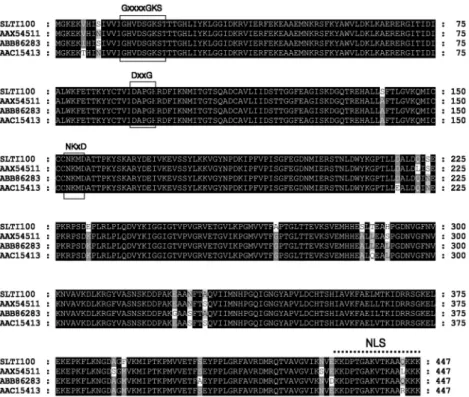
Fig. 1 Alignment of deduced amino-acid sequences of eEF1A cDNA sequences from other plant species; SLTI100 (this work), O. sativa (AAC15413), S. tuberosum (ABB86283), and A. deliciosa (AAX54511). Alignment of eEF1A sequences was performed using the T-Coffee program (Thompson et al. 1994). The regions corresponding to the GDP/GTP binding or GTPase activity domains of GTP-binding proteins are boxed; the consensus amino acid sequences are shown above. Nucleus localization signal (NLS) mainly composed of lysine (K) residues is indicated in the C terminus
corresponding sites of pSMGFP plasmids (Genbank acces- sion no; U70495) (Davis and Vierstra. 1996) resulting in pSLTI100-GFP. Thus, the start codon of GFP is transla- tionally fused to the C-terminal region of SLTI100 (Davis and Vierstra. 1996).
Subcellular localization of GFP and SLTI100-GFP pSMGFP and pSLTI100-GFP constructs were transformed into Agrobacterium sp. strain C58c1, respectively and the transformed Agrobacterium cells with pSMGFP or pSLTI100 -GFP were expressed in the leaves of 4- to 5-week-old Nicotiana benthamiana plants as previously described (Kim et al. 2009). Expression of the fusion protein and vector control was monitored 36 h after infiltration. The fluores-
cence photographs of epidermis and protoplasts were taken using a Carl Zeiss LSM510 laser confocal microscope as previously described (Kim et al. 2009). Excitation wavelength of 488 nm was used and GFP signals were detected with the filter set for fluorescein isothiocyanate (FITC; BP 505-530 nm). Excitation wavelength of 543 nm was used and RFP was detected with the filter set of LP 560.
Results and discussion
A subset of genes differentially expressed during low tem- perature stress in soybean was identified by SSH (Cho et al.
2007). Out of low-temperature induced genes, there were several genes encoding ribosomal protein associated with translational regulation (Kim et al. 2009a, 2009b). In this study, a 600-bp cDNA clone (SLTI100) displayed strong homology to eEF1A was characterized in relation to abiotic stress. The full-length cDNA of SLTI100 was obtained by 5’
and 3’ RACE using cDNA of soybean leaf with a pair of specific primer as described in materials and methods. The full-length cDNA sequence of SLTI100 is composed of an open reading frame (1,344 bp) (Genbank number EU790565).
Deduced amino acid sequences of SLTI100 cDNA are com- posed of 447 amino acid residues (M.W. 49.4 kDa; pI 9.03).
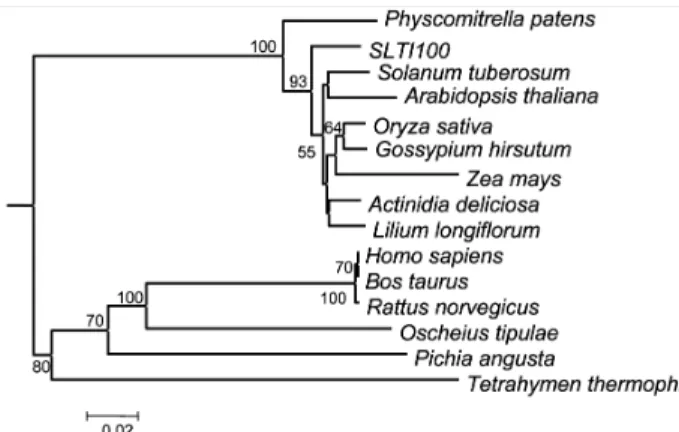
Fig. 2 Phylogenetic tree for the aligned amino acid sequences of eEF1A from diverse organisms; SLTI100 (this work), O. sativa (AAC15413), L. longiflorum (AAD56020), Z. mays (AAF42980), A. deliciosa (AAX54511), G. hirsutum (ABA12218), S. tuberosum (ABB86283), B. taurus (AJ238405), P. angusta (AY179868), H. sapiens (NM_001402), R. norvegicus (NM_175838), O. tipulae (AY928342), T. thermophila (XM_001032213), P. patens (XP_
001753167) and A. thaliana (BAF02151). Phylogenetic trees were constructed using PRODIST with the Jones-Taylor-Thornton matrix model and NEIGHBOR with the neighbor-joining method (Saitou et al. 1987) to analyze phylogenetic relationships. Boot- strap values are shown for each node that had >50% support in a bootstrap analysis of 1,000 replicates. The scale bar indicates 0.1 change per amino acid
Fig. 3 Expression of SLTI100 gene during low temperature, salt, ABA, or drought stresses. Soybean plants were incubated in a refrigerator (4ºC) upto 24 h. As a salt stress, soybean plants were fed with salt solution (NaCl, 100 mM) for 6 and 24 h. ABA (100 µM) was exogenously applied to soybean plants for 6 and 24 h.
For drought stress, soybean plants were air-dried for 6 and 24 h. RNA blot analysis was carried out at least 3 times showing the same result
SLTI100 cDNA sequences show 99% identity with tefS1, which was cloned and characterized before (Aguilar et al.
1991). Aguilar et al. showed that tefS1 transcript sharply increased 3 h after illumination (Aguilar et al. 1991). How- ever, it was tested its RNA expression during abiotic stresses.
A multiple sequence alignment of the deduced protein se- quences of SLTI100 gene with other eEF1A protein se- quences is shown in Fig. 1. Multiple alignments of SLTI100 and other plants eEF1A proteins showed that amino acid sequences are highly conserved each other (Fig. 1). There are three representative regions in the N-terminus of eEF1A known to be GTP binding domain important for the hy- drolysis of GTP to GDP (Kidou et al. 1998) (Fig. 1). Based on the prediction of localization of plant eEF1A by Expasy (http://expasy.org/), it was shown that the C-terminal region contains a nucleus localization signal (NLS) (Fig. 1).
An extensive phylogenetic analysis using the deduced amino acid sequences of SLTI100 and fourteen eEF1A genes was inferred on the basis of the multiple sequence alignment (Fig. 2). The analysis indicated that SLTI100 was clustered with plant eEF1As rather than animal and microbe eEF1As (Fig. 2). In fact, SLTI100 showed protein sequence identity from 93% to 96% to eEF1As originated from plants. Ho- mology between soybean eEF1A and non-plant species eEF1As is about between 73% and 76%. This shows that eEF1As are highly conserved in eukaryotes.
We investigated SLTI100 RNA expression level in soybean plants treated with abiotic stresses by northern blot analysis (Fig. 3). SLTI100 RNA level showed maximum after 6 h by low temperature stress and its RNA level was reduced after that. SLTI100 RNA expression was monitored by other abiotic stress such as high salt (NaCl), ABA or drought stress. SLTI100 RNA was strongly induced by high salt, ABA, or drought stress. After 24 h of drought stress, it seems that RNA got degraded to smaller sizes, which resulted in stronger staining with ethidium bromide (Fig. 3). Taken together, RNA expression of SLTI100 gene is regulated by low temperature, salt, ABA or drought stress in plants.
There are evidences proving that eEF1A gene expression is induced by environmental stresses in plants (Dunn et al.
1993; Morelli et al. 1994; Berberich et al. 1995; Vayada et al.
1995). Cold-inducible eEF1A genes were isolated from barley (Dunn et al. 1993) and maize (Berberich et al. 1995). It was reported that increases in protein synthesis are accompanied by an accumulation of eEF1A protein and transcript and that the expression of eEF1A may serve as an indicator of trans- lational stimulation (Morelli et al. 1994). Increased RNA level of SLTI100 may contribute to tolerance to osmotic stress by stimulated translation efficiency in plants.
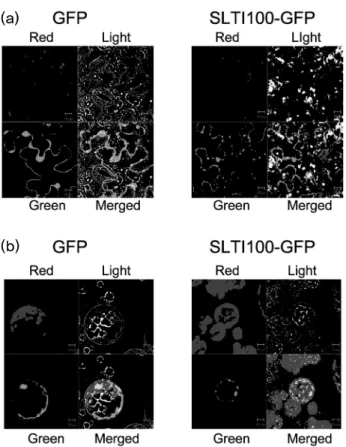
To examine the cellular localization of the gene product, pSLTI100-GFP was constructed and transiently expressed in the N. benthamiana via Agrobacterium-mediated trans- formation. Control GFP was abundant in the nucleus and cy- toplasm (Fig. 4). Fluorescence signal of SLTI100-GFP was also found in the nucleus and the cytoplasm (Fig. 4). Ac- cording to the prediction of SLTI100 protein by PSORT (http://psort.ims.u-tokyo.ac.jp/form.html), the probability of the nucleus localization by SLTI100 was 0.18 and ER tar- geting probability of SLTI100 was 0.65. It is possible that SLTI100 protein is associated with ER of outer layer of nuclear envelope and cytoplasm in cells. There are many reports demonstrated that eEF1A protein is associated with ER, and cytoskeleton, (Clore et al. 1996) and even virus pro-
(a)
(b)
Fig. 4 Confocal images of GFP and SLTI100-GFP protein in N.
benthamiana epidermal cells (a) and protoplasts (b). (a) Leaf epi- dermis was used for GFP localization analysis after 24 h of Agro -infiltration. (b) Protoplasts were isolated from tobacco leaves tran- siently expressing GFP proteins. The images of GFP were visualized at 800 times magnifications using a confocal microscope. For each panel, DIC shows the actual image, red channel shows chloroplast fluorescence and green channel shows GFP fluorescence. Merged image shows red and green channel at once
tein in cytoplasmic membrane vesicles derived from ER (Thivierge et al. 2008). In the C terminus (431-447 aa) of deduced amino acid sequences of SLTI100 contain the signal sequence for the nucleus targeting composed of Lys rich domain (Fig. 1). However, it is not clear if fluorescence signal of SLTI100-GFP in nucleus is present in the outer layer of nuclear envelope or inside nucleus (Fig. 4). It is most likely that SLTI100 is associated with translational process in plants.
In conclusion, we demonstrated that SLTI100 RNA expres- sion is induced by abiotic stresses such as low temperature, salt, ABA and drought stresses. It was shown that SLTI100 -GFP fusion protein was localized to the nucleus and cy- toplasm. We propose that SLTI100 may play an important role in protein translation process especially during abiotic stresses in plants.
Acknowledgements This research was supported by the grant from Dong-A University in Korea.
References
Aguilar F, Montandon P-E, Stutz E (1991) Two genes encoding the soybean translation elongation factor eEF-1α are transcribed in seedlings leaves. Plant Mol Biol 17:351-360
Axelos M, Bardet C, Liboz T, LeVan TA, Curie C, Lescure B (1989) The gene family encoding the Arabidopsis thaliana translation elongation factor EF-1α: molecular cloning, char- acterization and expression. Mol Gen Genet 219:106-112 Berberich T, Sugawara K, Harada M, Kusano T (1995) Molecular
cloning, characterization and expression of an elongation factor 1α gene in maize. Plant Mol Biol 29:611-615
Browing KS, Humphreys J, Hobbs W, Smith GB, Ravel JM (1990) Quantitation of translation initiation and elongation factors in wheat germ. J Biol Chem 265:17967-17973
Carneiro N P, Hughes PA, Larkins BA (1999) The eEF1A gene family is differentially expressed in maize endosperm. Plant Mol Biol 41:801-813
Cho C-W, Lee H-J, Chung E, Kim KM, Heo J E, Kim J-I, Chung J, Ma Y, Fukui K, Lee D-W, Kim D-H, Chung Y-S, Lee J-H (2007) Molecular characterization of the soybean L-asparaginase gene induced by low temperature stress. Mol Cells 23:280-286 Church GM, Gilbert W (1984) Genomic sequencing. Proc Natl
Acad Sci USA 81:1991-1995
Clore AM, Dannenhoffer JM, Larkins BA (1996) EF-1 alpha is associated with a cytoskeletal network surrounding protein bodies in maize endosperm cells. Plant Cell 8:2003-2014 Condeelis J (1995) Elongation factor 1 alpha, translation and the
cytoskeleton. Trends Biochem Sci 20:169-170
Davis SJ, Vierstra RD (1996) Soluble derivatives of green fluo- rescent protein (GFP) for use in Arabidopsis thaliana. Weeds World 3:43-48
Dunn MA, Morris A, Jack PL, Hughes MA (1993) A low-tem- perature-responsive translation elongation factor 1α from barley (Hordeum vulgare L.). Plant Mol Biol 23:221-225 Kidou S-I, Ejiri S-I (1998) Isolation, characterization and mRNA
expression of four cDNAs encoding translation elongation factor 1A from rice (Oryza sativa L.). Plant Mol Biol 36:
137-148
Kim K, Chung E, Cho CW, Soh HA, Chung YK, Seo YW, Lee SW, Lee YC, Chung YS, Lee JH (2009a) Molecular character- ization of soybean ribosomal protein S13 targeted to the nu- cleus. Russ J Plant Physiol 56:131-138
Kim K, Chung E, Cho CW, Soh HA, Yun BH, Kim JI, Seo YW, Lee SW, Lee YC, Chung YS, Lee JH (2009b) Cloning and char- acterization of SLTI98 encoding ribosomal protein S6 in soybean. Russ J Plant Physiol 56:118-125
Lopez-Valenzuela JA, Gibbon BC, Holding DR, Larkins BA (2004) Cytoskeletal proteins are coordinately increased in maize genotypes with high levels of eEF1A. Plant Physiol 134:1784-1797
Lopez-Valenzuela JA, Gibbon BC, Hughes PA, Dreher TW, Lar- kins BA (2003) eEF1A isoforms change in abundance and actin-binding activity during maize endosperm development.
Plant Physiol 133:1285-1295
Lund A, Knudsen SM, Vissing H, Clark B, Tommerups N (1996) Assignment of human elongation factor 1 genes: eEF1A maps to chromosome 6q14 and EF1A2 to 20q13.3. Genomics 36:
359-361
Metz AM, Timmer RT, Allen ML, Browning KS (1992) Sequence of a cDNA encoding the α-subunit of wheat translation elon- gation factor 1. Gene 120:315-316
Morelli J, Shewmaker CK, Vayada ME (1994) Biphasic stimulation of translational activity correlates with induction of translation elongation factor 1 subunit α upon wounding in potato tubers.
Plant Physiol 106:897-903
Saitou N, Nei M (1987) The neighbor-joining method: A new method for constructing phylogenetic trees. Mol Biol Evol 4:406-425
Thivierge K, Cotton S, Dufresne PJ, Mathieu I, Beauchemin C, Ide C, Fortin MG, Laliberté J-F (2008) Eukaryotic elongation factor 1A interacts with Turnip mosaic virus RNA-dependent RNA polymerase and VPg-Pro in virus-induced vesicles.
Virol 377:216-225
Thompson JD, Higgins DG, Gibson TJ (1994) CLUSTAL W: Im- proving the sensitivity of progressive multiple sequence align- ment through sequence weighting, position specific gap pen- alties and weight matrix choice. Nucleic Acids Res 22:4673 -4680
Vayada ME, Shewmaker CK, Morelli JK (1995) Translational arrest in hypoxic potato tubers is correlated with the aberrant association of elongation factor EF-1α with polysomes. Plant Mol Biol 28:751-757
Vijaykumar D, Ramachander TVN, Mahishi LH, Kaul R, Pyati P, Paul B, Rawal SK (2002) Molecular cloning, characterization and tissue specific expression of an elongation factor 1A gene in Saccharum officinarum L. Plant Sci 162:315-321 Xu W-L, Wang X-L, Wang H, Li X-B (2007) Molecular char-
acterization and expression analysis of nine cotton GhEF1A genes encoding translation elongation factor 1A. Gene 389:
27-35