서 론
흡연은 니코틴, 타르, 일산화탄소 및 중금속을 포함한 여러 가지 유해물질의 노출원이다. 최근 직접흡연뿐 아니라 간접흡연 피해에 대한 사회적 인식이 확산되고 있고, 정부에서도 2011년 국민건강증 진법을 개정하여 음식점 등 실내 금연과 보행로 등 길거리 금연을 시 행하는 등 간접흡연에 대한 피해를 막고자 노력하고 있는 실정이다.
담배연기는 주류연과 부류연으로 구성되어 있으며, 주류연은 흡
연자가 흡연 후 호기 연기이고, 부류연은 타고 있는 담배에서 발생하 는 연기를 말한다. 일반적으로 부류연이 주류연과 비교해 유해물질 이 2–3배 많은 것으로 알려져 있으며, 간접흡연의 경우 부류연이 80–
85% 정도를 차지한다.1-4) 담배연기에 포함된 독성 및 유해물질은 약 4 천여 종에 이르며 이 중에는 각종 중금속이 포함되어 있고, 이는 직 접흡연자는 물론 간접흡연자에게도 직접흡연 못지않은 해로운 영향 을 끼쳐 많은 논란이 되고 있다.5) 담배연기에 포함된 중금속 중 수은, 납, 카드뮴은 특히 인체에 해로운 물질로서 World Health Organiza-
Original Article
직접흡연, 간접흡연이 혈중 수은, 납, 카드뮴 농도에 미치는 영향:
제5기 국민건강영양조사 토대
문상원, 곽정임*, 박영호
안양 샘병원 가정의학과
The Effect of Smoking and Second-Hand Smoking on the Concentration of Mercury, Lead and Cadmium in the Blood: Based on the Fifth Korea National Health and Nutrition Examination Survey
Sang-Won Moon, Jung-Im Gwak*, Young-Ho Park
Department of Family Medicine, SAM Anyang General Hospital, Anyang, Korea
Background: Smoking exposes smokers and secondhand smokers to various toxic materials, including heavy metals. Therefore, this study evaluated the relationship between smoking, both first- and secondhand, and the concentration of heavy metals in the blood.
Methods: Five thousand eight hundred and twenty-two subjects aged 19 and older who had concentrations of heavy metals in their blood were selected from the participants in the fifth Korea National Health and Nutrition Examination Survey (2010–2012). The correlation between first- and secondhand smoking and the concentration of mercury, lead, and cadmium in the blood was analyzed.
Results: The odds ratio between smoking and the concentration of cadmium and lead in the blood was 4.818 and 1.766, respectively. These values are statistically significant, and show a clear correlation between smoking and heavy metals in the blood. (P<0.0001, P=0.0017) Smoking was found to have no correlation with the concentration of mercury in the blood, and secondhand smoking was found to have no correlation with the concentration of any heavy metals in the blood.
Conclusion: Smoking and secondhand smoking leads to exposure to various toxic materials and heavy metals. Since heavy metals can be harmful even in low concentrations, we need to work on expanding anti-smoking campaigns to improve public health.
Keywords: Smoking; Secondhand Smoking; Blood Mercury; Blood Lead; Blood Cadmium
http://dx.doi.org/10.21215/kjfp.2016.6.1.44pISSN 2233-9019 · eISSN 2233-9116 Korean J Fam Pract. 2016;6(1):44-48
KJFP
Korean Journal of Family PracticeReceived August 25, 2015 Accepted October 8, 2015 Corresponding author Jung-Im Gwak
Tel: +82-31-467-9114, Fax: +82-31-449-0151 E-mail: [email protected]
Copyright © 2016 The Korean Academy of Family Medicine
This is an open-access article distributed under the terms of the Creative Commons At- tribution Non-Commercial License (http://creativecommons.org/licenses/by-nc/4.0) which permits unrestricted noncommercial use, distribution, and reproduction in any medium, provided the original work is properly cited.
문상원 외. 직접흡연, 간접흡연이 혈중 중금속에 미치는 영향 Korean Journal of Family Practice
KJFP
Original Article
Korean Journal of Family Practice tion에서 규정한 공중보건을 위협하는 10대 화학물질에 포함되어 있
으며, European Union에서는 2006년 유해물질사용제한지침(restric- tion of the use of hazardous substances)을 발표하여 모든 전기전자제품 에 수은, 납, 카드뮴 등을 포함한 6종 물질의 사용을 제한하고 있다.
중금속은 비중이 큰 금속으로 직업적 노출, 환경, 생활습관, 식습 관 등 다양한 경로를 통해 인체에 유입되며, 적은 양이라도 장기간 유 입될 경우 간, 신장 등과 같은 장기와 체내 조직 등에 쉽게 축적되며 잘 배출되지 않고 유해한 영향을 주며 다양한 질병을 유발한다.6) 본 연구에서는 2010–2012년에 일반 인구를 대상으로 이루어진 제5기 국민건강영양조사의 혈중 중금속 조사결과7)를 통해 직접흡연, 간접 흡연이 혈중 수은, 납, 카드뮴의 농도에 미치는 영향에 대하여 고찰하 고자 하였다.
방 법
1. 연구대상 및 방법
본 연구는 국민건강영양조사 제5기 조사결과자료를 분석하였다.
국민건강영양조사 제5기(2010–2012년)는 매년 192개 표본조사구를 추출하여 3,800가구의 만1세 이상 가구원 전체를 대상으로 1–12월까 지 실시하였다. 목표모집단은 대한민국에 거주하는 국민으로 양로 원, 군대, 교도소 등에 입소한 자와 외국인 등은 제외되었다. 표본추 출틀은 2009년 주민등록인구와 2008년 아파트시세조사 자료를 이 용하였다. 일반주택 표본조사구는 2009년 주민등록인구의 통반리 조사구에서, 아파트 표본조사구는 아파트시세조사 자료의 아파트 단지조사구에서 추출하였다. 시도별(서울, 6대 광역시, 경기, 경상ㆍ강 원, 충청, 전라ㆍ제주)로 1차 층화하고, 일반지역은 성별, 연령대별 인 구비율 기준 26개 층, 아파트지역은 단지별 평당 가격, 평균 평수 등 기준 24개 층으로 2차 층화한 후 표본조사구를 추출하였다. 표본조
사구 내에서는 계통추출방법으로 조사구당 20개의 조사대상가구 를 추출하였다. 중금속검사 대상자는 조사구별, 성별, 연령별(10대, 20대, 30대, 40대, 50대, 60세 이상) 1명씩 랜덤추출하여 조사구당 12 명(또는 13명)으로 연간 총 2,400명을 선정하였다. 단, 조사구 내 해당 집단 검진대상자가 없을 경우 다른 조사구에서 추가 추출하되, 동일 가구 내 대상자가 2명 이하이면서 성별 또는 연령대가 같지 않도록 하여 선정하였다. 본 연구대상자는 19세 이상 혈중 중금속 농도 측정 자 5,822명을 대상으로 하였다. 대상자의 일반적 특성으로 성별, 월간 음주율(최근 1년 동안 한 달에 1회 이상 음주한 분율), 운동(최근 1주 일 동안 평소보다 몸이 조금 힘들거나 숨이 약간 가쁜 중등도 신체 활동을 1회 30분 이상, 주 5일 이상 기준), 거주지(도시 거주), 배우자 있음, 직업 있음, 교육수준(고졸 이상 기준), 소득수준(하위 25% 기 준), 평균 나이, 평균 체질량지수, 평균 허리둘레 등을 분석하였다.
2. 연구도구
국민건강영양조사에서 혈중 중금속 분석은 네오딘의학연구소에 의해 실행되었으며, 혈중 카드뮴과 납은 원자흡광광도계를 이용하 여 분석하였고, 혈중 수은은 골드아말감 수은전용분석기를 이용하 여 전처리 없이 분석하였다.
3. 통계분석
국민건강영양조사는 층화를 통한 표본조사를 실시하였으므로 분석과정에서 층화변수, 집락변수, 가중치를 고려하여 통계분석을 하였다. 기본적 특성에 대해서 연속형 변수는 means±standard error 로 제시하였고, 범주형 변수는 % (standard error)로 제시하였다. 간접/
직접흡연에 대해서는 분산분석 및 카이제곱 분석으로 검정하였으 며, 중금속 상위 25%에 대한 흡연에 대한 관련성을 다중 로지스틱회 귀분석으로 분석하고 odds ratio (95% confidence interval)로 제시하였
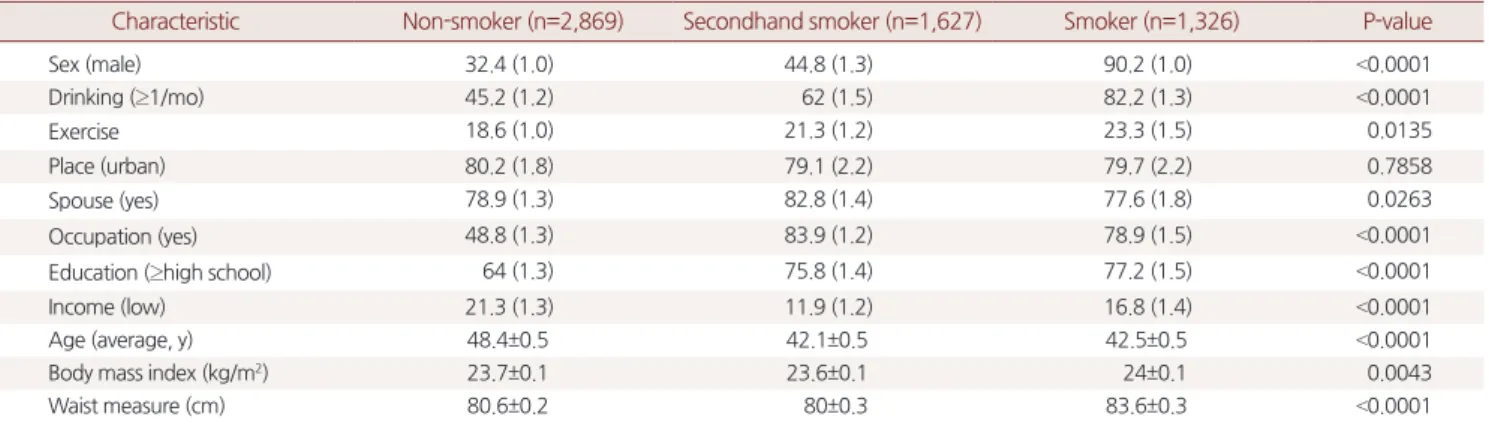
Table 1. Baseline characteristics of the populations
Characteristic Non-smoker (n=2,869) Secondhand smoker (n=1,627) Smoker (n=1,326) P-value
Sex (male) 32.4 (1.0) 44.8 (1.3) 90.2 (1.0) <0.0001
Drinking (≥1/mo) 45.2 (1.2) 62 (1.5) 82.2 (1.3) <0.0001
Exercise 18.6 (1.0) 21.3 (1.2) 23.3 (1.5) 0.0135
Place (urban) 80.2 (1.8) 79.1 (2.2) 79.7 (2.2) 0.7858
Spouse (yes) 78.9 (1.3) 82.8 (1.4) 77.6 (1.8) 0.0263
Occupation (yes) 48.8 (1.3) 83.9 (1.2) 78.9 (1.5) <0.0001
Education (≥high school) 64 (1.3) 75.8 (1.4) 77.2 (1.5) <0.0001
Income (low) 21.3 (1.3) 11.9 (1.2) 16.8 (1.4) <0.0001
Age (average, y) 48.4±0.5 42.1±0.5 42.5±0.5 <0.0001
Body mass index (kg/m2) 23.7±0.1 23.6±0.1 24±0.1 0.0043
Waist measure (cm) 80.6±0.2 80±0.3 83.6±0.3 <0.0001
Values are presented as % (standard error) or mean±standard error.
Sang-Won Moon, et al. The Effect of Smoking and Second-Hand Smoking on the Heavy Metals in the Blood
Korean Journal of Family Practice
KJFP
다. 모든 분석은 복합표본을 고려한 SAS SURVEYPROCESURE를 이 용하였다. 통계분석은 SAS ver. 9.3 (SAS Institute Inc., Cary, NC, USA) 을 이용하였으면 유의수준은 0.05로 정의하였다.
결 과
1. 연구대상자들의 일반적인 특성
연구대상자는 총 5,822명으로 비흡연자 2,869명, 간접흡연자 1,627 명, 직접흡연자 1,326명이었다. 대상자에 대한 일반적 특성을 Table 1 에 제시하였다. 연구대상자 중 직접흡연자에서 남성이 90%, 여성이 10%로 남성이 많은 비율을 차지하였다.
2. 중금속 농도 연관요인
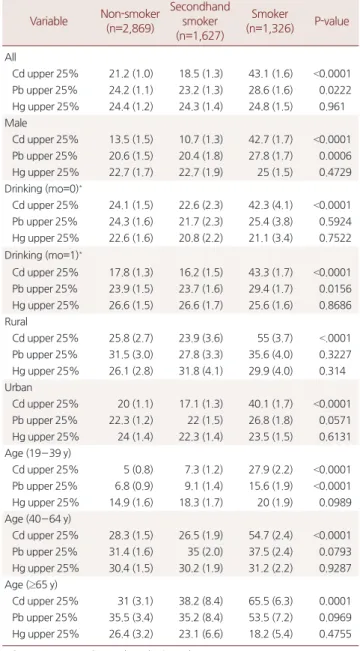
연구대상자 전체와 남성, 월간 음주율, 거주지역, 연령대에 따른 비 흡연, 간접흡연, 직접흡연군에서 각 중금속 농도 상위 25%를 차지하 는 비율에 대한 교차분석을 Table 2에 제시하였다. 전체 대상군 중 직 접흡연자에서 카드뮴 상위 25%가 43.1%로 가장 높았으며(P<0.001), 비흡연자와 간접흡연자 간의 유의한 차이는 보이지 않았다. 납 상위 25% 역시 직접흡연자에서 27.8%로 비흡연자나 간접흡연자에 비해 높은 결과를 보였으나 수은 상위 25%는 각 군 간의 유의한 차이를 보 이지 않았다. 연령대별 분석에서 연령대가 증가할수록 직접흡연자 에서 카드뮴 상위 25%를 차지하는 비율이 증가하였다.
각 중금속 상위 25%에 대한 직접, 간접흡연에 대한 관련성을 다중 로지스틱회귀분석 결과를 Table 3에 제시하였다. 카드뮴과 납의 혈중 농도의 경우 직접흡연과 관련성이 높았고 통계적으로 유의하였으며 (각각 odds ratio ratio=4.818, 1.766, P-value<0.05), 간접흡연과는 낮은 관련성을 보였으나, 수은의 혈중농도는 직접흡연, 간접흡연과 모두 연관성을 보이지 않았다.
고 찰
국가통계포털 2013년도 통계자료에 의하면 19세 이상 흡연율은 24% 정도이다. 또한 가정실내 간접흡연율은 약 11%, 직장실내 간접흡 연율은 약 47%에 달한다.8)
체내에 축적되는 중금속은 나이, 직업, 식습관, 흡연, 음주 등과 연 관이 있는 것으로 알려져 있다. 담배연기에는 다양한 유해물질이 포 함되어 있으며, 혈중 중금속 중 카드뮴은 흡연이 많은 역할을 하는 것으로 알려져 있으나, 수은, 납은 흡연 외에도 다양한 경로를 통해 축적된다.9,10) 또한 흡연은 음주와 더불어 신기능에 영향을 주어 중금 속의 배출에도 영향을 미칠 수 있다.11,12)
기존 연구에서도 카드뮴과 납의 경우 흡연과 높은 관련성을 가지 는 것으로 보고되었으며, 이는 본 연구결과에서도 일치한다. 혈중 수 은 농도의 경우 일부 연구에서 흡연과 관련성이 있는 것으로 보고되 었으나13) 관련성을 보이지 않은 연구결과도 보고되었으며,14) 본 연구 에서는 관련성을 보이지 않았다. 수은은 주로 해산물, 어패류나 음 주 등 음식물 섭취에 큰 영향을 받는 것으로 알려져 있다.15)
앞에서 언급했듯이 간접흡연에서 주로 마시게 되는 부류연은 일 반적으로 중금속을 포함한 독성물질의 농도가 높다. 주류연에 비해 부류연의 입자가 작아 간접흡연자의 경우 좀 더 폐포 깊숙이 도달하
Table 2. Analysis heavy metal (Hg, Pb, Cd) in blood for upper 25%
Variable Non-smoker (n=2,869)
Secondhand smoker (n=1,627)
Smoker
(n=1,326) P-value
All
Cd upper 25% 21.2 (1.0) 18.5 (1.3) 43.1 (1.6) <0.0001 Pb upper 25% 24.2 (1.1) 23.2 (1.3) 28.6 (1.6) 0.0222 Hg upper 25% 24.4 (1.2) 24.3 (1.4) 24.8 (1.5) 0.961 Male
Cd upper 25% 13.5 (1.5) 10.7 (1.3) 42.7 (1.7) <0.0001 Pb upper 25% 20.6 (1.5) 20.4 (1.8) 27.8 (1.7) 0.0006 Hg upper 25% 22.7 (1.7) 22.7 (1.9) 25 (1.5) 0.4729 Drinking (mo=0)*
Cd upper 25% 24.1 (1.5) 22.6 (2.3) 42.3 (4.1) <0.0001 Pb upper 25% 24.3 (1.6) 21.7 (2.3) 25.4 (3.8) 0.5924 Hg upper 25% 22.6 (1.6) 20.8 (2.2) 21.1 (3.4) 0.7522 Drinking (mo=1)*
Cd upper 25% 17.8 (1.3) 16.2 (1.5) 43.3 (1.7) <0.0001 Pb upper 25% 23.9 (1.5) 23.7 (1.6) 29.4 (1.7) 0.0156 Hg upper 25% 26.6 (1.5) 26.6 (1.7) 25.6 (1.6) 0.8686 Rural
Cd upper 25% 25.8 (2.7) 23.9 (3.6) 55 (3.7) <.0001 Pb upper 25% 31.5 (3.0) 27.8 (3.3) 35.6 (4.0) 0.3227 Hg upper 25% 26.1 (2.8) 31.8 (4.1) 29.9 (4.0) 0.314 Urban
Cd upper 25% 20 (1.1) 17.1 (1.3) 40.1 (1.7) <0.0001 Pb upper 25% 22.3 (1.2) 22 (1.5) 26.8 (1.8) 0.0571 Hg upper 25% 24 (1.4) 22.3 (1.4) 23.5 (1.5) 0.6131 Age (19−39 y)
Cd upper 25% 5 (0.8) 7.3 (1.2) 27.9 (2.2) <0.0001 Pb upper 25% 6.8 (0.9) 9.1 (1.4) 15.6 (1.9) <0.0001 Hg upper 25% 14.9 (1.6) 18.3 (1.7) 20 (1.9) 0.0989 Age (40−64 y)
Cd upper 25% 28.3 (1.5) 26.5 (1.9) 54.7 (2.4) <0.0001 Pb upper 25% 31.4 (1.6) 35 (2.0) 37.5 (2.4) 0.0793 Hg upper 25% 30.4 (1.5) 30.2 (1.9) 31.2 (2.2) 0.9287 Age (≥65 y)
Cd upper 25% 31 (3.1) 38.2 (8.4) 65.5 (6.3) 0.0001 Pb upper 25% 35.5 (3.4) 35.2 (8.4) 53.5 (7.2) 0.0969 Hg upper 25% 26.4 (3.2) 23.1 (6.6) 18.2 (5.4) 0.4755 Values are presented as % (standard error).
*Monthly drinking rate.
문상원 외. 직접흡연, 간접흡연이 혈중 중금속에 미치는 영향 Korean Journal of Family Practice
KJFP
게 된다.16,17) 일부 연구에서는 직접흡연뿐 아니라 간접흡연에서도 중
금속이 체내에 축적될 수 있음이 보고되었다.18) 아동에 대한 연구에 서도 집안에 흡연자의 수가 많을수록 카드뮴과 납의 농도가 높게 측 정되었고, 특히 어머니가 흡연을 할 경우 영향이 더 큰 것으로 보고되 었다.19,20)
본 연구에서는 직접흡연의 경우 혈중 중금속 농도와 큰 연관성이 있으나 간접흡연과는 낮은 연관성을 보였다. 직접흡연이 건강에 심 각한 피해를 주나, 간접흡연도 성인 폐암이나 심장동맥성 폐질환의 발생에 원인이 되고, 소아 청소년의 상기도 및 하기도 폐질환, 천식의 원인이 된다고 보고된 바 있다. 그리고 임신 중 산모의 간접흡연 노출 과 태아의 건강영향에 대해서는 다수의 연구가 관련성이 있음을 보 고하고 있다.
이 연구의 장점은 다음과 같다. 첫째, 직접흡연뿐 아니라 간접흡연 에 따른 혈중 중금속 농도의 상관관계를 분석하였다. 둘째, 우리나라 의 대표성 있는 대규모 표본을 통해 이루어진 조사결과를 바탕으로 수행되었다. 셋째, 비흡연자에는 과거 흡연자가 포함되어 있는데 자 료분석 시 비흡연자 중 과거흡연자를 보정하여 회귀분석을 시행하 였다.
단점은 첫째, 혈중 중금속 농도는 흡연 등 장기간 노출뿐 아니라 음식물 섭취 등 최근 노출에 대한 영향을 받음에도 불구하고 단기간 노출에 대한 요인은 고려하지 않고 분석하였다. 둘째, 중금속에 과량 노출될 수 있는 직업적 노출대상에 대한 배제가 이루어지지 않았다.
셋째, 10대 청소년의 간접흡연에 대한 조사가 이루어지지 않아 연구 대상자에서 배제된 점이다.
추후 음식섭취 등에 의한 단기간 노출요인과 직업요인을 고려하 고 청소년 흡연형태를 적용한 추가연구가 필요할 것이다.
요 약
연구배경:
흡연은 중금속을 포함한 다양한 독성물질의 노출원이다.이에 직접흡연, 간접흡연과 혈중 중금속 농도의 연관성에 대해 평가 하고자 하였다.
방법:
국민건강영양조사 제5기(2010–2012년) 대상자 중 19세 이상의 혈중 중금속 농도 측정자 5,822명을 대상으로 하였다. 직접흡연, 간접 흡연과 혈중 납, 수은, 카드뮴 농도의 관련성을 분석하였다.결과:
직접흡연과 혈중 카드뮴, 납 농도 간의 odds ratio R값은 각각 4.818, 1.766으로 관련성을 보였으며 통계적으로 유의하였다(각각 P<0.0001, P=0.0017). 혈중 수은 농도는 흡연과 관련성을 보이지 않았 다. 간접흡연과 혈중 중금속 농도는 관련성을 보이지 않았다.결론:
직접흡연과 간접흡연은 여러 유해물질과 중금속의 노출원이 며, 중금속은 저농도에서도 유해한 영향을 끼치므로 보건증진을 위 한 금연확산에 대한 노력이 필요하다.중심단어:
흡연; 간접흡연; 혈중 수은; 혈중 납; 혈중 카드뮴REFERENCES
1. Adams JD, O’Mara-Adams KJ, Hoffmann D. Toxic and carcinogenic agents in undiluted mainstream smoke and sidestream smoke of different types of Table 3. The correlation between smoking and heavy metal in blood using multiple logistic regression analysis
Variable Cd upper 25% Pb upper 25% Hg upper 25%
Model 1
Smoker 4.337 (3.584−5.248) 1.805 (1.47−2.218) 1.158 (0.963−1.392)
Secondhand smoker 1.181 (0.952−1.466) 1.344 (1.095−1.649) 1.133 (0.945−1.357)
Non-smoker 1 1 1
P-value <0.0001 <0.0001 0.2154
Model 2
Smoker 4.956 (3.452−7.114) 1.83 (1.29−2.595) 0.945 (0.689−1.295)
Secondhand smoker 1.22 (0.962−1.546) 1.255 (0.999−1.577) 1.166 (0.963−1.411)
Non-smoker 1 1 1
P-value <0.0001 0.0017 0.2075
Model 3
Smoker 4.818 (3.325−6.979) 1.766 (1.245−2.505) 0.878 (0.635−1.213)
Secondhand smoker 1.216 (0.959−1.541) 1.172 (0.927−1.482) 1.122 (0.926−1.36)
Non-smoker 1 1 1
P-value <0.0001 0.0056 0.2465
Values are presented as odds ratio (95% confidence interval). Model 1: adjusted for age. Model 2: adjusted for age, BMI, and eversmoke. Model 3: adjusted for age, BMI, eversmoke, drink, and exercise.
BMI, body mass index.
Sang-Won Moon, et al. The Effect of Smoking and Second-Hand Smoking on the Heavy Metals in the Blood
Korean Journal of Family Practice
KJFP
cigarettes. Carcinogenesis 1987;8:729-31.
2. Landsberger S, Wu D. The impact of heavy metals from environmental to- bacco smoke on indoor air quality as determined by Compton suppression neutron activation analysis. Sci Total Environ 1995;173-174:323-37.
3. United States Environmental Protection Agency. Health effects of exposure to environmental tobacco smoke, final report. Washington (DC): United States Environmental Protection Agency; 1997.
4. Zhou R, Li S, Zhou Y, Haug A. Comparison of environmental tobacco smoke concentrations and mutagenicity for several indoor environments.
Mutat Res 2000;465:191-200.
5. World Health Organization. WHO air quality guidelines for particulate matter, ozone, nitrogen dioxide and sulfur dioxide: global update 2005:
summary of risk assessment. Geneva: World Health Organization; 2006.
6. Kim DI, Kim YK, Kim JM, Jung KY, Kim JY. The levels of blood lead and zinc protoporphyrin for healthy urban population in Korea. Korean J Prev Med 1992;25:287-302.
7. Korea Centers for Disease Control and Prevention. The fifth Korea Nation- al Health and Nutrition Examination Survey [Internet]. Cheongju: Korea Centers for Disease Control and Prevention; 2010 [cited 2015 Aug 20].
Available from: http://knhanes.cdc.go.kr.
8. Statistics Korea. Statistics database [Internet]. Daejeon: Statistics Korea [cit- ed 2015 Aug 20]. Available from: http://kosis.kr/.
9. Bernhard D, Rossmann A, Wick G. Metals in cigarette smoke. IUBMB Life 2005;57:805-9.
10. Moon CS. Evaluation of Cd and Pb intake and exposure routes in some Ko- rean women. Korean J Environ Health 2007;33:353-8.
11. Briganti EM, Branley P, Chadban SJ, Shaw JE, McNeil JJ, Welborn TA, et al.
Smoking is associated with renal impairment and proteinuria in the normal population: the AusDiab kidney study. Australian Diabetes, Obesity and Lifestyle Study. Am J Kidney Dis 2002;40:704-12.
12. Hryhorczuk DO, Rabinowitz MB, Hessl SM, Hoffman D, Hogan MM, Mal- lin K, et al. Elimination kinetics of blood lead in workers with chronic lead intoxication. Am J Ind Med 1985;8:33-42.
13. Hong MK. A study on the association between factor of health/life and blood mercury concentration [dissertation]. Seoul: Yonsei University; 2003.
14. Jang BK, Park SI, Kim NS, Jung KS, Lee BK, Lee JW. Relationship between heavy metal concentrations in the soil with the blood and urine of residents around abandoned metal mines. J Environ Health Sci 2011;37:348-57.
15. Kim CW, Kim YW, Chae CH, Son JS, Park SH, Koh JC, et al. The effects of the frequency of fish consumption on the blood mercury levels in Koreans.
Korean J Occup Environ Med 2010;22:114-21.
16. Natusch DF, Wallace JR, Evans CA Jr. Toxic trace elements: preferential con- centration in respirable particles. Science 1974;183:202-4.
17. Dockery DW, Pope CA 3rd. Acute respiratory effects of particulate air pol- lution. Annu Rev Public Health 1994;15:107-32.
18. Chiba M, Masironi R. Toxic and trace elements in tobacco and tobacco smoke. Bull World Health Organ 1992;70:269-75.
19. Ozden TA, Gokcay G, Ertem HV, Suoglu OD, Kilic A, Sokucu S, et al. Elevat- ed hair levels of cadmium and lead in school children exposed to smoking and in highways near schools. Clin Biochem 2007;40:52-6.
20. Willers S, Schutz A, Attewell R, Skerfving S. Relation between lead and cad- mium in blood and the involuntary smoking of children. Scand J Work En- viron Health 1988;14:385-9.