서 론
흡연은 폐질환, 심장 및 뇌혈관 질환, 악성질환의 위험 인자로, 흡연자는 비흡연자보다 평균
10
년 조기 사망하는 것으로 알려져 있 다.1) 음주는 위장관, 간 등의 질환 및 악성 질환의 원인이 되며 과도 한 음주는 정신과적 질환의 원인이 된다.2) 반면 흡연과 정신과적 질 환의 관련성은 아직 논란의 여지가 있으나 우울증과 관련성이 보고 되고 있다.3)최근 금연에 대한 관심이 높아지면서 남성 흡연율은
30
% 가까이 감소되었다. 반면 음주는 우리나라에서 사회 생활의 일부분으 로 여겨진다.4) 알코올을 적당량을 복용하면 건강에 큰 문제가 되 지 않으며 치매 예방에 도움이 된다고 한다.5) 그러나 과도한 음주 는 육체적, 정신적 건강에 영향을 미치기 때문에 세계보건기구는
AUDIT
(Alcohol Use Disorder Identification Test
)를 개발하여 과도 한 음주로 인해 질병이 발생하는 것을 조기에 개입하여 질병 발생을 막으려고 하고 있다.6)AUDIT
-K
는AUDIT
를 우리나라 실정에 맞 춰서 적용하기 위해 개발되었다.현재 흡연율은 평생 담배
5
갑 이상 피웠고 현재 담배를 피는 만19
제 6기 국민건강영양조사 자료를 통해 확인한 한국 남성의 흡연과 AUDIT-K와의 관련성
최태진
1, 배서엽
1, 박윤수
1,*, 심승범
1, 이용한
2, 정용학
2, 문병대
21여수전남병원, 2여천전남병원
A study on the Relationship between AUDIT-K and Smoking in Korean men:
Data Analysis from the 6
thKorea National Health and Nutrition Examination Surveys(KNHANES)
Tai-Jin Choi
1, Seo-Yeop Bae
1, Yun-Soo Park
1,*, Seung-Bum Shim
1, Yong-Han Lee
2, Yong-Hak Jung
2, Byung-Dae Moon
21Department of family medicine of Yeosuchonnam hospital; 2Department of family medicine of Yeocheonchonnam hospital
Background: To The purpose of this study was to assess the association between smoking status and AUDIT-K among Korean males.
Methods: Data was obtained and analyzed from the 6
thKNHANES. Smoking status is was classified by current and past amount of smoking, including ex-smokers. Low A risklow-risk group and a high riskhigh-risk group of alcohol consumption are were classified by AUDIT-K. Association between smoking status and alcohol consumption was examined using logistic regression analysis.
Results: Ex-smokers are were 2.059 times as likely to be inin the high riskhigh-risk group of alcohol consumption as non-smokers. Current smokers are were 3.398 times as likely to be inin the high riskhigh-risk group of alcohol consumption as non-smokers. Among ex-smokers, those who smoked 11 to 20 cigarretescigarettes pera day are were 1.187 times as likely to be in the high riskhigh-risk group as those who smoked less than 10 cigarettes a daycigarettes per day. Those who smoked more than 20 cigarettes a daycigarettes per day are were 2.476 times as likely to be in the high riskhigh-risk group as those who smoked less than 10 cigarettes a daycigarettes per day. Among current smokers, people who smoke 11 to 20 cigarretescigarettes pera day are were 1.632 times as likely to be in the high riskhigh-risk group as people who smoke less than 10 cigarettes a daycigarettes per day. People who smoke more than 20 cigarettes a daycigarettes per day are were 2.141 times as likely to be in the high riskhigh-risk group as people who smoke less than 10 cigarettes a daycigarettes per day.
Conclusion: Amount of smoking is directly associated with the tendency to alcohol abuse alcohol among male smokers.
Keywords: male, smoking, AUDIT-K, 6
thKNHANES
Received February 26, 2015 Revised August 23, 2015 Accepted September 3, 2015 Corresponding Author Yun-Soo Park
Tel: +82-61-640-7575, Fax: +82-61-643-2628 E-mail: [email protected]
Copyright © 2015 The Korean Academy of Family Medicine
This is an open-access article distributed under the terms of the Creative Commons Attribution Non-Commercial License (http://creativecommons.org/licenses/by-nc/3.0) which permits unrestricted noncommercial use, distribution, and reproduction in any medium, provided the original work is properly cited.
Tai-Jin Choi, et al. A study on the Relationship between AUDIT-K and Smoking in Korean men : Data Analysis from the 6th Korea National Health and Nutrition Examination Surveys(KNHANES)
Korean Journal of Family Practice
KJFP
세 이상 기준으로,
2013
년 국민 건강 영양 조사 결과 남자42
.1
%, 여자6
.2
%이다. 그리고1
회 평균 음주량이7
잔 이상(여자5
잔)이 며 주2
회 이상 음주하는 만19
세 이상 기준으로 고위험 음주율은19
.7
%,5
.4
%이다. 흡연과 음주는 국민 건강 생활 습관에서 여전히 높은 비율을 차지하고 있고 질병 유병율에 영항을 미치고 있다.일반적으로 흡연자가 음주시 흡연을 하는 경향이 있는 것으로 알려져 있다. 알코올은 니코틴성 아세틸콜린 수용체에 작용하여 활성을 증가시킬 수 있다고 한다.7) 니코틴과 알코올은 각각 약물 의존성을 일으키는 대표적인 것들이며 니코틴 및 알코올 사용장애 가 있는 경우 다른 약물 중독에 취약할 가능성이 있다.
최근 연구에 따르면 알코올에 취하는 초기 음주 상태일 때, 니코 틴의
acetylcholine receptor
가ethanol
의target site
로 작용한다는 보고가 있다.8) 따라서 니코틴 중독이 알코올 중독을 악화시키는 가 능성을 간과할 수 없으며 실생활에서 흡연과 음주가 어느 정도 밀접 한 관계를 맺고 있는지 확인해 볼 필요가 있다. 제6
기 국민 건강 영 양 조사를 통해 우리나라 국민의 흡연과 음주의 관련성을 객관적으 로 평가하고자 한다.대상 및 방법
본 연구는
2013
년 제6
기 국민건강영양조사 자료를 분석하였다.만
19
세 이상 흡연력이 확인된 성인 남성을 대상으로 하였다. 그 결 과 대상자는 총4611
명이었다. 국민건강영양조사는 제1
기(1998
)부 터 제3
기(2005
)까지3
년 주기로 실시하였고, 이후 연중 조사체계 로 개편되어 제4
기(2007
~2009
)부터 현재까지 매년 실시하고 있다.2013
년6
기 국민 건강 영양조사는3840
가구,10
,113
명을 대상으로 이루어졌으며8
,018
명이 참여하였다. 국민 건강영양조사 자료를 이 용하여 목표 모집단인 대한민국에 거주하는 국민의 특성을 정확히 추정하기 위해서는 가중치를 적용하여 산출한다. 국민 건강 영향조 사 가중치는 가구 가중치와 개인가중치를 적용하여 전체 모집단 분 포를 산출하였다. 제6
기1
차년도(2013
) 기본 가중치는 가구조사 가 중치, 건강설문 검진조사가중치, 영양조사 가중치로 구성하였고 이 는 제5
기(2010
~2012
)와 동일하다.1. 흡연력
흡연 상태는 현재흡연자, 과거흡연자, 비흡연자로 분류하였다.
현재흡연은 세계보건기구의 정의를 따라 평생
5
갑(100
개피) 이상 흡연한 사람으로서 현재 매일 흡연하거나 가끔 흡연하는 사람으로 정의하였다. 과거흡연은 과거에 평생100
개피 이상 흡연하였고 현 재는 피우지 않는 사람으로 정의하였다.2. AUDIT-K
AUDIT
-K
는 세계보건기구에서 위험 음주자를 사전에 선별하 여 과도한 음주로 인해 발생할 수 있는 질병에 대해 조기에 개입하 여 폐해를 감소시키기 위한 목적으로 개발된AUDIT
(Alcohol Use Disorder Identification Test
))를 우리나라 성인남녀에게 적절히 적 용하기 위한 지침을 제공하기 위해 제작되었다.Audit
-k
는10
개 문 항으로 이루어져 있으며 총 점수 기준0
~8
점은 정상음주,9
~12
점 은 위험 음주수준,13
~19
점은 고위험음주,20
점 이상은 알코올 사 용장애 환자로 분류할 수 있다.AUDIT
-K
점수12
점을 기준으로 하였을 때 비정상적 간기능이 유의하게 증가하였다고 한다.9) 본 연 구에서12
점을 기준으로 점수가 낮은 경우를 음주습관 저위험군, 높은 경우를 음주습관 고위험군으로 설정하였다.3. 가중치
국민건강영양조사 자료의 통계적 데이터 처리를 위해서는 가구 및 개인 가중치를 적용하여 모집단 분포를 추정해야 하며 가중치를 적용하지 않는 통계 처리의 경우 결과가 왜곡될 수 있다.
4. 분석 방법
조사대상자 집단의 특성을 확인하기 위해 조사대상자의 연령, 소득 수준, 교육수준을 분석하였다. 연령은
19
세~39
세,40
세~49
세,50
세~59
세,60
세 이상으로 분류하였고, 월평균 가구 소득은 국 민 건강 영양 조사에서 제시하는 성·연령별 가구균등화 소득에 따 라 소득 수준을4
개군으로 분류하여 하, 중하, 중상, 상으로 분류하 였다. 교육수준은 초등학교 졸업 이하, 중학교 졸업 이하, 고등학교 졸업 이하, 대학교 졸업 이상으로 분류하였다,음주행태를 확인하기 위해 사용한 도구
AUDIT
-K scale
을 총점 기준0
~8
점을 정상 음주,9
~12
점은 위험음주,13
~19
점은 고위험 음주,20
점 이상은 알코올사용장애로4
단계로 분류하였다. 그리고AUDIT
-K
총점12
점을 기준으로 하여12
점 이하에 해당하는 군을 음주습관 저위험군,13
점 이상인 군을 음주습관 고위험군으로 정 의한 후, 남성의 흡연 여부와 과거흡연 및 현재흡연자의 하루평균 흡연량을 독립변수로 하고 음주습관 고위험군을 종속변수로 하여 로지스틱 회귀 분석을 시행하였다. 사용한 통계프로그램은PASW SPSS window 18
.0
을 사용하였고 유의수준은0
.05
로 하여 분석하 였다결 과
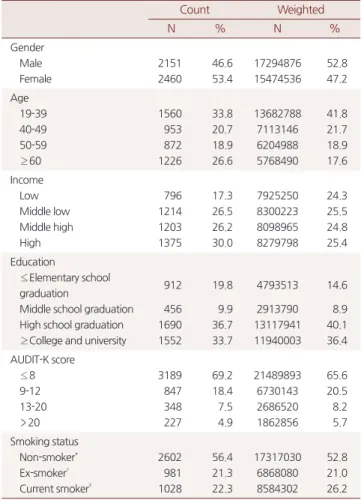
1. 대상자의 특성
19
세 이상 성인은 남성60
%, 여성40
%의 분포를 나타냈다. 연령 별로19
~39
세가41
.8
%로 가장 많이 차지하였다. 교육수준 초졸은14
..6
%, 중졸은8
.9
%, 고 졸은40
.1
%, 대졸 이상은36
.4
%를 차지하 였다(Table 1
).2. 알코올 및 흡연 사용 정도
AUDIT
-K 8
점 이하인 정상음주가65
.6
%로 가장 많은 비율을 차지하고 있다. 흡연여부는 비흡연이52
.8
%이었으며 과거흡연이21
.0
%이고, 현재흡연이26
.2
%이었다.남성에서 비흡연, 과거흡연, 현재흡연의 순으로 음주습관이 고위 험군에 해당하는 분포가 증가하였으며 이 결과는 통계적으로 유의 하였다.(
Table 2
) (P
-value
<0
.001
) 남성 과거 및 현재 흡연자 대상 으로 흡연량을10
개피/일 미만,10
개피/일 초과20
개피 이하,20
개 피/일 이상으로 구분하고AUDIT
점수12
점을 기준으로 저위험군 과 고위험군으로 구분하여 교차분석을 시행하였으며 흡연량이 증 가할수록 고위험군에 해당하는 분포가 증가하였으며 이는 통계적 으로 유의하였다.(Table 3
,4
) (과거 흡연자:P
-value
:0
.005
, 현재 흡연자:P
-value
:0
.010
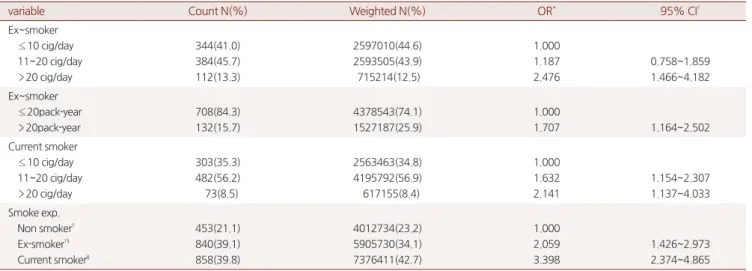
)남성의 흡연 여부를 독립변수로 하고
AUDIT
점수12
점을 기준 으로 음주습관 저위험군과 음주습관 고위험군으로 나누었을 때 고 위험군에 해당하는 경우를 종속변수로 설정하여 로지스틱 회귀 분 석을 시행하였다. 그 결과, 남성의 비흡연, 과거흡연, 현재 흡연에 따라서 음주습관이 고위험군일 위험도는 비흡연의 위험도를 기준 으로 할 때 과거흡연은2
.059
배, 현재흡연은3
.398
배의 위험도를 갖는 것으로 나타났다(Table 4
). 과거 남성 흡연자에서 흡연량을 독 립변수로 하였을 때 일일당10
개피 이하로 피는 집단에 비교하여11
~20
개피 피는 집단이 고위험군일 위험도는1
.187
배,20
개피 이 상 피는 집단은2
.476
배 높았다. 현재 남성 흡연자에서 흡연량을 종 속변수로 하였을 때 일일당10
개피 이하로 피는 집단에 비교하여11
~20
개피 피는 집단이 고위험군일 위험도는1
.632
배,20
개피 이Table 1. General characteristics of subjects
Count Weighted
N % N %
Gender Male Female
2151 2460
46.6 53.4
17294876 15474536
52.8 47.2 Age
19-39 40-49 50-59
≥ 60
1560 953 872 1226
33.8 20.7 18.9 26.6
13682788 7113146 6204988 5768490
41.8 21.7 18.9 17.6 Income
Low Middle low Middle high High
796 1214 1203 1375
17.3 26.5 26.2 30.0
7925250 8300223 8098965 8279798
24.3 25.5 24.8 25.4 Education
≤ Elementary school graduation
Middle school graduation High school graduation
≥ College and university
912 456 1690 1552
19.8 9.9 36.7 33.7
4793513 2913790 13117941 11940003
14.6 8.9 40.1 36.4 AUDIT-K score
≤ 8 9-12 13-20
>20
3189 847 348 227
69.2 18.4 7.5 4.9
21489893 6730143 2686520 1862856
65.6 20.5 8.2 5.7 Smoking status
Non-smoker* Ex-smoker† Current smoker‡
2602 981 1028
56.4 21.3 22.3
17317030 6868080 8584302
52.8 21.0 26.2 Values are presented as number(%).
* Adults who currently do not smoke cigarettes, including both former smokers and never smokers.
† Adults who have smoked at least 100 cigarettes in their lifetime, but say they currently do not smoke.
‡ Adults who have smoked 100 cigarettes in their lifetime and currently smoke cigarettes every day(daily) or some days(nondaily).
Table 2. AUDIT-K according to smoking status
Man AUDIT-K
P-value‡
Low-risk* High-risk† total
Non-smoker§ Count N(%)
Weighted N(%)
399(88.1) 3559468(88.7)
54(11.9) 453267(11.3)
453(100.0)
4012735(100.0) <0.001
Ex-smoker|| Count N(%)
Weighted N(%)
675(80.4) 4678948(79.2)
165(19.6) 1226782(20.8)
840(100.0) 5905730(100.0)
Current smoker¶ Count N(%)
Weighted N(%)
594(69.2) 5148513(69.8)
264(30.8) 2227899(30.2)
858(100.0) 7376411(100.0)
total Count N(%)
Weighted N(%)
1668(77.5) 13386929(77.4)
483(22.5) 3907948(22.6)
2151(100.0) 17294877(100.0) Values are presented as number(%).
* AUDIT-K≤12.
† AUDIT-K>12.
‡ Obtained by chi-square test.
§ Adults who currently do not smoke cigarettes, including both former smokers and never smokers.
Adults who have smoked at least 100 cigarettes in their lifetime, but say they currently do not smoke.
¶ Adults who have smoked 100 cigarettes in their lifetime and currently smoke cigarettes every day(daily) or some days(nondaily).
Tai-Jin Choi, et al. A study on the Relationship between AUDIT-K and Smoking in Korean men : Data Analysis from the 6th Korea National Health and Nutrition Examination Surveys(KNHANES)
Korean Journal of Family Practice
KJFP
Table 3. AUDIT-K according to smoking amount of Ex-smoker
Man Ex-smoker* AUDIT-K
P-value§
Low-risk† High-risk‡ total
≤10cig/day Count N(%)
Weighted N(%)
290(84.3) 2140848(82.4)
54(15.7) 456162(17.6)
344(100.0)
2597010(100.0) 0.005
>10cig/day
≤ 20cig/day
Count N(%) Weighted N(%)
306(79.7) 2069898(79.8)
78(20.3) 523608(20.2)
384(100.0) 2593506(100.0)
>20cig/day Count N(%)
Weighted N(%)
79(70.5) 468202(65.5)
33(29.5) 247012(34.5)
112(100.0) 715214(100.0)
total Count N(%)
Weighted N(%)
675(80.4) 4678948(79.2)
165(19.6) 1226782(20.8)
840(100.0) 5905730(100.0) Values are presented as number(%).
* Adults who have smoked at least 100 cigarettes in their lifetime, but say they currently do not smoke.
† AUDIT-K≤12.
‡ AUDIT-K>12.
§ obtained by chi-square test.
Table 4. AUDIT-K according to smoking amount of current smoker
Man current smoker* AUDIT-K
P-value§
Low-risk† High-risk‡ total
≤10 cig/day Count N(%)
Weighted N(%)
234(77.2) 1967137(76.7)
69(22.8) 596327(23.3)
303(100.0)
2563464(100.0) 0.010
>10 cig/day
≤ 20 cig/day
Count N(%) Weighted N(%)
319(66.2) 2807148(66.9)
163(33.8) 1388644(33.1)
482(100.0) 4195792(100.0)
>20cig/day Count N(%)
Weighted N(%)
41(56.2) 374228(60.6)
32(43.8) 242928(39.4)
73(100.0) 617156(100.0)
total Count N(%)
Weighted N(%)
594(69.2) 5148513(69.8)
264(30.8) 22278999(30.2)
858(100.0) 7376411(100.0) Values are presented as number(%).
* Adults who have smoked 100 cigarettes in their lifetime and currently smoke cigarettes every day(daily) or some days(nondaily).
† AUDIT-K≤12.
‡ AUDIT-K>12.
§ obtained by chi-square test.
Table 5. Risk of alcohol use disorder according to smoking status
variable Count N(%) Weighted N(%) OR* 95% CI†
Ex~smoker
≤ 10 cig/day 11~20 cig/day
>20 cig/day
344(41.0) 384(45.7) 112(13.3)
2597010(44.6) 2593505(43.9) 715214(12.5)
1.000 1.187 2.476
0.758~1.859 1.466~4.182 Ex~smoker
≤ 20pack-year
>20pack-year
708(84.3) 132(15.7)
4378543(74.1) 1527187(25.9)
1.000
1.707 1.164~2.502
Current smoker
≤ 10 cig/day 11~20 cig/day
>20 cig/day
303(35.3) 482(56.2) 73(8.5)
2563463(34.8) 4195792(56.9) 617155(8.4)
1.000 1.632 2.141
1.154~2.307 1.137~4.033 Smoke exp.
Non smoker‡ Ex-smoker†§
Current smoker||
453(21.1) 840(39.1) 858(39.8)
4012734(23.2) 5905730(34.1) 7376411(42.7)
1.000 2.059 3.398
1.426~2.973 2.374~4.865 Values are presented as number(%).
Data was calculated using Logistic regression analysis.
* Odds ratio
† Confidence interval
‡ Adults who currently do not smoke cigarettes, including both former smokers and never smokers.
§ Adults who have smoked at least 100 cigarettes in their lifetime, but say they currently do not smoke.
Adults who have smoked 100 cigarettes in their lifetime and currently smoke cigarettes every day(daily) or some days(nondaily).
상 피는 집단은
2
.141
배 높았다(Table 5
).고 찰
본 연구는 제
6
기 국민건강영양조사를 바탕으로19
세 이상 남성 들의 흡연 형태에 따른AUDIT
-K
관련성을 평가하였다. 비흡연자 에 비하여 과거 흡연자나 현재 흡연자는AUDIT
-K
점수가 높은 음 주습관 고위험군에 해당하는 것으로 나타났다. 현재 흡연자의 일일 흡연량이 증가할수록 음주습관 고위험군에 속하였으며 이러한 양 상은 과거 흡연자에서도 관찰되어 현재 흡연을 하지 않더라도 과거 일일 흡연량이 많았으면 고위험군에 속하는 경향을 보였다. 음주 습관 고위험군에 속할 위험도는 비흡연자를 기준으로 현재 흡연자 가 과거 흡연자보다 높았고 흡연량이 많을수록 더 높았다.제
6
기 국민 건강영양조사에 따르면,19
세이상에서 평생100
개 피 이상 피우고 현재 흡연 중인 인구는 남성42
.1
%, 여성6
.2
%라고 한다. 또한1
회 평균 음주량이7
잔(여성5
잔) 이상이며 주2
회 이상 음주하는 고위험음주율이 남성은19
.7
%, 여성5
.4
%로 흡연과 음주 는 국민 건강에 큰 영향을 끼치고 있다는 것을 알 수 있다.알코올과 정신과적 질환 관련성은 이미 여러 연구를 통해 알 려져 있다. 만성적인 알코올 투여는 뇌의
GABA
를 감소시킨다고 한다.10) 알코올은serotonin
이5
-hydroxyindo
-lacetaldehyde
나5
-hydroxytryptophol
로 대사되게 하며,dopamine
의 작용에도 다 양한 효과를 준다고 한다.11) 반면에 니코틴의 중독성과 정신과적 질 환과의 관련성은 명확하게 알려진 부분이 많지 않으며 청소년이나 노인 같은 특정 연령대에서 우울증과 같은 대표적인 정신과적 질환 과 흡연의 관련성은 보고되고 있다.12-13) 흡연량 증가가 음주습관 고 위험군에서 관찰되는 것에서 미루어 볼 때, 알코올성 정신질환에서 도 흡연의 영향을 고려해볼 필요가 있다.Ulrich
에 따르면 하루30
개피 이상 피고17
세부터 흡연을 시작 하였으며DSM
-IV
의 니코틴 사용장애에 해당하는 사람이 알코올 사용장애가 있을 위험도가 정상보다4
배 높다고 한다.14) 통계적으 로 음주와 흡연이 동반하는 경향은 관찰되고 있으며 이러한 현상 을 신경생화학적 또는 약물학적으로 설명하기 위한 노력하고 있다.Maltzman
의 연구에서 급성 알코올 투여는 아세틸콜린의 활성을 감 소시키고, 만성 알코올 환자에서 니코틴성 아세틸콜린 수용체를 증 가시킨다고 한다.15) 본 연구에서도 우리나라 성인 남성의 음주와 흡 연 행태는 매우 밀접한 관계를 맺고 있는 것을 알 수 있다.Berger
,Jeffrey
등의 연구를 보면 많은 양의 음주는 흡연의 심혈 관 질환 위험도를3
배 상승시킨다고 한다.16) 이 연구에서는 흡연과 음주를 독립적으로 보고 각각의 위험도를 제시하였으나 현재 흡연 자이고 흡연량이 많을수록 음주습관 고위험군에 해당할 위험도가 높아지므로 이로 인해 심혈관 질환을 포함한 여러 질환 및 정신과적질환의 위험도가 높아질 수 있는 것을 고려해야 할 것이다.
본 연구는 단면연구라는 한계점이 있어서 장기간의 추적 관찰 을 통해 흡연과 음주의 관련성을 알아볼 필요가 있다. 또한 주관 적인 설문 조사를 통하여 자료 조사가 이루어져서 정확한 평가가 어려운 부분이 있다. 알코올 의존 환자의 병식 상태가 낮은 경우
AUDIT
-K
나CAGE
같은 알코올리즘 선별 검사의 위음성 가능성이 높다고 한다.17) 따라서 고위험 음주군의 흡연량 평가에 왜곡이 있을 수 있다. 그리고 현재 흡연자 중 금연을 시도했던 사람들에 대해서 흡연량을 평가하는데 정보가 불충분하며,Pack
-years
가 흡연량을 추정하는데 중요지표로 쓰이는데 국민 건강 영양 조사 설문정보의 한계로 현재흡연자에서pack
-years
을 정확하게 확인하기가 어려웠 던 점이 있다. 흡연과 음주는 각각 다양한 질병의 위험요인으로 평 가 받고 있w
는데, 흡연과 음주가 서로 교호작용으로 질환의 발병 위험도를 높일 수 있는지 고찰해 볼 필요가 있다. 마지막으로 본 논 문은 흡연여부와 흡연량 증가에 따라서 음주행태가 고위험에 속하 는지 여부를 확인했는데, 이것은 즉 흡연이 음주에 미치는 영향이 며, 흡연-음주 습관이 서로 상호 작용한다는 점을 고려할 때 음주 가 흡연습관에 어떤 영양을 주는지에 대해서도 향후 조사할 필요가 있다.18)요 약
연구배경: 국내 역학 조사 결과를 기반으로 흡연 여부 및 흡연량과 음주의 관련성을 알아보았다.
방법: 제
6
기 국민건강영양조사를 분석하였다. 로지스틱 회귀분석 을 통해 흡연 여부 및 흡연량이 음주행태에 미치는 영향을 평가하 였다.결과: 비흡연자에 비하여 과거 흡연자나 현재 흡연자는
AUDIT
-K
점수가 높은 집단에 해당하는 것으로 나타났다. 과거 및 현재 흡연 자의 일일 흡연량이 증가할수록 음주습관 고위험군에 속하였다.비흡연자에 비하여 과거흡연자가 음주습관 고위험군일 위험도는
2
.059
배, 현재흡연자는3
.398
배의 위험도를 가졌다. 과거 남성 흡 연자의 음주습관 고위험군에 해당하는 위험도는 일일당10
개피 이 하로 피었던 집단에 비교하여11
~20
개피 피는 집단이1
.187
배,20
개피 이상 피는 집단은2
.476
배 높았으며, 현재 남성 흡연자가 음 주습관 고위험군에 해당할 위험도는 일일당10
개피 이하로 피는 집 단에 비교하여11
~20
개피 피는 집단이1
.632
배,20
개피 이상 피는 집단은2
.141
배 높았다.결론:
19
세 이상 성인 남성에서 흡연 경험이 있으면 비흡연자에 비Tai-Jin Choi, et al. A study on the Relationship between AUDIT-K and Smoking in Korean men : Data Analysis from the 6th Korea National Health and Nutrition Examination Surveys(KNHANES)
Korean Journal of Family Practice
KJFP
하여 음주 습관 고위험군에 속할 위험도가 높아진다. 과거 흡연자 보다 현재 흡연자가 음주 습관 고위험군에 해당할 위험도가 더 높으 며, 과거 흡연자 및 현재 흡연자에서 흡연량이 증가 할수록 음주 습 관 고위험군에 속할 위험도가 높다.
중심단어: 성인 남성, 흡연,
AUDIT
-K
, 제6
기 국민건강영양조사 REFERENCES1. Ki-Heon Lee, Cheol-Min Lee, Hyuk-Tae Kwon, Seung-Won Oh.
Relationship between Obesity and Smoking in Korean Men: Data Analysis from the Third and Fourth Korea National Health and Nutrition Examination Surveys(KNHANES). JKSRNT 2010; 1(2):
115-123.
2. Moon-Young Kim, Soon-Koo Baik. Nonalcoholic fatty liver disease as a risk of cardiovascular disease . Korean Journal of Hepatology 2008; 14(1): 1-3.
3. Tae-Suk Kim, Dai-Jin Kim. The Association between Smoking and Depression. The Korean Journal of Psychopharmacology 2007;
18(6): 393-398.
4. Sang-Woo Oh. Effects of Alcohol on Obesity and Metabolic Syndrome. Korean Society for the study of Obesity 2009; 18(1):
1-7.
5. Yun-Hwan Lee, Duk L. Na, Hae-Kwan Cheong, Chang Hyung Hong, Joung Hwan Back, et al. Life style Recommendation s for Dementia Prevention: PASCAL. Journal of the Korean Geriatrics Society 2009; 13(2): 61-68.
6. John B Saunders, Olaf G. Aasland, Thomas F. Babor, Juan R. De La Fuente, Marcus Grant. Development of the alcohol use disorders identification test (AUDIT): WHO collaborative project on early detection of persons with harmful alcohol consumption‐II.
Addiction 1993; 88(6): 791-804.
7. Di Chiara, Gaetano. Alcohol and dopamine. Alcohol Res Health 1997; 21: 108-114.
8. Valenzuela CF. Alcohol and neurotransmitter interactions. Alcohol Res Health 1997; 21: 144-148.
9. Jin-Guhn Sohn, Hae-Rhan Song, Kwang-Young Lee, Jin-Ha Kim, Ho-Chan Kim. A study on the Relationship between Alcohol Use Disorders Identification Test and Liver Function Test in Blue Collar Workers. Korean J Occup Environ Med 2003; 15(3): 281-289.
10. Seong-Ho Min, In-Deok Kong, Seung-Kyu Cha, Jong-Ho Shin.
The Effect of Alcohol in the Nicotinic Acetylcholine Receptor.
Korean J Psychopharmacol 2006; 17(1): 81-90.
11. Papke Roger L., Paul R. Sanberg, R. Douglas Shytle. Analysis of mecamylamine stereoisomers on human nicotinic receptor subtypes.
Journal of Pharmacology and Experimental Therapeutics 2001;
297(2): 646-656.
12. Hyun-Joo Lee, Sang-Kyoung Kahng, Jun-Young Lee. The Effects of Socioeconomic Position and Health Behavior on Geriatric Depressive Symptom. The Korean Gerotological Society 2008;
28(4): 1129-1145.
13. Hae-Won Byeon. Relationship between Cigarette Smoking and Depression Symptoms of High School Students. Journal of the Korea Academia-Industrial cooperation Society 2012; 13(10):
4669-4675.
14. Ulrich John, Christian Meyer, Hans-Jurgen Rumpf, Ulfert Hapke.
Probabilities of alcohol high‐risk drinking, abuse or dependence estimated on grounds of tobacco smoking and nicotine dependence.
Addiction 2003; 98(6): 805-814.
15. Irving Maltzman, Ksenija Marinkovic. Alcohol, alcoholism and the autonomic nervous system: a critical account. The pharmacology of alcohol and alcohol dependence 1996; 248-306.
16. Jeffrey S. Berger, Courtney O. Jordan, Donald Lloyd-Jones, Roger S. Blumenthal. Screening for cardiovascular risk in asymptomatic patients. Journal of the American College of Cardiology 2010;
55(12): 1169-1177.
17. Kyu-Chol Cho, Jong-Sung Kim, Jin-Gyu Jung, Sung-soo Kim, Jeong-Gil Lee, et al. Effects of Insight Level on the Sensitivity of Alcoholism Screening Tests in Alcohol Dependent Patients. Korean J Fam Med 2010; 31: 523-528.
18. Ki-Won Kang, Joo-hon Sung, Chang-Yup Kim. High RiskHigh- risk Groups in Health Behavior Defined by Clustering of Smoking, Alcohol, and Exercise Habits: National Heath and Nutrition Examination Survey. J Prev Med Public Health 2010; 43(1): 73-83.