41 41
THE EWHA MEDICAL JOURNAL THE EWHA MEDICAL JOURNAL
Syndrome of Inappropriate Secretion of Antidiuretic Hormone after Lung Transplantation
Young Su Joo, Chang-Yun Yoon, Seung Gyu Han, Eunyoung Lee, In Mee Han, Moon Sung Woo, Se Hee Park, Tae-Hyun Yoo
Department of Internal Medicine, Yonsei University College of Medicine, Seoul, Korea
Introduction
Hyponatremia is considered to be a frequent complication of many clinical conditions [1]. Euvolemic dilutional hyponatremia caused by water retention in normal sodium stores has been termed as a syndrome of inappropriate antidiuretic hormone (SI- ADH) [2]. SIADH has been developed in patients with a variety of disorders, including central nervous system disorders, malig- nancy with autonomous ADH release, drugs and other miscel- laneous causes. Pulmonary disease such as pneumonia or lung cancer is frequently combined with SIADH, however, there was no report of SIADH in a patient after lung transplantation (LT).
Herein, we describe a case of SIADH after LT, whose hypona- tremia was successfully treated with tolvaptan.
Case
A 54-year-old man treated with idiopathic pulmonary fibrosis for several years was admitted to Yonsei University Severance Hospital for LT. He had ten-year history of hypertension and diabetes mellitus and had a medical history of pulmonary tuber- culosis cured before 10 years. His medication included aspirin 75 mg once daily, eprosartan 300 mg daily, and pirfenidone 200 mg three times a day. He was a 20 pack-year ex-smoker with mod- erate alcohol consumption. On physical examination, there was no significant finding except bilateral coarse breathing sound.
His blood laboratory results on admission were: serum sodium 139 mmol/L, potassium 4.0 mmol/L, chloride 100 mmol/L, total CO2 25 mmol/L, blood urea nitrogen 25 mg/dL and creatinine 0.62 mg/dL. There was no significant abnormality in urinalysis.
Case Report
Ewha Med J 2014;37(Suppl):S41-S43 http://dx.doi.org/10.12771/emj.2014.37.S.S41 pISSN 2234-3180 • eISSN 2234-2591
A 54-year-old man was diagnosed as syndrome of inappropriate secretion of antidiuret- ic hormone (SIADH) 7 days after lung transplantation, whereas the preoperative serum sodium level was normal. Hypertonic saline infusion with furosemide did not improve hyponatremia, however, tolvaptan corrected his serum sodium levels from 123 mEq/
L to 131 mEq/L. Seven days after maintenance of tolvaptan, this drug was discontinued and hyponatremia did not occur. Herein, we report a case of SIADH after lung trans- plantation treated with tolvaptan. (Ewha Med J 2014;37(Suppl):S41-S43)
Received July 14, 2014 Accepted September 1, 2014 Corresponding author Tae-Hyun Yoo
Department of Internal Medicine, Yonsei University College of Medicine, 50, Yonsei-ro, Seodaemun-gu, Seoul 120-752, Korea
Tel: 82-2-2228-1989, Fax: 82-2-393-6884 E-mail: [email protected]
Key Words
Lung transplantation; Inappropriate ADH syndrome; Hyponatremia
Copyright ⓒ 2014, The Ewha Medical Journal
cc This is an Open Access article distributed under the terms of the Creative Commons Attribution Non Commercial License (http://creativecommons.org/licenses/by-nc/3.0/) which permits unrestricted non commercial use, distribution, and reproduction in any medium, provided the original work is properly cited.
42 THE EWHA MEDICAL JOURNAL Joo YS, et al
A bilateral double LT under sedation with remifentanyl was performed without any incidents. Seven days after LT, the patient developed nausea and became drowsy without focal neurologic signs. His blood pressure was 136/100 mmHg and pulse rate was 76 beats per minutes. Physical examination revealed no evidence of volume depletion or volume expansion. At the blood test, se- rum sodium was 129 mmol/L with a serum osmolality of 278 mOsm/kg and a urine osmolality of 493 mOsm/kg. His thyroid function was normal. Adrenocorticotropic hormone (ACTH) level was below 1.0 pg/mL (normal range, 7.3 to 63.3 pg/mL) and a rapid ACTH test showed adrenal failures with cortisol 0.6 μg/
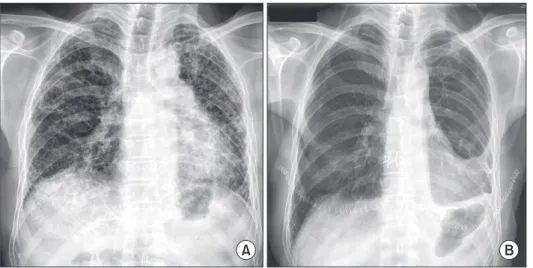
dL (normal range, 6.7 to 22.6 μg/dL) at baseline, 3.6 μg/dL at 30 minutes and 2.9 μg/dL at 60 minutes. Since corticosteroid supple- mentation for immunosuppresion after LT was considered as the cause of hypothalamic-pituitary-adrenal axis suppression and had maintained continuously, it was not likely that adrenal insuf- ficiency was a cause of hyponatremia. A chest X-ray and chest computed tomography were normal except for postoperative changes (Fig. 1). The patient was initially treated with hypertonic saline (3%NaCl, 40 mL/hr for 12 hours) with low dose furose- mide (Fig. 2). Despite replacement of hypertonic saline, serum sodium concentration was still low. He was treated with 7.5 mg of tolvaptan daily. Thirty six hours after treatment of tolvaptan, his serum sodium concentration was 133 mmol/L. After improve- ment in hyponatremia, tolvaptan was maintained and his serum sodium concentration 7 days after tolvaptan treatment was 136 mmol/L. During the follow-up after discontinuation of tolvap- tan, hyponatremia did not recur and he was discharged without tolvaptan.
Discussion
Our patient had normal serum sodium level before LT and developed hyponatremia after LT. SIADH was confirmed with hypotonic plasma and inappropriately concentrated urine in the absence of hypovolemia. Cardiac, renal, and thyroid func- tions were all preserved. Symptomatic hyponatremia, which was persistent despite of hypertonic saline replacement, was resolved after tolvaptan treatment.
Laboratory characteristics of SIADH are following: (1) hypo- natremia accompanied by plasma hypo-osmolality, (2) higher urine osmolality compared to plasma osmolality, (3) excessive renal excretion of sodium, (4) absence of volume expansion or
Fig. 2. Changes in the serum sodium levels during hospitalization.
Hypertonic saline was administrated for first 3 days and replaced to tolvaptan. Oral tolvaptan was maintained for 9 days and he was dis- charged on 23th day of lung transplantation.
Fig. 1. Chest X-ray taken before lung transplantation (LT) (A) and 7 days after LT (B). Chest X-ray shows no signs of pul- monary edema except for postoperative changes.
A B
Serumsodiumlevel(mmol/L)
1 150
140
130
120
110
100
Days after lung transplantation Hypertonic saline
20 2 3 4 5 6 7 8 9 10 11 12 13 14 15 16 17 18 19
Tolvaptan use
43
THE EWHA MEDICAL JOURNAL SIADH after LT
depletion, and (5) normal thyroid and adrenal function. SIADH is frequently developed after major surgeries such as intracranial [3,4], abdomen [5] and open heart surgery [6]. It has been known that the stress response and pain to surgery induces release of ADH in hypothalamus [7]. SIADH also occurs in various pulmo- nary diseases such as asthma, atelectasis, acute respiratory failure, and intra-thoracic malignancy. Potential mechanisms are related with hypoxemia, and hypercapnic acidosis [8]. It has been also explained that hemodynamic changes in the pulmonary blood flow due to either inflammation in lung or an abnormal breath- ing pattern stimulate the volume receptor and baroreceptor in the left atrium, which regulates ADH release [9]. Nausea and poor oral intake is frequently associated with volume depletion and decrease serum sodium levels via potentiation of ADH release.
But in our case, the patient did not have a symptom of nausea until serum sodium level was lower than 130 mEq/L. Since a present patient did not feel pain and already passed 7 days after LT, SIADH was probably arisen from inflammatory process and subsequent hemodynamic abnormality after LT.
Tolvaptan, a novel, orally active, selective, non-peptide V2 re- ceptor antagonist blocks arginine vasopressin from binding to V2 receptors of the distal nephron. This drug induces the excretion of electrolyte-free water without changing electrolyte excretion [10]. Two multicenter, randomized, double-blind, placebo-con- trolled trials, which evaluated the efficacy of tolvaptan in patients with euvolemic or hypervolemic hyponatremia [11], demonstrated a significant increase in the mean serum sodium concentration after 4 days of therapy compared to the placebo. In the present case, tolvaptan successfully corrected hyponatremia resistant to hypertonic saline replacement.
Considering the association between SIADH and pulmonary disease, SIADH can occur after LT. However, there has been no
report of a case of SIADH in a patient with LT. Herein, we report a patient with SIADH after LT, whose serum sodium levels were normalized after tolvaptan treatment.
References
1. Yeates KE, Singer M, Morton AR. Salt and water: a simple ap- proach to hyponatremia. CMAJ 2004;170:365-369.
2. Adrogue HJ, Madias NE. Hyponatremia. N Engl J Med 2000;342:1581-1589.
3. Torales J, Halperin I, Hanzu F, Mora M, Alobid I, De Notaris M, et al. Endoscopic endonasal surgery for pituitary tumors: results in a series of 121 patients operated at the same center and by the same neurosurgeon. Endocrinol Nutr 2014;61:410-416.
4. Taylor SL, Tyrrell JB, Wilson CB. Delayed onset of hyponatremia after transsphenoidal surgery for pituitary adenomas. Neurosur- gery 1995;37:649-653.
5. Cooper BC, Murray CA. Syndrome of inappropriate antidiuretic hormone in a healthy woman after diagnostic laparoscopy and hysteroscopy: a case report. J Reprod Med 2006;51:199-201.
6. Chung HM, Kluge R, Schrier RW, Anderson RJ. Postoperative hy- ponatremia: a prospective study. Arch Intern Med 1986;146:333- 336.
7. Fieldman NR, Forsling ML, Le Quesne LP. The effect of vaso- pressin on solute and water excretion during and after surgical operations. Ann Surg 1985;201:383-390.
8. Anderson RJ. Hospital-associated hyponatremia. Kidney Int 1986;29:1237-1247.
9. Hanagiri T, Muranaka H, Hashimoto M, Nagashima A. A syn- drome of inappropriate secretion of antidiuretic hormone asso- ciated with pleuritis caused by OK-432. Respiration 1998;65:310- 312.
10. Ghali JK, Hamad B, Yasothan U, Kirkpatrick P. Tolvaptan. Nat Rev Drug Discov 2009;8:611-612.
11. Schrier RW, Gross P, Gheorghiade M, Berl T, Verbalis JG, Czer- wiec FS, et al. Tolvaptan, a selective oral vasopressin V2-receptor antagonist, for hyponatremia. N Engl J Med 2006;355:2099-2112.