Subclinical Hypothyroidism Affects the Long-Term Outcomes of Patients Who Undergo Coronary Artery Bypass Grafting Surgery but Not Heart Valve Surgery
Hana Kim1,2, Sung Hye Kong1, Jae Hoon Moon3, Sang Yoon Kim4, Kay-Hyun Park4, Jun Sung Kim4, Joong Haeng Choh4, Young Joo Park1, Cheong Lim4
1Department of Internal Medicine, Seoul National University College of Medicine, Seoul; 2Department of Internal Medicine, Ilsan Cha Medical Center, Goyang; Departments of 3Internal Medicine, 4Thoracic and Cardiovascular Surgery, Seoul National University Bundang Hospital, Seongnam, Korea
Background: The aim of this study was to determine the associations between subclinical hypothyroidism (SCH) and long-term cardiovascular outcomes after coronary artery bypass grafting (CABG) or heart valve surgery (HVS).
Methods: We retrospectively reviewed and compared all-cause mortality, cardiovascular mortality, and cardiovascular events in 461 patients who underwent CABG and 104 patients who underwent HVS.
Results: During a mean±standard deviation follow-up duration of 7.6±3.8 years, there were 187 all-cause deaths, 97 cardiovascu- lar deaths, 127 major adverse cardiovascular events (MACE), 11 myocardial infarctions, one unstable angina, 70 strokes, 30 hospi- talizations due to heart failure, 101 atrial fibrillation, and 33 coronary revascularizations. The incidence of all-cause mortality after CABG was significantly higher in patients with SCH (n=36, 55.4%) than in euthyroid patients (n=120, 30.3%), with a hazard ratio of 1.70 (95% confidence interval, 1.10 to 2.63; P=0.018) after adjustment for age, sex, current smoking status, body mass index, un- derlying diseases, left ventricular dysfunction, and emergency operation. Interestingly, low total triiodothyronine (T3) levels in eu- thyroid patients who underwent CABG were significantly associated with increased risks of all-cause mortality, cardiovascular mor- tality, and MACE, but those associations were not observed in HVS patients. Both free thyroxine and thyroid-stimulating hormone levels in euthyroid patients were not related with any cardiovascular outcomes in either the CABG or HVS group.
Conclusion: SCH or low total T3 might be associated with a poor prognosis after CABG, but not after HVS, implying that preopera- tive thyroid hormonal status may be important in ischemic heart disease patients.
Keywords: Cardiovascular diseases; Heart valve diseases; Cause of death; Prognosis; Hypothyroidism; Thyrotropin; Triiodothyronine
INTRODUCTION
Subclinical hypothyroidism (SCH), which is defined as elevated
serum thyroid-stimulating hormone (TSH) levels with normal free thyroxine (fT4) levels, is a very prevalent condition, espe- cially in iodine-rich areas [1,2]. Therefore, concerns have been
Received: 22 December 2019, Revised: 3 March 2020, Accepted: 6 April 2020 Corresponding authors: Young Joo Park
Department of Internal Medicine, Seoul National University College of Medicine, 101 Daehak-ro, Jongno-gu, Seoul 03080, Korea
Tel: +82-2-2072-4183, Fax: +82-2-764-2199, E-mail: [email protected] Cheong Lim
Department of Thoracic and Cardiovascular Surgery, Seoul National University Bundang Hospital, 82 Gumi-ro 173beon-gil, Bundang-gu, Seongnam 13620, Korea
Tel: +82-31-787-7139, Fax: +82-31-787-4050, E-mail: [email protected]
Copyright © 2020 Korean Endocrine Society
This is an Open Access article distributed under the terms of the Creative Com- mons Attribution Non-Commercial License (https://creativecommons.org/
licenses/by-nc/4.0/) which permits unrestricted non-commercial use, distribu- tion, and reproduction in any medium, provided the original work is properly cited.
Endocrinol Metab 2020;35:308-318 https://doi.org/10.3803/EnM.2020.35.2.308 pISSN 2093-596X · eISSN 2093-5978
raised regarding the health effects of SCH, and a number of studies have shown an association between SCH and adverse clinical outcomes, especially an increased risk of cardiovascular morbidity or mortality [3-6]. Nonetheless, some inconsistent re- sults have been reported, showing no correlation between TSH levels and cardiovascular outcomes [3,7-11]. Despite these dis- crepancies, a meta-analysis showed a modest increase in the risks of cardiovascular disease (CHD) and mortality in SCH subjects, particularly among subjects with higher TSH levels [12,13]. Recently, we also demonstrated a clear association be- tween higher TSH levels and cardiovascular risk among indi- viduals with high cardiovascular risk in both a population-based prospective study [14] and a meta-analysis [15].
Therefore, morbidity or mortality after cardiac surgery could be influenced by the presence of SCH, especially in patients with high cardiovascular risk. In particular, SCH might influ- ence the clinical outcomes of patients who undergo coronary ar- tery bypass grafting (CABG), because their cardiovascular risk is very high. In this regard, we previously reported that preoper- ative SCH patients showed a higher incidence of postoperative atrial fibrillation (Afib) than their euthyroid counterparts [16].
We also have shown that the incidence of postoperative coro- nary revascularization and non-target lesion revascularization was significantly higher in patients with SCH than in those with euthyroid status after 8.2 years of follow-up of a cohort [17].
These results emphasize the possible importance of SCH for predicting surgical outcomes in these patients. However, in that study, we did not observe significant differences in all-cause or cardiovascular mortality in SCH patients after CABG. More- over, we did not confirm whether the poor outcomes of SCH patients were specific to CABG or would be similar after other cardiac surgical procedures in patients whose cardiovascular risk is not as high. A previous study showed increased postoper- ative Afib in SCH patients after aortic valve replacement sur- gery [18], although they did not present long-term outcomes af- ter surgery.
To clarify whether the influence of preoperative SCH on sur- gical outcomes after cardiac surgery is limited to patients with high cardiovascular risk and whether it makes a difference in mortality after surgery, we analyzed long-term outcomes in a large number of patients who underwent CABG in addition to the previous cohort, and compared their long-term prognosis to that of patients who underwent heart valve surgery (HVS).
METHODS
Study subjects
We retrospectively reviewed 476 patients who underwent CABG and 109 patients who underwent HVS at Seoul National Uni- versity Bundang Hospital (SNUBH) from July 2003 to Decem- ber 2009. The 476 CABG patients included 233 patients from our previous cohort (195 euthyroid and 38 SCH) and 228 new patients (200 euthyroid and 28 SCH) who subsequently under- went CABG. Fifteen patients who underwent CABG and 5 pa- tients who underwent HVS were excluded due to a lack of clini- cal data or loss to follow-up. Finally, 395 euthyroid and 66 SCH patients were included in the CABG group, while 87 euthyroid and 17 SCH patients were included in the HVS group. Their thyroid function was measured within 1 month before surgery, and no treatment was performed if their fT4 level was normal.
Participants were clustered by preoperative TSH and fT4 levels.
The study was approved by the Institutional Review Board of SNUBH (B1901/516-105). There was no requirement for in- formed consent due to the retrospective nature of the study.
Medical histories and anthropometric measurements We confirmed patients’ underlying diseases, including hyper- tension, dyslipidemia, diabetes mellitus, cerebrovascular dis- ease, and current smoking via their medical records. We defined chronic kidney disease according to the National Kidney Foun- dation criteria, and Afib was diagnosed by 12-lead electrocardi- ography (ECG) according to the American College of Cardiolo- gy (ACC), American Heart Association (AHA), and European Society of Cardiology (ESC) guidelines published in 2006. We measured patients’ height and body weight using a scale and wall-fixed extensimeter.
Cardiac surgery procedures and laboratory assessment The CABG procedures were conducted by four surgeons (Drs.
K.H.P., J.S.K., J.H.C., and C.L.) as described previously [16,19]. In CABG, grafting of the left internal thoracic artery to the left anterior descending artery was performed whenever possible. Other vessels were revascularized with the right inter- nal thoracic artery, radial artery, gastroepiploic artery, or saphe- nous vein. Off-pump, on-pump beating, or a conventional strat- egy for cardiopulmonary bypass (CPB) was chosen in accor- dance with the patient’s condition. HVS procedures were per- formed under CPB support utilizing the ascending aorta and bi- caval cannulation. Most of the time, moderate hypothermia (28°C to 32°C) was induced during aortic cross-clamping. Ei-
ther cold blood or crystalloid cardioplegia was used.
Blood samples were collected at the outpatient clinic within 1 month before surgery or at the admission time for urgent or emergent surgery. Serum TSH, fT4, and total triiodothyronine (T3) levels were measured by immunoradioassay using com- mercial kits (TSH, CIS Biointernational, Gif-sur-Yvette, France;
fT4 and total T3, DiaSorin S.p.A, Saluggia, Italy). Euthyroid status was defined as normal TSH (range, 0.4 to 4.0 mIU/L) and fT4 (range, 0.7 to 1.8 ng/dL) levels without any thyroidal drug.
SCH was defined as a TSH level over 4.0 mIU/L with a fT4 level in the normal range. Serum total cholesterol, triglyceride, and high-density lipoprotein cholesterol levels were measured using an autoanalyzer (Hitachi 747, Hitachi Ltd., Tokyo, Japan).
Low-density lipoprotein cholesterol levels were estimated as to- tal cholesterol−[high-density cholesterol+(triglycerides/5)] [20].
Colorimetry with an HST 403XE cell counter (Sysmex Corp., Kobe, Japan) was used to measure hemoglobin levels. Creati- nine and high-sensitivity C-reactive protein were measured by an autoanalyzer (Hitachi 747).
Follow-up and long-term prognosis
The patients were followed at 1 to 2 weeks and 1, 3, and 6 months after the operation, and every 6 to 12 months later. The follow-up schedule depended on each patient’s medical and so- cial condition. Long-term prognosis was defined in terms of the complications that occurred within 3 months after surgery. We collected data related with all-cause death and major adverse cardiovascular events (MACEs), comprising cardiovascular death, nonfatal myocardial infarction (MI), nonfatal stroke, or hospitalization for heart failure. Cardiovascular death was de- fined as mortality due to postoperative arrhythmia, acute MI, cardiogenic shock, heart failure, or cerebrovascular events. Data were also collected on postoperative outcomes, such as Afib, unstable angina, and coronary revascularization. We confirmed all-cause and cardiovascular death by reviewing both patients’
electronic medical records and the mortality records of the Na- tional Statistical Office in South Korea in April 2019. Acute MI was diagnosed by 12-lead ECG and elevated cardiac biomark- ers with typical angina symptoms. Unstable angina was defined by newly appearing typical chest pain or pain aggravation and positive ECG findings without cardiac biomarker elevation.
Hospitalization due to heart failure was defined as an admission for at least 12 hours with typical signs of heart failure (dyspnea, orthopnea, pulmonary, and peripheral edema, jugular venous distension, pulmonary effusion on X-ray, or related results on echocardiography). Postoperative Afib was confirmed by the
patients’ ECG within 3 months after surgery. We defined each postoperative event based on the ACC, AHA, and ESC practice guidelines [21-23]. Both CABG and percutaneous coronary in- tervention were included as postoperative coronary revascular- ization.
Statistical analysis
Continuous variables are presented as mean±standard devia- tion, while categorical variables are presented as numbers and percentages. The patients’ baseline characteristics were analyzed using the Student t test or chi-square test, as appropriate. Cox proportional hazards regression models were used to estimate hazard ratio (HR) and 95% confidence interval (CI) for all-cause mortality, cardiovascular mortality, MACE, MI, unstable angina, stroke, hospitalization for heart failure, Afib, and coronary re- vascularization. We calculated multivariate HRs by adjusting for age, sex, body mass index (BMI), smoking status, left ventricu- lar dysfunction, emergency operation, and underlying diseases such as diabetes, hypertension, dyslipidemia, and chronic kid- ney disease. Survival time was estimated to have lasted from the date of surgery to death or the last follow-up date. To compare survival according to thyroid function status before surgery, Ka- plan-Meier curves were used and P values were calculated using the log-rank test. A P<0.05 was considered to indicate statistical significance. All analyses were performed using SPSS version 25.0 (IBM Corp., Armonk, NY, USA).
RESULTS
Baseline characteristics
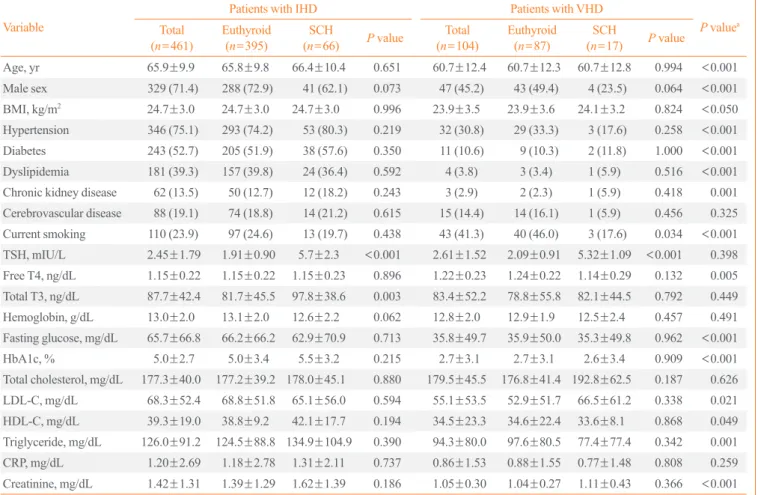
The baseline characteristics of the study subjects are shown in Table 1. Patients’ mean age was higher in the CABG group than in the HVS group (65.9±9.9 years vs. 60.7±12.3 years), and the proportion of male patients was also higher (71.4% vs.
45.2%). In addition, CABG patients showed a higher frequency of conditions related to cardiovascular risk, including a higher BMI and more underlying diseases such as hypertension, diabe- tes mellitus, dyslipidemia and chronic kidney disease, than the patients who underwent HVS. However, more current smokers were included in the HVS group than in the CABG group.
There were no significant differences in TSH and total T3 levels between the two groups, while fT4 levels were significantly higher (although within the normal range) in the HVS group than in the CABG group. Within the CABG and HVS groups, there were no significant differences in mean age, sex, or BMI between euthyroid and SCH patients. Furthermore, within the
CABG and HVS groups, underlying diseases and laboratory parameters also did not show statistically significant differences
according to thyroid function status (i.e., between euthyroid and SCH patients). Serum TSH levels were significantly higher in Table 1. Baseline Characteristics of Participants
Variable
Patients with IHD Patients with VHD
P valuea Total
(n=461) Euthyroid
(n=395) SCH
(n=66) P value Total
(n=104) Euthyroid
(n=87) SCH
(n=17) P value
Age, yr 65.9±9.9 65.8±9.8 66.4±10.4 0.651 60.7±12.4 60.7±12.3 60.7±12.8 0.994 <0.001
Male sex 329 (71.4) 288 (72.9) 41 (62.1) 0.073 47 (45.2) 43 (49.4) 4 (23.5) 0.064 <0.001
BMI, kg/m2 24.7±3.0 24.7±3.0 24.7±3.0 0.996 23.9±3.5 23.9±3.6 24.1±3.2 0.824 <0.050
Hypertension 346 (75.1) 293 (74.2) 53 (80.3) 0.219 32 (30.8) 29 (33.3) 3 (17.6) 0.258 <0.001 Diabetes 243 (52.7) 205 (51.9) 38 (57.6) 0.350 11 (10.6) 9 (10.3) 2 (11.8) 1.000 <0.001 Dyslipidemia 181 (39.3) 157 (39.8) 24 (36.4) 0.592 4 (3.8) 3 (3.4) 1 (5.9) 0.516 <0.001 Chronic kidney disease 62 (13.5) 50 (12.7) 12 (18.2) 0.243 3 (2.9) 2 (2.3) 1 (5.9) 0.418 0.001 Cerebrovascular disease 88 (19.1) 74 (18.8) 14 (21.2) 0.615 15 (14.4) 14 (16.1) 1 (5.9) 0.456 0.325 Current smoking 110 (23.9) 97 (24.6) 13 (19.7) 0.438 43 (41.3) 40 (46.0) 3 (17.6) 0.034 <0.001 TSH, mIU/L 2.45±1.79 1.91±0.90 5.7±2.3 <0.001 2.61±1.52 2.09±0.91 5.32±1.09 <0.001 0.398 Free T4, ng/dL 1.15±0.22 1.15±0.22 1.15±0.23 0.896 1.22±0.23 1.24±0.22 1.14±0.29 0.132 0.005 Total T3, ng/dL 87.7±42.4 81.7±45.5 97.8±38.6 0.003 83.4±52.2 78.8±55.8 82.1±44.5 0.792 0.449 Hemoglobin, g/dL 13.0±2.0 13.1±2.0 12.6±2.2 0.062 12.8±2.0 12.9±1.9 12.5±2.4 0.457 0.491 Fasting glucose, mg/dL 65.7±66.8 66.2±66.2 62.9±70.9 0.713 35.8±49.7 35.9±50.0 35.3±49.8 0.962 <0.001
HbA1c, % 5.0±2.7 5.0±3.4 5.5±3.2 0.215 2.7±3.1 2.7±3.1 2.6±3.4 0.909 <0.001
Total cholesterol, mg/dL 177.3±40.0 177.2±39.2 178.0±45.1 0.880 179.5±45.5 176.8±41.4 192.8±62.5 0.187 0.626 LDL-C, mg/dL 68.3±52.4 68.8±51.8 65.1±56.0 0.594 55.1±53.5 52.9±51.7 66.5±61.2 0.338 0.021 HDL-C, mg/dL 39.3±19.0 38.8±9.2 42.1±17.7 0.194 34.5±23.3 34.6±22.4 33.6±8.1 0.868 0.049 Triglyceride, mg/dL 126.0±91.2 124.5±88.8 134.9±104.9 0.390 94.3±80.0 97.6±80.5 77.4±77.4 0.342 0.001 CRP, mg/dL 1.20±2.69 1.18±2.78 1.31±2.11 0.737 0.86±1.53 0.88±1.55 0.77±1.48 0.808 0.259 Creatinine, mg/dL 1.42±1.31 1.39±1.29 1.62±1.39 0.186 1.05±0.30 1.04±0.27 1.11±0.43 0.366 <0.001 Values are expressed as mean±standard deviation or number (%).
IHD, ischemic heart disease; VHD, valvular heart disease; SCH, subclinical hypothyroidism; BMI, body mass index; TSH, thyroid-stimulating hormone;
T4, thyroxine; T3, triiodothyronine; HbA1c, hemoglobin A1c; LDL-C, low-density lipoprotein cholesterol; HDL-C, high-density lipoprotein cholesterol;
CRP, C-reactive protein.
aP values were analyzed for the difference between the total IHD and VHD patients.
Table 2. Long-Term Cardiovascular Outcomes According to Thyroid Function Status
Outcome Patients with IHD Patients with VHD
Euthyroid (n=395) SCH (n=66) P value Euthyroid (n=87) SCH (n=17) P value
All-cause mortality 120 (30.3) 36 (54.5) <0.001 25 (28.7) 6 (35.3) 0.575
Cardiovascular mortality 60 (15.2) 20 (30.3) 0.002 15 (17.2) 2 (11.8) 0.732
MACE 84 (21.2) 18 (27.2) 0.260 23 (26.4) 2 (11.8) 0.351
Hospitalization for heart failure 20 (5.1) 4 (6.1) 0.761 6 (6.9) 0 (0.0) 0.666
Fatal or nonfatal stroke 46 (11.6) 11 (16.7) 0.104 12 (13.8) 1 (5.9) 0.457
Coronary revascularization 27 (6.8) 5 (7.6) 0.792 1 (1.1) 0 (0.0) 1.000
Values are expressed as number (%). P values were analyzed by the log-rank test.
IHD, ischemic heart disease; VHD, valvular heart disease; SCH, subclinical hypothyroidism; MACE, major adverse cardiovascular events.
SCH patients than in euthyroid patients, while fT4 levels were not significantly different according to thyroid function status in either the CABG or HVS group (Table 1).
Long-term cardiovascular prognosis
During a mean follow-up duration of 7.6±3.8 years, in the CABG group, there were 156 (33.8%) all-cause deaths, 80 (17.4%) cardiovascular deaths, 112 (24.3%) MACEs, 20 (4.3%) hospitalizations for heart failure, 91 (19.7%) cases of postopera- tive Afib, 32 (6.9%) coronary revascularizations, 11 (2.4%) MIs, and 57 (12.4%) strokes (Table 2). During the same follow-up period, in the HVS group, there were 31 all-cause deaths (29.8%, P=0.489 vs. CABG group), 17 cardiovascular deaths (16.3%, P=0.886 vs. CABG group), 25 MACEs (24.0%, P=0.697 vs.
CABG group), six hospitalizations for heart failure (5.8%, P=
0.809 vs. CABG group), 10 cases of postoperative Afib (9.6%, P=0.022 vs. CABG group), one coronary revascularization (1.0%, P=0.007 vs. CABG group), 0 MIs (0.0%, P=0.230 vs.
CABG group), and 13 strokes (12.5%, P=1.000 vs. CABG group). Except for postoperative Afib and stroke, poor out- comes were more common in the CABG group than in the HVS group. When we compared those outcomes between SCH and euthyroid patients, the incidence of all-cause mortality (55.4%
vs. 30.3%, log-rank P<0.001) and cardiovascular mortality (30.8% vs. 15.2%, log-rank P<0.001) was higher in the SCH patients in the CABG group. The other outcomes, including MACE, hospitalization for heart failure, stroke, and coronary revascularization occurred more frequently in SCH patients than in euthyroid patients in the CABG group, but the differenc- es were not significant (Table 2). Contrary to the outcomes of the CABG group, thyroid function status showed no significant relationships with the incidence of all-cause mortality, cardio- vascular mortality, MACE, hospitalization for heart failure, stroke, or coronary revascularization in HVS patients (Table 2).
Multivariate analysis of the long-term prognosis of SCH patients
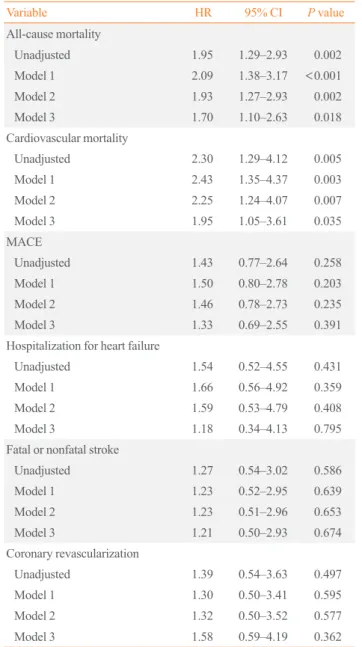
In the CABG group, SCH patients showed a significantly higher incidence of all-cause mortality than euthyroid patients (HR, 1.95; 95% CI, 1.29 to 2.93; P=0.002) (Table 3, Fig. 1A). The incidence of cardiovascular mortality was also significantly higher in SCH patients than in euthyroid patients (HR, 2.30;
95% CI, 1.29 to 4.12; P=0.005). (Table 3, Fig. 1B).
After adjustment for age and sex (model 1), the HR of all- cause death after CABG was significantly higher in SCH pa- tients than in euthyroid patients (HR, 2.09; 95% CI, 1.38 to 3.17;
P<0.001). We observed that the risk of all-cause death in model 2 (adjusting for BMI, smoking status, and the underlying diseas- es previously mentioned in addition to the variables in model 1) was significantly higher in SCH patients than in euthyroid pa-
Table 3. Multivariate Analysis of Hazard Ratios in Subclinical Hypothyroidism Patients Relative to Euthyroid Patients with Ischemic Heart Disease
Variable HR 95% CI P value
All-cause mortality
Unadjusted 1.95 1.29–2.93 0.002
Model 1 2.09 1.38–3.17 <0.001
Model 2 1.93 1.27–2.93 0.002
Model 3 1.70 1.10–2.63 0.018
Cardiovascular mortality
Unadjusted 2.30 1.29–4.12 0.005
Model 1 2.43 1.35–4.37 0.003
Model 2 2.25 1.24–4.07 0.007
Model 3 1.95 1.05–3.61 0.035
MACE
Unadjusted 1.43 0.77–2.64 0.258
Model 1 1.50 0.80–2.78 0.203
Model 2 1.46 0.78–2.73 0.235
Model 3 1.33 0.69–2.55 0.391
Hospitalization for heart failure
Unadjusted 1.54 0.52–4.55 0.431
Model 1 1.66 0.56–4.92 0.359
Model 2 1.59 0.53–4.79 0.408
Model 3 1.18 0.34–4.13 0.795
Fatal or nonfatal stroke
Unadjusted 1.27 0.54–3.02 0.586
Model 1 1.23 0.52–2.95 0.639
Model 2 1.23 0.51–2.96 0.653
Model 3 1.21 0.50–2.93 0.674
Coronary revascularization
Unadjusted 1.39 0.54–3.63 0.497
Model 1 1.30 0.50–3.41 0.595
Model 2 1.32 0.50–3.52 0.577
Model 3 1.58 0.59–4.19 0.362
Multivariable Cox regression analysis was done. Model 1 adjusted for age and sex. Model 2 adjusted for the factors in model 1 and additional- ly adjusted for body mass index, smoking status, history of diabetes, and hypertension, dyslipidemia, and chronic kidney disease. Model 3 adjusted for the factors in model 2 and additionally adjusted for left ventricular dysfunction (ejection fraction <40%) and emergent surgery.
HR, hazard ratio; CI, confidence interval; MACE, major adverse car- diovascular events.
tients (HR, 1.93; 95% CI, 1.27 to 2.93; P=0.002). After adjust- ing for the variables in model 3 (model 2 plus left ventricular dysfunction and emergent surgery), the risk of all-cause deaths after CABG also remained higher in SCH patients than in eu- thyroid patients (HR, 1.70; 95% CI, 1.10 to 2.63; P=0.018). In- terestingly, the HR of cardiovascular mortality for SCH patients relative to euthyroid patients who underwent CABG showed a similar tendency after adjustment for variables. In contrast, the HRs of MACE, hospitalization for heart failure, strokes, and coronary revascularization were not significantly different with and without adjustment for variables (Table 3).
In HVS patients, the HRs of all-cause mortality, cardiovascu-
lar mortality, MACE and stroke in SCH patients relative to eu- thyroid patients did not significantly increase before and after adjustment for variables (Supplemental Table S1, Supplemental Fig. S1).
Subgroup analysis of long-term cardiovascular prognosis in euthyroid subjects
We conducted a subgroup analysis of euthyroid patients to elu- cidate the specific effects of thyroid function on postoperative outcomes after heart surgery. We divided euthyroid patients into three groups (G1, the lowest tertile; G2, the middle tertile; G3, the highest tertile) according to total T3, fT4, and TSH levels.
1.00 0.75 0.50 0.25 0
1.00 0.75 0.50 0.25 0
1.00 0.75 0.50 0.25 0 1.00 0.75 0.50 0.25
All-cause mortality-free survival probabilityAll-cause mortality-free survival probability CV mortaily-free probabilityCV mortaily-free probability 0
Follow-up duration (mo)
Follow-up duration (mo) Follow-up duration (mo)
Follow-up duration (mo) Number at risk
Number at risk Number at risk
Number at risk HR 1.95 (95% CI, 1.20–2.93)
P=0.002
T3-G3 HR Reference
T3-G2 HR 1.60 (95% CI, 0.92–2.79) P=0.096 T3-G1 HR 3.02 (95% CI, 1.79–5.10) P<0.001
T3-G3 HR Reference
T3-G2 HR 3.06 (95% CI, 1.22–7.67) P=0.017 T3-G1 HR 4.01 (95% CI, 1.60–10.05) P=0.003 HR 2.30 (95% CI, 1.29–4.12)
P=0.005
Euthyroid
T3-G3 T3-G3
Euthyroid SCH
T3-G2 T3-G2
T3-G1 T3-G1
SCH 50 100 150 200
50 100 150 200 50 100 150 200
50 100 150 200
382 303 215 23 0
117 82 55 8 0 116 82 55 8 0
381 303 215 23 0
58 44 26 0 0
128 109 78 7 0 128 109 78 7 0
124 82 55 8 0 124 104 75 7 0
58 44 26 0 0
Fig. 1. Kaplan-Meier curves of cardiovascular outcomes in patients with ischemic heart disease. (A) All-cause mortality in subclinical hypo- thyroidism (SCH) patients over euthyroid patients. (B) Cardiovascular (CV) mortality in SCH patients over euthyroid patients. (C) All-cause mortality according to the total triiodothyronine (T3) tertile in euthyroid patients. (D) Cardiovascular mortality according to the total T3 ter- tile in euthyroid patients. Cox regression analysis was performed. The hazard ratios (HRs) are for SCH patients with euthyroid patients as references. The HRs are for T3-G1 and T3-G2 patients with T3-G3 as reference. Total T3 tertiles: T3-G1, 0.3 to 83 ng/dL; T3-G2, 85 to 109 ng/dL; T3-G3, 110 to 163 ng/dL. CI, confidence interval.
A
C D
B Euthyroid
SCH
Euthyroid SCH
In CABG patients, the incidence of all-cause mortality, car- diovascular mortality, and MACE significantly increased from the highest total T3 tertile (T3-G3) to the lowest total T3 tertile (T3-G1) (log-rank test P<0.001, P<0.001, and P=0.005, re- spectively) (Table 4, Fig. 1C, D). However, the incidence of hospitalization for heart failure, stroke and coronary revascular- ization did not change as the total T3 level decreased (Table 4).
On the contrary, there was no correlation between total T3 lev- els and the incidence of long-term cardiovascular outcomes in euthyroid patients after HVS (Table 4, Supplemental Fig. S2).
We conducted multivariate analysis according to the total T3 tertile in euthyroid patients with ischemic heart disease. Inter- estingly, the HR of all-cause mortality in the T3-G1 tertile pa- tients was significantly higher, by over 3-fold, than that in the T3-G3 tertile group before adjustment (P<0.001). After adjust- ment in model 1 and model 2, the HRs of the T3-G1 tertile were 2.84 (95% CI, 1.68 to 4.80; P<0.001) and 1.98 (95% CI, 1.13 to 3.46; P=0.017), respectively. However, statistical signifi- cance disappeared in model 3 (Table 5). More notably, cardio- vascular mortality in the T3-G1 tertile group was more than 4-fold higher than in the T3-G3 tertile patients after CABG, with an HR of 4.01 (95% CI, 1.60 to 10.05; P=0.003). Further- more, the T3-G2 tertile patients showed a higher cardiovascular mortality rate, by over 3-fold, than the T3-G3 tertile patients (HR, 3.06; 95% CI, 1.22 to 7.67; P=0.017). Moreover, the risk of cardiovascular mortality in the T3-G1 and T3-G2 tertile pa- tients remained significantly higher (at least 2-fold) than in the T3-G3 tertile after adjustment in model 1 and 2. However, sta- tistical significance disappeared in model 3 (Table 5). The risk of hospitalization for heart failure in the T3-G1 tertile was more
than five times higher than that in the T3-T3 tertile, although the HR was not significant after adjustment. In contrast, the inci- dence of MACE, stroke, and coronary revascularization did not increase with decreasing total T3 levels (Table 5).
However, the long-term outcomes were not significantly af- fected by the fT4 tertile or TSH tertile in the CABG group or the HVS group (Supplemental Table S2, Supplemental Figs. S3, S4).
DISCUSSION
In this study, during the mean follow-up period of 7.6 years, preoperative SCH patients showed higher all-cause mortality and cardiovascular mortality after CABG than their euthyroid counterparts. The HR for all-cause mortality was 1.70 after ad- justment for covariates. Cardiovascular mortality was also sig- nificantly higher, by 1.94-fold, in patients with preoperative SCH after CABG. Additionally, we found that patients with lower total T3 levels—even with euthyroid status—showed sig- nificantly higher risks for all-cause and cardiovascular death af- ter CABG. Notably, all these associations were only observed in patients with ischemic heart disease who had high cardiovascu- lar risk, but not in patients with valvular heart disease. These re- sults suggest that preoperative SCH and low total T3 in euthy- roid patients are important factors associated with long-term outcomes after CABG.
Some results have provided support for the possibility that SCH is a risk factor for CHD. Rodondi et al. [12] reported that SCH was associated with an increased risk of CHD in their me- ta-analysis. They also showed a significant positive correlation between TSH elevation and increased mortality from CHD in Table 4. Long-Term Cardiovascular Outcomes According to Total T3 Tertiles in Euthyroid Patients
Outcome
Patients with IHD (n=395) Patients with VHD (n=87) T3-G1
(n=125) T3-G2
(n=130) T3-G3
(n=126) P value T3-G1
(n=27) T3-G2
(n=27) T3-G3
(n=27) P value All-cause mortality 59 (45.7) 32 (25.4) 23 (18.1) <0.001 6 (22.2) 7 (29.6) 3 (25.9) 0.729 Cardiovascular mortality 29 (22.5) 19 (15.1) 8 (6.3) <0.001 5 (18.5) 4 (14.8) 4 (14.8) 0.998
MACE 35 (27.1) 28 (22.2) 17 (13.4) 0.005 8 (29.6) 3 (11.1) 10 (37.0) 0.120
Hospitalization for heart failure 11 (8.5) 6 (4.8) 3 (2.4) 0.083 3 (11.1) 1 (3.7) 2 (7.4) 0.791 Fatal or nonfatal stroke 17 (13.2) 15 (11.9) 12 (9.4) 0.277 3 (11.1) 2 (7.4) 6 (22.2) 0.168 Coronary revascularization 9 (7.0) 11 (8.7) 7 (5.5) 0.549 1 (3.7) 0 (0.0) 0 (0.0) 0.375 Values are expressed as number (%). P values were analyzed by the log-rank test. Total T3 tertiles in patients with IHD: T3-G1, 0.3 to 83 ng/dL; T3-G2, 85 to 109 ng/dL; T3-G3, 110 to 163 ng/dL. Total T3 tertiles in patients with VHD: T3-G1, 0.3 to 80 ng/dL; T3-G2, 83 to 118 ng/dL; T3-G3, 119 to 167 ng/dL.
T3, triiodothyronine; IHD, ischemic heart disease; VHD, valvular heart disease; MACE, major adverse cardiovascular events.
another meta-analysis of 55,287 adults, particularly in those with a TSH concentration of 10 mIU/L or greater [12]. Similar- ly, elevated serum TSH levels significantly increased the risk of CHD by approximately 20% per one standard deviation in men in a Korean cohort followed for 10 years [24].
We previously showed that SCH was associated with postop- erative Afib within 3 months after CABG [16], and that postop- erative Afib in SCH patients after CABG was related to an in- creased risk of poor postoperative outcomes, particularly coro- nary revascularization [17]. Although the mechanism is unclear, TSH itself has been suggested to stimulate the proliferation of vascular smooth muscle cells, endothelial cell damage, and in-
flammation, leading to atherosclerosis [25-27]. Patients with SCH also showed increased levels of inflammatory cytokines, lymphocytes, macrophages, and nitrotyrosine, reflecting endo- thelial dysfunction, but decreased collagen content in vascular plaques [27]. In this regard, a previous study suggested that pa- tients with SCH are susceptible to atherogenesis, which may lead to restenosis.
Importantly, we found that CABG patients with SCH were at an increased risk of all-cause death and cardiovascular death during the follow-up period. An association between mortality and SCH in CABG patients was not observed in our prior stud- ies [16,17]. This discrepancy might reflect the increased number Table 5. Multivariate Analysis of Hazard Ratios in Euthyroid Patients with Ischemic Heart Disease According to Total T3 Tertiles
Variable Univariate Model 1 Model 2 Model 3
HR (95% CI) P value HR (95% CI) P value HR (95% CI) P value HR (95% CI) P value All-cause mortality
T3-G1 3.02 (1.79–5.10) <0.001 2.84 (1.68–4.80) <0.001 1.98 (1.13–3.46) 0.017 1.67 (0.94–2.97) 0.079 T3-G2 1.60 (0.92–2.79) 0.096 1.61 (0.92–2.82) 0.097 1.17 (0.65–2.10) 0.592 1.03 (0.57–1.89) 0.912
T3-G3 Reference Reference Reference Reference
Cardiovascular mortality
T3-G1 4.01 (1.60–10.05) 0.003 3.85 (1.53–9.68) 0.004 3.32 (1.26–8.79) 0.016 2.47 (0.92–6.65) 0.073 T3-G2 3.06 (1.22–7.67) 0.017 3.04 (1.21–7.68) 0.019 2.68 (1.03–7.02) 0.044 2.05 (0.77–5.48) 0.151
T3-G3 Reference Reference Reference Reference
MACE
T3-G1 1.10 (0.62–1.95) 0.745 1.12 (0.63–2.02) 0.695 1.15 (0.62–2.11) 0.664 1.20 (0.65–2.23) 0.562 T3-G2 0.73 (0.39–1.36) 0.325 0.72 (0.39–1.35) 0.306 0.67 (0.36–1.27) 0.224 0.71 (0.37–1.35) 0.300
T3-G3 Reference Reference Reference Reference
Hospitalization for heart failure
T3-G1 5.09 (1.14–22.80) 0.033 4.04 (0.34–9.35) 0.069 4.05 (0.82–20.08) 0.087 3.80 (0.74–19.44) 0.109 T3-G2 1.91 (0.37–9.86) 0.439 1.79 (0.90–18.15) 0.489 1.78 (0.32–9.96) 0.511 1.89 (0.33–10.74) 0.472
T3-G3 Reference Reference Reference Reference
Fatal or nonfatal stroke
T3-G1 1.40 (0.59–3.30) 0.441 1.44 (0.61–3.41) 0.403 1.34 (0.53–3.44) 0.536 1.17 (0.45–3.07) 0.748 T3-G2 1.24 (0.54–2.82) 0.612 1.21 (0.53–2.76) 0.653 1.25 (0.53–2.96) 0.608 0.96 (0.39–2.37) 0.937
T3-G3 Reference Reference Reference Reference
Coronary revascularization
T3-G1 1.67 (0.66–4.25) 0.279 1.59 (0.62–4.10) 0.337 1.21 (0.44–3.28) 0.711 1.57 (0.56–4.45) 0.393 T3-G2 1.01 (0.37–2.78) 0.987 1.00 (0.36–2.75) 0.992 0.82 (0.29–2.33) 0.709 1.00 (0.34–2.99) 0.993
T3-G3 Reference Reference Reference Reference
Multivariable Cox regression analysis was done. The hazard ratios are for T3-G1 and T3-G2 participants with T3-G3 as reference. Model 1 adjusted for age and sex. Model 2 adjusted for the factors in model 1 and additionally adjusted for body mass index, smoking status, history of diabetes and hyperten- sion, dyslipidemia, and chronic kidney disease. Model 3 adjusted for the factors in model 2 and additionally adjusted for left ventricular dysfunction (ejection fraction <40%) and emergent surgery. Total T3 tertiles: T3-G1, 0.3 to 83 ng/dL; T3-G2, 85 to 109 ng/dL; T3-G3, 110 to 163 ng/dL.
T3, triiodothyronine; HR, hazard ratio; CI, confidence interval; MACE, major adverse cardiovascular events.
of subjects and the data retrieval method. We were able to ana- lyze about twice as many subjects by including new patients, al- though it resulted in a relatively short follow-up duration of 7.5±3.9 years, compared to the follow-up period of 8.2±4.1 years in our prior study. Moreover, in this study, we collected patients’ mortality records of the National Statistical Office in South Korea in addition to the medical records of SNUBH.
Thus, the mortality rate and the cause of death might have been more accurate than in previous studies, and we were able to demonstrate that SCH increased the risk of mortality in CABG patients. Another important finding was that the increased risk was only observed in patients with a higher risk of CHD. In HVS patients, the mortality rates were similar regardless of TSH levels, providing further supporting that the risk associated with higher TSH levels was not related to cardiac surgery, but to conditions associated with high cardiovascular risk. Regarding the associations of thyroid dysfunction in patients undergoing HVS, Martinez-Comendador et al. [18] reported that SCH was associated with an increased risk of postoperative Afib in pa- tients undergoing aortic valve replacement, but there were lim- ited data on the long-term outcomes of HVS patients according to thyroid function. We did not find any significant effects of SCH on postoperative outcomes in the HVS group, although the number of subjects might not have been sufficient to fully eluci- date the impact of SCH on the long-term prognosis in patients with HVS.
In the subgroup analysis of euthyroid subjects, there were no significant differences in long-term outcomes after CABG and HVS according to the fT4 tertile, whereas the lowest T3 tertile showed an increased risk of all-cause mortality and cardiovas- cular mortality, by up to 3- or 4- fold compared with the highest T3 tertile after adjustment in model 1 and 2. Daswani et al. [28]
showed that the occurrence of CHD was associated with lower serum free T3 (fT3) levels in the absence of primary thyroid diseases and acute coronary syndrome. In another Korean co- hort study including euthyroid subjects (n=212,456), fT4 and fT3 levels in euthyroid patients were inversely associated with the risks of all-cause and cancer mortality [29]. Although in this study, fT3 levels were not measured and fT4 levels did not show this tendency, the presence of preoperative lower total T3 levels, as well as SCH, in CABG patients may be suggested as a poor prognostic factor affecting long-term cardiovascular outcomes.
Furthermore, it is unclear whether the effects of SCH on long- term outcomes would be reduced by T4 replacement or whether T3 supplementation is needed instead of T4. More randomized controlled trials are needed to investigate this question conclu-
sively.
This study has several strengths. The mortality and cause of death data were very accurate, because we collected them by double-checking the data of the National Statistical Office in South Korea and medical records of SNUBH. In addition, to the best of our knowledge, this study is the first to evaluate long- term cardiovascular outcomes according to SCH in patients un- dergoing HVS.
There are also potential limitations of this study. First, serial follow-up of postoperative thyroid function was not performed;
therefore, we could not distinguish nonthyroidal illness before surgery from permanent thyroid dysfunction. Second, medical treatments affecting thyroid function such as amiodarone and iodine contrast might have been confounding factors in our study. Lastly, the number of patients with HVS might not have been sufficient to confirm the effect of thyroid function on post- operative outcomes in this group. Further studies are warranted to confirm the effects of thyroid function after other types of cardiac surgery, including HVS.
In conclusion, SCH and low total T3 levels in euthyroid pa- tients were associated with an increased risk of long-term mor- tality after CABG in patients with ischemic heart disease, in contrast to HVS patients, who did not show such a tendency.
Preoperative evaluations of thyroid function may be a meaning- ful marker for long-term cardiovascular outcomes in CABG pa- tients.
CONFLICTS OF INTEREST
No potential conflict of interest relevant to this article was re- ported.
ACKNOWLEDGMENTS
The study was supported by grants from the Korea Health In- dustry Development Institute (HI17C1099) and Seoul National University Bundang Hospital research fund (No. 02-2012-058).
AUTHOR CONTRIBUTIONS
Conception or design: H.K., Y.J.P., C.L. Acquisition, analysis, or interpretation of data: H.K., S.H.K., J.H.M., S.Y.K., K.H.P., J.S.K., J.H.C., Y.J.P., C.L. Drafting the work or revising: H.K., Y.J.P., C.L. Final approval of the manuscript: H.K., Y.J.P., C.L.
ORCID
Hana Kim https://orcid.org/0000-0002-9221-2988 Young Joo Park https://orcid.org/0000-0002-3671-6364 Cheong Lim https://orcid.org/0000-0003-0913-7014
REFERENCES
1. Kim YA, Park YJ. Prevalence and risk factors of subclinical thyroid disease. Endocrinol Metab (Seoul) 2014;29:20-9.
2. Park YJ, Lee YJ, Choi SI, Chun EJ, Jang HC, Chang HJ.
Impact of subclinical hypothyroidism on the coronary artery disease in apparently healthy subjects. Eur J Endocrinol 2011;165:115-21.
3. Ceresini G, Ceda GP, Lauretani F, Maggio M, Usberti E, Marina M, et al. Thyroid status and 6-year mortality in el- derly people living in a mildly iodine-deficient area: the ag- ing in the Chianti Area Study. J Am Geriatr Soc 2013;61:868- 74.
4. Gussekloo J, van Exel E, de Craen AJ, Meinders AE, Frol- ich M, Westendorp RG. Thyroid status, disability and cogni- tive function, and survival in old age. JAMA 2004;292:
2591-9.
5. Pereg D, Tirosh A, Elis A, Neuman Y, Mosseri M, Segev D, et al. Mortality and coronary heart disease in euthyroid pa- tients. Am J Med 2012;125:826.
6. Tseng FY, Lin WY, Lin CC, Lee LT, Li TC, Sung PK, et al.
Subclinical hypothyroidism is associated with increased risk for all-cause and cardiovascular mortality in adults. J Am Coll Cardiol 2012;60:730-7.
7. Ittermann T, Haring R, Sauer S, Wallaschofski H, Dorr M, Nauck M, et al. Decreased serum TSH levels are not associ- ated with mortality in the adult northeast German popula- tion. Eur J Endocrinol 2010;162:579-85.
8. Parle JV, Maisonneuve P, Sheppard MC, Boyle P, Franklyn JA. Prediction of all-cause and cardiovascular mortality in elderly people from one low serum thyrotropin result: a 10- year cohort study. Lancet 2001;358:861-5.
9. Westerink J, van der Graaf Y, Faber DR, Spiering W, Visseren FL; SMART study group. Relation between thy- roid-stimulating hormone and the occurrence of cardiovas- cular events and mortality in patients with manifest vascular diseases. Eur J Prev Cardiol 2012;19:864-73.
10. Hyland KA, Arnold AM, Lee JS, Cappola AR. Persistent subclinical hypothyroidism and cardiovascular risk in the elderly: the cardiovascular health study. J Clin Endocrinol
Metab 2013;98:533-40.
11. Selmer C, Olesen JB, Hansen ML, von Kappelgaard LM, Madsen JC, Hansen PR, et al. Subclinical and overt thyroid dysfunction and risk of all-cause mortality and cardiovascu- lar events: a large population study. J Clin Endocrinol Metab 2014;99:2372-82.
12. Rodondi N, den Elzen WP, Bauer DC, Cappola AR, Razvi S, Walsh JP, et al. Subclinical hypothyroidism and the risk of coronary heart disease and mortality. JAMA 2010;304:
1365-74.
13. Ochs N, Auer R, Bauer DC, Nanchen D, Gussekloo J, Cor- nuz J, et al. Meta-analysis: subclinical thyroid dysfunction and the risk for coronary heart disease and mortality. Ann Intern Med 2008;148:832-45.
14. Moon S, Kong SH, Choi HS, Hwangbo Y, Lee MK, Moon
JH, et al. Relation of subclinical hypothyroidism is associat- ed with cardiovascular events and all-cause mortality in adults with high cardiovascular risk. Am J Cardiol 2018;
122:571-7.
15. Moon S, Kim MJ, Yu JM, Yoo HJ, Park YJ. Subclinical hy- pothyroidism and the risk of cardiovascular disease and all- cause mortality: a meta-analysis of prospective cohort stud- ies. Thyroid 2018;28:1101-10.
16. Park YJ, Yoon JW, Kim KI, Lee YJ, Kim KW, Choi SH, et al. Subclinical hypothyroidism might increase the risk of transient atrial fibrillation after coronary artery bypass graft- ing. Ann Thorac Surg 2009;87:1846-52.
17. Kong SH, Yoon JW, Kim SY, Oh TJ, Park KH, Choh JH, et al. Subclinical hypothyroidism and coronary revasculariza- tion after coronary artery bypass grafting. Am J Cardiol 2018;
122:1862-70.
18. Martinez-Comendador J, Marcos-Vidal JM, Gualis J, Martin CE, Martin E, Otero J, et al. Subclinical hypothyroidism might increase the risk of postoperative atrial fibrillation after aortic valve replacement. Thorac Cardiovasc Surg 2016;64:
427-33.
19. O’Connor GT, Plume SK, Olmstead EM, Coffin LH, Mor- ton JR, Maloney CT, et al. A regional prospective study of in-hospital mortality associated with coronary artery bypass grafting. The Northern New England Cardiovascular Dis- ease Study Group. JAMA 1991;266:803-9.
20. Friedewald WT, Levy RI, Fredrickson DS. Estimation of the concentration of low-density lipoprotein cholesterol in plas- ma, without use of the preparative ultracentrifuge. Clin Chem 1972;18:499-502.
21. Ommen SR, Odell JA, Stanton MS. Atrial arrhythmias after
cardiothoracic surgery. N Engl J Med 1997;336:1429-34.
22. Biondi B. Mechanisms in endocrinology: heart failure and thyroid dysfunction. Eur J Endocrinol 2012;167:609-18.
23. Galli E, Pingitore A, Iervasi G. The role of thyroid hormone in the pathophysiology of heart failure: clinical evidence.
Heart Fail Rev 2010;15:155-69.
24. Kim TH, Choi HS, Bae JC, Moon JH, Kim HK, Choi SH, et al. Subclinical hypothyroidism in addition to common risk scores for prediction of cardiovascular disease: a 10-year community-based cohort study. Eur J Endocrinol 2014;171:
649-57.
25. Tian L, Ni J, Guo T, Liu J, Dang Y, Guo Q, et al. TSH stimu- lates the proliferation of vascular smooth muscle cells. En- docrine 2014;46:651-8.
26. Marfella R, Ferraraccio F, Rizzo MR, Portoghese M, Barb-
ieri M, Basilio C, et al. Innate immune activity in plaque of patients with untreated and L-thyroxine-treated subclinical hypothyroidism. J Clin Endocrinol Metab 2011;96:1015-20.
27. Hassan A, Altamirano-Ufion A, Zulfiqar B, Boddu P. Sub- clinical hypothyroidism and its association with increased cardiovascular mortality: call for action. Cardiol Res 2017;8:
31-5.
28. Daswani R, Jayaprakash B, Shetty R, Rau NR. Association of thyroid function with severity of coronary artery disease in euthyroid patients. J Clin Diagn Res 2015;9:OC10-3.
29. Zhang Y, Chang Y, Ryu S, Cho J, Lee WY, Rhee EJ, et al.
Thyroid hormones and mortality risk in euthyroid individu- als: the Kangbuk Samsung health study. J Clin Endocrinol Metab 2014;99:2467-76.