INTRODUCTION
As it is well-known that smoking is the main cause of
lung diseases and other diseases (Prochaska, Emmons, Pallonen & Tsoh, 1996), personal concerns about smok- ing cessation have increased, and at the same time, the government is vigorously pursueing a nationwide smok-
Factors Associated with the Stage of Change of Smoking Cessation
Behavior in Adolescents
Nam-Hee Park, RN, PhD1, Jung-Soon Kim, RN, PhD2, Yun-Mi Lee, RN, PhD3
1. Full-time Researcher, Department of Nursing Research Institute of Nursing Science, Busan National University 2. Professor, Department of Nursing, College of Medicine, Busan National University
3. Full -time lecturer, Department of Nursing, College of Medicine, Inje University
Corresponding author: Nam Hee Park, RN, PhD, Department of Nursing Research Institute of Nursing Science, Busan National University, 10-1Ga, Ami-dong, Seo-gu, Busan 602-739, Korea.
Tel: 82-51-245-7769 Fax: 82-51-248-2669 E-mail: [email protected] Received April 29, 2003 ; Accepted December 6, 2003January 31, 2000
Purpose. The purpose of this study was to identify the stage of change of smoking cessation behavior and inves- tigate factors associated with the stage of smoking cessation behavior according to the transtheoretical model.
Methods. The participants, 297 smokers & quitters were selected by a stratified random sampling from 127 high school sophomore students in B city. Data were collected from April 6th to 16th, in 2002 using the struc- tured self-report questionnaire.
Results. The subjects were distributed in each stage of change of smoking cessation behavior: there were 46 sub- jects (15.5%) in precontemplation, 73 subjects (24.6%) in contemplation, 67 subjects(22.3%) in prepara- tion, 56 subjects (18.5%) in action, 55 subjects (18.5%) in maintenance. Compared to the precontemplation and contemplation, people in preparation tended to smoke daily more and smoked for a shorter time, and as precontemplation progressed to the maintenance, past 1 year smoking cessation frequency increased and friends smoking decreased. Smoking onset age was the earliest in preparation, and the latest in mainte- nance. Helping relationships and self relationships are used a lot in precontemplation and also in contempla- tion. In preparation, self liberation and helping relationships are used a lot, in action, self liberation and helping relationships, and in maintenance, self liberation and environmental reevaluation. At each stage, the score of negative affect situation was the highest, but the one of negative affect situation, positive social situ- ation, habitual strength, weight control decreased as precontemplation progressed to the maintenance.
While the score of social pros and coping pros decreased with increasing stage, the one of cons tended to increase. Through stepwise discriminant analysis, it was found that social pros, smoking onset age, delf-libra- tion were the most influencing powers among factors associated with the stages of smoking cessation behav- ior.
Conclusions. This study suggested that, in developing an effective smoking cessation intervention for adoles- cents, all the stage of a client’s cessation had to be assessed prior to applying intervention programs. In addi- tion, the results of this study will become a pillar of smoking cessation program planning and application.
Key Words:Adolescent, Smoking cessation, Transtheoretical model
ing cessation campaign (Ministry of Health & Welfare, 2001; Alexander, 2001).
However, despite government and other private orga- nizations’ various smoking cessation programs, the smoking rate of Korean men over the age of 15 is twice that other advanced countries; It is the highest in the world (Korean Association of Smoking & Health, 2001).
Furthermore people starting to smoke before 15 tend to get lung cancer 4 times as much as people who begin over 25 (Vecchia, Decarli & Pagano, 1995). It is very im- portant for adolescents, more than other ages, to realize the importance of teenage smoking cessation and its practice because smoking in adolescence srongly influ- ences health, even into adulthood.
Likewise, although there have been studies using vari- ous smoking cessation education programs in order to decrease the smoking rate of adolescents (Kim, 1998;
Shin et al., 1998), they were effective just in the short run, but didn’t reduce the rate in the long run(Park, 2002). It’s because we have tried to change smoking be- havior on the assumption that the motive for quitting smoking is always the same (Oh & Kim, 1996a, 1996b), in spite of the fact that the most effective approach to smoking cessation is to apply smokers’ voluntary mo- tive(Choi, 1999).
To solve this problem, a smoking cessation study is in progress, based on transtheoretical model, TTM, by
Prochsaka and Diclemente (1983), which regards smok- ing cessation behavior as a dynamic process of change (Prochsaka & Velicer, 1997). In other words, it suggests that we should develop a reasonable stimulus to change behavior because not quitting smoking is just a stage in smoking cessation behavior, and this stage could be af- fected by various stimuli (cognitive or behavioral ones).
Now, among smoking cessation studies using TTM, there are some studies of university students (Oh & Kim, 1996a, 1996b, 1997; Choi, 1999) and adults (Chang, Park & Min, 2000; Kim, 2000; Chang & Park, 2001), but not enough studies of adolescents.
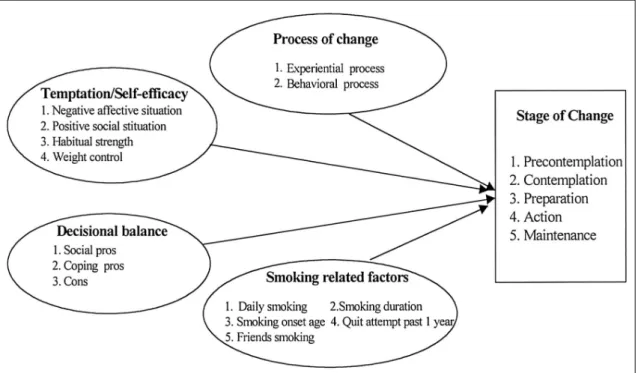
Therefore, in contrast to previous smoking cessation studies that have no concern for smoker’s motives and preparations of smoking and suggest one-sided methods for provider, this study was intended to furnish practical data in planning the smoking cessation intervention strategies, adapting TTM which can predict the change of behavior in smoking cessation based on personal mo- tives, and knowing the difference in smoking related characteristics, process of change, temptation/self-effica- cy, and decisional balance associated with the smoking cessation behavior stage (Figure 1).
Objectives
The purpose of this study is to divide the smoking ces- sation behavior stage of adolescents, and to find out the
Figure 1.Theoretical Framework of the study.
difference in smoking related characteristics, process of change, temptation/self-efficacy, and decisional balance associated with the stage of change. The specific objec- tives were;
1) to identify the stage of smoking cessation behavior in adolescents
2) to identify the difference in smoking related charac- teristics, process of change, temptation, and decisional balance
3) to analyze the explanatory power of factors associ- ated with the stage of smoking cessation behavior in adolescents.
METHODS
Research design
This study is a cross-sectional research to identify fac- tors that influence the smoking cessation behavior stage of adolescents.
Subjects and data collection
The participants, quitters or current smokers, were se- lected by a stratified random cluster sampling among the sophomore high school male and female students in B city on April, 2002. It was determined that a sample size of 270 subjects was needed to fulfil the aim of this study.
This was accomplished by considering size of effect (f=0.2), and power (p=0.75) at significance level (al- pha=0.05) as calculated by G-Power program.
The following is the specific process of sampling;
First, 127 high schools of the Office of Education were stratified by sex and type of school in 6 layers(general male highschool, general female highschool, general co- educational highschool, vocational male highschool, vo- cational female highschool, vocational coeducatioal highschool)
Second, 3 general male high schools, 3 general female high schools, 3 general coeducational high schools, 2 vo- cational male high schools, 2 vocational female high schools, 3 vocational coeducational high schools were selected by random probability proportion(the first sam- pling process).
Third, classes of each school, cluster, 2 classes were sampled randomly, and altogether 1041 students were chosen (the second sampling process).
Fourth, the questionnaires were distributed to all of students in the randomly chosen first sample, and I in- vestigated their latest smoking condition. Among these
students, 301 quitters and current smokers were chosen as final subjects and finally, 297 students in all were put on the list of subjects for analysis except for 4 students, who hadn’t answered faithfully.
For data collection, the selected high schools were con- tacted in person from the 6th to the 16th of April in 2002, and health teachers of these schools were asked for help, with explanation of the objectives and contents of the research. After that, the researchers visited the se- lected classes of these schools, explained the objectives of the research and gave students questionnaires.
Students who agreed to the research filled out the ques- tionnaires directly and they were collected.
Instruments Stage of change
Developed by Pallonen et al (1998), scales are com- posed of 5 questions, which decide what smoking cessa- tion stage (precontemplation, contemplation, prepara- tion, action, maintenance) subjects correspond to. The precontemplation stage includes smokers who are not thinking about quitting smoking in the next 6 months.
The contemplation stage includes smokers who are thinking about quitting within the next 6 months. The preparation stage consists of smokers who are planning to quit within the next 30days. The action stage includes those who have quit smoking during the past 6 months.
The maintenance stage includes those who remained nonsmokers for more than 6 months.
Smoking-related characteristics
Characteristics include the amount of daily smoking, smoking duration, smoking onset age, smoking cessation frequency over the past 1 year, and the number of smoking friends. The amount of daily smoking was mea- sured on Minessotta Smoking Index, invented by Pechacek in 1984, which is a self-report questionnaire, and consists of 3 questions : the number of cigarette butts over the past 7 days, over the past 24 hours, and over the past 1 month.
Process of change
A 5-point scale tool was used after translation and back translation; it was invented by Prochaska et al in 1988 and has 40 questions and 10 subordinate factors.
Subordinate parts are composed of the experiential process, which includes consciousness raising, dramatic relief, self-reevaluation, social liberation, and environ-
mental reevaluation, and the behavioral process, which includes helping relationships, counter conditioning, re- inforcement management, stimulus control and self-lib- eration. Each factor has 4 questions. Higher scores on the questions means that he or she experienced the fac- tor more. The reliability(Cronbach’s Alpha) of the tool was 0.62-0.92 when developed, and 0.60-0.84 for the present study.
Temptation/Self-efficacy
A 5 point scale, developed by Plummer et al. in 2001, and composed of 8 questions and 4 subordinate factors, was used after translation and back translation.
Subordinate factors consist of 2 questions of negative af- fect situation, 2 of positive social situation, 2 of habitual strength, and 2 of weight control. Higher point in these factors means that he or she can’t avoid smoking temp- tation situations. The reliability (Cronbach’s Alpha) of the tool was 0.92 of negative affect situation, 0.81 of positive social situation, 0.72 of habitual strength, and 0.88 of weight control when developed, and 0.84, 0.81, 0.64, 0.97 on preliminary research, and 0.83, 0.82, 0.78, 0.89 on this research respectively.
Decisional balance
The 5-point scale, developed by Pallonen et al (1988) for adolescents based on the tool of Velicer et al. (1985), including 12 questions and 3 subordinate factors, was used after translation and back translation. Subordinate factors are made up of 3 questions of change to positive aspects (social pros), 3 of change to positive aspects (cop- ing pros), and 6 of change to negative aspects (cons) of smoking. Higher points in these factors means that each factor plays an important role in making a decision on smoking. The reliability (Cronbach’s Alpha) of the tool was 0.67 in social pros, 0.75 in coping pros, 0.75 in cons when developed, 0.60, 0.80, 0.94 on preliminary re- search and 0.66, 0.82, 0.84 on this research respectively.
Data analysis
Data were analyzed by the SPSS Win 10.0 program.
1) The general characteristics of subjects were ana- lyzed by frequency, and percentage.
2) The smoking cessation stage of change of subjects were analyzed by frequency and percentage
3) One-way ANOVA was used to analyze the differ- ences in smoking related characteristics, process of change, temptation, and decisional balance associated
with the smoking cessation stage of subjects. Post hoc test was used to Turkey comparison.
4) Discriminant analysis was used to analyze influenc- ing power of relevant factors associated with the stage of change of smoking cessation.
RESULTS
General characteristics
Table 1 shows the general characteristics of subjects.
For subjects, 56.7% (169) were males, and 43.1% (128) females. For school type, vocational high school stu- dents(66.7%) were more than general high school stu- dents(33.3%). Moderate economic status, (50.5%) and unsatisfaction with school (39.4%) rated highest, and below moderate school performance (90.6%) placed in the majority.
Distribution of subject associated with the smoking cessation stage of change
Out of 297 subjects, 46 (15.5%) were in precontem- plation, 73 (24.6%) in contemplation, 67 (22.3%) in preparation, 56 (18.5%) in action, and 55 (18.5%) in maintenance.
Smoking related characteristics associated with the smoking cessation stage of change
Table 2 shows the results of an analysis of the differ- ence in smoking related characteristics associated with the stage of change of smoking cessation of subjects.
Table 1.General Characteristics (N=297) Characteristics N(%) Sex
male 169 (56.9)
female 128 (43.1)
School type
general 099 (33.3)
vocational 198 (66.7) Economic status
well 037 (12.5)
moderate 150 (50.5)
poor 110 (37.0)
School satisfaction
satisfaction 066 (22.2)
neutral 114 (38.4)
unsatisfaction 117 (39.4) School performance
upper (30%) 28 (9.4)
moderate 153 (51.5)
lower (30%) 116 (39.1)
There were significant differences in the amount of daily smoking (F=4.26, p=0.00), Post-hoc follow-up test- ing showed significant differences between the precon- templation and contemplation groups.
Only current smokers in precontemplation, contempla- tion, and preparation were researched on the amount of daily smoking and smoking duration; people in the pre- contemplation smoked the most, 8.61 butts on average.
The amount of daily smoking tends to decrease as the subjects progress from precontemplation to preparation.
A period of 2.63 years smoking in precontemplation was the longest, and it decreased with moving to the prepa- ration stage.
There were significant differences in smoking duration (F=4.50, p=0.00), smoking onset age (F=8.26, p=0.00), smoking cessation frequency over the past 1 year (F=2.65, p=0.00), and the number of friends smoking (F=12.58, p=0.00) corresponding to the smoking cessa- tion stage.
Those in preparation started to smoke the latest, when 15.13 years old, and those in maintenance began to smoke the earliest, when 14.00 years old, but there were no clear tendencies associated with the stage of change.
In preparation, people tried to quit smoking the most, 10.22 times, over the past 1 year. People in precontem- plation had the most, 6.80, friends smoking, which tend- ed to decrease with increasing stage.
Process of change associated with the smoking cessation stage of change
Table 3 tells the results of an analysis of the difference in process of change associated with the stage of change of smoking cessation of subjects.
Apart from re-inforcement management and environ- mental reevaluation, there was a significant difference in consciousness raising (F=3.80, p=0.00), Post-hoc follow- up testing showed significant differences between the precontemplation and contemplation groups. There was
Table 2.Smoking Rrelated Characteristics of Smoking Cessation Stage of Change (N=297) Smoking cessation stage of change
Characteristics Pc (N=46) Con (N=73) Pre (N=67) Act (N=56) Main (N=55)
F Turkey
M±SD M±SD M±SD M±SD M±SD comparison
Daily smoking (N=186) 08.61±7.40 06.60±5.05 04.33±4.13 - - 04.26** Pc>Con>Pre
Smoking duration (N=186) 02.63±1.49 02.46±1.39 01.86±1.14 - - 04.50** -
Smoking onset age 14.30±1.21 14.40±1.18 15.13±0.92 14.79±1.14 14.00±1.52 08.26** - Past 1 years smoking 06.32±7.10 08.16±7.96 10.22±8.28 09.04±9.07 05.92±8.39 02.65** -
cessation frequency
Friends smoking 06.80±3.24 06.68±2.93 05.88±3.04 04.77±3.16 03.45±2.90 12.58** -
**p <.01
Pc=precontemplation, Con=contemplation, Pre=prepartion, Act=action, Main=maintenance
Table 3.Smoking Cessation Stage of Change and Process of Change (N=297) Smoking cessation stage of change
Characteristics Pc (N=46) Con (N=73) Pre (N=67) Act (N=56) Main (N=55)
F Turkey
M±SD M±SD M±SD M±SD M±SD comparison
Experiential process
consciousness raising 2.83±0.97 3.41±0.72 3.46±1.05 3.21±0.99 3.03±1.14 03.80** Pc<Con dramatic relief 3.05±1.08 3.46±0.85 3.70±1.06 3.37±1.06 2.90±1.14 05.60** - self- reevaluation 2.86±0.82 3.19±0.69 3.28±.90 3.01±0.92 2.33±0.79 12.35** Act<Main social liberation 2.88±0.80 3.12±0.76 2.90±1.03 3.01±0.84 2.59±0.92 3.06* - environmental reevaluation 3.30±0.94 3.42±0.89 3.60±1.00 3.75±1.00 3.70±0.92 02.16**
Behavioral process
helping relationship 4.04±.88 4.10±.70 3.81±.69 3.89±.97 3.49±.89 05.00** - counter conditioning 2.76±.85 2.97±.76 3.26±.79 3.47±.96 3.05±.97 05.51** - re-inforcement management 2.91±1.04 3.17±.73 3.28±.91 3.31±.91 2.88±1.41 02.29**
stimulus control 1.88±.79 2.26±.84 2.51±.92 2.47±1.14 2.00±.84 05.02** -
self- liberation 3.61±.98 3.95±.74 4.23±.72 4.51±..61 4.48±.64 13.49** -
**p<.01, *p<.05
Pc=precontemplation. Con=contemplation. Pre=prepartion. Act=action. Main=maintenance
a significant difference in self- reevaluation (F=12.35, p=0.00), Post-hoc follow-up testing showed significant differences between the action and maintenance groups.
There were significant differences in dramatic relief (F=5.60, p=0.00), social liberation (F=3.06, p=0.02), helping relationships (F=5.00, p=0.00), counter condi- tioning (F=5.51, p=0.00), stimulus control (F=5.02, p=0.00), and self-liberation (F=13.49, p=0.00).
Figure 2 shows that in the process of change associated with the smoking cessation stage, people in precontem- plation use helping relationships and self-liberation the most; and also those in the contemplation used self-lib- eration and helping relationships. In preparation, self lib- eration and helping relationship were used predominant- ly, in action, self-liberation and helping relationships were used predominantly, and in maintenance, self-liber- ation and environmental reevaluation were used pre- dominantly.
Temptation and decisional balance associated with the smoking cessation stage of change
Table 4 shows the result of an analysis of the difference
in temptation and decisional balance associated with the smoking cessation stage of subjects. In temptation, there was a significant difference in negative affect situation (F=21.20, p=0.00), Post-hoc follow-up testing showed significant differences between the preparation and ac- tion groups. There was a significant difference in habitual strength (F=17.49, p=0.00), Post-hoc follow-up testing showed significant differences between the contempla- tion and preparation groups. There were significant dif- ference in positive social situation (F=16.16, p=0.00), and weight control (F=7.31, p=0.00).
At every stage, negative affect situation scored highest, and the scores of negative affect situation, positive social situation, habitual strength, weight control decreased as they progressed from precontemplation to maintenance.
In decisional balance, there were significant differences in social pros (F=28.51, p=0.00), and coping pros (F=15.64, p=0.00) corresponding to the smoking cessa- tion stage.
There was a significant difference in cons (F=3.12, p=0.05), Post-hoc follow-up test showed significant dif- ferences between the preparation and precontemplation
Figure 1.Smoking cessation stage of change and process of change(N=297).
groups. Although social pros and coping pros decreased with increasing stage, cons increased.
Analysis of influence of factors associated with the smoking cessation stage
In analyzing the influence of factors associated with the smoking cessation stage, we say that variables which were significantly different between the smoking cessa- tion stage are the independent variables, and precontem- plation, contemplation, preparation, action and mainte- nance belong to the dependent variables.
The assumption of stepwise discriminant analysis (Covariance Comparison, was done by Box’s M, 252.11, p >0.05 which is above the significant level) satisfied the basic thesis that each stage’s variance must be equal,;and accordingly, discriminant analysis was conducted.
As a result of analysis, 4 canonical discriminant func- tions were extracted, and in view of the fact that the first canonical discriminant function provided an explanation of 74.3% (canonical correlation=0.676), and the second one offered an explanation of 20.8%(canonical correla- tion=0.437), both discriminant functions were important to explain the difference of groups in the smoking cessa- tion behavior stage (Table 5).
There were a 32.6% probability to correctly classify precontemplation, a 56.2% for contemplation, 50.7%
for preparation, 42.9% for action, and 63.6% for main- tenance, using the combination of variables, which had turned out to be significant in stepwise discriminant analysis (Table 6).
DISCUSSION
This study revealed that in the smoking cessation stage, 72 subjects (24.2%) rated highest in contemplation, 62 subjects (21.1%) rated second in preparation, 60 sub- jects (19.2%) were in the maintenance, 57 subjects (19.2%) rated fourth in action, and the lowest rated stage was 45 subjects (14.2%) in precontemplation.
This result was rather different from the results of Prochaska et al. (1992)’s analysis of various adult popu- lation groups: 50-60% in precontemplation, 30-40%
in contemplation, and 10-15% in preparation, and es- pecially, it was somewhat distinct from the results of Pallonen (1998)’s analysis of adolescents: 50% in the
Table 4.Smoking Cessation Stage of Change Temptation and Decisional Balance (N=297) Smoking cessation stage of change
Characteristics Pc (N=46) Con (N=73) Pre (N=67) Act (N=56) Main (N=55)
F Turkey
M±SD M±SD M±SD M±SD M±SD comparison
Temptation
negative affect situation 4.17±1.04 3.69±1.14 3.39±1.20 2.83±1.30 2.25±1.23 21.20** Pre<Act positive social situation 3.38±1.08 3.21±1.02 2.75±0.94 2.46±1.23 1.98±0.98 16.16** - habit strength 3.07±1.28 2.59±1.31 2.01±1.03 1.76±1.13 1.43±0.88 17.49** Con.<Pre weight control 2.24±1.44 1.88±1.29 1.435±0.97 1.29±0.69 1.37±0.91 07.31** - Decisional balance
social pros 2.83±0.91 2.69±0.85 2.55±0.91 1.79±0.66 1.58±0.53 28.21** -
coping pros 3.43±0.82 2.98±0.91 2.75±0.99 2.35±0.93 2.09±1.11 15.64** Pre <Pc
cons 3.66±0.82 3.98±0.71 4.05±0.78 4.21±0.79 4.06±0.98 3.12* -
**p<.01, *<.05
Pc=precontemplation, Con=contemplation, Pre=prepartion, Act=action, Main=maintenance
Table 5.Canonical Discriminant Funtions (N=297) Funtion Eigen value % of variance Canonical Correlation Wilk’s Lamba Chi - Squre df p
1 0.842 74.3 0.676 0.416 254.056 32 0.00
2 0.236 20.8 0.437 0.766 77.190 21 0.00
3 0.039 3.5 0.195 0.947 15.888 12 0.20
4 0.016 1.4 0.127 0.984 4.680 5 0.46
Table 6.Classification Results (N=297) Smoking cessation stage of change Classification(%)
Precontemplation 32.6
Contemplation 56.2
Preparation 50.7
Action 42.9
Maintenance 63.6
precontemplation, 30% in contemplation, and 20% in preparation. It is believed that this study reports a bit different phase from existing distribution charts of smok- ing cessation stage because in the case of Korea people have been only concerned about smoking cessation since the end of 2001, governmental smoking cessation activi- ties and anti-smoking campaigns for schools and public institutions such as no-smoking zones, began in earnest in 2002, and these campaigns played a large role in caus- ing awareness of the dangers of smoking in adolescents which have been a motivating factor to quit smoking.
Moreover, the reason that the most subjects were in contemplation means that many adolescents were al- ready motivated to stop smoking, and therefore, it’s con- sidered that these smokers, who were prompted to quit smoking, need intervention strategies at this point to help them progress to a higher stage and reach smoking cessation.
There were significant differences corresponding to the stages of smoking cessation in the amount of daily smok- ing (p=0.00), smoking duration (p=0.00), smoking onset age (p=0.00), smoking cessation frequency over the past 1 year (p=0.00), and the number of friends smoking (p=0.00). And this study showed that as the subjects move from precontemplation to maintenance, the amount of daily smoking and smoking duration de- creased, smoking onset age was more likely to be late and more smokers had tried smoking cessation frequent- ly over the past 1 year.
This corresponded to the analysis result (Sargent et al., 1998; Zhu et al., 1999) that people in preparation smoke less daily, their smoking onset age is later, smok- ing duration is shorter, and smoking cessation frequency for the past 1 year is higher than people in the precon- templation and the contemplation. However, this dif- fered from the result of Rose et al.’s study that the smok- ing amount and smoking cessation frequency can’t pre- dict smoking cessation behavior. As it is seen in the fact that the number of smoking friends of people in precon- templation decreased as they progress to preparation, the number of friends smoking were significantly differ- ent in each stage; and this result corresponded to the re- sult (Stanton, 1995; Jeong et al., 1998) that smoking adolescents have many friends who smoke.
In the smoking cessation stage and process of change, there were significant differences in consciousness raising (p=0.00), dramatic relief (p=0.00), self- reevaluation (p=0.00), social liberation (p=0.05), helping relationships
(p=0.00), counter conditioning(p=0.00), stimulus control (p=0.00), and self- liberation (p=0.00).
It showed that subjects use helping relationships and self liberation predominantly in precontemplation, help- ing relationship and self-liberation in contemplation, self-liberation and helping relationship in preparation, self-liberation and helping relationships in action. In maintenance, coping strategies, such as self-liberation and environmental reevaluation, are being used predom- inantly. The study of Pallonen (1998) of adolescents re- ported that the factors influencing the change from pre- contemplation into contemplation are self-liberation and self-reevaluation, the factors influencing the change from contemplation into preparation are self-liberation, the factors influencing the change from preparation into ac- tion are counter conditioning and re-inforcement man- agement, and the factors influencing the change from ac- tion into maintenance are re-inforcement management and environmental reevaluation, it showed that it matched coping strategies used in precontemplation and preparation, but partly, found somewhat different.
Therefore, we can see that this result, as descripted on Oh & Kim (1998)’s study, supports indirectly that we have to consider cultural characteristics when TTM is used in each different culture.
Temptation associated with the smoking cessation stage decreased, as it progressed from precontemplation to contemplation, preparation, action, and maintenance.
It means that self-efficacy increases with increasing stage. That is, this result supports that self-efficacy is an important predictable factor (Ding, Pallonen & Velicer, 1995, Pallonen et al., 1998; Plummer et al, 2001) in try- ing to quit smoking and continuing smoking cessation.
Thus, through smoking temptation is an influencing fac- tor in smoking behavior, it is considered that self-effica- cy improvement programs are certainly necessary for nursing intervention and program development suitable for subjects’ smoking cessation stage.
Social pros and coping pros in Decisional Balance de- creased as they progressed from precontemplation to ac- tion and maintenance, and cons increased as they go to contemplation, preparation, and action, compared to cons of the precontemplation. This supports that the as- sessment of pros and cons of smoking is closely related to the smoking cessation stage (Velicer, 1985), and is the essential factor to predict smoking cessation(Pallonen, 1998; Pallonen et al., 1998; Plummer et al., 2001).
Therefore, We expect that the smoking rate of adoles-
cents could decrease, if we can change the erroneous perception that smoking is helpful in making friends or getting rid of the stresses and strains of studying and help adolescents to be strongly aware of how serious are smoking related harmful effects.
According to this study, to increase the smoking cessa- tion rate of adolescents, it had to learn the skills to cope confidently with any smoking temptation situation con- sidering the personal smoking cessation motivation level with regards to Korean circumstances, change the erro- neous perception of smoking through smoking cessation education, and develop smoking cessation programs in- cluding various strategies that can change adolescents’
smoking habits.
CONCLUSION AND SUGGESTIONS
This study is a survey researchs study, attempting to in- crease the basic data for developing smoking cessation intervention programs for adolescents through under- standing the stage of smoking cessation of adolescents, and analyzing the difference of smoking related charac- teristics, process of change, temptation, and decisional balance associated with smoking behavior stage of change.
The participants, 297 smokers & quitters, were select- ed from among 1041 high school sophomores in B city.
Data were collected from April 6th to 16th, in 2002 us- ing the structured self-report questionnaire, and ana- lyzed using SPSS Windows Program (Version 10.0). The results are as follows;
1) The subjects were distributed in each stage of change of smoking cessation behavior: 46 subjects (15.5%) in precontemplation, 73 subjects (24.6%) in contemplation, 67 subjects (22.3%) in preparation, 56 subjects(18.5%) in action, 55 subjects (18.5%) in main- tenance.
2) Of smoking related characteristics corresponding to the stages of smoking cessation behavior, there showed significant differences in daily smoking, smoking dura- tion, smoking onset age, smoking cessation frequency for the past 1 year, and smoking friends. Compared to precontemplation and contemplation, people in prepara- tion tended to smoke daily more and smoked for a shorter time, and as precontemplation progress to the maintenance, past 1 year smoking cessation frequency increased and smoking friends decreased. Smoking on- set age was the earliest in preparation, and latest in
maintenance.
3) Of factors associated with the smoking cessation stage of change, process of change, temptation, pros and cons in decisional balance were different between each stage of change.
In process of change associated with the smoking ces- sation stage, there were significant differences in con- sciousness raising (F=3.80, p=0.00), dramatic relief (F=5.60, p=0.00), self reevaluation (F=12.35, p=0.00), social liberation (F=3.06, p=0.02), helping relationships (F=5.00, p=0.00), counter conditioning (F=5.51, p=0.00), stimulus control(F=5.02, p=0.00), and self lib- eration (F=13.49, p=0.00). Helping relationships and self relationship were used frequently in precontemplation and also in contemplation. In preparation, self liberation and helping relationships were used frequently, in action, self liberation and helping relationships, and in mainte- nance, self liberation and environmental reevaluation were predominant.
In temptation associated with the smoking cessation stage of change, there were significant differences in neg- ative affect situation (F=21.20, p=0.00), positive social situation (F=16.16, p=0.00), habitual strength (F=17.49, p=0.00), and weight control (F=7.31, p=0.00). At each stage, the score of negative affect situations was the high- est, but the scores of negative affect situation, positive social situation, habitual strength, and weight control de- creased as precontemplation progressed to maintenance.
In decisional balance, there were significant differences associated with the stage of change in all social pros (F=28.21, p=0.00), coping pros (F=15.64, p=0.00), and cons (F=3.12, p=0.05). While the score of social pros and coping pros decreased with increasing stage, the scores of cons tended to increase.
4) It was found that social pros was the most influenc- ing power among factors dividing the smoking cessation behavior stage of change, and smoking onset age and self liberation were the second most influential factorsr.
The probability to be able to classify correctly precon- templation using these factors’ combinations was 32.6%;
for contemplation the probability was 56.2%, for prepa- ration, it was 50.7% , for action, it was 42.9%, and for maintenance, it was 63.6%.
When the results of all these analyses are considered, the smoking behavior of adolescents, as showed in TTM, was classified into the stage of smoking cessation. It showed that the associated factors at each stage of smok- ing cessation behavior were the amount of daily smok-
ing, smoking duration, smoking onset age, past 1 year smoking cessation frequency, the number of friends smoking, process of change, temptation, and decisional balance. The most influencing factor were social pros in decisional balance, and the next most influential were smoking onset age and self liberation. Therefore, in de- veloping an effective smoking cessation intervention program for adolescents, first of all, the stage of a sub- jects change prior to applying intervention programs had to be assessed. In helping them progress to a higher stage, it is important that we help subjects in precontem- plation be aware of smoking cessation’s good aspects and advance to contemplation, and for subjects in con- templation and preparation, we should apply programs for improving self-efficacy to try quitting smoking active- ly and continue smoking cessation.
References
Alexander, C., Piazza, M., Mekos, D., & Valente, T. (2001). Peers, Schools, and Adolescent Cigarette Smoking. J Adolesc Health, 29, 22-30.
Chang, S. O., Park, C. S.(2001). Analysis of Smoking Temptation, Nicotine Dependency, Perceived Health Status corresponding to Stage of Change in Smoking Cessation in Middle Aged Men.
J Korean Acad Fund Nurs, 8(1), 69-80.
Chang, S. O., Park, C. S., & Min, I. S.(2000). Decisional balance corresponding to the Stage of Change of Smoking Cessation in Middle Aged Men. J Korean Acad Fund Nurs, 7(2), 164-176.
Choi, J. S. (1999). The effects of a smoking cessation program ap- plying the cognitive behavior therapy. Unpublished doctoral dissertation, Seoul National University, Korea.
Ding, L., Pallonen, U.E., & Velicer, E.F.(1995). Temptations to smoke and stages of change among adolescent smokers (Abstract). Ann Behav Med, 17, S087.
Jeong, T. H., Park, S. M., Bae, M. K., Lee, K. M., Jeong, S. P., &
Baek, S. H.(1998). Smoking behavior and its related factors in male students of one senior high school in Taegu. J Korean Acad Fam Med, 19(1), 58-67.
Kim, B. J.(2000). Factors association with the stages of change of smoking cessation behavior in military officers. Unpublished master’s dissertation, Yonsei University, Korea.
Kim, S. J.(1998). The effect of Smoking Cessation Program using the transtheoretical model on the smoking behavior and psy- chosocial variables in high school students. Unpublished doc- toral dissertation, The Catholic University, Korea.
Korean association of smoking & health (2001). Middle & high school smoking survey. Korean association of smoking &
health data book.
Ministry of health & welfare (2001). 2000 of health and welfare statistics.
Oh, H. S., Kim, Y. S.(1996a). Factor Analysis on Behavior Change Mechanisms in Self-help Smoking Cessation. J Korean Acad Nurs, 26(3), 678-832.
Oh, H. S., Kim, Y. S.(1996b). Changing mechanisms corresponding
to the changing stages of smoking cessation. J Korean Acad Nurs, 26(4), 820-832.
Oh, H. S., Kim, Y. S.(1997). Exploratory study on developing mod- el for smoking cessation process. J Korean Acad Nurs, 27(1), 71-82.
Pallonen, U. E.(1998). Transtheoretical measure for adolescent and adult smokers: similarities and differences. Prev Med, 27, A29- A38.
Pallonen, U. E., Velicer, W. F., Prochaska, J. O., Rossi, J. S., Bellis, J. M., Tsoh, J. Y., Migneault, J. P., Smith, N. F. & Prokhorov, A. V.(1998). Computer-based smoking cessation interventions in adolescents: description, feasibility, and six-month follow-up findings. Subst Use Misuse, 33(4), 935-965.
Park, N. H.(2002). Predictors of stage of change for smoking cesstion among adolescents utilizing the transtheroretical mod- el. Unpublished doctoral dissertation, The Pusan National University, Korea.
Pechacek, T. F., Murray, D. M., Luepker, R. V., Mittelmark, M. B., Johnson, C. A. & Schutz, J. M.(1984). Measurement of Adolescent Smoking Behavior: Rationale and Methods. J Behav Med, 7(1). 123-141.
Plummer, B. A., Velicer, W. F., Redding, C. A., Prochaska, J. O., Rossi, J. S., Pallonen, U. E. & Meier, K. S.(2001). Stage of change, decisional balance, and temptations for smoking Measurement and validation in large, school-based population of adolescents. Addict Behav, 26, 551-571.
Prochaska, A. V., Emmons, K. M., Pallonen, U. E., & Tsoh, J.
Y.(1996). Respiratory response to cigarette smoking among adolescent smokers; A pilot study. Prev Med, 25, 633-640.
Prochaska, J. O., DiClemente, C. C.(1983). Stages and process of self-change of smoking: toward and integrative model of change. J Consult Clin Psychol, 51, 390-395.
Prochaska, J. O., Velicer, W. F.(1997). The transtheoretical model of health behavior change. Am J Health Promot, 12(1), 38-48.
Prochaska, J. O., Velicer, W. F., DiClemente, C. C., & Fava, J.
L.(1988). Measuring the processes of change: applications to the cessation of smoking. J Consult Clin Psychol, 56, 520-528.
Prochsaka, J. O., DiClemente, C. C., & Norcross, J. C.(1992). In search of how people change. Am Psychol, 9, 1102-1114.
Rose, J., Chassin, L., Presson, C., & Sherman, S. J.(1996).
Prospective predictors of quit attempts and smoking cessation in young adults. Health Psychol, 15(4), 261-268.
Sargent, J. D., Mott, L. A. & Stevens, M.(1998). Predictors of smok- ing cessation in adolescents. Arch Pediatr Adolesc Med. 152(4).
388-393.
Shin, Y. K., Kang, Y. J., Moon S. I., Park, S. Y., Lee, H. R.(1998).
The effects of the adolescent smoking cesssation program. J Korean Acad Fam Med, 19(12), 1387-1399.
Stanton, W.R.(1995). DSM-III-R tobacco dependence and quitting during late adolescence. Addict Behav, 20, 595-603.
Vecchia,, C. L., Decarli, A., & Pagano, R.(1995). Pattern of smoking initiation in Italian males and females from 1955-1985. Prev Med, 24, 293-296.
Velicer, W. F., Diclemente C. C., Prochaska J. O., & Brandenburg N.(1985). Decisional balance measure for assessing and pre- dicting smoking status. J Pers Soc Psychol 48, 1279-1289.
Zhu, S ,H, Sun, J., Billings, S. C., Choi, W. & Malarcher, A.(1999).
Predictors of smoking cessation in U. S. adolescents. Am J Prev Med. 16(3), 202-207.