Comparison of Effects Between Modified Vertical Roll Sling and Bobath Roll Sling in Hemiplegic Shoulder Subluxation
Dong-hyun Kim, M.Sc., C.P.O
Dept. of Physical Therapy, The Graduate School, Hanseo University Tack-hoon Kim, Ph.D., P.T.
Jung-suk Roh, Ph.D., P.T.
Heon-seock Cynn, Ph.D., P.T.
Houng-sik Choi, Ph.D., P.T.
Dong-sik Oh, M.Sc., P.T.
Dept. of Physical Therapy, Hanseo University
Abstract
1)The purpose of this study was to compare the effectiveness of modified vertical roll sling and conven- tional Bobath roll sling in reducing hemiplegic shoulder subluxation. Radiography of 40° anterior oblique radiographic view were taken, before and immediately after wearing each sling in 13 hemiplegic patients.
The vertical distance, horizontal distance, and joint distance were measured. Analysis of radiographically measured distances showed that both modified vertical roll sling and Bobath roll sling decreased vertical, horizontal, and joint distances. Reduction in vertical and joint distances were significantly greater in modified vertical roll sling compared to Bobath roll sling, while horizontal distance showed no significant difference between the two slings. Therefore it can be concluded that modified vertical roll sling is an ef- fective orthosis in reducing hemiplegic shoulder subluxation.
Key Words: Bobath roll sling; Hemiplegia; Modified vertical roll sling; Subluxation.
Introduction
The subluxation of shoulder joint is the most common complication in hemiplegic patients. Ikai et al (1998) reported that 17~64% of hemiplegic pa- tients were diagnosed with shoulder subluxation. The etiologic factors of shoulder subluxation during flac- cid stage include impaired locking mechanism of ro- tator cuff muscles (Basmajian and Bazant, 1959;
Cailliet, 1991; Davis, 1985). The clinical manifes- tations are pain, discomfort, contracture, joint move- ment dysfunction (Anderson, 1985; Antonio et al, 1977), delayed functional recovery, and reflex sym- pathetic dystrophy (Dursun et al, 2000; Smith et al, 1982). When this shoulder subluxation is not treated appropriately, secondary irreversible injuries in mus-
cle, ligament, nerve, and blood vessels can be oc- curred (Moskowitz et al, 1969).
Clinically, to diagnose shoulder subluxation, thera- pists measure a distance between inferior acromion and humeral head using investigator's fingers, or plexiglass jig, or caliper. More objectively, radio- graphic measurement is performed using X-ray to determine the vertical distance and horizontal dis- tance between acromion and humeral head. The ver- tical distance between acromion and humeral head is similar to clinical test and easily determined in 45 degree oblique view and dorsal view in X-ray (Keats et al, 1985). The horizontal distance is asso- ciated with lateral deviation of humeral head and is affected by roll position of sling rather than pathol- ogy itself in shoulder joint (Zoravitz et al, 1995).
Corresponding author: Tack-hoon [email protected]
To treat subluxation in hemiplegic patients, vari- ous slings have been applied. Among these ap- proaches, Bobath roll sling has been advocated by many researches. The advantages of wearing sling include protection of hemiplegic upper limb, main- tenance of humeral head into glenoid fossa, and pre- vention of shoulder subluxation by blocking caudal sliding of humeral head. Bobath roll sling, especially, has been used widely because it is easy to wear and does not limit range of motion stimulating proprioception. However, there has been a con- troversy regarding the effect of sling so far. Zoravitz et al (1995) compared the wearing effects among single strap hemisling, Rolyan upper limb cuff sling, Bobath roll sling, and Cavalier shoulder support, and concluded that single strap hemisling reduced sub- luxation significantly and Bobath roll sling induced lateral deviation of humeral head. Cailliet (1980) and Hurd et al (1974) stated that single strap hemisling and Breuer-Kauper sling have limited correction ef- fect because elbow can be lowered causing caudal movement of humeral head. Most slings induce flex- ion in elbow joint and flexor synergy pattern in hemiplegic upper limb, limit range of motion, and re- inforce the movement of sound side. Brooke et al (1991) argued that single strap hemisling can cause shoulder contracture and asymmetric arm swing pre- venting normal arm pendular motion and learning normal gait pattern. Rajaram and Holtz (1985) and Zoravitz et al (1995) stressed that Bobath roll sling does not limit upper limb movement so that free up- per limb movement is ensued receiving abundant pro- prioceptive input. However, he also indicated the shortcomings of Bobath sling; that is, lateral devia- tion of humeral head and compressing radial nerve.
Claus and Godfrey (1985) described possible circu- lation disorder in hemiplegic upper limb after wearing Bobath roll sling. Sullivan and Rogers (1989) stated that distal upper limb edema can be aggravated from not supporting forearm and hand in hemiplegic side.
Recently, a newly-modified vertical roll sling has been designed to treat and prevent further shoulder
subluxation by achieving glenohumeral stability in hemiplegic shoulder. The development of modified ver- tical roll sling was for meeting the needs of hemiplegic shoulder; maintenance of humeral head in the glenoid fossa, unlimited shoulder abduction and external rota- tion, comfortability, easy donning and doffing, pro- tection from trauma, and proper upper limb weight dis- tribution (Smith and Okamoto, 1981). From the design and manufacturing mechanism of modified vertical roll sling, it was hypothesized that vertical distance, hori- zontal distance, and joint distance measured in hemi- plegic shoulder with radiography would be different compared with conventional Bobath roll sling. Thus, this study was aimed at comparing the immediate cor- rection effects between modified vertical roll sling and Bobath roll sling in hemiplegic shoulder using X-ray.
Methods Subjects
Thirteen hemiplegic subjects who were inpatients or outpatients in rehabilitation hospital in Daejeon in Korea voluntarily participated in this study. The in- clusion criteria was as follows: 1) six months after the stroke onset, 2) no previous history of shoulder dis- location or subluxation prior to stroke onset, 3) hemi- plegic shoulder subluxation confirmed by positive sul- cus sign less than 2 fingers width, 4) 0~1 grade up- per limb spasticity determined by modified Ashworth scale, 5) less than poor grade determined by manual muscle strength. Table 1 shows subjects' character- istics, and Table 2 depicts physical examination data.
Modified Vertical Roll Sling
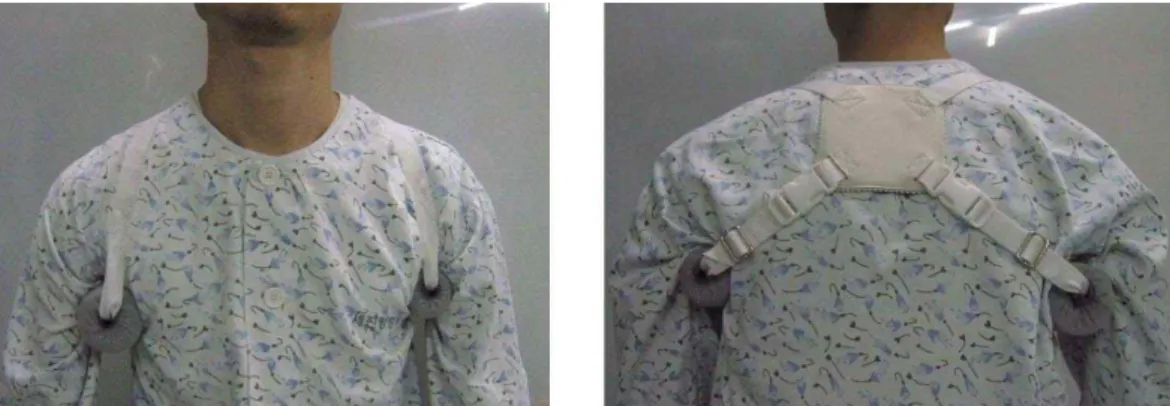
The pad was positioned in acromion on hemiplegic shoulder, and the roll was secured in axilla. The strap was connected vertically between acromion and roll in hemiplegic upper limb. This strap was de- signed to modify applied pressure in axilla. Another strap was secured from acromion anteriorly and con- nected to acromion posteriorly (Figure 1).
Parameters Subjects (%)
Sulcus sign (number of fingers) 1.0 8 (62)
1.5 5 (38)
Upper limb spasticity (modified Ashworth scale)
Grade 0 11 (85)
Grade 1 2 (15)
Muscle strength of hemiplegic shoulder (flexors and abductors)
Poor 5 (38)
Trace 1 (8)
Zero 7 (54)
Table 2. Physical examination data of subjects (N=13)
Parameters Subjects
Gender (men/women) 7/6 (54%/46%)
Age (year) 61.5
Onset (month) 6.9
Diagnosis (cerebral infarct/hemorrhage) 11/2 (85%/15%)
Hemiplegic side (right/left) 10/3 (77%/23%)
Table 1. Characteristics of subjects (N=13)
Figure 1. Anterior and posterior views of modified vertical roll sling.
Figure 2. Anterior and posterior views of Bobath roll sling.
Figure 3. Radiographic measurement. VD:
Vertical distance, HD: horizontal distance, JD: joint distance.
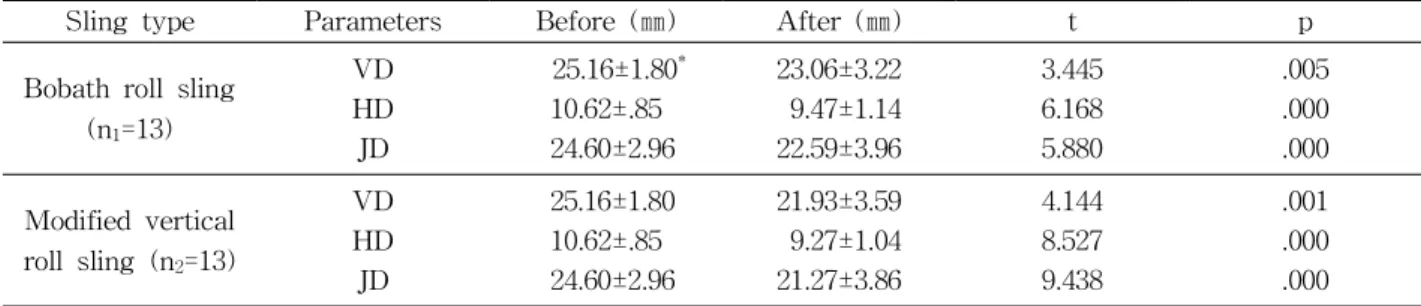
Sling type Parameters Before (㎜) After (㎜) t p
Bobath roll sling (n1=13)
VD 25.16±1.80* 23.06±3.22 3.445 .005
HD 10.62±.85 9.47±1.14 6.168 .000
JD 24.60±2.96 22.59±3.96 5.880 .000
Modified vertical roll sling (n2=13)
VD 25.16±1.80 21.93±3.59 4.144 .001
HD 10.62±.85 9.27±1.04 8.527 .000
JD 24.60±2.96 21.27±3.86 9.438 .000
*Mean±SD.
VD: vertical distance.
HD: horizontal distance.
JD: joint distance.
Table 3. Statistical analysis for slings application (N=13)
Parameters Modified vertical roll sling (㎜) Bobath roll sling (㎜) t p
VD 21.93±3.59* 23.06±3.22 5.113 .000
HD 9.27±1.04 9.47±1.14 6.373 .000
JD 21.27±3.86 22.59±3.96 1.935 .077
Table 4. Statistical analysis after wearing slings The pad was positioned in the middle of cervicothora- cic junction area, and rolls were secured in bilateral axillae. The straps connected each roll obliquely at pos- terior aspect, and vertically at anterior aspect (Figure 2).
Radiographic Measurement
Each subject was asked to sit with bilateral shoulders relaxed before wearing each sling. Modified
vertical roll sling and Bobath roll sling were applied randomly in hemiplegic shoulder. X-ray was taken by 40 degree anteromedial to posterolateral view with 40 inch film focus distance. The principle in- vestigator inserted the index finger between the roll and patient's axilla while the strap was fastened to confirm the same fastening level of strap in hemi- plegic shoulder. The vertical distance was determined by the length between the inferolateral aspect of ac- romion and the superior aspect of humeral head. The horizontal distance between the center of glenoid fos- sa and the medial aspect of humeral head, joint space between the superior aspect of glenoid fossa and humeral head; that is, the perpendicular distance from tangential line contacting humeral head (Figure 3).
Statistical Analysis
SPSS program for Window version 10.0 was used for data analysis. To determine the statistical differ- ences in measured distances between sling types and before and after sling wearing, paired t-test was used with the level of significance of .05.
Results Radiographic Measurements
Table 3 shows radiographic data for both slings.
After wearing Bobath roll sling, vertical, horizontal, and joint distances decreased significantly. After wearing modified vertical roll sling, vertical, horizon- tal, and joint distances decreased significantly. In comparison for decrement in all distances after wear- ing each sling, vertical and joint distance of modified vertical roll sling decreased significantly compared with Bobath roll sling. There was no significant dif- ference in horizontal distance between modified verti- cal roll sling and Bobath roll sling (Table 4).
Discussion
This study investigated the effect of modified ver- tical roll sling on radiographic measurement in hemi- plegic patients, and the findings of this study parti- ally supported the research hypotheses. The vertical and joint distances reduced significantly in modified vertical roll sling compared with those of Bobath roll sling. These results are consistent with those of Cheong (2001) and Cho et al, (2007) who reported that Bobath roll sling was effective in limiting depression of humeral head by finding decreased vertical distance. The joint distance was stated as a sensitive measure reflecting both the vertical and lateral move- ment of humeral head (Han et al, 1993; Han et al, 1994). Even though the roll of modified vertical roll sling placed in hemiplegic axilla was manufactured by two different textures to minimize the pressure on axilla and to decrease lateral movement of humeral head, it was determined that modified vertical roll sling fails to decrease horizontal distance compared with Bobath sling in this study. This result is thought to be caused by lateral deviation of humeral head.
The results of this study can be interpreted that modified vertical roll sling is superior to conventional Bobath sling for stabilizing the glenohumeral joint in
hemiplegic side. The possible explanations for im- proved stability in modified vertical roll sling are summarized as follows. First, the pad secured on su- perior aspect of acromion in hemiplegic side was de- signed in relation with hemiplegic shoulder contour.
Second, by encompassing anterior and posterior humeral head using shoulder pad, glenohumeral sta- bility was promoted. Third, the strap is aligned ver- tically connecting the pad and the roll supporting both glenoid fossa and humeral head. The subjective comfortability of modified vertical roll sling was not reported in this study, however, most subjects re- ported that a donning and doffing and adjusting a strap in a modified vertical roll sling was much eas- ier compared with Bobath roll sling.
There are some limitations in the present study.
First, the vertical, horizontal, and joint distances of sound shoulder of subjects were not compared with those of affected shoulder. Second, the number of subject was small. Third, the effect of modified verti- cal roll sling was assessed with only radiographic test rather than functional measures. Fourth, only the im- mediate effect of modified vertical roll sling was studied. Further researches are required to investigate the long term effect of modified vertical roll sling us- ing a functional measure with a large sample group.
Additionally, the effect of roll size and texture materi- al to affect horizontal distance should be investigated.
Conclusion
The modified vertical roll sling reduced vertical and joint distances significantly in radiographic test, whereas no significant difference in horizontal dis- tance was observed between the two slings.
Therefore, based on the findings of the present study, modified vertical roll sling is effective in im- proving glenohumeral joint stability in hemiplegic shoulder subluxation by decreasing vertical and joint distances between glenoid fossa and humeral head.
This article was received October 23, 2008, and was accepted November 4, 2008.
References
Anderson LT. Shoulder pain in hemiplegia. Am J Occup Ther. 1985;39(1):11-19.
Antonio CT, Tso ML, Roper BB. Vest-sling for re- ducing pain. Am J Occup Ther. 1977;31(3):174-176.
Basmajian TV, Bazant FJ. Factors preventing down- ward dislocation of adducted shoulder joint:
Electromyographic and morphological study. J Bone Joint Surg Am. 1959;41-A:1182-1186.
Brooke MM, de Lateur BJ, Diana-Rigby GC, et al.
Shoulder subluxation in hemiplegia: Effects of three different supports. Arch Phys Med Rehabil. 1991;72(8):582-586.
Cailliet R. The Shoulder in Hemiplegia. 2nd ed.
Philadelphia, F.A. Davis Co., 1980:63-68.
Cailliet R. Shoulder Pain. 3rd ed. Philadelphia, F.A.
Davis Co., 1991:198-201.
Cheong JY. Radiologic evaluations and clinical Implications of anterior displacement of humeral head in hemiplegic shoulder subluxation. Seoul, Ewha Women's University, 2001.
Cho DS, Cho HJ, Park SB, et al. The Effect of GivMohr slings on shoulder subluxation in hem- iplegic patients. Journal of Korean Academy of Rehabilitation Medicine. 2007;31(4):410-416.
Claus BS, Godfrey KJ. A distal support sling for the hem- iplegic patient. Am J Occup Ther. 1985;39(8):536-537.
Davis PM. Steps to Follow: The comprehensive treatment of patients with hemiplegia. 1st ed.
Chicago, Springer-Verlag Berlin Heidelberg, 1985:206-223.
Dursun E, Dursun N, Ural CE, et al. Glenohumeral joint subluxation and reflex sympathetic dys- trophy in hemiplegic patients. Arch Phys Med Rehabil. 2000;81(7):944-946.
Han GH, Kim KD, Jang KE. Radiologic evaluation of cor- rective effect for shoulder subluxation by four differ-
ent types of arm sling. Journal of Korean Academy of Rehabilitation Medicine. 1994;18(1):118-124.
Han GH, Park TH, Jang KE. Radiologic evaluation of the shoulder subluxation in hemiplegic patients.
Journal of Korean Academy of Rehabilitation Medicine. 1993;17(2):226-234.
Hurd M, Farrell KH, Waylonis GW. Shoulder sling for hemiplegia: Friend or foe? Arch Phys Med Rehabil. 1974;55(11):519-522.
Ikai T, Tei K, Miyano S, et al. Evaluation and treat- ment of shoulder subluxation in hemiplegia:
Relationship between subluxation and pain. Am J Phys Med Rehabil. 1998;77(5):421-426.
Keats TE, Lusted LB, Teates CD. Atlas of Roentgenographic Measurement. 5th ed. Chicago, IL, Year Book Medical Publishers, 1985:160.
Moskowitz H, Goodman CR, Smith E, et al. Hemiplegic shoulder. N Y State J Med. 1969;69(4):548-550.
Rajaram V, Holtz M. Shoulder forearm support for the subluxated shoulder. Arch Phys Med Rehabil. 1985;66(3):191-192.
Smith RG, Cruikshank JG, Dunbar S, et al.
Malalignment of shoulder after stroke. Br Med J (Clin Res Ed). 1982;284(6324):1224-1226.
Smith RO, Okamoto GA. Checklist for the pre- scription of slings for the hemiplegic patient.
Am J Occup Ther. 1981;35(2):91-95.
Sullivan BE, Rogers SL. Modified Bobath sling with distal support. Am J Occup Ther. 1989;43(1):47-49.
Zoravitz RD, Idank D, Hughes MB, et al. Shoulder sub- luxation after stroke: A comparison of four supports.
Arch Phys Med Rehabil. 1995;76(8):763-771.