1. INTRODUCTION
One-dimensional nanostructures have been investigated extensively for their potential applications, such as electronics, optoelectronics, mechanics, catalysis, as well as biological and environmental systems because of their unique properties[1-4]. TiO2has been prepared by using numerous methods such as sputtering, sol-gel, spray pyrolysis, and metal-organic chemical vapor deposition[1-5].
Among the various synthetic methods, electrospinning (ES) is employed to synthesize fibular mesostructures for simplicity[6]. Despite these advantages, weak bonding strength between the nanofiber and the substrate limits its widespread use[1, 4]. The sintered TiO2nanofibers shrunk dramatically in the lateral direction and the layer peeled off[1]. This poor adhesion resulted in inferior device
performance[1, 4].
TiO2nanofibers were fabricated by drying electrospun TiO2/polyvinylpyrrolidone (PVP) nanofibers for 5 h in air and subsequent annealing for 3 h at 500£C in air[3, 4]. As the temperature rose, an interesting phenomenon occurred, in which the fibers began to break apart because high temperature made the fibers as brittle as dry spaghetti noodles. The TiO2fibers without the TiO2buffer layer on glass did not show any bond strength[4]. In order to improve the bond strength, a TiO2buffer layer was spin- coated on the glass slide at room temperature prior to ES by using the same precursor solution. However, the bond strength increased only 3-10%, suggesting that the addition of the buffer layer in the middle of the coatings had only a modest effect on the bond strength[4].
The adhesion difficulties of longer nanofibers on fluorine-doped SnO2 (FTO) glass can be solved by employing short nanorod powders. Fujihara et al.[1]
developed a large-area (~20 cm2) of nanofibrous layers by spraying TiO2 nanorods, obtained by the grinding of electrospun nanofibers, dispersed in suitable solvents on FTO glass and subsequent sintering. Such enhanced adhesion provides electrospun TiO2 nanofibers the possibility of application in electronic devices[3].
Although the performance of dye-sensitized solar cells (DSSCs) using TiO2nanomaterials on FTO glass has been
1Department of Materials Engineering, Daelim University, Suam 2209, 29 Imgok-ro, Anyang 431-715, Korea
2Materials Engineering, Korea Aerospace University, Goyang 412-791, Korea
3Green Ceramics Division, KICET, Seoul 153-801, Korea
4MS&E, University of Incheon, Incheon 406-772, Korea +Corresponding author: [email protected]
(Received : Jun. 18, 2012, Revised : Jul. 10, 2012, Accepted : Jul. 11, 2012)
This is an Open Access article distributed under the terms of the Creative Commons Attribution Non-Commercial License(http://creativecommons.org/licenses/by- nc/3.0)which permits unrestricted non-commercial use, distribution, and reproduction in any medium, provided the original work is properly cited.
pISSN 1225-5475/eISSN 2093-7563
Bond Strength of TiO
2Coatings onto FTO Glass for a Dye-sensitized Solar Cell
Deuk Yong Lee1,+, Jin-Tae Kim1, Young-Hun Kim2, In-Kyu Lee2, Myung-Hyun Lee3, and Bae-Yeon Kim4
Abstract
The bond strength of three types of TiO2coatings onto fluorine-doped SnO2 (FTO) glass was investigated with the aid of a tape test according to ASTM D 3359-95. Transmittance was then measured using an UV-vis spectrophotometer in the wavelength range of 300 nm to 800 nm to evaluate the extent of adhesion of TiO2nanorods/nanoparticles on FTO glass. A sharp interface between the coating layer and the substrate was observed for single TiO2coating (TiO2nanorods/FTO glass), which may be detrimental to the bonding strength. In multicoating sample (TiO2nanorod/TiO2nanoparticle/TiO2nanoparticle/FTO glass), the tape test was not performed due to severe peeling-off prior to the test. On the other hand, the dual coating sample (TiO2nanorod/TiO2nanoparticle/FTO glass) showed minimum variation of transmittance (4%) after the test, suggesting that the topcoat adheres well with the FTO substrate due to the presence of the TiO2nanoparticle buffer layer. The use of a TiO2nanorod electrode layer with good adhesion may be attributed to the excellent dye sensitized solar cell performance.
Keywords : TiO2thin film, Transmittance, Nanorod, Nanoparticle, Bond Strength, Tape test
-396- J. Sensor Sci. & Tech. Vol. 21, No. 6, 2012
studied by numerous researchers due to the channeled electron transfer, no quantitative study for the bond strength is given[1]. Poor adhesion of nanomaterials with the conductive glass substrate imposes severe restrictions on the fabrication of DSSCs. In the present study, the bond strength of TiO2nanomaterials was investigated by using a tape test according to ASTM D 3359-95 to evaluate the extent of adhesion regarding the TiO2 nanorods/
nanoparticles on FTO glass[7-9]. The properties of TiO2 nanorods were evaluated by using an UV-vis spectro- photometer, a scanning electron microscope (SEM), and a transmission electron microscope (TEM).
2. EXPERIMENTAL
The precursor solution was prepared from titanium tetraisopropoxide (Ti(OCH(CH3)2)4, 98%, Aldrich, USA) in ethanol and acetic acid by stirring (0.14 g/mL)[11].
Polyvinylpyrrolidone (PVP, Mw=1,300,000, Aldrichi, USA) dissolved in ethanol (0.09 g/mL) was added to the TiO2precursor solution by weight. The solutions were mixed and stirred for 1 h at room temperature. The precursor solution was then filtered by using a sintered glass filter(16-40 Ïm) to remove possible impurities in the solution. The ES apparatus consisted of a syringe pump (KDS-200, Stoelting Co., USA), a 22 gage metal needle, a grounded collector, and a high-voltage supply (ES30P-5W, Gamma High Voltage Research Inc., USA) equipped with current and voltage digital meters[10-13]. The solution was placed in a 5 mL BD Luer-Lok syringe attached to the syringe pump and fed into the metal needle at a flow rate of 0.5 mL/h. TiO2nanofibers were electrospun at an electric field of 1 kV/cm. The as-spun nanofibers were dried in air for 5 h to allow the hydrolysis of Ti (OCH(CH3)2)4. Subsequently, annealing for 3 h at 500£C in air at a heating rate of 1 £C/min was performed to remove the PVP and achieve the crystallization of titania[4,6]. Then, these fibers were ground mechanically in a pestle and mortar to produce TiO2nanorods[1, 11].
FTO glass was first surface cleaned by sonicating using distilled water, alcohol, and KOH (1 M), followed by rinsing and drying. The FTO glass (25ø25 mm2) was used as a substrate. Three types of TiO2multilayers on the FTO glass were fabricated. Firstly, only a TiO2nanorod layer
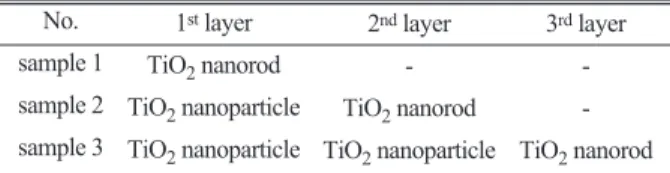
was sprayed using a high volume low pressure (HVLP) gravity feed spray gun with a nozzle (’=1.0 mm) directly onto the FTO glass. During spray deposition, the FTO glass was maintained at a temperature of 75£C. Secondly, the TiO2nanorod/nanoparticle layer on the FTO glass was deposited. The TiO2nanoparticle layer was first prepared by the spin coating technique (ACE-1020, Dong Ah Trading Corp., Korea). TiO2sol was first spin coated at 500 rpm for 8 s and then 3000 rpm for 30 s on the FTO glass. The TiO2 nanorod powder slurry, dispersed in a mixture of ethanol and methanol (10 g/L), were sprayed subsequently on the TiO2 sol layer. The substrate was placed on a hotplate at 75£C. Lastly, a dense TiO2 (d-TiO2) underlayer was deposited on the FTO glass substrate by spray pyrolysis[1]. This was followed by spin coating of a diluted precursor solution (1 : 5 volume ratio in ethanol) at a speed of 1300 rpm for 10 s in order to form the ultrathin surface treatment layer (STL). The substrate was then placed on a hotplate at 75£C. The TiO2nanorods dispersed in a mixture of ethanol and methanol were sprayed on the surface of the STL. Three types of TiO2nanorod layers on FTO glass, as summarized in Table 1, were then calcined for 1 h at 500£C. The sintered TiO2nanorod layer was further solution treated with TiCl4 (40 mM) for 30 min at 75£C to provide improved connectivity between the nanorods, followed by calcination for 1 h at 500£C[1-3].
After the coating process was completed, the tape test was applied onto those materials in order to observe the adhesion strength qualitatively. The bond strength of the coatings was evaluated by a tape test according to ASTM D 3359-95[7]. An adhesive Scotch (3M) tape was applied onto the surface and rubbed to improve adhesion of the tape to the surface. The tape was then removed by pulling it off rapidly. The bond strength of the sample was then evaluated qualitatively using an UV spectrophotometer (V- 570, Jasco, Japan) by examining the optical transmittance in the wavelength range of 300 nm to 800 nm[8, 9].
Table 1. Three types of TiO2layers on the FTO glass
No.
sample 1 sample 2 sample 3
1stlayer TiO2nanorod TiO2nanoparticle TiO2nanoparticle
2ndlayer - TiO2nanorod TiO2nanoparticle
3rdlayer - - TiO2nanorod
3. RESULTS AND DISCUSSIONS
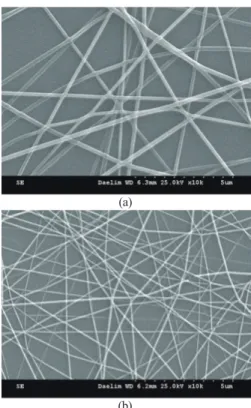
The phase of the as-annealed fibers was previously reported to be a typical anatase phase[4, 11]. The morphologies of the as-spun and the as-annealed fibers were examined by using SEM, as shown in Fig. 1. The images show that the as-spun fibers with an average diameter of 180 nm have smooth and uniform surfaces with a random orientation. The SEM results revealed that the fiber diameter decreased from 180 nm to 100 nm after calcination at 500£C, which is probably due to the decomposition of PVP and crystallization of TiO2[4, 6].
The TiO2nanorods were then produced by grinding the as- annealed fibers mechanically in a pestle and mortar, as depicted in Fig. 2.
The sintered TiO2nanorod layer on the FTO glass was further solution treated with TiCl4at 75£C to provide improved connectivity between the nanorods, followed by calcination for 1 h at 500£C. Fig. 3 shows the smooth surface of the porous TiO2nanorods filled with the TiO2 nanoparticles after solution treatment. The cross-section of the sintered TiO2 topcoat on the FTO glass or TiO2 nanoparticle/FTO glass is shown in Figs. 4 and 5. A sharp interface (white line) between the FTO glass and the topcoat was visible for sample 1. In sample 1, the TiO2 nanorods were sprayed directly onto the FTO glass, which was heated at 75£C, without the TiO2buffer layer. The observed interface may be due to the absence of the TiO2 buffer layer, probably leading to weaker bonding between the TiO2nanorod layer and the FTO substrate. On the other hand, the coatings having the TiO2nanoparticle buffer layer demonstrated the continuous interface. The observation of the discontinuous interface is possibly attributed to the presence of the TiO2buffer layer.
Although a peel-off test using an adhesive tape showed that the TiO2nanorods adhere well with the substrate, sample 3 could not perform the tape test due to severe peeling-off prior to the test, as shown in Fig. 6. In the multicoat sample, adhesion failure occurred between the coats so that the adhesion of the coating system to the FTO glass is not determined. By contrast, two samples (Fig. 6(a) and (b)) adhere well to the FTO glass or the TiO2 nanoparticle/FTO glass without peeling-off. In order to evaluate the adhesion, the difference in transmittance before and after detaching the Scotch (3M) tape was investigated. The tape was adhered to the coating by rubbing the entire surface area using constant pressure.
Transmittance was measured using an UV-vis spectro- photometer in the wavelength range of 300 nm to 800 nm,
Fig. 1. SEM images of nanofibers (a) before and (b) after calcination for 1 h at 500£C.
Fig. 2. TEM image of nanorods.
Fig. 3. SEM image of the surface of the TiO2nanorods/
nanoparticles top coating layer.
(b) (a)
-398- J. Sensor Sci. & Tech. Vol. 21, No. 6, 2012
as shown in Fig. 7. The transmittance spectra were measured and examined at the wavelength of 550 nm.
Transmittance of sample 1 rose from 2.4% to 18.8% after the tape test, indicating that the TiO2nanorod layer on the FTO glass was detached. Although the variation of trans- mittance of sample 3 (65.9% Ê66.5%) was only 0.6%, the TiO2nanorod/TiO2nanoparticle/TiO2nanoparticle/FTP glass was already damaged significantly prior to the test.
On the contrary, sample 2 showed the best adhesion (6.4%
Ê10.1%) among the samples investigated, suggesting that the TiO2 nanorods adhere well with the TiO2 nanoparticle/FTO glass. It is evident that the TiO2 nanoparticle buffer layer is crucial to the bond strength of the TiO2coatings.
Fig. 4. Low magnification SEM images for the cross-section of the coatings on FTO glass ; (a) sample 1, (b) sample 2, and (c) sample 3, respectively.
Fig. 5. High magnification SEM images for the cross-section of the coatings on FTO glass ; (a) sample 1, (b) sample 2, and (c) sample 3, respectively.
Fig. 6. Optical photographs for the surface of the coatings on FTO glass before the tape test ; (a) sample 1, (b) sample 2, and (c) sample 3, respectively. Note that the coating area is 10 ø10 mm2.
(b) (a)
(c)
(b) (a)
(c)
(a) (b) (c)
In the present study, the thickness of the TiO2coatings investigated was less than 1Ïm, which was insufficient for the DSSC. The TiO2nanoparticles/nanorods layer with a thickness of 15 Ïm to 20 Ïm on the FTO glass is known to be the best DSSC electrode with a high efficiency[1]. For the use of the TiO2nanorods with a good adhesion as the DSSC electrode, the TiO2nanorod layer should be deposited with a thickness greater than 15 Ïm. The results of DSSC performance constructed using a TiO2electrode layer with good adhesion are known to be excellent probably due to the minimization of electron back transfer[1]. The electrodes with good adhesion may reduce the electron back transfer between the FTO glass and the electrolyte, resulting in higher solar cell efficiency.
However, it warrants further study.
4. CONCLUSIONS
The adhesion test of three types of TiO2coatings onto FTO glass was performed by using a tape test according to ASTM D 3359-95. Transmittance spectra were then examined in the wavelength range of 300 to 800 nm to evaluate the extent of adhesion of the TiO2nanorods/
nanoparticles on the FTO glass. A sharp interface between the layer and the substrate was detected for the single TiO2 coating (TiO2nanorods/FTO glass), resulting in weaker bonding strength. In the muticoating sample (TiO2 nanorod/TiO2nanoparticle/TiO2nanoparticle/FTO glass), the tape test was not performed due to severe peeling-off prior to the test. On the other hand, the dual coating sample (TiO2 nanorod/TiO2nanoparticle/FTO glass) revealed a minimum variation of transmittance (4%) after the test, suggesting that the topcoat adheres well with the TiO2 nanoparticle buffer layer on the FTO substrate. The use of a TiO2electrode layer with good adhesion may provide excellent DSSC performance due to the minimization of electron back transfer.
ACKNOWLEDGEMENTS
This research was supported by the Basic Science Research Program through the National Research Foundation of Korea (NRF) funded by the Ministry of Education, Science and Technology (Grant No. 2010- 0007095).
REFERENCES
[1] K. Fujuhara, A. Kumar, R. Jose, S. Ramakrishna, and S. Uchida, “Spray deposition of electrospun TiO2 nanorods for dye-sensitized solar cell”, Nano- technology, Vol. 18, p. 365709, 2007.
[2] U. Bach, D. Lupo, P. Comte, J. E. Moser, F. Welssortel, J. Salbeck, H. Spreitzer, and M. Graztel, “Solid-state dye-sensitized mesoporous TiO2solar cells with high photon-to-electron conversion efficiencies”, Nature, Vol. 395, pp. 583-585, 1998.
[3] R. Zhu, C. Jiang, X. Liu, B. Liu, A. Kumar, and S.
Ramakrishna, “Improved adhesion of interconnected TiO2nanofiber network on conductive substrate and its application in polymer photovoltaic devices”, Appl.
Phys. Lett., Vol. 93, p. 013102, 2008.
[4] D.Y. Lee, E. Cho, M. Lee, N. Cho, and Y. Song,
“Insertion of a TiO2 buffer layer for the fixation of
Fig. 7. Transmittance spectra of the TiO2coatings on the wavelength range of 300 nm to 800 nm before and after the tape test.
-400- J. Sensor Sci. & Tech. Vol. 21, No. 6, 2012
electrospun TiO2 nanofibers on glass substrates”, J.
Korean Phys. Soc., Vol. 55, pp. 84-88, 2009.
[5] H. Choi, S. Kim, Y. Song, and D.Y. Lee, “Photode- composition and bactericidal effects of TiO2thin films prepared by a magnetron sputtering”, J. Mater. Sci., Vol. 39, pp. 5695-5699, 2004.
[6] D. Li and Y. Xia, “Fabrication of titania nanofibers by electrospinning”, Nano Lett., Vol. 3, pp. 555-560, 2003.
[7] ASTM D3359-97, Standard Test Methods for Measuring Adhesion by Tape Test (ASTM Inter- national, 1998).
[8] S.W. Lee, K.K. Kim, Y. Cui, S.C. Lim, Y.W. Cho, S.M. Kim, and Y.H. Lee, “Adhesion test of carbon nanotube film coated onto transparent conducing substrate”, Nano : Brief Reports and Reviews, Vol. 5, pp. 133-138, 2010.
[9] J.J. Joo, Y.H. Kim, D.S. Paik, and D.H. Kang,
“Characteristics of ZnO thin films modified by various additives”, Proc. of SPIE, pp. 72170W-1-72170W-9, 2009.
[10] D.Y. Lee, M. Lee, and N. Cho, “Preparation and photocatalytic degradation of erbium doped titanium dioxide nanorods”, Current Appl. Phys., Vol. 12, pp.
1229-1233, 2012.
[11] D.Y. Lee, B. Kim, S. Lee, M. Lee, Y. Song, and J.
Lee, “Titania nanofibers prepared by electrospinning”, J. Korean Phys. Soc., Vol. 48, pp. 1686-1690, 2006.
[12] D.Y. Lee and N. Cho, “Synthesis and characterization of Pt-TiO2nanofibers”, Physica Status Solidi C, Vol.
9, pp. 1423-1426, 2012.
[13] D.Y. Lee, J.Y. Park, B. Kim, and N. Cho, “Effect of collector speed and flow rate on morphology of Er doped TiO2nanofibers”, J. Nanosci. Nanotechnol., vol. 12, pp. 1599-1603, 2012.
Deuk Yong Lee graduated from Yonsei University in Korea in 1984 and received his MS and PhD in materials science & engineering from The University of Texas at Austin and Arizona State University in USA (1986 and 1991), respectively. Later, he was at The University of Sunderland in England (1994), Kyushu National Industrial Research Institute in Japan (1999) and The University of Nevada- Reno in USA (2004) as a visiting scholar or a guest researcher. He joined the faculty at Daelim University in 1992 and is currently a professor at the department of materials engineering. He has been serving as the reviewer of more than 25 SCI journals since 2004.
His main research interests are in the fields of nanotechnology including synthesis and characterization of smart nanomaterials (nanofibers, nanorods, nanocone, etc.) and their related devices.
Jin-Tae Kim received his MS in metallurgical engineering from Yonsei University in Korea in 2001 and PhD in advanced materials engineering from Chungbuk National University in 2010.
He was at Biomaterials Lab. of Asan Medical Center in 1998, bioengineering institute of STENTECH Co., Ltd in 2000, tissueengineering institute of Hans biomed Co., Ltd in 2003, tissue- engineering institute of Humantissue Korea Corp. in 2006, and is currently an assistant professor at Daelim University. His main research interests are in synthesis and characterization of nanocomposite membranes composed of polymer/metal of tissue engineering such as scaffold and DDS.
Young-Hun Kim received his BS degree in materials engineering of Korea Aerospace University in 2012 and is currently a graduate at Korea Aerospace University, pursuing a MS degree in materials engineering. His main research interests are in preparation and characterization of HA (hyaluronic acid) and analysis of DSSC (dye-sensitized-solar-cell).
In Gyu Lee attended Seoul National University where he received his B.S.
(1982) and M.S. (1984) in metal- lurgical engineering. He received his Ph.D. degree in materials science &
engineering from The University of Michigan at Ann Arbor in 1992. Later, he worked at Korea Electronics Technology Institute from 1993 to 1996. He joined the faculty at Korea Aerospace University in 1996 and is currently a professor at the department of materials engineering. He was at the University of Washington in USA (2004) as a visiting scholar. His main research interests are in the fields of MEMS and ceramic micro sensors.
Myung-Hyun Lee received his B.S, M.S. and Ph.D. in ceramic engineering from Yonsei University in Korea (1991, 1993, and 1998). He has worked at Korea Institute of Ceramic Engineering and Technology since 2000 and is currently a principal researcher at the division of Green Ceramics. He was at the Oak Ridge National Laboratory in USA (2010) as a visiting scholar. His main research interests are in the fields of material processing for medical and energy applications.
Bae-Yeon Kim received his BS, MS and PhD in ceramic engineering from Yonsei University in Korea (1983, 1986 and 1991), respectively. He joined the faculty at The University of Incheon in 1990 and is currently a professor at the department of materials science and engineering. Later, he was at The University of California at Berkeley (1994) and also Lawrence Berkeley National Laboratory (LBNL) in USA as a visiting professor, visiting scientist, and guest researcher. His main research interests are in the fields of PEO, high temperature ceramic heater, alumina ceramics, and etc.