• 검색 결과가 없습니다.

Stimulating the Growth of Kefir-isolated Lactic Acid Bacteria using Addition of Crude Flaxseed (Linum usitatissimum L.) Extract

N/A
N/A
Protected

Academic year: 2021

Share "Stimulating the Growth of Kefir-isolated Lactic Acid Bacteria using Addition of Crude Flaxseed (Linum usitatissimum L.) Extract"

Copied!
5
0
0

로드 중.... (전체 텍스트 보기)

전체 글

(1)

This is an Open Access article distributed under the terms of the Creative Commons Attribution Non-Commercial License (http://creativecommons.org/

licenses/by-nc/3.0) which permits unrestricted non-commercial use, distribution, and reproduction in any medium, provided the original work is properly cited.

Stimulating the Growth of Kefir-isolated Lactic Acid Bacteria using Addition of Crude Flaxseed

( Linum usitatissimum L.) Extract

Dong-Hyeon Kim

1†

, Dana Jeong

1†

, Yong-Taek Oh

1

, Kwang-Young Song

1*

, Hong-Seok Kim

1

, Jung-Whan Chon

1,2†

, Hyunsook Kim

3

, and Kun-Ho Seo

1†

1Center for One Health, College of Veterinary Medicine, Konkuk University, Seoul, Korea

2National Center for Toxicological Research, US Food and Drug Administration, Jefferson, AR, USA

3Dept. of Food & Nutrition, College of Human Ecology, Hanyang University, Seoul, Korea

Abstract

Linum usitatissimum

L. (flaxseed) is emerging as an important functional food ingredient because of its rich contents, namely, α-linolenic acid (ALA, omega-3 fatty acid), lignans, and fiber, which are potentially beneficial for human health. Furthermore, flax or flaxseed oil has also been incorporated as a functional food ingredient into various foods such as milk, dairy products, and meat products. Flaxseed is known to possess antimicrobial activity

in vitro

and

in vivo

, but its growth-stimulating effect on lactic acid bacteria is not clear. Hence, the objective of this study was to determine whether crude flaxseed extract stimulated the growth kefir-isolated lactic acid bacteria

in vitro

. The result of this study showed that

Lactobacillus kefiranofaciens

DN1,

Lactobacillus brevis

KCTC3102,

Lactobacillus bulgaricus

KCTC3635, and

Lactobacillus plantarum

KCTC3105 treated with 100 μL of crude flaxseed extract showed significantly higher growth than the control treated with 100 μL of water (

p

<0.05). Based on the results of this study, crude flaxseed extract could be used as a growth stimulator for lactic acid bacteria in various food applications, including production of milk and dairy products.

Keywords

flaxseed, lactic acid bacteria, kefir, growth stimulator

Received: June 05, 2017 Revised: June 11, 2017 Accepted: June 26, 2017

These authors contributed equally to this study.

*Corresponding author : Kwang-Young Song, Center for One Health, College of Veterinary Medicine, Konkuk University, Seoul, Korea.

Tel : +82-2-450-4121, Fax : +82-2-3436-4128, E-mail : [email protected]

Introduction

The Latin name of the flaxseed was Linum usitatissimum L., which means “very useful”.

And flaxseed was an annual herb and originated from Egypt (Kaithwas et al., 2011), and flaxseed was one of the oldest crops, having been cultivated since the beginning of civilization (Laux, 2011). Every part of the flaxseed plant was utilized commercially, either directly or after processing, while flaxseed oil and its sub-products were used in animal feed formulation (Laux, 2011; Singh et al., 2011; Shim et al., 2014) (Fig. 1).

There is a small difference in using the terms flaxseed (when consumed as food by humans) and linseed (when it was used in the industry and feed purpose) (Morris, 2008).

Until now, flaxseed has been the focus of increased interest in the field of diet and

disease research due to the potential health benefits associated with some of its bio-

logically active components(Goyal et al., 2014; Shim et al., 2014) (Table 1).

(2)

Fig. 1. Linum usitatissimum L. (flaxseed) was one of the oldest cultivated corps, continues to be widely grown for oil, fiber, and food (Resource: Shim et al., 2014).

Flaxseeds have nutritional characteristics and are rich source of ω-3 fatty acid, α-linolenic acid (ALA), short chain polyunsaturated fatty acids (PUFA), soluble and insoluble fibers, phytoestrogenic lignans (secoisolariciresinol digly- coside-SDG), proteins and an array of antioxidants (Iva- nova et al., 2011; Singh et al., 2011; Oomah, 2001; Alha- ssane and Xu, 2010).

And, according to various previous researches, flaxseed could have the health imparting benefits for reducing the

Table 1. Physiological effects imparted by functional elements of flaxseeds (Resource: Goyal et al., 2014; Shim et al., 2014)

Increase (↑) Decrease (↓)

1. Apoptosis 2. Bowel movement

3. Fluidity of cardiac muscles 4. Glucose uptake

5. HLD-cholesterol 6. Peristalsis

7. Production of ‘memory boosting’

acetylcholine

8. Production of anti-inflammatory 3-series eicosanoid compound 9. Production of less aggregatory

3-series eicosanoids compound 10. Production of serotonin 11. Vasodilatory response

1. Angiogenesis 2. Blood pressure 3. Blood viscosity 4. Cardiac arrest 5. LDL-oxidation

6. Level of pro-inflammatory cytokines

7. Morning stiffness 8. Obesity

9. Prostate & colon cancer 10. Reduce pain in joints 11. Rheumatoid arthritis 12. Serum glucose 13. Synthesis of VLDL 14. Total cholesterol 15. Triglyceride production
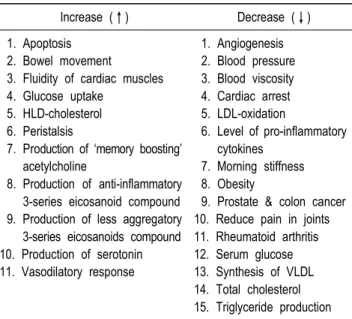
cardiovascular diseases, for decreasing the risk of cancer related to the mammary and prostate gland, for alleviating the menopausal symptoms and osteoporosis, for promo- ting the anti-inflammatory activity and laxative effect, and so on (Goyal et al., 2014). Above all, flaxseed was added to animal feed to improve animal reproductive perfor- mance and health (Heimbach, 2009; Turner et al., 2014).

Generally, lactic acid bacteria (LAB) like generally recog- nized as safe (GRAS) was an order of Gram-positive, acid- tolerant, nonsporulating, rod-(or coccus-) shaped bacteria that shared the physiological and metabolic characte- ristics. Usually found in decomposing plants and milk products, LAB produced lactic acid as the major meta- bolic end product of carbohydrate fermentation. Through the acidification’s process by several LAB strains, it could be provide an additional hurdle for spoilage and patho- genic microorganisms, and hence contribute to the healthy microflora of human mucosal surfaces (Lee et al., 2014;

Chatterjee et al., 2016). However, whether crude flaxseed extract have the growth stimulating effects of kefir-iso- lated lactic acid bacteria in vitro is not know.

Therefore, we assessed the effects of crude flaxseed extract on the growth of Kefir-isolated lactic acid bacteria and identified the main active compounds in crude flaxseed extract responsible for the growth-stimulating effects.

Materials and Methods

1. Crude flaxseed extract from flaxseed ( Linum usitati- ssimum L.)

Flaxseed (Linum usitatissimum L.) was donated from Center for One Health, College of Veterinary Medicine, Konkuk University in Seoul, Korea. The dried flaxseed (Linum usi- tatissimum L.) was macerated in 100% sterilized distilled water for 48 hours with occasionally stirring at room temperature. And then, the soluble ingredients were concentrated were filtrated through 0.45 mm Millipore and stored at -20°C before use.

2. Preparation of 4 kefir-isolated lactic acid bacteria

As probiotic cultrure, 4 Kefir-isolated lactic acid bacteria

(3)

tested in this study were originated from Kefir, and donated from Center for One Health, College of Veterinary Medi- cine, Konkuk University in Seoul, Korea, Lactobacillus ke- firanofaciens DN1, Lactobacilllus brevis KCTC3102, Lac- tobacillus bulgaricus KCTC3635, and Lactobacillus plan- tarum KCTC3105. All 4 kefir-isolated lactic acid bacteria were grown in MRS broth and were incubated at 37℃ for 48 hrs.

3. Effect of crude flaxseed extract on the growth of various Kefir-isolated lactic acid bacteria

The effect of crude flaxseed extract on the growth of various Kefir-isolated lactic acid bacteria was determined with growth curve analysis. A total of 100 μL crude flaxseed extract was added to 1 mL of MRS broth, and also ino- culated with 50 μL suspensions of each Kefir-isolated lactic acid bacteria at the level of 10

5

Log CFU. After mixing and incubating at 37°C, optical density was measured at 600 nm at 1 h intervals using a microplate reader (Multis- kan FC; Thermo Fisher Scientific, Waltham, MA, USA).

4. Statistical analysis

All data were presented as mean±SD (standard deviation), and were the results of at least two independent experi- ments with duplicate assays. All statistical analysis were performed using one-way analysis of variance (ANOVA;

GraphPad Prism 5, USA) followed by Duncan’s post hoc test for mean comparison. Statistical significance was established as p<0.05.

Results and Discussion

In this study, the growth of 4 kefir-isolated lactic acid bacteria in MRS broth containing 10% final volumes (100 μL/1 mL) of crude flaxseed extract from flaxseed (Linum usitatissimum L.) was analyzed by measuring the optical density of cultures at 600 nm (Fig. 2). This results of this study showed that Lactobacillus kefiranofaciens DN1, Lactobacilllus brevis KCTC3102, Lactobacillus bulgaricus KCTC3635, and Lactobacillus plantarum KCTC3105 with the addition of 100 μL crude flaxseed extract from flaxseed

(Linum usitatissimum L.) showed higher stimulation than control with addition of 100 μL water (Fig. 2). There was a significant difference between treated group with the addition of crude flaxseed extract from flaxseed (Linum usitatissimum L.) and control group (p<0.05).

As shown in Fig. 2, Lactobacillus kefiranofaciens DN1 with the addition of 100 μL crude flaxseed extract from flaxseed (Linum usitatissimum L.) showed the significant growth-stimulation from 14 hours to 24 hours (p<0.05), Lactobacilllus brevis KCTC3102 and Lactobacillus planta- rum KCTC3105 with the addition of 100 μL crude flaxseed extract from flaxseed (Linum usitatissimum L.) showed the significant growth-stimulation from 17 hours to 24 hours and from 18 hours to 24 hours, respectively (p<0.05). And Lactobacillus bulgaricus KCTC3635 with the addition of 100 μL crude flaxseed extract from flaxseed (Linum usi- tatissimum L.) showed the significant growth-stimulation from 14 hours to 21 hours. However, Lactobacillus bulga- ricus KCTC3635 without the addition of 100 μL water showed the significant stimulation from 23 hours to 24 hours (p<0.05), maybe it was thought to be due to pH.

Until now, several bifidogenic (or lactic acid bacteria) growth stimulators have been reported such as 2-amino- 3-carboxy-1,4-naphthoquinone, 1,4-dihydroxy-2-naphthoic acid, O-α-d-Glucopyranosyl-(1→6)-O-α-d-glucopyranosyl- (1→4)-α-d-glucose, and so on (Isawa et al., 2002; Make- lainen et al., 2009).

Lee et al. (2014) reported that fermented rice extract (0.2%) stimulated the growth of the lactic acid bacteria such as Lactobacillus acidophilus, Streptococcus thermo- philus, and Bifidobacterium lactis. Specifically, the num- ber of bacteria increased significantly to 11~53 fold after 12-18 hours incubation, compared with negative control significant (p<0.05). Namely, fermented rice extract with known or unknown substances strongly stimulated the growth of both bifidobacteria and lactic acid bacteria.

Also, Chatterjee et al. (2016) studies the growth of lactic

acid bacteria using fruit pectin. Pectin could be classified

as a prebiotic on food ingredient. Generally, however, it

is assumed that a prebiotic should increase the number or

activity of bifidobacteria and lactic acid bacteria (Gibson

(4)

Fig. 2. Growth curves of Lactobacillus kefiranofaciens DN1, Lactobacilllus brevis KCTC3102, Lactobacillus bulgaricus KCTC3635, and

Lactobacillus plantarum KCTC3105 as kefir-isolated lactic acid bacteria grown in MRS broth mixed with crude flaxseed extract from flaxseed

(Linum usitatissimum L.) at 10 % final concentration at 37°C for 24 h. Growth was analyzed by measuring optical density at 600 nm.

and Collins, 1999). According to research results of Cha- tterjee et al. (2016), the optical density was measured at 660 nm, for Lactobacillus acidophilus culture it was found to be 0.8 at 48 hrs of incubation and 0.77 by 60 hrs of incubation at 37°C. Whereas Bifidobacterium bifi- dum O.D. value was 0.6 at 48 hrs and 0.56 at 60 hrs of incubation. There was no significant change in the growth of lactic acid bacteria on incubation for 60 hrs, Lacto- bacillus casei the OD was 1.004 at 48 hrs and 0.985 at 60 hrs. There was a reduction in the absorbance when the cultures were incubated more than 48 hrs. Especially, the pH at which the fermentation was carried out had a direct effect on the substrate metabolism due to the change in enzyme activity at different pH (Palframan et al., 2002).

According to the results of this study, crude flaxseed extract from flaxseed (Linum usitatissimum L.) could be a

potential prebiotic so as to stimulate the bacteria to grow on colon and then alter the colonic microflora toward a more health composition. Further understanding of the protective mechanisms conferred by crude flaxseed extract from flaxseed (Linum usitatissimum L.) will further enhance the numerous beneficial effects of prebiotics. The results of the current study suggest that crude flaxseed extract from flaxseed (Linum usitatissimum L.) could be used as the growth-stimulating agents for Kefir-isolated lactic acid bacteria.

Disclaimer

The views expressed herein do not necessarily reflect

those of the US Food and Drug Administration or the US

Department of Health and Human Services.

(5)

References

1. Alhassane, T., Xu, X. M. 2010. Flaxseed lignans:

source, biosynthesis, metabolism, antioxidant activity, bio-active components and health benefits. Compr.

Rev. Food Sci. Food Saf. 9:261–269.

2. Chatterjee, E., Manuel, S. G. A. and Hassan, S. S. 2016.

Effect of fruit pectin on growth of lactic acid bacteria.

J. Probiotics & Health, 4:147.

3. Gibson, G. R. and Collins, M. D. 1999. Concept of balanced colonic microbiota, prebiotics and synbio- tics. In: Hanson, L. A., Yolken, R. H. (eds). Probiotics Other Nutritional Factors, and Intestinal Microflora 42: 139-152.

4. Goyal, A., Sharma, V., Upadhyay, N., Gill, S. and Sihag, M. 2014. Flax and flaxseed oil: an ancient medicine

& modern functional food. J. Food Sci. Technol.

51:1633-1653.

5. Isawa, K., Hojo, K., Yoda, N., Kamiyama, T., Makino, S., Saito, M., Sugano, H., Mizoguchi, C., Kurama, S., Shibasaki, M., Endo, N. and Sato, Y. 2002. Isolation and identification of a new bifidogenic growth stimu- lator produce by Propionibacterium freudenreichii ET-3. Biosci. Biotechnol. Biochem. 66:679-681.

6. Ivanova, S., Rashevskaya, T. and Makhonina, M. 2011.

Flaxseed additive application in dairy products pro- duction. Procedia. Food Sci. 1:275-280.

7. Kaithwas, G., Mukerjee, A., Kumar, P. and Majumdar, D. K. 2011. Linum usitatissimum (linseed/flaxseed) fixed oil: Antimicrobial activity and efficacy in bovine mastitis. Inflammopharmacology 19:45-52.

8. Laux, M. 2011. http://www.agmrc.org/commodities_

products/grains_oilseeds/flax_profile.cfm. Accessed May

10, 2017.

9. Lee, J. K., Cho, H. R., Kim, K. Y., Lim, J. M., Jung, G. W., Sohn, J. H. and Choi, J. S. 2014. The growth- stimulating effects of fermented rice extract (FRe) on lactic acid bacteria and Bifidobacterium spp. Food Science and Technology Research 20:479-483.

10. Makelainen, H., Hasselwander, O., Rautonen, N. and Ouwehand, A. C. 2009. Panose, a new prebiotic can- didate. Lett. Appl. Microbiol. 49:666-672.

11. Morris, D. H. 2008. Linseed in the ruminant diet–

adding linseed to feed enhances the fat profile of milk Winnipeg, MB, Flax Council of Canada. http://www.

flaxcouncil.ca/files/web/Beef_R3_final.pdf. Accessed May 15, 2017.

12. Oomah, B. D. 2001. Flaxseed as a functional food source. J. Sci. Food Agric. 81(9):889–894.

13. Palframan, R. J., Gibson, G. R. and Rastall, R. A. 2002.

Effect of pH and dose on the growth of gut bacteria on prebiotic carbohydrates in vitro. Anaerobe 8:287- 292.

14. Shim, Y. Y., Gui, B., Arnison, P. G., Wang, Y., and Reaney, M. J. T. 2014. Flaxseed (Linum usitatissimum L.) bioactive compounds and peptide nomenclature: A review. Trends in Food Science & Technology 38:5-20.

15. Singh, K. K., Mridula, D., Rehal, J. and Barnwal, P.

2011. Flaxseed- a potential source of food, feed and fiber. Crit. Rev. Food Sci. Nutr. 51:210–222.

16. Turner, T. D., Mapiye, C., Aalhus, J. L., Beaulieu, A. D., Patience, J. F., Zijlstra, R. T. and Dugan, M. E. 2014.

Flaxseed fed port: n-3 fatty acid enrichment and con-

tribution to dietary recommendations. Meat Science

96:541-547.

수치

Table  1.  Physiological  effects  imparted  by  functional  elements  of  flaxseeds  (Resource:  Goyal  et  al.,  2014;  Shim  et  al.,  2014)
Fig.  2.  Growth  curves  of  Lactobacillus  kefiranofaciens  DN1,  Lactobacilllus  brevis  KCTC3102,  Lactobacillus  bulgaricus  KCTC3635,  and  Lactobacillus  plantarum  KCTC3105  as  kefir-isolated  lactic  acid  bacteria  grown  in  MRS  broth  mixed

참조

관련 문서

Changes of lactic acid bacteria numbers and photodiode during fermentation mode and storage mode in S kimchi · · ·40..

- A novel lactic acid bacterium for the production of high purity l-lactic acid, Lactobacillus paracasei subspL. helveticus - Production of Lactic Acid from Water Hyacinth

균의 산도 screening 실험을 통해 대표적인 유산균 6종 ( Leuconostoc kimchii, Lactobacillus paraplantanum, Leuconostoc gasicomitatum, Lactobacillus

In addition, this study confirmed the superiority of the thermomechanical reliability of drilled Cu pillar bump (DCPB) through a hysteresis loop, which showed the

Spoilage potential of psychrotrophic lactic acid bacteria (LAB) species: Leuconostoc gelidum subsp. gasicomitatum and Lactococcus piscium , on sweet bell

The purpose and necessity of this study was to investigate the effects of lactic acid fatigue and body oxidation through myofascial relaxation exercise using small tools

Probiotic properties of lactic acid bacteria isolated from mukeunji, a long-term ripened kimchi. Journal of Food

Using the CGE model with endogenous technology progress, this study investigates economic impacts and differences of subsidy and taxation for stimulating