교신저자: 이덕철, 서울시 서대문구 신촌동 연세의료원 의과대학건물 5층, 120-752, 연세대학교 의과대학 가정의학교실 Tel: 02-2228-2330, Fax: 02-362-2473, E-mail: [email protected]
서상훈, 서울시 서대문구 신촌동 연세대학교 용재관 313호, 120-749, 연세대학교 교육과학대학 체육교육학과
Tel: 02-2123-6187, Fax: 02-2123-6187, E-mail: [email protected]
걸음걸이 속도와 인지기능의 연관성
김춘옥, 이지원, 임지애1, 강희철, 이승범, 서상훈2, 이덕철
연세대학교 의과대학 세브란스병원 가정의학교실, 1(주)INTOTO,
2연세대학교 체육교육학과 운동생리, 의학 실험실
Gait Speed Is Associated with Cognitive Function in Community Dwelling Elderly
Choon-Ok Kim, M.D., Ji-Won Lee, M.D., Jee-Aee Im, Ph.D.
1, Hee-Chul Kang, M.D., Ph.D., Seung-Bum Lee, M.D., Sang-Hun Suh, Ph.D.
2, Duk-Chul Lee, M.D., Ph.D.
Department of Family Medicine, Severance Hospital, College of Medicine, Yonsei University,
1
Sports and Medicine Research Center, INTOTO Inc.
2Laboratory of Exercise Physiology and Medicine, Department of Physical Education, Yonsei University, Seoul, Korea
Background: There is some evidence that gait abnormality precedes the diagnosis of dementia but it is not clarified that gait speed is associated with cognitive function in healthy elderly.
Methods: A total of 126 community dwelling healthy old people were recruited in this study. We measured blood pressure, weight and height, as well as drug history and behavioral habits. Beck Depression Inventory and Korean version of Mini Mental State Examination (KMMSE) were used for the assessment of depression and cognitive function. Usual gait speed (m/s) over 6 m was measured.
Results: There was no difference in gait speed between normal (KMMSE score>24) and cognitive impaired group (KMMSE score≤24), divided by MMSE score. However, in Pearson correlation analysis, gait speed was positively associated with KMMSE score (r=0.204, P=0.022). After adjustment of confounders, gait speed contributed independently to KMMSE score by multiple linear regression analysis (β=0.207, P=0.021).
Conclusion: Gait speed was independently associated with cognitive function. That is, slow gait speed could predict cognitive dysfunction.
Key Words: Cognitive function, Gait speed, Old people
서 론
고령화가 진행됨에 따라 노인성 질환의 빈도도 급격하게 증가하고 있다. 이 중 가장 사회적으로 문제가
되는 질환이 치매이고 이는 전세계적으로 중요하게 인식되고 있다.
1)국내 역학조사에 따르면 65세 이상 노인에서 치매 유병률은 12.8%로 2020년에 이르면 최소 60만 명의 치매환자가 발생할 것으로 추정되고 있다.
2)또한 나이가 증가함에 따라 걸음걸이와 균형감각 이상이 흔하게 나타나고
3,4)85세 이상에서는 약 72%가 이러한 변화를 호소한다고 한다.
5)그 동안 기억력 감퇴와 같은 인지기능 저하나 걸음걸이 속도 감소, 균형감 각 이상 같은 운동능력 이상은 정상적인 노화의 과정이라고 생각했지만 최근 이와 같은 증상이 이환율 및 사망률 증가를 예측한다는 점
5)에서 정상 노화의 과정이 아닌, 원인은 아직 모르지만 노화와 연관된 질병 의 표지자로서 최근 인식되고 있다.
6)아직까지 치매를 조기에 진단하거나 예방하는 방법이 개발되지 않아 임상적으로 명확한 증상이 나타난 후 진단되는 경우가 많았지만, 최근 명백한 치매 증상이 나타나기 전에 애매모호한 다른 증상들이 미리 선행된다는 연구결과가 발표되고 있다.
7)즉, 치매로 진단되기 전에 선행 증상을 파악하여 치매 고위험군을 선별, 처치 및 예방하는 데 많은 도움을 줄 것으로 예상하고 있다.
1)특히 경증 인지기능 장애를 가진 노인 환자군에서 걸음걸이의 형태가 변하거나 속도가 느려지는 등의 걸음걸이 이상이 흔하게 나타나고
8)인지기 능 장애가 나타나기 전에 걸음걸이 이상이 선행된 경우, 그렇지 않은 군에 비해 치매 발생률이 높아
9-12)이는 향후 치매를 예측하는데 도움을 줄 수 있다.
1,5,8,13,14)과거에는 걷기와 같은 운동기능은 인지기능이 관여하지 않는 자동과정
15,16)으로 생각했었지만 최근 걷기 는 hippocampus, prefrontal cortex와 같은 복잡한 인지기능
17-19)을 통해 직접적으로 혹은 periventricular white matter를 통해 연결
20)되어 신호를 받아 일어나는 기능으로 생각되고 있다. 즉, hippocampus, prefrontal cortex 혹은 periventricular white matter의 이상은 걸음걸이 속도 감소 및 형태 변화, 균형 감각 저하, 낙상 증가 등과 연관성이 있고 걷기와 같은 운동 기능 이상이 있는 군이 그렇지 않은 군에 비해 인지기능이 더 저하되어 있다는 보고가 있다.
21)이와 같이 걸음걸이 변화와 인지기능 간의 연관성에 대한 연구는 많지만 인지기능 평가 방법이나 걸음걸 이 변화에 대한 평가법이 다양해 임상적으로 적용하기 어려울 뿐만 아니라 아직 한국인을 대상으로 시행된 연구는 없어 우리나라 노인에 대해 일반화 시키기에는 제한점이 있다. 이에 지역사회에 거주하는 한국의 노인을 대상으로 인지기능과 걸음걸이 속도 간의 연관성을 알아보고 이를 바탕으로 치매 조기 진단에 대한 근거자료로 이용하고자 한다.
방 법
1. 연구대상
2007년 4월부터 8월까지 서울과 수도권 내에 위치한 노인 복지관을 방문하여 일상 생활이 가능하고 보조 기구의 도움 없이 혼자 걸을 수 있는 60세 이상의 성인 중 본 연구에 동의하는 남녀 367명을 대상으로 하였다. 임상적으로 치매가 있거나 인지기능에 영향을 줄 수 있는 약물을 복용하고 있거나 인지기능에 영향 을 줄 수 있는 뇌혈관 질환, 부정맥, 당뇨, 고지혈증, 갑상선 기능 저하, 우울증 및 암의 병력이 있는 경우는 연구 대상에서 제외시켜 최종적으로 126명의 성인을 대상으로 연구를 시행하였다.
2. 문진 및 신체계측
문진을 통해 흡연, 음주력, 교육정도, 과거 질병력, 약물 복용력을 확인하여 흡연은 현재 시점에서 흡연을
하는 사람으로, 습관적인 음주자는 일주일에 세 번 이상 음주를 하는 군으로 정의하였다. 우울은 Beck Depression Inventory (BDI)에 기초하여 한홍무 등에 의해 만들어진 한국어판 척도를 이용하였다. 총 21개 문항으로 이루어져 있고 0∼63점으로 구성된다. 0∼9점을 비우울, 10∼15점을 경한 우울증, 16∼23점은 중 등도 우울증, 24∼63점은 중증 우울증에 해당한다고 해석한다. 한국어판 BDI의 신뢰도 계수는 0.85이다.
22)일상생활 기능은 일상생활활동(activity of daily living, ADL) 설문을 시행하였다.
신체계측은 신발을 벗고 가벼운 옷차림을 한 상태에서 키, 몸무게 허리둘레, 엉덩이 둘레 및 체지방량을 측정하였다. 체중은 킬로그램으로, 키는 센티미터 단위로 각각 소수점 한 자리까지 측정하였으며, 체질량지 수(body mass index)는 체중(kg)/키(m
2)으로 계산하였다. 측정변이를 줄이기 위해 연구 대상 전체를 한 사람이 측정하였다.
3. 인지기능 평가
인지기능 평가 도구는 1975년 미국의 Folstein 등
23)이 개발하여 현재까지 개발된 검사도구 중 방법이 간편 하고 민감도와 특이도가 높다고 알려진 간이 정신상태 검사(Mini Mental State Examination, MMSE)를 우리나라 에서 번역하여 신뢰도와 타당도가 만족스럽다는 것이 입증된 MMSE를 사용하였다. MMSE는 다른 검사들과 의 상관관계가 높을 뿐만 아니라 뇌전산화 단층 촬영상의 병변 정도와 상관관계가 높다고 알려져 있다.
24)인지기능 평가는 12문항에 총 30점 만점으로 구성되어 있으며 지남력(Orientation), 기억등록(Registration), 기 억회상(Recall), 주의 집중 및 계산(Attention and Calculation), 언어기능(Language), 이해 및 판단(Reasoning and judgement) 등 6개 항목으로 구성되어 있으며, 교육을 받지 못했을 경우에는 시간에 대한 지남력, 주의집중, 언어기능에 각각 1점을 더하여 가중치를 주게 된다. 한국판 MMSE에서는 24점 이상인 경우에 정상으로 간주하고 23점 이하의 경우 인지기능의 장애를 의미한다.
25,26)1명의 의사가 직접 모든 대상자들에게 실시하 였다.
4. 걸음걸이 속도 측정
걸음걸이 속도는 평상시 걸음으로 6미터에 해당하는 직선 길이를 걸었을 때 걸리는 시간을 초 단위로 측정하여 m/s로 계산하였다. 평상시 걸음걸이 속도는 건강한 노인의 신체 활동 정도를 나타내는 인자로서 타당성과 신뢰도가 확증되어 있고 입원, 불구, 낙상, 골절 및 사망을 예측할 수 있다고 보고가 있다.
27-29)또한 Health ABC battery에서 포함된 신체활동 정도 측정 중 평소 걸음걸이 속도가 인지기능과 가장 관계가 높았음을 보여주고 있다.
30)5. 혈액검사
8시간 이상 금식한 후 총 콜레스테롤, 중성지방, 고밀도 지단백 콜레스테롤(HDL), 공복 혈당은 비색법 (colorimetry)을 이용한 ADVIA 1650 전자동 임상화학분석기(Bayer, terrytown, NY, USA)를 사용하였고, 저밀도 지단백 콜레스테롤(LDL)은 {총 콜레스테롤−(HDL+중성지방/5)}로 계산하였다. 공복 인슐린은 화학발광면 역분석(chemiluminescence immunoassay)을 이용한 Elecsys 2010 (Roche, Indianapolis, IN, USA) 장비로 분석하였다.
인슐린 저항은 homeostasis model assessment of insulin resistance (HOMA-IR) 지표(공복 인슐린{U/ml}×공복혈당 {mmol/L}/22.5)로 계산하였다.
6. 통계분석
KMMSE 24점을 기준으로 정상 인지기능군과 인지기능 저하군으로 나누어 두 군 간에 음주, 흡연, 과거병
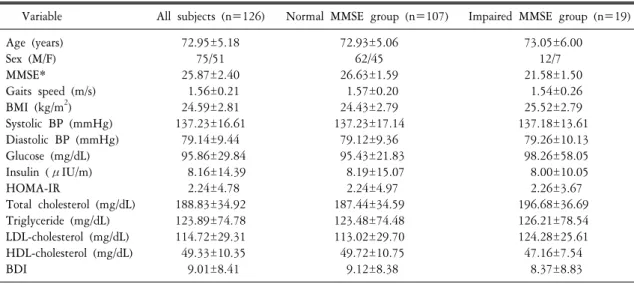
Table 1. General characteristics
Variable All subjects (n=126) Normal MMSE group (n=107) Impaired MMSE group (n=19)
Age (years) 72.95±5.18 72.93±5.06 73.05±6.00
Sex (M/F) 75/51 62/45 12/7
MMSE* 25.87±2.40 26.63±1.59 21.58±1.50
Gaits speed (m/s) 1.56±0.21 1.57±0.20 1.54±0.26
BMI (kg/m
2) 24.59±2.81 24.43±2.79 25.52±2.79
Systolic BP (mmHg) 137.23±16.61 137.23±17.14 137.18±13.61
Diastolic BP (mmHg) 79.14±9.44 79.12±9.36 79.26±10.13
Glucose (mg/dL) 95.86±29.84 95.43±21.83 98.26±58.05
Insulin (μIU/m) 8.16±14.39 8.19±15.07 8.00±10.05
HOMA-IR 2.24±4.78 2.24±4.97 2.26±3.67
Total cholesterol (mg/dL) 188.83±34.92 187.44±34.59 196.68±36.69 Triglyceride (mg/dL) 123.89±74.78 123.48±74.48 126.21±78.54 LDL-cholesterol (mg/dL) 114.72±29.31 113.02±29.70 124.28±25.61 HDL-cholesterol (mg/dL) 49.33±10.35 49.72±10.75 47.16±7.54
BDI 9.01±8.41 9.12±8.38 8.37±8.83
Independent t-test. *P<0.0001.
력, 신체계측치, 혈액검사의 차이가 있는지 알아보기 위해 t 검정을 시행하였고 인지기능과 걸음걸이 속도 와의 연관성을 알아보기 위해 피어슨 상관분석을 시행하였다. 성별, 연령, 음주, 흡연, 교육정도, 체질량지수 및 허리둘레를 통제하였을 때 인지기능에 독립적인 영향을 미치는 요인을 알아보기 위해 다중회귀분석을 이용하였다. 모든 분석은 SPSS 12.0 for window를 이용하였고 P값이 0.05 미만일 때 통계적 유의성이 있는 것으로 간주하였다.
결 과
1. 일반적인 특성 및 인지기능에 따른 비교
대상자 126명 중 평균 연령은 72.95±5.18세(60∼85세), 남자가 75명(59.5%), 여자가 51명(40.5%)이며 MMSE 평균점수는 25.87±2.40점, 평균 걸음걸이 속도는 1.56±0.21 m/s로 나타났다.
대상자를 KMMSE의 값에 따라 정상 인지기능군(KMMSE score>24, n=107)과 인지기능 저하군(KMMSE≤
24, n=19)으로 나누었을 때 두 군 간의 KMMSE를 제외한 연령, 체질량지수, 수축기 및 이완기 혈압, 인슐린 저항성을 나타내는 HOMA-IR, 총콜레스테롤, 중성지방, LDL, HDL 및 BDI 모두 통계적으로 유의한 차이는 없었다. 걸음걸이 속도도 두 군간의 유의한 차이는 없었지만 인지기능 저하군이 정상군에 비해 느린 속도를 나타냈다(Table 1).
2. 인지기능과 걸음걸이 속도 및 다른 위험인자와의 관련성
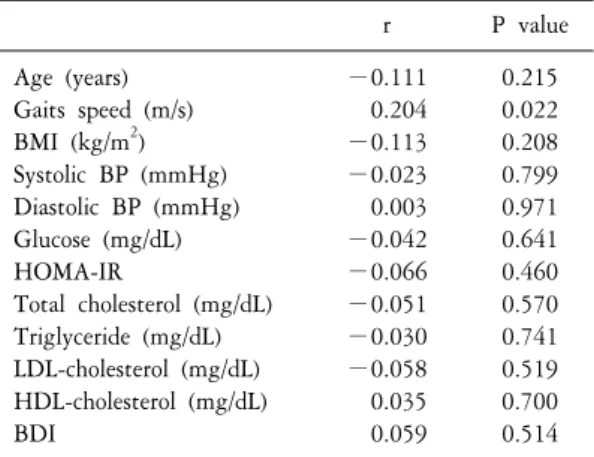
인지기능과 걸음걸이 속도 및 인지기능에 영향을 줄 수 있는 위험인자 가운데 심혈관 위험인자
31,32)와의
관련성을 알아보기 위해 피어슨 상관분석을 시행하였다. KMMSE값과 걸음걸이 속도는 양의 상관관계를
보였다. 걸음걸이 속도를 제외한 기타 심혈관 위험인자 및 BDI는 유의한 상관관계를 나타내지 않았다
(Table 2).
Table 2. Correlations between MMSE and other variables r P value
Age (years) −0.111 0.215
Gaits speed (m/s) 0.204 0.022
BMI (kg/m
2) −0.113 0.208
Systolic BP (mmHg) −0.023 0.799 Diastolic BP (mmHg) 0.003 0.971 Glucose (mg/dL) −0.042 0.641
HOMA-IR −0.066 0.460
Total cholesterol (mg/dL) −0.051 0.570 Triglyceride (mg/dL) −0.030 0.741 LDL-cholesterol (mg/dL) −0.058 0.519 HDL-cholesterol (mg/dL) 0.035 0.700
BDI 0.059 0.514
Table 3. Step-wise multiple linear regression analysis to identify clinical variables associated with MMSE score as a dependent variable
Parameter
Variables SE F value P value estimate
Gait speed 0.207 1.026 5.476 0.021 All variables left in the model are significant at the 0.15 level. No other variable met the 0.15 significance level for entry into the model. R2=0.043. Variables included in the step-wise model: age, gait speed, BMI, SBP, DBP, HOMA-IR, total cholesterol, TG, HDL, LDL, BDI.
연령, 체질량지수, 흡연력, 음주력, 교육정도를 통제하였을 때 인지기능에 독립적인 영향을 줄 수 있는 인자를 알아보기 위해 다중회귀분석을 시행하였을 때 걸음걸이 속도만이 독립적인 연관성이 있는 것으로 나타났다(Table 3).
고 찰
본 연구는 인지기능에 대한 조기진단의 한 방법으로 대두되고 있는 인지기능과 걸음걸이 속도와의 연관 성을 살펴보기 위해 거동이 가능하고 일상생활이 가능한 지역사회에 거주하는 60세 이상의 노인을 대상으 로 단면 연구를 시행하였다.
본 연구 결과, 다른 혼란변수를 보정한 후에 걸음걸이 속도만이 인지기능과 독립적인 연관성이 있음을 나타내었다. 상관계수는 크지 않지만 걸음걸이 속도가 느릴수록 인지기능의 저하가 나타남을 알 수 있었다.
이는 다른 많은 연구 결과와 일치한다.
9,13,33)일반적으로 걷는 것은 고위 인지기능이 관여하지 않는 자동적인
과정이라고 생각되었다. 즉, 리듬을 유지하면서 번갈아 가며 다리를 바꾸고 직립자세를 유지하는 “걷기”는
spinal cord level에서 조절되는 움직임이라고 생각했었다.
15,16)그래서 알츠하이머 질환이 있는 경우 그렇지
않은 군에 비해 낙상 위험이 3배 이상 증가한다는 보고는 굉장히 놀라운 사실이었다.
34,35)하지만 최근 걷기
는 어떤 환경에 대해 집중하고 실행으로 옮길 수 있어야 하며, 이러한 인지기능의 변화는 낙상위험과 연관
이 있을 수 있다는 연구들이 발표되고 있다.
13,36)일단 걷는 동작이 같은 움직임으로 훈련되고 반복되는
경우 주로 움직임을 조절하는 cortex (supplementary motor area {SMA}, primary sensorimotor areas, basal ganglia,
cerebellum)에서 활성을 갖게 된다. 하지만 목적을 향해 우리의 의도대로 움직이려고 하는 경우 dorso-lateral
prefrontal cortex (DLPFC), anterior cingulated gyrus, posterior parietal, middle, superior temporal gyri와 같은 인지영역
이 관여한다.
37-40)하지만 우리의 의도대로 움직이는 것과 반복된 움직임은 따로 분리되어 있는 것이 아니라
서로 통합되어 있다. 다시 말해 모든 움직임에는 인지기능과 서로 연관되어 조절된다. 우선 어떤 움직임을
하고자 계획할 경우 DLPFC에서 정보가 코딩되고, 그리고 나서 SMA에서는 posterior parietal association area와
superior temporal gyri로부터 정보가 들어온 후 일련의 움직임의 순서를 결정한다. 또한 hippocampus와
parahipocampal region에서는 공간적인 계획과 어떤 자극에 대해 기존의 저장된 기억과 비교하는 작업이 일어 나며 움직임에 대한 계획은 그 후 primary motor cortex로 전달된다. 이것은 동시에 basal ganglia와 cerebellum, spinal cord를 통해 자극이 전달되어 최종적으로 anterior cord에 있는 motor neuron에 전달된다. 즉 평상시처럼 걷는다는 것은 끊임없이 posterior sensory system으로부터 자극이 들어오고 이전에 학습된 motor program의 정보와 통합
37,40-43)함으로써 고위 인지기능과 통합되어 조절되는 과정이다.
44)따라서 걸음걸이 속도 저하와 인지기능 간의 연관성을 설명할 수 있는 기전은 다음과 같다. Hippocampal region의 위축으로 기억력 감퇴와 경미한 인지기능 장애, 혈관성 치매 및 frontotemporal dementia와 연관이 있을 뿐만 아니라 공간 지각력 장애 및 자극이 주어졌을 때 기존의 정보와 통합한 후 움직임에 대한 정보가 전달되어 자발적인 움직임을 일으키는 능력의 장애를 가져오게 되며 이는 결국 균형유지 장애, 보폭 감소 및 걸음걸이 속도 저하 등의 걸음걸이의 장애를 유발하게 된다.
17,45,46)또한 앞에서 언급한 집중력과 실행력 에 관여하는 prefrontal cortex의 장애도 인지기능 장애 및 걸음걸이의 이상을 유발하게 된다.
47-49)본 연구의 제한점은 모집된 피험자 수가 적다는 것과 단면연구이기 때문에 인지기능과 걸음걸이 속도 간의 원인관계를 알 수는 없다는 한계점이 있다. 또한 여러 가지 인자에 인해 영향을 받을 수 있는 KMMSE 만을 이용해 인지기능을 파악했다는 점에서도 제한점이 있다. 그래서 본 연구에서는 KMMSE에 영향을 줄 수 있는 교육수준 및 우울의 영향을 보정하였다. 그리고 움직임에 대한 강도를 고려하지 못했다는 한계점이 있다. 걸음걸이 속도가 지속적인 인지기능 장애 및 치매와 밀접한 연관성이 있지만 이외에도 움직임에 대한 강도, 즉 에너지 소비량도 인지기능과 밀접한 연관성이 있다는 많은 연구가 있다. 즉 에너지 소비량이 많을 수록, 유산소 운동을 지속적으로 유지한 군이 그렇지 않은 군에 비해 치매 발생도 적었을 뿐만 아니라 인지 기능이 향상되었다는 보고가 있다.
50)따라서 추후 걸음걸이와 인지기능에 관한 연구에는 걸음걸이 속도뿐 만 아니라 움직임에 대한 강도 및 평소 운동량에 대한 고려해야 할 것으로 생각되며 더 나아가 걸음걸이 속도 및 움직임을 강화시켰을 때 인지기능의 호전을 나타내는지에 대한 전향적 연구가 필요할 것으로 생각 된다.
참고문헌
1. Verghese J, Wang C, Lipton RB, Holtzer R, Xue X. Quantitative gait dysfunction and risk of cognitive decline and dementia.
J Neurol Neurosurg Psychiatry 2007;78:929-35.
2. Kim J, Jeong I, Chun JH, Lee S. The prevalence of dementia in a metropolitan city of South Korea. Int J Geriatr Psychiatry 2003;18:617-22.
3. Hageman PA, Thomas VS. Gait performance in dementia: the effects of a 6-week resistance training program in an adult day-care setting. Int J Geriatr Psychiatry 2002;17:329-34.
4. Lord SR, Lloyd DG, Li SK. Sensori-motor function, gait patterns and falls in community-dwelling women. Age Ageing 1996;25:292-9.
5. Snijders AH, van de Warrenburg BP, Giladi N, Bloem BR. Neurological gait disorders in elderly people: clinical approach and classification. Lancet Neurol 2007;6:63-74.
6. Onen F, Henry-Feugeas MC, Roy C, Baron G, Ravaud P. Mobility decline of unknown origin in mild cognitive impairment:
an MRI-based clinical study of the pathogenesis. Brain Res 2008;1222:79-86.
7. Hall CB, Lipton RB, Sliwinski M, Stewart WF. A change point model for estimating the onset of cognitive decline in preclinical Alzheimer's disease. Stat Med 2000;19:1555-66.
8. Boyle PA, Wilson RS, Buchman AS, Aggarwal NT, Tang Y, Arvanitakis Z, et al. Lower extremity motor function and disability in mild cognitive impairment. Exp Aging Res 2007;33:355-71.
9. Marquis S, Moore MM, Howieson DB, Sexton G, Payami H, Kaye JA, et al. Independent predictors of cognitive decline in healthy elderly persons. Arch Neurol 2002;59:601-6.
10. van Iersel MB, Hoefsloot W, Munneke M, Bloem BR, Olde Rikkert MG. Systematic review of quantitative clinical gait analysis in patients with dementia. Z Gerontol Geriatr 2004;37:27-32.
11. Waite LM, Grayson DA, Piguet O, Creasey H, Bennett HP, Broe GA. Gait slowing as a predictor of incident dementia: 6-year longitudinal data from the Sydney Older Persons Study. J Neurol Sci 2005;229-230:89-93.
12. Wang L, Larson EB, Bowen JD, van Belle G. Performance-based physical function and future dementia in older people. Arch Intern Med 2006;166:1115-20.
13. Camicioli R, Wang Y, Powell C, Mitnitski A, Rockwood K. Gait and posture impairment, parkinsonism and cognitive decline in older people. J Neural Transm 2007;114:1355-61.
14. Wilson RS, Schneider JA, Bienias JL, Evans DA, Bennett DA. Parkinsonianlike signs and risk of incident Alzheimer disease in older persons. Arch Neurol 2003;60:539-44.
15. Dietz V. Neurophysiology of gait disorders: present and future applications. Electroencephalogr Clin Neurophysiol 1997;103:
333-55.
16. Shik ML, Orlovsky GN. Neurophysiology of locomotor automatism. Physiol Rev 1976;56:465-501.
17. Bland BH, Oddie SD. Theta band oscillation and synchrony in the hippocampal formation and associated structures: the case for its role in sensorimotor integration. Behav Brain Res 2001;127:119-36.
18. Jordan K, Schadow J, Wuestenberg T, Heinze HJ, Jancke L. Different cortical activations for subjects using allocentric or egocentric strategies in a virtual navigation task. Neuroreport 2004;15:135-40.
19. Malouin F, Richards CL, Jackson PL, Dumas F, Doyon J. Brain activations during motor imagery of locomotor-related tasks:
a PET study. Hum Brain Mapp 2003;19:47-62.
20. Filley CM. The behavioral neurology of cerebral white matter. Neurology 1998;50:1535-40.
21. Scherder E, Eggermont L, Swaab D, van Heuvelen M, Kamsma Y, de Greef M, et al. Gait in ageing and associated dementias;
its relationship with cognition. Neurosci Biobehav Rev 2007;31:485-97.
22. Ra HJ, Park GS, Do HJ, Choi JK, Joe HG, Kweon HJ, et al. Factors influencing the impulse of suicide in adolescence. J Korean Acad Fam Med 2006;27:988-97.
23. Folstein MF, Folstein SE, McHugh PR. "Mini-mental state". A practical method for grading the cognitive state of patients for the clinician. J Psychiatr Res 1975;12:189-98.
24. Dick JP, Guiloff RJ, Stewart A, Blackstock J, Bielawska C, Paul EA, et al. Mini-mental state examination in neurological patients.
J Neurol Neurosurg Psychiatry 1984;47:496-9.
25. 권용철, 박종한, 노인용. 한국판 Mini-Mental State Examination (MMSE-K)의 표준화 연구. 제 1편: MMSE-K의 개발. 신경 정신의학 1989;28:125-35.
26. 박종한, 권용철, 노인용. 한국판 Mini-Mental State Examination (MMSE-K)의 표준화 연구. 제 2편: 구분점 및 진단적 타당도. 신경정신의학 1989;28:508-13.
27. Guralnik JM, Ferrucci L, Pieper CF, Leveille SG, Markides KS, Ostir GV, et al. Lower extremity function and subsequent disability:
consistency across studies, predictive models, and value of gait speed alone compared with the short physical performance battery.
J Gerontol A Biol Sci Med Sci 2000;55:M221-M31.
28. Montero-Odasso M, Schapira M, Soriano ER, Varela M, Kaplan R, Camera LA, et al. Gait velocity as a single predictor of adverse events in healthy seniors aged 75 years and older. J Gerontol A Biol Sci Med Sci 2005;60:1304-9.
29. Studenski S, Perera S, Wallace D, Chandler JM, Duncan PW, Rooney E, et al. Physical performance measures in the clinical setting. J Am Geriatr Soc 2003;51:314-22.
30. Rosano C, Simonsick EM, Harris TB, Kritchevsky SB, Brach J, Visser M, et al. Association between physical and cognitive function in healthy elderly: the health, aging and body composition study. Neuroepidemiology 2005;24:8-14.
31. de la Torre JC. Alzheimer disease as a vascular disorder: nosological evidence. Stroke 2002;33:1152-62.
32. van Oijen M, de Jong FJ, Witteman JC, Hofman A, Koudstaal PJ, Breteler MM. Atherosclerosis and risk for dementia. Ann Neurol 2007;61:403-10.
33. Barberger-Gateau P, Fabrigoule C, Helmer C, Rouch I, Dartigues JF. Functional impairment in instrumental activities of daily living: an early clinical sign of dementia? J Am Geriatr Soc 1999;47:456-62.
34. Imamura T, Hirono N, Hashimoto M, Kazui H, Tanimukai S, Hanihara T, et al. Fall-related injuries in dementia with Lewy
bodies (DLB) and Alzheimer's disease. Eur J Neurol 2000;7:77-9.
35. Morris JC, Rubin EH, Morris EJ, Mandel SA. Senile dementia of the Alzheimer's type: an important risk factor for serious falls.
J Gerontol 1987;42:412-7.
36. Nakamura T, Meguro K, Sasaki H. Relationship between falls and stride length variability in senile dementia of the Alzheimer type. Gerontology 1996;42:108-13.
37. D'Esposito M, Ballard D, Zarahn E, Aguirre GK. The role of prefrontal cortex in sensory memory and motor preparation: an event-related fMRI study. Neuroimage 2000;11(5 Pt 1):400-8.
38. Gopher D. Attention control: explorations of the work of an executive controller. Brain Res Cogn Brain Res 1996;5:23-38.
39. Johansen-Berg H, Matthews PM. Attention to movement modulates activity in sensori-motor areas, including primary motor cortex. Exp Brain Res 2002;142:13-24.
40. Jueptner M, Stephan KM, Frith CD, Brooks DJ, Frackowiak RS, Passingham RE. Anatomy of motor learning. I. Frontal cortex and attention to action. J Neurophysiol 1997;77:1313-24.
41. Badgaiyan RD. Executive control, willed actions, and nonconscious processing. Hum Brain Mapp 2000;9:38-41.
42. de Jong BM, van Zomeren AH, Willemsen AT, Paans AM. Brain activity related to serial cognitive performance resembles circuitry of higher order motor control. Exp Brain Res 1996;109:136-40.
43. Jueptner M, Frith CD, Brooks DJ, Frackowiak RS, Passingham RE. Anatomy of motor learning. II. Subcortical structures and learning by trial and error. J Neurophysiol 1997;77:1325-37.
44. Sheridan PL, Hausdorff JM. The role of higher-level cognitive function in gait: executive dysfunction contributes to fall risk in Alzheimer's disease. Dement Geriatr Cogn Disord 2007;24:125-37.
45. Nutt JG. Classification of gait and balance disorders. Adv Neurol 2001;87:135-41.
46. Wiener SI, Berthoz A, Zugaro MB. Multisensory processing in the elaboration of place and head direction responses by limbic system neurons. Brain Res Cogn Brain Res 2002;14:75-90.
47. Erickson CA, Barnes CA. The neurobiology of memory changes in normal aging. Exp Gerontol 2003;38:61-9.
48. Giladi N, Herman T, Reider G II, Gurevich T, Hausdorff JM. Clinical characteristics of elderly patients with a cautious gait of unknown origin. J Neurol 2005;252:300-6.
49. Pugh KG, Lipsitz LA. The microvascular frontal-subcortical syndrome of aging. Neurobiol Aging 2002;23:421-31.
50. Fabre C, Chamari K, Mucci P, Masse-Biron J, Prefaut C. Improvement of cognitive function by mental and/or individualized aerobic training in healthy elderly subjects. Int J Sports Med 2002;23:415-21.
51. 통계청. 장래인구추계 결과. 2001.