Introduction
코로나바이러스감염증-19 (이하 COVID-19)는 SARS- CoV-2에 의한 신종바이러스 감염질환으로 주로 호흡기 질환으로 발전하지만 신장, 심장, 소화기, 혈액 및 신경을 포함한 다양한 기관에 영향을 미칠 수 있다[1,2]. COV- ID-19의 일반적인 임상증상은 발열(98%), 기침(76%), 근
육통(18%) 및 피로감(18%)이며, 어린이를 제외하고는 콧 물, 객담을 수반한 기침 등의 상기도감염 증상은 드물게 나 타난다[3]. 약 0.5%-9%의 COVID-19 확진 환자에서 급성 신장손상(acute kidney injury)이 발생하는 것으로 보고 [4,5]되고 있어 질병과정 중 투석 치료가 필요한 상황이 언 제든 발생할 수 있으며, 말기 신질환 환자 중 특히 혈액 투 석 환자들의 경우 면역기능이 저하되어 있거나, 고령, 당뇨
pISSN 2508-5999 • eISSN 2671-9886
Review Article
코로나바이러스감염증-19 대응을 위한 투석환자 감염관리
최지연
1ㆍ손희정
2ㆍ차경숙
3ㆍ김성란
4ㆍ신명진
5ㆍ최종림
6ㆍ한시현
7중앙대학교병원 감염관리팀1, 이화여자대학교 목동병원 감염관리실2, 선문대학교 간호학과3, 고려대학교 구로병원 감염관리실4, 분당서
울대학교병원 감염관리실5, 삼성서울병원 감염병대응센터 감염관리실6, 단국대학교의과대학부속병원 감염관리팀7
Infection Control of Dialysis Patients for Coronavirus Infectious Disease-19 Response
Ji Youn Choi
1, Hee Jung Son
2, Kyeong-Sook Cha
3, Sung Ran Kim
4, Myoung Jin Shin
5, Jong Rim Choi
6, Si Hyeon Han
7Infection Control Team, Chungang University Hospital1, Infection Control Office, Ewha Womans University Mokdong Hospital2, Seoul, Department of Nursing Science, Sun Moon University3, Asan, Infection Control Office, Korea University Guro Hospital4, Seoul, Infection Control Office, Seoul National University Bundang Hospital5, Seongnam, Center for Infection Prevention and Control, Samsung Medical Center6, Seoul, Infection Control Department, Dankook University Hospital7, Cheonan, Korea
Received June 4, 2020 Revised June 16, 2020 Accepted June 17, 2020
Corresponding author:
Kyeong Sook Cha
E-mail: [email protected] ORCID:
https://orcid.org/0000-0002-7307-898X
The effects of coronavirus disease 19 (COVID-19) on patients with chronic kidney disease have not yet been fully studied, but acute kidney damage has been reported in some COV- ID-19 patients. Hemodialysis is an essential treatment for patients with chronic kidney disease and they receive treatment for extended periods of time in congested spaces such as artificial kidney rooms. Because suspected or confirmed COVID-19 patients must visit medical institu- tions regularly for dialysis treatment, it is necessary to take efficient and safe infection control measures to prevent infections from spreading to medical staff or other patients during he- modialysis. Due to artificial kidney rooms receiving a high number of patients for outpatient treatment, it is important to assess the patients before admission. Therefore, a monitoring sys- tem is needed to check the epidemiological relevance and possible symptoms of COVID-19.
Even if they are not epidemiologically related to COVID-19, patients with fever or respiratory symptoms should receive treatment in isolation rooms, while patients with suspected or con- firmed COVID-19 infection should use negative-pressure isolation rooms. The medical staff participating in dialysis treatment for COVID-19 patients should wear appropriate personal protective equipment and provide specific guidelines for equipment, environmental, and waste management according to institutional circumstances.
Key Words: COVID-19, Dialysis, Education, Guideline, Infection control
Copyright ⓒ Korean Society for Healthcare-associated Infection Control and Prevention
This is an Open Access article distributed under the terms of the Creative Commons Attribution Non-Commercial License (http://creativecommons.org/
병과 같은 동반 질환이 있는 경우가 흔하기 때문에 감염에 취약하다. 또한 투석환자들이 SARS-CoV-2에 감염될 경 우 질환이 더 심각한 상태로 진행될 위험이 있어 각별한 주 의가 필요하다.
혈액투석은 COVID-19와 같은 감염병 유행 기간에도 반드시 정기적으로 의료기관에 방문하여 통원치료를 받아 야 하는 치료방법이다. 혈액투석은 인공신장실 등 특정 공 간에서만 제공이 가능하므로 대부분의 환자들은 밀폐된 공 간에서 환자들이 밀집한 상태로 장시간 동안 투석 치료를 받게 된다. 이 때문에 인공신장실에서 COVID-19 환자가 발생한 경우 의료진은 물론 환자의 가족에게로 감염이 전 파될 위험이 높다[3,6,7]. 혈액투석은 생명유지를 위해 필 수적인 치료방법이므로 COVID-19 의심 또는 확진 환자 라 하더라도 반드시 의료기관의 인공신장실 등에 방문하여 야 한다. 따라서 혈액투석을 하는 시간 동안 의료진이나 다 른 환자에게 감염을 전파하지 않도록 효율적이고 안전한 감염관리 대책을 마련하여야 한다.
이에 COVID-19 의심 또는 확진 환자 투석과정에서 발 생할 수 있는 감염전파를 예방하기 위한 실제적인 감염관 리 내용을 기술하여 COVID-19 환자를 돌보는 의료현장 에 도움을 주고자 한다.
Main Body
1. 투석 전 관리
인공신장실은 다수의 환자가 장시간 동안 제한된 공간에 있어야 하며, 인공신장실로 입실하기 전 갱의실, 대기실 등 밀폐된 공용 공간을 이용한다. 따라서 COVID-19 환자 발 생 시 감염전파의 위험이 높으므로 인공신장실 입실 전 환 자선별(screening)이 중요하다. 인공신장실에 내원하는 환자의 COVID-19 감염 또는 감염의심 여부를 조기에 인 지할 수 있도록 환자가 병원에 도착하기 전 또는 인공신장 실 입실 전 COVID-19 의심 증상을 확인하는 감시체계가 필요하다. 또한 대기 장소에서 여러 환자들이 서로 접촉하 는 것을 최소화하기 위해 인공신장실을 예약제로 운영하고 철저하게 시간을 준수하도록 환자에게 교육하여야 한다.
혈액투석 일정이 결정되면 방문 전 안내를 통해 발열 또는 호흡기 증상 유무, 확진자 접촉 또는 COVID-19 유행장소 또는 위험지역 방문 여부를 확인하여 해당되는 사항이 있 다면 병원 방문 전 관할 보건소 또는 콜센터에 문의한 후 지시에 따르도록 안내한다[6]. 정기적으로 내원하는 환자
의 경우 용이하게 증상 보고를 할 수 있도록 해당 혈액투석 일에 문자 전송을 하거나 자동녹음전화(robocall) 등의 자 동화된 의사소통(automated communications) 방법을 활용할 수 있다[7].
발열이나 호흡기 증상이 있으면 병원 방문 전 보건당국 은 물론 인공신장실 의료진에 연락하여 보고하도록 교육 하고[6], 직원이 환자 도착 전 필요한 사항을 미리 준비하 거나 좀 더 적절한 시설이나 장소로 환자를 안내하여 분류 (triage)할 수 있도록 한다. 발열이나 호흡기 증상이 있는 환자는 다른 환자들과 함께 대기하지 않도록 하며, 환자 간 2미터 이상의 간격이 유지되면서 환기가 잘 되는 별도의 공간에서 환자들이 대기할 수 있도록 한다[7].
투석 전 또는 투석 중 COVID-19 의심 환자가 발생했을 때를 대비하여 별도의 공간을 준비해야 한다. 의심 환자 발 생을 확인한 경우 즉시 추가적인 평가(assessment)를 위 해 환자를 미리 준비한 별도의 공간에 격리하고, 기관 내 적절한 시설이나 다른 기관으로 이송하기 전까지 대기하도 록 한다.
거동이 불편하거나 시야가 보이지 않아 혼자 이동이 어 려운 환자를 제외하고 보호자의 동반을 금지하여 불필요한 방문을 제한한다. 또한 투석환자의 문진 시 함께 거주하는 가족 또는 동거인에 대한 COVID-19 관련 역학적 위험요 인(예, 증상 유무, COVID-19 확진자 접촉, 위험지역 방문 등)을 문진하여 대응하는 것도 초기 전파를 예방할 수 있는 방법이다.
환자들이 환자선별 중임을 인지할 수 있도록 인공신장 실 출입구와 대기 장소에 발열 또는 호흡기 감염 증상이 있 는 환자에 대한 안내사항을 게시한다. 손위생, 호흡기 예절 (respiratory hygiene and cough etiquette)에 대한 안 내문을 제공하고, 인공신장실을 출입할 때 반드시 마스크 를 착용하고, 손위생을 수행하도록 한다. 손위생과 기침예 절을 준수할 수 있도록 침상, 의자, 간호사실 등 치료 공간 근처에 관련 물품을 비치한다. 환자와 접촉하는 공간에는 가급적 반드시 필요한 물품만 비치하며, 잡지나 신문과 같 은 공용 물품은 비치하지 않는다.
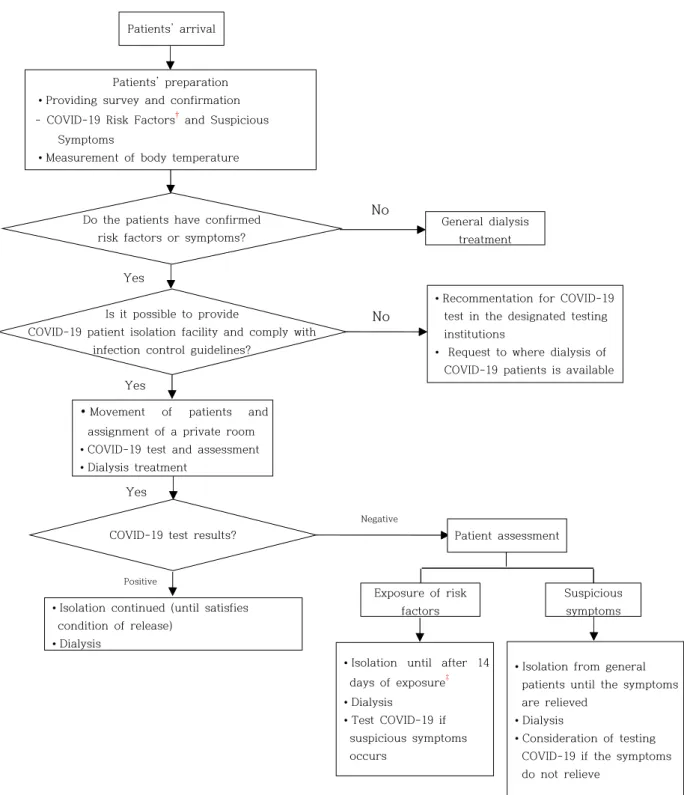
인공신장실에서 COVID-19 의심환자를 확인한 후 신속 하게 대응할 수 있도록 COVID-19 선별과 평가방법을 구 조화하면 Fig. 1과 같다. 이는 캐나다의 외래투석환자를 위 한 COVID-19 지침[8]과 대한신장학회ㆍ대한투석협회의 투석 환자에 대한 COVID-19 선별 및 관리 지침[6]을 바 탕으로 인공신장실에서 일반적으로 COVID-19 의심 환자 를 선별하여 평가하는 절차를 정리한 것이다. 투석 전 CO- 최지연/손희정/차경숙/김성란/신명진/최종림/한시현
12 www.kjicp.org
Patients’ arrival
Patients’ preparation ∙Providing survey and confirmation - COVID-19 Risk Factors
†and Suspicious
Symptoms
∙Measurement of body temperature
Do the patients have confirmed risk factors or symptoms?
Yes
Is it possible to provide
COVID-19 patient isolation facility and comply with infection control guidelines?
Yes
∙ Movement of patients and assignment of a private room
∙COVID-19 test and assessment
∙Dialysis treatment
No
General dialysis treatment
Yes
No
∙Recommentation for COVID-19 test in the designated testing institutions
∙ Request to where dialysis of COVID-19 patients is available
COVID-19 test results?
Positive
∙Isolation continued (until satisfies condition of release)
∙Dialysis
Negative
Patient assessment
Exposure of risk factors
Suspicious symptoms
∙Isolation from general patients until the symptoms are relieved
∙Dialysis
∙Consideration of testing COVID-19 if the symptoms do not relieve
∙Isolation until after 14 days of exposure
‡∙Dialysis
∙Test COVID-19 if suspicious symptoms occurs
*
based on revised Guideline: Novel coronavirus (COVID-19) for hemodialysis outpatients from BC Renal in 2020, Guideline for response of Coronavirus infectious diseases-19 (1-3 edition) (Dialysis Facility) from the Korean Society of Nephrology and Korean Society for Dialysis Therapy in 2020.
†
COVID-19 risk factors: Contact with COVID-19 confirmed patients within the last 14
Fig. 1.
COVID-19 screening and evaluation procedure for dialysis patients.*Based on revised Guideline: Novel coronavirus (COVID-19) for hemo dialysis outpatients from BC Renal in 2020, Guideline for response of Coronavirus infectious diseases-19 (1-3 edition) (Dialysis Facility) from the Korean Society of Nephrology and Korean Society for Dialysis Therapy in 2020.
†COVID-19 risk factors: Contact with COVID-19 confirmed patients within the last 14 days, visits over seas, visits to areas or places of dis ease spread and danger.
‡Disclosure of isolation can be deter mined based on clinical judgment on patients and guidelines from health authorities.
VID-19에 대한 역학적 관련성과 의심 증상을 확인한 후 해당 환자의 경우, COVID-19 환자 치료를 위한 시설이나 감염관리지침 적용이 가능한 기관에서 COVID-19 검사와 투석치료를 시행할 수 있도록 한다. 각 의료기관에서는 이 를 참고하여 기관의 상황에 맞는 구체적인 대응 전략을 수 립하고 실무에 적용하도록 한다.
2. 투석 시 관리
COVID-19 의심 및 확진 환자의 투석 시에는 감염 전 파를 예방하기 위하여 아래와 같은 감염관리 절차를 권고 한다. 만약 신장 손상이 급성으로 진행되는 경우라면 임상 의의 판단에 따라 지속적 신대체요법(continuous renal replacement therapy: CRRT)을 실시할 수 있다. 지속 적 신대체요법은 24시간 지속적으로 노폐물의 제거, 전해 질 및 산염기 불균형 교정과 체액의 균형을 조절하는 치료 방법[9]으로 환자가 인공신장실로 이동하지 않고 격리실에 서 치료받을 수 있다는 장점이 있으나 의료진이 투석환자 에 따라 24시간 동안 격리실에 체류하면서 환자 상태를 모 니터링 해야 하므로 장시간 의료진 노출이 불가피하다. 지 속적 신대체요법을 적용하는 경우에도 간헐적 혈액투석 (intermittent hemodialysis)과 동일한 기본적인 감염관 리 지침을 적용한다[10].
1) 환자 배치(Patient placement)
COVID-19와 역학적 관련성이 없더라도 발열이나 호흡 기 증상 등이 있는 환자는 가능한 격리실(독립된 공간)에서 투석한다. 격리실을 사용할 수 없다면, 인공신장실 내 주요 이동경로와 떨어진 구석이나 가장 끝자리에 환자를 배치한 다. 이때 인접한 침상과의 간격을 2미터 이상으로 유지하 거나 커튼이나 스크린과 같은 물리적 차단막을 설치한다.
COVID-19 의심 또는 확진 환자는 음압이 유지되는 격 리실에서 투석 치료를 한다. 환자가 입원 중인 경우 인공신 장실로 이동하는 과정에서 다른 사람이 노출되거나 환경이 오염될 위험이 있으므로 가능하다면 입원하고 있는 격리 실 내에서 투석이 가능하도록 설비를 갖춘다. 불가피하게 인공신장실로 이동해야 하는 경우, 다른 환자들과의 접촉 을 차단시키기 위해 당일 혈액투석 일정 중 가장 마지막 시 간으로 배정하며, COVID-19 환자 이송 절차에 따라 주변 통제 하에 지정된 경로로 이송한다. 인공신장실 내 음압격 리실에 전실이 없다면 음압격리실 앞 또는 옆에 개인보호 구를 착ㆍ탈의할 수 있는 공간을 마련하고, 교차 감염을 예
방하기 위하여 청결 구역과 오염 구역으로 나누어 관리한 다.
2) 개인보호구
의료기관 종사자는 상황에 따라 적절한 개인보호구를 선택하여 착용해야 한다. COVID-19 의심 또는 확진환 자를 돌보는 의료종사자의 개인보호구는 각 국가 또는 전 문 기관에 따라 권장하는 개인보호구의 종류에 일부 차이 가 있다. 세계보건기구(World Health Organization, 이 하 WHO)에서는 COVID-19 환자를 직접 대면하는 의료 종사자는 의료용 마스크(medical mask), 가운, 장갑, 안 면보호구 또는 고글을 착용하도록 하고, 에어로졸 생성 처 치 시 N95 호흡기보호구, 가운, 장갑, 안면보호구 또는 고 글, 앞치마의 착용을 권고한다[11]. 미국질병통제예방센 터(Centers for Disease Control and Prevention)에서 는 환자접촉 시 N95 호흡기보호구, 가운, 장갑, 안면보호 구 또는 고글의 착용을 권장하고[12], 호주에서는 수술용 마스크(surgical mask), 긴팔가운, 장갑, 안면보호구 또는 고글을 착용하되 밀접접촉 빈도가 높거나 에어로졸 생성 처치를 시행할 때는 N95 호흡기보호구를 사용하도록 권고 하고 있다[13]. 또한 국제신장학회에서는 투석환자에게 정 기적인 검사(routine examination)를 시행하는 의료진은 수술용 마스크, 앞치마, 장갑, 안면보호구를 착용하고, 에 어로졸 생성 처치를 하는 경우 N95 호흡기보호구, 가운(없 을 경우 앞치마), 장갑, 안면보호구를 착용할 것을 권고하 고 있어[14], Table 1에서 기술한 국내 기준과 차이가 있 는 것을 알 수 있다. 국내에서는 COVID-19 의심 또는 확 진환자를 대면하여 진료, 간호, 검사 등을 시행하는 경우 KF94 또는 N95 호흡기보호구, 일회용 방수성 긴팔가운 또는 전신보호복(덧신 포함), 장갑, 고글 또는 안면보호구 를 착용하도록 하고 있어, 다른 국가나 전문 기관들에 비하 여 의료 종사자들의 안전을 위하여 개인보호구 권고 기준 을 강화한 것을 확인할 수 있다.
투석환자는 투석이 진행되는 동안 금기가 아니라면 마스 크를 계속 착용하고 적절한 호흡기 예절을 준수해야 한다 [6,15].
[고려사항]
질병관리본부의 지침[16]에 따르면 접촉자의 범위는 “추 정 또는 확진 환자와 1미터 이내 거리에서 15분 이상 대 면 접촉, 추정 또는 확진 환자와 직접적인 신체적 접촉, 적 절한 개인보호구를 하지 않고 추정 또는 확진환자를 직접 최지연/손희정/차경숙/김성란/신명진/최종림/한시현
14 www.kjicp.org
3) COVID-19 의심 및 확진 환자 이송
COVID-19 환자를 이송할 때에는 감염전파 위험을 최 소화하기 위하여 전담 이송팀을 구성하고 관련 부서 간 연 락체계를 구축한다. 이송팀에는 병동, 인공신장실, 이송요 원, 보안, 청소 부서 등이 포함될 수 있으며, 환자가 출발하 는 부서에서는 사전에 이송팀에 환자 및 이송과 관련된 정 보를 제공한다. 이동 경로가 통제되면 적절한 개인보호구 를 착용한 후 이송팀이 환자를 이송한다. 환자 이송 시 가 능한 주변 노출을 최소화 할 수 있는 경로를 지정하여 전용 으로 사용하고, 다른 사람들이 접근하지 못하도록 차단 장 치를 설치한다. 승강기로 이동한 경우에는 환자 이송 후 소
독제를 사용하여 승강기 내·외부의 표면을 소독한다.
4) 기구 및 환경 관리
SARS-CoV-2는 적절한 온도 및 습도가 유지되는 경우 수 시간에서 수 일 동안 물체의 표면에 생존 가능하다. 따 라서 COVID-19 환자가 이용한 공간의 주변 환경, 기구, 장비, 물품 표면을 청소하고 소독하는 것은 매우 중요한 감염예방관리 방법이다. 투석 치료에 사용한 장비는 CO- VID-19 전파예방을 위한 추가소독에 대한 지침이 없으므 로 다른 환자에게 사용하기 전 제조사의 권고 사항에 따라 적절한 방법으로 세척과 소독을 시행한다. 다만 다른 장비 나 환경표면이 교차 오염되지 않도록 세심한 주의를 기울 여야 한다. 기구 소독에 사용하는 소독제는 COVID-19에 대한 식품의약품안전처의 용도별 승인을 받은 제품을 사용 해야 하는데 이 때, 해당 제품이 혈액매개 병원체(예; HIV, B형 간염 등)에 효과가 있는지도 함께 확인해야 한다[15].
COVID-19 환자에게 사용하는 물품이나 기구는 가능하 다면 일회용으로 사용하고 사용한 일회용 의료기구는 사용 후 모두 폐기한다. 불가피하게 재사용 기구나 물품을 사용 할 경우, 가능한 전용으로 사용하고 사용 후에는 주변을 오 염시키지 않도록 밀폐된 용기 등에 담아 수거한다. 수거된 기구와 물품은 재처리 장소로 이동하여 세척, 소독 또는 멸 균한다. 세척이나 소독 과정에 사용한 도구는 가능한 일회 용으로 사용하고 일회용 사용이 불가능한 경우 사용 직후 세척 및 소독한다.
COVID-19 환자가 이용한 공간의 주변 환경과 물품의 표면은 소독제를 사용하여 소독한다. 이때 환자가 사용한
Table 1. The personal protective gears for hemodialysis of COVID-19 suspected or confirmed patients*
Conditions
Respiratory Whole body Eye/face
Surgical mask
KF94/
respiratorN95 PAPR Disposable gloves†
Disposable waterproof long-sleeve
gowns
Full body protective equipment (including
shoe covers)
Goggles or facial protective equipment
Medical treatment, nursing care ● ● ● ●
Performing aerosol generation procedures ●‡ ● ● ●
Movement of patients (contact with patients) ● ● ● ●
Cleaning, disinfection ● ● ● ●
Packing and dealing with wastes ● ● ● ●
Transporting wastes ● ● ●
*Based on coronavirus infectious disease-19 response guidelines (For local governments) (8-1 edition) from Korea Centers for Disease Control and Prevention in 2020.
†In the cases of performing medical treatment, nursing, examination, cleaning, etc. on suspected and confirmed COVID-19 patient areas;
wearing double gloves considering the risk of damage to gloves and exposure to infection.
‡KF94/N95 respirator or PAPR.
Abbreviation: PAPR, powered air purifying respirators.
돌본 자 등이 포함된다.” 예를 들면, 의료기관 내 병실, 대 기실 등과 같은 공간에서 적절한 보호구를 착용하지 않은 채 2미터 이내에서 확진환자와 상당한 시간 동안 함께 머 문 자(의료진, 간병인 등)는 접촉자로 분류된다. 현재 의료 법 시설기준에 인공신장실의 병상 간 이격에 대한 기준이 없어 인공신장실의 경우 환자 간 2미터 이상의 간격을 유 지하지 못한 채 근접 접촉할 가능성이 높다. 따라서 CO- VID-19 유행기간에는 가능한 동일 증상군(예, 호흡기 증 상 있는 환자 군 등), 동일 투석시간 군(예, O요일 오전 투 석환자 군) 등으로 환자를 분류하여 환자 간 노출 기회를 최소화할 필요가 있다. 또한 혈액투석 중 환자와 환자 간의 대화를 자제하고 금기가 아니라면 음식 섭취를 금하게 하 는 등 인공신장실의 특성을 고려한 구체적인 지침을 마련 하여 환자를 교육하고 참여를 독려할 필요가 있다.
리모콘이나 전화기 등의 물품도 소독한다.
투석 치료 후 발생하는 모든 폐기물과 폐수, 세탁물은 정 해진 법령 및 규칙에 따라 처리하며, 격리실은 사용 후 절 차에 따라 청소 및 소독을 한 후 일정시간 비워둔다. 환경 소독제를 선택할 경우, COVID-19에 유효 성분으로 확인 되었거나 WHO 등 공식적인 기관에서 제시한 제제 중 환 경부의 승인 및 신고가 완료된 제품을 사용한다. 환경소독 제 사용 시에는 사용량, 희석농도, 주의사항을 준수하도 록 한다. 환자가 이용한 공간에 사용하는 환경 소독제의 주 요 성분별 유효 농도와 표면 접촉 시간은 Table 2와 같다 [17]. 세계보건기구는 환경 청소 및 소독 절차를 일관되고 정확하게 준수할 것을 강조하고 있으며, 효과적인 소독제 를 선택하여 적절하게 사용할 것을 권장하고 있다. 0.1%
농도의 차아염소산나트륨의 경우 적절한 방법으로 사용할 경우 1분 안에 코로나 바이러스를 비활성화 시킬 수 있다 [18].
COVID-19의 원인 바이러스인 SARS-CoV-2의 확산 은 주로 호흡기 비말을 통한 것으로 유추하며, 위장관, 타 액, 소변에서도 바이러스가 검출 될 수 있지만[19,20] 공 기 매개 전파에 대한 근거는 현재까지 확실하지 않다[10].
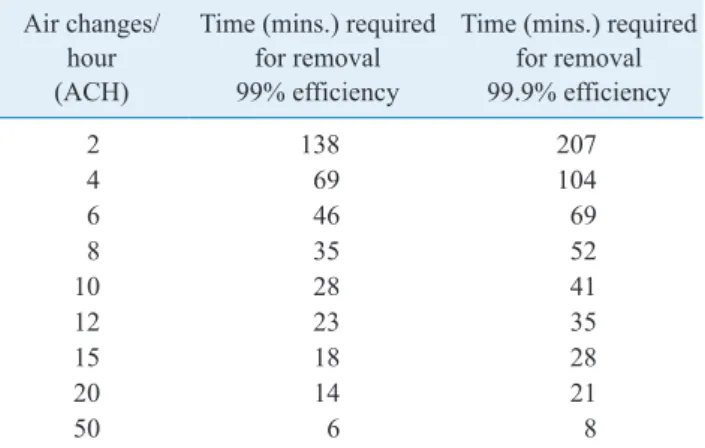
환자가 머물렀던 격리실 내부의 공기는 병실의 크기, 시간 당 공기 순환회수, 환자 체류 시간, 에어로졸 발생 시술 수 행 유무 등 여러 가지 요인에 따라 달라질 수 있다. 따라서 환자 퇴실 후 병실을 비워두는 시간은 시설 조건 및 상황을 고려해야 한다(Table 3) [21]. 에어로졸이 발생하는 시술 을 한 경우 감염전파위험도가 더 높은 것으로 가정하여 결 핵이나 홍역 등 공기를 매개로 전파하는 질환에 준하여 병 실을 비워둔다. 충분한 시간이 경과할 때까지 적절한 개인 보호구 없이 환자나 의료진이 격리실에 입실하는 것을 제 한한다[10].
COVID-19 유행 기간 동안 투석 환자의 의료기관 간 이 송은 가급적 피하며, 불가피한 경우 환자가 감염되지 않았 다는 확실한 객관적 근거가 있는 경우에만 해당 기관과 논 의한 후 환자를 이송한다[22].
3. 의료기관 종사자 관리
의료기관에서는 COVID-19 환자의 선별과 격리, 감염 확산을 예방하기 위해 의료기관 종사자를 대상으로 CO- VID-19 의심 증상, 감염관리 방법, COVID-19 환자 진료 구역 및 환자이동 동선 등에 대해 교육하고, 시각화된 안내 서 등을 제공하여 감염노출의 기회를 최소화하도록 한다.
또한 실무대응 능력 향상을 위해 개인보호구 착·탈의와 의 심환자 발생 시 격리방법, 환자 이송 방법 등에 대해 훈련
Table 2. Effective concentration, surface contact time, and application of environmental disinfectants in the patient's space*
Category Representative effective
concentration Effective concentration Surface contact time Subject of application Chlorine compound Sodium hypochlorite 0.1% (1,000 ppm) 1 minute or longer
(Refer WHO) Surface of patient’s space
0.5% (5,000 ppm) Disinfection of patient’s
blood and body fluid
Alcohol Ethanol 70-90% 1 minute
Surface of patient’s space
Isopropanol 50%
Quaternary ammonium
compounds Benzalkonium chloride 0.05-0.5% 10 minutes or longer
Peroxide Hydrogen peroxide 0.5% 5 minutes or longer
Phenolic compounds Chloroxylenol 0.12% 30 seconds or longer
*Based on coronavirus infectious disease-19 response: disinfection guideline for collective facilities and multi-use facilities (3-3 edition) from Korea Centers for Disease Control and Prevention in 2020.
Table 3.
Air changes/hour (ACH) and time required for airborne- contaminant removal by efficiency*Air changes/
(ACH)hour
Time (mins.) required for removal 99% efficiency
Time (mins.) required for removal 99.9% efficiency
2 138 207
4 69 104
6 46 69
8 35 52
10 28 41
12 23 35
15 18 28
20 14 21
50 6 8
*Based on guidelines for environmental infection control in health- care facilities (Appendix B Air) from Centers for Disease Con trol and Prevention in 2003.
최지연/손희정/차경숙/김성란/신명진/최종림/한시현
16 www.kjicp.org
Table 4. Coronavirus disease 2019 (COVID-19) outpatient dialysis facility preparedness assessment tool*
1. Infection prevention and control policies and training for healthcare personnel (HCP): Completed In progress Not started Facility leadership including, but not limited to, the Chief Medical Officer, quality officers,
medical directors, facility administrator, nurse manager, infection prevention personnel, chief operating officer, nephrologists, nurse practitioners has reviewed the Centers for Disease Control and Prevention's COVID-19 guidance for dialysis facilities
□ □ □
Facility provides education and job-specific training to HCP regarding COVID-19 including:
Signs and symptoms of COVID-19 □ □ □
Importance of hand hygiene, respiratory hygiene, cough etiquette and wearing a facemask □ □ □ Use of personal protective equipment (PPE) including competency evaluation □ □ □
Triage procedures and patient placement □ □ □
Institutions’ policies for HCP sick leave □ □ □
Self-monitoring for fever or respiratory symptoms □ □ □
Report system of patients who are COVID-19 suspected or confirmed □ □ □
Facility provides education to patients about the following:
Symptoms of COVID-19 and how COVID-19 is transmitted □ □ □
Importance of immediately informing HCP if they feel feverish or ill □ □ □
Infection control guidance (e.g., hand hygiene, covering their cough, maintaining and
wearing a facemask) □ □ □
Actions the facility is taking to keep the dialysis procedures safe (e.g., visitor restrictions,
changes in PPE) □ □ □
2. Process for rapidly identifying and isolating patients with confirmed or suspected COVID-19:
Facility has provided prior education to patients not to visit dialysis facilities if they have fever or respiratory symptoms, or has prepared with process to check patients by calling ahead and asking them to report fever or symptoms of respiratory infection
□ □ □
Installation of selective care center □ □ □
Signs are posted in triage areas (e.g., at entrance, and in waiting areas) advising patients with fever or symptoms of respiratory infection to immediately notify triage personnel so appropriate precautions can be put in place
□ □ □
Facemasks are equipped to all patients upon entry to the facility and kept on until they leave
the facility □ □ □
Alcohol based hand sanitizer for hand hygiene is available at each entrance, in waiting areas
and near treatment stations □ □ □
Facility has space of waiting area for ill patients (to sit separated from other patients by at
least 2 meters) □ □ □
Facility has a process to ensure patients with confirmed or suspected COVID-19 are placed
in the appropriate isolation area □ □ □
Facility has a process in place for immediate notification of facility leadership when a
suspect case is identified □ □ □
Facility has a process to notify local or state health department of a suspect case □ □ □ 3. Patient placement:
Confirm the number and location of available isolation rooms in the facility □ □ □ Facility has an isolation room for patients with undiagnosed respiratory infection □ □ □ If an appropriate isolation room is unavailable, facility has a designated dialysis station(s) at
a corner or end-of-row, away from the main flow of traffic, separated by at least 2 meters from nearest patient (in all directions), to dialyze a masked symptomatic patient
□ □ □
Facility has a plan for cohorting patients and HCP if they are dialyzing multiple patients with suspected or confirmed COVID-19 [e.g. in the same section of the unit and/or on the same shift - consider the last shift of the day]
□ □ □
Facility has plans to minimize the number of HCP who enter the isolation dialysis room (or isolation station) (e.g., having dedicated HCP to care for patients with suspected or confirmed COVID-19)
□ □ □
하고, 적절한 개인보호구를 제공하여 의료기관 종사자를 보호하도록 한다. 상시 손위생과 호흡기 예절을 준수할 것 을 독려하며, 의료기관 종사자들이 몸이 아플 경우 출근하 지 말고 집에서 쉴 수 있는 문화를 조성한다.
일상적으로 모든 의료진을 대상으로 발열 또는 호흡기 증상 유무 등을 모니터링하고 만일 COVID-19가 의심되 는 경우 최우선적으로 검사를 시행하고 업무에서 배제한다 [12].
4. 가정에서 복막투석 환자 관리
가정에서 복막투석을 하는 환자에게 투석에 필요한 약품 과 물품의 공급이 중단되는 일이 없어야 한다. 만약 복막투 석액 등의 부족이 예상될 경우, 공급업체와 협의하여 사전 에 대책을 마련하여야 한다. 또한 필요 시 환자가 의료기관 에 방문할 수 있도록 마스크 등 개인보호구를 준비해 둘 것 을 환자에게 교육한다.
전화나 문자를 이용한 환자 상담이나 관리가 필요할 수
Table 4. Continued
4. Transmission-Based Precautions: Completed In progress Not started
Facility has a procedure for supplying and assessing of personal protective equipment (PPE)
and other infection prevention and control supplies (e.g. hand hygiene supplies) □ □ □
Facility has a contingency plan to optimize PPE use during shortages □ □ □
Facility is providing all staff with face covering or face masks that are to be worn at all times
while in the facility □ □ □
HCP receive appropriate training on selection and proper use of (including putting on and
removing) PPE with a required demonstration of competency □ □ □
Facility has a process for auditing HCP adherence to recommended PPE use □ □ □
5. Movement of patients with confirmed or suspected COVID-19 within the dialysis facility:
Process of patient movement to the isolation room (isolation station) or other institutions
when COVID-19 suspected or confirmed patients were reported within the dialysis facility □ □ □
Patient will be asked to wear a facemask □ □ □
6. Hand hygiene (HH):
HH supplies including alcohol-based hand sanitizer are readily accessible in patient care
areas, including areas where HCP put on and remove PPE □ □ □
Facility has a process for auditing HCP adherence to recommended hand hygiene practices □ □ □ 7. Environmental management:
Facility has a appropriate guideline to ensure proper cleaning and disinfection of
environmental surfaces and equipment in the patient isolation room or station □ □ □ All HCP in the dialysis facility understand the environmental management guideline and the
instructions for use and contact time for selected products □ □ □
Disinfectants used in dialysis facilities must be approved by health authorities □ □ □ Facility uses disinfectants that are effective on bloodborne pathogens (HBV, HIV) □ □ □ 8. Monitoring and managing HCP:
Facility has sick leave policies for ill healthcare personnel (HCP) or those who reported they
have symptoms to stay home □ □ □
Facility has a process to conduct active-and/or self-monitoring of HCP □ □ □
Facility has a process to conduct symptom and temperature checks of HCP prior to the start
of the shift □ □ □
9. Visitor access and movement within the dialysis facility:
Facility has a plan to restrict or monitor visitors from entering the facility □ □ □ Visitors entering the facility will be required to wear a facemask at all times □ □ □ Visitors are screened for symptoms of acute respiratory infection before entering the facility □ □ □ 10. Facility maintains situational awareness of COVID-19 at the national level:
Facility regularly monitors the situation on COVID-19 which are reported at the national level □ □ □ Facility checks which institutions to contact within the local area that are available for
treatment and hospitalization of COVID-19 patients □ □ □
Facility maintains the system to cooperate with local health authorities □ □ □
*Based on Coronavirus disease 2019 (COVID-19) outpatient dialysis facility preparedness assessment tool from Centers for Disease Control and Prevention in 2020.
최지연/손희정/차경숙/김성란/신명진/최종림/한시현
18 www.kjicp.org
있으므로 의료기관에서는 이에 대한 대책을 마련해야 한 다. 환자가 의료기관을 방문해야 하는 경우 방문 전 환자선 별이 필요하며, 발열 및 증상이 있는 경우 의료기관 방문일 정을 연기할 수 있는지 평가한다. COVID-19 감염예방을 위하여 환자에게 다음의 사항을 교육할 수 있다[23]. ① 가 족이외 방문자의 자택 방문을 금하고 가능한 외출을 삼가 한다 ② 외출이 불가피할 경우, 마스크 착용, 손위생 및 사 회적 거리두기 등의 감염관리 지침을 준수한다 ③ 안전한 투석 치료를 위해 추가 약물이나 감염관리 물품이 필요한 지 의료기관에 문의한다 ④ 발열, 기침, 피로, 근육통, 호흡 곤란 및 인후염을 포함한 COVID-19 증상을 숙지하고 이 와 같은 증상이 나타나면 의료기관를 방문하지 않고 관할 보건소 또는 콜센터, 해당 의료기관에 연락하여 조치에 따 르도록 한다.
5. 환자 가족 및 간병인 관리
투석 환자와 함께 거주하는 모든 가족 구성원은 주기적 으로 체온을 측정하고 개인위생을 청결하게 유지해야 한 다. 가족 간 COVID-19 전파를 예방하기 위해 환자에게 적용되는 모든 예방 조치 및 규정에 따라야한다. 투석 환자 의 가족 또는 간병인이 COVID-19가 의심되거나 확진되 는 경우, 신속하게 의료기관에 알릴 것을 교육한다[3].
6. COVID-19 대비 인공신장실 준비사항 평가
미국질병통제예방센터(Centers for Disease Control and Prevention)에서는 투석환자가 내원하는 의료기관 을 위해 COVID-19 대응을 위한 의료기관의 준비사항을 Table 4와 같이 평가도구로 개발하여 배포하였다[24]. 투 석환자가 내원하는 의료기관에서는 이를 참조하여 준비정 도를 평가하고 부족한 부분을 보완할 필요가 있다.
Conclusion
코로나바이러스에 의해 발생하는 감염성 질환인 COV- ID-19는 현재 전 세계적으로 유행하고 있다. COVID-19 가 만성신장질환 환자에게 미치는 영향에 대해서는 아직 충분히 연구된 바가 없으나 COVID-19 환자이거나 확진 자와 접촉한 투석 환자의 감염관리는 다른 투석환자의 안 전을 보장하는데 매우 중요하다. 특히 정기적으로 의료기 관을 방문하여 장시간 동안 제한된 공간에서 많은 환자들
과 함께 있게 되는 인공신장실의 특성상 환자 발생 시 집단 감염의 위험이 높다. 집단감염의 발생으로 인공신장실이 폐쇄될 경우 환자들이 혈액투석을 받을 수 없는 상황에 놓 이게 되므로 의료공백이 발생할 수 있다. 따라서 의료기관 에서는 인공신장실 내 감염전파를 예방하기 위해서 매우 엄격한 프로토콜을 마련하여 적용해야 한다.
본 연구에서 제시한 COVID-19 대응 투석환자 감염관 리지침은 환자들이 주기적으로 기관에 방문하여 치료를 받 고 있는 외래 주사실, 치료방사선과, 작업치료실 등에도 적 용이 가능할 것이다.
Acknowledgements
본 연구는 2020년도 대한감염관리간호사회 정책연구로 수행되었음.
References
1. Wang D, Hu B, Hu C, Zhu F, Liu X, Zhang J, et al. Clini- cal characteristics of 138 hospitalized patients with 2019 novel Coronavirus-infected pneumonia in Wuhan, China.
JAMA 2020;323:1061-9.
2. World Health Organization. WHO web sites on report of the WHO-China joint mission on Coronavirus disease 2019 (COVID-19). https://www.who.int/docs/default- source/coronaviruse/who-china-joint-mission-on-covid- 19-final-report.pdf (Updated on 2 March 2020).
3. Naicker S, Yang CW, Hwang SJ, Liu BC, Chen JH, Jha V.
The novel Coronavirus 2019 epidemic and kidneys. Kid- ney Int 2020;97:824-8.
4. Ronco C, Reis T. Kidney involvement in COVID-19 and rationale for extracorporeal therapies. Nat Rev Nephrol 2020;16:308-10.
5. National Kidney Foundation. National Kidney Founda- tion web sites on dialysis & COVID-19. https://www.kid- ney.org/coronavirus/dialysis-covid-19#aki-and-covid-19 (Updated on 13 May 2020).
6. Korean Society of Nephrology and Korean Society for Dialysis Therapy. Korean Society of Nephrology web sites on guideline for response of Coronavirus infectious diseases-19 (1-3 edition) (Dialysis facility). http://www.
ksn.or.kr/rang_board/list.html?num=1626&code=notice (Updated on 16 March 2020).
7. Centers for Disease Control and Prevention. CDC web sites on screening dialysis patients for COVID-19, screening and triage at intake. https://www.cdc.gov/
coronavirus/2019-ncov/hcp/dialysis/screening.html (Up-
dated on 13 May 2020).
8. BC Renal. BC Renal web sites on guideline: novel Coro- navirus (COVID-19) for hemodialysis outpatients. http://
www.bcrenalagency.ca/resource-gallery/Documents/
COVID-19_Guideline_for_Hemodialysis_Programs.pdf (Updated on 3 June 2020).
9. Seo JW, Park JS. Continuous renal replacement therapy (CRRT). Korean J Crit Care Med 2001;16:115-8.
10. Centers for Disease Control and Prevention. CDC web sites on healthcare infection prevention and con- trol FAQs for COVID-19. https://www.cdc.gov/
coronavirus/2019-ncov/hcp/infection-control-faq.
html?CDC_AA_refVal=https%3A%2F%2Fwww.cdc.
gov%2Fcoronavirus%2F2019-ncov%2Finfection- control%2Finfection-prevention-control-faq.html (Up- dated on 13 May 2020).
11. World Health Organization. Rational use of personal protective equipment (PPE) for Coronavirus dis- ease (COVID-19). https://apps.who.int/iris/bitstream/
handle/10665/331498/WHO-2019-nCoV-IPCPPE_use- 2020.2-eng.pdf (Updated on 19 March 2020).
12. Centers for Disease Control and Prevention. CDC web sites on interim infection prevention and control recom- mendations for patients with suspected or confirmed Coronavirus disease 2019 (COVID-19) in health- care settings. https://www.cdc.gov/coronavirus/2019- ncov/hcp/infection-control-recommendations.
html?CDC_AA_refVal=https%3A%2F%2Fwww.cdc.
gov%2Fcoronavirus%2F2019-ncov%2Finfection- control%2Fcontrol-recommendations.html (Updated on 13 May 2020).
13. Australian Government Department of Health. Australian Government Department of Health web sites on personal protective equipment (PPE) for the health workforce dur- ing COVID-19. https://www.health.gov.au/news/health- alerts/novel-coronavirus-2019-ncov-health-alert/coro- navirus-covid-19-advice-for-the-health-and-aged-care- sector/personal-protective-equipment-ppe-for-the-health- workforce-during-covid-19 (Updated on 28 May 2020).
14. International Society of Nephrology. ISN web sites on recommendations for the novel Coronavirus 2019 epi- demic: kidney patients, health care professionals and family/caregivers. https://www.theisn.org/881 (Updated on 13 May 2020).
15. Centers for Disease Control and Prevention. CDC web sites on considerations for providing hemodialysis to patients with suspected or confirmed COVID-19 in acute
care settings. https://www.cdc.gov/coronavirus/2019- ncov/hcp/dialysis/dialysis-in-acute-care.html (Updated on 13 May 2020).
16. Korea Centers for Disease Control and Prevention.
KCDC web sites on coronavirus infectious disease-19 response guidelines (For local governments). (8-1 edi- tion). https://www.cdc.go.kr/board/board.es?mid=
a20507020000&bid=0019 (Updated on 12 June 2020).
17. Korea Centers for Disease Control and Prevention.
KCDC web sites on coronavirus infectious disease-19 re- sponse: disinfection guideline for collective facilities and multi-use facilities. (3-3 edition). https://www.cdc.go.kr/
board/board.es?mid=a20507020000&bid=0019 (Updated on 21 May 2020).
18. Kampf G, Todt D, Pfaender S, Steinmann E. Persistence of Coronaviruses on inanimate surfaces and their inacti- vation with biocidal agents. J Hosp Infect 2020;104:246- 51.
19. Lei H, Li Y, Xiao S, Lin CH, Norris SL, Wei D, et al.
Routes of transmission of influenza A H1N1, SARS CoV, and Norovirus in air cabin: comparative analyses. Indoor Air 2018;28:394-403.
20. Guan WJ, Ni ZY, Hu Y, Liang WH, Ou CQ, He JX, et al.
Clinical characteristics of Coronavirus disease 2019 in China. N Engl J Med 2020;382:1708-20.
21. Centers for Disease Control and Prevention. CDC web sites on guidelines for environmental infection control in health-care facilities (2003). Appendix B. Air. https://
www.cdc.gov/infectioncontrol/guidelines/environmental/
appendix/air.html#tableb1B (Updated on 22 July 2019).
22. Park HC, Kim DH, Yoo KD, Kim YG, Lee SH, Yoon HE, et al. Korean clinical practice guidelines for preventing transmission of Coronavirus disease 2019 (COVID-19) in hemodialysis facilities. Kidney Res Clin Pract, in press 2020.
23. Centers for Disease Control and Prevention. CDC web sites on special considerations for patients on home di- alysis. https://www.cdc.gov/coronavirus/2019-ncov/hcp/
dialysis/home-dialysis.html (Updated on 13 May 2020).
24. Centers for Disease Control and Prevention. CDC web sites on Coronavirus disease 2019 (COVID-19) out- patient dialysis facility preparedness assessment tool.
https://www.cdc.gov/coronavirus/2019-ncov/hcp/dialy- sis.html?CDC_AA_refVal=https%3A%2F%2Fwww.
cdc.gov%2Fcoronavirus%2F2019-ncov%2Fhealthcare- facilities%2Fdialysis.html (Updated on 13 May 2020).
최지연/손희정/차경숙/김성란/신명진/최종림/한시현
20 www.kjicp.org