http://dx.doi.org/10.15250/joie.2014.13.3.215 ISSN 2288-923X (Online)
충남 일부지역 초등학교의 실내 라돈농도에 관한 연구
오수진1·우경숙2·임지영1·박희진2·홍은주3·손부순2*
1국립환경과학원
2순천향대학교 환경보건학과
3한양대학교 환경 및 산업의학연구소
A study on the concentration of radon for elementary school in Chungnam area
Su-Jin Oh1·Kyung-Sook Woo2·Ji-Young Lim1·Hee-Jin Park2·Eun-Ju Hong3·Bu-Soon Son2*
1National Institute of Environmental Research
2Department of Environmental Health Science, Soonchunhyang University
3Institute of Environmental and Industral Medicine, Hanyang University (Received 14 July, 2014; Revised 2 September, 2014; Accepted 6 September, 2014)
Abstract
In this study, this researcher measured the indoor concentration of radon in elementary schools located in Chungcheongnamdo, and conducted a questionnaire survey from June 2008 to June 2011. Indoor radon densities of elementary schools by season were 86.4 Bq/m3 in winter, 71.2 Bq/m3 in fall, 61.1 Bq/m3 in spring, and 40.5 Bq/
m3 in summer in order. Among flooring materials by construction material, the radon level of concrete was 57.8 Bq/
m3, and cement was 71.5 Bq/m3. For exterior wall materials, it was established that the density of cement, concrete, wood, and soil was 102.9 Bq/m3, 64.4 Bq/m3, 51.0 Bq/m3, and 48.7 Bq/m3, respectively. In addition, for radon densities according to distances between a detector and floors, 150 cm and under was recorded at 99.3 Bq/m3, 151 to 200 cm was recorded at 62.6 Bq/m3, and 201 cm and more was recorded at 59.2 Bq/m3 sequentially. From the results of analyzing correlations between radon concentrations and factors affecting the indoor radon concentrations in elementary schools, it was discovered that the nearer the distances to floors were and the older the construction was(r = 0.300), the higher were indoor radon concentrations. With regard to factors influencing the indoor radon concentrations in elementary schools, derived from multiple regression analysis, it was revealed that distances from floors has the greatest influence(β = 0.354, p < 0.05). And it was determined that the construction year was also a factor contributing to indoor radon levels. This had an explanation power of 27.9%.
Keywords : Radon, Elementary school, Indoor air
1. 서 론
현대 사회는 산업화와 도시화를 거치면서 인구 증가, 경제 수준 향상 등을 이루었지만, 오염물질로 인한 환 경문제가 인간의 건강에 심각한 영향을 주는 것으로
보고되고 있다. 대부분의 환경문제 중 대기오염, 수질 오염, 토양오염, 폐기물 오염 등은 심각하게 인지하고 있지만, 하루 중 80~90% 이상의 시간을 보내는 실내 공기 오염에 대해서는 크게 인식하지 못하고 있는 실 정이다(Kim, 2010).
에너지 절감을 위해 건물 밀폐 및 환기 부족 등으로 인하여 실내공기 오염이 심각해지고 있으며(Sohn et al., 2006), 이는 건물병증후군(SBS), 새집증후군(SHS),
*Corresponding author
Tel : +82-41-530-1270 E-mail : [email protected]
복합화학물질과민증(MCS) 등을 발생시킨다(Harada et al., 2010).
실내환경을 오염시키는 물질로는 휘발성유기화합물 (VOCs), 폼알데하이드(HCHO), 이산화탄소(CO2), 일 산화탄소(CO), 이산화질소(NO2), 라돈(Rn), 오존(O3), 미세먼지(PM10), 석면(Asbestos), 총부유세균(TAB), 진 드기, 낙하세균 등이 있으며, 국내에서는 학교보건법과 다중이용시설 등의 실내공기질관리법으로 규제·관리 하고 있다.
라돈은 토양이나 암석의 우라늄에서 붕괴되어 발생 하는 천연 방사성물질로 무색, 무취, 무미의 비활성 기 체이며 천연 기체 중 가장 무겁다. 또한 확산과 대류를 통해 지각, 건축물, 암석, 토양, 물 등에서 대기로 발산 되며 사람은 일생동안 노출되는 자연방사선 중 라돈에 가장 많이(약 55%) 노출되고 있다. 라돈이 붕괴되면 딸핵종(Daughter nuclide)을 생성하게 되고 이 딸핵종 은 공기 중에서 먼지나 에어로졸과 결합하여 호흡기를 통해 폐에 들어가 알파선을 방출한다(Lee et al., 2013).
실내 라돈의 유입경로는 건물 하부의 갈라진 틈이나 (Papachristodoulou et al., 2010) 접합이 느슨한 관의 갈라진 틈, 벽돌과 벽돌 사이, 벽돌 내의 기공(Khan, 2000), 바닥과 벽의 이음매, 건물에 직접 노출된 토양 이 가장 큰 비중을 차지하며(Magalhães et al., 2003), 그 외 건축자재 등을 통해서도 실내로 유입될 수 있다 (Lamonaca et al., 2014).
실내로 유입된 라돈에 장기적으로 노출되면 폐암을 유발할 수 있으며 EPA에서는 라돈노출로 인한 연간 폐암 사망자는 약 21,000명 정도로 흡연에 이어 높은 폐암 발병률을 보인다고 발표하였고(EPA, 2009), 1988 년 국제암연구소(IARC)에서는 라돈을 “사람에게 암을 일으키는 물질”인 ‘발암성 등급 1군(Group 1)’로 분류 하고 있다.
국외에서는 어린이, 노인 등의 민감군을 대상으로 한 라돈에 대한 연구가 활발히 진행되고 있으며(Clou- vas et al., 2011; Trevisi et al., 2012), 특히 미국에서는 실내 라돈 농도를 기준으로 라돈지도 작성 및 라돈 저 감화 방법, 노출가이드라인을 제시하면서 국민들에게 라돈 관련 정보를 제공하고 있고(Drolet et al, 2013), EPA에서는 ‘Managing Radon in Schools’을 발간하여 학교 내 라돈 노출을 최소화하기 위한 활동을 강화하 고 있다. 터키에서는 2012년 주택과 초등학교의 실내 라돈 농도 비교 및 유효선량을 평가하였고(Kapdan et al., 2012), 세르비아에서는 초등학교를 대상으로 연간 평균 라돈 농도 지도를 만들어 라돈의 위험성을 알리 고 있다(Bossew et al., 2014).
국내의 경우 1988년에 실내 라돈 관련 연구가 이루 어지기 시작하였고(Kim, 1989), 폐암환자의 거주지 라 돈 농도에 관한 연구가 진행되었으며(Jung, 2013), 군 병영시설의 실내 라돈 농도 관련 유해성에 대한 보고 가 있었다(Yun, 2013). 어린이 라돈 피폭에 관한 조사 는 경주지역의 초등학교에 대한 연구가 있었으나(Kim, 2013) 충청남도를 대상으로 중소도시까지 연구된 자료 가 많지 않은 편이다.
어린이는 성인에 비해 체중과 비교해 보면 더 빨리 그리고 더 많이 호흡하게 되어 오염물질 노출에 더 취 약하며(Lee et al., 2011), 그 결과 어린이의 라돈 노출 은 소아 백혈병 발병에 큰 영향을 주는 것으로 보고되 고 있다(Pacheco-Torgal, 2012). 현재 우리나라 대부분 의 라돈에 관한 연구들이 일반국민들을 대상으로 진행 되고 있으나 오염물질에 민감도가 성인보다 훨씬 큰 어린이에 대한 연구는 아직도 부족한 실정이다.
따라서, 본 연구에서는 어린이의 활동 공간인 초등학 교를 대상으로 실내 라돈 농도 분포를 확인하고 라돈 농도에 영향을 주는 환경인자를 파악하여 지자체의 실 내 라돈 관리방안 마련에 기초자료로 활용하고자 한다.
2. 연구대상 및 방법
2.1 연구기간 및 대상
본 연구는 2008년 6월부터 2011년 6월까지 충청남 도에 위치한 초등학교 60개소를 대상으로 봄(3~5월), 여름(6~8월), 가을(9~11월), 겨울(12~2월)로 나누어 실 내 라돈 농도를 측정하였다. 장기간 측정해야 하는 라 돈의 특성상 검출기의 분실, 파손, 측정대상 시설의 이 사 등의 문제가 발생한 경우와 각 계절의 측정결과가 없는 경우, 측정기간이 60일 미만인 경우 등을 제외한 초등학교 54개소의 측정 자료를 활용하였다.
2.2 설문조사
실내 라돈 농도 측정과 동시에 초등학교 교직원을 대상으로 설문조사를 병행하였다. 설문지는 라돈검출 기 설치에 관한 항목 5개, 건물구조 항목 8개, 생활습 관 및 주변 환경 항목 4개로 구성되었다.
2.3 측정 및 분석방법
실내 라돈 농도의 측정은 실내공기질 공정시험기준 의 알파비적검출법을 이용하였고, 측정에 사용된 검출 기(Fig. 1)는 라돈(Rn) 및 토론(Tn)을 동시에 측정할 수 있는 CR-39 검출소자를 이용하는 라듀엣(Raduet, Radosys, Hungary)을 사용하였다. 라돈과 딸핵종들은
전자적 성질을 띄고 있으므로 전자파나 정전기가 발생 하는 전자기구와 전열기, 냉·난방기 등이 가까이에 있 을 때, 공기의 확산 및 대류가 있는 창 주변에 있을 경 우 실내 라돈 농도에 영향을 받기 때문에 벽면으로부 터 약 30 cm 떨어진 캐비넷, 책장 등의 위에 설치하였 다. 검출기는 1층에 설치하는 것을 원칙으로 하되, 초 등학교의 경우는 파손 및 분실을 고려하여 교무실에 설치·측정하였다. 측정이 완료된 검출기는 뒷면에 회 수날짜를 기록하고, 측정기간 이후의 라돈 노출의 영향 을 최소화하기 위해 알루미늄 재질과 정전기 방지용 재질의 이중 지퍼백에 넣어 완전히 밀봉한 다음 실험 실로 운반하였다. 실험실로 회수된 라듀엣은 내부에 장 착된 검출소자를 분리하여 90oC의 6.25 M NaOH 용액 에서 화학적 에칭을 실시한 후 1% 초산 용액에서 중 화하여 하루 동안 상온 건조시켰다. 알파입자에 의해 생성된 비적은 자동 판독 장치를 이용하여 계수한 후 Equation 1을 통해 라돈 농도를 산출하였다(Radosys, 2013).
RAC = ExpRn× 1000 / 24 / T
ExpRn=CF × (RnD − 0.02 × TnD) (Equation 1) RAC : Radon Activity Concentration, Bq/m3
T : Time of exposure in days
ExpRn: Exposure value for the Rn-channel, kBq·h/
m3
CF : Calibration Factor provided by the radosys QC system
RnD : Track density counted for the Rn-channel, mm2 TnD : Track density counted for the Tn-channel, mm2 2.4 통계분석
통계분석은 SPSS ver 20.0을 이용하였다. 계절, 건축 연도, 바닥과의 거리에 따른 농도 차이는 F-test를 적용
하였고, 생활지역, 환풍기 사용여부에 따른 농도 차이 는 Mann-Whitney test를 이용하여 요인별 실내 라돈 농도를 비교하였다. 실내 라돈 농도와 환경인자들의 관 련성 여부는 상관분석을 실시하였고, 라돈 농도에 영향 을 주는 각 요인의 기여율을 평가하기 위하여 다중회 귀분석(Multi Regression Analysis)을 적용하였다.
3. 연구결과 및 고찰
3.1 계절별 실내 라돈 농도
초등학교의 계절별 실내 라돈 농도를 Fig. 1에 나타 내었다. 겨울철 농도는 86.4 Bq/m3, 가을철 71.2 Bq/m3, 봄철 61.1 Bq/m3, 여름철 40.5 Bq/m3로 겨울이 가장 높 고 여름이 가장 낮은 농도 분포를 보였다(p < 0.01).
여름의 경우 토양이나 암석 중 라돈 가스의 발산율은 높지만 대기가 불안정하여 라돈농도가 낮을 가능성이 있는 것으로 보고되었고(Lee et al., 2000), 겨울은 다른 계절에 비해 실외 기온은 낮고 실내 기온이 높아 라돈 이 실내로 유입될 수 있으며 실내 온도 유지를 위해 창 문이나 출입구를 닫고 있기 때문에 환기율 또한 낮아 높게 나타난 것으로 생각된다. 계절별로 실내 라돈 농 도를 감소시키기 위해서는 기온이 낮은 겨울의 경우 실 내 난방을 고려하여 짧은 시간 빈번히 창과 문을 열어 환기를 시키고, 여름에도 밀폐된 상태에서 에어컨을 가 동시키는 것보다 외기와의 순환을 이용하여 실내 라돈 을 실외로 배출해야 될 것으로 보인다(WHO, 2009).
3.2 생활지역별 실내 라돈 농도
생활지역에 따른 실내 라돈 측정결과, 도심지역 초 등학교의 실내 라돈 농도는 54.8 Bq/m3, 농업지역은 76.3 Bq/m3로 농업지역이 도심지역보다 높게 측정되었 고 통계적으로 유의한(p < 0.05) 차이를 보였다(Table 1).
이는 농업지역(85.8 Bq/m3)이 도심지역(64.1 Bq/m3)보 다 라돈 농도가 높았던 Lee (2012)의 연구 결과와 같이 라돈의 발생원인 토양이나 산, 암석이 아파트 단지나 도 시지역에 비하여 농업지역에 많이 분포하고 있어 농업 지역에서의 라돈 농도가 높게 나타난 것으로 생각된다.
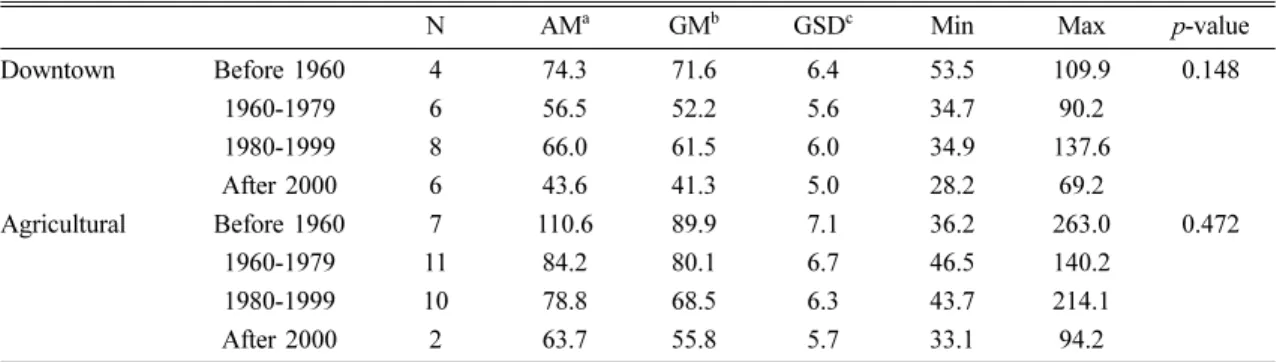
3.3 생활지역에 따른 건축연도별 실내 라돈 농도 생활 지역에 따른 건축연도별 실내 라돈 농도를 Table 2에 나타내었다. 도심지역의 경우 60년대 이전에 지어진 학교는 71.6 Bq/m3, 60-70년대 52.2 Bq/m3, 80~
90년대 61.5 Bq/m3, 2000년대 41.3 Bq/m3이었고, 농업 지역의 경우 60년대 이전에 지어진 학교는 89.9 Bq/m3, 60~70년대 80.1 Bq/m3, 80~90년대 68.5 Bq/m3, 2000년 Fig. 1. Indoor radon concentration by season at elementary
schools.
대 55.8 Bq/m3로 측정되었다. 전체적으로 농업지역이 도심지역보다 높은 농도를 나타냈으며 건축년도가 오 래될수록 농도가 높게 나타났다(p < 0.01)(Table 3).
Han (2006)에서는 실내 라돈 농도와 건축연도를 조사 한 결과, 1990년대 건물(20.9 Bq/m3)이 2000년대 건물 (12.4 Bq/m3)보다 농도가 높다고 보고하였다. 본 연구 에서는 건축연도가 오래된 건물일수록 바닥이나 벽에 균열이 많아 그 틈으로 라돈 가스가 유입(Oh et al., 2012)된 것으로 생각된다. 건축연도가 오래된 건물은 균열 마감과 같은 개보수 작업이 필요하고, 신축건물들
은 토양에 라돈을 배출해주는 별도의 라돈 배출 파이 프를 연결하거나 환풍기를 설치해주는 것이 실내 라돈 농도를 줄일 수 있는 방법이라고 판단된다(EPA, 2009).
건축연도가 가장 오래된 학교와 가장 최근 지어진 학교의 농도 차이는 농업지역은 168.8 Bq/m3이었으며, 도심지역은 43.2 Bq/m3로 농업지역의 농도 차이가 도 심지역보다 크게 나타났다(Table 4). Song (2001)의 연 구에 의하면 건물의 균열이 라돈 농도에 영향을 주는 것으로 나타났고, 본 연구의 경우 농업지역은 평균 건 축연도가 1982년으로 평균 1996년인 도심지역보다 오 Table 1. Indoor radon concentration in the living area (unit : Bq/m3)
N AMa GMb GSDc p-value
Downtown 24 59.4 54.8 5.7 0.026*
Agricultural 30 87.2 76.3 6.6
aArithmatic mean, bGeomatric mean, cGeomatric standard deviation, *p < 0.05
Table 2. Indoor radon concentration by construction year in the living area (unit : Bq/m3)
N AMa GMb GSDc Min Max p-value
Downtown Before 1960 4 74.3 71.6 6.4 53.5 109.9 0.148
1960-1979 6 56.5 52.2 5.6 34.7 90.2
1980-1999 8 66.0 61.5 6.0 34.9 137.6
After 2000 6 43.6 41.3 5.0 28.2 69.2
Agricultural Before 1960 7 110.6 89.9 7.1 36.2 263.0 0.472
1960-1979 11 84.2 80.1 6.7 46.5 140.2
1980-1999 10 78.8 68.5 6.3 43.7 214.1
After 2000 2 63.7 55.8 5.7 33.1 94.2
aArithmatic mean, bGeomatric mean, cGeomatric standard deviation
Table 3. Indoor radon concentration by construction year at elementary schools (unit : Bq/m3)
Construction year N AMa GMb GSDc p-value
Before 1960 11 97.4 82.7 6.8 0.03*
1960-1979 17 74.4 68.9 6.3
1980-1999 18 73.1 65.3 6.1
After 2000 8 48.6 44.6 5.2
aArithmatic mean, bGeomatric mean, cGeomatric standard deviation, *p < 0.05
Table 4. Indoor radon concentration between oldest and earlier school (unit : Bq/m3) Construction year Concentration O-Ea
Downtown Oldest 1924 71.5 43.2
Earlier 2008 28.3
Agricultural Oldest 1930 263.0 168.8
Earlier 2002 94.2
aConcentration difference Between Oldest and Earlier school
래 되었기 때문에 건물의 균열로 인하여 라돈 농도가 더 높게 나타난 것으로 사료된다.
3.4 환풍기 사용여부별 실내 라돈 농도
환풍기를 사용하는 초등학교는 51.3 Bq/m3, 사용하 지 않는 곳은 67.2 Bq/m3로 환풍기를 사용하는 곳의 농도가 더 낮게 나타났는데 이는 환풍기를 작동시킴으 로써 실내에 축적되어있던 라돈이 실외로 배출되어 낮 게 나타난 것으로 판단된다(Table 5).
Kim (2008)의 연구에 의하면 강제환기가 자연환기 에 비해 약 2배정도 낮은 농도로 측정되어 실내라돈농 도와 환기 여부가 밀접한 관련이 있는 것으로 보여 어 린 학생들의 체류시간이 많고, 활동량이 큰 공간인 초 등학교 교실 내에서의 라돈 농도를 저감하기 위해서는 교실별 적절한 환풍기 등 환기시설을 설치·가동하여 유해물질의 농도를 줄이는 것이 바람직하다고 생각된 다(Je, 2010).
3.5 건축자재별 실내 라돈 농도
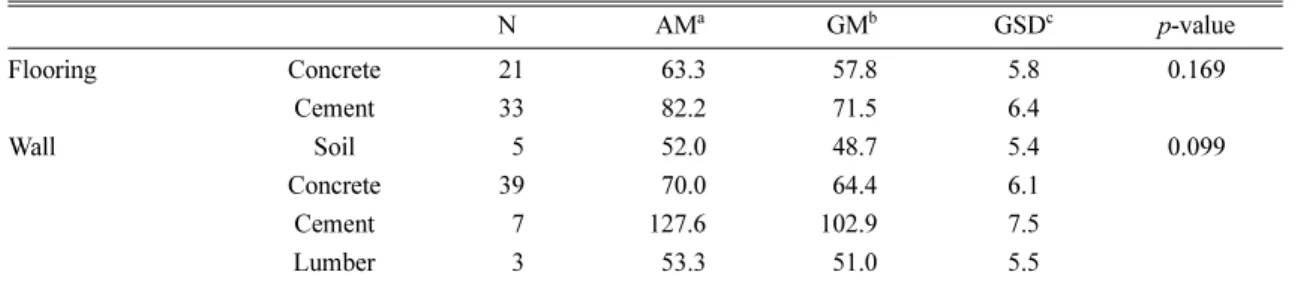
바닥재로 콘크리트를 사용한 학교는 57.8 Bq/m3, 시 멘트는 71.5 Bq/m3로 나타나 시멘트를 사용한 학교에 서 콘크리트를 사용한 학교보다 농도가 높게 측정되었 다. 외벽재에 따른 실내 라돈 농도 측정결과 시멘트 102.9 Bq/m3, 콘크리트 64.4 Bq/m3, 목재 51.0 Bq/m3, 흙 48.7 Bq/m3순으로 나타나 시멘트를 사용한 곳에서 실내 라돈 농도가 가장 높게 조사되었다.
Kim et al. (2006)과 Yun (2012)의 연구에 의하면 콘 크리트가 시멘트보다 라돈(222Rn) 농도가 높게 방출된
다고 보고하고 있어 본 연구와 다른 경향으로 나타나 이에 대한 체계적인 연구가 필요할 것으로 생각된다.
또한, 자재에 따라 실내라돈농도 수준의 차이가 나는 것으로 보아 학교 건축 시 가능하면 라돈가스의 유입 을 줄일 수 있는 건축자재를 선정하여(ME, 2010) 오염 을 최소화 하는 것이 필요할 것으로 판단된다.
3.6 바닥과의 거리별 실내 라돈 농도
검출기와 바닥과의 거리를 150 cm 이하, 151~200 cm, 201 cm 이상으로 구분하여 비교한 결과 바닥과의 거리가 150 cm 이하인 곳은 99.3 Bq/m3, 151~200 cm 62.6 Bq/m3, 201 cm이상 59.2 Bq/m3으로 검출기가 바닥 에서 가까울수록 라돈 농도가 높게 나타났다(Table 5).
바닥의 균열을 통해 토양에서 라돈이 유입될 가능성 이 많으므로(Papachristodoulou et al., 2010) 바닥에서 가까울수록 라돈 농도가 높게 나타난 것으로 생각된다.
따라서 초등학교 건축 시 지반을 더 높여야 할 것으로 판단되며 바닥의 균열을 메우는 시공을 하거나 저층 특히, 1층 교실을 지양하는 것(EPA, 2010)이 필요할 것으로 생각된다.
3.7 환경인자간 상관성 분석
초등학교의 실내 라돈 농도에 영향을 주는 요인과 라돈 농도 상관관계를 분석한 결과, 바닥과의 거리가 가까울수록(r = 0.388), 건축연도가 오래 될수록(r = 0.300) 실내 라돈 농도가 높게 분석되었다. 또한, 주변 지형과 바닥과의 거리(r = 0.281)가 유의한 차이를 보였 다(Table 6).
Table 5. Indoor radon concentration by using fan (unit : Bq/m3)
N AMa GMb GSDc p-value
Install 4 56.0 51.3 5.5 0.311
Not install 50 76.4 67.2 6.2
aArithmatic mean, bGeomatric mean, cGeomatric standard deviation
Table 6. Indoor radon concentration by flooring and wall materials (unit : Bq/m3)
N AMa GMb GSDc p-value
Flooring Concrete 21 63.3 57.8 5.8 0.169
Cement 33 82.2 71.5 6.4
Wall Soil 5 52.0 48.7 5.4 0.099
Concrete 39 70.0 64.4 6.1
Cement 7 127.6 102.9 7.5
Lumber 3 53.3 51.0 5.5
aArithmatic mean, bGeomatric mean, cGeomatric standard deviation
3.8 라돈농도에 기여하는 환경인자
초등학교의 실내 라돈 농도에 영향을 주는 요인들의 기여율을 파악하기 위하여 다중회귀분석을 수행한 결 과, 바닥과의 거리가 가장 높은 영향(β = −0.369, p <
0.01)을 보였고, 건축연도(β = −0.280, p < 0.05)도 실내 라돈 농도에 기여하는 요인으로 분석 되었으며 이는 24.4%의 설명력을 나타냈다(Table 7).
4. 결 론
본 연구는 2008년 6월부터 2011년 6월까지 충청남 도에 위치한 초등학교의 실내 라돈 농도 측정과 설문 조사를 통하여 다음과 같은 결론을 얻었다.
1. 계절별 초등학교의 실내 라돈 농도는 겨울 86.4 Bq/m3, 가을 71.2 Bq/m3, 봄 61.1 Bq/m3, 여름 40.5 Bq/m3순으로 겨울이 가장 높은 농도를 보였으며 여름이 가장 낮은 농도로 나타났으며, 도심지역에 서 60년대 이전에 지어진 학교는 71.6 Bq/m3, 60~
70년대 52.2 Bq/m3, 80~90년대 61.5 Bq/m3, 2000
년대 41.3 Bq/m3로, 농업지역에서 60년대 이전에 지어진 학교는 89.9 Bq/m3, 60~70년대 80.1 Bq/m3, 80~90년대 68.5 Bq/m3, 2000년대 55.8 Bq/m3로 측정되었다.
2. 환풍기를 사용하는 초등학교의 라돈농도는 51.3 Bq/m3, 사용하지 않는 곳은 67.2 Bq/m3로 환풍기 를 사용하는 곳에서 낮은 농도분포를 보였고, 건 축자재별 바닥재는 콘크리트 57.8 Bq/m3, 시멘트 71.5 Bq/m3로 나타났고 외벽재는 시멘트, 콘크리 트, 목재, 흙의 순으로 각각 102.9 Bq/m3, 64.4 Bq/m3, 51.0 Bq/m3, 48.7 Bq/m3로 조사되었다.
3. 검출기와 바닥과의 거리를 150 cm 이하, 151~
200 cm, 201 cm 이상으로 구분하여 비교한 결과 바닥과의 거리가 150 cm 이하인 곳은 99.3 Bq/m3, 151~200 cm 62.6 Bq/m3, 201 cm 이상 59.2 Bq/m3 으로 검출기가 바닥에서 가까울수록 라돈 농도가 높게 나타났다.
4. 초등학교의 실내 라돈 농도에 영향을 주는 요인과 라돈 농도 상관관계를 분석한 결과, 바닥과의 거 리가 가까울수록(r = 0.388), 건축연도가 오래 될 수록(r = 0.300) 실내 라돈 농도가 높게 분석되었 다. 초등학교의 실내 라돈 농도에 영향을 주는 기 여요인은 다중회귀분석 결과, 바닥과의 거리가 가 장 높은 영향(β = −0.369, p < 0.01)을 보였고, 건 축연도(β = −0.280, p < 0.05)도 실내 라돈 농도에 기여하는 요인으로 분석 되었으며 이는 24.4%의 설명력을 가지고 있었다.
References
Bossew, P., Žuni , Z. S., Stojanovska, Z., Tollefsen, T., Carpentieri, C., Veselimovi , N., Komatina, S., Vaupoti , J., Simovi , R. D., Antignani, S., Bochicchio, F., 2014.
Geographical distribution of the annual mean radon concentrations in primary schools of Southern Serbia- application of geostatistical methods. Journal of Environ- mental Radioactivity 127, 141-148.
Clouvas, A., Xanthos, S., Takoudis, G., 2011. Indoor radon levels in Greek schools. Journal of Environmental
cí
cí cí
cí
Table 7. Indoor radon concentration by distance to detector at elementary schools (unit : Bq/m3)
N AMa GMb GSDc p-value
Under 150 cm 7 129.3 99.3 7.4 0.312
151~200 cm 38 68.1 62.6 6.0
Over 200 cm 9 61.2 59.2 5.9
aArithmatic mean, bGeomatric mean, cGeomatric standard deviation
Table 8. Correlation analysis between indoor radon concentration and influence factors
Radon conc.
Construction year
Distance to detector Radon conc. 1
Construction year 0.300* 1
Distance to detector 0.388** .075 1
*p < 0.05, **p < 0.01
Table 9. Result of the multiple regression analysis between indoor radon concentration and influence factors
β p-value
Construction year -0.280 0.028*
Distance to detector -0.369 0.004**
R2 0.279
*p < 0.05, **p < 0.01
Radioactivity 102(9), 881-885.
Drolet, J. P., Martel, R., Poulin, P., Dessau, J. C., Lavoie, D., Parent, M., Lévesque, B., 2013. An approach to define potential radon emission level maps using indoor radon concentration measurements and radiogeochemical data positive proportion relationships. Journal of Environmental Radioactivity 124, 57-67.
Han, I. S., 2006. Measurement and analysis of radon concentration in karaoke in Jeon-Ju City, Master’s thesis, The Graduate School of Jeonbuk University.
Harada, K., Hasegawa, A., Wei, C. N., Minamoto, K., Noguchi, Y., Hara, K., Matsushita, O., Noda, K., Ueda, A., 2010. A review of indoor air pollution and health problems from the viewpoint of environmental hygiene: focusing on the studies of indoor air environment in Japan compared to those of foreign countries. Journal of Health Science 56(5), 488-501.
Je, H. K., 2010. Overview of Recent Radon Policy and Radon Industry in and outside the Country. The Korean Society of Mineral and Energy Resources Engineers 47(3), 400-405.
Jung, K. S., 2013. A study on radon concentration analysis according to rasidence of lung-cancer patients using charcoal canister. Master’s thesis, Graduate School of Yonsei University.
Kapdan, E., Altinsoy, N., 2012. A comparative study of indoor radon concentrations between dwellings and schools.
Radiation Physics and Chemistry 81, 383-386.
Khan, A. J., 2000, A study of indoor radon levels on Indian dwellings, influencing factors and lung cancer risks.
Radiation Measurements 32(2), 87-92.
Kim, J. Y., 2008. Measurement and analysis of radon concentration in karaoke in Jeon-Ju City, Master’s thesis, Graduate School of Chonbuk National University.
Kim, S. J., 2013. A study of radon concentration in indoor, soil and groundwater in Gyeongju, Master’s thesis, Graduate School of Dongguk University.
Kim, W. K., 2010. Editorial : Between Air Pollutants and Prevalence of Allergic Disease. Pediatric allergy and respiratory disease 20(4), 209-211.
Kim, Y. M., Choi, H. Y., Chung, Y. G., Ryu, H. G., 2006.
A study on the properties and friendly environment efficiency charcoal concrete bricks. Journal of the Korea Institute of Building Construction 6(1), 123-130.
Kim, Y. S., 1989. Indoor Radon Concentration in the Seoul Area, Journal of Environmental Health Science 15(1) 11-18.
Lamonaca, F., Nastro, V., Nastro, A., Grimaldi, D., 2014.
Monitoring of indoor radon pollution. Measurement 47, 228-233.
Lee, D. M., Kim, C. K., Rho, B. H., Lee, S. C., and Kang, H. D., 2000. Diurnal and season variations of the radon progeny concentration in the open atmosphere and the influence of meteorological parameters. Journal of Korean Association for Radiation Protection 25(4), 207-216.
Lee, K. S. 2012. A Study on the indoor radon concentration of elementary school in Korea, Master’s thesis, The Graduate School Soonchunhyang University.
Lee, S. H., Ko, J. C., Lee, J. S., 2011. The effect on urban child’s health by indoor environment. Journal of Korean Society of Urban Environment 11(2) 193-204.
Lee, S. Y., Lee Y. M., Park J. H., Kim, S. S., Hong, G. Y., Ahn, H. G., Yang, W. H., 2013. Radon concentration assessment of studio apartments surrounding a university.
Journal of Environmental Health Sciences 39(2), 138-143.
Magalhães, M. H., Amaral, E. C. S., Sachett, I., Rochedo.
E. R. R., 2003. Radon-222 in Brazil: an outline of indoor and outdoor measurements. Journal of Environmental Radioactivity 67(2), 131-143.
Ministry of Environment (ME), 2010. Indoor radon Reduction guidelines.
Oh, S. S., Koh, S. B., Yong, S. J., 2012. Radon and environmental diseases. Journal of Korean Medical Association 55(3), 223-229.
Pacheco-Torgal, F., 2012, Indoor radon: An overview on a perennial problem. Building and Environment 58, 270-277.
Papachristodoulou, C. A., Patiris, D. L., Ioannides, K. G., 2010. Exposure to indoor radon and natural gamma radiation in public workplaces in notrh-western Greece.
Radiation Measurements 45(7), 865-871.
Radosys, 2013. User’s Manual 4, 5-58.
Sohn, J. R., Roh, Y. M., Son, B. S., 2006. The assessment of survey on the indoor air quality at schools in Korea.
Journal of Environmental Health Sciences 32(2), 140-148.
Song. J. K., 2001. A study on the using floor materials of the normal class in elementary school, Master’s thesis, The Graduate School Chonbuk National University.
Trevisi, R., Leonardi, F., Simeoni, C., Tonnarini, S., Veschetti, M., 2012. Indoor radon levels in schools of South- East Italy. Journal of Environmental Radioactivity 112, 160- 164.
U.S Environmental Protection Agency (EPA)., 2009. A Citizen's Guide To Radon.
U.S Environmental Protection Agency (EPA), 2010.
Managing Radon in Schools.
World Health Organization (WHO), 2009. WHO Handbook on indoor radon.
Yun, G. S., 2013. A study on the noxiousness of radon exposure on military facilities. Master’s thesis, Graduate School of Yonsei University
Yun, Y. D., 2012. Comparison of radon generation characteristics as a housing form and the development of construction check list for the reduction of radon. Master’s thesis, The Graduate School of Hoseo University.