Received:February 15, 2017, Revised:February 16, 2017, Accepted:March 4, 2017
Corresponding to:William Stohl, Division of Rheumatology, Department of Medicine, University of Southern California Keck School of Medicine, 2011 Zonal Avenue, HMR 711, Los Angeles, CA 90033, USA. E-mail:[email protected]
Copyright ⓒ 2017 by The Korean College of Rheumatology. All rights reserved.
This is a Free Access article, which permits unrestricted non-commerical use, distribution, and reproduction in any medium, provided the original work is properly cited.
The Future of B-cell Activating Factor Antagonists in the Treatment of Systemic Lupus Erythematosus
William Stohl
Division of Rheumatology, Department of Medicine, University of Southern California Keck School of Medicine, Los Angeles, CA, USA
To review B-cell activating factor (BAFF)-antagonist therapy in systemic lupus erythematosus (SLE), literature was searched us- ing the search words and phrases, “BAFF”, “B lymphocyte stimulator (BLyS)”, “a proliferation-inducing ligand (APRIL)”, “B-cell maturation antigen (BCMA)”, “transmembrane activator and calcium-modulating and cyclophilin ligand interactor (TACI)”,
“BLyS receptor 3 (BR3)”, “belimumab”, “atacicept”, “blisibimod”, “tabalumab”, and “lupus clinical trial”. In addition, papers from the author’s personal library were searched. BAFF-antagonist therapy in SLE has a checkered past, with four late-stage clin- ical trials meeting their primary endpoints and four failing to do so. Additional late-stage clinical trials are enrolling subjects to address some of the remaining unresolved questions, and novel approaches are proposed to improve results. The BAFF-centric pathway is a proven therapeutic target in SLE. As the only pathway in the past 50+ years to have yielded an United States Food and Drug Administration-approved drug for SLE, it occupies a unique place in the armamentarium of the practicing rheumatologist. The challenges facing clinicians and investigators are how to better tweak the BAFF-centric pathway and im- prove on the successes realized. (J Rheum Dis 2017;24:65-73)
Key Words. Systemic lupus erythematosus, BAFF, B lymphocyte
INTRODUCTION
The inclusion of the word, “future”, in the title of this re- view is justifiable only if there is a “past”. For B-cell acti- vating factor (BAFF) antagonists, the past is a short one.
In this review, I will highlight the salient properties of BAFF and its biologic associates, the importance of the BAFF pathway to systemic lupus erythematosus (SLE) pathogenesis, and the clinical successes and failures to date with different individual BAFF antagonists. With that as a backdrop, I will then speculate on the clinical
“future” of BAFF antagonism in SLE.
MAIN SUBJECTS
BAFF, APRIL, and their receptors
BAFF (also known as B lymphocyte stimulator [BLyS]) is a 285-amino acid type-II transmembrane protein mem-
ber of the tumor necrosis factor (TNF) ligand superfamily [1,2]. Cleavage of surface BAFF by a furin protease re- sults in release of a soluble, biologically active 17-kDa molecule [1,3] which binds to three receptors, B-cell ma- turation antigen (BCMA), transmembrane activator and CAML interactor (TACI), and BLyS receptor 3 (BR3) (also known as B cell activating factor receptor [BAFFR]) on the surface of B cells [4-7].
BAFF serves as a vital survival and differentiation factor [8-11]. Mature B cells and circulating immunoglobulin (Ig) levels are profoundly reduced in mice bearing a dis- rupted Baff gene [12] or in mice genetically programmed to constitutively express high levels of a BAFF antagonist [13,14]. Conversely, B cell expansion and hyper- gammaglobulinemia develop in mice repeatedly injected with exogenous BAFF [2].
Closely related to BAFF is a proliferation-inducing li- gand (APRIL), a 250-amino acid member of the TNF li-
gand superfamily that shares substantial homology with BAFF and binds to two of the three BAFF receptors (BCMA and TACI) [15-20] but not to BR3 [6]. Unlike BAFF, APRIL also binds to heparan sulfate proteoglycans, such as syndecans, on B cells [21,22].
APRIL can co-stimulate B cells, induce Ig class swit- ching, and promote plasmablast/plasma cell survival [16,18,23-26]. Nevertheless, APRIL-deficient mice re- main phenotypically normal [27] or harbor selective defi- ciencies in circulating IgA levels and IgA responses to mu- cosal challenges [28]. Similarly, mice that constitutively over-express APRIL do not undergo B cell expansion or develop elevated circulating levels of IgG [29].
Intriguingly, BAFF and APRIL form heterotrimers [30,31], although the in vivo biological consequences of such heterotrimeric formation remain unexplored.
Roles for BAFF and APRIL in SLE 1) Murine studies
In mice, the link between BAFF and SLE is ironclad.
Constitutive over-expression of BAFF in otherwise non-au- toimmune-prone mice often leads to SLE-like features, including elevated circulating titers of multiple autoanti- bodies, renal immunopathology, and clinical disease [32-34]. Conversely, development of disease in SLE-prone mice is greatly attenuated by genetic disruption of the Baff gene [35] or by pharmacologic treatment with a BAFF antagonist [33,36-38].
Despite APRIL sharing many B cell-agonist activities with BAFF, the link between APRIL in SLE is tenuous.
Constitutive over-expression of APRIL in non-auto- immune-prone mice fails to promote serologic or clinical autoimmune features [29]. Indeed, features of SLE are modestly exaggerated, rather than attenuated, in APRIL-de- ficient SLE-prone mice [39], and even the modest delay in development of proteinuria and death observed in some SLE-prone mice treated with an anti-APRIL mAb [40]
may be related to reductions in circulating BAFF/APRIL heterotrimers and, hence, reductions in circulating BAFF activity rather than reductions in circulating APRIL activity.
2) Human studies
Whereas modern-day scientific tools and approaches permit investigators to genetically alter inbred strains of mice and experimentally manipulate them, use of such tools and approaches in humans is strictly unethical. It is not surprising, therefore, that the link between BAFF and
SLE in humans is not as compelling as it is in mice.
Nonetheless, the evidence, albeit circumstantial, is sub- stantial. As many as 50% of SLE patients harbor elevated circulating BAFF levels at any given time point [41-43], and several longitudinal studies documented a significant correlation between circulating BAFF levels and clinical disease activity [44-47]. SLE patients who chronically harbor high circulating BAFF levels develop greater organ damage over time than do SLE patients who chronically harbor normal circulating BAFF levels [48]. Indeed, SLE patients with high circulating BAFF levels are at in- creased risk for development of moderate and severe SLE flares [49].
As with murine SLE, the link between APRIL and hu- man SLE is flimsy. Genome-wide association studies, meta-analysis studies, candidate gene studies, and repli- cation studies that have identified multiple SLE suscepti- bility genes have failed to document an association be- tween the APRIL gene and SLE [50]. Whereas two small cross-sectional studies suggested a positive relationship between circulating APRIL levels and SLE disease activity [51,52], the findings were validated neither by indepen- dently testing a second SLE cohort nor by re-testing the original SLE patients at a later time point. In fact, two lon- gitudinal studies pointed to a negative, rather than pos- itive, association between circulating APRIL levels and SLE disease activity [53,54].
Experience with BAFF antagonists in SLE
To date, four anti-BAFF agents have undergone clinical evaluation in human SLE: belimumab, blisibimod, taba- lumab, and atacicept. Of these, belimumab, blisibimod, and tabalumab have specificity for BAFF only, whereas atacicept has specificity for both BAFF and APRIL.
1) Belimumab
Belimumab is a fully human IgG1λ mAb that binds and neutralizes soluble BAFF [55]. As assessed by the SLE re- sponse index (SRI) [56], both phase-III randomized, dou- ble-blind, placebo-controlled trials of belimumab in SLE demonstrated statistically significant increases in clinical responders among subjects treated with belimumab (10 mg/kg intravenously at weeks 0, 2, 4, and then every 4 weeks through week 52) plus standard-of-care (SOC) than among subjects treated with placebo plus SOC [57,58]. Pooled analyses of these two phase-III trials in- dicated that improvements in the mucocutaneous, im- munological, musculoskeletal, vascular, and central nerv-
ous system domains were significantly more frequent among belimumab-treated subjects than among place- bo-treated subjects [59].
Based, in part, on these two successful phase-III trials, the United States Food and Drug Administration (FDA) on March 9, 2011, approved belimumab for the treatment of SLE [60]. Since its approval by the FDA, “real-world”
clinical experience with belimumab has largely been pos- itive [61-63]. Also since approval of belimumab as an IV drug, a randomized, double-blind, placebo-controlled tri- al of belimumab (200 mg fixed dose SC weekly through week 52) plus SOC in SLE demonstrated a statistically significantly greater response rate among belimumab-trea- ted subjects than among placebo-treated subjects [64]. It is anticipated that the FDA will soon approve the SC for- mulation, thereby giving SLE patients the option of re- ceiving their medication away from an infusion center or a medical clinic.
2) Blisibimod
Blisibimod is a fusion protein between the Fc portion of IgG and a synthetic peptide selected for its ability to bind with high affinity to both soluble and membrane BAFF but not to APRIL [65]. Results from phase-Ia and phase-Ib studies in SLE documented a favorable safety profile for blisibimod [66]. However, a phase-IIb study in SLE of bli- sibimod at multiple dosing regimens failed to meet its primary endpoint with any dosing regimen [67].
3) Tabalumab
Tabalumab is an IgG4κ anti-BAFF mAb that binds to both soluble and membrane BAFF but does not bind to APRIL [68]. Clinical testing of tabalumab in SLE has been limited to two separate phase-III studies. The clinical endpoint was met in one of these trials [69] but not in the other [70]. The safety profile was favorable in each trial.
4) Atacicept
Atacicept is a fusion protein between the BAFF receptor, TACI, and the Fc portion of human IgG1. Since TACI binds both BAFF and APRIL, atacicept neutralizes both BAFF and APRIL. Consequent to its neutralization of both BAFF and APRIL, safety concerns with atacicept have emerged. A phase-II/III trial of atacicept in combina- tion with mycophenolate in SLE nephritis patients was prematurely terminated after enrollment of only 6 sub- jects due to development of hypogammaglobulinemia and serious pneumonia in atacicept-treated subjects [71].
In a separate phase-II/III trial of atacicept in SLE, enroll- ment at the higher dose was discontinued prematurely due to two deaths, and neither the primary nor the main secondary endpoint was achieved in patients randomized to the lower (less toxic) dose [72].
Can the limited clinical efficacy of BAFF antago- nists be overcome?
Despite the BAFF antagonist, belimumab, becoming the first drug approved in over 50 years by the FDA for SLE, many practitioners within the Rheumatology community remain ambivalent, at best, in their view toward BAFF antagonists. Of the eight late-stage clinical trials of BAFF antagonists in SLE reported to date in complete manu- script form, only four met their respective primary end- points: each of the three phase-III trials of belimumab [57,58,64], and one of the two phase-III trials of tabalu- mab [69]. The phase-II belimumab trial, the phase-IIb blisibimod trial, the phase-II/III atacicept trial, and one of the two phase-III tabalumab trials all failed [67,70,72,73].
Even in the successful trials, the absolute percentage dif- ferences in clinical responses between BAFF-antago- nist-treated and placebo-treated patients were only 10%∼14%. Collectively, the limited ability of BAFF an- tagonists to adequately control human SLE disease activ- ity points to a BAFF-independent component to human SLE. Stated differently, the maximum efficacy achievable through pharmacologic antagonism of BAFF may in- herently be limited.
Even if, for argument’s sake, we stipulate to this notion of an inherent limitation, the question becomes a quanti- tative one: have we reached this limitation? Although our BAFF-centric approaches to date have yielded absolute percentage differences in clinical responses of ≤15%, there, at present, is no reason to believe that this percent- age could not be increased to 25% or 35% if our BAFF-cen- tric approach were optimized. Surely the Rheumatology community would enthusiastically embrace a therapeutic approach that achieves such results while retaining a fa- vorable safety profile.
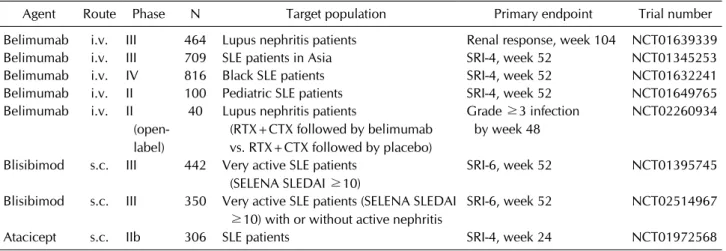
Moving forward (Table 1) 1) Unresolved issues
(1) Responses in Black SLE patients
Although the three phase-III belimumab trials in SLE met their primary endpoints, sub-group analyses failed to document a positive effect for belimumab among Black SLE patients [64,74]. (Clinical responses among in-
Table 1. Late-stage randomized clinical trials of BAFF antagonists planned/ongoing in SLE
Agent Route Phase N Target population Primary endpoint Trial number
Belimumab i.v. III 464 Lupus nephritis patients Renal response, week 104 NCT01639339
Belimumab i.v. III 709 SLE patients in Asia SRI-4, week 52 NCT01345253
Belimumab i.v. IV 816 Black SLE patients SRI-4, week 52 NCT01632241
Belimumab i.v. II 100 Pediatric SLE patients SRI-4, week 52 NCT01649765
Belimumab i.v. II (open- label)
40 Lupus nephritis patients
(RTX+CTX followed by belimumab vs. RTX+CTX followed by placebo)
Grade ≥3 infection by week 48
NCT02260934
Blisibimod s.c. III 442 Very active SLE patients (SELENA SLEDAI ≥10)
SRI-6, week 52 NCT01395745
Blisibimod s.c. III 350 Very active SLE patients (SELENA SLEDAI
≥10) with or without active nephritis
SRI-6, week 52 NCT02514967
Atacicept s.c. IIb 306 SLE patients SRI-4, week 24 NCT01972568
BAFF: B-cell activating factor, SLE: systemic lupus erythematosus, RTX: rituximab, CTX: cyclophosphamide, SELENA SLEDAI:
safety of estrogens in lupus erythematosus national assessment SLE disease activity index, SRI: SLE response index.
dividual racial/ethnic sub-groups were not reported in the successful ILLUMINATE-2 trial [69]). Whether these failures reflected underpowered sub-cohorts of Black SLE patients within the individual trials or whether Black SLE patients truly are less sensitive than other racial groups to the beneficial effects of BAFF-antagonist therapy is uncertain. A phase-IV trial of IV belimumab in Black SLE patients (NCT01632241) sufficiently powered to assess clinical efficacy is recruiting patients to address this issue.
(2) What about the very sick SLE patients?
As a rule, SLE subjects eligible for clinical trials are those whose overall health status is sufficiently robust so that anticipated adverse events related to the experimental drug do not unduly jeopardize life or vital organs. That is, the candidate subject must not only be sufficiently fit from a cardiopulmonary standpoint, but he/she must al- so not be on an immunosuppressive regimen that would increase the risk of infection to an “unacceptable” level.
Accordingly, SLE patients with active nephritis or active CNS disease (who routinely require high-dose cortico- steroid therapy plus mycophenolate or cyclophosphamide) have been excluded from the vast majority of the phase-II and phase-III trials of BAFF antagonists in SLE reported to date [57,58,67,69,70,72,73].
To address this deficiency, a phase-III trial of belimumab (along with standard-of-care therapy, including high-dose corticosteroids plus cyclophosphamide or mycopheno- late) in SLE nephritis patients (NCT01639339) is cur- rently recruiting subjects. (As discussed below, a phase-II trial of belimumab in SLE nephritis patients following treatment with rituximab plus cyclophosphamide is also
currently recruiting subjects). The subjects in these trials will be at high risk for infection and will need to be moni- tored very closely.
(3) What about the children?
Although SLE is predominantly a disease of women in their child-bearing years, it is not solely a disease of wom- en in their child-bearing years. SLE does develop in the pediatric population, and successful therapeutic ap- proaches in adults do not necessarily translate to children.
The clinical trials to date of BAFF antagonists in SLE have all focused on adults. To address the efficacy and safety of BAFF-antagonist therapy in pediatric SLE, a phase-II clin- ical trial (NCT01649765) is currently enrolling subjects.
2) If at first you don’t succeed, try, try again Just because a clinical trial with a given drug fails to ach- ieve its primary endpoint does not mean that the drug is a “failure”. The road traversed by belimumab to its ulti- mate approval by the FDA was neither straight nor smooth and had its “failures” along the way [60], so there remains hope that at least some of the other BAFF antag- onists that have so far “failed” will also be able to cross the FDA-approval finish-line.
(1) Blisibimod
Although it failed to achieve its primary endpoint, post hoc analysis of the phase-II blisibimod trial pointed to a favorable clinical response among patients with high dis- ease activity [67]. Based on this impression, one phase-III trial of blisibimod in patients with very active SLE (NCT01395745) has been completed. Results from this trial have not yet been reported in a peer-reviewed format,
but top-line results have been made public. Disappointingly, the clinical endpoint was not achieved in this trial. A sec- ond phase-III trial of blisibimod in patients with very ac- tive SLE (including patients with active nephritis;
NCT02514967), is currently enrolling subjects.
(2) Atacicept
Not deterred by the serious complications associated with high-dose (150 mg) atacicept in a previous phase-II/III trial of atacicept in SLE [72], another phase-IIb trial of atacicept in SLE (NCT01972568) has been completed.
Results from this trial have not yet been reported as a peer-reviewed manuscript, but an abstract was presented at the 2016 American College of Rheumatology annual meeting. Once again, the primary endpoint was not achieved. However, pre-specified sensitivity analyses pointed to atacicept promoting greater clinical responses among patients with high disease activity and/or serolog- ically active disease. Serious infections were not over-rep- resented among atacicept-treated subjects. Looking at the glass as half-full rather than half-empty, it is likely that phase-III trials with atacicept in SLE are in the offing.
(3) Tabalumab
Based on the failure of one phase-III trial of tabalumab in SLE to achieve its primary endpoint [70] and the
“belimumab-like” limited success of tabalumab in the second phase-III trial in SLE [69], a corporate decision was made to withdraw tabalumab from further testing in SLE. Although it takes three strikes in baseball for the batter to be called “out”, tabalumab was called “out” after only a strike and a half.
3) Targeting of BAFF as part of sequential therapy Combination therapy is an approach used not just in Rheumatology but throughout Medicine. Combinations of DMARDs are used to achieve optimal disease control in patients with rheumatoid arthritis; combinations of anti-hypertensives are used to achieve optimal disease control in patients with refractory hypertension; and combination of anti-hyperglycemics are used to achieve optimal disease control in patients with brittle diabetes.
By extension, there is no a priori reason that a BAFF an- tagonist could (should) not be used as part of combina- tion therapy to achieve optimal disease control in patients with SLE.
Indeed, BAFF neutralization may contribute in an addi- tive or synergistic manner as part of a sequential pharma- cologic approach. In SLE patients treated with rituximab, circulating BAFF levels rise concurrent with depletion of
the B cells [75]. As B cells recover, circulating BAFF levels decline. Circulating BAFF levels at the time of SLE clinical relapse are greater than those at times of disease re- mission and greater than those prior to rituximab treat- ment [76]. Since BAFF is critical to the survival of many autoreactive B cells [77,78], these observations point to the rebounding BAFF levels as important contributors to the emerging disease flare.
If correct, then neutralization of the “BAFF rebound”
could clinically be highly efficacious. Accordingly, a phase-II trial of belimumab in SLE nephritis patients fol- lowing treatment with rituximab plus cyclophosphamide (NCT02260934) is currently recruiting subjects. One can imagine that the subjects in this trial may be at high risk for infection, and development of grade ≥3 is the primary endpoint of this trial. It is hoped that the anticipated ben- efit through enhanced clinical efficacy will outweigh the morbidities associated with increased serious infections.
4) Targeting of BAFF receptors rather than of BAFF To date, all reported BAFF-centric clinical trials to date have targeted BAFF±APRIL, whereas there have been no reports of targeting any of the BAFF receptors (BCMA, TACI, or BR3). This is rather surprising, since efforts in SLE at other biologic targets have been directed against both ligand and receptor, sometimes with highly di- vergent results.
Clinical trials directed against type-I interferon (IFN) collectively serve as an illustrative example. The primary endpoint was not achieved in the phase-II trial of the an- ti-IFNα mAb, rontalizumab [79], whereas the primary endpoint (assessed at week 52) was achieved in the phase-IIb trial of a different anti-IFNα mAb, sifalimumab.
In this latter trial, the absolute percentage difference in clinical response between patients treated with the high- est dose of sifalimumab and those treated with placebo was 14% [80], similar to the absolute percentage differ- ences observed in the successful trial with belimumab or tabalumab. Of note, however, were results from the phase-IIb trial of the anti-IFNα receptor mAb, ani- frolumab, in which the absolute percentage difference in clinical response between patients treated with the opti- mal dose of anifrolumab and those treated with placebo being 26% [81]. Although comparisons of response rates across different trials are notoriously unreliable and must be taken with a large grain of salt, the strikingly greater re- sponse rate in the trial that targeted the IFNα receptor rather than IFNα itself raises the plausibility of im-
proved results in BAFF-centric trials that target BAFF re- ceptors rather than BAFF itself.
Based on studies in SLE-prone NZM 2328 (NZM) mice, more than one BAFF receptor may need to be targeted.
NZM mice deficient in any single BAFF receptor develop clinical SLE with a time course indistinguishable from that of NZM wild-type mice [82]. That is, there is suffi- cient functional redundancy among the BAFF receptors to render any single BAFF receptor dispensable to the de- velopment of SLE in NZM mice. By extension, pharmaco- logic targeting of any single BAFF receptor might not be therapeutically beneficial in human SLE. Nevertheless, development of clinical disease is greatly attenuated in NZM mice deficient in specific pairs of BAFF receptors (BR3+BCMA or BR3+TACI) [83]. This raises the possi- bility that agents that target both BR3 and BCMA or both BR3 and TACI may be therapeutically efficacious. To date, no agents have been developed that specifically block the relevant pairs of BAFF receptors, so no clinical trials with such agents are currently planned.
CONCLUSION
The BAFF-centric pathway is a proven therapeutic target in SLE. As the only pathway in the past over 50 years to have yielded an FDA-approved drug for SLE, it occupies a unique place in the armamentarium of the practicing rheumatologist. The challenges facing clinicians and in- vestigators are how to better tweak the BAFF-centric pathway and improve on the successes realized to date.
ACKNOWLEDGMENTS
This work was supported in part by a grant from the Alliance for Lupus Research (WS). Consulting fees from Amgen and Janssen Research & Development. Clinical tri- als support from GlaxoSmithKline and Pfizer.
CONFLICT OF INTEREST
The author has no financial support or other benefits from commercial sources to report for the work reported in this manuscript.
REFERENCES
1. Schneider P, MacKay F, Steiner V, Hofmann K, Bodmer JL, Holler N, et al. BAFF, a novel ligand of the tumor necrosis
factor family, stimulates B cell growth. J Exp Med 1999;
189:1747-56.
2. Moore PA, Belvedere O, Orr A, Pieri K, LaFleur DW, Feng P, et al. BLyS: member of the tumor necrosis factor family and B lymphocyte stimulator. Science 1999;285:260-3.
3. Nardelli B, Belvedere O, Roschke V, Moore PA, Olsen HS, Migone TS, et al. Synthesis and release of B-lymphocyte stimulator from myeloid cells. Blood 2001;97:198-204.
4. Laabi Y, Gras MP, Brouet JC, Berger R, Larsen CJ, Tsapis A.
The BCMA gene, preferentially expressed during B lym- phoid maturation, is bidirectionally transcribed. Nucleic Acids Res 1994;22:1147-54.
5. von Bülow GU, Bram RJ. NF-AT activation induced by a CAML-interacting member of the tumor necrosis factor re- ceptor superfamily. Science 1997;278:138-41.
6. Thompson JS, Bixler SA, Qian F, Vora K, Scott ML, Cachero TG, et al. BAFF-R, a newly identified TNF receptor that spe- cifically interacts with BAFF. Science 2001;293:2108-11.
7. Yan M, Brady JR, Chan B, Lee WP, Hsu B, Harless S, et al.
Identification of a novel receptor for B lymphocyte stim- ulator that is mutated in a mouse strain with severe B cell deficiency. Curr Biol 2001;11:1547-52.
8. Thompson JS, Schneider P, Kalled SL, Wang L, Lefevre EA, Cachero TG, et al. BAFF binds to the tumor necrosis factor receptor-like molecule B cell maturation antigen and is im- portant for maintaining the peripheral B cell population. J Exp Med 2000;192:129-35.
9. Do RK, Hatada E, Lee H, Tourigny MR, Hilbert D, Chen-Kiang S. Attenuation of apoptosis underlies B lym- phocyte stimulator enhancement of humoral immune response. J Exp Med 2000;192:953-64.
10. Rolink AG, Tschopp J, Schneider P, Melchers F. BAFF is a survival and maturation factor for mouse B cells. Eur J Immunol 2002;32:2004-10.
11. Litinskiy MB, Nardelli B, Hilbert DM, He B, Schaffer A, Casali P, et al. DCs induce CD40-independent immuno- globulin class switching through BLyS and APRIL. Nat Immunol 2002;3:822-9.
12. Schiemann B, Gommerman JL, Vora K, Cachero TG, Shulga-Morskaya S, Dobles M, et al. An essential role for BAFF in the normal development of B cells through a BCMA-independent pathway. Science 2001;293:2111-4.
13. Gross JA, Dillon SR, Mudri S, Johnston J, Littau A, Roque R, et al. TACI-Ig neutralizes molecules critical for B cell devel- opment and autoimmune disease. impaired B cell matura- tion in mice lacking BLyS. Immunity 2001;15:289-302.
14. Schneider P, Takatsuka H, Wilson A, Mackay F, Tardivel A, Lens S, et al. Maturation of marginal zone and follicular B cells requires B cell activating factor of the tumor necrosis factor family and is independent of B cell maturation antigen. J Exp Med 2001;194:1691-7.
15. Hahne M, Kataoka T, Schröter M, Hofmann K, Irmler M, Bodmer JL, et al. APRIL, a new ligand of the tumor necrosis factor family, stimulates tumor cell growth. J Exp Med 1998;188:1185-90.
16. Yu G, Boone T, Delaney J, Hawkins N, Kelley M, Ramak- rishnan M, et al. APRIL and TALL-I and receptors BCMA and TACI: system for regulating humoral immunity. Nat Immunol 2000;1:252-6.
17. Kelly K, Manos E, Jensen G, Nadauld L, Jones DA. APRIL/
TRDL-1, a tumor necrosis factor-like ligand, stimulates cell
death. Cancer Res 2000;60:1021-7.
18. Marsters SA, Yan M, Pitti RM, Haas PE, Dixit VM, Ashkenazi A. Interaction of the TNF homologues BLyS and APRIL with the TNF receptor homologues BCMA and TACI. Curr Biol 2000;10:785-8.
19. Wu Y, Bressette D, Carrell JA, Kaufman T, Feng P, Taylor K, et al. Tumor necrosis factor (TNF) receptor superfamily member TACI is a high affinity receptor for TNF family members APRIL and BLyS. J Biol Chem 2000;275:35478- 85.
20. Rennert P, Schneider P, Cachero TG, Thompson J, Trabach L, Hertig S, et al. A soluble form of B cell maturation anti- gen, a receptor for the tumor necrosis factor family member APRIL, inhibits tumor cell growth. J Exp Med 2000;192:
1677-84.
21. Hendriks J, Planelles L, de Jong-Odding J, Hardenberg G, Pals ST, Hahne M, et al. Heparan sulfate proteoglycan bind- ing promotes APRIL-induced tumor cell proliferation. Cell Death Differ 2005;12:637-48.
22. Ingold K, Zumsteg A, Tardivel A, Huard B, Steiner QG, Cachero TG, et al. Identification of proteoglycans as the APRIL-specific binding partners. J Exp Med 2005;201:1375- 83.
23. Castigli E, Wilson SA, Scott S, Dedeoglu F, Xu S, Lam KP, et al. TACI and BAFF-R mediate isotype switching in B cells. J Exp Med 2005;201:35-9.
24. Sakurai D, Hase H, Kanno Y, Kojima H, Okumura K, Kobata T. TACI regulates IgA production by APRIL in collaboration with HSPG. Blood 2007;109:2961-7.
25. He B, Xu W, Santini PA, Polydorides AD, Chiu A, Estrella J, et al. Intestinal bacteria trigger T cell-independent im- munoglobulin A(2) class switching by inducing epithelial- cell secretion of the cytokine APRIL. Immunity 2007;26:
812-26.
26. Belnoue E, Pihlgren M, McGaha TL, Tougne C, Rochat AF, Bossen C, et al. APRIL is critical for plasmablast survival in the bone marrow and poorly expressed by early-life bone marrow stromal cells. Blood 2008;111:2755-64.
27. Varfolomeev E, Kischkel F, Martin F, Seshasayee D, Wang H, Lawrence D, et al. APRIL-deficient mice have normal im- mune system development. Mol Cell Biol 2004;24:997- 1006.
28. Castigli E, Scott S, Dedeoglu F, Bryce P, Jabara H, Bhan AK, et al. Impaired IgA class switching in APRIL-deficient mice.
Proc Natl Acad Sci U S A 2004;101:3903-8.
29. Stein JV, López-Fraga M, Elustondo FA, Carvalho-Pinto CE, Rodríguez D, Gómez-Caro R, et al. APRIL modulates B and T cell immunity. J Clin Invest 2002;109:1587-98.
30. Roschke V, Sosnovtseva S, Ward CD, Hong JS, Smith R, Albert V, et al. BLyS and APRIL form biologically active het- erotrimers that are expressed in patients with systemic im- mune-based rheumatic diseases. J Immunol 2002;169:
4314-21.
31. Dillon SR, Harder B, Lewis KB, Moore MD, Liu H, Bukowski TR, et al. B-lymphocyte stimulator/a proliferation-inducing ligand heterotrimers are elevated in the sera of patients with autoimmune disease and are neutralized by atacicept and B-cell maturation antigen-immunoglobulin. Arthritis Res Ther 2010;12:R48.
32. Mackay F, Woodcock SA, Lawton P, Ambrose C, Baetscher M, Schneider P, et al. Mice transgenic for BAFF develop lym-
phocytic disorders along with autoimmune manifestations.
J Exp Med 1999;190:1697-710.
33. Gross JA, Johnston J, Mudri S, Enselman R, Dillon SR, Madden K, et al. TACI and BCMA are receptors for a TNF homologue implicated in B-cell autoimmune disease.
Nature 2000;404:995-9.
34. Khare SD, Sarosi I, Xia XZ, McCabe S, Miner K, Solovyev I, et al. Severe B cell hyperplasia and autoimmune disease in TALL-1 transgenic mice. Proc Natl Acad Sci U S A 2000;
97:3370-5.
35. Jacob CO, Pricop L, Putterman C, Koss MN, Liu Y, Kollaros M, et al. Paucity of clinical disease despite serological auto- immunity and kidney pathology in lupus-prone New Zealand mixed 2328 mice deficient in BAFF. J Immunol 2006;177:2671-80.
36. Kayagaki N, Yan M, Seshasayee D, Wang H, Lee W, French DM, et al. BAFF/BLyS receptor 3 binds the B cell survival factor BAFF ligand through a discrete surface loop and pro- motes processing of NF-kappaB2. Immunity 2002;17:515- 24.
37. Ramanujam M, Wang X, Huang W, Schiffer L, Grimaldi C, Akkerman A, et al. Mechanism of action of transmembrane activator and calcium modulator ligand interactor-Ig in murine systemic lupus erythematosus. J Immunol 2004;
173:3524-34.
38. Ramanujam M, Wang X, Huang W, Liu Z, Schiffer L, Tao H, et al. Similarities and differences between selective and non- selective BAFF blockade in murine SLE. J Clin Invest 2006;116:724-34.
39. Jacob CO, Guo S, Jacob N, Pawar RD, Putterman C, Quinn WJ 3rd, et al. Dispensability of APRIL to the development of systemic lupus erythematosus in NZM 2328 mice. Arthritis Rheum 2012;64:1610-9.
40. Huard B, Tran NL, Benkhoucha M, Manzin-Lorenzi C, Santiago-Raber ML. Selective APRIL blockade delays sys- temic lupus erythematosus in mouse. PLoS One 2012;
7:e31837.
41. Zhang J, Roschke V, Baker KP, Wang Z, Alarcón GS, Fessler BJ, et al. Cutting edge: a role for B lymphocyte stimulator in systemic lupus erythematosus. J Immunol 2001;166:6-10.
42. Cheema GS, Roschke V, Hilbert DM, Stohl W. Elevated se- rum B lymphocyte stimulator levels in patients with sys- temic immune-based rheumatic diseases. Arthritis Rheum 2001;44:1313-9.
43. Stohl W, Metyas S, Tan SM, Cheema GS, Oamar B, Xu D, et al. B lymphocyte stimulator overexpression in patients with systemic lupus erythematosus: longitudinal observations.
Arthritis Rheum 2003;48:3475-86.
44. Petri M, Stohl W, Chatham W, McCune WJ, Chevrier M, Ryel J, et al. Association of plasma B lymphocyte stimulator levels and disease activity in systemic lupus erythematosus.
Arthritis Rheum 2008;58:2453-9.
45. Collins CE, Gavin AL, Migone TS, Hilbert DM, Nemazee D, Stohl W. B lymphocyte stimulator (BLyS) isoforms in sys- temic lupus erythematosus: disease activity correlates bet- ter with blood leukocyte BLyS mRNA levels than with plas- ma BLyS protein levels. Arthritis Res Ther 2006;8:R6.
46. Becker-Merok A, Nikolaisen C, Nossent HC. B-lymphocyte activating factor in systemic lupus erythematosus and rheu- matoid arthritis in relation to autoantibody levels, disease measures and time. Lupus 2006;15:570-6.
47. Ju S, Zhang D, Wang Y, Ni H, Kong X, Zhong R. Correlation of the expression levels of BLyS and its receptors mRNA in patients with systemic lupus erythematosus. Clin Biochem 2006;39:1131-7.
48. McCarthy EM, Lee RZ, Ní Gabhann J, Smith S, Cunnane G, Doran MF, et al. Elevated B lymphocyte stimulator levels are associated with increased damage in an Irish systemic lupus erythematosus cohort. Rheumatology (Oxford) 2013;52:
1279-84.
49. Petri MA, van Vollenhoven RF, Buyon J, Levy RA, Navarra SV, Cervera R, et al. Baseline predictors of systemic lupus erythematosus flares: data from the combined placebo groups in the phase III belimumab trials. Arthritis Rheum 2013;65:2143-53.
50. Cui Y, Sheng Y, Zhang X. Genetic susceptibility to SLE: re- cent progress from GWAS. J Autoimmun 2013;41:25-33.
51. Koyama T, Tsukamoto H, Miyagi Y, Himeji D, Otsuka J, Miyagawa H, et al. Raised serum APRIL levels in patients with systemic lupus erythematosus. Ann Rheum Dis 2005;64:1065-7.
52. Hegazy M, Darwish H, Darweesh H, El-Shehaby A, Emad Y.
Raised serum level of APRIL in patients with systemic lupus erythematosus: correlations with disease activity indices.
Clin Immunol 2010;135:118-24.
53. Stohl W, Metyas S, Tan SM, Cheema GS, Oamar B, Roschke V, et al. Inverse association between circulating APRIL lev- els and serological and clinical disease activity in patients with systemic lupus erythematosus. Ann Rheum Dis 2004;63:1096-103.
54. Morel J, Roubille C, Planelles L, Rocha C, Fernandez L, Lukas C, et al. Serum levels of tumour necrosis factor family members a proliferation-inducing ligand (APRIL) and B lymphocyte stimulator (BLyS) are inversely correlated in systemic lupus erythematosus. Ann Rheum Dis 2009;68:997-1002.
55. Baker KP, Edwards BM, Main SH, Choi GH, Wager RE, Halpern WG, et al. Generation and characterization of LymphoStat-B, a human monoclonal antibody that antago- nizes the bioactivities of B lymphocyte stimulator. Arthritis Rheum 2003;48:3253-65.
56. Furie RA, Petri MA, Wallace DJ, Ginzler EM, Merrill JT, Stohl W, et al. Novel evidence-based systemic lupus eryth- ematosus responder index. Arthritis Rheum 2009;61:
1143-51.
57. Navarra SV, Guzmán RM, Gallacher AE, Hall S, Levy RA, Jimenez RE, et al. Efficacy and safety of belimumab in pa- tients with active systemic lupus erythematosus: a rando- mised, placebo-controlled, phase 3 trial. Lancet 2011;377:
721-31.
58. Furie R, Petri M, Zamani O, Cervera R, Wallace DJ, Tegzová D, et al. A phase III, randomized, placebo-controlled study of belimumab, a monoclonal antibody that inhibits B lym- phocyte stimulator, in patients with systemic lupus erythematosus. Arthritis Rheum 2011;63:3918-30.
59. Manzi S, Sánchez-Guerrero J, Merrill JT, Furie R, Gladman D, Navarra SV, et al. Effects of belimumab, a B lymphocyte stimulator-specific inhibitor, on disease activity across mul- tiple organ domains in patients with systemic lupus eryth- ematosus: combined results from two phase III trials. Ann Rheum Dis 2012;71:1833-8.
60. Stohl W, Hilbert DM. The discovery and development of be-
limumab: the anti-BLyS-lupus connection. Nat Biotechnol 2012;30:69-77.
61. Hui-Yuen JS, Reddy A, Taylor J, Li X, Eichenfield AH, Bermudez LM, et al. Safety and efficacy of belimumab to treat systemic lupus erythematosus in academic clinical practices. J Rheumatol 2015;42:2288-95.
62. Collins CE, Dall'Era M, Kan H, Macahilig C, Molta C, Koscielny V, et al. Response to belimumab among patients with systemic lupus erythematosus in clinical practice set- tings: 24-month results from the OBSErve study in the USA.
Lupus Sci Med 2016;3:e000118.
63. Iaccarino L, Bettio S, Reggia R, Zen M, Frassi M, Andreoli L, et al. Effects of belimumab on flare rate and expected dam- age progression in patients with active systemic lupus erythematosus. Arthritis Care Res (Hoboken) 2017;69:115- 23.
64. Stohl W, Schwarting A, Okada M, Scheinberg M, Doria A, Hammer AE, et al. Efficacy and safety of subcutaneous beli- mumab in systemic lupus erythematosus: A randomized, double-blind, placebo-controlled, 52-week study. Arthritis Rheumatol 2017 Jan 24 [Epub]. DOI: 10.1002/art.40049.
65. Hsu H, Khare SD, Lee F, Miner K, Hu YL, Stolina M, et al. A novel modality of BAFF-specific inhibitor AMG623 pepti- body reduces B-cell number and improves outcomes in mur- ine models of autoimmune disease. Clin Exp Rheumatol 2012;30:197-201.
66. Stohl W, Merrill JT, Looney RJ, Buyon J, Wallace DJ, Weisman MH, et al. Treatment of systemic lupus eryth- ematosus patients with the BAFF antagonist "peptibody"
blisibimod (AMG 623/A-623): results from randomized, double-blind phase 1a and phase 1b trials. Arthritis Res Ther 2015;17:215.
67. Furie RA, Leon G, Thomas M, Petri MA, Chu AD, Hislop C, et al. A phase 2, randomised, placebo-controlled clinical tri- al of blisibimod, an inhibitor of B cell activating factor, in pa- tients with moderate-to-severe systemic lupus eryth- ematosus, the PEARL-SC study. Ann Rheum Dis 2015;74:
1667-75.
68. Manetta J, Bina H, Ryan P, Fox N, Witcher DR, Kikly K.
Generation and characterization of tabalumab, a human monoclonal antibody that neutralizes both soluble and membrane-bound B-cell activating factor. J Inflamm Res 2014;7:121-31.
69. Merrill JT, van Vollenhoven RF, Buyon JP, Furie RA, Stohl W, Morgan-Cox M, et al. Efficacy and safety of subcuta- neous tabalumab, a monoclonal antibody to B-cell activat- ing factor, in patients with systemic lupus erythematosus:
results from ILLUMINATE-2, a 52-week, phase III, multi- centre, randomised, double-blind, placebo-controlled study. Ann Rheum Dis 2016;75:332-40.
70. Isenberg DA, Petri M, Kalunian K, Tanaka Y, Urowitz MB, Hoffman RW, et al. Efficacy and safety of subcutaneous ta- balumab in patients with systemic lupus erythematosus: re- sults from ILLUMINATE-1, a 52-week, phase III, multi- centre, randomised, double-blind, placebo-controlled study.
Ann Rheum Dis 2016;75:323-31.
71. Ginzler EM, Wax S, Rajeswaran A, Copt S, Hillson J, Ramos E, et al. Atacicept in combination with MMF and cortico- steroids in lupus nephritis: results of a prematurely termi- nated trial. Arthritis Res Ther 2012;14:R33.
72. Isenberg D, Gordon C, Licu D, Copt S, Rossi CP, Wofsy D.
Efficacy and safety of atacicept for prevention of flares in pa- tients with moderate-to-severe systemic lupus eryth- ematosus (SLE): 52-week data (APRIL-SLE randomised tri- al). Ann Rheum Dis 2015;74:2006-15.
73. Wallace DJ, Stohl W, Furie RA, Lisse JR, McKay JD, Merrill JT, et al. A phase II, randomized, double-blind, placebo-con- trolled, dose-ranging study of belimumab in patients with active systemic lupus erythematosus. Arthritis Rheum 2009;61:1168-78.
74. Mitka M. Treatment for lupus, first in 50 years, offers mod- est benefits, hope to patients. JAMA 2011;305:1754-5.
75. Cambridge G, Isenberg DA, Edwards JC, Leandro MJ, Migone TS, Teodorescu M, et al. B cell depletion therapy in systemic lupus erythematosus: relationships among serum B lymphocyte stimulator levels, autoantibody profile and clinical response. Ann Rheum Dis 2008;67:1011-6.
76. Carter LM, Isenberg DA, Ehrenstein MR. Elevated serum BAFF levels are associated with rising anti-double-stranded DNA antibody levels and disease flare following B cell deple- tion therapy in systemic lupus erythematosus. Arthritis Rheum 2013;65:2672-9.
77. Lesley R, Xu Y, Kalled SL, Hess DM, Schwab SR, Shu HB, et al. Reduced competitiveness of autoantigen-engaged B cells due to increased dependence on BAFF. Immunity 2004;
20:441-53.
78. Thien M, Phan TG, Gardam S, Amesbury M, Basten A, Mackay F, et al. Excess BAFF rescues self-reactive B cells
from peripheral deletion and allows them to enter forbidden follicular and marginal zone niches. Immunity 2004;20:
785-98.
79. Kalunian KC, Merrill JT, Maciuca R, McBride JM, Townsend MJ, Wei X, et al. A Phase II study of the efficacy and safety of rontalizumab (rhuMAb interferon-α) in patients with systemic lupus erythematosus (ROSE). Ann Rheum Dis 2016;75:196-202.
80. Khamashta M, Merrill JT, Werth VP, Furie R, Kalunian K, Illei GG, et al. Sifalimumab, an anti-interferon-α mono- clonal antibody, in moderate to severe systemic lupus eryth- ematosus: a randomised, double-blind, placebo-controlled study. Ann Rheum Dis 2016;75:1909-16.
81. Furie R, Khamashta M, Merrill JT, Werth VP, Kalunian K, Brohawn P, et al. Anifrolumab, an anti-interferon-α re- ceptor monoclonal antibody, in moderate-to-severe sys- temic lupus erythematosus. Arthritis Rheumatol 2017;69:
376-86.
82. Jacob CO, Yu N, Guo S, Jacob N, Quinn WJ 3rd, Sindhava V, et al. Development of systemic lupus erythematosus in NZM 2328 mice in the absence of any single BAFF receptor.
Arthritis Rheum 2013;65:1043-54.
83. Jacob CO, Yu N, Sindhava V, Cancro MP, Pawar RD, Putterman C, et al. Differential development of systemic lu- pus erythematosus in NZM 2328 mice deficient in discrete pairs of BAFF receptors. Arthritis Rheumatol 2015;67:
2523-35.