Kor.
J .
Appl. Microbiol. Bioeng Vol.11 ,
No.2 ,
101- 1O4( 1983)Isolation and Electronmicroscopic Observation of Plasmids in Zymomonas anaerobia
s. 1. Do and M. Y. Pack
Korea Advanced Institute of Science and Technology F. O. Box lSO , Chongyangni , Seoul
(Rece d.i ved F ebrany 8 , 1983)
Zymomonas anaerobia가 가진 plasrnid의 분리 및 전자현마경 관찰
도수일·박무영 한국과학기술원 생물공학과
(1983 년
2
월8
일 접수)101
Two natural plasmids 01 different sizes were isolated lrom cell Iysates 01
Zymomoflas aflaerobialollowing Kleinschmidt
’s
protoc이From electron microscopic observations the molecular weights 01 the isolated plasmids were estimated as 17 Mdal and 2 Mdal
,respectively. A cured cell 01
Z aflaerobialacking the 17 Mdal
plasmid was also ob-tained through sequential liquid cultures lollowed by random isolations 01 colonies appeared on solid
cultures.Possibilities 01 using the 2 Mdal plasmid as a vehicle 01 translerring manipulated genes into
Zymomoflas werediscussed
Recently
, special attentionhas been paid on
Zymomoflasjusted to 5.6 by adding concentrated hydrochloric acid
5미u-which can produce ethanol with advantages over yeasts. The tion
advantages include high
yield01 ethanol Irom Chemicals and enzymes
glucose(I
,IO
,7,8.11) and their capability 01 lermenting sugar and Sodill m dodecyl su llate(SOS)
,sarcosyl
, cesiu.~ chloride ethanol ofhigh concentrations(16,8
,1
1,I2
,14) The disadvantage. (CsCl)
, eιidiumbromide(EtBr). RNase A
,lysozyme
, andhowever
,is on their narrow spectrum 01 substrate choice. restriction endonucleases such as EcoRI
,Sall
,and Hindlll
, Zymomoflascan utilize glu cose
,Iructose
,and sucrose
,but were purchased lrom Sigma Chemical Co.(S
I.Louis
,can not lerment other carbon sources suc h as maltose or Missouri
, USA).Dextrose
,yeast extract
,and tryptone pu r-
starch(16) chased lrom Dilco (Detroit
,Michiga n
,USA). Ethan01 and
Attempts were made to prodtice
betterstrains 01 urarcyl acetate were lrom Merck Co. (Munchen
,Germany).
Zymomoflas
lor ethanol production by screening a variety 01 Other reslriction endonucleases such as HapI
,Xhol
,BamHI
,natural
is이atesand by developing methods lor genetic Pvu
l!,Hae
l!,Kpnl
,and Pstl were purchased lrom Takara manupulation 01 these strains(15) The purpose 01 present Biochemi cals (Kyoto, Japa미-
survey is to lind suitable plasmids which may be used a vehi- Isolation of plasmid DNA
c1e 01 translerring
genes into the cells 01
ZymomOflas.Plasmids 01
Z aflaerobiawere isolated lollowing the
method developed by Hansen and Olsen(2) with minor Materials and Methods modifications. Cells harvested at late log phase gave best Iysis and SOS alone could disolve cell membrane without
Organism and culture medium help 01 Iysozyme
Zymomoflas aflaerobia
NCIB 8227 purchased lrom the Electron micr08coPY
A TCC was used as a source 01 plasmids. The organism was The
is이 atedplasmids were. translormed to a mono-
grown in a standard medium prepared by dissolving 20 g 01 molecular layer lollowing the procedure described by
dextrose
,5 g 01 yeast extract
,and 10 g 01 tryptone in 1000 ml
Kleinschmid앤) with some modifications.In a
c1eanplastic
01 distilled
wate~9) The pH 01the standard medium was ad- trough Ireshly prepa red hypophase solution was filled. The
102
hypophase solution was prepared by mixing 70
비buller(O.OI M Tris-HC
I,pH 8.5
,0.001 M Na2-EDTA) and 30
비formamide (99%). Spreading solution which contains both plasmid DNA and
pr이einwas
f10àted down a ramp 01 slide glass which leads to the surlace of the hypophase solution. The spreading solution was composed 01 10
비buller (0.1 M Tris-HCI
,pH 8.5
,0.01 M Na2-EDTA)
,20
비DNA solution (approximately 10 mg 01 DNA)
,and 70
비formamide(99%). The protein- DNA monolayer lormed on the surface 01 the trough was then translerred on a carbon-coated grid by touching smoothly. Staining was made by submerging the grid in saturated uranyl-acetate solution for 5-10 min. After dehydrating the stained specimen was then photographed in the electron microscope (Hitachi
,Japan)
Restriction enzyme treatment
The isolated plasmids were tried to cieave with restriction endonucieases such as EcoR
I,Sa
!I,HindIII
,Hap
l,Xho
l,BamH
I,Pvull
,Hae
!I,Kpnl
,and Pstl. AII reactions were car- ried out at 37 0C except that for BamHL which was at 30 0C.
The bulfers recommended by the enzyme manufactures were used lor digestions. Exactly 25
비01 the purilied plasmid DNAs was mixed with one volume 01 2X digestion buffer and excess amount 01 restriciion enzyme was added and the mixture was incubated lor hr in a temperature regulated water bath. For the size estimation 01 plasrnid DNA pragments
,HindIII digested
)、.c1857 Sam7 DNA was coelec- trophoresised(5)
Isolation of cured cells
Cells were grown in 100 ml 01 sucrose standard medium (dextrose was replaced by sucrose in the standard medium) until the growth curve reached to the death phase. Then 5-10 ml 01 the cell suspension was translerred to 100 ml 01 Iresh medium and incubated until the death phase reached. The same procedure 01 transler and cuIture was repeated again
‘At the third culture the cells 01 log phase were plated out on standard agar (agar added to the standard medium) and then colonies were isolated. Cell Iysates 01 the isolated colonies were subjected to agarose electrophoresis and then plasmid bands were observed
‘An isolate which had lost one or all bands 01 plasmid DNAs was considered to be a cured strain 01
Z.anaerobia
Results
Detection through electrophoresis
Cells 01 Zymomonas anaerobia NCIB 8227 grown in the standard liqu id mediu m were harvested
at late log phase andK or.
J.Appl. M icrobiol. Bi eng.
Iysed by treating with sodium dodecylsullate(SDS). Alter serial treatments lollowing Kleischmidt
’s
protoc이01 plasmid isolation
,the Iysate was subjected to agarose gel elec- trophoresis. The two distinct bands beside the chromosomal one as shown in Figure 1 suggesi the presence 01 at least two plasmids 01 different sizes in a cell 01
Z.anaerobia
•- , plas
•- chr
•- plas
Fig.
1.Agarose gel electrophoresis of cell Iysate obtained from Z. mobilis NCIB 8227. Two distinct plasmid band s( plas) were located on both sides of a chromosomal
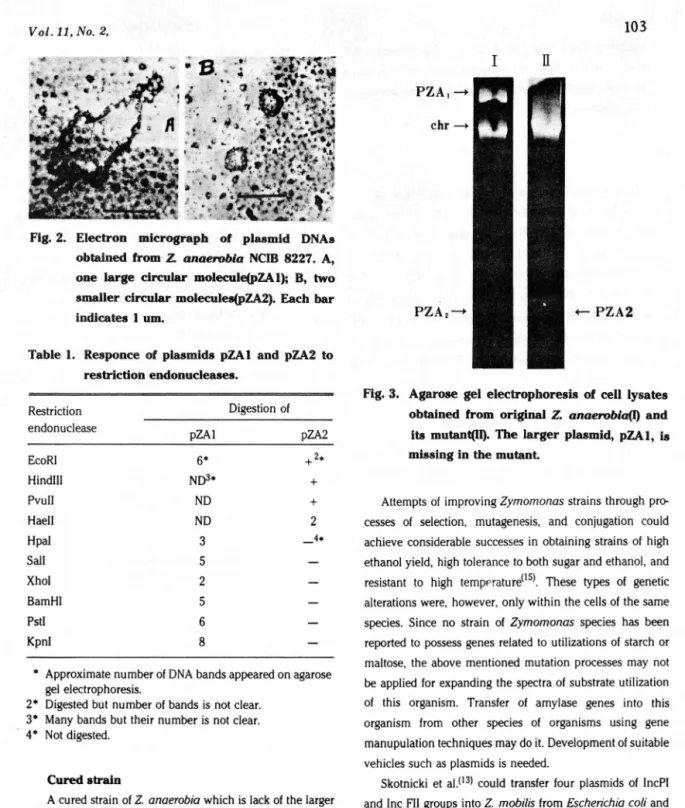
ban띠chr).Observation through electron microscopy The presence 01 two types 01 plasmids in
Z.anaerobia was reconlirmed by observing the celllysate with an electron
mlcroscop어 Fig.
2). The average contour lengths 01 the larger and smaller plasmids were about 8.2 um and 1.0 um respec- tively. According to Lang
’s estimation(6J
,1 um 01 contour length is equivalent to 2.07 Mdal. Thereupon
,the molecular sizes 01 the two plasmids were calculated as 17 Mdal lor the larger one and 2 Mdal lor the smaller plasmid. The observed plasmids 01 Z. anaerobia were tentatively named as pZA 1 lor the 17 Mdal plasmid and pZA2 lor the 2 Mdal one
Responces to restriction enzymes
The two plasmids
,pZA1 and pZA2
,were treated separate- Iy with ten different restriction endonucieases, and their responces on these enzymes were observed by counting the number 01 bands obtained through the agarose gel elec- trophoresis. As shown in Table 1 the larger plasmid
,pZA 1
,had sites lor all the enzymes tested. However
,the smaller one
,pZA2
,responded only to the lour restriction en- donucleases such as
,EcoRI
,HindIII
,Pvu
!I,and HaeII.
Estifhätio디
01 the number 01 DNA bands after the digestion 01
pZA2 with these lour enzymes was not successlul.
Vol.
11, No. 2 ,
Fig. 2. Electron micrograph of plasmid DNAs obtained from Z. anaerobia NCI8 8227. A ,
one
Iarge clrcular molecul
e(pZA1); 8 , two smaller circular molecule
s(pZA2).
Each
뼈rindicates 1 um.
Table 1. Responce of plasmids pZAl and pZA2 to restrlction endonucleases.
Restriction Digestion 01
endonuclease pZAI pZA2
EcoRI 6* +2*
Hindlll N
[)3*+
Pv
ull ND +
Haell ND 2
Hpal 3 4*
Sall 5
Xhol 2
BamHI 5
Pstl 6
Kpnl 8
103
I n
PZA
1•
chr -•
PZA
2• • PZA2
Fig. 3. Agarose gel electrophoresis of cell lysates obtained from original Z. anaerobi
a(I)and its mutant(ll). The larger plasmid , pZA1 , is missing in the mUtanl
Attempts 01 improving Zymomonas strains through pr
o-cesses 01 selection. mutagenesis. and conjugation could achieve considerable successes in obtaining strains 01 high ethanol yield. high tolerance to both sugar and ethanol. and resistant to high tempprature
(l5).These types 01 genetic alterations were. however. only within the cells 01 the same species. Since no strain 01 Zymomonas species has been reported to possess genes related to utilizations 01 starch or maltose. the above mentioned mutation processes may not
* Approximate number 01 DNA bands appeared on agarose
g;lr~l~;;~~'h~;~;~~-'
_. _ ." .. -_ .. _- -rr --'-- _ .. -,,-'--- be applied lor expanding the spectra 01 substrate utilization 2" Digested but number 01 bands is not clear. 01 this organism. Transler 01 amylase genes into this 3" Many bands but their number is not clear. organism Irom other species 01 organisms using gene 4" Not digested.
manup비ation
techniques may do i
t.Development 01 suitable vehicles such as plasmids is needed
Cured strain Skotnicki et a
l.(I3)could transler lour plasmids
이IncPI
A cured strain 01
Z.anaerobia which is lack 01 the larger and Inc FII groups into
Z.mobilis lrom Escherichia coli and plasmid. pZAI. was isolated after a sequential transler 01 the Pseudomonas aeruginosa. The transler Irequency was con- original culture as desctibed in the tex
t.The ONA band 01 siderably
비ghbetween JO'land 10
-4‘However. these pZAI was completely disappeared lrom the agarose gel elec- plasmids have
뾰enknown to be large(2
,3)and may not be us- trophoresis 01 the cured celllysat
e(Fig. 3). The cured cell was ed as vehicles
이gene transler without lurther
manip벼ations.obtained after examining cells 01 32 isolates. Succeeding The smaller plasmid. p
ZA2.isolated lrom
Z.anaerobia in translers proved that the loss 01 pZA r Irom this strain is per- the present study weighs only 2 Mdal. a suitable size lor a
manen
t.vehicle. Furthermore. since this is a native plasmid in
Zymomonas
,pZA2 may be used with advantages in transler-
Discussion ring loreign genes such as those lor amylase into the host
104
organisms. The difficulty in obtaining a large amount 01 this plasmid may be solved by using the cured cell lrom which the larger plasmid was eliminated allowing less procedures lor purilication
요 약
Zymomonas anaerobia의 세포 용해액에서
Klei-
nschmidt 의 방법에 따라 크기가 다른2
개의plasm
id를 분리했다. 전자현미경 관찰을 통해 그들이 각 각 17Mdal 과2
Mdal 의 크기를 가진것을 알았다.액체 애지에 계대 배양한 다음 고체 배지위에 나타 난 colOr<lY플 무의사 단리 하므로서
Z. anaerobia
세 포에서 17Mdal 의 plasmid를 잃어 버린cured
cell 을 분리해 냈다. 이2
Mdal 의 Plasmid를 이용하여 조 작된 유:천자를 Zymomonas세포속에 전엽시킬 가능 성을 논의하였다.Acknowledgements
We would Iike to thank to the Forest Research lnstitute lor generously allowing us to use the electron microscope
References
1. Dawes, E.A.
, D.W.Ribbons, and P.J. Large: Biochem. J., 98 , 795-803
, (1966)
2. Hansen,
J.B. andR.H. Olsen:
J.Bacteriol. 135 (1),
Kor. ι Appl. M icrobiol. Bi eng.
227-238
,(1978)
3. Hardy, K.:
“Bacterial Plasmids", p58, Thomas Nelson and Sons
, Ltd. (1981)4. Kleinschmidt
,A.K.: “
Monolayer Techniques in ElectronMicroscopy 01 Nucleic Acid Molecules", Methods En- zymol., 128, 361-377, (1978)
5, Kramer, P.P. and R. Davis: 123 J. M. B., 371 (1978) 6.
Lang, D.: J.M. B., 54, 557-565, (1970)
7. Lavers, B.H., P. Pang, c.R. Mackenzie, G.R. Lawlord, J Pik
,and H.G.
Lawlord: Abst. 6th Int.Ferment. Symp. p 81
, (1980)
8. Lee, K.J., D.E. Tribe, and P.
L.Rogers: Biotechnol. Letter, 1 , 421-426
,(1979)
9.
L얹,K.J.: Ethanol Fermentation using Strains 01
Zymomonas mobilis, Ph.D. Thesis, (1981)10. Millis, N.F.:
J.Gen. Microbiol., 15, 521-528, (1 956) 11. Rogers, P.L., K.J. Lee, and D.E. Tribe: Biotechnol. Letter,
1 , 165-170 (1 979)
12. Rose, 0.: Process Biochem., II (2) 10-12, (1976) 13. Skotnicki, M.L., D.E. Tribe
, and P.L.Rogers: Appl.
EnvMicrobiol., 40, 7-12, (1 980)
14. Skotnicki, M.
L.,K.J. Lee, D.E. Tribe, and P.L. Rogers:
Appl. Env. Microbiol., 41
, 889-893, (1981)15. Skotnicki, M.L., K.J. Lee, D.E. Tribe, and P.L. Rogers
“