• 검색 결과가 없습니다.

Successful Management of a Recurrent Primary Malignant Fibrous Histiocytoma of the Lung: Report of a Case

N/A
N/A
Protected

Academic year: 2021

Share "Successful Management of a Recurrent Primary Malignant Fibrous Histiocytoma of the Lung: Report of a Case"

Copied!
3
0
0

로드 중.... (전체 텍스트 보기)

전체 글

(1)

Korean J Thorac Cardiovasc Surg 2012;45:345-347 □ Case Report □ http://dx.doi.org/10.5090/kjtcs.2012.45.5.345 ISSN: 2233-601X (Print) ISSN: 2093-6516 (Online)

− 345 −

Department of Thoracic and Cardiovascular Surgery, Catholic University of Daegu School of Medicine Received: March 5, 2012, Revised: June 13, 2012, Accepted: August 3, 2012

Corresponding author: Ki-Sung Park, Department of Thoracic and Cardiovascular Surgery, Catholic University of Daegu School of Medicine, 33 Duryugongwon-ro 17-gil, Nam-gu, Daegu 705-718, Korea

(Tel) 82-53-650-4567 (Fax) 82-53-629-6963 (E-mail) [email protected]

C

The Korean Society for Thoracic and Cardiovascular Surgery. 2012. All right reserved.

CC
This is an open access article distributed under the terms of the Creative Commons Attribution Non-Commercial License (http://creative- commons.org/licenses/by-nc/3.0) which permits unrestricted non-commercial use, distribution, and reproduction in any medium, provided the original work is properly cited.

Successful Management of a Recurrent Primary Malignant Fibrous Histiocytoma of the Lung: Report of a Case

Yun-Ho Jeon, M.D., Ki-Sung Park, M.D.

We describe herein an extremely rare case of a recurrent primary pulmonary malignant fibrous histiocytoma 3 months after operation that occurred in a 55-year-old man who was treated with chemotherapy and radiotherapy successfully. Until now, 36 months later, the patient has shown no evidence of tumor recurrence. The clinical, ra- diographic, and pathologic features are reported here together with a brief review of the literature.

Key words: 1. Lung neoplasms 2. Surgery

3. Chemotherapy 4. Histiocytoma

CASE REPORT 1) Case summary

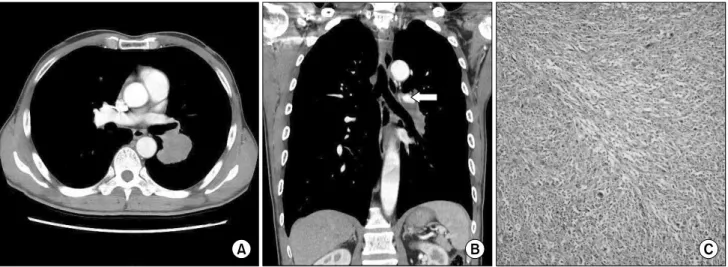
A 55-year-old male presented with a two months history of cough and chest pain. Six months ago, there were no abnor- mal findings in chest X-ray at that time presented with mild chest pain. At the time of cough with chest pain presentation, chest X-ray showed a about 5 cm sized round mass in left hilar area and computed tomography (CT) scan of chest showed a about 5×4 cm lobulated mass arising superior seg- mental bronchus in lower lobe with interlobar pulmonary ar- tery invasion (Fig. 1A, B). Positron emission tomography (PET)-CT was revealed only increasing uptake of hilar mass without anywhere active lesion. Brain magnetic resonance (MR) showed no evidence of metastasis. Bronchoscopic find- ing was a complete obstruction of superior segmental bron- chus. Bronchoscopic and CT-guided needle biopsy of the le- sion results a histological diagnosis of suggestive sarcoma.

The hilar lesion could be considered as the primary malignant tumor, based on clinical findings including CT scan of chest, PET-CT, and brain MR. The patient underwent a left pneu- monectomy with a dissection of the regional lymph nodes.

2) Pathology, postoperative recurrence, and management

The resected tumor was encapsulated, firm, and areas of focal hemorrhage and necrosis with pulmonary arterial in- vasion by tumor.

Microscopically, the tumor was consisted of a pleomorphic

and spindle cell proliferation in a storiform pattern with high

grade differentiation (Fig. 1C). By an immunohistochemical

staining, the tumor was positive for CD68, but negative for

S-100 protein and desmin. The histological final diagnosis

was typical of malignant fibrous histiocytoma (MFH) by the

features of microscopic finding and special staining. There

was no evidence of regional lymph node metastasis and bron-

chial and arterial resection margin were negative.

(2)

Yun-Ho Jeon and Ki-Sung Park

− 346 −

Fig. 1. Computed tomography scan of chest shows (A) about 5×4 cm lobulated mass arising superior segmental bronchus in lower lobe with (B) interlobar pulmonary artery invasion (arrow). (C) The tumor was composed of pleomorphic, spindle-shaped cells arranged in a stori- form pattern (H&E, ×40).

Fig. 2. Positron emission tomography-computed tomography im- ages showing a local relapse of a tumor in postpneumonectomy space with an increased uptake (arrows).

Postoperative recurrence was developed on pleura in pneu- monectomy space during first regular follow-up three months after the operation. The CT scan of chest and PET-CT show- ed a positive finding of recurrence (Fig. 2). There were no findings of extrathoracic metastasis.

The patient was received chemotherapy including doxor- ubicin, followed by radiotherapy for salvage management.

The patient is still alive without any evidence of cancer re-

currence in the chest and another site for 36 months after operation.

DISCUSSION

MFH is the most common soft tissue sarcoma in adult, arising frequently in the extremity, retroperitoneum and trunk [1]. Metastasis to the lung as secondary MFH is not uncom- mon. But primary MFH of the lung is extremely rare, ac- counting only for less than 0.2% of lung neoplasm [1]. To diagnose primary MFH, there must be no evidence of tumor- ous lesion except for primary site by careful physical exami- nation and radiological study. In our case, there was only pulmonary lesion in CT scan of chest and PET-CT without extrathoracic lesion. Up to date, Maeda et al. [2] reviewed the clinical features of only 93 cases of MFH, searching English medical literature in the world.

The median age of these patients was 55 years, range from 10 to 80 years [3]. In our case was compatible with the literature. Pediatric cases have been reported as age range [4].

Male was predominance, but some literature reported female frequently occurred [3]. The common symptoms of patients were coughing, chest pain, and dyspnea. Weight loss, he- moptysis, and fatigue were also observed. But about 32% pa- tients were symptom free [2,3].

In our case, just six months after first symptom of scanty

(3)

Recurrent Primary Malignant Fibrous Histiocytoma

− 347 − chest, the tumor has appeared in CT scan of the chest and PET-CT. There were relatively fewer symptoms at the early stage and the tumor thought to be having a tendency of rapid growing. Maeda et al. [2] reported that a preoperative diag- nosis is difficult and only 4% of their reported cases were histologically diagnosed prior to resection. Maybe, this is be- cause of rarity of MFH and insufficient biopsy specimens by rapid growing. Our case was similar to reported cases.

Therefore, symptom is never missed to detect this disorder.

The microscopic features of MFH are similar to other soft tissue sarcoma. The differential diagnostic diseases are other sarcoma, malignant schwannoma, spindle-cell and anaplastic carcinoma, and malignant melanoma. So, immunohistoche- mical stain is required for the precise diagnosis [5]. Weiss and Enzinger [1] have proposed storiform, pleomorphic, myx- oid, inflammatory, giant cell, and angiomatoid variants may be occurred. The cell feature of our case was a pleomorphic spindle-shaped cell arranged in a storiform pattern.

Maeda et al. [2] reported, cases without a resection who died of the disease, the median survival was 9 months, range from 2 months to 24 months, and the 5-year survival rate for the patients with resection was significantly better than those without resection. As for treatment of MFH, surgical re- section is the most important therapy.

Weiss and Enzinger [1] reported that cases with lymph node metastasis account for 12% of all cases. Other report has similar result in 19%. The 5-year survival rate for the pa- tients without lymph node metastasis was better than those with lymph node metastasis. And patients with lymph node metastasis at surgery were frequently recurred compared with without lymph node metastasis [2]. Our case had turned out not to be lymph node metastasis at surgery. But recurrence was detected at pleural space 3 months after operation. We are thinking of the tumor behavior being rapid growing and

relative early recurrence in high grade.

Systemic metastases at presentation are not infrequently reported. A brain is a common site of metastasis. In our case, metastasis to the brain was not discovered in radiographic study.

It is likely to controversy over adjuvant therapy such as ra- diation and chemotherapy. Radiation therapy has not com- monly been used in the treatment regimen [3]. Drugs used for chemotherapy are doxorubicin, dacarbazine, cyclophospha- mide, and cisplatin. No series reported the response to che- motherapy [3]. But chemoradiation is likely to be having an effect on recurrent case of MFH the same as our case.

So, we report recurrent case of postoperative primary MFH was treated with chemotherapy and radiotherapy successfully, and we do suggest primary MFH should be considered for careful and closed follow-up to detect recurred case as early as possible and postoperative adjuvant chemotherapy need to a selected patient who has large tumor size and high grade differentiation.

REFERENCES

1. Weiss SW, Enzinger FM. Malignant fibrous histiocytoma: an analysis of 200 cases. Cancer 1978;41:2250-66.

2. Maeda J, Ohta M, Inoue M, et al. Surgical intervention for malignant fibrous histiocytoma of the lung: report of a case.

Surg Today 2007;37:316-9.

3. Halyard MY, Camoriano JK, Culligan JA, et al. Malignant fibrous histiocytoma of the lung: report of four cases and review of the literature. Cancer 1996;78:2492-7.

4. Ismailer I, Khan A, Leonidas JC, Wind E, Herman P.

Computed tomography of primary malignant fibrohistio- cytoma of the lung. Comput Radiol 1987;11:37-40.

5. McDonnell T, Kyriakos M, Roper C, Mazoujian G. Malig- nant fibrous histiocytoma of the lung. Cancer 1988;61:

137-45.

수치

Fig. 1. Computed tomography scan of chest shows (A) about 5×4 cm lobulated mass arising superior segmental bronchus in lower lobe  with (B) interlobar pulmonary artery invasion (arrow)

참조

관련 문서

The proposal of the cell theory as the birth of contemporary cell biology Microscopic studies of plant tissues by Schleiden and of animal tissues by Microscopic studies of

However, it is expected that in the case of biotech start-ups facing the Valley- of-Death, the shareholders’ equity value has a function of a growth option in real

Since every classical or virtual knot is equivalent to the unknot via a sequence of the extended Reidmeister moves together with the forbidden moves, illustrated in Section 2,

3) A comparison of the stoichiometric equation with the experimental kinetic expression can suggest whether or not we are dealing with an elementary reaction. 4) If one

It considers the energy use of the different components that are involved in the distribution and viewing of video content: data centres and content delivery networks

After first field tests, we expect electric passenger drones or eVTOL aircraft (short for electric vertical take-off and landing) to start providing commercial mobility

1 John Owen, Justification by Faith Alone, in The Works of John Owen, ed. John Bolt, trans. Scott Clark, "Do This and Live: Christ's Active Obedience as the

- distributes indexes across multiple computers and/or multiple sites - essential for fast query processing with large numbers of documents - many variations: