© 2014 The Korean Academy of Medical Sciences.
This is an Open Access article distributed under the terms of the Creative Commons Attribution Non-Commercial License (http://creativecommons.org/licenses/by-nc/3.0) which permits unrestricted non-commercial use, distribution, and reproduction in any medium, provided the original work is properly cited.
pISSN 1011-8934 eISSN 1598-6357
Thrombolytic Therapy Complemented by ECMO: Successful Treatment for A Case of Massive Pulmonary Thromboembolism with Hemodynamic Collapse
Pulmonary thromboembolism (PTE) is a common clinical condition related to significant mortality. Furthermore, patients with PTE presenting with right heart thrombus show higher mortality due to rapid hemodynamic deterioration. But the optimal treatment of massive PTE is controversial although various methods have been developed and improved.
Here, we presented a case of 56-yr-old woman with massive PTE showing hemodynamic collapse, who was successfully treated with extracorporeal membrane oxygenation (ECMO) adjunct to thrombolytic therapy even without thrombectomy. ECMO was useful for resuscitation and stabilization of the cardiopulmonary function. In conclusion,
thrombolytic therapy complemented by ECMO may be an effective treatment option for acute massive PTE with hemodynamic instability.
Keywords: Pulmonary Thromboembolism; Extracorporeal Membrane Oxygenation, Percutaneous Cardiopulmonary Support; Thrombolysis
Min Ku Chon, Yong Hyun Park, Jin Hee Choi, Sang Hyun Lee,
Jeong Su Kim, Jun Kim, June Hong Kim, and Kook Jin Chun
Division of Cardiology, Department of Internal Medicine, Pusan National University Yangsan Hospital, Yangsan, Korea
Received: 9 June 2013 Accepted: 17 October 2013 Address for Correspondence:
Yong Hyun Park, MD
Division of Cardiology, Department of Internal Medicine, Pusan National University Yangsan Hospital, 20 Geumo-ro, Mulgeum-eup, Yangsan 626-770, Korea
Tel: +82.55-360-1594, Fax: +82.55-360-2204 E-mail: [email protected]
http://dx.doi.org/10.3346/jkms.2014.29.5.735 • J Korean Med Sci 2014; 29: 735-738
INTRODUCTION
Massive pulmonary thromboembolism (PTE) is a disease asso- ciated with poor clinical outcome due to the natural course of the disease frequently presenting with rapid hemodynamic de- terioration. Front-line therapy of massive PTE is thrombolysis (1). But the treatment failure still occurs in about 8.2%-20% of patients (2, 3). The surgical embolectomy and catheter-based embolectomy are recommended in various cases. However, the outcome of embolectomy is not always satisfactory (4). Unfor- tunately, there’s no consensus for the management of massive pulmonary thromboembolism.
This case report shows thrombolytic therapy supported by extracorporeal membrane oxygenation (ECMO) was used suc- cessfully for treatment of patient with massive PTE who suffered from cardiogenic shock.
CASE DESCRIPTION
A 56-yr-old woman was transferred to emergency room of our hospital because of suspected PTE on October fifth, 2010. When she arrived, mental state was clear and she complained dyspnea and chest discomfort. Initial systolic blood pressure (BP) was 90mmHg and heart rate was 116 bpm. Chest X-ray revealed no remarkable finding. Transthoracic echocardiography demon- strated decreased contractility of dilated right ventricle (RV) with
D-shaped left ventricle on parasternal short axis view (Fig. 1A).
Also it showed a huge echogenic mass in dilated pulmonary trunk and a whip-like moving mass in right atrium (RA) (Fig.
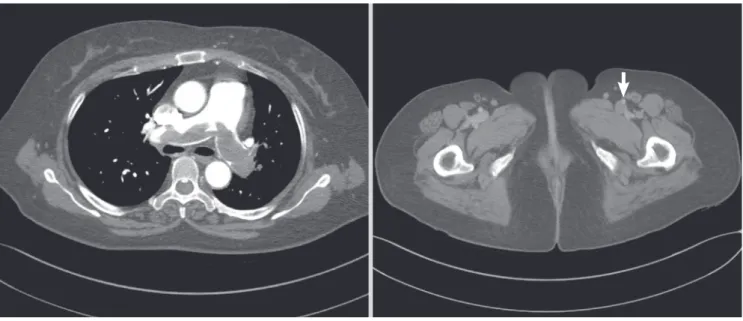
1B). The right atrial mass moved through tricuspid valve to right ventricle. Estimated pulmonary artery systolic pressure was about 70 mmHg. Computed tomography (CT) finding also showed heavy thrombus in main pulmonary artery which extended into lobar branches of pulmonary system and deep vein thrombosis of left external iliac vein (Fig. 2).We diagnosed PTE with huge thrombus on RA clinically. Because the patient had stable vital sign, we selected thrombolytic therapy with tissue plasminogen activator (t-PA) infusion (100 mg over 2 hr). After one hour from t-PA infusion, the patient suddenly became unconscious. Her peripheral oxygen saturation was 76%, systolic BP 50 mmHg, and heart rate decreased to 33 bpm. Shortly afterward, the pa- tient arrested and we started cardiopulmonary resuscitation (CPR). During CPR, our team made a critical decision to apply percutaneous cardiopulmonary support (PCPS) system for he- modynamic stabilization before surgical embolectomy. PCPS was inserted via right femoral artery and left femoral vein under fluoroscopic guidance and local anesthesia. The Capiox (Teru- mo, Tokyo, Japan) emergent bypass system was used. Thereaf- ter, hemodynamic state of patient was stabilized at the PCPS flow rate of 3-3.5 L/min. We revised our plan to continue throm- bolytic therapy and anticoagulation with PCPS support in con- sideration of stable vital sign and high bleeding risk of surgery CASE REPORT
Cardiovascular Disorders
Chon MK, et al. • ECMO Adjunct to Thrombolytic Therapy for Treatment of PTE
736 http://jkms.org http://dx.doi.org/10.3346/jkms.2014.29.5.735
A B
RV
RV
RA LA
Ao
LV
Fig. 1. Initial transthoracic echocardiography (TTE) image. (A) D-shape of LV on parasternal short axis view. (B) Free-floating, whip-like right atrial (RA) mass (arrow) suggesting thrombus. RA, right atrium; LV, left ventricle; LA, left atrium; Ao, aorta.
Fig. 2. Initial computed tomography (CT) image.Large saddle thrombus in main pulmonary artery and deep vein thrombus of external iliac vein (arrow) were presented in CT with contrast enhancement.
during thrombolytic therapy. Heparin was administered intra- venously and warfarin was overlapped after 5 days. Activated coagulation time was maintained within target range of 150-200 sec and activated partial thromboplastin time (aPTT) was con-
trolled at approximately 80 sec during the PCPS support. She was decannulated sixty-two hours after PCPS insertion, when repeat echocardiography noted that RV function was much im- proved compared with initial echocardiography and estimated
Chon MK, et al. • ECMO Adjunct to Thrombolytic Therapy for Treatment of PTE
http://jkms.org 737
http://dx.doi.org/10.3346/jkms.2014.29.5.735
pulmonary artery systolic pressure decreased below 50mmHg even though mass remained on main pulmonary artery.
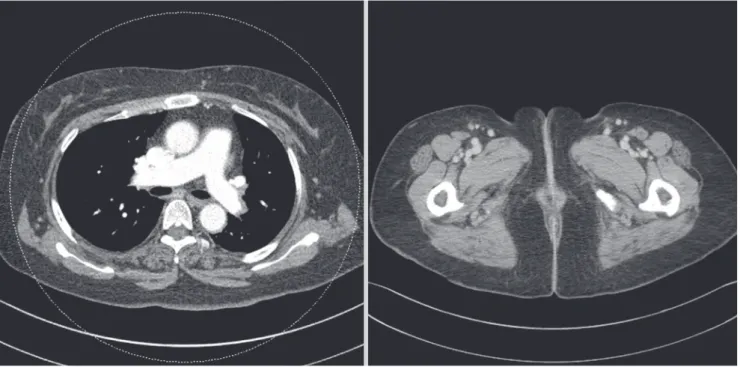
In sequence, ventilator was weaned and she transferred to general ward. General condition of the patient was improved gradually and she discharged without complication. After dis- charge, warfarin was continued at target international normal- ized ratio (INR) of 3. One month later from discharge, we fol- lowed up chest CT. The CT showed thrombus on main pulmo- nary artery and deep vein thrombus of left external iliac artery were clearly disappeared (Fig. 3). For two years follow up, she has been doing well without any complication and recurrence of thromboembolism.
DISCUSSION
Pulmonary thromboembolism with floating right heart throm- bus is uncommon but reported mortality rate is over 44% (5, 6).
The presence of right heart thrombus considerably increases the mortality rate compared to the presence of pulmonary throm- boembolism alone (7). Despite the risk is high, the optimal treat- ment of pulmonary thromboembolism with right ventricular thrombus remains controversial.
Thrombolysis is the preferred primary therapeutic option, but the result is poor when pulmonary thromboembolism pro- gresses rapidly (8). Surgical embolectomy can be another treat- ment option. However, mortality of surgical embolectomy in hemodynamically unstable patientis still high even though re- cent data have shown improved outcome (In-hospital mortality is 25% to 100% in patient with preoperative arrest) (9). Percuta-
Fig. 3. Follow up computed tomography (CT) image, 1 month after discharge. Pulmonary thrombus in main pulmonary artery and deep vein thrombus of external iliac vein were clearly disappeared.
neous catheter-directed thrombolysis or catheter thrombecto- my is another treatment option (10, 11). Although these proce- dures are potentially effective, they take more time to apply and show poor outcome in patient with cardiovascular collapse (12). Pulmonary thromboembolism progresses to cardiogenic shock and cardiac arrest due to right ventricular failure (9). In this situation, ECMO may be able to play a key role for emergent circulatory and respiratory support.
The first heart-lung machine is developed by Gibbon for treat- ment of patient with pulmonary thromboembolism (13). And it has evolved into PCPS, a kind of ECMO. PCPS is commonly used in urgent situations because it can be inserted quickly and easi- ly (14). In massive pulmonary thromboembolism, PCPS decom- presses the acutely overloaded right ventricle and improves ox- ygenation (15). PCPS also can provide mechanical support when hypoxia has continued after thrombolysis because of increased lung vascular permeability with reperfusion injury (16). PCPS is considered an appropriate method for supporting hemodyna- mic circulatory collapse during thrombolysis.
Inoue et al. (17) reported a case that PCPS was used as ad- junct to thrombolytic therapy for patient who has massive pul- monary thromboembolism with RV thrombus. This case, like our case, showed satisfactory clinical outcome and the patient has been well in follow-up period. Some article and case report suggest surgical embolectomy is preferred in hemodynamic unstable patient (18, 19). But there are no comparative trials of thrombolysis and surgery for massive pulmonary thromboem- bolism. A report documented that thrombolysis is an alterna- tive to embolectomy because it has been shown that the risk of
Chon MK, et al. • ECMO Adjunct to Thrombolytic Therapy for Treatment of PTE
738 http://jkms.org http://dx.doi.org/10.3346/jkms.2014.29.5.735 death or recurrent PTE decreased by 55% (20). In our opinion,
outcome of the paper may be improved if thrombolysis would be complemented by ECMO.
In presented case, we suggest that thrombolysis complement- ed by ECMO could be a successful treatment option for the pa- tients who have massive PTE with circulatory collapse even with- out surgical embolectomy.
ORCID
Yong Hyun Park http://orcid.org/0000-0001-6122-214X
REFERENCES
1. Kearon C, Akl EA, Comerota AJ, Prandoni P, Bounameaux H, Goldha- ber SZ, Nelson ME, Wells PS, Gould MK, Dentali F, et al. American Col- lege ofChest Physicians. Antithrombotic therapy for VTE disease: Anti- thrombotic therapy and prevention of thrombosis, 9th ed: American col- lege of chest physicians evidence-based clinical practice guidelines. Chest 2012; 141: e419S-94S.
2. Charbonnier B, Meyer G, Stern M, Sors H, Brochier ML. Thrombolytic treatment of acute pulmonary embolism. Herz 1989; 14: 157-71.
3. Meneveau N, Seronde MF, Blonde MC, Legalery P, Didier-Petit K, Bri- and F, Caulfield F, Schiele F, Bernard Y, Bassand JP. Management of un- successful thrombolysis in acute massive pulmonary embolism. Chest 2006; 129: 1043-50.
4. Stein PD, Matta F. Case fatality rate with pulmonary embolectomy for acute pulmonary embolism. Am J Med 2012; 125: 471-7.
5. Chartier L, Bera J, Delomez M, Asseman P, Beregi JP, Bauchart JJ, Warem- bourg H, Thery C. Free-floating thrombi in the right heart: Diagnosis, ma- nagement, and prognostic indexes in 38 consecutive patients. Circulation 1999; 99: 2779-83.
6. Torbicki A, Galie N, Covezzoli A, Rossi E, De Rosa M, Goldhaber SZ, ICOPER Study Group. Right heart thrombi in pulmonary embolism: Re- sults from the international cooperative pulmonary embolism registry. J Am Coll Cardiol 2003; 41: 2245-51.
7. Rose PS, Punjabi NM, Pearse DB. Treatment of right heart thromboem- boli. Chest 2002; 121: 806-14.
8. Goldhaber SZ. Thrombolysis for pulmonary embolism. N Engl J Med 2002; 347: 1131-2.
9. He C, Von Segesser LK, Kappetein PA, Mestres CA, Smith JA, Choong CK. Acute pulmonary embolectomy. Eur J Cardiothorac Surg 2013; 43:
1087-95.
10. Weinberg L, Kay C, Liskaser F, Jones D, Tay S, Jaffe S, Seevanayagam S, Doolan L. Successful treatment of peripartum massive pulmonary em- bolism with extracorporeal membrane oxygenation and catheter-direct- ed pulmonary thrombolytic therapy. Anaesth Intensive Care 2011; 39:
486-91.
11. Griffith KE, Jenkins E, Haft J. Treatment of massive pulmonary embolism utilizing a multidisciplinary approach: A case study. Perfusion 2009; 24:
169-72.
12. Margheri M, Vittori G, Vecchio S, Chechi T, Falchetti E, Spaziani G, Gi- uliani G, Rovelli S, Consoli L, BiondiZoccai GG. Early and long-term clin- ical results of AngioJet rheolytic thrombectomy in patients with acute pul- monary embolism. Am J Cardiol 2008; 101: 252-8.
13. GIBBON JH,Jr. Application of a mechanical heart and lung apparatus to cardiac surgery. Minn Med 1954; 37: 171-85; passim.
14. von Segesser LK. Cardiopulmonary support and extracorporeal mem- brane oxygenation for cardiac assist. Ann Thorac Surg 1999; 68: 672-7.
15. Maggio P, Hemmila M, Haft J, Bartlett R. Extracorporeal life support for massive pulmonary embolism. J Trauma 2007; 62: 570-6.
16. Kawahito K, Murata S, Adachi H, Ino T, Fuse K. Resuscitation and circu- latory support using extracorporeal membrane oxygenation for fulminant pulmonary embolism. Artif Organs 2000; 24: 427-30.
17. Inoue T, Oka H, Oku H. Percutaneous cardiopulmonary support for the treatment of right ventricular thrombus. Perfusion 2002; 17: 73-5.
18. Takahashi H, Okada K, Matsumori M, Kano H, Kitagawa A, Okita Y. Ag- gressive surgical treatment of acute pulmonary embolism with circula- tory collapse. Ann Thorac Surg 2012; 94: 785-91.
19. Hisatomi K, Yamada T, Onohara D. Surgical embolectomy of a floating right heart thrombus and acute massive pulmonary embolism: Report of a case. Ann Thorac Cardiovasc Surg 2013; 19: 316-9.
20. Büller HR, Agnelli G, Hull RD, Hyers TM, Prins MH, Raskob GE. Anti- thrombotic therapy for venous thromboembolic disease: The seventh ACCP conference on antithrombotic and thrombolytic therapy. Chest 2004; 126:
401S-28S.