52 http://www.aard.or.kr
서 론
급성 전신성 발진성 농포증(acute generalized exanthematous pustulosis, AGEP)은 급성의 부종성 홍반에 비화농성 농포를 특징 으로 하는 비교적 드문 질환이다.1 European study of Severe Cuta- neous Adverse Reaction (EuroSCAR)에 따르면 AGEP의 발생률은 연간 백만 명당 1–5명의 비율로 발생하며 남녀의 발생비율은 비슷 하다고 알려져 있다.1,2 AGEP의 약 90% 정도가 약물에 의해 발생하 는데 이중 대부분은 항생제가 원인이며 이외에 바이러스감염, 한 약제, 거미 독, 수은과의 접촉 등이 드문 원인으로 알려져 있다.2
Acetaminophen은 세계적으로 빈번하게 사용되고 있는 해열진 통제이다. Acetaminophen에 의한 AGEP는 국내에서 현재까지 보 고된 바가 없으며 저자는 acetaminophen을 복용 후 발생한 임상 경과와 조직학적 소견으로 추정 진단된 AGEP 1예를 경험하여 문 헌고찰과 함께 보고하는 바이다.
증 례
환자: 78세 여자
주소: 발열, 전신의 농포성 피부 발진
현병력: 78세 여자가 내원 4일전부터 발생한 피부의 농포성 병변 과 하루 전부터 발생한 발열을 주소로 내원하였다. 환자는 내원 2 개월 전 흉추 6번 압박골절로 인한 통증으로 지역 신경외과에서 aceclofenac과 carbamazepine을 2개월간 지속적으로 복용해왔다.
이후 통증 조절되어 경과 보던 중에 연고지 문제로 내원 6일전부터 는 정형외과의원에서 기존의 aceclofenac과 carbamazepine을 중 단하고 대신 acetaminophen과 tramadol의 복합제를 처방받아 복 용했다. 복합제로 약물교체한지 2일째인 내원 4일전부터 얼굴과 몸 통에 발진과 가려움 증상이 발생했고 피부과의원에서 항히스타민 제를 복용했으나 증상 호전 없었다고 하며 전날부터는 발진이 전신 으로 퍼지고 발열이 동반되어 본원에 내원하였다.
Allergy Asthma Respir Dis 5(1):52-55, January 2017 https://doi.org/10.4168/aard.2017.5.1.52
pISSN: 2288-0402 eISSN: 2288-0410
CASE REPORT
Correspondence to: Mi-Jung Oh http://orcid.org/0000-0002-7827-8411
Department of Internal Medicine, Bundang Jesaeng General Hospital, 20 Seohyeon-ro 180beon-gil, Bundang-gu, Seongnam 13590, Korea
Tel: +82-31-779-0200, Fax: +82-31-779-0897, E-mail: [email protected] Received: June 15, 2016 Revised: August 9, 2016 Accepted: August 11, 2016
© 2017 The Korean Academy of Pediatric Allergy and Respiratory Disease The Korean Academy of Asthma, Allergy and Clinical Immunology This is an Open Access article distributed under the terms of the Creative Commons Attribution Non-Commercial License (http://creativecommons.org/licenses/by-nc/4.0/).
Acetaminophen이 원인으로 추정되는 급성 전신성 발진성 농포증 1예
김형우, 최용선, 원정호, 이재민, 허진영, 최정아, 오미정 분당제생병원 내과
Acute generalized exanthematous pustulosis presumed to be caused by acetaminophen
Hyeong Woo Kim, Yong Sun Choi, Jung Ho Won, Jae Min Lee, Jin Young Heo, Jung Ah Choi, Mi-Jung Oh Department of Internal Medicine, Bundang Jesaeng General Hospital, Seongnam, Korea
Acute generalized exanthematous pustulosis (AGEP) is a severe and rare disease usually related to drug eruption. AGEP is induced by drugs in over 90% of cases with antibiotics being the most common. It is characterized by a fever and a pustular eruption on ery- thematous skin with acute onset and without follicular localization. Acetaminophen is commonly used as an antipyretic and anal- gesic. Acetaminophen has been reported to be an uncommon cause of AGEP. We report a 79-year-old woman presenting with fever and erythematous maculopapular eruptions on the trunk with sterile pustules arising upon the use of acetaminophen for back pain. Leukocytosis and elevated C-reactive protein levels were noted on the laboratory examination. The histopathological exami- nation of the skin biopsy specimen showed intraepidermal pustule formation with superficial perivascular lymphocytic infiltration, including eosinophils, and extensive red blood cell extravasation. The lesions were resolved with discontinuation of acetaminophen and use of systemic corticosteroid. We report a case of AGEP probably caused by acetaminophen. (Allergy Asthma Respir Dis 2017:5:52-55) Keywords: Acute generalized exanthematous pustulosis, Acetaminophen, Drug eruption
김형우 외 • Acetaminophen으로 원인 추정된 급성 전신성 발진성 농포증 Allergy Asthma Respir Dis
https://doi.org/10.4168/aard.2017.5.1.52 53 과거력: 골다공증과 관절염으로 5년 전부터 약물 복용해오다 2
년 전부터 임의로 중단하였다. 내원 6일 전까지 최근 2개월간 지역 신경외과에서 근이완제인 afloqualone, 소화제인 itopride, 비스테 로이드성 소염진통제인 aceclofenac과 항전간제인 carbamazepine 을 복용하였으며 이전 알레르기 질환 및 약물 알레르기 기왕력은 없었다.
사회력: 특이 사항 없었다.
가족력: 특이 사항 없었다.
진찰 소견: 혈압은 99/68 mmHg, 맥박 수 분당 104회, 호흡 수 분 당 27회, 체온 39.4°C였다. 의식은 명료했고 임파선 비대나 점막침 범은 없었으며 복부 진찰 및 신경학적 검사에서도 특이 소견은 보 이지 않았다. 피부 소견에서는 크기가 1–2 mm 가량의 다수의 홍반 성 구진의 작은 비모낭성 농포가 몸통을 중심으로 얼굴과 사지를 포함하여 전신에 관찰되었고 발진은 시간이 경과할수록 몸통에서 두피와 얼굴, 사지말단으로 번지고 융합되는 양상이었다(Fig. 1).
검사실 소견: 말초혈액검사에서는 백혈구 수 13,000/mm³ (호중 구 66.4%, 림프구 14.7%, 호산구 10.4%), 혈색소 14.1 g/dL, 혈소판 수 150,000/mm³이었고, C-반응 단백질은 2.14 mg/dL으로 증가되 어 있었다. 혈청생화학검사에서 아스파르테이트아미노전달효소 33 IU/L, 알라닌아미노기전달효소 32 IU/L, 알칼리성 인산가수분 해효소 146 IU/L, 혈액요소질소 17 mg/dL, 크레아티닌 0.97 mg/dL 으로 정상이었고 소변검사는 단백뇨 2+인 것 이외는 특이 소견 없 었고 혈액배양검사도 음성이었다.
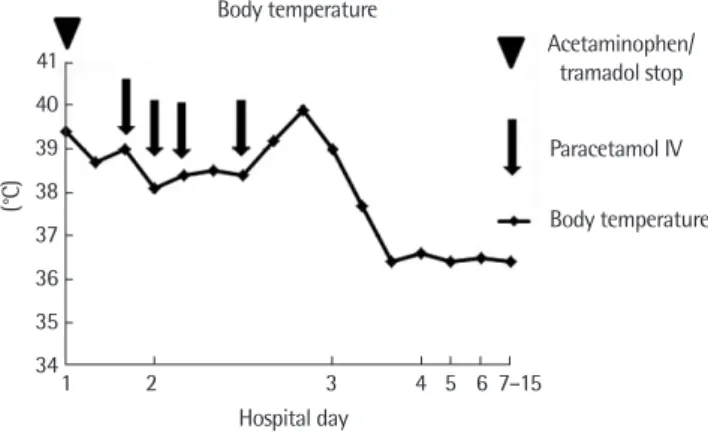
치료 및 경과: 환자는 내원 후 복용 중이던 acetaminophen과 tramadol의 복합제를 포함한 자가약을 모두 중단했고 전신 스테로 이드와 항히스타민제를 정주했다. 이후에도 지속적인 발열이 있어 해열목적으로 paracetamol을 정주했지만 고열이 지속되어 para- cetamol이 성분인 acetaminophen에 의한 약물발진 가능성을 고려 하여 이후 해당약물을 중단하고 24시간 후에 발열은 해소되었다
(Fig. 2). 발진에 대해 피부과 협진 후 병변의 AGEP 가능성하에 환 자의 앞가슴과 좌측 대퇴부에서 조직검사를 시행했다. 병리조직학 적 소견상 표피 내 농포와 호산구가 포함된 혈관주위 림프구 침윤 과 광범위한 적혈구의 혈관 외 유출을 보였다(Fig. 3).
임상 양상과 병리조직학적 소견에 따라 AGEP로 진단하였고 피 부병변은 약물 중단한지 시간이 지남에 따라 점진적으로 호전되어 치료 시작 3주경 후 스테로이드 투여도 중단하였다. 4개월 뒤 acet- aminophen, tramadol, aceclofenac, carbamazepine에 대한 약물첩 포시험을 생리식염수를 용매로 모두 10%의 농도로 시행하였다.3-5 검사 결과는 72시간 후 International Contact Dermatitis Research Group Criteria에 따라 판독하였는데 acetaminophen과 tramadol 은 음성이었고 aceclofenac과 carbamazepine은 침윤 없는 홍반으 로 불확실한 반응을 보였다.3,5
고 찰
AGEP는 1980년 Beylot에 의해 처음 기술되었는데 대부분은 항 생제가 원인이지만 유발할 수 있는 다른 약물로 calcium channel blockers, isoniazid, antimycotics, nonsteroidal anti-inflammatory
Fig. 2. The patient became afebrile the very next day of stopping of paracetamol.
Hospital day
1 2 3 4 5 6 7–15 Body temperature
Acetaminophen/
tramadol stop Paracetamol IV Body temperature 41
40 39 38 37 36 35 34
(°C)
Fig. 3. Histologic examination shows intraepidermal pustule formation with su- perficial perivascular lymphocytic infiltration including eosinophils and exten- sive red blood cell extravasation (A: H&E, × 100; B: H&E, × 200).
A B
Fig. 1. There are multiple nonfollicular, pustular lesions on an erythematous background on the back.
Kim HW, et al. • AGEP caused by presumed acetaminophen Allergy Asthma Respir Dis
54 https://doi.org/10.4168/aard.2017.5.1.52
drugs, furosemide, codeine, dexamethasone, carbamazepine, phenytoin 등이 있다.2,6,7
AGEP의 유발기전은 명확히 알려지지 않았으나 병변의 면역화 학조직검사상 기저막과 진피 혈관 내에 면역복합체, C3의 침착을 보이므로 제3형과 제4형 면역반응이 관여한다는 주장과 원인 약물 특이 T 세포가 활성화되고 CD4+ T 세포가 Interleukin (IL)-1 또는 IL-8과 같은 호중구의 화학주성을 나타내는 물질을 분비함으로 인 해 농포가 형성된다는 주장 등이 있다.8,9
AGEP는 원인 물질 노출 후 24시간 또는 수일 내 급격하게 크기 5 mm 이하의 수많은 농포성 발진과 38°C 이상의 발열 그리고 혈액 검사상 때때로 경도의 호산구 증가증을 동반한 호중구 증가증이 나타난다. AGEP의 농포성 병변은 몸통을 주로 침범하며 목이나 사 지로 확장되는 양상을 보이는데 얼굴과 손, 발 등 말단에도 침범할 수 있다. 병리 조직학적으로는 각질층하 또는 표피 내 농포와 진피 부종, 혈관주위 호산구 침윤 등을 특징적으로 보인다.9-11
AGEP와 감별해야 할 대표적 질환으로 전신성 농포성 건선이 있 는데 AGEP는 이전에 건선의 병력이 없고 약물에 의해 빈번히 유발 된다는 점과 병리조직학적 소견상 각질층하 농포성 병변이 존재하 고 건선양 극세포증이나 비틀리고 확장된 혈관이 없으며 호중구의 각질층하 결집이 있다는 점에서 전신성 농포성 건선과 차이가 있다.
이처럼 AGEP의 임상적인 소견과 병리조직학적 소견의 특징적인 차이점이 다른 농포성 피부 질환과의 감별 진단에 도움이 된다.2,9,11
앞서 말한 것처럼 AGEP의 진단은 임상 양상, 질병 경과와 조직 학적 특징을 근거로 하는데 2001년 Sidoroff는 AGEP의 진단 기준 을 제안했다. 그 기준은 (1) 급성의 크기가 5 mm 이하의 수개의 비 모낭성 농포, (2) 38°C 이상의 발열, (3) 경도의 호산구 증가증을 동 반하거나 하지 않은 호중구 증가증, (4) 조직학적으로 각질층하 또 는 표피 내 농포의 존재, (5) 병변이 발생한지 15일 이내 자발적 소실 을 포함한다.2 현재는 EuroSCAR의 진단 기준을 사용하고 있으며 8–12점 사이일 경우 AGEP라고 진단할 수 있는데 이번 증례는 12 점에 해당되어 진단 기준에 부합하였다(Table 1).2
AGEP는 대부분 원인 물질 노출 중단 후 15일 이내 병변이 자발 적으로 소실되는 임상 경과를 보이므로 특별한 치료가 필요하지 않으나 경우에 따라 스테로이드나 항히스타민의 투여가 증상 완화 에 도움이 될 수 있으며 이차적인 세균감염이 동반된 경우 항생제 가 필요할 수 있다고 알려져 있다.11
원인을 확인하기 위한 검사로는 약물첩포시험을 해 볼 수 있는 데 사실 AGEP 의 경우에 있어 첩포시험의 민감도는 50%에 불과하 다고 알려져 있다. 이것은 약물의 노출경로에 따라 서로 다른 면역 학적 기전이 활성화되기 때문이라고 설명될 수 있으며 따라서 약물 첩포시험의 양성 결과가 AGEP의 전형적인 소견이라고 말할 수는
없다.10,12 이번 증례의 경우에도 결과가 음성이었는데 위에서 언급
한 이유 이외에도 첩포시험의 용매로 생리식염수를 사용해 약물이
Table 1. Scores for the diagnosis of AGEP (proposed by the EuroSCAR group)2 Score Morphology
Pustules
Typical +2
Compatible +1
Insufficient 0
Erythema
Typical +2
Compatible +1
Insufficient 0
Distribution/pattern
Typical +2
Compatible +1
Insufficient 0
Postpustular desquamation
Yes +1
No/insufficient 0
Course
Mucosal involvement
Yes -2
No 0
Acute onset
Yes-2 0
No
Resolution of pustules and erythema ≤ 15 days
Yes 0
No -4
Fever (≥ 38°C)
Yes +1
No 0
Blood neutrophil count (≥ 7,000 cells/mm3)
Yes +1
No 0
Histopathological analysis
Other diseases -10
Not significant/no anatomopathological examination 0
Polymorphonuclear cell exocytosis +1
No subcorneal and/or intraepidermal spongiosis or unspecified Pustules with papilledema or subcorneal and/or intraepidermal
Spongiosis or unspecified, pustules without papilledema
+2
Subcorneal and/or intraepidermal spongiform pustules with
papilledema +3
AGEP, acute generalized exanthematous pustulosis.
Interpretationn (score): 0, not AGEP; 1–4, AGEP is possible; 5–7, AGEP is probable;
8–12, AGEP is established.
*Typical: typical morphology. †Compatible: morphology is not typical but strongly suggestive. ‡Insufficient: lesions cannot be evaluated (due to advanced stage of de- velopment).
Adapted from Sidoroff et al. J Cutan Pathol 2001;28:113-9, with permission of John Wiley and Sons.2
김형우 외 • Acetaminophen으로 원인 추정된 급성 전신성 발진성 농포증 Allergy Asthma Respir Dis
https://doi.org/10.4168/aard.2017.5.1.52 55 표피에 잘 침투하지 못하여 위 음성 결과를 보였을 가능성이 있겠
다. 추후에 유사한 증례에서 약물첩포시험 시행 시에는 용매로 생 리식염수와 petrolatum 둘 다 사용하고 첩포 제거 뒤 2일 후 추가 판독하는 것이 첩포시험 민감도를 높이는데 도움이 될 것으로 생 각한다.5
비록 이번 증례의 첩포시험에서 aceclofenac과 carbamazepine 에 홍반이 나타났으나 전형적인 양성반응에서 보이는 침윤이나 수 포가 없는 일반적으로 알레르기 반응으로 해석되지 않는 불확실 한 반응이었던 점과 발진이 발생하기 6일 전에 2개월간 복용 중이 던 aceclofenac과 carbamazepine을 중단하고 acetaminophen과 tramadol 복합제로 변경했던 점으로 비추어 볼 때 aceclofenac이나 carbamazepine보다는 acetaminophen이나 tramadol이 원인일 가 능성이 높다고 판단하였다.
Tramadol에 의한 AGEP의 문헌보고는 없는 반면 acetamino- phen에 의한 AGEP는 외국에서 몇몇 증례보고들이 있어 acet- aminophen에 의한 가능성이 높다고 생각하였다.4,13 하지만 발진 호전 후 acetaminophen이나 tramadol 재투여를 하지 않아 원인에 대해 확정 짓기에는 제한이 있겠다.
결론적으로 AGEP는 대체로 저절로 치유되는 예후가 좋은 질환 이지만 기저질환이 있는 고령의 환자에서는 고열과 이차적인 감염 으로 인해 1%–2%의 치사율을 보일 수 있기 때문에 잠재적으로 치 명적일 수 있다.2,6,10 그러므로 AGEP가 임상적으로 의심되는 경우 유발 원인이 되는 약물을 찾아내는 것이 무엇보다 중요하다. 본 증 례를 통하여 임상의사는 해열진통제로 흔히 사용되는 acetamino- phen에 의해 AGEP가 유발될 수 있음을 숙지할 필요가 있겠다.
REFERENCES
1. Bomarrito L, Zisa G, Delrosso G, Farinelli P, Galimberti M. A case of acute generalized exanthematous pustulosis due to amoxicillin-clavula- nate with multiple positivity to beta-lactam patch testing. Eur Ann Aller-
gy Clin Immunol 2013;45:178-80.
2. Sidoroff A, Halevy S, Bavinck JN, Vaillant L, Roujeau JC. Acute general- ized exanthematous pustulosis (AGEP): a clinical reaction pattern. J Cu- tan Pathol 2001;28:113-9.
3. Brockow K, Garvey LH, Aberer W, Atanaskovic-Markovic M, Barbaud A, Bilo MB, et al. Skin test concentrations for systemically administered drugs: an ENDA/EAACI Drug Allergy Interest Group position paper.
Allergy 2013;68:702-12.
4. Mashiah J, Brenner S. A systemic reaction to patch testing for the evalua- tion of acute generalized exanthematous pustulosis. Arch Dermatol 2003;139:1181-3.
5. Romano A, Viola M, Gaeta F, Rumi G, Maggioletti M. Patch testing in non-immediate drug eruptions. Allergy Asthma Clin Immunol 2008;4:
66-74.
6. Bachot N, Roujeau JC. Differential diagnosis of severe cutaneous drug eruptions. Am J Clin Dermatol 2003;4:561-72.
7. Sidoroff A, Dunant A, Viboud C, Halevy S, Bavinck JN, Naldi L, et al.
Risk factors for acute generalized exanthematous pustulosis (AGEP)-re- sults of a multinational case-control study (EuroSCAR). Br J Dermatol 2007;157:989-96.
8. Britschgi M, Steiner UC, Schmid S, Depta JP, Senti G, Bircher A, et al. T- cell involvement in drug-induced acute generalized exanthematous pus- tulosis. J Clin Invest 2001;107:1433-41.
9. Kardaun SH, Kuiper H, Fidler V, Jonkman MF. The histopathological spectrum of acute generalized exanthematous pustulosis (AGEP) and its differentiation from generalized pustular psoriasis. J Cutan Pathol 2010;
37:1220-9.
10. Sener O, Kose Ö, Kartal Ö, Safali M. Acute generalized exanthematous pustulosis due to oral use of blue dyes. Korean J Intern Med 2011;26:360- 11. Szatkowski J, Schwartz RA. Acute generalized exanthematous pustulosis 3.
(AGEP): a review and update. J Am Acad Dermatol 2015;73:843-8.
12. Wolkenstein P, Chosidow O, Fléchet ML, Robbiola O, Paul M, Dumé L, et al. Patch testing in severe cutaneous adverse drug reactions, including Stevens-Johnson syndrome and toxic epidermal necrolysis. Contact Der- matitis 1996;35:234-6.
13. Halevy S, Cohen A, Livni E. Acute generalized exanthematous pustulosis associated with polysensitivity to paracetamol and bromhexine: the diag- nostic role of in vitro interferon-gamma release test. Clin Exp Dermatol 2000;25:652-4.