INTRODUCTION
The permanent neurologic impairments following trau- matic brain injury and brain disease is divided into physical and neuropsychological dysfunction (1, 2). Physical impair- ment is further divided into impairment of upper and lower extremity and impairment of cranial nerves. To secure the rights of disabled people due to brain injury and brain dis- ease, an objective assessment of the permanent impairment and its degree is necessary. Current Korean assessment stan- dards for the impairment evaluation is based on over 30 dif- ferent laws including Welfare Law for the Disabled, Work- ers’ Compensation Law, etc. However, each standard with different levels of impairment or disability leads to a confu- sion in which an impairment or disability is diagnosed into different levels (3-5). Also, the compensation of the disabili- ty requires different forms of medical certificate for each stan- dards with further inconvenience.
In the United States of America, there is a scientific guide- line to the evaluation of permanent impairment, established by the American Medical Association (AMA) (6). Likewise, we need a guideline for rating the permanent physical impair- ment suitable for our cultural and social background. Thus,
as a part of developing an objective, scientific systemic stan- dard for the assessment of physical impairment of Korea, this study aims to develop an objective and scientific evaluation tool for motor impairment with brain injury and brain dis- ease, based on AMA Guides for Rating the Permanent Physi- cal Impairment.
MATERIALS AND METHODS
A committee of neuro-dysfunction-pain-assessment with neurosurgeon, neurologist, physiatrist, psychiatrist, and anes- thesiologist who are experienced at the impairment evalua- tion of brain injury and brain disease and pain was assembled.
This brain injury and brain disease motor dysfunction study team comprise a third party consisting of physiatrists and neurologist. After the analysis of physical impairment assess- ment standard for central nervous system from Guides to the evaluation of permanent impairment 5th edition of AMA (6) in 2001, we planned to develop a motor impairment assessment tool for physical impairment suitable for Korea, based on the American standard. It was set as a principle that the devel- oping physical impairment assessment tool should include
S247
Ueon Woo Rah1, Jong Sam Baik2, Seong Ho Jang3, and Dong Sik Park4
Department of Physical Medicine and Rehabilitation1, Ajou Unversity School of Medicine, Suwon; Department of Neurology2, Sanggye Paik Hospital, Inje Unveristy College of Medicine, Seoul; Department of Physical Medicine and Rehabilitation3, College of Medicine Hanyang Unversity, Guri; Department of Rehabilitation Medicine4, Kangdong Sacred Heart Hospital, Hallym University College of Medicine, Seoul, Korea
Address for correspondence Ueon Woo Rah, M.D.
Department of Physical Medicine and Rehabilitation, Ajou University School of Medicine, San 5 Woncheon-dong, Yeongtong-gu, Suwon 442-721, Korea Tel : +82.31-219-5802, Fax : +82.31-219-5799 E-mail : [email protected]
DOI: 10.3346/jkms.2009.24.S2.S247
Development of the Korean Academy of Medical Sciences Guideline for Rating the Impairment in the Brain Injured and Brain Diseased Persons with Motor Dysfunction
To develop an objective and scientific method to evaluate the brain injured and brain diseased persons with motor dysfunction, American Medical Association’s Guides to the Evaluation of Permanent Impairment was used as an exemplar. After the motor dysfunction due to brain injury or brain disease was confirmed, active range of motion and muscle strength of affected extremities were measured. Also, the total function of extremities was evaluated through the assessment of activities of daily living, fine coordination of hand, balance and gait. Then, the total score of manual muscle test and functional assessment of impaired upper and lower extremity were added, respectively. Spasticity of upper and lower extremity was used as minus fac- tors. Patients with movement disorder such as Parkinson’s disease were assessed based on the degree of dysfunction in response to medication. We develop a new rating system based on the concept of total score.
Key Words : Disability Evaluation; Brain Diseased; Brain Injury; Motor Dysfunction
Received : 4 March 2009 Accepted : 4 May 2009
the identification of brain injury and brain disease through clinical symptoms and signs, and diagnostic studies such as brain magnetic resonance imaging, and should only be applied to the dysfunction of upper and lower extremities owing to brain injury and brain disease. In motor dysfunction such as Parkinson’s disease, the degree of impairment is assessed in relation to the response to medication.
Assessment of upper extremity impairment due to brain injury and brain disease
To evaluate the upper extremity impairment due to brain injury and brain disease, manual muscle test (Medical Research Council scale) (7) is used to assess the muscle power. Muscles to evaluate include shoulder flexor, extensor, abductor and adductor, elbow flexor and extensor, forearm pronator and supinator, wrist flexor, extensor, abductor and adductor, sec- ond to fifth finger flexors, extensors, abductors and adductors, thumb extensor and oppositor. Each muscle power is graded between zero (complete paralysis) to five (normal) points, total of which is 90 points. In cases where the manual muscle test is not possible due to accompanied contracture or manual muscle test needs to be corrected for the limited range of motion, grading system of active range of motion is used.
Measured active range of motion of the involved joint is scored as percentage of normal active range of motion. When nor- mal active range of motion is 100%, maximal active range of motion of the joint is 5 point, and 0% of total ankylosis of the joint is 0 point (8). With impairment of both upper extremities, the value of both muscle power added and divid- ed by two is used. With motor impairment of an upper ex-
tremity, grasp power and fine coordination of hand are eval- uated.
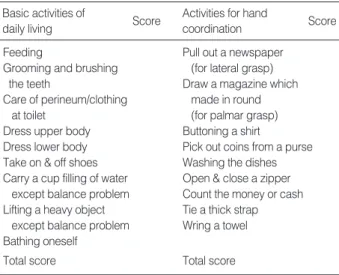
The total function of an upper extremity is assessed with 18 criteria of activities of daily living (ADL) (Table 1). The assessment of minute activities of daily living using both arms contains 9 criteria including feeding with spoon while fine coordination of both hand is assessed. Each criterion is assessed with scales of one to five. It is scaled as one (totally depen- dent or unable to do by oneself) when independent activity is impossible, and as five (totally independent or able to do very well) when capable of independent activity. The degree of spasticity due to brain injury and brain disease is assessed with modified Asthworth scale (9) and, when the functional impairment is exacerbated with spasticity, it is applied as a minus factor.
Assessment of lower extremity impairment due to brain injury and brain disease
To evaluate the lower extremity impairment due to brain injury and brain disease, manual muscle test (Medical Research Council scale) (7) is used to assess the muscle strength. Mus- cles to evaluate include hip flexor, extensor, abductor, adduc- tor, internal and external rotator, knee flexor and extensor, ankle dorsiflexor, plantar flexor, invertor and evertor, and toe flexors and extensors. Each muscle power is graded between zero to five points, total of which is 70 points. Like the impair- ment of upper extremity, in cases where the manual muscle test is not possible due to accompanied contracture or man- ual muscle test needs to be corrected for the limited range of motion, grading system of active range of motion is used.
With impairment of both lower extremities, the value of both muscle strength added then divided by two is used. The total functional assessment of lower extremity includes changing position and maintaining balance, walking and moving out- side and otherwise (Table 2). When orthosis is necessary for gait, the kind of orthosis and the degree of dependency are
Basic activities of daily living
Activities for hand coordination
Score Score
Feeding Pull out a newspaper
Grooming and brushing (for lateral grasp)
the teeth Draw a magazine which
Care of perineum/clothing made in round
at toilet (for palmar grasp)
Dress upper body Buttoning a shirt
Dress lower body Pick out coins from a purse Take on & off shoes Washing the dishes Carry a cup filling of water Open & close a zipper
except balance problem Count the money or cash Lifting a heavy object Tie a thick strap
except balance problem Wring a towel Bathing oneself
Total score Total score
Table 1. Functional tests of the upper extremity in brain injured persons
Scores from 1 to 5 (mimimum 18, maximum 180).
5, Complete independence or able to do very well; 4, Able to do but sometimes need an assistive device or observation; 3, Sometimes need a helper; 2, Almost need a helper; 1, Unable to do by oneself and total- ly dependent.
Functional mobility items Score
Sit up
Rise to standing position Rising from the floor Transfers
Walking on inside level surface Walking on outside level surface Standing on one leg
Go up stairs and/or ramps Go down stairs and/or ramps Use transportation
Total score
Table 2. Functional mobility tests of the lower extremity in brain injured persons
Scoring system (1-5) is the same as tests of the upper extremity (mimi- mum 10, maximum 50).
evaluated. Also, when the muscle spasticity of lower extrem- ity with brain injury and brain disease exacerbates the dis- ability, it is applied as a minus factor.
RESULTS
Timing of disability evaluation for the brain injured persons
The primary assessment of motor dysfunction due to brain injury and brain disease is performed at least one year post- injury when the functional improvement is not noted even after six or more months of rehabilitation treatment. With severe brain injury, impairment assessed within one year of injury needs to be re-evaluated after two years. For patients with Parkinson’s disease or motor dysfunction, drug-on state maintained over 50% of a day with adequate (best) medica- tion is used as the assessment state.
Criteria for rating the motor impairments of upper extremities relating to central impairment
As a criterion for impairment of upper extremity in brain injury and brain disease, the basic normal score is total 180 points with 90 points of muscle test and 90 points of func- tional test. With both upper extremities impairment, mus- cle power for each upper extremity is added and divided into two. Impairment rating is divided into four levels like the standard for AMA. Level one is very severe upper extremity impairment of 18-73 points with 0-34% of normal function remaining and level four is minimal upper extremity impair-
ment of 155-178 points with 85-99% of normal function remaining. Impairment rating of dominant hand, non-dom- inant hand, and both hands impairment in relation to whole body is decided based on the principles of the AMA Guides (Table 3, 4).
Criteria for rating the motor impairments of lower extremities relating to central impairment
For impairment of lower extremity with brain injury and brain disease, the basic normal score is total 120 points with 70 points of muscle test and 50 points of functional test. Im- pairment rating is divided into four levels, ranging from one to four like the standard for AMA. Level one is very severe lower extremity impairment of 10-42 points with 0-29% of normal function remaining, and level four is minimal lower extremity impairment of 98-109 points with 80-99% of nor- mal function remaining. Since the impairment rating for lower extremity due to brain injury and brain disease is lower
Classification
Impairment of upper extremities points (% of normal)
Rating impairments of whole persons One hand (%)
Dominant Nondominant Both hands (%)
Class 1 18-73 (0-34%) 40-60% 30-45% 80% and over
Class 2 74-114 (35-59%) 25-39% 15-29% 40-79%
Class 3 115-154 (60-84%) 10-24% 5-14% 20-39%
Class 4 155-178 (85-99%) 1-9% 1-4% 1-19%
Table 4. Criteria for rating impairments of upper extremities relating to central impairment
Selection criteria Total scores
Muscle strengths of lower extremities 70 Active ROM scores of lower extremities for 70
only persons with joint contractures*
Spasticity grade of lower extremities -10 Complex functions of lower extremities 50 Maximal normal values of lower extremities 120 Table 5. Criteria for impairment of lower extremities in brain in- jured persons
*, Optional test.
ROM, range of motion.
Selection criteria Total scores
Muscle strengths of upper extremties 90 Active ROM scores of upper extremties for 90
only persons with joint contractures*
Spasticity grade of upper extrtemities* -10 Complex functions of upper extremities 90 Maximal normal values of upper extremities 180 Table 3. Criteria for impairment of upper extremities in brain injured persons
*, Optional test.
ROM, range of motion.
Classification
Rating impairments of whole persons (%) This study AMA Guides Impairment of lower
extremities points (% of normal)
Class 1 10-42 (0-29%) 50-70% 40-60%
Class 2 43-73 (30-57%) 30-49% 25-39%
Class 3 74-97 (58-79%) 15-29% 10-24%
Class 4 98-109 (80-99 %) 1-14% 1-9%
Table 6. Criteria for rating impairments of lower extremities relat- ing to central impairment
AMA, American Medical Association.
than other impairments, it was up-regulated than the AMA Guides (Table 5, 6).
DISCUSSION
Physical impairment is a state of functional or structural impairment of health in a person. Thus, impairment is a medi- cal concept that needs medical evaluation. Also, the perma- nent physical impairment means the state in which the symp- tom and sign are fixed after enough time needed for treatment and any further treatment would be futile in changing the current state of health. This impairment limits a person in activities of daily living, and the degree of functional restraint is expressed as impairment rate (3).
In Korea, the compensatory disability rating standard in relation to occupation is the estimation of loss of efficiency.
It is well established in McBride's disability evaluation (10) that it is used as the standard in the fields of law enforcement and insurance-related compensatory work. However, Mc- Bride’s disability evaluation was enacted in 1963 that is dif- ferent from current state of Korea. Also, it is not adequate to be used as the standard for impairment rating for brain injury and brain disease related motor dysfunction (3, 11).
The Guides to the Evaluation of Permanent Impairment of AMA uses medically established impairment rate with high objective and scientific reliability (6).
In this study, the scientific and rational guideline for im- pairment rating of AMA is used as an exemplar to evaluate motor dysfunction of the brain injury and brain disease. For more objective evaluation of motor dysfunction, functional assessment tools as well as basic physical examination and neurophysiological assessment are used. The impairment rat- ing of upper extremity after brain injury or brain disease is divided into four levels like that of AMA Guides. The AMA Guides evaluates the functional limitations of upper extrem- ity due to diseases of central nervous system according to its influence on the activities of daily living (6). It is believed that the basic tasks of everyday living depend on dexterous use of the dominant upper extremity. The impairment rat- ing level is determined from neurological examination of motor strength, coordination, and dexterity. Functional activ- ities such as buttoning a shirt, lacing shoes, writing, and per- forming a pegboard task can assess abilities needed for daily activities (6). Also, impairment of lower extremity relating to the injury of central nervous system is assessed as station and gait impairment (6). In other words, the degree of inde- pendent standing, independent gait, walking inside and out- side, climbing stairs and station and gait function of legs is evaluated to assess its impairment. However, the problem with criteria for rating impairment of upper and lower extrem- ity relating to central impairment in AMA Guides is that each standard without specific explanation may lead to dif- ferent conclusion of impairment rate, depending on the eval-
uator (3, 4, 11).
This study aims to develop a physical impairment assess- ment tool to resolve such problems. After thorough evalua- tion of muscle power, range of motion, spasticity, activities, and whole function of upper and lower extremities in brain injury and brain-diseased people with motor dysfunction, the result labelled as points to determine each impairment level.
To further assess the impairment of upper extremity in detail, basic activities of daily living are divided into specific crite- ria. For the evaluation of fine coordination of hands, several functional assessment tools are included. The total function of lower extremity assessment is based on the specific details of balance and gait function. In addition, with respect to the Korean culture, standing up from floor, using public trans- portation criteria are added (12). Each assessment criteria is given five-point scale according to the performance. Nation- al pension impairment assessment provision attached chart
#1 (13) is used after considerable change to increase the reli- ability of criteria in assessing upper and lower extremity func- tion, since it is described as the functional assessment tools of national pension rules of disability judgement attached chart #1 enacted according to the Law of National Pension
#58 and its Enforcement Ordinance #41-4. Each of total points of muscle power in upper and lower extremity as well as that of functional assessments is used to decide rating impairment.
According to the rules of degree of disability in the Law of Welfare of Disabled People (14), this grading system is reverse to AMA Guides. Impairment class one is severe impairment with less than 34% of normal function remaining for upper extremity and less than 42% of normal function remaining for lower extremity. Impairment class four indicates minimal impairment with 85-99% of normal function remaining for upper extremity and 80-99% of normal function remaining for lower extremity.
The advantage of newly developed physical impairment assessment standard in this study is that more objective and rational determination of rating impairment in motor dys- function of upper and lower extremity is possible. Also, while the AMA Guides divided impairment into four classes, the newly developed class of impairment is expressed in percent- age and can be classified into six to eight levels of impairments.
The time of evaluation of impairment due to brain injury and brain disease is when the symptom and sign are fixed after enough treatment. The guides to the evaluation of per- manent impairment of AMA states that the maximal medi- cal improvement should be done when the change of impair- ment rate is less than three percent despite further treatment of one year (5). By this period, the impairment is assumed to be permanent. Current national pension rules of disabili- ty judgement in the Law of Korean National Pension (13) states this maximal medical improvement as the recovery date of impairment. This period varies depending on the brain injury and brain disease, however, except for vegetative states, it is to be at least 12 months in most of the cases, after the
initial date of medical examination (13). In the rules of degree of disability in the Law of Welfare of Disabled People (14), the maximal medical improvement is to be more than six months after developing the injury or disease which is short- er than that of AMA Guides. There is a complementation of a re-evaluation after 2 yr so that the possible change after 6 months of injury or disease can be confirmed. It is to give more faster welfare benefit to the disabled people. Neverthe- less, it has in reality been the cause of many problems in defin- ing the impairment level. It should be stated in all forms of physical impairment assessment standards that the period of maximal medical improvement should be assessed after 6 months of enough rehabilitation since early rehabilitation and the period of rehabilitation can make difference. In pa- tients with movement disorders including Parkinson’s dis- ease, response to medication can be variable. If performance efficiency is more than 50% greater in medication on-state than off-state, physical impairment should be made when the drug response is maximal (15).
For one upper extremity impairment due to the dysfunc- tion of central nervous system, dominant and non-dominant upper extremity function is separately assessed to estimate impairment rate in the AMA Guides (6). However, this has problems. First, it is difficult to define a dominant hand after the brain injury. Second, it might work as a factor to decrease the effect of rehabilitation, even though activities of daily living can be improved with enough rehabilitation treatment.
But, considering the nature of Korean culture in which using left hand is regarded as a disability and most people tend to use the right hand as the dominant one, the up-regulation of the impairment rate of dominant upper extremity is decided.
Limitations to further application of this physical impair- ment assessment are as follows. First, the effectiveness might be compromised since the time needed to evaluate increases when many fields of assessment are included. Second, it is necessary to educate the disability evaluating specialists for more efficient evaluation of the impairment and/or disabili- ty. However, in case of general hospitals with physical and occupational therapists, brain disease and brain injury impair- ment evaluating specialists can colligate the result after the initial assessment is done by the therapists with minimal problem. Third, verification steps for this assessment tool are required. To resolve these problems, further studies on the correlations between late physical impairment assessment tools and newly developed physical impairment assessment standard and between late impairment level of AMA Guides and new impairment assessment standard would be helpful.
REFERENCES
1. Whyte J, Hart T, Laborde A, Rosenthal M. Rehabilitation issues in traumatic brain injury. In: DeLisa JA, eds. Physical medicine and rehabilitation: principles and practice, 4th ed, Philadelphia: Lippin- cott Willaims & Wilkins, 2005; 1688-702.
2. Cifu DX, Kreutzer JS, Slater DN, Taylor L. Rehabilitation after trau- matic brain injury. In: Braddom RL, eds. Physical medicine and reha- bilitation, 3rd ed, Philadelphia: Elsevier Inc, 2007; 1145-61.
3. Lee KS. Assessment of physical impairment and disability evalua- tion: problem of present system and design for better system. J Kore- an Neurosurg Soc 1994; 23: 276-82.
4. Lee SH. The disability evaluation system in U.S.A. Indep Med Exam 2005; 2: 22-6.
5. Lee SG. Problems of assessment of physical impairment and disabil- ity evaluation in central nervous system in Korea. Indep Med Exam 2004; 1: 20-5.
6. Cocchiarella L, Andersson GB. Guides to the evaluation of perma- nent impairment, 5th ed, Chicago: American Medical Association Press, 2001; 1-16, 305-8, 336-40.
7. Florence JM, Pandya S, King WM, Robinson JD, Baty J, Miller JP, Schierbecker J, Signore LC. Intrarater reliability of manual muscle test (Medical Research Council scale) grades in Duchenne’s mus- cular dystrophy. Phys Ther 1992; 72: 115-26.
8. Omer GE Jr, Bell-Krotoski J. Evaluation of clinical results follow- ing peripheral nerve suture. In: Omer GE Jr, Spinner M, Van Beek AL, eds. Management of peripheral nerve problems, 2nd ed, Philadel- phia: WB Saunders Co, 1998; 341.
9. Bohannon RW, Smith MB. Interrater reliability of a modified Ash- worth scale of muscle spasticity. Phys Ther 1987; 67: 206-7.
10. McBride ED. Disability evaluation and principles of treatment of compensable injuries, 6th ed, Philadelphia: JB Lippincott Co, 1963.
11. Lee SG. Assessment of physical impairment and disability evaluation in head injury: comparison between McBride and AMA guidelines.
Indep Med Exam 2005; 2: 27-38.
12. Rah UW, Bae HS, Chun SI, Jang JC, Lee IY. Functional evaluation of elderly with modified Barthel index and modified Lambeth disabili- ty screening questionnaire. J Korean Acad Rehab Med 1995; 19:
559-71.
13. National Pension Service. National pension rules of disability judge- ment, Seoul: National Pension Service, 2006.
14. Ministry of Health and Welfare. Rules of degree of disability, Seoul:
Ministry of Health and Welfare, 2003.
15. Weisscher N, Post B, de Haan RJ, Glas CA, Speelman JD, Vermeu- len M. The AMC Linear Disability Score in patients with newly diag- nosed Parkinson disease. Neurology 2007; 69: 2155-61.