INTRODUCTION
Methicillin-resistance Staphylococcus aureus (MRSA) has been a major cause of nosocomial infections and has been isolated with increasing frequency from patients in hospitals and nurs- ing homes (1). Nasal and extranasal carriage of MRSA is an essential step in invasive MRSA infections and plays a deci- sive role in the dissemination of these microorganisms (2).
Topical mupirocin has been widely used for managing MRSA infections, reducing certain types of surgical site infec- tions, and clearing nasal MRSA carriage, especially among healthcare workers. In 1987, shortly after the introduction of mupirocin, clinical isolates of mupirocin-resistant S. aureus began appearing in the U.K. (3). Since then, such isolates have been increasingly reported in many countries (4-6). In- creasing numbers of mupirocin-resistant MRSA isolates have been detected in patients who had previously received mu- pirocin treatment, an observation cautioning against extend- ed use of mupirocin ointment for eradication of MRSA nasal carriage (5).
Mupirocin binds to the target enzyme, isoleucyl-tRNA synthetase (IleS), in the vicinity of an ATP-binding subsite
and is a bifunctional inhibitor with characteristics of both iso- leucine and ATP, i.e. an analogue of isoleucyladenylate (7).
Mupirocin resistance is phenotypically divided into two gro- ups: low-level (minimal inhibition concentration [MIC]=8 to 256 g/mL) and high-level (MIC ≥512 g/mL) (8). High- level resistance is mediated by a plasmid containing the ileS- 2 gene that encodes a novel isoleucyl-tRNA synthetase en- zyme, whereas low-level resistance usually results from alter- ation of the native IleS as a consequence of spontaneous muta- tions in the ileS gene (8, 9). Since low-level mupirocin resis- tance is more prevalent among clinical isolates (10), concerns about treatment failure for nasal decolonization of MRSA are increasing (11).
Previous studies revealed the presence of molecular hetero- geneity of mutations in the ileS gene among clinical isolates and low-level mupirocin resistant MRSA strains selected in vitro (12, 13). These studies reported that the V588F muta- tion affecting the Rossman fold could interact directly with mupirocin, causing emergence of low-level mupirocin resis- tance (12). Notably, this mutation was not absolutely neces- sary for the development of low-level mupirocin resistance, and the V631F mutation was found to have effects similar
Jin Ah Yang�,�, Dae Won Park*,�, Jang Wook Sohn*,�, In Seok Yang�, Kyung Hyun Kim�, Min Ja Kim*,�
Division of Infectious Diseases*, Korea University College of Medicine; Research Institute of Emerging Infectious Diseases�, Graduate School of Life Science
& Biotechnology�, Korea University, Seoul, Korea
Address for correspondence Min Ja Kim, M.D.
Department of Internal Medicine, Division of Infectious Diseases, Korea University College of Medicine, 126-1 5-ga, Anam-dong, Sungbuk-gu, Seoul 136-705, Korea Tel : +82.2-920-5096, Fax : +82.2-920-5616 E-mail : [email protected]
827
Molecular Analysis of Isoleucyl-tRNA Synthetase Mutations in Clinical Isolates of Methicillin-Resistant Staphylococcus aureus with Low-Level Mupirocin Resistance
Emergence and spread of low-level mupirocin resistance in staphylococci have been increasingly reported in recent years. The aim of this study was to characterize mis- sense mutations within the chromosomal isoleucyl-tRNA synthetase gene (ileS) among clinical isolates of methicillin-resistant Staphylococcus aureus (MRSA) with low-level mupirocin resistance. A total of 20 isolates of MRSA with low-level mupiro- cin resistance (minimal inhibitory concentration, 16-64 g/mL) were collected from 79 patients in intensive care units for six months. The isolates were analyzed for isoleucyl-tRNA synthetase (IleS) mutations that might affect the binding of mupirocin to the three-dimensional structure of the S. aureus IleS enzyme. All isolates with low-level mupirocin resistance contained the known V588F mutation affecting the Rossman fold, and some of them additionally had previously unidentified mutations such as P187F, K226T, F227L, Q612H, or V767D. Interestingly, Q612H was a novel mutation that was involved in stabilizing the conformation of the catalytic loop con- taining the KMSKS motif. In conclusion, this study confirms that molecular hetero- geneity in ileS gene is common among clinical MRSA isolates with low-level mupirocin resistance, and further study on clinical mutants is needed to understand the struc- tural basis of low-level mupirocin resistance.
Key Words : Staphylococcus aureus; Mupirocin; Drug Resistance; Isoleucine-tRNA Ligase; Mutation, Mis- sense
Received : 9 September 2005 Accepted : 17 February 2006
to those of V588F on the structure IleS. Although V588F and V631F clearly play a role in low-level mupirocin resistance, it is unknown whether these mutations represent the full spec- trum of IleS mutations that give rise to low-level mupirocin resistance.
In this study, we examined the ileS gene for molecular het- erogeneity in low-level mupirocin resistant MRSA strains isolated from patients in intensive care units (ICUs), and ana- lyzed how individual amino acid mutations affect the crystal structure of the complex of S. aureus IleS with mupirocin.
MATERIALS AND METHODS Bacterial isolates
A total of 79 MRSA isolates were consecutively collected from clinical cultures taken from patients in ICUs in a ter- tiary care hospital from November 2003 to April 2004. The specimens originated from blood, gastric juice, pus, skin, cen- tral venous catheter tip, sputum, stool, swab, tracheal tip, urine, and wounds. Isolates from one patient that were recov- ered from different cultures were included only once. The strains were stored in brain-heart infusion broth plus 20%
glycerol at -70℃until studied.
MRSA detection and mupirocin susceptibility
MRSA isolates were identified by the standard disk diffu- sion method (14) and mecA was detected by polymerase chain reaction (PCR). The primer pair used was MecA1 (5′- ATG CTA AAG TTC AAA AGA GTA TTT ATA A) and MecA2 (5′-TGA TGA TTC TAT TGC TTT TAA GTC), yielding a 400-bp product. MICs of mupirocin were determined by a standardized agar dilution method in Mueller-Hinton agar (Oxoid, Basingstoke, United Kingdom) with inocula in Mue- ller-Hinton agar (Oxoid) of 106CFU per spot. After 24 hr of incubation at 37℃, the MIC was deemed the lowest con- centration of antibiotic that prevented visible colonial growth.
MIC determination was evaluated according to the Clinical and Laboratory Standards Institute (CLSI, formerly NCCLS) guidelines (15). S. aureus ATCC 29213 was used as the con- trol for the susceptibility test.
PCR amplification and sequencing of the ileS gene
To overcome the difficulty of long-PCR amplification of the 3,044 bp- ileS gene sequence, we selected three parts of the gene to be amplified which might contain the potential mutations related to mupirocin resistance based on previous studies (12, 13) and the three-dimensional structure of the IleS enzyme active site. Three primer pairs were designed from the S. aureus ileS gene (GenBank accession number X74219);
one pair was Smr1 (5′-ATA AAG GTA AAA AGC CAG
TTT ATT GGT) and Smr2 (5′-TAA TCG CAA CAT TTG ATG GAA TTG TC) for the fragment of 200 bp (nt 450 to 650), the second was Mrm1 (5′-TCC CAG CAG ATA TGT ATT TAG AAG GT) and Mrm2 (5′-AAC CAC TTG GTC AGG TAC AAT CAC A) for the fragment of 450 bp (nt 800 to 1,250), and the third was Lmr1 (5′-GTA AAT CTT TAG GTA ATG TGA TTG TAC) and Lmr2 (5′-TCT TCT TTA ACA TGT GGT GTA TGA GA) for the fragment of 690 bp (nt 1,730 to 2,420). Genomic DNA was prepared, and the ileS gene fragments were amplified by PCR, as previously described (12). PCR products were purified with QIAquick-spin PCR purification kit (Qiagen, GmbH, Germany) and sequenced by Bioneer Corporation (Daejeon, Korea). To detect the ileS-2 gene conferring high-level mupirocin resistance, a 410-bp region in the ileS-2 gene was amplified using another primer pair Mup1 (5′-TAT ATT ATG CGA TGG AAG GTT GG) and Mup2 (5′-AAT AAA ATC AGC TGG AAA GTG TTG) (10).
Structural analysis of IleS mutations
To better understand the interactions of IleS with mupirocin, we used the crystal structure of IleS from S. aureus (Protein Data Bank code: 1FFY) (16).
Pulsed-field gel electrophoresis (PFGE)
Chromosomal DNA for the SmaI restriction digest was purified from 20 clinical MRSA isolates with low-level mupi- rocin resistance as described previously (17). Electrophoresis was performed with the GeneNavigatorTM‚ System (GE Heal- thcare U.K. Ltd. Buckinghamshire, United Kingdom) at 130 V and at 16℃; 5 sec pulse time for 4 hr, 25 sec pulse time for 6 hr, 45 sec pulse time for 20 hr, and 75 sec pulse time for 6 hr. Total running time was 36 hr. PFGE ladder* (New England Biolabs Inc.) was used to provide molecular size mar- kers. After staining with ethidium bromide, the band pat- terns were compared using the criteria for bacterial strain typing (18).
RESULTS
Isolation of clinical MRSA strains with low-level mupirocin resistance
We isolated a total of 79 MRSA strains from patients in ICUs in our hospital for the six-month study period. The iso- lation rate of MRSA strains was approximately 75%. MRSA isolates were mostly recovered from sputum cultures. Deter- mination of MICs of mupirocin by the agar dilution method revealed that twenty strains (Kua 1 to 20) (25.3% of total isolates) displayed low-level mupirocin resistance from 16 g/
mL to 64 g/mL (Table 1). There were no MRSA isolates with high-level mupirocin resistance.
Identification of missense mutations in the ileS gene se- quence in clinical MRSA isolates
To identify missense mutations that might contribute to the low-level mupirocin resistance phenotype, we compared the sequences of the ileS gene fragments amplified from 49 MRSA isolated from patients in ICUs, including 20 low-level mupirocin resistance and 29 mupirocin-susceptible isolates,
with the published S. aureus ileS gene sequence (GenBank accession no. X74219). We identified six missense mutations, P187F, K226T, F227L, V588F, Q612H, and V767D, in the strains with low-level mupirocin resistance. Those were not identified in any of the mupirocin susceptible MRSA isolates.
Except for V588F, none of these mutations have been report- ed previously. The V588F and Q612H mutations are locat- ed near the Rossman fold motif, whereas the others are locat- ed outside this motif. All of the strains with low-level mupi- rocin resistance possessed the V588F, and some of them had an additional one to three other mutations (Table 2, 3). An A213D mutation was identified in all 49 strains analyzed, irrespective of the MIC level of mupirocin resistance. Addi- tionally, we identified various null mutations (T594C, A602C, A643T, A685C and T1679C) that were present only in the ileS genes of low-level mupirocin-resistant strains and some (T1701C, T1974C, T1980C, T1995C and T2031G) that were present in both mupirocin-resistant and -susceptible strains (data not shown).
Structural analysis of amino acid mutations
To better understand the significance of the novel mutations,
MIC ( g/mL) No. of isolate (%) Remark
<8 59 (74.7%) Susceptible
16 1 (1.2%)
32 13 (16.5%) Low-level resistant
64 6 (7.6%)
>256 0 (0%) High-level resistant
Total 79 (100%)
Table 1.Distribution of mupirocin MICs among MRSA isolates from 79 patients in ICUs during November 2003 through April 2004
20 (25.3%)
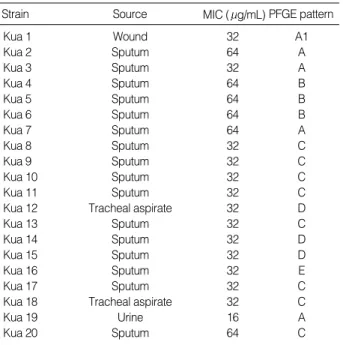
Strain Source MIC ( g/mL) PFGE pattern
Kua 1 Wound 32 A1
Kua 2 Sputum 64 A
Kua 3 Sputum 32 A
Kua 4 Sputum 64 B
Kua 5 Sputum 64 B
Kua 6 Sputum 64 B
Kua 7 Sputum 64 A
Kua 8 Sputum 32 C
Kua 9 Sputum 32 C
Kua 10 Sputum 32 C
Kua 11 Sputum 32 C
Kua 12 Tracheal aspirate 32 D
Kua 13 Sputum 32 C
Kua 14 Sputum 32 D
Kua 15 Sputum 32 D
Kua 16 Sputum 32 E
Kua 17 Sputum 32 C
Kua 18 Tracheal aspirate 32 C
Kua 19 Urine 16 A
Kua 20 Sputum 64 C
Table 2.Mupirocin MICs and PFGE patterns of 20 MRSA iso- lates with low-level mupirocin resistance
P, Proline; F, Phenylalanine; K, Lysine; T, Threonine; L, Leucine; V, valine;
Q, glutamine; H, histidine; D, Aspartic acid.
Mutation identified Isolates (%) containing individual mutation
P187F Kua 4-12, 14, 15, 19 (60)
K226T Kua 3 (5)
F227L Kua 3 (5)
V588F Kua 1-20 (100)
Q612H Kua 8-11, 13-15, 17, 18, 20 (50)
V767D Kua 1 (5)
Table 3.Heterogeneity of IleS mutations among 20 MRSA iso- lates with low-level mupirocin resistance
Fig. 1.Structure of IleS from S. aureus Oxford. Distribution of mu- tated residues identified from MRSA isolates with low-level mupiro- cin resistance. (A) Overall IleS structure showing bound tRNAIle (violet) and mupirocin (slate/red) (22). The backbone fold of IleS is shown as a ribbon, with individual sites of mutation highlighted displaying 6 residues’ side chains (red) and sequence numbers, and yellow-colored structure with the Q612H mutation. (B) Enlarged view of the beta-helix region adjacent to the Rossman fold and residues 588 and 612. Note that the Q612H mutation has poten- tial to interact with mupirocin. Q612 sits close to the core of IleS Rossman fold motif (yellow/blue), where it forms a water-bridged hydrogen bond with the side chain of D635 (arrow).
V767
V588
D635 water Q612
S. aureus 591GEGKKMSKSLGNV603 Q612
V588 P187
F226 F227
mupirocin
mupirocin A
B
we used a computer program to superimpose them on the crystal structure of the S. aureus IleS. With the exception of V588F, all the missense mutations we identified in this study are novel mutations. Two of them, V588F and Q612H, are located near the Rossman fold motif, and the others are locat- ed outside (Fig. 1A). Because V588 is located in a hydropho- bic pocket that interacts directly with the fatty acid side chain of mupirocin, mutation of this residue causes steric repulsion to mupirocin. The Q612H mutation has potential to inter- act with mupirocin. Q612 sits close to the core of IleS Ross- man fold motif, where it forms a water-bridged hydrogen bond with the side chain of D635 (Fig. 1B). Since it is located at about 15 Åfrom the binding site of mupirocin, it is not clear how the Q612H mutation could directly affect the inter- action with mupirocin. The Q612H mutation appeared to affect the catalytic loop configuration during substrate bind- ing, thus leading to the differences in the inhibitory activity of mupirocin.
Contributions of other mutations to mupirocin resistance are unlikely to be as direct as that of V588F, and these muta- tions might indirectly affect the interaction with mupirocin.
K226T and F227L are on the outer surface adjacent to the tRNA molecule about 20 Åfrom the editing active site.
P187F, about 20 Ådistant from the 3′end of the tRNA, is located near the CP2 domain. In contrast, V767D lies in the interior surface of the cylindrical central helical domain of the IleS, distal to the tRNA binding site.
Characterization of low-level mupirocin resistant MRSA isolates by PFGE analysis
To determine whether the emergence of low-level mupirocin
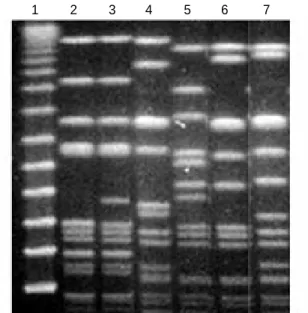
resistant MRSA isolates in ICUs was derived from a clone with epidemic potential, we analyzed the genetic relatedness of 20 MRSA isolates with low-level mupirocin resistance by PFGE analysis. Related isolates were identified by SmaI mac- rorestriction patterns. All twenty isolates were separated into five PFGE types (A, B, C, D, and E) and a subtype, A1 (Fig.
2). PFGE type A was considered an endemic clone, since it was isolated persistently from the beginning to the end of the six-month study. Other clones (PFGE types, B, C, D and E) had colonized or infected patients for a few months and, once introduced into the ICUs, spread among patients. Inter- estingly, PFGE types were not associated with individual mu- tations of IleS enzymes. Isolates with the identical PFGE pat- tern contained different IleS mutations, and isolates from dif- ferent PFGE types contained the same IleS mutations. Nota- bly, the Q612H mutation was only identified in PFGE types C and D (Table 2).
DISCUSSION
In this study, we investigated the molecular heterogeneity of IleS mutations in low-level mupirocin resistant MRSA strains isolated from patients in ICUs. We characterized the identified mutations by superimposition on the crystal struc- ture of the S. aureus IleS. We identified six missense mutations (P187F, K226T, F227L, V588F, Q612H, and V767D) that were only present among MRSA isolates with low-level mupi- rocin resistance. Based on previously reported ileS gene muta- tions associated with low-level mupirocin resistance in MRSA strains originating in Europe, North America (12), and Japan (13), five of the six missense mutations identified in this study are novel. In particular, the Q612H is a novel mutation that seems to be involved in stabilizing the conformation of cat- alytic loop containing the KMSKS motif. Until now, only amino acid substitutions at two sites (V588F and V631F) in IleS have been detected in clinical S. aureus isolates express- ing low-level mupirocin resistance (12, 13). Whether these are the only lleS mutations that confer mupirocin resistance is unknown. The V588F mutation is known to disrupt the hydrophobic pocket within the mupirocin-binding Rossman fold possessing the consensus HXGX and GXKMSKS motifs, and the V631F substitution has an effect similar to that of V588F. Our results suggest that the mutations located at some distance from the KMSKS motif could have a significant effect on the conformational changes of IleS, leading to the low- level mupirocin resistance.
A recent study showed that other novel mutations linked to emergence of mupirocin resistance (G593V, R816C, H67Q, and F563L in various combinations) could be generated from laboratory S. aureus isolates with incremental increases in resis- tance after repeated exposure to increasing concentrations of mupirocin (19). However, in our study we only detected the V588F mutation and failed to detect either the novel muta-
Fig. 2.Representative PFGE patterns of Sma I macrorestriction frag- ments of genomic DNA of MRSA strains with low-level mupirocin resistance isolated from patients in ICUs. Lane 1, ladder marker; lane 2 to lane 7 show PFGE patterns A0, A1, B, C, D, and E, respectively.
1 2 3 4 5 6 7
tions that originated from the laboratory stains or other IleS mutations including the V631F mutation identified in pre- vious clinical isolates with low-level mupirocin resistance (12, 13). On the other hand, the contributions of the other four mutations newly identified in this study are unlikely to be those of V588F or Q612H, and further studies on these mutations are needed. These findings confirm that the molec- ular heterogeneity of S. aureus IleS mutations are common among clinical isolates of MRSA with low-level mupirocin resistance.
Our study has revealed an unexpectedly high rate (25.3%) of isolation of MRSA strains with low-level mupirocin resis- tance, compared to rates reported previously in Japan (20) or in Korea (10). This probably stems from the targeted surveil- lance of patients in ICUs where MRSA is endemic. The PFGE analysis revealed different PFGE patterns among MRSA iso- lates with low-level mupirocin resistance. Several isolates with identical PFGE patterns contained different IleS mutations, whereas isolates from different PFGE types contained the same IleS mutations. The Q612H mutation was identified only in PFGE types C and D. Therefore, it is likely that indi- vidual IleS mutations might occur in several PFGE clones.
It is also possible that a few of PFGE clones with the same IleS mutation were spread. It is not known whether the pati- ents in the ICUs were exposed to mupirocin.
Although low-level mupirocin resistance in S. aureus is more prevalent in clinical isolates than high-level resistance (4, 10, 20), its clinical significance is still unknown. It is possible, however, that the increasing frequency of IleS mutants might cause failure for nasal decolonization of MRSA carriers (4).
Alternatively, it might suggest that a low fitness cost is asso- ciated with the high prevalence of low-level mupirocin resis- tant strains (19).
In conclusion, molecular heterogeneity of IleS mutations conferring low-level mupirocin resistance is commonly pre- sent among clinical MRSA strains in ICUs in a setting where MRSA is endemic. In addition to the V588F, the novel Q612H mutation is expected to be linked to low-level mupirocin resistance. Further study of several IleS structures from mutant clinical isolates is necessary to better understand the structural basis of low-level mupirocin resistance.
ACKNOWLEDGMENT
We thank Hee Sun Sim for her invaluable help with data handling and laboratory work.
REFERENCES
1. Muder RR, Brennen C, Wagener MM, Vickers RM, Rihs JD, Han- cock GA, Yee YC, Miller JM, Yu VL. Methicillin-resistant staphy- lococcal colonization and infection in a long-term care facility. Ann
Intern Med 1991; 114: 107-12.
2. Kluytmans J, van Belkum A, Verbrugh H. Nasal carriage of Staphy- lococcus aureus: epidemiology, underlying mechanisms, and asso- ciated risks. Clin Microbiol Rev 1997; 10: 505-20.
3. Rahman M, Noble WC, Cookson B, Baird D, Coia J. Mupirocin- resistant Staphylococcus aureus. Lancet 1987; 330: 387-8.
4. Schmitz FJ, Lindenlauf E, Hofmann B, Fluit AC, Verhoef J, Heinz HP, Jones ME. The prevalence of low- and high-level mupirocin resis- tance in staphylococci from 19 European hospitals. J Antimicrob Chemother 1998; 42: 489-95.
5. Watanabe H, Masaki H, Asoh N, Watanabe K, Oishi K, Furumoto A, Kobayashi S, SatoA, Nagatake T. Emergence and spread of low- level mupirocin resistance in methicillin-resistant Staphylococcus aureus isolated from a community hospital in Japan. J Hosp Infect 2001; 47: 294-300.
6. Gales AC, Andrade SS, Sader HS, Jones RN. Activity of mupirocin and 14 additional antibiotics against staphylococci isolated from Latin American hospitals: report from the SENTRY antimicrobial surveillance program. J Chemother 2004; 16: 323-8.
7. Yanagisawa T, Lee JT, Wu HC, Kawakami M. Relationship of pro- tein structure of isoleucyl-tRNA synthetase with pseudomonic acid resistance of Escherichia coli. A proposed mode of action of pseu- domonic acid as an inhibitor of isoleucyl-tRNA synthetase. J Biol Chem 1994; 269: 24304-9.
8. Gilbart J, Perry CR, Slocombe B. High-level mupirocin resistance in Staphylococcus aureus: evidence for two distinct isoleucyl-tRNA synthetases. Antimicrob Agents Chemother 1993; 37: 32-8.
9. Ramsey MA, Bradley SF, Kauffman CA, Morton TM. Identification of chromosomal location of mupA gene, encoding low-level mupirocin resistance in staphylococcal isolates. Antimicrob Agents Chemother 1996; 40: 2820-3.
10. Yun HJ, Lee SW, Yoon GM, Kim SY, Choi S, Lee YS, Choi EC, Kim S. Prevalence and mechanisms of low- and high-level mupirocin resistance in staphylococci isolated from a Korean hospital. J Antimi- crob Chemother 2003; 51: 619-23.
11. Walker ES, Vasquez JE, Dula R, Bullock H, Sarubbi FA. Mupirocin- resistant, methicillin-resistant Staphylococcus aureus: does mupirocin remain effective? Infect Control Hosp Epidemiol 2003; 24: 342-6.
12. Antonio M, McFerran N, Pallen MJ. Mutations affecting the Ross- man fold of isoleucyl-tRNA synthetase are correlated with low-level mupirocin resistance in Staphylococcus aureus. Antimicrob Agents Chemother 2002; 46: 438-42.
13. Fujimura S, Tokue Y, Watanabe A. Isoleucyl-tRNA synthetase muta- tions in Staphylococcus aureus clinical isolates and in vitro selection of low-level mupirocin-resistant strains. Antimicrob Agents Chemother 2003; 47: 3373-4.
14. National Committee for Clinical Laboratory Standards. Performance Standards for Antimicrobial Disk Susceptibility Tests. Approved Stan- dard M2-M5. National Committee for Laboratory Standards, Villano- va. Pa 1993.
15. National Committee for Clinical Laboratory Standards. Methods for dilution antimicrobial susceptibility tests for bacteria that grow aer- obically-fifty edition. Approved Standard M7-A5. National Commit- tee for Laboratory Standards, Wayne, Pa. 2000.
16. Silvian LF, Wang J, Steitz TA. Insights into editing from an ile-tRNA synthetase structure with tRNAileand mupirocin. Science 1999; 285:
1074-7.
17. Katayama Y, Ito T, Hiramatsu K. A new class of genetic element, staphylococcus cassette chromosome mec, encodes methicillin resis- tance in Staphylococcus aureus. Antimicrob Agents Chemother 2000;
44: 1549-55.
18. Tenover FC, Arbeit RD, Goering RV, Mickelsen PA, Murray BE, Persing DH, Swaminathan B. Interpreting chromosomal DNA res-
triction patterns produced by pulsed-field gel electrophoresis: crite- ria for bacterial strain typing. J Clin Microbiol 1995; 33: 2233-9.
19. Hurdle JG, O’Neill AJ, Ingham E, Fishwick C, Chopra I. Analysis of mupirocin resistance and fitness in Staphylococcus aureus by molec- ular genetic and structural modeling techniques. Antimicrob Agents Chemother 2004; 48: 4366-76.
20. Fujimura S, Watanabe A. Survey of high- and low-level mupirocin- resistant strains of methicillin-resistant Staphylococcus aureus in 15 Japanese hospitals. Chemotherapy 2003; 49: 36-8.