56
©The Korean Society of Food Science and Technology
효모종류를 달리한 탁주 술덧의 품질특성
이흥숙*·박창숙1·최진영2
세종대학교 식품공학과/탄수화물소재연구소, 1(주)바이오세움, 2한북대학교 식품영양학과
Quality Characteristics of the Mashes of Takju Prepared
Using Different Yeasts
Heungsook Lee*, Chang Sook Park1, and Jin Young Choi2
Department of Food Science and Technology/Carbohydrate Bioproduct Research Center, Sejong University
1BioSewoom Co. Ltd.
2Department of Food and Nutritional Sciences, Hanbuk University
Abstract Quality characteristics such as alcohol, acid, and sugar contents of takju brewing mashes prepared using several
yeasts were investigated during 12-days of fermentation. Among the yeasts examined, S. cerevisiae led to the highest level
of ethanol (10.2-13.4%) and total minor alcohols (0.729-0.831 mg/mL). Regardless of the yeasts used, the acidity showed drastic changes (pH from 3.4-4.2 down to 2.4-2.7) during the first 2 days, and displayed negligible changes from day 4. The total acid contents rapidly increased to the first 4 days of fermentation and leveled off from 4 to the end of fermentation period. The common organic acid components were lactic, succinic and acetic acids. The total and reducing sugar contents varied depending on the yeasts used, with mashes prepared using S. coreanus and S. rouxii producing the
maximum total sugar contents (5.43-5.5%) at the end of fermentation. The reducing sugar showed its maximum (7.53-14.89%) at day 2, after which it decreased to its minimum levels (3.04-4.52%). The common free sugar components were glucose and fructose, while S. ellipsoideus led to a higher free sugar level (0.35-5.29%).
Key words:takju, mash fermentation, yeast, quality
서 론 술이란탄수화물이미생물의분해작용을받아알코올을비롯 한여러가지성분이생긴일종의발효음료이다. 발효원료로는 전분질을주성분으로 하는곡류, 감자류와당분을 주성분으로하 는과일이나당밀이사용된다(1). 술의종류는대단히많으나제 조방법에따라분류하면, 크게양조주, 증류주, 혼성주로 구분할 수있다. 양조주는발효주라고도 하고발효가끝난술덧을그냥 또는여과하여 음용하는술이다. 발효주는 단발효주와 복발효주 로다시나뉘는데, 단발효주는원료에 함유된당분을그대로발 효시켜음용하는 주류로, 포도주, 사과주, 기타발효주 등이이에 포함된다. 복발효주는 전분질을 당화효소로 당화시켜 발효시킨 것으로탁주, 약주, 일본청주, 맥주등이이에속한다(2). 전통재래의탁주나 약주는주로 찹쌀이나멥쌀을 원료로하 고누룩을 발효제로양조하여왔는데누룩은 술덧숙성중에전 분질을분해하여포도당으로만들어주는효소원이되는원료이 다(1-3). 그다음누룩에의하여생성된당분을 발효해서알코올 화하는것이효모이다. 탁주담금전에 주모(酒母, seed mash)를 담금하는데주모란, 밑술또는술밑이라고도하며효모를순수 하게배양해놓은일종의스타터로주모에서온효모가당을발 효해서알코올화하게된다(3). 원료와주모가준비되면담금을 한다. 누룩과 증숙 원료, 용수, 주모를 혼합하는 일을 담금이라 하고이때의혼합물을술덧이라 한다. 그동안의탁주관련연구내용으로는탁주의원료와누룩의종 류에따른탁주술덧의성분변화(4-12), 탁주술덧중의미생물 분류(13-15)에관한 내용등이대부분이었고 탁주발효관련 효 모(16,17)에 관한 연구는 거의 이루어지지 않았다. 탁주 술덧의 발효에관여하는미생물의종류에따라서발효결과 생산되는향 미성분들의종류도다양할것으로추측된다(18). 따라서본실험 에서는 발효에관여하는 효모의 종류를달리하여 그영향이 탁 주술덧의 품질특성에 어느정도 기여하는지를 살펴보고자 하 였다. 한국의전통주인탁주 양조에널리사용된 한국토착 효모 균인 S. coreanus와포도주제조에사용되는 S. ellipsoideus, 맥주 발효에 중요한 S. carlsbergensis, Baker's yeast로서의 S.
cerevi-siae, 그리고전통장류발효에이용되는 S. rouxii를각각사용하
여주모를담금 하여술덧을제조하였고발효 과정중효모의 특
성이탁주술덧의품질특성에미치는영향을살펴보았다.
재료 및 방법
사용균주
Saccharomyces coreanus(KCCM 11215), Saccharomyces
ellipsoi-*Corresponding author: Heungsook Lee, Department of Food Sci-ence and Technology/Carbohydrate Bioproduct Research Center, Sejong University, Seoul 143-747, Korea
Tel: 82-2-497-8866 Fax: 82-2-3408-3319
E-mail: [email protected]
Received October 20, 2009; revised November 18, 2009; accepted November 18, 2009
deus(KCCM 11290), Saccharomyces carlsbergensis(KCCM 12235),
Saccaromyces cerevisiae(Baker’s yeast, KCCM 11201), Saccharo-myces rouxii(KCCM 12066)는한국미생물보존센터(KCCM)에서 분양받아사용하였다. 주모제조 주모제조 시각각의 시험구에 첨가되는 멥쌀의 중량이 200 g 이므로 전체 시험구에 필요한 멥쌀 전체 중량 1 kg을 한번에 121oC에서 40분의조건으로가압살균한후다시각각의분량만 큼나누어사용하였다. 이때각각의증자된멥쌀외에물 1 L와 누룩 80 g, 각 효모 배양액 100 mL를 가하여 잘 혼합한 다음 25oC에서 2일간발효시켜주모를제조하였다. 탁주의 담금 및 발효 멥쌀 2 kg씩을 5시간물에침지한후물을 빼고 121oC에서 40 분간 가압 살균한 후 30oC로 방냉하였다. 18 L들이의 유리병에 물 6 L와누룩 820 g을혼합하여미리만들어둔수국에상기방 법으로증자하여냉각한 쌀과각각의주모 1 L를혼합하여 25oC 의항온기에서 12일간발효시켰다. 분석시료 발효과정 중의 술덧을 2일 간격으로 채취하여 균질기(MII-f,
Tokushu Kira Kogyo, Ltd., Tokyo, Japan)로 균질화하여 분석에
사용하였으며주모를넣은때를담금일로하여분석하였다. 에탄올 술덧을 증류한 후 주정계로 측정하고 Gay-Lussac 표에 의해 15oC로보정하여 %(v/v)로표시하였다. 미량 알코올 성분 술덧을냉동원심 분리기를이용하여 4oC에서 8,000×g로 20분 간원심 분리하여취한 상등액에 cyclohexyl alcohol 0.1 mL을내 부표준물질로 가하여 methylene chloride 5 mL로 2회연속 추출
한 후 추출액을 0.2µm syringe filter(PTFE syringe filter,
What-man plc., kent, UK)로여과하여그여액 1.0 µL를 gas
chromato-graph(GC 17A, Shimadzu, Kyoto, Japan)로 분석한 후 internal
standard 법으로 정량하였다. GC의 작동 조건은 BP-20 column
(30 m×0.25 mm ID, 0.25 film thickness, Shimadzu, Kyoto,
Japan)을사용하여오븐온도 40oC에서 150oC까지 7oC/min의속도 로상승시킨후다시 195oC까지 3oC/min로상승시켰다. 주입기와 검출기의 온도는 각각 220, 250oC이었고 carrier gas는 N 2 (99.999%)이었다. pH 및 총산
pH는 pH meter(sp-5A, Suntex, Taipei, Taiwan)로 측정하였고, 총산은 1% phenolphthalein을지시약으로하여 0.1 N NaOH 용액 으로 적정하고 적정 소비량에 0.009를 곱하여 시료 중의 산을 lactic acid로계산하였다. 유기산 술덧을냉동 원심분리기를 이용하여 4oC에서 8,000×g로 20분 간 원심분리하여 취한 상등액에서 10 mL를 취하여 0.45µm
syringe filter(cellulose nitrate, Adventec MFS Inc., Dublin, CA,
USA)로여과하였다. 그여액을 Sep-pak C18 cartridge(WAT 020515,
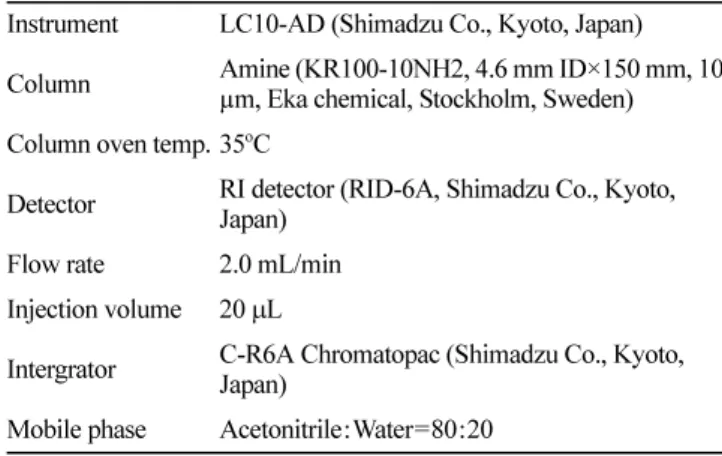
Waters Co., Milford, MA, USA)를통과시켜 단백질, 색소, 지방, 유리당등의물질을제거시킨후 Table 1과같은조건에서 HPLC 로유기산을분석하고, 유기산의검량곡선으로부터 정량하였다. 총당 및 환원당 총당은술덧을 2.5% HCl로가수분해한후, 환원당은 술덧자 체를 각각 Somogyi변법(19)에 의해정량하고 포도당 농도로 환 산하였다. 유리당 술덧을냉동 원심분리기를 이용하여 4oC에서 8,000×g로 20분 간원심분리하여취한상등액에서 10 mL를취하여 0.2µm
Acro-disc syringe filter(CR PTFE, Pall Life Sciences, NY, USA)로 여 과하여단백질, 지방, 색소, 유기산등의물질을제거시킨후 Table 2와같은 조건에서 HPLC로유리당을 분석하고, 유리당의 검량 곡선으로부터 정량하였다. 결과 및 고찰 에탄올 주모제조용효모종류를달리하여담금한탁주 술덧의발효 과정 중에탄올 함량은 Fig. 1과같다. 에탄올은 탁주의품질을 좌우하고탁주의보존성이나향미에영향을주는가장 중요한성 분으로술덧중에탄올함량이높아야한다. 탁주담금시주모 에서 유래된에탄올에의해담금 직후에에탄올함량이 0.0-0.8%
Table 1. Operating condition of HPLC for determination of organic acids
Instrument LC10-AD (Shimadzu Co., Kyoto, Japan) Column Styrene divinylbenzene copolymer (R Spak KC-811, 8.0 mm ID×300 mm, Shodex serial No.
H511024, Showa Denko k.k., Kanasaki, Japan) Column oven temp. 35oC
Detector UV-visible detection (SPD-10A, Shimadzu Co., Kyoto, Japan), 210 nm Flow rate 1.0 mL/min
Injection volume 20 µL
Intergrator C-R6A Chromatopac (Shimadzu Co., Kyoto, Japan) Mobile phase 0.1% H3PO4/H2O
Table 2. Operating condition of HPLC for determination of free sugars
Instrument LC10-AD (Shimadzu Co., Kyoto, Japan) Column Amine (KR100-10NH2, 4.6 mm ID×150 mm, 10 µm, Eka chemical, Stockholm, Sweden) Column oven temp. 35oC
Detector RI detector (RID-6A, Shimadzu Co., Kyoto, Japan) Flow rate 2.0 mL/min
Injection volume 20 µL
Intergrator C-R6A Chromatopac (Shimadzu Co., Kyoto, Japan) Mobile phase Acetonitrile:Water=80:20
였고 S. carlsbergensis, S. cerevisiae(Baker’s yeast)구는 발효 2일 에에탄올함량이 9.0-9.4%로급격히증가되었다. S. coreanus, S. ellipsoideus, S. rouxii구는발효 4일에 4.4-11.6%로급격히증가하 였고, 이후모든시험구가완만하게증가하였다. 본실험결과로 보아 S. cerevisiae와 S. ellipsoideus구가 발효 12일에 각각 13.4, 12.4%로에탄올함량이높아보존성에서유리한것으로추측된다. 미량 알코올 성분 주모제조용효모종류를달리하여담금한탁주 술덧의발효 과정중 미량알코올 성분은 Table 3과 같다. Ethanol을 제외한 미량알코올성분으로 n-propyl alcohol, isobutyl alcohol, 1,3-butyl
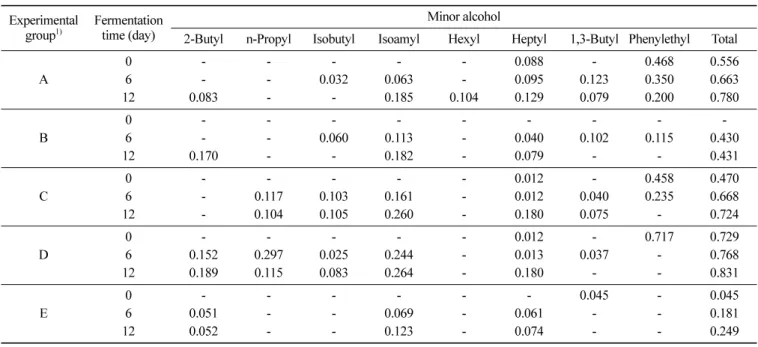
alcohol, 2-butyl alcohol, isoamyl alcohol, n-hexyl alcohol, hep-tyl alcohol, phenylethyl alcohol 등 8종의알코올이시험구에따라
검출되었다. 미량 알코올의 총량은 S. coreanus구가 0.556-0.780 mg/mL, S. ellipsoideus구가 nd-0.431 mg/mL, S. carlsbergensis구가 0.470-0.724 mg/mL, S. cerevisiae구가 0.729-0.831 mg/mL, S. rouxii구가 0.045-0.249 mg/mL의범위였다. S. cerevisiae구가발효 과정동안 모든시험구 중에서미량 알코올의 총량이가장높은 편이나, 함량차이는근소하였다. Isoamyl alcohol은담금직후에 는검출되지않았으나발효 6일(Fig. 2)부터모든시험구에서 검 출되었고발효과정중대체로증가하는경향을보였다. Han 등 (12)은누룩종류를달리한탁주술덧의알코올성분중 isoamyl alcohol이미량 알코올 중함량이가장 높은성분으로 보고하였 고 본 실험의 결과와도 대체로 일치하였다. 미량 알코올 중
isoamyl alcohol은 nd-0.264 mg/mL의함량을 보였고, heptyl
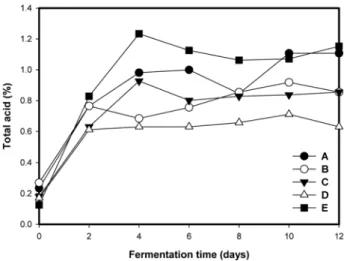
alco-hol은 그함량이 nd-0.180 mg/mL 로서 isoamyl alcohol 다음으로 높았으며, isobutyl alcohol은발효 6일차에 0.025-0.103 mg/mL 범 위로 S. rouxii구를제외한모든시험구술덧에서검출되었다. 퓨 젤유는그함량이높으면 향미가나빠지고두통, 숙취의원인이 되나 미량 존재 시 주류의 맛과 향을 향상시키는 역할을 한다 (20). 우리나라 식품첨가물공전의 주류규격에는 주류 중퓨젤유 함량이 1 mg/mL 이하로규정되어있는데(21), 본실험의탁주에 서는 nd-0.831 mg/mL로탁주규격에적합하였다. pH 및 총산 발효과정 중탁주 술덧의 pH 및총산은 Fig. 3, 4와같다. 담 금직후 pH 3.41-4.25였으나발효 2일에 pH 2.40-2.70으로현저 히저하된후발효 4일에 pH 2.38-2.99로완만히증가한이후 큰 변화가없었다. 총산은 휘발성향기 성분과 함께탁주의 맛, 냄새와 직접 관 련되며보존성에영향을준다(22). 총산은담금직후 S. ellipsoideus 구술덧이 0.27%로높았고, 발효 4일후는 S. rouxii구, S.
corea-nus구, S. carlsbergensis구, S. ellipsoideus구, S. cerevisiae구 술덧
의순으로높았다. 발효 12일에 S. rouxii구술덧의총산은 1.15%
로가장낮은 S. cerevisiae구술덧의 0.63%와는 0.52% 차이를보
였다. 담금직후의총산은 주로누룩이나원료에서유래되나 발
효가 진행되면서술덧 중의효모나 젖산균등의 미생물작용으
로생성된각종유기산들이 가산되므로총산의함량이증가되었
Fig. 1. Change in ethanol contents of mashes for takju using
different kinds of yeast. A, Mashes of takju fermented by S.
coreanus; B, Mashes of takju fermented by S. ellipsoideus; C,
Mashes of takju fermented by S. carlsbergensis; D, Mashes of takju
fermented by S. cerevisiae; E, Mashes of takju fermented by S. rouxii
Table 3. Change in minor alcohol contents of mashes for takju using different kinds of yeast during fermentation (Unit: mg/mL)
Experimental
group1) Fermentation time (day) Minor alcohol
2-Butyl n-Propyl Isobutyl Isoamyl Hexyl Heptyl 1,3-Butyl Phenylethyl Total
0 - - - 0.088 - 0.468 0.556 A 6 - - 0.032 0.063 - 0.095 0.123 0.350 0.663 12 0.083 - - 0.185 0.104 0.129 0.079 0.200 0.780 0 - - - -B 6 - - 0.060 0.113 - 0.040 0.102 0.115 0.430 12 0.170 - - 0.182 - 0.079 - - 0.431 0 - - - 0.012 - 0.458 0.470 C 6 - 0.117 0.103 0.161 - 0.012 0.040 0.235 0.668 12 - 0.104 0.105 0.260 - 0.180 0.075 - 0.724 0 - - - 0.012 - 0.717 0.729 D 6 0.152 0.297 0.025 0.244 - 0.013 0.037 - 0.768 12 0.189 0.115 0.083 0.264 - 0.180 - - 0.831 0 - - - 0.045 - 0.045 E 6 0.051 - - 0.069 - 0.061 - - 0.181 12 0.052 - - 0.123 - 0.074 - - 0.249
으나(22,23), 유기산이 알코올 등과 결합하여 ester와 같은 향미
형성등에이용되므로후기에는 감소된것으로추측된다.
유기산
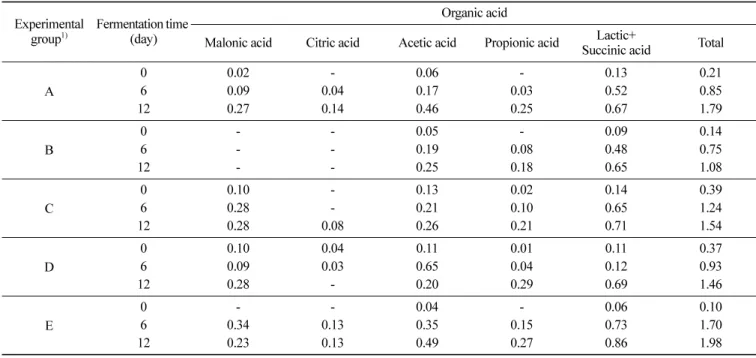
발효 과정 중탁주 술덧의 유기산을 HPLC로분석한 결과는
Table 4와같다. 탁주의유기산으로 lactic acid, succinic acid,
ace-tic acid는발효 전과정을 통하여모든시험구 탁주술덧에서 확 인되었고, malonic acid, citric acid, propionic acid는시험구에 따
라발효기간중검출되었다. 유기산총량은 S. coreanus구
0.21-1.79%, S. ellipsoideus구 0.14-1.08%, S. carlsbergensis구
0.39-1.54%, S. cerevisiae구 0.37-1.46%, S. rouxii구 0.10-1.98%로시험
구중 S. rouxii구가가장높았고 S. coreanus구, S. carlsbergensis
구, S. cerevisiae구, S. ellipsoideus구 순으로 높았다. Lactic
acid+Succinic acid는각시험탁주술덧에서담금일부터계속증
가하여 발효 12일에최대치를보였다. 담금 후젖산균의발효 작
용으로 젖산함량이 증가되는것으로 추측되며 모든탁주술덧
에서 lactic acid+succinic acid는유기산중가장많은함량을 차
지하여 탁주의 주유기산으로 나타났다. 시험구에 따라 다소의
Fig. 2. GC-FID chromatograms of minor alcohol in mashes for
takju using different kinds of yeast on the 6th day of
fermentation. A, B, C, D and E: Refer to footnote of Fig. 1.
Fig. 3. Change in pH of mashes for takju using different kinds of
yeast during fermentation. A, B, C, D and E: Refer to footnote of Fig. 1.
Fig. 4. Change in total acid of mashes for takju using different
kinds of yeast during fermentation. A, B, C, D and E: Refer to footnote of Fig. 1.
차이가 있으나 lactic acid+succinic acid 다음으로 함량이 높은
acetic acid는 0.04-0.65%의범위로시험구 중에는 S. cerevisiae구
와S. rouxii구, S. coreanus구가높은편이었으며발효기간중대
체로 증가하는 경향을 보였다. 본 실험의 결과는 lactic acid 및
succinic acid가탁주 발효과정 중주요유기산으로 보고한 Song
(24)의찹쌀및보리쌀탁주나 Lee 등(7)의원료처리를달리하여 담금한탁주술덧의유기산결과와대체로부합되었다. 총당 및 환원당 발효과정중탁주술덧의총당의함량은 Fig. 5와같다. 총당 함량은담금일에 18.49-20.16%로가장높았고 발효 4일에 6.54-7.74%로 많이 감소하였다. 이후 서서히 감소하여 발효 12일에 4.12-5.50%로나타났다. 시험구별로는 담금 후 발효 2일까지 S. coreanus, S. rouxii구의탁주술덧에서 총당함량이 높은편이었 고, 이후발효기간에 따라시험구 간에일정한경향을 나타내지 않았으나발효 12일에 S. coreanus구와S. rouxii구의 탁주술덧에 서총당함량이높았다. 발효과정중술덧의환원당함량의변화는 Fig. 6와같다. 환 원당 함량은담금일에 8.48-11.26%였으나발효 2일에 S. rouxii구, S. ellipsoideus구, S. coreanus구는 11.70-14.89%로담금일보다증 가되었고 S. carlsbergensis구와 S. cerevisiae구는 7.53-8.26%로담금 일보다감소하였다. 이러한결과는S. carlsbergensis구와 S. cere-visiae구가발효 2일에에탄올함량이급격히증가한사실과부합
된다. 발효 12일에 S. rouxii구, S. coreanus구, S. ellipsoideus구, S.
carlsbergensis구, S. cerevisiae구의 탁주술덧순으로환원당 함량
이높았다. 탁주담금후원료중의 탄수화물이당화 amylase의
효소작용으로분해되어발효 초기에함량이가장높았던총당은
감소하고환원당이증가되었으나효모나젖산균의발효기질로이
Table 4. Change in organic acid contents of mashes for takju using different kinds of yeast during fermentation (Unit: %)
Experimental
group1) Fermentation time (day)
Organic acid
Malonic acid Citric acid Acetic acid Propionic acid Succinic acidLactic+ Total A 06 0.020.09 0.04 0.17- 0.06 0.03 0.52- 0.13 0.210.85 12 0.27 0.14 0.46 0.25 0.67 1.79 B 06 -- -- 0.050.19 0.08 0.48 0.75- 0.09 0.14 12 - - 0.25 0.18 0.65 1.08 C 06 0.100.28 -- 0.130.21 0.02 0.14 0.390.10 0.65 1.24 12 0.28 0.08 0.26 0.21 0.71 1.54 D 06 0.100.09 0.04 0.110.03 0.65 0.01 0.110.04 0.12 0.370.93 12 0.28 - 0.20 0.29 0.69 1.46 E 06 0.34- 0.13 0.35- 0.04 0.15- 0.060.73 0.101.70 12 0.23 0.13 0.49 0.27 0.86 1.98
1)Refer to footnote of Fig. 1.
Fig. 5. Change in total sugar contents of mashes for takju using
different kinds of yeast during fermentation. A, B, C, D and E: Refer to footnote of Fig. 1.
Fig. 6. Change in reducing sugar contents of mashes for takju
using different kinds of yeast during fermentation. A, B, C, D and E: Refer to footnote of Fig. 1.
용되므로발효후기에총당과환원당의감소가현저하였다. 본실 험의결과는 Han 등(12)의누룩종류를달리한탁주와 Lee 등(25) 의전분질원료를달리한탁주의환원당변화와대체로일치되었다. 탁주중의당분은에탄올생성과감미도에관여하는성분으로 중요시된다. 본실험 결과로보면 S. rouxii구나 S. coreanus구가 감미가다소강한탁주로추측된다. 유리당 발효과정 중 탁주술덧의 유리당을 HPLC로 분석한 결과는
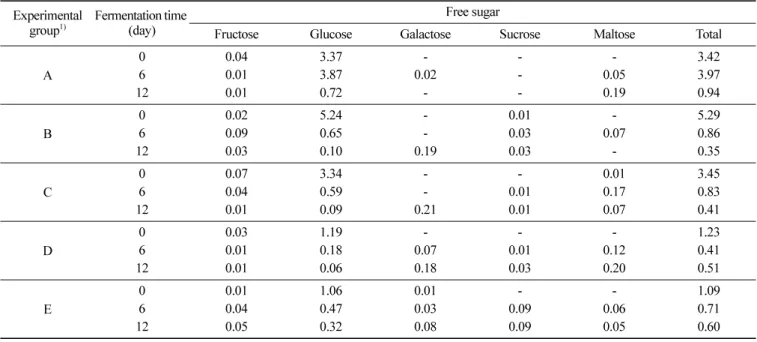
Table 5와같다. 탁주의 유리당으로 glucose, fructose는발효 전
과정을통하여모든시험탁주에서확인되었고 galactose, sucrose,
maltose는시험구에따라발효기간중검출되었다. 유리당총량
은 S. coreanus구 0.94-3.97%, S. ellipsoideus구 0.35-5.29%, S.
carlsbergensis구 0.41-3.45%, S. cerevisiae구 0.41-1.23%, S. rouxii
구 0.60-1.09%였다. S. ellipsoideus구는 담금일에 유리당 함량이 5.29%로시험구 중 함량이 가장 높았던 반면 발효 12일차에는 0.35%로시험구중함량이가장낮았는데, 이는 S. ellipsoideus구 가에탄올함량결과에서보여주었던 경향과일치한다. 발효초 기에 S. ellipsoideus 구는 에탄올함량이낮았지만발효 12일차에 12.4%로에탄올함량이 S. cerevisiae의 13.4%에이어시험구중 가장높게 나타났다. 총당함량은 S. rouxii구와 S. coreanus구에 서높았으나 정량되지않은 미지의당이 가산되지않아 총당의 결과와는차이를보인것으로추측된다. 본실험탁주의유리당
주성분으로나타난 glucose와 fructose의함량은각각 glucose
0.06-5.24%, fructose 0.01-0.09% 범위였고 glucose는각시험탁주술 덧에서담금일에 가장많은 함량을보이고 발효가진행됨에 따 라 감소했다. 당화 amylase에 의한 전분질의 분해로 생성된 glucose은담금일에는함량이높아탁주의주구성당으로나타났 으나, 발효 중효모나젖산균의 영양원및발효기질로이용되어 발효가진행됨에따라 감소한것으로추측된다. Galactose는시험 구에따라차이는있으나각시험탁주술덧에서담금일부터발 효기간 12일동안약간씩증가하는 변화를보였다. 탁주술덧의
glucose, fructose, maltose, sucrose 등의당류는백미나누룩등의 원료와당화 amylase의작용으로생성된 것으로본다. 시험구간 의유리당 함량이각각다르게나타난 것은탁주발효중술덧 의당화 amylase, 발효미생물의 종류및활성도등의차이에 의 한것으로추측된다. 요 약 탁주의품질을 좌우하는 여러요인중효모의 영향을살펴보
기 위해 S. coreanus, S. ellipsoideus, S. carlsbergensis, S.
cerevi-siae, S. rouxii각각의효모를달리 사용하여주모를담금하여 술 덧을제조하였고발효과정중효모의특성이탁주술덧의품질 특성에 미치는 영향을 살펴보았다. 에탄올 함량은 발효 12일에 S. cerevisiae구와 S. ellipsoideus구에서각각 13.4, 12.4%로시험구 중가장 높았다. 미량알코올의 총량은 nd-0.831 mg/mL 범위로 서, 시험구중에는 S. cerevisiae구가 0.729-0.831 mg/mL 범위로가 장높았고, 미량알코올 성분중 isoamyl alcohol 함량은발효 12 일에함량 0.123-0.264 mg/mL로최대치를보였다. pH는담금일에 3.41-4.25였으나 발효 2일후 2.40-2.70으로크게 저하되었다. 발 효과정중시험구간의 pH 차이는크게없었지만총산함량에 서는 S. rouxii구가발효 12일에 1.15%로가장높게나타났다. 유 기산 총량에서도 S. rouxii구가 0.10-1.98%로가장 높았으며 lactic
acid, succinic acid, acetic acid가탁주유기산의주성분으로나타
났다. 총당 함량은 S. coreanus구가 담금일과 발효 12일에각각 20.16, 5.50%로가장높았고환원당함량은발효 12일에 S. rouxii 구와 S. coreanus구가각각 4.52, 4.30%로가장높았다. 유리당총 량에서는 S. ellipsoideus구가 담금일에 5.29%로시험구중유리당 함량이 가장 높았던 반면 발효 12일차에는 0.35%로 시험구 중 함량이가장낮았는데, 이는 S. ellipsoideus구의에탄올함량의경 향과일치하는결과였으며, glucose, fructose가탁주유리당의주 성분으로나타났다. 탁주의품질을좌우하고탁주의보존성이나향미에영향을주 는가장중요한성분인에탄올함량은 S. cerevisiae구가가장높 았고, 알코올등과 결합하여 ester와같은향미 형성등에 이용되 어 탁주의 맛, 냄새와 직접관련되는 성분인 총산과 유기산 총 함량은 S. rouxii구에서높게나타났다. 탁주중의당분은에탄올
Table 5. Change in free sugar contents of mashes for takju using different kinds of yeast during fermentation (Unit: %)
Experimental
group1) Fermentation time (day) Free sugar
Fructose Glucose Galactose Sucrose Maltose Total A 06 0.040.01 3.373.87 0.02 -- - 0.05- 3.42 3.97 12 0.01 0.72 - - 0.19 0.94 B 06 0.02 5.24 -0.09 0.65 - 0.01 -0.03 0.07 0.86 5.29 12 0.03 0.10 0.19 0.03 - 0.35 C 06 0.07 3.34 -0.04 0.59 - 0.01 0.17 0.83- 0.01 3.45 12 0.01 0.09 0.21 0.01 0.07 0.41 D 06 0.03 1.19 -0.01 0.18 0.07 0.01 0.12- - 1.230.41 12 0.01 0.06 0.18 0.03 0.20 0.51 E 06 0.01 1.06 0.010.04 0.47 0.03 0.09 0.06- - 1.090.71 12 0.05 0.32 0.08 0.09 0.05 0.60
생성과 감미도에 관여하는 성분으로 중요시되는데, 시험구 중 S. coreanus구와 S. rouxii구가 총당 및 환원당의 함량이 높아 감미 가 다소 강한 탁주로 추측된다. 본 실험 결과 효모 종류를 달리하여 제조한 탁주 술덧의 품질 특성이 서로 분명하게 차이를 보임을 알 수 있었다. 따라서 탁주 발효 시 효모의 단독 사용보다 각각의 효모를 병용하여 발효에 이용한다면 각각의 효모 특색이 상승 작용하여 저장성 향상 및 풍미 증진이라는 탁주의 전반적인 품질 개선 효과를 기대할 수 있을 것이다. 각각의 효모를 조합하여 탁주 술덧을 발효시키고 이에 대한 품질특성을 분석하는 연구에 대한 진행이 앞으로 필 요할 것으로 사료된다. 문 헌
1. Lee SR. Korean Fermented Foods. Ewha Women's University Press, Seoul, Korea. pp. 222-294 (1986)
2. Kim ZU. Food Processing. Moonwoondang, Seoul, Korea. p. 5 (1985)
3. Kim CJ, Kim KC, Kim DY, Oh MJ, Lee SK, Lee SO, Chung ST, Jung JH. Fermentation Technology. Sunjinmunwhasa, Seoul, Korea. pp. 79-103 (1990)
4. Lee HS. Quality characteristics of takju using rice nuruk during fermentation. M.S. thesis, Seoul Women's Univ., Seoul (2000) 5. Jung JH. Studied on the identification of organic acids and sugars
in the fermented mash of the takju made from different raw-materials. J. Korean Agric. Chem. Soc. 8: 39-43 (1967)
6. Lee JS, Lee TS, Park SO, Noh BS. Flavor components in mash of takju prepared by different raw materials. Korean J. Food Sci. Technol. 28: 316-323 (1996)
7. Lee SM, Lee TS. Effect of roasted rice and defatted soybean on the quality characteristics of takju during characteristics fermenta-tion. J. Nat. Sci. Seoul Women’s Univ., Korea 12: 71-79 (2000) 8. Jeong JW, Park KJ, Kim MH, Kim DS. Quality characteristics of
takju fermentation by addition of chestnut peel powder. Korean J. Food Preserv. 13: 329-336 (2006)
9. Hong SW, Hah YC, Min KH. The biochemical constituents and their changes during the fermentation of takju. J. Korean Agric. Chem. Soc. 8: 107-115 (1970)
10. Kim CJ. Studies on the quantitative changes of organic acid and
sugars during the fermentation of takju. J. Korean Agric. Chem. Soc. 8: 33-42 (1970)
11. Lee WK, Kim JR, Lee MW. Studies of the changes in the free amino acids and organic acids of takju prepared with different
koji strains. J. Korean Agric. Chem. Soc. 30: 323-327 (1987) 12. Han EH, Lee TS, Noh BS, Lee DS. Quality characteristics in
mash of takju prepared by using different nuruk during fermenta-tion. Korean J. Food Sci. Technol. 29: 555-562 (1997)
13. Kim CJ. Microbiological and enzymological studies on takju
brewing. J. Korean Agric. Chem. Soc. 10: 69-100 (1968)
14. Lee JS, Lee TW. Studies on the microflora of takju brewing. Korean J. Microbiol. 8: 116-133 (1970)
15. Ko CM, Choi TJ, Yoo J. Microbiological studies on the takju
(makguly) brewing: The Korean local wine. Korean J. Microbiol. 11: 167-174 (1973)
16. Lee SK, Park YJ, Oh MJ. Studies on takjoo yeasts (Part ) - influ-ences of kind of yeast strains and brewing conditions of fermen-tation of takjoo mash. J. Korean Agric. Chem. Soc. 16: 85-93 (1973)
17. Kim CJ, Oh MJ, Kim SY. Studies on the induction of available mutants of takju yeast by UV light irradiation (Part ) - On the selection and Identification of the Mutants. J. Korean Agric. Chem. Soc. 18: 10-16 (1975)
18. So MH. Aptitudes for takju brewing of wheat flour-nuluks made with different mold species. Korean J. Food Nutr. 8: 6-12 (1995) 19. Kang KH, Noh BS, Seo JH, Hur WD. Food Analysis.
Sungkyunkwan University Press. Seoul, Korea. pp. 109-110 (1998)
20. Yuda J. Volatile components from beer fermentation. J. Soc. Brew. 71: 818-830 (1976)
21. KFIA. Food Code. Korea Food Industry Association, Seoul, Korea. p. 330 (1989)
22. Hong HG. The effect on the composition of takju of addition of
nuruk under varied conditions. MS thesis, Seoul Women’s Uni-versity, Seoul, Korea (1984)
23. Lee J. Studies on the qualities of takju with various koji strains. MS thesis, Seoul Women's University, Seoul (1982)
24. Song JY. Quality characteristics of takju made of glutinus rice or barley. MS thesis, Seoul Women’s University, Seoul (1998) 25. Lee JS, Lee TS, Noh BS, Park SO. Quality characteristics of
mash of takju prepared by different raw materials. Korean J. Food Sci. Technol. 28: 330-336 (1996)