Dysport and Botox at a Ratio of 2.5:1 Units in Cervical Dystonia: A Double-Blind, Randomized Study
Ji Young Yun, MD,
1Jae Woo Kim, MD, PhD,
2Hee-Tae Kim, MD, PhD,
3Sun Ju Chung, MD, PhD,
4Jong-Min Kim, MD, PhD,
5Jin Whan Cho, MD, PhD,
6Jee-Young Lee, MD,
7Ha Neul Lee, MD,
3Sooyeoun You, MD,
8Eungseok Oh, MD,
9Heejeong Jeong, MD,
10Young Eun Kim, MD,
11Han-Joon Kim, MD, PhD,
12Won Yong Lee, MD, PhD,
6and Beom S. Jeon, MD, PhD
12*
1
Department of Neurology, Ewha Womans University School of Medicine and Ewha Medical Research Institute, Seoul, Republic of Korea
2
Department of Neurology, Parkinson‘s Disease Centre, Dong-A University Hospital, Pusan, Republic of Korea
3
Department of Neurology, College of Medicine, Hanyang University, Seoul, Republic of Korea
4
Department of Neurology, Asan Medical Center, University of Ulsan College of Medicine, Seoul, Republic of Korea
5
Department of Neurology, Seoul National University Bundang Hospital, Seongnam, Republic of Korea
6
Department of Neurology, Samsung Medical Center, Sungkyunkwan University School of Medicine, Seoul, Republic of Korea
7
Department of Neurology. Seoul National University-Seoul Metropolitan Government Boramae Medical Center, Seoul, Republic of Korea
8
Department of Neurology, Dongsan Medical Center, Keimyung University, Daegu, Republic of Korea
9
Department of Neurology, Chungnam National University Hospital, Chungnam National University School of Medicine, Daejeon, Republic of Korea
10
Department of Neurology, Gyeongsang National University School of Medicine, Jinju, Republic of Korea
11
Department of Neurology, Hallym University Sacred Heart Hospital, Hallym University College of Medicine, Anyang, Republic of Korea
12
Department of Neurology and Movement Disorder Center, Parkinson study group, and Neuroscience Research Institute, College of Medicine, Seoul National University, Seoul, Republic of Korea
A B S T R A C T : We aimed to compare Dysport (abobotulinumtoxinA, Ipsen Biopharm, Slough, UK) and Botox (onabotulinumtoxinA, Allergan, Irvine, CA, USA) at a 2.5:1 ratio in the treatment of cervical dystonia (CD). A Dysport/Botox ratio of lower than 3:1 was sug- gested as a more appropriate conversion ratio, consid- ering its higher efficacy and more frequent incidence of adverse effects not only in the treatment of CD but also in other focal movement disorders. A randomized, double-blind, multicenter, non-inferiority, two-period crossover study was done in CD, with a duration of at least 18 months. Patients were randomly assigned to treatment for the first period with Dysport or Botox, and they were followed up for 16 weeks after the injection.
After a 4-week washout period, they were switched to
the other formulation and then followed up for 16 weeks. The primary outcome was the changes in the Tsui scale between the baseline value and that at 1 month after each injection. A total of 103 patients were enrolled, and 94 completed the study. Mean changes in the Tsui scale between baseline and 4 weeks after each injection tended to favor Botox; however, this was not statistically significant (4.0 6 3.9 points for the Dysport treatment vs. 4.8 6 4.1 points for Botox; 95% confi- dence interval, 20.1-1.7; P 5 0.091). The mean change of the Toronto western spasmodic torticollis rating scale score, the proportion of improvement in clinical global impression and patient global impression, and the inci- dences of adverse events were not significantly different between the two treatments. With regard to safety and
---
This is an open access article under the terms of the Creative Commons Attribution License, which permits use, distribution and reproduction in any medium, provided the original work is properly cited.
*Correspondence to: Beom S. Jeon, Department of Neurology, College of Medicine, Seoul National University, 28 Yongon-dong, Chongno-gu, Seoul, 110-744, Republic of Korea, E-mail: [email protected]
Funding agencies: This study was supported by Ipsen Ltd. This study was also supported by Republic of Korea and Basic Science Research Program through the National Research Foundation of Korea (NRF) funded by the Ministry of Education, Science and Technology (2010-0021653, BSJ).
Relevant conflicts of interest/financial disclosures: The study sponsors had no role in the study design, data collection, data analysis, data interpreta- tion, or writing of the report.
Full financial disclosures and author roles may be found in the online version of this article.
Received: 21 June 2014; Revised: 11 October 2014; Accepted: 19 October 2014 Published online 5 December 2014 in Wiley Online Library
(wileyonlinelibrary.com). DOI: 10.1002/mds.26085
efficacy, Dysport was not inferior to Botox in patients with CD at a conversion factor of 2.5:1. [clinicaltrial.gov:
NCT00950664] V
CThe Authors. Movement Disorders published by Wiley Periodicals, Inc. on behalf of Inter- national Parkinson and Movement Disorder Society.
K e y W o r d s : cervical dystonia; torticollis; botulinum toxin; motor control; movement disorders
Cervical dystonia (CD) is characterized by involun- tary contraction of the neck muscles, frequently lead- ing to neck pain, disability, abnormal posture, and social withdrawal. 1 At present, botulinum toxin type A (BoNT-A) is recommended as the first-line treat- ment option for CD. 2
Several commercially available formulations of BoNT-A are available for CD treatment: Dysport (abobotulinumtoxinA, Ipsen Biopharm, Slough, UK), Botox (onabotulinumtoxinA, Allergan, Irvine, CA, USA), and Xeomin (incobotulinumtoxinA, Merz Phar- maceuticals GmBH, Frankfurt, Germany).
International units are used to express the potency of these formulations. However, the units for each product are not equivalent, and debate has arisen con- cerning the optimal unit conversion ratio between Dysport and Botox. 3 The Dysport/Botox conversion ratio has ranged from 1.7:1 to 5:1 in the treatment of CD. 4-6
Two double-blind, randomized clinical trials have been performed to investigate treatment equivalency and Dysport/Botox conversion ratios. 7,8 A ratio of 3:1 was suggested. 7 However, Ranoux et al. 8 proposed that ratios lower than 3:1, if producing equivalent effi- cacies, may be preferred because of the frequent adverse effects (AE) at the ratios used in their studies. 8 Other authors have also suggested that the optimal ratios may be lower than 3:1, 3,9 with one study sug- gesting a range of 2 to 2.5:1. 10
Botox is usually supplied in 100-unit vials and Dys- port in 500-unit vials, and the average recommended dose for patients with CD is 200 units of Botox (2 vials) or 500 units of Dysport (1 vial). 11 On that basis, the conversion rate is 2.5:1. Assuming a bioequiva- lence ratio of 2.5:1 units in the treatment of CD, we undertook a double-blind, randomized, multi-center, crossover study to determine the non-inferiority of Dysport in clinical efficacy and safety, in comparison with Botox, when treating at a 2.5:1 conversion ratio.
Methods
Patients
The CD patients in this study were recruited in movement disorder clinics at participating centers from August 2009 to March 2010. Patients with CD were eligible for enrollment in this study if they were older than 20 years and had CD duration of 18 or
more months. The oral CD medications dosages were kept stable throughout the study.
Patients were excluded if they had a history of clini- cally significant dysphagia due to BoNT-A injection requiring a Levin tube; a diagnosis of myasthenia gravis or other disease of the neuromuscular junction;
a diagnosis of cervical contracture; or if they were cur- rently pregnant or breastfeeding. Patients were also excluded if they underwent previous myotomy to cer- vical muscles, phenol injections, or denervation sur- gery involving the cervical region. Patients who required a BoNT-A dose of greater than 200 units as Botox or greater than 500 units as Dysport were excluded. Because nearly all Korean CD patients receive Dysport less than 500 units or Botox less than 200 units, no patient was excluded in the screening because of these criteria. Patient who had participated in other clinical trials in the 4 months preceding this study’s enrollment period were also not permitted to participate. Patients treated previously with BoNT-A were allowed to participate if at least 16 weeks had elapsed since the last injection.
All participating centers obtained the approval of their institutional review boards and conformed to the principles of the Declaration of Helsinki. All patients signed informed consents before participation in this study. The study was registered at http://www.Clini- calTrials.gov (identifier: NCT00950664).
Randomization and Intervention
Initially, all patients were randomly assigned to either the Dysport or Botox treatment group by using a predetermined randomization table. To ensure blind- ness, the following measures were undertaken:
The randomization code was generated by the Medi- cal Research Collaborating Center at Seoul National University Hospital before study initiation. Random- ization of the injection order was carried out by using a permuted-block design with a block size of 4 and 6.
Assignments were not stratified by enrolling centers.
The randomization table was transferred by the Medical Research Collaborating Center at Seoul National University Hospital directly to the pharmacy of each clinical trial center. All patients and investiga- tors except for the pharmacists were blinded from assignment until all data were ready for analysis after study completion. The pharmacists were not involved in any patient’s treatment or assessment.
D Y S P O R T V S . B O T O X I N C E R V I C A L D Y S T O N I A
Both formulations were diluted in a room separated from all investigators and patients, by the pharmacists. To ensure blindness, 2 mL normal saline was used to dilute one vial of 500-unit Dysport and two vials of 100-unit Botox at a Dysport/Botox unit ratio of 2.5:1. To ensure the same injection volumes for the two crossover injec- tions, those dilutions were then drawn into three 1-mL syringes containing 0.6 mL, 0.6 mL, and 0.4 mL.
The syringes were delivered to the injectors, who were blinded to the contents of the syringes. During the study, 0.1 to 0.2 mL was administered at each injection site. Treatment-related training was per- formed twice before initiating the study, and once dur- ing the study.
Study Design
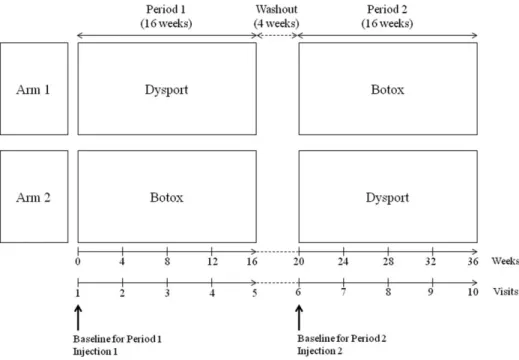
Patients received either Dysport or Botox injection on assignment during the first study period. The sub- jects were followed up once per month for 16 weeks in the first study period. After a 4-week washout period, those who received Dysport were reassigned Botox, and vice versa. To avoid carryover effects in this crossover design, we planned a 16-week treatment period followed by a 4-week washout period, even though the benefit of an injection for CD lasts gener- ally approximately 14 weeks 11 (Fig. 1).
Doses of BoNT-A received by patients were deter- mined a priori and fixed by the investigators at a dose of 2.5:1 for Dysport and Botox, respectively. The vol- ume, sites, and number of injections into each muscle were the same between the two regimens. For each patient, injectors were the same in the crossover. Sub- jects were also followed up monthly for 16 weeks in
the second period. The results from both periods were merged and compared according to the two different formulations.
Clinical Assessments
In each treatment group, monthly changes from base- line at follow-up weeks 4, 8, 12, and 16 were assessed by using the Tsui scale 12 and the Toronto western spas- modic torticollis rating scale (TWSTRS). 13
At each visit, including baseline, the investigators obtained clinical global impression (CGI) and patients assessed their global impression (PGI) for each treat- ment. A patient’s preference for treatments types was asked at trial completion. The preference was assessed on the basis of response to the question: “Which regi- men do you prefer?” The choices of answers were: “I prefer the first one”, “I prefer the second one” or “I do not prefer one treatment over the other,” in addi- tion to reasons for their preference.
Efficacy Assessments
The primary efficacy outcome was the change in the Tsui scale between the baseline value and that at 1 month after each injection (peak effect). 14,15 Second- ary outcomes included analysis of changes in the TWSTRS between baseline and 1 month after each injection and the proportions of patients with CGI of illness (CGI-I) and PGI of improvement (PGI-I). We also recorded all changes in Tsui and TWSTRS scales and the proportion of CGI-I and PGI-I at each visit.
Additionally, we analyzed improvements in the TWSTRS subscale for severity, disability, and pain at each visit and the proportions of patient with a
FIG. 1. Study design.
preference for Dysport or Botox. Safety was assessed by the incidence of AE reported throughout the study.
Sample Size and Statistical Analysis The required sample size calculation was based on the previous studies investigating a mean change in Tsui score between baseline and 4 weeks after first injection. 7,8 Assuming that a between-treatment differ- ence in Tsui score was 1.5 points based on the study by Ranoux et al, 8 and using one-sided test with a sig- nificance level of 0.05 and 80% power, the target sample size of 79 patients was estimated. The required patient number also assumed an estimated 25% attri- tion rate.
The study was designed to test the hypothesis that the change in Tsui score from baseline achieved with Dysport is non-inferior to that of Botox in a 2.5:1 ratio at the end of 4 weeks of treatment. For the pri- mary outcome, non-inferiority of Dysport/Botox at a ratio of 2.5:1 was concluded if the upper limit of the one-sided 95% confidence interval (CI) for the differ- ence between treatment (Dysport minus Botox) in change from baseline as Tsui score was 1.5 points or less. For scale variables, including changes in Tsui scale and total score and subscales in TWSTRS from baseline, the data were analyzed by paired t tests between baseline and 4 weeks after each injection.
McNemar chi-square tests were used to evaluate cate- gorical values, such as differences in CGI-I or PGI-I proportions and in the incidence of overall AEs between the treatment groups. For assessment of patients’ preference, descriptive statistics were used.
Two study populations were defined. The modified intent-to-treat population (mITT) consisted of all randomized patients who completed the Tsui scale at baseline and at least once after 4 weeks of treatment in each crossover period. The per-protocol population (PP) consisted of patients in the mITT who had no protocol violations and who completed the Tsui scale at all visits.
In our crossover design, to test for presence of a car- ryover effect, changes in Tsui score obtained immedi- ately before each intervention were compared, and the Mann-Whitney U test was used to assess differences between the patients switching from Dysport to Botox (arm 1) and those changing from Botox to Dysport (arm 2).
All statistical analyses were performed by using SPSS 21.0. A P-value < 0.05 was considered statisti- cally significant.
Results
Patient Disposition and Characteristics Of the 103 patients originally enrolled from seven centers, one declined to participate before initiation of
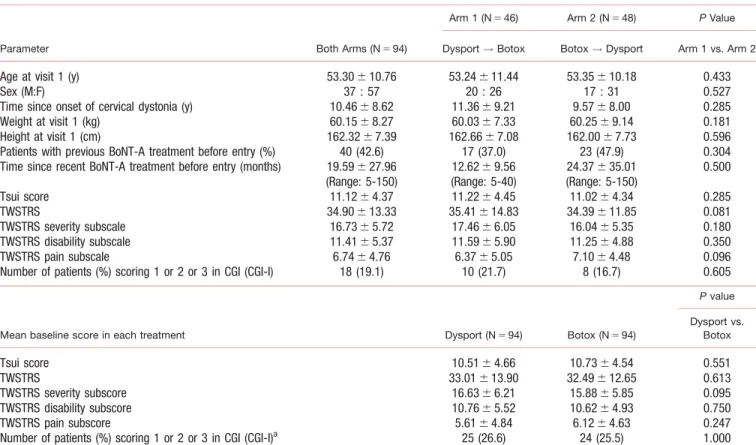
randomization. Thus, 102 subjects were randomized, with 49 and 53 allocated to the arm 1 and arm 2 groups, respectively. In arm 1, patients received Dys- port during the first injection period (period 1); two of those patients withdrew consent after the intervention, and one patient discontinued the study because of noncompliance. During the second injection period (period 2) of arm 1, the remaining 46 patients received Botox, and all completed the intervention. In period 1 of arm 2, all participants received Botox; two of those patients withdrew consent in subsequent visits, and three subjects discontinued the study because of poor compliance. After the washout period, the remaining 48 patients received Dysport and completed the study (Fig. 2). The two groups were similar at baseline with respect to demographic and clinical characteristics (Table 1).
A total of 94 patients completed both interventions and participated in all study evaluations. After trial, however, one patient’s disease duration was corrected to 8 months, thus not meeting enrollment indication.
Moreover, injection sites of eight patients were not kept the same between the two phases, thus violating the study protocol. We included all of the patients who completed two treatments in the study plan; these nine patients were included in the mITT. Eight drop- outs in period 1 were excluded from analysis because they did not complete both treatments (Fig. 2).
Patients received a mean dose of 361.04 6 57.91 (range, 200-400) units of Dysport and 144.41 6 23.16 of Botox (80-160) in each period.
Outcome Measures
A tendency was seen to favor Botox in the mean changes in the Tsui scale between baseline and 4 weeks after each injection; however, it was not statisti- cally significant (4.0 6 3.9 points for Dysport vs.
4.8 6 4.1 points for Botox; 95% confidence interval, 20.1 to 1.7; P 5 0.091). In addition, no significant dif- ference was found between the two formulation groups in mean reduction in TWSTRS (95% CI for difference, 23.4 to 1.5, P 5 0.429) from the baseline to 4 weeks after each injection (Table 2). At other follow-up visits, similar results were obtained for changes in the Tsui scale and TWSTRS from baseline (Supplemental Data Table e-1).
No significant differences were seen in the propor- tion of CGI-I or PGI-I over the period containing all follow-up visits. In addition, no detectable differences in the TWSTRS subscale were found over the entire follow-up period (Table 2).
Thirty-six patients preferred Dysport, and 34 chose Botox. Twenty-one patients said there was no differ- ence between two treatments. In the group that pre- ferred Dysport, the preference reasons were better efficacy (n 5 25), longer duration of action (n 5 8),
D Y S P O R T V S . B O T O X I N C E R V I C A L D Y S T O N I A
decreased side effects (n 5 9), and more tolerable pain (n 5 5). The reasons for preferring Botox were better efficacy (n 5 24), longer duration of action (n 5 7), decreased side effects (n 5 5), and more tolerable pain (n 5 2).
Safety Analysis
Adverse events were observed in 25 patients (14 in Dysport, 19 in Botox), and eight patients exhibited side effects in both regimens. Muscle weakness and dysphagia were the two most common AEs in both treatments; however, both effects were transient and tolerable. The incidence of AE was not significantly different between treatments (P 5 0.332; Table 3).
Discussion
Dysport, a commonly available preparation of BoNT-A, has been used in the treatment of CD patients, and its efficacy and safety has been demon- strated in multiple randomized, placebo-controlled studies. 16-18 Moreover, treatment with 500 units Dys- port is reported to be effective and safe in the treat- ment of CD when provided as initial or maintenance doses. 15,17,18
A review suggests that the different formulations of BoNT-A are clinically similar and differ only in AEs. 19 However, other literatures have reported intrinsic dif- ferences between formulations that render them non-
FIG. 2. CONSORT 2012 flow diagram of patients.
bioequivalent, irrespective of dose ratios, 20 and the conversion ratio may not be applicable. 21
The use of BoNT-A in CD should be based on their individual dosing. However, when changing one prep- aration to the other because of any reasons, including economical or regional causes, we need minimum standards to avoid an overdose or an inefficient response.
A previous double-blinded study reported that Dys- port treatment at a ratio of 3:1 was more effective than Botox in CD, but the incidence of AEs was some-
what higher with the 3:1 Dysport treatment. 8 There- fore, use of a ratio lower than 3:1 was proposed.
However, data for ratios lower than 3:1 were lacking, and a Dysport/Botox conversion ratio has been a mat- ter of debate. 3,10
To our knowledge, this is the first, double-blind randomized trial to compare Dysport and Botox at a ratio of 2.5:1 in the treatment of CD. We detected two significant results in the treatment of CD with Dysport and Botox. First, our study shows that Dys- port treatment results were not inferior to those from TABLE 1. Baseline characteristics and disease characteristics in the modified intent-to-treat population.
Parameter Both Arms (N 5 94)
Arm 1 (N 5 46) Arm 2 (N 5 48) P Value Dysport ! Botox Botox ! Dysport Arm 1 vs. Arm 2
Age at visit 1 (y) 53.30 6 10.76 53.24 6 11.44 53.35 6 10.18 0.433
Sex (M:F) 37 : 57 20 : 26 17 : 31 0.527
Time since onset of cervical dystonia (y) 10.46 6 8.62 11.36 6 9.21 9.57 6 8.00 0.285
Weight at visit 1 (kg) 60.15 6 8.27 60.03 6 7.33 60.25 6 9.14 0.181
Height at visit 1 (cm) 162.32 6 7.39 162.66 6 7.08 162.00 6 7.73 0.596
Patients with previous BoNT-A treatment before entry (%) 40 (42.6) 17 (37.0) 23 (47.9) 0.304
Time since recent BoNT-A treatment before entry (months) 19.59 6 27.96 (Range: 5-150)
12.62 6 9.56 (Range: 5-40)
24.37 6 35.01 (Range: 5-150)
0.500
Tsui score 11.12 6 4.37 11.22 6 4.45 11.02 6 4.34 0.285
TWSTRS 34.90 6 13.33 35.41 6 14.83 34.39 6 11.85 0.081
TWSTRS severity subscale 16.73 6 5.72 17.46 6 6.05 16.04 6 5.35 0.180
TWSTRS disability subscale 11.41 6 5.37 11.59 6 5.90 11.25 6 4.88 0.350
TWSTRS pain subscale 6.74 6 4.76 6.37 6 5.05 7.10 6 4.48 0.096
Number of patients (%) scoring 1 or 2 or 3 in CGI (CGI-I) 18 (19.1) 10 (21.7) 8 (16.7) 0.605
Mean baseline score in each treatment Dysport (N 5 94) Botox (N 5 94)
P value
Dysport vs.
Botox
Tsui score 10.51 6 4.66 10.73 6 4.54 0.551
TWSTRS 33.01 6 13.90 32.49 6 12.65 0.613
TWSTRS severity subscore 16.63 6 6.21 15.88 6 5.85 0.095
TWSTRS disability subscore 10.76 6 5.52 10.62 6 4.93 0.750
TWSTRS pain subscore 5.61 6 4.84 6.12 6 4.63 0.247
Number of patients (%) scoring 1 or 2 or 3 in CGI (CGI-I)
a25 (26.6) 24 (25.5) 1.000
BoNT-A, Botulinum toxin type A; TWSTRS, Toronto western spasmodic torticollis rating scale; CGI, clinical global impression; CGI-I, clinical global impression of illness.
a
CGI-I is the proportions of patients with CGI of illness of ‘1 5 normal/not at all ill’or ‘2 5 borderline mildly ill,’ or ‘3 5 mildly ill.’
TABLE 2. Clinical outcomes after 4 weeks from baseline in the modified intent-to-treat population
Scale Dysport (n 5 94) Botox (n 5 94)
Between-treatment
difference in end-point P value
Mean changes of Tsui from baseline 23.98 6 3.89 24.77 6 4.10 0.78 [-0.13 to 1.70] 0.091
Mean changes of Total TWSTRS from baseline 29.76 6 10.25 28.78 6 10.11 20.97 [-3.39 to 1.45] 0.429
Mean changes of TWSTRS severity subscore 25.55 6 4.99 25.26 6 4.79 20.30 [-1.46 to 0.86] 0.611
Mean changes of TWSTRS disability subscore 22.76 6 3.64 22.46 6 3.60 20.30 [-1.23 to 0.64] 0.529
Mean changes of TWSTRS pain subscore 21.45 6 4.05 21.19 6 4.16 20.25 [-1.28 to 0.77] 0.623
Number of patients (%) scoring 1 or 2 or 3 on CGI scale (CGI-I)
a54/94 (57.4 %) 57/94 (60.6 %) 0.648 Number of patients (%) scoring 1 or 2 or 3 on PGI scale (PGI-I)
a75/94 (79.8 %) 78/94 (83.0 %) 0.690
TWSTRS, Toronto western spasmodic torticollis rating scale; CGI, clinical global impression; CGI-I, clinical global impression of illness; PGI, Patient’s global impression; PGI-I, Patient’s global impression of improvement.
a