Harumi Takahashi,
1Tadao Shibasaki,
2Jae-Hyung Park,
3Shihomi Hidaka,
1Toshimasa Takahashi,
1,4Aika Ono,
2Dae-Kyu Song,
3and Susumu Seino
1Role of Epac2A/Rap1 Signaling in Interplay Between Incretin and Sulfonylurea in Insulin Secretion
Diabetes 2015;64:1262–1272 | DOI: 10.2337/db14-0576
Incretin-related drugs and sulfonylureas are currently used worldwide for the treatment of type 2 diabetes. We recently found that Epac2A, a cAMP binding protein having guanine nucleotide exchange activity toward Rap, is a target of both incretin and sulfonylurea. This suggests the possibility of interplay between incretin and sulfonylurea through Epac2A/Rap1 signaling in in- sulin secretion. In this study, we examined the combi- natorial effects of incretin and various sulfonylureas on insulin secretion and activation of Epac2A/Rap1 signaling. A strong augmentation of insulin secretion by combination of GLP-1 and glibenclamide or glimepiride, which was found in Epac2A
+/+mice, was markedly reduced in Epac2A
2/2mice. In contrast, the combinatorial effect of GLP-1 and gliclazide was rather mild, and the effect was not altered by Epac2A ablation. Activation of Rap1 was enhanced by the combination of an Epac-selective cAMP analog with glibenclamide or glimepiride but not gliclazide. In diet-induced obese mice, ablation of Epac2A reduced the insulin secretory response to coadministration of the GLP-1 receptor agonist liraglutide and glimepiride.
These findings clarify the critical role of Epac2A/Rap1 signaling in the augmenting effect of incretin and sulfo- nylurea on insulin secretion and provide the basis for the effects of combination therapies of incretin-related drugs and sulfonylureas.
Recently developed incretin-related drugs such as dipeptidyl peptidase-4 (DPP-4) inhibitors and GLP-1
receptor agonists are increasingly being used worldwide in the treatment of type 2 diabetes. Incretins such as GLP-1 and glucose-dependent insulinotropic polypep- tide, which are secreted from the intestine upon meal ingestion, amplify insulin secretion from pancreatic b-cells in a glucose concentration–dependent manner (1,2). This glucose dependency of incretin action pro- vided the basis for recently developed incretin-based therapies (3), which have less risk for hypoglycemia.
GLP-1 and glucose-dependent insulinotropic polypep- tide bind to their speci fic receptors on pancreatic b-cells, increasing the intracellular cAMP level through the activation of adenylate cyclase, thereby leading to the potentiation of insulin secretion. This potentiation is mediated by both protein kinase A (PKA)-dependent and PKA-independent pathways, the latter involving Epac2, a protein possessing guanine nucleotide ex- change activity toward the small GTPase Rap (4–6).
Three subtypes of Epac2 have been identified, as fol- lows: Epac2A (originally referred to as Epac2), mainly expressed in the brain and neuroendocrine and endo- crine tissues; Epac2B, in the adrenal gland (7); and Epac2C, in the liver (8). Epac2A/Rap1 signaling has been shown to be required for the potentiation of the first phase of glucose-induced insulin secretion in the pancreatic b-cell (9–11).
On the other hand, sulfonylureas are antidiabetic drugs commonly used for many years. A primary target of sulfonylureas is the ATP-sensitive potassium (K
ATP)
1Division of Molecular and Metabolic Medicine, Kobe University Graduate School of Medicine, Chuo-ku, Kobe, Japan
2Division of Cellular and Molecular Medicine, Kobe University Graduate School of Medicine, Chuo-ku, Kobe, Japan
3Department of Physiology, Keimyung University School of Medicine, Dalseo-Gu, Daegu, Korea
4Division of Diabetes and Endocrinology, Kobe University Graduate School of Medicine, Chuo-ku, Kobe, Japan
Corresponding author: Susumu Seino, [email protected].
Received 10 April 2014 and accepted 7 October 2014.
This article contains Supplementary Data online at http://diabetes .diabetesjournals.org/lookup/suppl/doi:10.2337/db14-0576/-/DC1.
© 2015 by the American Diabetes Association. Readers may use this article as long as the work is properly cited, the use is educational and not for profit, and the work is not altered.
ISLET STUDIES
channels in pancreatic b-cells. Binding of sulfonylureas to SUR1, the regulatory subunit of the K
ATPchannel, causes closure of the channel, resulting in depolarization of the b-cells and opening of voltage-dependent Ca
2+channels (VDCCs). The influx of extracellular Ca
2+through VDCC triggers insulin secretion (12–14).
We have previously found that Epac2A is also a direct target of sulfonylureas and that activation of Epac2A/
Rap1 signaling is required for sulfonylurea-induced in- sulin secretion (15). Thus, Epac2A is a target of both incretin/cAMP signaling and sulfonylureas. We recently identified the sulfonylurea binding site in Epac2A and characterized the binding properties of various sulfonyl- ureas to Epac2A (16), and found that cAMP signaling and sulfonylurea cooperatively activate Epac2A.
In clinical settings, combination therapies of incretin- related drugs and sulfonylureas are often used for glycemic control in type 2 diabetes (17,18) but lead to hypoglycemia in some cases (19). Coadministration of incretin and sul- fonylurea has been found to enhance insulin secretion in humans (20,21). However, the underlying mechanism for the augmentation of insulin secretion by the combination of incretin/cAMP signaling and sulfonylurea is not known.
In the current study, we have examined the role of Epac2A/
Rap1 signaling in the interplay between incretin/cAMP sig- naling and sulfonylurea in insulin secretion.
RESEARCH DESIGN AND METHODS Animals and Diet
Epac2A
2/2mice were generated as previously described (9). Epac2A
+/2mice with C57BL/6 background were main- tained to obtain Epac2A
+/+and Epac2A
2/2littermates.
For a high-fat diet (HFD) study, mice were fed with an HFD (Research Diets, Inc., New Brunswick, NJ) for 6 weeks from 4 or 5 weeks of age. All animal experiments were performed in accordance with the guidelines of the Kobe University Animal Ethics Committee of Kobe Uni- versity Graduate School of Medicine. HFD mice experi- ments were approved (KM-2013–42) by the Keimyung University Institutional Ethics Committee.
Reagents
Glibenclamide and gliclazide were purchased from Sigma- Aldrich (St. Louis, MO). Glimepiride was from Wako (Osaka, Japan). 6-Bnz-cAMP-AM (6-Bnz), 8-pCPT-29-O- Me-cAMP-AM (8-pCPT), and 8-Br-cAMP-AM were from BIOLOG Life Science Institute (Bremen, Germany). GLP-1 was from The Peptide Institute (Osaka, Japan). Anti-CREB antibody and anti –phospho-CREB antibody were purchased from Cell Signaling Technology (Danvers, MA).
Insulin Secretion Experiments
Pancreatic islets were isolated from C57BL/6 mice by collagenase digestion and cultured for 2 days, as described previously (6). Thirty minutes after preincubation of isolated islets with Krebs-Ringer bicarbonate HEPES buffer (KRBH) containing 2.8 mmol/L glucose, five size-matched islets were collected in each well of a 96-well plate and
incubated for 30 min in 100 mL of the same buffer con- taining various stimuli. To assess insulin content, the islets were extracted in acid ethanol overnight at 4°C.
Insulin released in the incubation buffer and islet insulin contents were measured by homogeneous time-resolved fluorescence assay using an insulin assay kit (CIS Bio In- ternational, Gif-sur-Yvette, France). The amount of insu- lin secretion was normalized by islet insulin content.
Perfusion Experiments
Perfusion experiments were performed as previously described (22). Briefly, overnight (16 h) fasted male mice 16–25 weeks of age were used. The perfusion pro- tocol began with a 20-min equilibration period with the same buffer used in the initial step shown in the figures.
The flow rate of the perfusate was 1 mL/min. The insulin levels in the perfusate were measured by homogeneous time-resolved fluorescence assay.
Cell Culture
MIN6-K8 cells were grown in DMEM (Sigma-Aldrich) containing 10% heat-inactivated FBS and maintained in a humidified incubator with 95% air and 5% CO
2at 37°C (23).
Measurement of Rap1 Activity
Pull-down assay for Rap1-GTP (guanosine triphosphate) was performed as described previously (9). DMSO was used as a vehicle. Precise quantification was achieved by densitometric analysis of the immunoreactive bands with the National Institutes of Health ImageJ software. The intensity of the Rap1-GTP signal was normalized to that of total Rap1. Anti-Rap1 antibody was purchased from Millipore (Bedford, MA).
Small Interfering RNA Knockdown Studies
For Rap1a and Rap1b knockdown experiments, small interfering RNAs (siRNAs) (siGENOME SMARTpool and ON-TARGETplus nontargeting pool) were purchased from Dharmacon (Lafayette, CO). MIN6-K8 cells were trans- fected with siRNAs using DharmaFECT2 transfection reagent (Dharmacon) according to the manufacturer’s instructions.
Measurement of Intracellular Ca
2+Concentration Primary cultured b-cells isolated from mouse pancreatic islets were loaded with 2 mmol/L Fura Red-AM (In- vitrogen) for 30 min at 37°C in KRBH. The cells were stimulated with indicated secretagogues and excited at 480/440 nm using an Olympus IX-71 microscope cou- pled to an ImagEM camera (Hamamatsu Photonics, Hamamatsu, Japan). The images were acquired by MetaMorph (Molecular Devices, CA).
Total Internal Re flection Fluorescence Microscopy Primary cultured b-cells isolated from mouse pancreatic islets were infected with adenovirus carrying insulin- Venus and subjected to analysis by total internal re- flection fluorescence microscopy (TIRFM) as previously described (9). Cells were preincubated in KRBH containing
diabetes.diabetesjournals.org Takahashi and Associates 1263
4.4 mmol/L glucose for 30 min, and then various agents were added to the chamber at the final concentrations that are indicated in the figures. Images were acquired every 250 ms by MetaMorph.
In Vivo Experiments
For liraglutide and glimepiride challenge test, after 12-h fasting, mice were administered with liraglutide (6.0 mg/mL; Victoza; Novo Nordisk) (300 mg/kg i.p.) and glime- piride (1 mg/kg orally via gavage). For oral glucose toler- ance testing, liraglutide (300 mg/kg i.p.) and glimepiride (1 mg/kg orally via gavage) were administered after 16 h of fasting to mice 15 min before glucose (1.5 g/kg) load- ing. Serum insulin levels were measured using Mouse In- sulin ELISA Kit (Morinaga Institute of Biological Science, Inc., Yokohama, Japan) and Ultrasensitive Mouse Insulin ELISA (Mercodia, Uppsala, Sweden).
Statistical Analysis
The data are expressed as means 6 SEM. Comparisons were made using Student unpaired t test, Dunnett test, or Tukey- Kramer test, as indicated in the legends. A probability level of P , 0.05 was considered statistically significant.
RESULTS
Combination of GLP-1 and Sulfonylurea Augments Insulin Secretion From Mouse Pancreatic Islets
The combinatorial effects of GLP-1 and glibenclamide, glimepiride, or gliclazide on insulin secretion from mouse
pancreatic islets were first examined in the presence of 8.8 mmol/L glucose, a glucose-stimulated condition (Fig.
1A). Glucose-induced insulin secretion was augmented by 100 nmol/L glibenclamide and 10 nmol/L GLP-1. The combination of GLP-1 and glibenclamide exhibited an ad- ditive effect on insulin secretion. Similar effects were ob- served by the combination of GLP-1 and glimepiride or gliclazide. At a basal level of glucose (4.4 mmol/L glucose), 10 nmol/L GLP-1 alone did not induce insulin secretion, but synergistically augmented glibenclamide-induced in- sulin secretion (Fig. 1B). A similar synergistic effect was observed by the combination of GLP-1 with glimepiride or gliclazide.
Augmentation by GLP-1 of Glibenclamide- or Glimepiride-Induced Insulin Secretion, but Not Gliclazide-Induced Insulin Secretion, Is Reduced in Epac2A
2/2Mice
To examine the augmenting effect of GLP-1 and sulfo- nylurea on insulin secretion at the basal level of glucose concentration in detail, we investigated the dynamics of insulin secretion by perfusion of mouse pancreas. In Epac2A
+/+mice, 100 nmol/L glibenclamide induced insulin secretion in a biphasic manner: a transient increase im- mediately after stimulation (first phase), followed by sus- tained release (second phase) at 4.4 mmol/L glucose (Fig.
2A, left). The first phase of insulin secretion induced by glibenclamide tended to be reduced in Epac2A
2/2mice. At 4.4 mmol/L glucose, 10 nmol/L GLP-1 alone did not
Figure 1—Combination of GLP-1 and sulfonylureas augments insulin secretion from mouse pancreatic islets. A: Insulin secretion from mouse pancreatic islets stimulated with 10 nmol/L GLP-1 and 100 nmol/L glibenclamide (GLB) (left), 100 nmol/L glimepiride (GLM) (middle), or 5mmol/L gliclazide (GLC) (right) at 8.8 mmol/L glucose for 30 min. B: Insulin secretion from mouse pancreatic islets stimulated with 10 nmol/L GLP-1 and 100 nmol/L GLB (left), 100 nmol/L GLM (middle), or 5mmol/L GLC (right) at 4.4 mmol/L glucose for 30 min. Data are expressed as means6 SEM. The numbers of wells are indicated above the columns. The representative data of three independent experiments are shown. *P< 0.01 (Tukey-Kramer test).
induce insulin secretion in either Epac2A
+/+or Epac2A
2/2mice (Supplementary Fig. 1). The combination of GLP-1 and glibenclamide synergistically augmented insulin se- cretion in both the first and second phases of insulin secretion in Epac2A
+/+mice, while the augmenting ef- fect on both phases was markedly reduced in Epac2A
2/2mice (Fig. 2A, right). We have recently found that, like
glibenclamide, glimepiride activates Epac2A, as assessed by Epac2A fluorescence resonance energy transfer sensor (16). Glimepiride also activated Rap1 in a dose-dependent manner in MIN6-K8 cells (Supplementary Fig. 2). The first phase of glimepiride-induced insulin secretion tended to be reduced (Fig. 2B, left), and the augmenting effect of GLP-1 and glimepiride on insulin secretion was markedly
Figure 2—Augmentation by GLP-1 of glibenclamide (GLB)- and glimepiride (GLM)-induced, but not gliclazide (GLC)-induced, insulin secretion is reduced in Epac2A2/2mice. A–C: Comparison between Epac2A+/+ and Epac2A2/2mice of insulin secretion from perfused mouse pancreata stimulated with 100 nmol/L GLB alone (A, left); 100 nmol/L GLM alone (B, left); 5mmol/L GLC alone (C, left); and combination of 10 nmol/L GLP-1 with 100 nmol/L GLB (A, right), 100 nmol/L GLM (B, right), or 5 mmol/L GLC (C, right) at 4.4 mmol/L glucose.
D: Comparison between Epac2A+/+and Epac2A2/2mice of the AUC for insulin secretion induced by each stimulus indicated. Data are expressed as means6 SEM of four to eight mice for each group. *P < 0.05, **P < 0.01 (Student unpaired t test). NS, not significant.
diabetes.diabetesjournals.org Takahashi and Associates 1265
reduced (Fig. 2B, right) in Epac2A
2/2mice. Gliclazide induced a transient insulin secretion immediately after stimulation, and the dynamics of insulin secretion in Epac2A
2/2mice were nearly identical to those in Epac2A
+/+mice (Fig. 2C, left). GLP-1 moderately aug- mented gliclazide-induced insulin secretion, predomi- nantly in the second phase (Fig. 2C, right). There was no significant difference between Epac2A
+/+and Epac2A
2/2mice in the augmentation by GLP-1 of gliclazide-induced insulin secretion. The area under the curve (AUC) calculated for minutes 0–25 (sulfonylurea stimulation) showed a significant reduction in the augmen- tation by the combination of GLP-1 with glibenclamide and glimepiride, but not with gliclazide, in Epac2A
2/2mice (Fig. 2D).
Epac2A Plays a Major Role in the Augmentation of Glibenclamide-Induced Insulin Secretion by cAMP Signaling
To determine the roles of PKA and Epac2A in the augmentation by GLP-1 of glibenclamide-induced insulin secretion, we used 6-Bnz and 8-pCPT, cAMP analogs that are specific for PKA and Epac, respectively. The effects of 6-Bnz and 8-pCPT on the phosphorylation of CREB and the activation of Rap1 in MIN6-K8 cells were examined.
6-Bnz signi ficantly increased the level of phosphorylated CREB, whereas 8-pCPT did not increase them at the
concentrations used (Supplementary Fig. 3A). Rap1 was signi ficantly activated by 5 and 10 mmol/L 8-pCPT, but not by 6-Bnz at any concentration used (Supplementary Fig.
3B and C). 6-Bnz exhibited little effect on glibenclamide- induced insulin secretion at 10 mmol/L and augmented it predominantly in the second phase at 30 mmol/L (Fig. 3A, left, and B); whereas, 8-pCPT at both 5 and 10 mmol/L markedly augmented glibenclamide-induced insulin secre- tion in both the first and second phases (Fig. 3A, right, and B), indicating that Epac2A rather than PKA plays a major role in the augmentation of sulfonylurea-induced insulin secretion by cAMP signaling.
Rap1 Activation Is Markedly Enhanced by Combination of an Epac-Selective cAMP Analog With Glibenclamide or Glimepiride, but Not With Gliclazide
The combinatorial effect of a cAMP analog and sulfonyl- urea on the activation of Rap1, the downstream sig- naling of Epac2A, was examined using MIN6-K8 cells.
A significant enhancement of Rap1 activation was found by costimulation of glibenclamide and 8-pCPT at 5 or 10 mmol/L (Fig. 4A). In contrast, Rap1 activation by glibenclamide was not affected by the combination of glibenclamide with 6-Bnz at concentrations that suf fi- ciently phosphorylate CREB (Fig. 4B). The combination of glimepiride and 10 mmol/L 8-pCPT markedly enhanced Rap1 activation (Fig. 4C), whereas the combination of
Figure 3—Epac2A plays a major role in the augmentation of glibenclamide (GLB)-induced insulin secretion by cAMP signaling. A: Effects of 6-Bnz, a PKA-selective cAMP analog, at 10mmol/L (open circles) and 30 mmol/L (closed circles) on the dynamics of insulin secretion from mouse perfused pancreata induced by 100 nmol/L GLB at 4.4 mmol/L glucose (left), and effects of 8-pCPT at 5mmol/L (open circles) and 10mmol/L (closed circles) on the dynamics of insulin secretion from mouse perfused pancreata induced by 100 nmol/L GLB at 4.4 mmol/L glucose (right). Gray circles represent insulin secretion induced by 100 nmol/L GLB alone (A). B: Comparison of AUC for insulin secretion induced by each stimulus indicated. Data are expressed as means6 SEM. *P < 0.01 (Dunnett test).
gliclazide and 8-pCPT did not (Fig. 4D). These results in- dicate that the combination of GLP-1 with glibenclamide or glimepiride, but not with gliclazide, enhances Epac2A/
Rap1 signaling and that PKA activation is not involved in Epac2A/Rap1 activation.
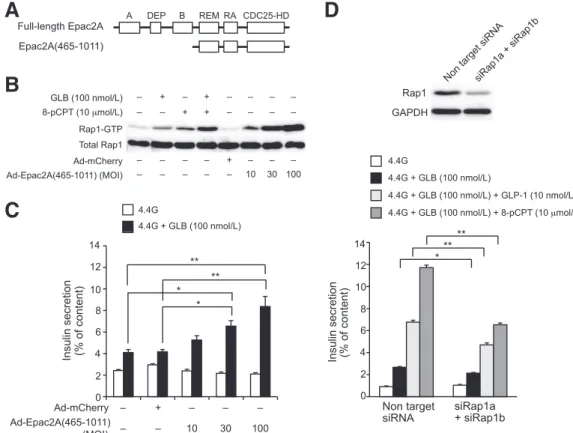
Activation of Rap1 Is Required for the Augmenting Effect of Incretin/cAMP Signaling and Glibenclamide on Insulin Secretion
To determine the role of the enhanced Rap1 activation in insulin secretion, we used Epac2A(465 –1011), a con- stitutive active mutant of Epac2A lacking both cyclic nucleotide-binding domain (cNBD) A and cNBD-B (Fig.
5A). X-ray crystallographic analysis of Epac2A revealed that the access of Rap1 to the catalytic region of Epac2A is sterically blocked by the regulatory region including two cNBDs in the absence of cAMP (24). The binding of cAMP to Epac2A induces a conformational change, releasing a catalytic region that leads to Rap1 binding and activa- tion (25,26). The catalytic region of Epac2A(465–1011) is open for the access of Rap1, thus constitutively exhibiting guanine nucleotide exchange activity toward Rap1. In the MIN6-K8 cells infected with adenovirus carrying
Epac2A(465–1011), Rap1 was strongly activated in the absence of cAMP (Fig. 5B). The infection of MIN6-K8 cells with adenovirus carrying Epac2A(465 –1011), but not full- length Epac2A, augmented glibenclamide-induced insulin secretion (Fig. 5C and Supplementary Fig. 4). The aug- menting effect of introducing Epac2A(465 –1011) on in- sulin secretion was dependent on the dose of adenovirus.
The introduction of Epac2A(465–1011) into MIN6-K8 cells also augmented glucose-induced insulin secretion sig- nificantly (Supplementary Fig. 5). In contrast, knockdown of Rap1 expression by siRNA in MIN6-K8 cells signifi- cantly reduced the augmentation by GLP-1 or 8-pCPT of glibenclamide-induced insulin secretion (Fig. 5D). These results indicate that Rap1 activation is required for the augmenting effects of incretin and sulfonylureas on in- sulin secretion.
Costimulation by Glibenclamide and GLP-1 Augments the Rise in Ca
2+Level in Primary Cultured b-Cells of Epac2A
+/+Mice, but Not Epac2A
2/2Mice
Since Epac2A/Rap1 signaling has been shown to modulate the intracellular Ca
2+level in pancreatic b-cells (27), we next examined the combinatorial effects of GLP-1 and
Figure 4—Rap1 activation is markedly enhanced by the combination of 8-pCPT with glibenclamide (GLB) or glimepiride (GLM), but not with gliclazide (GLC). A: Dose-dependent effects of 8-pCPT on the enhancement of Rap1 activation in MIN6-K8 cells. Cells were treated with each stimulus indicated for 15 min. Data are expressed as means6 SEM of four independent experiments. B: Combinatorial effects of 100 nmol/L GLB with 10, 30, or 50mmol/L 6-Bnz. Data are expressed as means 6 SEM of four independent experiments. C: Combinatorial effects of 100 nmol/L GLM with 10mmol/L 8-pCPT. Data are expressed as means 6 SEM of four independent experiments. D: Combi- natorial effects of 5mmol/L GLC with 10 mmol/L 8-pCPT. Data are expressed as means 6 SEM of four independent experiments. *P <
0.01, **P< 0.001 (Tukey-Kramer test). NS, not significant.
diabetes.diabetesjournals.org Takahashi and Associates 1267
glibenclamide on intracellular Ca
2+level in primary cul- tured b-cells from Epac2A
+/+mice and Epac2A
2/2mice. In Epac2A
+/+b-cells, costimulation by 10 nmol/L GLP-1 and 100 nmol/L glibenclamide induced a rise in Ca
2+level greater than that by stimulation with 100 nmol/L gliben- clamide alone at 4.4 mmol/L glucose (Fig. 6A and B). In contrast, in Epac2A
2/2b-cells, the augmentation of Ca
2+level by the combination of GLP-1 and glibenclamide was diminished (Fig. 6C and D). These results indicate that the intracellular Ca
2+level is involved in the augmentation of glibenclamide-induced insulin secretion by GLP-1 at 4.4 mmol/L glucose.
Combination of GLP-1 and Glimepiride Markedly Enhances Insulin Granule Exocytosis
To examine the combinatorial effects of GLP-1 and glimepiride on insulin granule dynamics, we performed TIRFM analysis (9). In the presence of 4.4 mmol/L glu- cose, glimepiride at 100 nmol/L induced insulin granule exocytosis in a biphasic manner, dynamics that are similar to those of insulin secretion by glimepiride from perfused pancreata (Fig. 7A, left, and Supplementary Movie 1). A
great number of fusion events were observed immediately after stimulation, and both the first and the second phases in insulin granule exocytosis were significantly augmented by the combination of GLP-1 and glimepiride (Fig. 7A, right, and Supplementary Movie 2). The combi- nation of GLP-1 and glimepiride increased the number of fusion events derived from granules that are newly recruited, docked, and fused to the plasma membrane by stimulation (resting newcomer) as well as granules that are newly recruited and immediately fused to the plasma membrane by stimulation (restless newcomer) (9) (Fig. 7B).
Insulin Secretory Response to Coadministration of Liraglutide and Glimepiride Is Reduced in Epac2A
2/2Mice With Diet-Induced Obesity
We next examined whether the combinatorial effect of incretin and sulfonylurea on blood glucose and insulin levels is mediated by Epac2A in vivo. Concomitant administration of liraglutide, a GLP-1 receptor agonist, and glimepiride lowered the blood glucose level by ;30%
compared with the level before administration and
Figure 5—Activation of Rap1 is required for the augmenting effect of GLP-1 or 8-pCPT and glibenclamide (GLB) on insulin secretion.
A: Domain structures of full-length Epac2A and Epac2A(465–1011). A, cNBD-A; DEP, Dishevelled, Egl-10, and Pleckstrin domain; B, cNBD-B;
REM, Ras exchange motif; RA, Ras association domain; CDC25-HD, CDC25 homology domain. B: Rap1 activation in noninfected MIN6-K8 cells or MIN6-K8 cells infected with adenovirus carrying mCherry or Epac2A(465–1011) at a multiplicity of infection (MOI) of 10, 30, or 100.
C: Insulin secretion from noninfected MIN6-K8 cells or MIN6-K8 cells infected with adenovirus carrying mCherry or Epac2A(465–1011) at an MOI of 10, 30, or 100. Data are expressed as means6 SEM (n = 4 for each group). *P < 0.05, **P < 0.01 (Tukey-Kramer test). D: Effects of Rap1 knockdown on insulin secretion from MIN6-K8 cells. Top: Efficiency of knockdown was confirmed by immunoblot analysis. Bottom:
Insulin secretion from MIN6-K8 cells transfected with nontarget siRNA or siRNA for Rap1a and Rap1b. Data are expressed as means6 SEM (n = 4 for each group). *P< 0.005, **P < 0.001 (Tukey-Kramer test).
induced insulin secretion in Epac2A
+/+mice (Supplemen- tary Fig. 6). In Epac2A
2/2mice, although the blood glu- cose level was lowered to almost the same extent as that of Epac2A
+/+mice by administration of the drugs, the insulin secretory response tended to be reduced. It has recently been reported (28) that the insulin secretory re- sponse to intraperitoneal glucose load was impaired in Epac2A
2/2mice with diet-induced obesity. We therefore examined the combinatorial effect of liraglutide and glimepiride on the mice that were fed an HFD. The blood glucose levels in Epac2A
2/2mice were higher than those in Epac2A
+/+mice during the experiment (Fig. 8A, left). Al- though the fasting serum insulin level of Epac2A
2/2mice was higher than that of Epac2A
+/+mice, the combinatorial effect on the insulin secretory response was almost com- pletely abolished in Epac2A
2/2mice (Fig. 8A, right). We then examined the combinatorial effect of liraglutide and glimepiride on blood glucose levels and insulin levels after oral glucose loading. Epac2A
2/2mice exhibited higher blood glucose levels and reduced insulin response com- pared with Epac2A
+/+mice (Fig. 8B). These results indicate that the glucose-lowering effect of the combination of liraglutide and glimepiride is diminished in Epac2A
2/2mice. Thus, Epac2A plays a critical role in insulin secretion
induced by the combination of incretin and sulfonylurea, especially in a model of diet-induced obesity.
DISCUSSION
We have previously shown that Epac2A is a target of both incretin/cAMP signaling and sulfonylurea in insulin secretion (5,6,15). The current study shows that incretin and the sulfonylureas glibenclamide and glimepiride syn- ergistically stimulate insulin secretion at a basal level of glucose concentration (4.4 mmol/L) through Epac2A/
Rap1 signaling. Our data also indicate that the synergistic effect of GLP-1 and gliclazide is rather mild and is not mediated by Epac2A/Rap1 signaling. These results are supported by our recent findings that cAMP and sulfonyl- urea (except for gliclazide) cooperatively activate Epac2A (16). Gliclazide is unique among sulfonylureas in that its effect is not influenced by Epac2A/Rap1 signaling. The differences in the action of various sulfonylureas on Epac2A may well account for the differences in the com- binatorial effects of incretin and sulfonylureas.
Epac2A is known to regulate various cellular functions through the activation of Rap1 (29–31). In pancreatic b-cells, Rap1 mediates Epac2A-dependent amplification of insulin secretion (9). Rap1 has recently been shown
Figure 6—Costimulation of glibenclamide (GLB) and GLP-1 augments the rise in Ca2+level in primary culturedb-cells of Epac2A+/+mice, but not Epac2A2/2mice. Change in intracellular Ca2+concentration induced by 100 nmol/L GLB alone (blue line) and the combination of 100 nmol/L GLB and 10 nmol/L GLP-1 (red line) at 4.4 mmol/L glucose in primary culturedb-cells from Epac2A+/+(A) and Epac2A2/2(C) mice. Gray line indicates change in Ca2+concentration induced by 30 mmol/L KCl in Epac2A+/+b-cells. Traces are mean values for the indicated number ofb-cells. Data are expressed as the change in the ratio (DR) of the fluorescence emission at 440/480 nm, normalized to the ratio at 0 s (R0) for the same cell. Comparison of the AUC for the 10-min period after stimulation in Epac2A+/+(B) and Epac2A2/2(D) b-cells. Data are expressed as means 6 SEM. *P < 0.05 (Tukey-Kramer test). NS, not significant.
diabetes.diabetesjournals.org Takahashi and Associates 1269
to mediate the potentiation of insulin secretion through activation of phospholipase C-e. Phospholipase C-e acti- vated by Rap1 possibly potentiates insulin secretion by promoting Ca
2+-induced Ca
2+release through the produc- tion of inositol triphosphate (32,33). Costimulation by sulfonylurea and cAMP has been found to induce a larger change in intracellular Ca
2+level than stimulation by sul- fonylurea alone (34–36). On the contrary, a recent study (37) has shown that intracellular Ca
2+level is not a factor in the potentiation of tolbutamide-induced insulin secre- tion by an Epac-selective cAMP analog, 8-pCPT, in mouse pancreatic islets. However, our study of Epac2A
2/2mice indicates that the intracellular Ca
2+is involved in the potentiation of insulin secretion by the combination of GLP-1 and glibenclamide (Fig. 6). The reason for the dis- crepancy between the recent study (37) and our present study is not clear at present, but might be due to the differences in the experimental conditions used. Since GLP-1 was reported to facilitate the inhibitory action of sulfonylurea at the K
ATPchannels (34), Epac2A/Rap1 sig- naling may also contribute to promoting Ca
2+influx.
Interactions of the K
ATPchannel, Epac2A, Rim2a, and
VDCC (38) also support this notion. It is possible that mechanisms other than the regulation of intracellular Ca
2+are also involved. We found by TIRFM analysis that costimulation by GLP-1 and sulfonylurea increased the number of fusion events derived from resting new- comer as well as restless newcomer, indicating that cAMP and sulfonylurea cooperatively promote the fusion of granules docked to the plasma membrane in addition to promoting the recruitment of granules from the cell in- terior to the plasma membrane. We have shown that the interaction of Epac2A and Rim2 a is required for the po- tentiation by Epac-selective cAMP analog of glucose- induced insulin secretion (39). Rim2 a is involved in the priming and docking to the plasma membrane of the in- sulin granule through interaction with Munc13–1 and Rab3A. The enhanced activation of Epac2A/Rap1 signal- ing may thus affect the docking and priming states of the insulin granules through interaction with Rim2a, which leads to an increase in the number of fusion events de- rived from resting newcomer and old face.
Epac2A has been found to be required for insulin secretion in response to the GLP-1 receptor agonist
Figure 7—Combination of GLP-1 and glimepiride markedly enhances insulin granule exocytosis. A: Histogram of fusion events at 30 s intervals in primary cultured pancreaticb-cells. Cells were stimulated with 100 nmol/L glimepiride alone (left) and a combination of 100 nmol/L glimepiride and 10 nmol/L GLP-1 (right) at 30 s (see Supplementary Movie 1 [100 nmol/L glimepiride] and Supplementary Movie 2 [100 nmol/L glimepiride and 10 nmol/L GLP-1]). Old face (blue), granules that are predocked to the plasma membrane and fused to the membrane by stimulation; Restless newcomer (red), granules that are newly recruited and immediately fused to the plasma membrane by stimulation; Resting newcomer (green), granules that are newly recruited, docked, and fused to the plasma membrane by stimulation. See also Shibasaki et al. (9) for details. B: Distribution of three modes of fusion events induced by 100 nmol/L glimepiride alone (open columns) and the combination of 100 nmol/L glimepiride and 10 nmol/L GLP-1 (closed columns). Data are expressed as means6 SEM of four to five independent experiments (n = 1–4 cells for each experiment). *P < 0.05 (Student unpaired t test).
exendin-4 in vivo, indicating that Epac2A signaling is important for the blood glucose–lowering effects of incretin-related drugs (28). It has been reported (17,18) that combination therapies of DPP-4 inhibitors and sulfonylureas are often used for glycemic control in type 2 diabetes, but cause hypoglycemia in some cases. The incidence rate of hypoglycemia for DPP-4 inhibitors com- bined with gliclazide is lower than that for combination with glibenclamide or glimepiride (19). Our findings show that Epac2A/Rap1 signaling participates in the hyperse- cretion of insulin observed with combination therapies and suggest a mechanism for the sulfonylurea-dependent difference in the incidence rate of hypoglycemia.
In conclusion, we demonstrate the critical role of Epac2A/Rap1 signaling in the augmenting effect of incretins and sulfonylureas in insulin secretion, and we also find that such augmentation depends on the structures of the sulfonylureas. Our findings thus provide the basis for the effects of the combination therapies of incretin-related drugs and sulfonylureas in the treatment of type 2 diabetes.
Acknowledgments.
The authors thank K. Minami and N. Yokoi (Kobe University Graduate School of Medicine) for helpful discussions and C. Seki (Kobe University Graduate School of Medicine) for technical assistance.Funding.
This work was supported by a CREST grant from the Japan Science and Technology Agency, and a Grant-in-Aid for Scientific Research from the Ministry of Education, Culture, Sports, Science and Technology, Japan. This study was also partly supported by research funding from the Japan Diabetes Foun- dation. D.-K.S. has received a grant from the Korean government (No.NRF-2013R1A2A2A01068220). S.S. has received research grants from MSD K.K., Novo Nordisk Pharma, Sumitomo Dainippon Pharma, and Takeda Pharma- ceutical Company.
Duality of Interest.
No potential conflicts of interest relevant to this article were reported.Author Contributions.
H.T. designed the study, researched the data, and wrote, reviewed, and edited the manuscript. T.S. researched the data, contributed to the discussion, and wrote, reviewed, and edited the manuscript.J.-H.P. and D.-K.S. performed the high-fat–diet study and contributed to the discussion. S.H. and A.O. researched the data. T.T. researched the data and contributed to the discussion. S.S. contributed to the study design and the discussion and wrote, reviewed, and edited the manuscript. S.S. is the guar- antor of this work and, as such, had full access to all the data in the study and takes responsibility for the integrity of the data and the accuracy of the data analysis.
References
1. Drucker DJ. The biology of incretin hormones. Cell Metab 2006;3:153–165 2. Gheni G, Ogura M, Iwasaki M, et al. Glutamate acts as a key signal linking glucose metabolism to incretin/cAMP action to amplify insulin secretion.
Cell Reports 2014;9:661–673
3. Drucker DJ, Nauck MA. The incretin system: glucagon-like peptide-1 receptor agonists and dipeptidyl peptidase-4 inhibitors in type 2 diabetes. Lancet 2006;368:1696–1705
Figure 8—Insulin secretory response to coadministration of liraglutide and glimepiride is reduced in Epac2A2/2mice with diet-induced obesity. A: Effects of concomitant administration of liraglutide and glimepiride on blood glucose levels (left) and serum insulin levels (right) in Epac2A+/+mice (left, open circles; right, open columns) and Epac2A2/2mice (left, closed circles; right closed columns) fed an HFD.
Liraglutide (300mg/kg) and glimepiride (1 mg/kg) were administered at 0 min. B: Changes in blood glucose levels (left) and serum insulin levels (right) after oral glucose load following the concomitant administration of liraglutide and glimepiride in Epac2A+/+mice (left, open circles; right, open columns) and Epac2A2/2mice (left, closed circles; right, closed columns) fed an HFD. Liraglutide (300mg/kg) and glimepiride (1 mg/kg) were administered at215 min, and glucose (1.5 g/kg) was administered at 0 min. Data are expressed as means 6 SEM (n = 5 for each group). *P< 0.05, **P < 0.01 (Student unpaired t test).
diabetes.diabetesjournals.org Takahashi and Associates 1271
4. Renström E, Eliasson L, Rorsman P. Protein kinase A-dependent and -independent stimulation of exocytosis by cAMP in mouse pancreatic B-cells.
J Physiol 1997;502:105–118
5. Ozaki N, Shibasaki T, Kashima Y, et al. cAMP-GEFII is a direct target of cAMP in regulated exocytosis. Nat Cell Biol 2000;2:805–811
6. Kashima Y, Miki T, Shibasaki T, et al. Critical role of cAMP-GEFII—Rim2 complex in incretin-potentiated insulin secretion. J Biol Chem 2001;276:46046– 46053
7. Niimura M, Miki T, Shibasaki T, Fujimoto W, Iwanaga T, Seino S. Critical role of the N-terminal cyclic AMP-binding domain of Epac2 in its subcellular localization and function. J Cell Physiol 2009;219:652–658
8. Ueno H, Shibasaki T, Iwanaga T, et al. Characterization of the gene EPAC2: structure, chromosomal localization, tissue expression, and identification of the liver-specific isoform. Genomics 2001;78:91–98
9. Shibasaki T, Takahashi H, Miki T, et al. Essential role of Epac2/Rap1 signaling in regulation of insulin granule dynamics by cAMP. Proc Natl Acad Sci U S A 2007;104:19333–19338
10. Seino S, Takahashi H, Fujimoto W, Shibasaki T. Roles of cAMP signalling in insulin granule exocytosis. Diabetes Obes Metab 2009;11(Suppl. 4):180–188 11. Seino S, Shibasaki T, Minami K. Dynamics of insulin secretion and the clinical implications for obesity and diabetes. J Clin Invest 2011;121:2118– 2125
12. Seino S. ATP-sensitive potassium channels: a model of heteromultimeric potassium channel/receptor assemblies. Annu Rev Physiol 1999;61:337–362 13. Henquin JC. Triggering and amplifying pathways of regulation of insulin secretion by glucose. Diabetes 2000;49:1751–1760
14. Ashcroft FM, Rorsman P. K(ATP) channels and islet hormone secretion: new insights and controversies. Nat Rev Endocrinol 2013;9:660–669
15. Zhang CL, Katoh M, Shibasaki T, et al. The cAMP sensor Epac2 is a direct target of antidiabetic sulfonylurea drugs. Science 2009;325:607–610 16. Takahashi T, Shibasaki T, Takahashi H, et al. Antidiabetic sulfonylureas and cAMP cooperatively activate Epac2A. Sci Signal 2013;6:ra94
17. Marre M, Shaw J, Brändle M, et al.; LEAD-1 SU study group. Liraglutide, a once-daily human GLP-1 analogue, added to a sulphonylurea over 26 weeks produces greater improvements in glycaemic and weight control compared with adding rosiglitazone or placebo in subjects with Type 2 diabetes (LEAD-1 SU).
Diabet Med 2009;26:268–278
18. Kubota A, Maeda H, Kanamori A, et al. Efficacy and safety of sitagliptin monotherapy and combination therapy in Japanese type 2 diabetes patients. J Diabetes Investig 2012;3:503–509
19. Yabe D, Seino Y. Dipeptidyl peptidase-4 inhibitors and sulfonylureas for type 2 diabetes: friend or foe? J Diabetes Investig 2014;5:475–477
20. Gutniak MK, Juntti-Berggren L, Hellström PM, Guenifi A, Holst JJ, Efendic S. Glucagon-like peptide I enhances the insulinotropic effect of glibenclamide in NIDDM patients and in the perfused rat pancreas. Diabetes Care 1996;19:857–863
21. Aaboe K, Knop FK, Vilsboll T, et al. KATPchannel closure ameliorates the impaired insulinotropic effect of glucose-dependent insulinotropic polypeptide in patients with type 2 diabetes. J Clin Endocrinol Metab 2009;94:603–608 22. Miki T, Minami K, Shinozaki H, et al. Distinct effects of glucose- dependent insulinotropic polypeptide and glucagon-like peptide-1 on insulin secretion and gut motility. Diabetes 2005;54:1056–1063
23. Iwasaki M, Minami K, Shibasaki T, Miki T, Miyazaki J, Seino S. Estab- lishment of new clonal pancreaticb-cell lines (MIN6-K) useful for study of incretin/
cyclic adenosine monophosphate signaling. J Diabetes Investig 2010;1:137–142 24. Rehmann H, Das J, Knipscheer P, Wittinghofer A, Bos JL. Structure of the cyclic-AMP-responsive exchange factor Epac2 in its auto-inhibited state.
Nature 2006;439:625–628
25. Rehmann H, Arias-Palomo E, Hadders MA, Schwede F, Llorca O, Bos JL.
Structure of Epac2 in complex with a cyclic AMP analogue and RAP1B. Nature 2008;455:124–127
26. Li S, Tsalkova T, White MA, et al. Mechanism of intracellular cAMP sensor Epac2 activation: cAMP-induced conformational changes identified by amide hydrogen/deuterium exchange mass spectrometry (DXMS). J Biol Chem 2011;286:17889–17897
27. Kang G, Joseph JW, Chepurny OG, et al. Epac-selective cAMP analog 8-pCPT-29-O-Me-cAMP as a stimulus for Ca2+-induced Ca2+release and exo- cytosis in pancreatic beta-cells. J Biol Chem 2003;278:8279–8285
28. Song WJ, Mondal P, Li Y, Lee SE, Hussain MA. Pancreaticb-cell re- sponse to increased metabolic demand and to pharmacologic secretagogues requires EPAC2A. Diabetes 2013;62:2796–2807
29. de Rooij J, Rehmann H, van Triest M, Cool RH, Wittinghofer A, Bos JL.
Mechanism of regulation of the Epac family of cAMP-dependent RapGEFs. J Biol Chem 2000;275:20829–20836
30. Kawasaki H, Springett GM, Mochizuki N, et al. A family of cAMP-binding proteins that directly activate Rap1. Science 1998;282:2275–2279
31. Gloerich M, Bos JL. Epac: defining a new mechanism for cAMP action.
Annu Rev Pharmacol Toxicol 2010;50:355–375
32. Dzhura I, Chepurny OG, Kelley GG, et al. Epac2-dependent mobilization of intracellular Ca²+ by glucagon-like peptide-1 receptor agonist exendin-4 is disrupted inb-cells of phospholipase C-e knockout mice. J Physiol 2010;588:
4871–4889
33. Dzhura I, Chepurny OG, Leech CA, et al. Phospholipase C-e links Epac2 activation to the potentiation of glucose-stimulated insulin secretion from mouse islets of Langerhans. Islets 2011;3:121–128
34. Leech CA, Dzhura I, Chepurny OG, Schwede F, Genieser HG, Holz GG.
Facilitation of ß-cell K(ATP) channel sulfonylurea sensitivity by a cAMP analog selective for the cAMP-regulated guanine nucleotide exchange factor Epac. Islets 2010;2:72–81
35. Yaekura K, Kakei M, Yada T. cAMP-signaling pathway acts in selective synergism with glucose or tolbutamide to increase cytosolic Ca2+in rat pan- creaticb-cells. Diabetes 1996;45:295–301
36. Jarrard RE, Wang Y, Salyer AE, et al. Potentiation of sulfonylurea action by an EPAC-selective cAMP analog in INS-1 cells: comparison of tolbutamide and gliclazide and a potential role for EPAC activation of a 2-APB-sensitive Ca2+
influx. Mol Pharmacol 2013;83:191–205
37. Henquin JC, Nenquin M. Activators of PKA and Epac distinctly influence insulin secretion and cytosolic Ca2+in female mouse islets stimulated by glucose and tolbutamide. Endocrinology 2014;155:3274–3287
38. Shibasaki T, Sunaga Y, Fujimoto K, Kashima Y, Seino S. Interaction of ATP sensor, cAMP sensor, Ca2+sensor, and voltage-dependent Ca2+channel in insulin granule exocytosis. J Biol Chem 2004;279:7956–7961
39. Yasuda T, Shibasaki T, Minami K, et al. Rim2a determines docking and priming states in insulin granule exocytosis. Cell Metab 2010;12:117–129