Anti-inflammatory and Anti-allergic Effects of Phlorofucofuroeckol A and Dieckol Isolated from Ecklonia cava
Seung-Su Lee1, Myun-Ho Bang1, Hyeong-Ju Jeon2, Taekyoo Hwang3 and Seun-Ah Yang4*
1Skin Biotechnology Center, Kyung Hee University, Suwon, Gyeonggi 16229, Korea
2Department of Food & Nutrition, Jangan University, Hwaseong, Gyeonggi 18331, Korea
3Department of Hotel & Aviation Tourism Management, Woosuk University, Jeollabuk-do 55338, Korea
4Department of Food Science and Technology, Keimyung University, Daegu 42601, Korea Received August 8, 2018 /Revised October 9, 2018 /Accepted October 11, 2018
The anti-inflammatory effect of brown alga Ecklonia cava is well known, and several phlorotannins have also been reported. In this study, major active components for anti-allergy and anti-inflammation were identified by NMR and MS analysis, and the levels of effectiveness were compared. Six major phlorotannins—phloroglucinol, eckol, eckstolonol, triphlorethol-A, phlorofucofuroeckol A, and dieckol
—were isolated from the ethyl acetate fraction of E. cava. In order to analyze the major active sub- stances in E. cava, antioxidant, anti-inflammatory, and anti-allergic effects were evaluated for the six separate substances. Antioxidant capacities of each phlorotannin were evaluated using the 1,1-di- phenyl-2-picrylhydrazyl (DPPH) and 2,2'-azino-bis(3-ethylbenzothiazoline-6-sulphonic acid) (ABTS) rad- icals, where phlorofucofuroeckol A and triphlorethol-A had the highest radical scavenging capacity in respective radical scavenging assays. Phlorofucofuroeckol A exhibited the highest inhibition of nitric oxide production in LPS-stimulated RAW 264.7 cells among phlorotannins tested. Dieckol inhibited the release of β-hexosaminidase, a marker for the release of histamine in mast cells, in a dose-depend- ent manner in antigen-stimulated RBL-2H3 mast cells. Additionally, no cytotoxicities were observed at 1 and 2 μg/ml in both phlorofucofuroeckol A and dieckol. These results suggest that phlorofucofur- oeckol A and dieckol may play a key role in allergic inflammatory reactions.
Key words : β-Hexosaminidase release, dieckol, NO production, phlorofucofuroeckol A, phlorotannins
*Corresponding author
*Tel : +82-53-580-5117, Fax : +82-53-580-5372
*E-mail : [email protected]
This is an Open-Access article distributed under the terms of the Creative Commons Attribution Non-Commercial License (http://creativecommons.org/licenses/by-nc/3.0) which permits unrestricted non-commercial use, distribution, and reproduction in any medium, provided the original work is properly cited.
Journal of Life Science 2018 Vol. 28. No. 10. 1170~1178 DOI : https://doi.org/10.5352/JLS.2018.28.10.1170
Introduction
Seaweeds traditionally include macroscopic, multicellular marine red, green, and brown algae. Ecklonia cava, a brown alga (Alariaceae), is widely distributed on the southern coast of Korea. Marine algae are widely used as a source of bio- active compounds with diversely structural forms. E. cava has also been reported to have many biological activities in- cluding anti-diabetes [12], antioxidation [1], neuroprotection [13], anti-inflammation [14], anti-plasmin activity [8], acetyl cholinesterase inhibitory activity [28, 37], tyrosinase in- hibitory activity [10], anti-cancer [18], anti-HIV [4], and hyp- notic effect [6].
Among the phlorotannins isolated from E. cava, dieckol
and phlorofucofuroeckol A were identified as major active compounds [16, 37]. Dieckol isolated from E. cava was found to have a neuroprotective effect through inhibition of ex- pression of cycloxygenase-2 and inducible nitric oxide syn- thase in lipopolysaccharide-stimulated murine BV2 micro- glial cells [11], as well as inhibited expression of matrix met- alloproteinase-2 (MMP-2) and MMP-9 in human fibrosarco- ma HT1080 cells [38]. In addition, dieckol exhibited in- hibitory effects against elastase and hyaluronidase activity [3]. On the other hand, fucodiphloroethol G and phlor- ofucofuroeckol A were identified as active compounds re- lated to the inhibition of histamine release in human baso- philic leukemia KU812 and rat basophilic leukemia RBL-2H3 cells [19].
The anti-inflammatory effects of phlorotannins from E.
storonifera, Eisenia arborea, Ei. bicyclis, and Ishige okamura have recently been reported. However, most studies have been progressed by the extracts of E. cava. Thus, research is still needed to investigate which phlorotannins from E. cava has strong effects on anti-inflammatory and anti-allergic activ- ities. The objectives of the present study were to isolate and
identify major phlorotannins of E. cava, to evaluate the levels of antioxidant capacity of each phlorotannins, and ultimately to investigate whether major phlorotannins showed the an- ti-inflammatory and anti-allergic effects.
Materials and Methods
Samples
E. cava was collected in July, 2011 in Jeju, Korea and iden- tified by Dae-Keun Kim, College of Pharmacy, Woosuk University, Jeonju, Korea. A voucher specimen (KHU 0111107) was deposited at the Laboratory of Natural Products Chemistry, Kyung Hee University, Yongin, Korea.
Extraction of Ecklonia cava and isolation of phlor- otannins by MPLC and preparative HPLC
The dried powder (10 kg) was extracted with 80% (v/v) aqueous methanol (MeOH) (3 l ×3). The phenolic extracts were partitioned using EtOAc (3 l ×3), n-buthanol (BuOH) (3 l ×3) and water (3 l). The EtOAc fraction (120 g) was com- bined and chromatographed on a MPLC column: Chroma- torex-PRC (PRC-S150×2). The fractions were analyzed using an UV detector at 254 nm. The mobile phases consisted of solvent A (MeOH) and solvent B (CHCl3). The flow rate was kept at 15 ml/min. The gradient consisted of 90% B held for 400 min to 80% B at a rate of 0.25%/min, from 80% B to 70% B at a rate of 0.01%/min, from 70% B to 0% B at a rate of 0.25%/min. A total of 15 sub-fractions (ECE-1 to ECE-15) were collected. Fraction ECE-9 (800 mg) was sub- jected to a Sephadex LH-20 and eluted with absolute MeOH to give seven fractions (ECE-9-1 to ECE-9-7) and to yield compound 1 (45 mg, Ve/Vt 0.10-0.15, TLC (RP-18 F254S) Rf
0.65, MeOH-H2O = 1:2). ECE-10 (321 mg) was proceeded by preparative HPLC column: Kromasil 100-10 C18 (21.2 mm×
250 mm; particle size 10 μm), using A: H2O, and B: acetoni- trile as mobile phases at a flow rate of 20 ml/min. The de- tector was set at 254 nm The gradient consisted of 95% A to 75% A at a rate of 1.0%/min held for 10 min, from 75%
A to 60% A at a rate of 0.6%/min held for 5 min, and from 60% A to 0% A at a rate of 4%/min held for 15 min.
Compound 2 (48 mg, RT = 30.07 min) and compound 3 (52 mg, RT = 36.43 min) were obtained. And ECE-11 (1 g×9) was proceeded by preparative HPLC column: Kromasil 100-10 C18 (21.2 mm×250 mm; particle size 10 μm), using A: H2O, and B: acetonitrile as mobile phases at a flow rate of 20 ml/min. and the detector was maintained at 254 nm.
The gradient consisted of 100% A to 85% A at a rate of 0.5%/min, from 85% A to 60% A at a rate of 0.6%/min.
Compound 4 (20 mg, RT = 7.81 min), compound 5 (110 mg, RT = 36.9 min), and compound 6 (30 mg, RT = 44.2 min) were obtained.
General experimental procedures
MPLC (TELEDYNE Isco Inc, Lincoln, NE, USA) and prep- arative HPLC (Waters, MA, USA) were used for separation.
TLC analysis was performed using Kiesel gel 60 F254 and RP-18 F254S (Merck, Darmstradt, Germany) resins and de- tected using a UV lamp Spectroline Model ENF-240 C/F (Spectronics Corporation, New York, NY, USA) and 10%
H2SO4 solution. FAB-MS was recorded on a JEOL JMSAX- 700 (Tokyo, Japan). 1H-NMR (400 MHz) and 13C-NMR (100 MHz) spectra were recorded on a Varian Unity Inova AS-400 FT-NMR spectrometer (Palo Alto, CA, USA).
Determination of antioxidant capacities
The antioxidant capacity was measured using two radical chromogens, 2,2'-azino-bis(3-ethylbenzothiazoline-6-sulphonic acid) (ABTS) and 1,1-diphenyl-2-picrylhydrazyl (DPPH) rad- icals [20]. Antioxidant capacity of each phlorotannin was ex- pressed as mg vitamin C equivalents (VCE)/mg. Butylated hydroxyanisole (BHA) was used as a positive control [32].
Cell culture
RAW 264.7 cells, a murine macrophage cell line, and RBL-2H3 cells, a rat basophilic leukemia cell line, were pur- chased from the Korean Cell Line Bank (KCLB, Seoul, Korea). RAW 264.7 cells were cultured in DMEM (Gibco- BRL, Rockville, MD, USA) containing 1% antibiotics (penicillin/
streptomycin) and 10% heat-inactivated fetal bovine serum (FBS, Gibco BRL). RBL-2H3 cells were grown in MEM (Gibco BRL) with 10% FBS and 1% penicillin/streptomycin. Both cell lines were grown in a 37℃ humidified incubator with 5% CO2 in air.
Cell viability assay
To determine the cytotoxicity of the phlorotannins, cell viability was determined using the MTT assay,in which ac- tive mitochondria reduce MTT into formazan dye. RAW 264.7 and RBL-2H3 cells were seeded at a density of 1×10⁵ cells/well and 3×10⁴ cells/well in 96-well microplates, re- spectively, and then incubated for 24 hr. Both cells were treated with various concentrations (0-10 μg/ml) of phlor-
Fig. 1. Chemical structures of phlorotannins isolated from Ecklonia cava. (1) phloroglucinol, (2) eckol, (3) eckstolonol, (4) triphlor- ethol-A, (5) phlorofucofuroeckol A, (6) dieckol.
otannins at 37℃. After 48 hr, 100 μl of MTT (5 mg/ml) was added to each well, and plates were incubated at 37℃ for 4 hr. One hundred microliters of DMSO were added to each well to dissolve formazan. The absorbance was measured at 550 nm using a multiwell spectrophotometer (Molecular Devices, Sunnyvale, CA, USA). Cytotoxicity of each phlor- otannins in IgE-sensitized RBL-2H3 cells was also assessed using the MTT assay. The cells (3×10⁴ cells/well) were seed-
ed and incubated with 450 ng/ml DNP-specific IgE at 37℃
overnight before treatment with phlorotannins.
Determination of lipopolysaccharide (LPS)-induced NO production from RAW 264.7 cells
RAW 264.7 cells were seeded in 96-well plates (1×10⁵ cells/well) overnight and treated with various concen- trations of samples dissolved in 0.1% DMSO in the presence
of LPS (final concentration, 100 ng/ml) at 37℃ for 24 hr.
After LPS stimulation for 24 hr, NO production in the cell culture medium was measured using the Griess Reagent System. Briefly, the culture supernatant (100 μl) was mixed with the same volume of Griess reagent (1% sulfanilamide and 0.1% naphtylethylendiamine in 2.5% phosphoric acid) for 10 min, and absorbance was measured at 540 nm. The NO concentration was calculated from a standard curve of NaNO2. N-nitro-l-arginine-methyl ester (L-NAME) was used as iNOS inhibitor at a concentration of 250 μM [29].
Determination of antigen-induced release of β- hexosaminidase from RBL-2H3 cells
The inhibitory effect of the extract on release of β-hexosa- minidase in RBL-2H3 cells was evaluated as reported by Matsuda et al. [24] with modifications. In brief, RBL-2H3 cells seeded in 24-well plates (2×10⁵ cells/well) were sensi- tized with anti-DNP IgE (450 ng/ml) at 37℃ overnight. The cells were washed with Siraganian buffer followed by in- cubation in 160 μl of incubation buffer at 37℃ for 20 min.
The cells were then treated with 20 μl of extract for 10 min, followed by addition of 20 μl of antigen (DNP-BSA, 10 μg/
ml) at 37℃ for 10 min in order to stimulate the cells for granulation. The reaction was stopped by cooling in an ice bath for 10 min. Twenty-five microliters of the supernatant were transferred into a 96-well plate and incubated with 25 μl of substrate (1 mM p-nitrophenyl-N-acetyl-β-D-glucosami- nide) in 0.1 M citrate buffer (pH 4.5) at 37℃ for 1 hr. The reaction was stopped by addition of 200 μl of stop solution (0.1 M Na2CO3/NaHCO3, pH 10.0), and absorbance was measured at 405 nm using a microplate reader. The extract was dissolved in 0.1% DMSO and added to incubation buffer. Wortmannin was used as a positive control at a con- centration of 500 nM [17].
Statistical analysis
All experiments were performed three to five times. Data are expressed as the means ± standard deviation (SD). One way ANOVA test (using SPSS 20 statistical software) was used to compare the mean values of each treatment.
Significant differences were verified by Duncan’s multiple range tests (p<0.05).
Results and Discussion
Isolation and identification of Phlorotannins The dried powder of Ecklonia cava was extracted in 80%
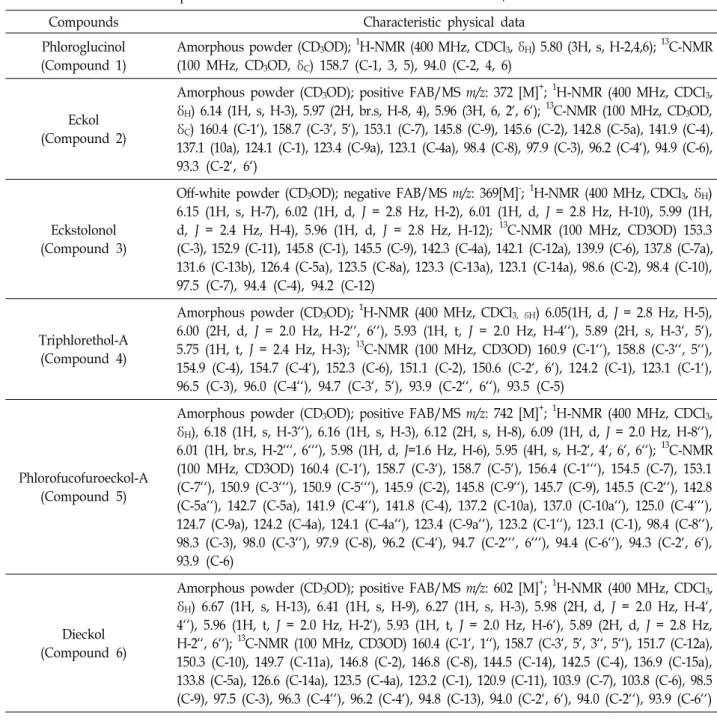
MeOH, and concentrated extracts were successively parti- tioned using EtOAc, n-BuOH, and H2O. The EtOAc fraction was proceeded by preparative HPLC and MPLC system equipped with ODS column, six phlorotannins were purified. Six phenolic compounds isolated from E. cava were phloroglucinol (compound 1), eckol (compound 2), eck- stolonol (compound 3), triphlorethol-A (compound 4), phlor- ofucofuroeckol A (compound 5), and dieckol (compound 6) based on interpretation of the spectroscopic data, including NMR, FAB/MS, IR, and were confirmed by comparison of the data with those reported in the literatures [22, 27] as shown in Table 1.
Antioxidant capacities of six phlorotannins
Antioxidant capacities of phlorotannins measured by two different assays using ABTS and DPPH radical chromogens found in E. cava are shown in Table 2. In weight basis of six phenolic compounds, their antioxidant capacities in DPPH assay were in decreasing order as follows: phlor- ofucofuroeckol A > phloroglucinol > eckstolonol > dieckol
> triphlorethol-A > eckol. Phlorofucofuroeckol A exhibited approximately 1.3 time higher antioxidant capacity than eck- ol in the DPPH assay. As in ABTS assay, antioxidant capaci- ties of these phlorotannins were in decreasing order as fol- lows: triphlorethol-A > phlorofucofuroeckol A > dieckol >
eckstolonol > eckol > phloroglucinol. Triphlorethol-A had about 1.4 time higher antioxidant capacity than phlorogluci- nol. Previously, antioxidant capacity (in 50% effective con- centration) of phlorotannins measured by the DPPH assay was in decreasing order as follows: phlorofucofuroeckol A
> dieckol > eckol, whereas in superoxide anion scavenging activities, three phlorotannins ranked as: dieckol > phlor- ofucofuroeckol A > eckol [31]. The different ranking of anti- oxidant capacities of phlorotannins may be attributed to dif- ferent radicals used and reaction mechanisms [36].
Inhibitory effects of phlorotannins from E. cava on NO production in LPS-treated RAW 264.7 cells To evaluate the anti-inflammatory effects of the six major phlorotannins from E. cava, NO production and cytotoxicity were measured in untreated and LPS-treated RAW 264.7 cells. As shown in Fig. 2, phloroglucinol, eckol, phlorofuco- furoeckol A, and dieckol at the concentrations of 1 and 2 μg/ml inhibited NO production without affecting cell viability. In particular, phlorofucofuroeckol A at 1 and 2 μg/
ml markedly suppressed the NO production with approx-
Table 1. Identification of six phlorotannins in Ecklonia cava and data from FAB-MS, 1H-NMR and 13C-NMR
Compounds Characteristic physical data
Phloroglucinol (Compound 1)
Amorphous powder (CD3OD); 1H-NMR (400 MHz, CDCl3, δH) 5.80 (3H, s, H-2,4,6); 13C-NMR (100 MHz, CD3OD, δC) 158.7 (C-1, 3, 5), 94.0 (C-2, 4, 6)
Eckol (Compound 2)
Amorphous powder (CD3OD); positive FAB/MS m/z: 372 [M]+; 1H-NMR (400 MHz, CDCl3, δH) 6.14 (1H, s, H-3), 5.97 (2H, br.s, H-8, 4), 5.96 (3H, 6, 2‘, 6‘); 13C-NMR (100 MHz, CD3OD, δC) 160.4 (C-1‘), 158.7 (C-3‘, 5‘), 153.1 (C-7), 145.8 (C-9), 145.6 (C-2), 142.8 (C-5a), 141.9 (C-4), 137.1 (10a), 124.1 (C-1), 123.4 (C-9a), 123.1 (C-4a), 98.4 (C-8), 97.9 (C-3), 96.2 (C-4‘), 94.9 (C-6), 93.3 (C-2‘, 6‘)
Eckstolonol (Compound 3)
Off-white powder (CD3OD); negative FAB/MS m/z: 369[M]-; 1H-NMR (400 MHz, CDCl3, δH) 6.15 (1H, s, H-7), 6.02 (1H, d, J = 2.8 Hz, H-2), 6.01 (1H, d, J = 2.8 Hz, H-10), 5.99 (1H, d, J = 2.4 Hz, H-4), 5.96 (1H, d, J = 2.8 Hz, H-12); 13C-NMR (100 MHz, CD3OD) 153.3 (C-3), 152.9 (C-11), 145.8 (C-1), 145.5 (C-9), 142.3 (C-4a), 142.1 (C-12a), 139.9 (C-6), 137.8 (C-7a), 131.6 (C-13b), 126.4 (C-5a), 123.5 (C-8a), 123.3 (C-13a), 123.1 (C-14a), 98.6 (C-2), 98.4 (C-10), 97.5 (C-7), 94.4 (C-4), 94.2 (C-12)
Triphlorethol-A (Compound 4)
Amorphous powder (CD3OD); 1H-NMR (400 MHz, CDCl3, δH) 6.05(1H, d, J = 2.8 Hz, H-5), 6.00 (2H, d, J = 2.0 Hz, H-2‘‘, 6‘‘), 5.93 (1H, t, J = 2.0 Hz, H-4‘‘), 5.89 (2H, s, H-3‘, 5‘), 5.75 (1H, t, J = 2.4 Hz, H-3); 13C-NMR (100 MHz, CD3OD) 160.9 (C-1‘‘), 158.8 (C-3‘‘, 5‘‘), 154.9 (C-4), 154.7 (C-4‘), 152.3 (C-6), 151.1 (C-2), 150.6 (C-2‘, 6‘), 124.2 (C-1), 123.1 (C-1‘), 96.5 (C-3), 96.0 (C-4‘‘), 94.7 (C-3‘, 5‘), 93.9 (C-2‘‘, 6‘‘), 93.5 (C-5)
Phlorofucofuroeckol-A (Compound 5)
Amorphous powder (CD3OD); positive FAB/MS m/z: 742 [M]+; 1H-NMR (400 MHz, CDCl3, δH), 6.18 (1H, s, H-3‘‘), 6.16 (1H, s, H-3), 6.12 (2H, s, H-8), 6.09 (1H, d, J = 2.0 Hz, H-8‘‘), 6.01 (1H, br.s, H-2‘‘‘, 6‘‘‘), 5.98 (1H, d, J=1.6 Hz, H-6), 5.95 (4H, s, H-2‘, 4‘, 6‘, 6‘‘); 13C-NMR (100 MHz, CD3OD) 160.4 (C-1‘), 158.7 (C-3‘), 158.7 (C-5‘), 156.4 (C-1‘‘‘), 154.5 (C-7), 153.1 (C-7‘‘), 150.9 (C-3‘‘‘), 150.9 (C-5‘‘‘), 145.9 (C-2), 145.8 (C-9‘‘), 145.7 (C-9), 145.5 (C-2‘‘), 142.8 (C-5a‘‘), 142.7 (C-5a), 141.9 (C-4‘‘), 141.8 (C-4), 137.2 (C-10a), 137.0 (C-10a‘‘), 125.0 (C-4‘‘‘), 124.7 (C-9a), 124.2 (C-4a), 124.1 (C-4a‘‘), 123.4 (C-9a‘‘), 123.2 (C-1‘‘), 123.1 (C-1), 98.4 (C-8‘‘), 98.3 (C-3), 98.0 (C-3‘‘), 97.9 (C-8), 96.2 (C-4‘), 94.7 (C-2‘‘‘, 6‘‘‘), 94.4 (C-6‘‘), 94.3 (C-2‘, 6‘), 93.9 (C-6)
Dieckol (Compound 6)
Amorphous powder (CD3OD); positive FAB/MS m/z: 602 [M]+; 1H-NMR (400 MHz, CDCl3, δH) 6.67 (1H, s, H-13), 6.41 (1H, s, H-9), 6.27 (1H, s, H-3), 5.98 (2H, d, J = 2.0 Hz, H-4‘, 4‘‘), 5.96 (1H, t, J = 2.0 Hz, H-2‘), 5.93 (1H, t, J = 2.0 Hz, H-6‘), 5.89 (2H, d, J = 2.8 Hz, H-2‘‘, 6‘‘); 13C-NMR (100 MHz, CD3OD) 160.4 (C-1‘, 1‘‘), 158.7 (C-3‘, 5‘, 3‘‘, 5‘‘), 151.7 (C-12a), 150.3 (C-10), 149.7 (C-11a), 146.8 (C-2), 146.8 (C-8), 144.5 (C-14), 142.5 (C-4), 136.9 (C-15a), 133.8 (C-5a), 126.6 (C-14a), 123.5 (C-4a), 123.2 (C-1), 120.9 (C-11), 103.9 (C-7), 103.8 (C-6), 98.5 (C-9), 97.5 (C-3), 96.3 (C-4‘‘), 96.2 (C-4‘), 94.8 (C-13), 94.0 (C-2‘, 6‘), 94.0 (C-2‘‘), 93.9 (C-6‘‘)
imately 64.46% and 71.99% inhibition, respectively. At 10 μg/
ml, however, phlorofucofuroeckol A significantly decreased cell viability up to 34%, suggesting its cytotoxicity to RAW 264.7 cells. Except for eckstolonol) and triphlorethol-A which showed significant cytotoxicity even at 1 μg/ml, the other four phlorotannins showed relatively high inhibitory effects of approximately 50-65% at 1 μg/ml and 56-72% at 2 μg/ml.
Water extract and carbohydrase-treated extract of E. cava are known to exhibit anti-inflammatory activity in LPS- stimulated RAW 264.7 cells [14]. Among phlorotannins from E. cava, only dieckol suppressed LPS-induced production of
NO and prostaglandin E2 in BV2 microglial cells [11]. On the other hand, phlorofucofuroeckol A separated from E. sto- lonifera had strong inhibition activity against NO production induced by LPS in RAW 264.7 cells through down-regulation of iNOS protein expression [16]. NO can be produced by bacterial LPS or immunological stimuli through iNOS, and NO mediates inflammatory reactions in macrophages and other cells. Excess NO production can cause cerebral injury [2], myocardial ischemia [23], and inflammatory disorders [26, 30, 33]. Therefore, inhibition of NO synthesis might be a target for prevention of inflammatory reactions. RAW
Table 2. Antioxidant capacities of six phlorotannins found in Ecklonia cava1)
Radicals DPPH ABTS
Phloglucinol Eckol Eckstolonol Triphlorethol-A Phlorofucofuroeckol A Dieckol
Butylated hydroxyanisole (BHA)
0.99 ± 0.08 0.80 ± 0.15 0.96 ± 0.17 0.89 ± 0.17 1.05 ± 0.12 0.95 ± 0.17 4.74 ± 0.21
1.66 ± 0.29 1.84 ± 0.22 1.96 ± 0.78 2.35 ± 0.85 2.15 ± 0.51 2.04 ± 0.39 3.94 ± 0.24
1)Data are represented as the means ± SD of three independent experiments. Antioxidant capacity was expressed as mg vita- min C equivalents/mg of each chemical. BHA was used as a positive control (IC50, μg/ml).
A
B
Fig. 2. Effects of the six phlorotannins from Ecklonia cava on LPS-induced NO production in RAW 264.7 cells. Nitrite levels were measured in the supernatants. Data are rep- resented as the means±SD of three independent experi- ments. Values with different superscript letters are sig- nificantly different (p<0.05). The asterisk (*) represents significantly different from control (p<0.05). L-NAME used as a positive control at a concentration of 250 μM.
Fig. 3. Inhibitory effects of the six phlorotannins from Ecklonia cava on β-hexosaminidase release in RBL-2H3 cells in- duced by IgE with DNP-BSA. The levels of released β- hexosaminidase were measured in the supernatants. Data are represented as the means±SD of three independent experiments. Values with different superscript letters are significantly different (p<0.05). The asterisk (*) represents significantly different from control (p<0.05). Wortmannin was used as a positive control at a concentration of 500 nM.
264.7, a murine macrophage-like cell line, is well charac- terized as a model system for characterizing the actions of various immunomodulatory compounds at the molecular levels [5, 7, 21].
Inhibitory effects of phlorotannins from E. cava on release of β-hexosaminidase induced by IgE with DNP-BSA in RBL-2H3 cells
RBL-2H3 rat mast cells were used to investigate the in vitro anti-allergy effect of each phlorotannin and the release of β-hexosaminidase, a marker of mast cell degranulation, into the cell media was measured. The inhibitory effects of phlorotannins to inhibit release of β-hexosaminidase from IgE-sensitized RBL-2H3 cells induced by DNP-BSA are shown in Fig. 3. Dieckol significantly inhibited the release of β-hexosaminidase by approximately 51.4% at 10 μg/ml without affecting cell viability of RBL-2H3 cells. The other five phlorotannins tested in this study showed less in- hibitory effects with approximately 20.5-37.8% inhibition.
We tested cell viability using the MTT assay to ensure that the decrease in NO production was not due to cell death.
Eckol decreased the cell viability to approximately 69%, however, the other phlorotannins showed no toxicity at 10
Fig. 4. Cytotoxicity and inhibitory effects of dieckol on β-hex- osaminidase release from RBL-2H3 cells induced by IgE with DNP-BSA. Letters on bars indicate significant dif- ferences according to Duncan’s multiple range test (p<0.05, n=3).
μg/ml.
Because dieckol exhibited a significantly higher inhibitory effect on release of β-hexosaminidase in antigen-stimulated RBL-2H3 cells, its regulatory effect was further evaluated.
The release of β-hexosaminidase was suppressed in a dose- dependent manner without cytotoxicity (Fig. 4). Li et al. [19]
reported that two bioactive phloroglucinol derivatives, fuco- diphloroethol G and phlorofucofuroeckol A, from E. cava ex- erted significant inhibitory activity against histamine release in RBL-2H3 cells. Allergic reactions mediated by IgE, such as asthma and allergic rhinitis, can be activated by release of β-hexosaminidase and various pharmacological agents [5, 37].β-Hexosaminidase is stored in secretory granules within mast cells and is released with histamine in response to an antigen. Release of histamine from mast cells occurs in re- sponse to an antigen or a degranulation inducer. Therefore, β-hexosaminidase is a marker for histamine release from mast cell degranulation. There are several inhibitors of β -hexosaminidase release, including flavonoids [21], diary- lheptanoids [25], sesquiterpenes [9], anthraquinones [35], and alkaloids [34].
In conclusion, six phlorotannins obtained from a brown alga, E. cava included phloroglucinol, eckol, eckstolonol, tri- phlorethol-A, phlorofucofuroeckol A, and dieckol, which identified by MS and NMR analyses. Antioxidant capacities of six phlorotannins were ranked by the DPPH and ABTS assays, where phlorofucofuroeckol A and triphlorethol-A
had the highest antioxidant capacity in respective assays.
Among phlorotannins tested in LPS-stimulated RAW 264.7 cells, phloroglucinol, eckol, phlorofucofuroeckol A, and die- ckol at 1 and 2 μg/ml inhibited NO production without cytotoxicity. Phlorofucofuroeckol A exhibited the highest in- hibition of NO production. On the other hand, dieckol dose-dependently inhibited the release of β-hexosaminidase in antigen-stimulated RBL-2H3 cells, suggesting that dieckol act as an anti-allergic agent. Thus, phlorofucofuroeckol A and dieckol may play a key role in allergic inflammatory reactions.
Acknowledgements
This work was supported by the Korea Institute of Plan- ning and Evaluation for Technology in Food, Agriculture, Forestry, and Fisheries (IPET) through the High-Value Added Food Technology Development Program, funded by the Ministry of Agriculture, Food, and Rural Affairs (MAFRA) (No. 115009-3).
References
1. Ahn, G. N., Kim, K. N., Cha, S. H., Song, C. B., Lee, J. H., Heo, M. S., Yeo, I. K., Lee, N. H., Jee, Y. H. and Kim, J.
S. 2007. Antioxidant activities of phlorotannins purified from Ecklonia cava on free radical scavenging using ESR and H2O2-mediated DNA damage. Eur. Food Res. Technol. 226, 71-79.
2. Beckman, J. S. 1994. Peroxynitrite versus hydroxyl radical:
the role of nitric oxide in superoxide-dependent cerebral injury. Ann. NY Acad. Sci. 738, 69-75.
3. Bu, H. J., Ham, Y. M., Kim, J. M., Lee, S. J., Hyun, J. W.
and Lee, N. H. 2006. Elastase and hyaluronidase inhibition activities of phlorotannins isolated from Ecklonia cava. Kor.
J. Pharmacogn. 37, 92-96.
4. Chauthe, S. K., Bharate, S. B., Sabde, S., Mitra, D., Bhutani, K. K. and Singh, I. P. 2010. Biomimetic synthesis and an- ti-HIV activity of dimeric phloroglucinols. Bioorg. Med. Chem.
18, 2029-2036.
5. Cho, J. Y., Kim, A. R., Yoo, E. S., Baik, K. U. and Park, M. H. 1999. Immunomodulatory effect of arctigenin, a li- gnan compound, on tumour necrosis factor-alpha and nitric oxide production, and lymphocyte proliferation. J. Pharm.
Pharmacol. 51, 1267-1273.
6. Cho, S. M., Yang, H. J., Jeon, Y. J., Lee, C. J., Jin, Y. H., Baek, N. I., Kim, D. S., Kang, S. M., Yoon, M. S., Yong, H. I., Shimizu, M. and Han, D. S. 2012. Phlorotannins of the edible brown seaweed Ecklonia cava Kjellman induce sleep via positive allosteric modulation of gamma-amino- butyric acid type A-benzodiazepine receptor: A novel neu-
rological activity of seaweed polyphenols. Food Chem. 132, 1133-1142.
7. Cho, S. Y., Park, S. J., Kwon, M. J., Jeong, T. S., Bok, S.
H., Choi, W. Y., Jeong, W. I., Ryu, S. Y., Do, S. H., Lee, C. S., Song, J. C. and Jeong, K. S. 2003. Quercetin suppresses proinflammatory cytokines production through MAP kin- ases and NF-Κb pathway in lipopolysaccaride-stimulated macrophage. Mole. Cell. Biochem. 243, 153-160.
8. Fukuyama, Y., Kodama, M., Miura, I., Kinzyo, Z., Kido, M., Mori, H., Nakayama, Y. and Takahashi, M. 1989. Structure of an anti-plasmin inhibitor, eckol, isolated from the brown alga Ecklonia kurome Okamura and inhibitory activities of its derivatives on plasma plasmin inhibitors. Chem. Pharm.
Bull. 37, 349-353.
9. Goldsby, R. A., Kindt, T. J., Osborne, B. A. and Kuby, J.
2002. Immunology, 5th ed., WH Freedman and Company, New York, USA, p553.
10. Heo, S. J., Ko, S. C., Cha, S. H., Kang, D. H., Park, H. S., Choi, Y. U., Kim, D., Jung, W. K. and Jeon, Y. J. 2009. Effect of phlorotannins isolated from Ecklonia cava on melano- genesis and their protective effect against photo-oxidative stress induced by UV-B radiation. Toxicol. In Vitro 23, 1123- 1130.
11. Jung, W. K., Heo, S. J., Jeon, Y. J., Lee, C. M., Park, Y. M., Byun, H. G., Choi, Y. H., Park, S. G. and Choi, I. W. 2009.
Inhibitory effects and molecular mechanism of dieckol iso- lated from marine brown alga on COX-2 and iNOS in micro- glial cells. J. Agr. Food Chem. 57, 4439-4446.
12. Kang, C. K., Jin, Y. B., Lee, H. K., Cha, M. J., Sohn, E. T., Moon, J. H., Park, C. W., Chun, S. H., Jung, E. S., Hong, J. S., Kim, S. B., Kim, J. S. and Kim, E. K. 2010. Brown alga Ecklonia cava attenuates type 1diabetes by activating AMPK and Akt signaling pathways. Food Chem. Toxicol. 48, 509- 516.
13. Kang, S. M., Cha, S. H., Ko, J. Y., Kang, M. C., Kim, D.
K., Heo, S. J., Kim, J. S., Heu, M. S., Kim, Y. T., Jung, W.
K. and Jeon, Y. J. 2012. Neuroprotective effects of phlor- otannins isolated from a brown alga, Ecklonia cava, against H2O2-induced oxidative stress in murine hippocampal HT22 cells. Environ. Toxicol. Pharmacol. 34, 96-105.
14. Kang, S. M., Kim, K. N, Lee, S. H., Ahn, G., Cha, S. H., Kim, A. D., Yang, X. D., Kang, M. C. and Jeon, Y. J. 2011.
Anti-inflammatory activity of polysaccharide purified from AMG-assistant extract of Ecklonia cava in LPS-stimulated RAW264.7 macrophages. Carbohydr. Polym. 85, 80-85.
15. Kawakami, T. and Galli, S. J. 2002. Regulation of mast-cell and basophil function and survival by IgE. Nat. Rev. Immu- nol. 2, 773-786.
16. Kim, A. R., Shin, T. S., Lee, M. S., Park, J. Y., Park, K. E., Yoon, N. Y., Kim, J. S., Choi, J. S., Jang, B. C., Byun, D.
S., Park, N. K. and Kim, H. R. 2009. Isolation and identi- fication of phlorotannins from Ecklonia stolonifera with anti- oxidant and anti-inflammatory properties. J. Agr. Food Chem.
57, 3483-3489.
17. Kobayashi, S. and Tanabe, S. 2006. Evaluation of the anti-al- lergic activity of Citrus unshiu using rast basophilic leukemia
RBL-2H3 cells as well as basophils of patients with seasonal allergic rhinitis to pollen. Int. J. Mol. Med. 17, 511-515.
18. Lee, H. K., Kang, C. K., Jung, E. S., Kim, J. S. and Kim, E. K. 2011. Antimetastatic activity of polyphenol-rich extract of Ecklonia cava through the inhibition of Akt pathway in A549 human lung cancer cells. Food Chem. 127, 1229-1236.
19. Li, Y., Lee, S. H., Le, Q. T., Kim, M. M. and Kim, S. K.
2008. Anti-allergic effects of phlorotannins on histamine re- lease via binding inhibition between IgE and Fc epsilonRI.
J. Agr. Food Chem. 56, 12073-12080.
20. Lim, D., Kim, W., Lee, M. G., Heo, H. J., Chun, O. K. and Kim, D. O. 2012. Evidence for protective effects of coffees on oxidative stress-induced apoptosis through antioxidant capacity of phenolics. Food Sci. Biotechnol. 21, 1735-1744.
21. Lyu, S. Y. and Park, W. B. 2005. Production of cytokine and NO by RAW 264.7 macrophages and PBMC in vitro in- cubation with flavonoids. Arch. Pharm. Res. 28, 573-581.
22. Mari, Y. Y., Sawako, K., Shinya, S., Lin, Y. C., Haruhiko, T., Hisatomi, I., Keiichi, K., Yuko, C. and Takafumi, U. 2013, Isolation and structural determination of two novel phlor- otannins from the brown alga Ecklonia kurome Okamura, and their radical scavenging activities. Mar. Drugs 11, 165-183.
23. Matheis, G., Sheman, M. P., Buckberg, G. D., Haybron, D.
M., Young, H. H. and Ignarro, L. J. 1992. Role of L-argi- nine-nitric oxide pathway in myocardial reoxygenation injury. Am. J. Physiol. 262, H616-H620.
24. Matsuda, H., Morikawa, T., Ueda, K., Managi, H. and Yoshikawa, M. 2002. Labdane-type diterpenes with in- hibitory effects on increase in vascular permeability and ni- tric oxide production from Hedychium coronarium. Bioorg.
Med. Chem. 10, 2527-2534.
25. Matsuda, H., Tewtrakul, S., Morikawa, T., Nakamura, A.
and Yoshikawa, M. 2004. Anti-allergic principles from Thai zedoary: structural requirements of curcuminoids for in- hibition of degranulation and effect on the release of TNF- alpha and IL-4 in RBL-2H3 cells. Bioorg. Med. Chem. 12, 5891- 5898.
26. McDaniel, M. L., Kwon, G., Hill, J. R., Marshall, C. A. and Corbett, J. A. 1996. Cytokines and nitric oxide in islet in- flammation and diabetes. Proc. Soc. Exp. Biol. Med. 211, 24- 32.
27. Mwangi, H. M., Njue, W. M., Onani, M. O., Thovhoghi, T.
and Mabusela, W. T. 2017, Phlorotannins and a sterol iso- lated from a brown alga Ecklonia maxima, and their cyto- toxic activity against selected cancer cell lines HeLa, H157 and MCF 7. Inter. J Chem. doi: 10.15761/IJC.1000120.4.
28. Myung, C. S., Shin, H. C., Bao, H. Y., Yeo, S. J., Lee, B.
H. and Kang, J. S. 2005. Improvement of memory by dieckol and phlorofucofuroeckol in ethanol-treated mice: Possible involvement of the inhibition of acetylcholinesterase. Arch.
Pharm. Res. 28, 691-698.
29. Oskoueian, E., Abdullah, N., Saad, W. Z., Omar, A. R., Ahmad, S., Kuan, W. B., Zolkifli, N. A., Hendra, R. and Ho, Y. W. 2011. Antioxidant, anti-inflammatory and anti- cancer activities of methanolic extracts from Jatropha curcas Linn. J. Med. Plants Res. 5, 49-57.
초록:감태에서 분리된 플로로탄닌의 염증 및 알러지 억제 효과 이승수1․방면호1․전형주2․황태규3․양선아4*
(1경희대학교 피부생명공학센터, 2장안대학교 식품영양학과, 3우석대학교 호텔관광학과, 4계명대학교 식품가공학과)
갈조류인 감태(Ecklonia cava)의 에틸아세테이트 분획으로부터 phloroglucinol, eckol, eckstolonol, triphlorethol- A, phlorofucofuroeckol A, dieckol의 6종의 phlorotannin이 분리되었으며, NMR 및 MS분석으로 구조가 규명되었 다. 감태의 주요 활성물질 분석을 위하여, 분리된 6종 물질에 대한 항산화, 항염증 및 항알러지 효과를 평가하였 다. 그 중 phlorofucofuroeckol A와 triphlorethol-A가 라디컬(DPPH, ABTS) 소거 활성이 높았으며, 염증 반응에 대한 활성을 분석하기 위하여 LPS를 처리한 대식세포주인 Raw264.7에서 산화질소(NO) 생성 억제활성을 측정한 결과, phlorofucofuroeckol A의 NO 생성 억제 효과가 가장 큰 것으로 나타났다. 또한, 알러지 반응에 대한 억제 활성을 분석하기 위하여 IgE-항체로 활성화시킨 비만세포주 RBL-2H3에서 분비되는 β-hexosaminidase를 측정한 결과, dieckol이 농도의존적으로 가장 높은 억제 효과를 나타냈다. 따라서, 본 연구에서 항염증 및 항알러지 활성 을 중심으로 분리된 6종의 플로로탄닌 중 phlorofucofuroeckol A와 dieckol은 감태의 알러지 염증 억제활성을 나 타내는 주요 물질로 사료된다.
30. Rees, D. D., Cellek, S., Palmer, R. M. and Moncada, S. 1990.
Dexamethasone prevents the induction by endotoxin of a nitric oxide synthase and the associated effects on vascular tone: an insight into endotoxin shock. Biochem. Biophy. Res.
Commun. 173, 541-547.
31. Shibata, T., Ishimaru, K., Kawaguchi, S., Yoshikawa, H. and Hama, Y. 2008. Antioxidant activities of phlorotannins iso- lated from Japanese Laminariaceae. J. Appl. Phycol. 20, 705- 711.
32. Siddhuraju, P. 2007. Antioxidant activity of polyphenolic compounds extracted from deffated raw and dry heated Tamarindus indica seed coat. LWT-Food Sci. Technol. 40, 982- 990.
33. Stefanovic-Racic, S., Stadler, J. and Evan, C. H. 1993. Nitric oxide and arthritis. Arthritis Rheum. 36, 1036-1044.
34. Sun, B., Morikawa, T., Matsuda, H., Tewtrakul, S., Wu, L.
J., Harima, S. and Yoshikawa, M. 2004. Structures of new
β-carboline-type alkaloids with antiallergic effects from Stellaria dichotoma (1,2). J. Nat. Prod. 67, 1464-1469.
35. Wedemeyer, J., Tsai, M. and Galli, S. J. 2000. Roles of mast cells and basophils in innate and acquired immunity. Curr.
Opin. Immunol. 12, 624-631.
36. Yoo, K. M., Kim, D. O. and Lee, C. Y. 2007. Evaluation of different methods of antioxidant measurement. Food Sci.
Biotechnol. 16, 177-182.
37. Yoon, N. Y., Chung, H. Y., Kim, H. R. and Choi, J. S. 2008.
Acetyl- and butyrylcholinesterase inhibitory activities of sterols and phlorotannins from Ecklonia stolonifera. Fish Sci.
7, 200-207.
38. Zhang, C., Li, Y., Qian, Z. J., Lee, S. H., Li, Y. X. and Kim, S. K. 2011. Dieckol from Ecklonia cava regulates invasion of human fibrosarcoma cells and modulates MMP-2 and MMP- 9 expression via NF-κB pathway. Evid. Based Complement.
Alternat. Med. 2011, 1-8.