KOREAN J. FOOD SCI. TECHNOL. Vol. 41, No. 5, pp. 477~482 (2009)
477 총 설
©The Korean Society of Food Science and Technology
Michael addition acceptor
그룹을 가지고 있는phytochemicals
의toll-like receptor
신호전달체계 조절을 통한 항염증 효과윤 형 선*
순천향대학교 의료과학대학 임상병리학과
Anti-inflammatory Effects of Phytochemicals Having Michael Addition Acceptors by the Modulation of Toll-like Receptor Signaling Pathways
Hyung-Sun Youn*
Department of Biomedical Laboratory Science, College of Medical Sciences, Soonchunhyang University
Abstract Toll-like receptors (TLRs) play a critical role in the induction of innate immune responses that are essential for host defense against invading microbial pathogens. In general, TLRs have two major downstream signaling pathways, namely MyD88- and TRIF-dependent pathways, leading to the activation of nuclear factor-κB (NF-κB) and interferon regulatory factor 3 (IRF3) and the expression of inflammatory mediators. TLR4 dimerization is required for the activation of downstream signaling pathways and may be one of the first lines of regulation in activating TLR-mediated signaling pathways. In this paper, the molecular targets of curcumin, 6-shogaol, and cinnamaldehyde in TLR signaling pathways will be discussed. Curcumin, 6-shogaol, and cinnamaldehyde with α,β-unsaturated carbonyl groups inhibit the dimerization of TLR4 induced by lipopolysaccharide, resulting in the downregulation of NF-κB and IRF3. These results suggest that phytochemicals with the structural motif conferring Michael addition inhibit TLR4 dimerization, suggesting a novel mechanism for the anti-inflammatory activity of phytochemicals.
Key words: toll-like receptors, Michael addition, curcumin, 6-shogaol, cinnamaldehyde
서 론
Toll-like receptors(TLRs)는여러병원체들이숙주안에침입하였 을때, 병원균들이가지고있는 pathogen-associated molecular pat- terns(PAMPs)을인식하여선천성면역(innate immunity) 반응과뒤 이어후천성면역(acquired immunity) 반응을유도하는중요한역
할을한다(1-5). 현재까지최소한 13개의 TLRs가포유동물 세포 에서발견되었으며, 각각의 TLRs은미생물들이가지고 있는서
로다른구조를 인식하는것으로알려져있다. TLR2는 TLR1 또
는 TLR6와 이합체를 형성하여 triacyl 또는 diacyl lipopeptide를
인식한다(6). TLR3는 double stranded RNA, TLR4는 lipopolysac- charide(LPS), TLR5는 flagellin, TLR7과 TLR8은 single stranded RNA, 그리고 TLR9은 박테리아와 바이러스 unmethylated CpG DNA를인식하는 것으로 알려져있다. 즉 TLR1, TLR2, TLR4,
TLR5, 그리고 TLR6는세포막에 존재하며박테리아가 가지고있
는 PAMPs를 인식하는 반면에, TLR3, TLR7, TLR8, 그리고
TLR9은 endosome과같은세포질에 있는성분들의 막에존재하
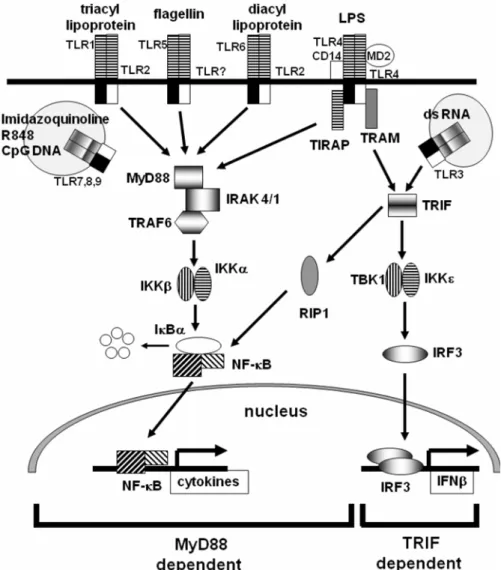
며바이러스 핵산들을인식한다(Fig. 1)(7). 또한 TLR9은박테리 아핵산을인식한다.
본논문에서는 α,β-unsaturated carbonyl group(Michael addition acceptor)을가지고 있는 phytochemicals이어떻게 TLRs 신호전달 체계를조절해서항염증효능을가지고있는지기술하고자한다.
이러한설명에의해서 앞으로기능성식품에대해연구하고자하 는 연구자들에게 TLRs 신호전달 시스템에 의해서 조절되어지
는염증(inflammation)반응이나뒤이어 발생하는만성적인질병들
이, 우리가 흔히 먹는 식품이나 약초들에 포함되어 있는 phy-
tochemicals에의해서어떻게조절되는지를이해하는데도움이 될
것으로기대한다.
Toll-like receptors
TLRs는광범위하게 MyD88-과 TRIF-의존신호전달체계를가
지고 있다. TLRs가 pathogen associated molecular pat- terns(PAMPs)을 인식하면, PAMPs에의해서유도된 수용체의 이
합체는 TLRs에의해서유도되는신호전달체계의활성화를유
도한다. TLRs는 일반적으로 myeloid differential factor 88(MyD88)과 Toll/IL-1R domain-containing adaptor inducing interferon-β(TRIF) 의존신호전달체계를가지고있다(Fig. 1)(2).
MyD88-dependent signaling pathway
MyD88은 TLR3를제외한 모든포유동물에서 발견되는 TLRs
의 Toll/IL-1R(TIR) 도메인에붙는즉각적인어댑터(adaptor) 분자 이다(2). TLRs는 TIR domain에최초의어댑터분자인 MyD88를
*Corresponding author: Hyung-Sun Youn, Department of Biomedical Laboratory Science, College of Medical Sciences, Soonchunhyang University, Asan, Chungnam 336-745, Korea
Tel: 82-41-530-3086 Fax: 82-41-530-3085 E-mail: [email protected]
Received June 22, 2009; revised August 16, 2009;
accepted August 18, 2009
homophilic interaction에의해서모은다(8). MyD88은 IL-1 recep- tor-associate kinase 4(IRAK-4)를 유도하고, IRAK-4는 IRAK-1을 인산화시키며, 인산화된 IRAK-1은 TNF receptor-associated factor 6(TRAF6)를 유도하고, TRAF6는 IκB kinase(inhibitor of κB kinase, IKK)를활성화시켜, 전사요소 nuclear factor-κB(NF-κB)의
활성화를유도한다. 두개의 kinases(IKKα와 IKKβ)에의해서유 발되는 IκBα의인산화(phosphorylation)와분해(degradation)가 NF-
κB 활성화를 유도한다. 연구에 의하면 IKKα보다 IKKβ가 TLR signaling pathways 안에서 NF-κB 활성화를 위해서중요한 역할
을하는 것으로 알려져 있는 반면에, IKKα는 NF-κB 활성화를 종결시키는데 보다더중요한 역할을 하는것으로알려져 있다
(9,10). NF-κB는 Rel-homology domains(RHDs)을포함하는 이합 체(dimeric) 전사요소(transcription factor)이다. 모두 다섯 종류의 NF-κB families[RelA(p65), RelB, C-Rel, p105(NF-κB1; a precur- sor of p50), p100(NF-κB2; a precursor of p52)]가포유동물세포
에서 발견되며, NF-κB는 동종(homo)- 또는 이종(hetero)-이합체 (dimers)를형성해서존재하는 것으로알려져있다(8). TLRs 신호 전달 체계에서 가장 종종 활성화되는 NF-κB는 p65와 p50으로 구성된 이종이합체로알려져 있다(11). 이렇게 TLRs를시작으로
IKK kinases를통해 NF-κB 활성화를 유도하는신호전달체계를
‘canonical pathway’라고 부르며, 이러한 신호전달 체계를 통해
cytokine이나 cyclooxygenase-2(COX-2)와같은염증 유전물질들 을유도하여알레르기(allergy)나건선(psoriasis)과같은여러 질병 을유발하게된다(12).
TRIF-dependent signaling pathway
NF-κB 활성화에 부가적으로, TLR3에 의한 double stranded RNA(dsRNA)의인식과 TLR4에 의한 LPS의인식은 MyD88 대
신에 어댑터 분자인 TRIF를 통하여 전사요소 interferon(IFN)- regulatory factor 3(IRF3)의 활성화를 유도한다(Fig. 1)(13). TRIF
Fig. 1. Toll-like receptor (TLR) signaling pathways and their agonists. TLRs have two major downstream signaling pathways; MyD88- and TRIF-dependent pathways leading to the activation of NF-κB and IRF3. TLR2 dimerized with TLR1 or TLR6 recognizes triacyl or diacyl lipopeptides of Gram-positive bacteria. TLR4 recognizes bacterial LPS. TLR5 recognizes bacterial flagellin. TLR3 recognizes double-stranded RNA (dsRNA). TLR7 recognizes imidazoquinolines and single-stranded viral RNA (ssRNA). TLR9 recognizes both viral and bacterial CpG DNA motifs. LPS, lipopolysaccharide; CpG DNA, cytosine phosphate guanine DNA; MyD88, myeloid differential factor 88; TRIF, TIR domain-containing adapter inducing IFNβ; IFN, interferon; TIRAP, TIR domain-containing adapter protein; TRAM, TRIF-related adapter molecule; IkBα, inhibitor of κB alpha; IKK, IκB kinase; IRAK, IL-1 receptor-associate kinase; TBK1, TANK-binding kinase 1; RIP1, receptor interacting protein 1; IRF3, IFN-regulatory factor 3; NF-κB, nuclear factor kB.
Phytochemicals의항염증효과 479
는 kinase TBK1과 IKKε을통하여 IRF3의활성화를유도한다. 활
성화된 IRF3는쉽게인산화되고, 인산화된 IRF3는이합체되어핵
(nucleus) 안으로들어간다. 핵안으로 들어간 IRF3는 IFN-stimu- lated response element(ISRE)나 regulated on activation normal T- cell Expressed and secreted(RANTES)로써 알려진 consensus DNA sequence에결합한다(14,15). 전사요소 NF-κB나 IRF3 양쪽 다바이러스나박테리아 감염에의해서활성화되지만, 양쪽전 사요소들의활성화에의해서유도되는타겟유전자는서로다른 것으로알려져 있다. NF-κB 활성화는 proinflammatory cytokines
을유도하지만, IRF3 활성화는 type I IFN 유전자들을 유도하는 것으로알려져있다(16-18).
TBK1과 IKKε이 구조적으로 또는기능적으로 유사함에도 불
구하고, 두 kinase의발현양식은구별되는것으로알려졌다. TBK1
은여러종류의 세포에서 계속적으로 발현되는반면에, IKKε은 바이러스 감염에 의해 활성화된 면역세포나 non-hematopoietic cells에서 유도된다(19). TBK1 knockout mice 실험에 의하면 TBK1은 IRF3 활성화나 IFNβ 생성에관여하는 downstream sig- naling에관여하는것으로보고되었다(19,20). 하지만 IKKε knock- out mice 실험에의하면 IKKε은 IRF3 활성화나 IFNβ 생성에분
명한 변화를 보여주지 못하였다(19). 이러한 결과는 TBK1만이
IRF3 활성화나 IFNβ 생성에중요한역할을한다는것을보여주
는 것이다. 부가적으로 TLRs를 통한 NF-κB 활성화에 미치는
TBK1과 IKKε의 역할은 TBK1과 IKKε double knockout mice
실험에 의해서 증명되었다(19). TBK1과 IKKε double knockout mice 안에서, TLR3와 TLR4 agonists에 의해서유도된 IκBα분 해, NF-κB와 DNA 결합, 그리고 inflammatory cytokines의생성에 아무런변화를 보여주지못했다. 이러한 결과는 TBK1이나 IKKε 이바이러스나 박테리아감염에의해서유도된 NF-κB 활성화에
중요한역할을가지고있지않다는것을보여주는것이라할수 있겠다. 즉 TRIF는 TBK1과 IRF3를통하여 IFNβ나 IFN에의해 서유도되는 유전체들을 유도한다. 하지만 TRIF의 C-말단부분 은 receptor interacting protein 1(RIP1)과반응하여지연된 NF-κB
활성화를유도하는것으로알려져있다(21). 그래서 TRIF는 IRF3
활성화를위해서 TBK1을사용하고, NF-κB 활성화를위해서 RIP1
을사용하는 것으로알려져있다(Fig. 1)(13,22).
Phytochemicals
Curcumin
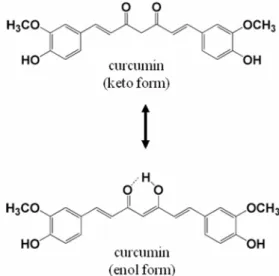
Curcumin은 Curcuma longa안에서발견되는노란색을띄는물 질이며, 우리가흔히 먹는카레의 주성분이다(Fig. 2). Curcumin
은 IKKβ를분자학적인 타깃으로하여여러 pro-inflammatory 자 극제에의해서유도된 NF-κB 활성화를억제시킨다(23-26). TLR
신호전달체계에서 curcumin은 ‘canonical pathway’의 key kinase
인 IKKβ의조절를통하여 MyD88-dependent 신호전달체계를조 절한다고알려져있다(Fig. 3)(27).
TLRs의이합체형성은 TLRs에의해서유도되는신호 전달체
계의활성화와뒤이어발생하는선천성면역반응을유도하기위
해서최초로 일어나는반응으로 알려져있다. TLRs는세포막의
바깥쪽에 leucine이반복적으로나타나는부위가존재하고, cysteine
이풍부한지역이있으며, 또한세포막안쪽에는 TIR(Toll/IL-1R homologous) 지역을가지고있는세포막을통과하는 Type I 단백
질이다. 그러므로 TLRs는 세포막의 안과 밖으로 여러 개의
cysteines을가지고있다. 이러한 cysteines은이황화물(disulfide) 결
합에 의해서 TLRs가 이합체를 형성하는데 필요한 것으로 알려
져있다(28). 많은연구에 의하면 α,β-unsaturated carbonyl group
을가지고있는 phytochemicals은 Michael addition 반응에의해서
cysteine의 thiol group에붙어단백질의 활성을 억제시킨다고 알 려져있다(29,30). 그러므로 α,β-unsaturated carbonyl group을가지 고있는 curcumin은 Michael addition 반응에의해서 LPS에의해
유도된 TLR4의 동종이합체를 억제한다고 알려졌다(27). 이러한
결과에의해서 curcumin은분자학적인타깃이 IKKβ에부가적으
로최초의방어체계라할수있는수용체의이합체형성을방해 하여 NF-κB 활성화를 억제시키는 것으로 밝혀졌다(Fig. 3)(27).
이와같은 결과는기능성물질들이신호전달체계에존재하는단 백질만을 분자학적인타깃으로하는것이 아니라, 수용체 레벨을 타깃으로하여항염증효과를가질수있다는것을보여주는결 과라할수있겠다.
6-Shogaol
웰빙식품중하나인생강(Zingiber officinale, Rosecoe)은오랫동
안 herbal medicine으로사용되어 왔으며, 전통적으로 신경성 질
환(nervous diseases), 치은염(gingivitis), 치통(toothache), 천식
(asthma), 뇌졸중(stroke), 변비(constipation) 그리고당뇨(diabetes)에
효과적인것으로보고되어있다(31). 특히생강추출물들은항염
증(anti-inflammatory)(32), 항산화(antioxidant)(33), 항혈전(anti- thrombotic)(34), 항암(anticancer)(35) 그리고관절염치료를(36) 위 해서효과적인 것으로알려져있다. 항염증효과를설명하기 위 하여생강에포함되어있는중요한물질들은 gingerols, shogaols,
그리고 paradols 등이 있다(Fig. 4). Gingerol은가수분해에의해서
생강가루의 중요구성물질인 shogaol로쉽게변형된다. Shogaol
또한 가수분해에 의해서 paradol로 전환된다. Shogaol은 신선한 생강에서는 적은양만이 발견되지만, 건조된 생강가루에서는많
은양이존재한다. 특히생강추출물들중에서 gingerols과 shog- aols이 prostaglandin과 leukotriene 합성효소의효과적인억제제로 보고되었다(37). 하지만 본 논문에서는 6-shogaol이 TLR 신호전 달체계에미치는효과에대해서만논의하고자한다.
많은연구에 의하면생강 추출물들은여러 요인에의해서 유 도된 NF-κB 활성화와 COX-2 발현을억제시킨다고 알려졌으며,
side chain의길이가 활성화결정을위해서중요한 역할을한다고
Fig. 2. The molecular structures of curcumin. Curcumin can exist in at least two tautomeric forms, keto (in solid phase) and enol (in solution).
밝혀졌다(38,39). 6-shogaol은 macrophage-activating lipopeptide 2- kDa(MALP-2, TLR2 and TLR6 agonist), polyriboinosinic polyri- bocytidylic acid(poly[I:C], TLR3 agonist) 그리고 LPS(TLR4 ago- nist)에의해서유도된 NF-κB 활성화와 COX-2 발현을 억제시켰 다. 6-Shogaol은 TLRs의 downstream 분자인 MyD88, IKKβ, 또
는 p65에의해서유도된 NF-κB 활성화를억제시켰다(40). 이러 한결과들은 TLR 신호전달체계에대한 6-shogaol의분자학적인 타깃이적어도하나는 IKKβ보다 아래쪽에놓여있다는것을보 여주는것이라 할수있겠다. 부가적으로 6-shogaol은 LPS에의
해서유도된 TLR4의이합체형성을억제시켰다(Fig. 3)(41). 이 미 앞서 언급하였듯이, Michael addition 반응을 유도하는 α,β- unsaturated carbonyl group을 가지고 있는 물질들은 cysteine의
thiol 구룹에결합하여 단백질의활성을억제시키는 것으로밝혀
졌다. 즉α,β-unsaturated carbonyl group을가지고있는 6-shogaol
은 TLR4의 cysteine에 결합하여 TLR4의이합체 형성을 억제시 키는것이다. 이러한 결과는 6-shogaol이수용체의이합체형성을
조절하여염증유전자발현을감소시킨다는것을보여주는것이 라할수있겠다.
Cinnamaldehyde
계피는Cinnamomum 나무로부터분리된나무껍질을말린것
으로주성분은계피유라고 하는정유(essential oil)로 cinnamalde-
hyde(3-phenyl-2-propenal)가 주요한 구성물질이다(Fig. 5). α,β- unsaturated carbonyl group을가지고있는 cinnamaldehyde는향수 와살균제의 구성물질로써그리고 껌, 아이스크림, 캔디, 음료수
Fig. 3. The molecular targets of curcumin, 6-shogaol, and cinnamaldehyde in TLR4 signaling pathway. Cur; curcumin, Sho; 6-shogaol, Cin; cinnamaldehyde.
Fig. 4. The molecular structures of gingerols, shogaols, and paradols.
Phytochemicals의항염증효과 481
등에서맛을내는물질로써널리사용되고 있으며, 항염증과항 박테리아성질을포함한여러가지생물학적인활성을가지고있 다고알려져있다(42).
TLR4 신호전달체계는두개의중요한전사요소 NF-κB와 IRF3
의활성화를유도한다(2). Cinnamaldehyde는 LPS에의해서유도 된 NF-κB와 IRF3의활성화를억제한다(43). 또한 cinnamaldehyde
는 LPS에의해서유도된 TLR4의타깃유전자인 COX-2와 IFN-
β의발현을 감소시켰다. 그러나 cinnamaldehyde는 TLR4의신호 전달체계의 구성요소인 MyD88과 IKKβ에의해서 유도된 NF-
κB 활성화와 TRIF와 TBK1에의해서유도된 IRF3 활성화를억
제시키지못한다. 이러한결과는 cinnamaldehyde의분자학적인타 깃이 MyD88과 TRIF 위에놓여있으며, 수용체자체가 cinnamal-
dehyde의분자학적인타깃이라는것을의미한다고할수있겠다.
수용체의이합체형성은 TLRs에의해서 유도되는신호전달체
계의활성화와 뒤이어발생하는 선천성 그리고후천성 면역반 응을유도하기 위해서최초로 일어나는 반응중하나로 알려져 있다. Cinnamaldehyde는 LPS에의해서유도된 TLR4의이합체형
성을 억제시켰으며(Fig. 3), 그 결과로 LPS에 의해서 유도된
IRAK-1 분해와 NF-κB 활성화를억제시키는것으로알려져있다
(43). 앞에 논의한바와 같이α,β-unsaturated carbonyl group을가 지고있는 cinnamaldehyde는최초의방어체계라할수있는수용
체의이합체형성을 억제하여 NF-κB와 IRF3 활성화 및그것들 에의해서조절되는타깃 유전자들인 COX-2와 IFNβ를 억제시키 는것으로 알려져있다.
요 약
TLRs는여러병원균들이가지고있는 PAMPs를인식해서, 선
천성면역 반응을유도하는중요한 역할을한다. TLR4의이합체
형성은신호전달체계의활성화와뒤이어발생하는선천성면역 반응을 유도하기 위해서 최초로 일어나는 반응으로 알려져 있 다. 우리가먹는 식품 중에는항염증 효과가 있다고널리 알려 져 있는 phytochemicals이 포함되어 있다. 특히 α,β-unsaturated carbonyl group을가지고있는 curcumin, 6-shogaol, 그리고 cinna- maldehyde는 Michael addition 반응에의해서 LPS에의해서유도 된 TLR4의이합체형성을억제시켜, 전사요소 NF-κB와 IRF3 활 성화및그것들에의해서조절되는타깃유전자들을억제시킨다.
이러한결과는 α,β-unsaturated carbonyl group을가지고있는 cur- cumin, 6-shogaol, 그리고 cinnamaldehyde의 항염증 효능에 대한 새로운기전을설명해주는것이라할수있겠다.
문 헌
1. Beutler B, Jiang Z, Georgel P, Crozat K, Croker B, Rutschmann S, Du X, Hoebe K. Genetic analysis of host resistance: Toll-like receptor signaling and immunity at large. Annu. Rev. Immunol.
24: 353-389 (2006)
2. Takeda K, Akira S. Toll-like receptors in innate immunity. Int.
Immunol. 17: 1-14 (2005)
3. Medzhitov R. Toll-like receptors and innate immunity. Nat. Rev.
Immunol. 1: 135-145 (2001)
4. O'Neill LA. TLRs: Professor Mechnikov, sit on your hat. Trends Immunol. 25: 687-693 (2004)
5. Vogel SN, Fitzgerald KA, Fenton MJ. TLRs: Differential adaptor utilization by toll-like receptors mediates TLR-specific patterns of gene expression. Mol. Interv. 3: 466-477 (2003)
6. Hajjar AM, O'Mahony DS, Ozinsky A, Underhill DM, Aderem A, Klebanoff SJ, Wilson CB. Cutting edge: functional interactions between toll-like receptor (TLR) 2 and TLR1 or TLR6 in response to phenol-soluble modulin. J. Immunol. 166: 15-19 (2001)
7. Kawai T, Akira S. Pathogen recognition with toll-like receptors.
Curr. Opin. Immunol. 17: 338-344 (2005)
8. Kawai T, Akira S. Signaling to NF-κB by toll-like receptors.
Trends Mol. Med. 13:460-469 (2007)
9. Karin M, Greten FR. NF-κB: Linking inflammation and immu- nity to cancer development and progression. Nat. Rev. Immunol.
5: 749-759 (2005)
10. Li Q, Lu Q, Bottero V, Estepa G, Morrison L, Mercurio F, Verma IM. Enhanced NF-κB activation and cellular function in mac- rophages lacking IκB kinase 1 (IKK1). P. Natl. Acad. Sci. USA 102: 12425-12430 (2005)
11. Hayden MS, West AP, Ghosh S. NF-κB and the immune response. Oncogene 25: 6758-6780 (2006)
12. Rhee SH, Hwang D. Murine toll-like receptor 4 confers lipopolysaccharide responsiveness as determined by activation of NF κB and expression of the inducible cyclooxygenase. J. Biol.
Chem. 275: 34035-34040 (2000)
13. Sato S, Sugiyama M, Yamamoto M, Watanabe Y, Kawai T, Takeda K, Akira S. Toll/IL-1 receptor domain-containing adaptor inducing IFN-β (TRIF) associates with TNF receptor-associated factor 6 and TANK-binding kinase 1, and activates two distinct transcription factors, NF-κB and IFN-regulatory factor-3, in the toll-like receptor signaling. J. Immunol. 171: 4304-4310 (2003) 14. Lin R, Heylbroeck C, Genin P, Pitha PM, Hiscott J. Essential
role of interferon regulatory factor 3 in direct activation of RANTES chemokine transcription. Mol. Cell. Biol. 19: 959-966 (1999)
15. Schafer SL, Lin R, Moore PA, Hiscott J, Pitha PM. Regulation of type I interferon gene expression by interferon regulatory factor- 3. J. Biol. Chem. 273: 2714-2720 (1998)
16. Stetson DB, Medzhitov R. Type I interferons in host defense.
Immunity 25: 373-381 (2006)
17. Wietek C, O'Neill LA. Diversity and regulation in the NF-κB system. Trends Biochem. Sci. 32: 311-319 (2007)
18. Honda K, Taniguchi T. IRFs: master regulators of signalling by toll-like receptors and cytosolic pattern-recognition receptors. Nat.
Rev. Immunol. 6: 644-658 (2006)
19. Hemmi H, Takeuchi O, Sato S, Yamamoto M, Kaisho T, Sanjo H, Kawai T, Hoshino K, Takeda K, Akira S. The roles of two IκB kinase-related kinases in lipopolysaccharide and double stranded RNA signaling and viral infection. J. Exp. Med. 199:
1641-1650 (2004)
20. McWhirter SM, Fitzgerald KA, Rosains J, Rowe DC, Golenbock DT, Maniatis T. IFN-regulatory factor 3-dependent gene expres- sion is defective in Tbk1-deficient mouse embryonic fibroblasts.
P. Natl. Acad. Sci. USA 101: 233-238 (2004)
21. Meylan E, Burns K, Hofmann K, Blancheteau V, Martinon F, Kelliher M, Tschopp J. RIP1 is an essential mediator of toll-like receptor 3-induced NF-κB activation. Nat. Immunol. 5: 503-507 (2004)
22. Fitzgerald KA, McWhirter SM, Faia KL, Rowe DC, Latz E, Golenbock DT, Coyle AJ, Liao SM, Maniatis T. IKKepsilon and TBK1 are essential components of the IRF3 signaling pathway.
Nat. Immunol. 4: 491-496 (2003)
23. Pan MH, Lin-Shiau SY, Lin JK. Comparative studies on the sup- pression of nitric oxide synthase by curcumin and its hydroge- nated metabolites through down-regulation of IκB kinase and NFκB activation in macrophages. Biochem. Pharmacol. 60: 1665- 1676 (2000)
24. Jobin C, Bradham CA, Russo MP, Juma B, Narula AS, Brenner Fig. 5. The molecular structure of cinnamaldehyde.
DA, Sartor RB. Curcumin blocks cytokine-mediated NF-κB acti- vation and proinflammatory gene expression by inhibiting inhibi- tory factor I-κB kinase activity. J. Immunol. 163: 3474-3483 (1999)
25. Brouet I, Ohshima H. Curcumin, an anti-tumour promoter and anti-inflammatory agent, inhibits induction of nitric oxide syn- thase in activated macrophages. Biochem. Bioph. Res. Co. 206:
533-540 (1995)
26. Kang G, Kong PJ, Yuh YJ, Lim SY, Yim SV, Chun W, Kim SS.
Curcumin suppresses lipopolysaccharide-induced cyclooxygenase- 2 expression by inhibiting activator protein 1 and nuclear factor
κβ bindings in BV2 microglial cells. J. Pharmacol. Sci. 94: 325- 328 (2004)
27. Youn HS, Saitoh SI, Miyake K, Hwang DH. Inhibition of homodimerization of toll-like receptor 4 by curcumin. Biochem.
Pharmacol. 72: 62-69 (2006)
28. Tao X, Xu Y, Zheng Y, Beg AA, Tong L. An extensively associ- ated dimer in the structure of the C713S mutant of the TIR domain of human TLR2. Biochem. Bioph. Res. Co. 299: 216-221 (2002)
29. Dinkova-Kostova AT, Massiah MA, Bozak RE, Hicks RJ, Talalay P. Potency of Michael reaction acceptors as inducers of enzymes that protect against carcinogenesis depends on their reactivity with sulfhydryl groups. P. Natl. Acad. Sci. USA 98: 3404-3409 (2001)
30. Siedle B, Garcia-Pineres AJ, Murillo R, Schulte-Monting J, Cas- tro V, Rungeler P, Klaas CA, Da Costa FB, Kisiel W, Merfort I.
Quantitative structure-activity relationship of sesquiterpene lac- tones as inhibitors of the transcription factor NF-κB. J. Med.
Chem. 47: 6042-6054 (2004)
31. Afzal M, Al-Hadidi D, Menon M, Pesek J, Dhami MS. Ginger:
An ethnomedical, chemical, and pharmacological review. Drug Metabol. Drug Interact. 18: 159-190 (2001)
32. Chang CP, Chang JY, Wang FY, Chang JG. The effect of Chinese medicinal herb Zingiberis rhizoma extract on cytokine secretion by human peripheral blood mononuclear cells. J. Ethnopharmacol.
48: 13-19 (1995)
33. Ippoushi K, Azuma K, Ito H, Horie H, Higashio H. [6]-Gingerol
inhibits nitric oxide synthesis in activated J774.1 mouse macroph- ages and prevents peroxynitrite-induced oxidation and nitration reactions. Life Sci. 73: 3427-3437 (2003)
34. Thomson M, Al-Qattan KK, Al-Sawan SM, Alnaqeeb MA, Khan I, Ali M. The use of ginger (Zingiber officinale Rosc.) as a potential anti-inflammatory and antithrombotic agent. Prostag.
Leukotr. Ess. 67: 475-478 (2002)
35. Surh YJ. Anti-tumor promoting potential of selected spice ingre- dients with antioxidative and anti-inflammatory activities: A short review. Food Chem. Toxicol. 40: 1091-1097 (2002)
36. Altman RD, Marcussen KC. Effects of a ginger extract on knee pain in patients with osteoarthritis. Arthritis Rheum. 44: 2531- 2538 (2001)
37. Kiuchi F, Iwakami S, Shibuya M, Hanaoka F, Sankawa U. Inhibi- tion of prostaglandin and leukotriene biosynthesis by gingerols and diarylheptanoids. Chem. Pharm. Bull. 40: 387-391 (1992) 38. Tjendraputra E, Tran VH, Liu-Brennan D, Roufogalis BD, Duke
CC. Effect of ginger constituents and synthetic analogues on cyclooxygenase-2 enzyme in intact cells. Bioorg. Chem. 29: 156- 163 (2001)
39. Kim SO, Chun KS, Kundu JK, Surh YJ. Inhibitory effects of [6]- gingerol on PMA-induced COX-2 expression and activation of NF-κB and p38 MAPK in mouse skin. Biofactors 21: 27-31 (2004)
40. Kim JJ, Ahn SI, Lee JS, Yun SM, Lee MY, Youn HS. Suppres- sion of the expression of cyclooxygenase-2 induced by toll-like receptor 2, 3, and 4 agonists by 6-shogaol. Korean J. Food Sci.
Technol. 40: 332-336 (2008)
41. Ahn SI, Lee JK, Youn HS. Inhibition of homodimerization of toll-like receptor 4 by 6-shogaol. Mol. Cells 27: 211-215 (2009) 42. Ooi LS, Li Y, Kam SL, Wang H, Wong EY, Ooi VE. Antimicro-
bial activities of cinnamon oil and cinnamaldehyde from the Chi- nese medicinal herb Cinnamomum cassia Blume. Am. J. Chin.
Med. 34: 511-522 (2006)
43. Youn HS, Lee JK, Choi YJ, Saitoh SI, Miyake K, Hwang DH, Lee JY. Cinnamaldehyde suppresses toll-like receptor 4 activation mediated through the inhibition of receptor oligomerization. Bio- chem. Pharmacol. 75: 494-502 (2008)