효모의 종류를 달리하여 제조한 Black Raspberry 발효주의 품질 특성
이윤지1․김재철1․황금택1†․김동호2․정창민3
1
서울대학교 식품영양학과․생활과학연구소
2
국립농산물품질관리원 시험연구소
3
배상면주가
Quality Characteristics of Black Raspberry Wine Fermented with Different Yeasts
Yoonji Lee1, Jae Cheol Kim1, Keum Taek Hwang1†, Dong-Ho Kim2, and Chang Min Jung3
1Dept. of Food and Nutrition and Research Institute of Human Ecology, Seoul National University, Seoul 151-742, Korea
2National Agricultural Products Quality Management Service, Seoul 150-804, Korea
3Baesangmyun Brewery Institute Co., Ltd, Gyeonggi 487-840, Korea
Abstract
Four different yeasts (Fermivin (FM), Saf-instant yeast red (SI), Angest wine active dry yeast (AW) and Angest instant yeast high sugar (AI)) were used for the fermentation of black raspberry wine. The amount of reducing sugars in FM (2.7%) and AI (2.8%) were higher than those in SI (2.4%) and AW (2.5%). The amount of glucose (the major free sugar) was higher in AW (2.57 mg/mL) and AI (2.50 mg/mL) than FM (2.03 mg/mL) and SI (1.75 mg/mL). AW (11.95%) had the highest alcohol content, while SI (11.75%) had the lowest. The pH of FM (pH 3.73) was the lowest, and there were no significant differences in total acidity among the samples.
The major organic acid in the wines was citric acid (6.71∼8.18 mg/mL) and the amount of organic acids depended on the type of yeasts. The amount of malic acid was highest in SI (2.92 mg/mL), and lowest in AI (1.83 mg/mL).
The Hunter color test showed that SI was highest in lightness, redness and yellowness, whereas AI was lowest.
There were no differences in turbidity between the samples. There were no significant differences in total phe- nolic contents (TPC) and total anthocyanin contents (TAC). However, the TPC and TAC of black raspberry wines were higher than those in commercial red wines. The antioxidant activities of wines (determined by ABTS and FRAP) increased in the order of FM, AI, AW and SI. It could not be concluded which yeast is adequate for the fermentation of black raspberry wine because any of the tested yeasts showed the best in all the quality characteristics of the wines.
Key words: black raspberry wine, yeast, phenolics, anthocyanin, antioxidant activity
†
Corresponding author. E-mail: [email protected]
†
Phone: 82-2-880-2531, Fax: 82-2-884-0305
서 론
근래에 나무딸기류에 대한 관심이 높아지면서 외국으로 부터 raspberry, blackberry, black raspberry, boysenberry 등으로 불리는 다양한 종류가 유입되었다(1). 우리나라에서 현재 널리 보급하여 재배하는 나무딸기류는 black rasp- berry(
Rubus occidentalis)로서 이것을 주로 복분자로 일컫 는다. 복분자에는 anthocyanin, tannin, polyphenol 등의 유 용한 성분이 다량 함유되어 있으나, 과실의 크기가 작고, 수 분 함량이 높아 부패하기 쉽고 저장이 어려워서 잼, 술, 음료 등으로 가공하여 이용하고 있다(2).
국내에서 가공에 사용하는 복분자는 2005년에 2,222 ton 으로, 그중 93%는 술 제조에 사용하였다. 매년 복분자 가공
량은 증가하여 2009년에는 4,914 ton을 음료, 술, 잼 등으로 가공하였다. 그러나 그중 술을 생산하는 비율은 58.9%로 감 소하였는데(3), 이는 자유무역협정(FTA)이 발효되면서 레 드 와인의 수입이 급증했기 때문이라고 생각한다. 따라서 복분자 발효주가 수입산 레드 와인과 경쟁하려면 맛뿐만 아 니라 품질을 와인 수준 이상으로 개선시켜야 할 것이다.
복분자 발효주는 원료 특성이 품질에 가장 큰 영향을 미치 지만 제조법이나 효모에 따라서도 품질에 차이가 나타난다.
따라서 복분자 발효주에 적합한 효모의 선택은 복분자 발효
주의 맛을 결정하는 중요한 요소이다. 복분자 발효주 발효의
주체가 되는 효모와 관련된 국내연구로는 활성 건조 효모를
이용한 복분자주의 아미노산 함량을 분석한 연구(4), 활성건
조 효모 별로 발효 중의 성분 변화를 비교한 연구(5), 효모
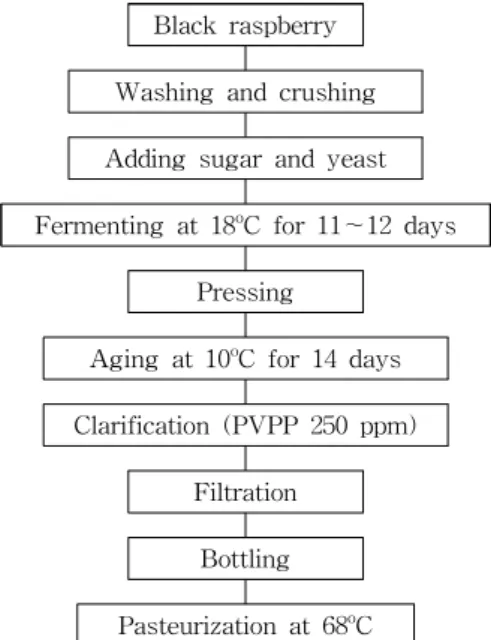
Black raspberry
Washing and crushing Adding sugar and yeast Fermenting at 18
oC for 11~12 days
Pressing
Aging at 10
oC for 14 days Clarification (PVPP 250 ppm)
Filtration Bottling
Pasteurization at 68
oC
Fig. 1. Flow chart of black raspberry wine making.
종류 및 효소 첨가에 따른 복분자주 발효과정 중 이화학적 특성을 분석한 연구(6) 등이 있다. 그러나 발효 효모에 따른 복분자 발효주의 주요 생리활성 성분인 polyphenol 및 an- thocyanin 함량 차이와 이에 따른 항산화능을 비교한 연구 는 전무하다.
따라서 본 연구에서는 복분자 발효주의 품질 향상을 위하 여 국내에서 시판되고 있는 효모 4종을 이용하여 복분자 발 효주를 제조하고, 이화학적 특성 및 항산화능을 비교 검토하 였다.
재료 및 방법
실험 재료
Black raspberry는 전라북도 고창군에서 2012년에 수확 한 것을 구입하여 사용하였고, 고과당(Cheil Jedang Co., Seoul, Korea)과 주정(12%, Korea Ethanol Supplies Com- pany, Seoul, Korea)은 시중 마트에서 구입하여 사용하였다.
효모는
Saccharomyces cerevisiaeFermivin(DSM Food Specialties, Seclin, France),
S.
cerevisiaeSaf-instant yeast red(Societe Industrielle Lesaffre, Marcq-Baroeul, France),
S.
cerevisiaeAngest wine active dry yeast(Angel Yeast Co., Yichang, Hubei, China),
S.
cerevisiaeAngest instant yeast high sugar(Angel Yeast Co.)를 사용하였다.
본 연구에서는 black raspberry는 복분자로, black rasp- berry wine은 복분자 발효주로 통칭하고자 한다.
복분자 발효주 제조
복분자 발효주 제조과정은 Fig. 1과 같다. 당도 10∼
11
oBrix인 복분자 20 kg을 으깬 뒤 고과당 3.69 kg을 넣어 24
oBrix로 맞춘 후, 건조효모 20 g을 혼합하여 18
oC에서 11
∼12일 동안 발효시켰다. 발효 후 압착하여 지게미를 제거하
고 10
oC에서 2주간 숙성시킨 뒤, polyvinylpolypyrrolidone (PVPP, Polyclar 10, American Tartaric Products Inc., Larchmont, NY, USA) 250 ppm을 첨가하여 청징처리 하였 다. 그 후 시료는 여과하여 병입하고 68
oC로 살균하였다.
Fermivin, Saf-instant yeast red, Angest wine active dry yeast, Angest instant yeast high sugar로 제조한 복분자 발효주는 FM, SI, AW, AI로 나타내었다.
복분자 발효주 및 복분자의 전처리
복분자 발효주 100 mL를 45
oC에서 감압농축기(rotary evaporator, N-1000, EYELA, Tokyo, Japan)로 농축한 후, 동결건조기(KVC 2300, Sori Tech Co., Hwaseong, Korea) 로 -73
oC에서 7일간 동결건조 하였다. 동결건조한 시료는 -20
oC에서 보관하였다. 복분자는 과일 20 g을 70% etha- nol(Samchun Pure Chemical Co., Pyeongtaek, Korea) 100 mL로 1시간 추출한 후, 복분자 발효주 전처리와 같은 방법 으로 처리하였다.
환원당 측정
3,5-dinitrosalicylic acid(Samchun Pure Chemical Co.) 0.25 g과 sodium potassium tartrate(Samchun Pure Chemi- cal Co.) 75 g을 2 M NaOH(Samchun Pure Chemical Co.) 50 mL에 녹인 후 증류수로 희석하였다. 이 용액 1 mL와 시료 100 μL를 잘 섞은 후 100
oC에서 10분간 중탕하였다.
상온에서 충분히 식힌 후 570 nm에서 흡광도를 측정하였다.
Glucose(Sigma Chemical Co., St. Louis, MO, USA) stand- ard curve를 이용하여 환원당 함량(%)을 구하였다(7).
유리당 조성 분석
시료 10 mL를 0.45 μm syringe filter로 여과한 후 HPLC (Ultimate 3000, Dionex-Softron GmbH, Germering, Ger- many)로 분석하였다. 유리당 분석은 carbohydrate column (Zorbax, 4.6×250 mm, 5 μm, Agilent Technologies Inc., Palo Alto, CA, USA)을 사용하였다. 이동상은 75% acetoni- trile(HPLC grade, J.T. Baker, Phillipsburg, NJ, USA)을 사 용하였고, 유속은 1.4 mL/min으로 하였다. Injection volume 은 20 μL였다. Detector는 evaporative light scattering de- tector(ELSD, PL-ELS 2100, Polymer Laboratories, Shrop- shire, UK)를 사용하였다.
알코올 함량
알코올 함량은 복분자 발효주 100 mL에 증류수 100 mL를 넣고 증류하여 증류액 100 mL를 받아 주정계(DA-105, Kyoto Electronics Manufacturing Co., Kyoto, Japan)로 측 정하였다.
pH 및 산도
pH는 pH meter(Orion 3-Star Plus Benchtop pH meter,
Thermo Scientific, Waltham, MA, USA)로 측정하였다. 산
도(8)는 복분자 발효주 10 mL를 취하여 pH 7이 될 때까지
0.1 N NaOH(Samchun Pure Chemical Co.)로 적정하고, cit- ric acid(%)로 환산하였다.
유기산 조성 분석
시료 10 mL를 0.45 μm syringe filter(Acrodisc, Pall Life Sciences, East Hills, NY, USA)로 여과한 후, HPLC(Waters 2695 Separations Module, Waters Co., Milford, MA, USA) 로 분석하였다. 칼럼은 Carbomix H-NP 5, 8% crosslinking column(7.8×300 mm, 5 μm, Sepax Technologies, Inc., Newark, DE, USA)을 사용하였고, 칼럼 오븐 온도는 55
oC로 하였다. 이동상은 2.5 mM H
2SO
4(Matsunoen Chemicals, Osaka, Japan)이었으며, 유속은 0.5 mL/min으로 하였다.
Injection volume은 20 μL였으며 diode array detector(210 nm)로 분석하였다.
색도 및 탁도
색도는 시료를 12배 희석하여 colorimeter(Minolta CM- 3600A Chromameter, Minolta Co., Ltd., Tokyo, Japan)로 L(Hunter), a(Hunter), b(Hunter) 값을 측정하였고, 광원은 Illuminant D
65-10
o을 사용하였다. 탁도는 Hach 2100N nephelometer(Hach, Loveland, CO, USA)를 이용하여 측정 하였다.
Total phenolics 함량 측정
Total phenolics 함량은 Folin-Ciocalteu 방법(9)에 따라 측정하였다. 시료 10 μL에 증류수 790 μL와 2 N Folin- Ciocalteu(Sigma Chemical Co.) 50 μL를 첨가하였다. 3분 후 20% Na
2CO
3(Yakuri Pure Chemicals Co., Osaka, Japan) 용액 150 μL를 가하여 40
oC에서 30분간 방치한 후, spec- trophotometer(Spectramax 190, Molecular Devices Corpo- ration, Sunnyvale, CA, USA)를 사용하여 765 nm에서 흡광 도를 측정하였다. Total phenolics 함량은 gallic acid(Sigma Chemical Co.)에 의한 표준곡선을 이용하여 mg GAE/L로 나타냈다.
Total anthocyanin 함량 측정
Total anthocyanin은 pH differential method를 사용하여 측정하였다(10). 시료를 0.025 M potassium chloride(Sam- chun Pure Chemical Co.) buffer(pH 1.0)로 희석하여 흡광도 값이 0.7∼1.0이 나오도록 희석배수를 정하였다. 이 희석배 수로 시료를 0.025 M potassium chloride buffer(pH 1.0)와 0.4 M sodium acetate(Sigma Chemical Co.) buffer(pH 4.5) 로 각각 희석하였다. 15분간 평형화시킨 후, spectropho- tometer를 사용하여 최대흡수파장(515 nm)과 700 nm에서 흡광도를 측정했고 다음 식에 의하여 total anthocyanin 함 량을 산출하였다.
Total anthocyanin (mg/L)= A×MW×DF×1000 ε× 1
A=(A
λvis-max-A
700 nm)
pH 1.0-(A
λvis-max-A
700 nm)
pH 4.5MW: cyanidin-3-glucoside의 분자량=449.2 DF: 희석배수
ε : 몰흡광계수=26,900 1: path length
Anthocyanin 조성 분석
시료를 0.01%(v/v) HCl(Samchun Pure Chemical Co.) 수 용액에 용해시켜 사용하였다. Sep-Pak C
18cartridge(Waters Co.)를 0.01%(v/v) HCl methanol(HPLC grade, J.T. Baker) 용액 5 mL와 0.01% HCl 수용액 5 mL로 활성화시킨 다음 시료 5 mL를 loading하였다. 여기에 0.01% HCl 수용액 5 mL를 통과시켜 당을 비롯한 anthocyanin을 제외한 물질을 받아 버린 후, 5 mL의 0.01%(v/v) HCl methanol 용액을 통 과시켜 anthocyanin을 수집하였고, 0.45 μm syringe filter로 여과한 후 HPLC(Waters 2695 Separations Module, Waters Co.)에 주입하였다. 칼럼은 Nova-pak C18 column(3.9×
300 mm, 4 μm, Waters Co.)을 사용하였고, 이동상으로는 5% formic acid(용매 A, Samchun Pure Chemical Co.)와 100% acetonitrile(용매 B, Samchun Pure Chemical Co.)을 사용하였다. 0∼1 min에는 용매 B 2∼10%, 1∼30 min에는 용매 B 10∼13%, 30∼35 min에는 용매 B 13∼60%, 35∼36 min에는 용매 B 60∼2%, 36∼50 min에는 용매 B 2%의 gradient로 주입하였다. 유속은 1 mL/min로 하였고, 시료의 주입량은 20 μL였으며 diode array detector(520 nm)로 분석 하였다(11). Anthocyanin 조성은 anthocyanin peak 각각의 면적(mV×sec)으로 나타내었다.
ABTS radical scavenging activity 측정
Re 등(12)의 방법에 따라 2,2'-azino-bis(3-ethylbenzo- thiazoline-6-sulfonic acid) diammonium salt(ABTS, Sig- ma Chemical Co.)를 증류수에 용해시켜 7 mM의 ABTS 용 액을 만들어 2.45 mM potassium persulfate(Sigma Chemi- cal Co.)와 1:1로 혼합하여 30
oC의 암소에서 12∼16시간 동 안 방치하였다. 혼합액은 734 nm에서 흡광도 값이 0.70 이하 가 되도록 에탄올로 희석하였다. 희석한 ABTS 용액 900 μ L와 시료 100 μL를 1분 동안 반응시켜 734 nm에서 흡광도 를 측정하였다. 다음 식에 의해 free radical scavenging ac- tivity를 구하였으며, 표준물질로 (+/-)-6-hydroxy-2,5,7,8- tetramethylchromane-2-carboxylic acid(Trolox, Sigma Chemical Co.)를 사용하여 검량선을 작성하여 시료의 trolox equivalent antioxidant capacity를 산출하였다.
Free radical scavenging activity (%)=
( 1- sample absorbance control absorbance ) × 100
Ferric reducing antioxidant power(FRAP) 측정
FRAP의 측정은 Benzie와 Strain(13)의 방법에 따라 10
mM 2.4.6-tri(2-pyridyl)-s-triazine(TPTZ, Sigma Chemi-
cal Co.)을 40 mM HCl에 녹여서 TPTZ 용액을 만들었다.
Table 1. Reducing sugar, free sugars and alcohol content of black raspberry and wines Sample Reducing sugar
(%, w/v)
Free sugars (mg/mL) Alcohol
(%, v/v) Fructose Glucose Sucrose Maltose Lactose Total
Black raspberry 15.4±1.3
1)70.5±1.9 49.7±3.1 ND
2)ND ND 120.2±4.9 -
3)FM SI AW AI
2.7±0.1
a2.4±0.1
b2.5±0.2
b2.8±0.1
a1.03±0.27
a1.10±0.22
a1.00±0.08
a0.98±0.19
a2.03±0.69
bc1.75±0.13
c2.57±0.44
a2.50±0.15
ab0.90±0.45
ab0.73±0.29
b1.37±0.30
a1.09±0.41
ab1.88±0.93
ab1.33±0.42
b2.07±0.10
ab2.32±0.72
a1.82±0.41
b1.49±0.50
b2.28±0.12
a2.35±0.23
a7.66±2.75 6.40±1.56 9.28±1.03 9.24±1.70
11.90±0.00
ab11.75±0.07
b11.95±0.07
a11.85±0.07
abFM, black raspberry wine fermented with Fermivin; SI, with Saf-instant yeast red; AW, with Angest wine active dry yeast;
AI, with Angest instant yeast high sugar.
1)
Each value represents the mean±standard deviation.
2)ND: not detected.
3)-: not tested.
a-c
Values with different superscripts among the wine samples are significantly different (ANOVA and Duncan’s multiple range test at p<0.05).
Table 2. pH, total acidity and organic acids of black raspberry and wines
Sample pH Total acidity
(% as citric acid)
Organic acids (mg/mL) Oxalic
acid Citric
acid Malic
acid Succinic
acid Lactic
acid Acetic
acid Total Black raspberry 3.88±0.02
1)a0.98±0.01
aND
2)b16.39±2.13
a5.62±0.68
a4.86±0.32
a0.11±0.02
bND
b26.97±3.15 FM SI
AW AI
3.73±0.01
c3.79±0.06
b3.76±0.05
bc3.79±0.01
b0.91±0.08
b0.86±0.04
b0.86±0.01
b0.86±0.02
b0.39±0.10
a0.33±0.03
a0.36±0.04
a0.39±0.05
a7.90±2.16
b6.91±0.43
b8.18±2.12
b6.71±1.28
b2.59±1.32
bc2.92±0.37
b2.47±0.36
bc1.83±0.34
c2.47±0.08
b2.47±0.49
b2.73±0.44
b2.70±0.26
b0.30±0.23
ab0.39±0.30
a0.45±0.03
a0.53±0.06
a0.26±0.25
ab0.14±0.13
b0.29±0.26
ab0.44±0.18
a13.92±4.13 13.15±1.75 14.47±3.24 12.60±2.18 Samples are the same as in Table 1.
1)
Each value represents the mean±standard deviation.
2)ND: Not detected.
a-c
Values with different superscripts in the same columns are significantly different (ANOVA and Duncan’s multiple range test at p<0.05).
실험 직전에 pH 3.6인 300 mM sodium acetate buffer와 20 mM FeCl
3(Duksan Pure Chemical Co., Ansan, Korea) 용액 을 만들었다. Sodium acetate buffer, TPTZ 용액, FeCl
3용 액을 각각 10:1:1의 비율로 혼합하여 37
oC에서 15분간 반응 시켰다. FRAP 측정 시 모든 시료의 희석과 용액의 제조는 Chelex(2 g/L, Chelex 100 sodium form, Sigma Chemical Co.)로 deionized water를 만들어 사용하였다. 시료를 de- ionized water로 용해하고 시료 첨가 직전에 37
oC에서 데워 놓은 TPTZ 용액 270 μL와 희석한 시료 30 μL를 37
oC에서 15분간 반응시킨 후, 540 nm에서 흡광도를 측정하였다. 표 준물질로 1 mM trolox를 사용하여 검량선을 작성하여 시료 의 trolox equivalent antioxidant capacity를 산출하였다.
통계학적 분석
본 실험에서는 복분자 발효주를 2회 반복 제조하여 분석 하였으며, 실험결과는 SPSS program(version 19.0, SPSS, Chicago, IL, USA)을 이용하여 평균과 표준편차(mean±
SD)를 산출하고, 평균값은 one-way analysis of variance (one-way ANOVA)와 Duncan's multiple range test를 실 시하여 p<0.05 유의수준에서 다중비교하였다.
결과 및 고찰
환원당, 유리당 및 알코올 함량
당 함량은 효모에 의한 발효 유무를 알아보는 간단한 지표
이다. 본 연구에서는 사용한 복분자의 환원당 함량은 15.4%
였으나 발효 후에는 2.4∼2.8%로 감소하였는데, 이는 복분 자 발효액에 포함된 당이 알코올로 전환되기 때문이다. 효모 에 따른 환원당 함량은 FM과 AI가 SI와 AW보다 많았다 (Table 1). 복분자에서 검출된 유리당은 fructose와 glucose 이었으며, 발효에 의해 그 함량이 현격히 감소하였다. 이는 효모가 fructose와 glucose를 발효에 이용했음을 알 수 있다.
검출된 유리당 함량은 효모마다 달랐는데, 특히 AW와 AI가 FM과 SI에 비해 fructose를 제외한 유리당 함량이 많았다.
이는 효모마다 당 이용률이 다르기 때문으로 보인다. Lim 등(14)의 연구에서는 복분자 발효주에서 fructose와 glucose 만이 검출된 것과는 달리, 본 연구에서는 fructose, glucose, sucrose, maltose, lactose가 검출되었는데, 이는 사용한 효 모의 종류가 다르기 때문으로 보인다. 알코올 함량은 AW가 SI보다 높았으며, 당으로부터 생성된 알코올 생성 비율은 Lim 등(14)의 결과와 차이가 있었는데, 이는 발효기간이 달 랐기 때문으로 보인다.
pH, 산도 및 유기산
효모의 종류를 달리하여 제조한 복분자 발효액의 pH는
FM이 3.73으로 SI와 AI에 비해 유의적으로 낮았다(Table
2). 총 산도는 모든 시료에서 0.86∼0.91%로 시료간의 유의
적인 차이는 없었다. 복분자 발효주의 pH와 총 산도는 복분
자의 발효과정에서 생성되는 다양한 유기산의 종류와 농도
등에 영향을 받게 되며, 발효진행 상황을 판단할 수 있는
Table 3. Color values (L, a and b) and turbidity of black rasp- berry and wines
Sample Color value Turbidity
(NTU)
L a b
Black raspberry 18.2±0.7
1)b40.8±1.1
a11.5±0.3
ab-
2)FM SI
AW AI
20.5±2.5
ab22.4±0.2
a19.6±1.7
ab17.6±2.0
b36.9±1.6
b37.7±0.4
ab36.0±1.5
b34.6±1.7
b11.6±0.8
ab12.4±0.5
a11.5±0.5
ab10.8±0.9
b1.11±0.26
a1.11±0.12
a1.05±0.76
a1.34±0.57
aSamples are the same as in Table 1.
1)
Each value represents the mean±standard deviation.
2)
-: not tested.
a,b
Values with different superscripts in the same columns are significantly different (ANOVA and Duncan’s multiple range test at p<0.05).
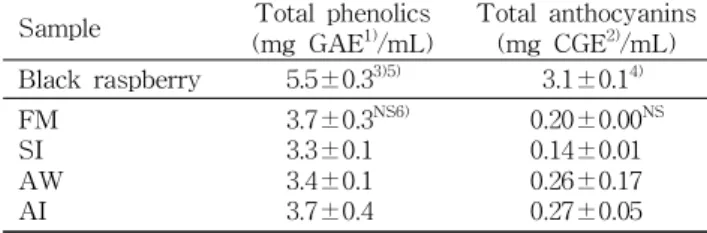
Table 4. Total phenolics and anthocyanins in black raspberry and wines
Sample Total phenolics
(mg GAE
1)/mL) Total anthocyanins (mg CGE
2)/mL) Black raspberry 5.5±0.3
3)5)3.1±0.1
4)FM SI
AW AI
3.7±0.3
NS6)3.3±0.1 3.4±0.1 3.7±0.4
0.20±0.00
NS0.14±0.01 0.26±0.17 0.27±0.05 Samples are the same as in Table 1.
1)
GAE: gallic acid equivalent.
2)
CGE: cyanidin 3-glucoside equivalent.
3)
mg GAE/g fresh weight
4)
mg CGE/g fresh weight
5)
Each value represents the mean±standard deviation.
6)
NS: not significant.
중요한 지표이다(15). 일반적인 과실주의 총산 함량이 0.4∼
0.6%인 것과 비교했을 때(16), 효모별 복분자 발효주의 총 산도는 약 0.9%로 높았다. 이는 복분자 과즙 자체의 총 산도 가 1% 정도로 높기 때문이다(Table 2). 따라서 발효주를 2∼
3배 희석하거나 증류주를 혼합하여 적정산도를 유지해야 할 것이다. Lee와 Ahn(17)의 연구에서는 산지별 복분자주의 총 산도가 1.34∼1.62%로 산지에 따라 차이가 컸다. 이는 복분 자의 총 산도에 영향을 미치는 요인이 발효원인 효모보다는 발효기질인 과일의 영향을 더 많이 받는다는 것을 알 수 있 다. 유기산은 복분자 발효주의 맛, 색깔, 향에 영향을 주며 미생물에 대한 안전에 영향을 미치기 때문에 중요하다(18).
검출된 총 유기산 함량은 12.6∼14.5 mg/mL 수준으로, Lim 등(14)의 연구에서 검출된 총 유기산 함량과 유사하였다. 복 분자 발효주의 주요 유기산은 citric acid였으며, 전체 유기산 중 이들이 차지하는 비율은 52.6∼56.8%였다. 효모에 따라 유기산 함량이 달랐는데, malic acid는 SI(2.92 mg/mL)에서 유의적으로 높았고 lactic acid와 acetic acid의 경우 AI에서 유의적으로 높았다. 또한 복분자는 발효과정을 통해 citric acid와 malic acid의 함량이 감소하였고, lactic acid의 함량 은 증가하였다. 이는 발효 과정 중 citric acid가 lactic acid로 전환되며(6), malolactic fermentation을 통해 malic acid가 lactic acid로 전환되기 때문으로 보인다(16). 또한 acetic acid는 새롭게 검출되었는데, 이는 초산균에 의해 alcohol이 acetic acid로 전환되거나 젖산균에 의해 citric acid가 acetic acid로 전환될 때 생성된다(16). 본 연구에서는 모든 시료에 서 acetic acid가 검출되어 발효 과정 중 일부 진행된 것으로 여겨진다.
색도 및 탁도
효모의 종류를 달리하여 제조한 복분자 발효주의 색도 및 탁도는 Table 3과 같다. 관능적 성질 중 색깔은 식품의 기호 와 관련된 가장 우선적인 요인이다. SI는 발효 과정에 의해 L 값이 증가하였다. 복분자 발효주의 색과 관련된 antho- cyanin 색소는 pH, 유기산, 페놀화합물 및 당 등에 의해 영향 을 받는다. 붉은 색을 나타내는 a 값은 발효 과정을 거치면서
낮아졌는데, 이는 색소 안정화에 기여하던 유기산 함량 및 총 산도가 발효를 통해 감소했기(Table 2) 때문이다. L, a, b 값은 SI에서 가장 높았으며 AI의 경우 가장 낮았다. 따라 서 SI는 밝고 진한 붉은 색을 나타냈고 AI는 어두운 붉은 색을 나타내었다. 복분자 발효액에는 효모와 과피, 섬유질 등 부유물질들이 바닥으로 가라앉게 되는데, 이때 효모에 따라 분비 물질이나 응집성이 달라 혼탁물질의 침전에 차이 가 나게 된다(19). 탁도가 가장 낮았던 AW(1.05 NTU)는 다른 효모에 비해 발효액 중에 있는 혼탁물질들이 가장 빠르 게 침강됨을 알 수 있다.
Total phenolics 및 anthocyanin 함량
복분자에는 anthocyanin, ellagitannin, quercetin 등 다량 의 phenol 화합물이 함유되어 있으며(20), 이들은 항산화 효 과, 항균성, 아질산염 소거능 등의 생리활성 기능을 가지는 것으로 알려져 있다(21). 본 연구에서 사용한 복분자의 total phenolics은 5.5 mg GAE/g이었으며, 이는 Jeong 등(22)이 black raspberry 과일에서 측정한 polyphenol(5.6 mg GAE/
g)과 유사하였고, Ordidge 등(23)이 raspberry에서 측정한 polyphenol(1.34∼2.25 mg GAE/g)보다 많았다. 본 연구에 서 사용한 복분자의 total anthocyanin은 3.1 mg CGE/g으 로, 이는 Wada와 Ou(24)가 black raspberry 과일에서 측정 한 5.89 mg CGE/g보다 적고 boysenberry의 anthocya- nin(1.31 mg CGE/g)보다는 많은 양이었다. 따라서 복분자 를 와인으로 가공했을 때 이러한 생리활성물질의 함량 변화 를 파악하기 위해 total phenolics 및 anthocyanin 함량을 측정했다(Table 4). 효모의 종류를 달리하여 제조한 복분자 발효주의 total phenolics 함량은 3,254∼3,711 mg GAE/L로 효모별로 유의적인 차이는 나타나지 않았지만, 국내에서 판 매되는 레드 와인의 polyphenol 함량(250∼2,298 mg GAE/
L)보다 높았다. Lee와 Ahn(17)의 연구에서는 복분자(
Rubus occidentalisL.)와 복분자 발효주의 total phenolics 함량이
유사하다고 보고하여 복분자와 복분자 발효주 사이에 생리
활성 물질 함량에는 차이가 없는 것으로 보인다. 본 연구에
서는 복분자 발효주의 total anthocyanin 함량이 복분자에
Table 5. Anthocyanin composition of black raspberry and wines
Sample Anthocyanins (% peak area)
Cyanidin 3-glucoside Cyanidin 3-xylosylrutinoside Cyanidin 3-rutinoside Unknown
Black raspberry 13.8±0.6
1)a23.2±0.1
c63.0±0.7
aND
2)bFM SI AW AI
6.4±0.2
b6.2±0.6
b5.5±1.7
b4.5±0.1
b28.5±1.6
ab29.3±1.5
a26.6±0.5
b27.5±1.3
ab25.1±2.5
b21.6±1.6
b27.3±5.4
b21.9±0.6
b40.2±4.3
a43.1±3.7
a40.7±7.6
a46.2±0.6
aSamples are the same as in Table 1.
1)
Each value represents the mean±standard deviation.
2)ND: Not detected.
a,b
Values with different superscripts in the same columns are significantly different (ANOVA and Duncan’s multiple range test at p<0.05).
Table 6. Antioxidant activities of black raspberry and wines
Sample ABTS
(mmol TEAC
1)/L) FRAP (mmol TEAC/L) Black raspberry 49.0±6.6
2)3)24.9±2.9
2)FM SI
AW AI
24.0±4.9
NS4)21.8±0.0 22.8±0.3 23.3±1.1
9.4±1.0
NS6.2±0.3 7.9±0.1 9.3±2.1 Samples are the same as in Table 1.
1)
TEAC: trolox equivalent antioxidant capacity.
2)
mmol TEAC/kg fresh weight.
3)
Each value represents the mean±standard deviation.
4)
NS: not significant.
비해 상당량 감소하였는데, 이는 복분자 발효주 제조과정 (Fig. 1) 중 많은 양이 제거된 것으로 보인다. 그러나 국내에 서 판매되는 수입산 레드 와인의 anthocyanin 함량(16∼130 mg CGE/L)보다는 높았다(25). 효모별로 total anthocyanin 함량에 유의적인 차이를 보이지 않았으나, AI에서 270 mg CGE/L로 가장 많았고, SI에서 139 mg CGE/L로 가장 적었 다.
Anthocyanin 조성
Anthocyanin은 복분자의 중요한 항산화 물질로 항산화 제, 항염증 기능을 한다(26). 복분자에서 발견되는 antho- cyanin에는 cyanidin 3-sambubioside, cyanidin 3-gluco- side, cyanidin 3-xylosylrutinoside, cyanidin 3-rutinoside, pelargonidin 3-rutinoside 등이 존재한다고 보고되었으며, 특히 cyanidin 3-xylosylrutinoside와 cyanidin 3-rutinoside 가 차지하는 비율이 가장 크다(26). 본 연구에서 사용한 복분 자의 anthocyanin 조성을 분석한 결과(Table 5), cyanidin 3-glucoside, cyanidin 3-xylosylrutinoside, cyanidin 3-ru- tinoside가 검출되었으며, 그중 cyanidin 3-rutinoside가 차 지하는 비율이 가장 컸다. 복분자 발효주에서는 cyanidin 3-glucoside, cyanidin 3-xylosylrutinoside, cyanidin 3-ru- tinoside가 검출되었으며, 새로운 미지의 물질이 검출되었 다. Cyanidin 3-glucoside와 cyanidin 3-rutinoside의 경우 효모별로 유의적인 차이는 없었지만 발효 과정을 통해 면적 비율이 감소하였다. Cyanidin 3-xylosylrutinoside의 면적 비율은 SI(29.3%)에서 유의적으로 컸으며, AW(26.6%)에서 는 작았다. Shoji 등(27)은 gel permeation chromatography 를 이용하여 rose cider와 레드 와인의 anthocyanin 색소를 분석한 결과, 레드 와인의 발효와 숙성 중에는 anthocyanin 과 phenolic 화합물들 사이의 상호작용으로 monomeric an- thocyanin은 감소하고, polymeric anthocyanin은 증가한다 고 보고하였다. 따라서 모든 시료에서 검출된 미지의 물질은 polymeric anthocyanin이라고 추정한다.
항산화능
복분자 발효주의 항산화능을 알아보기 위해서 ABTS와 FRAP법을 사용하였다. ABTS법은 ABTS radical이 항산화 활성을 가진 물질에 의해 제거되면서 탈색되는 정도를 측정
하며(12), FRAP법은 ferric tripyridyltriazine(Fe
3+-TPTZ) 이 항산화 물질에 의해 ferrous tripyridyltriazine(Fe
2+- TPTZ)으로 환원되는 것을 측정한다(13).
ABTS와 FRAP법을 이용하여 복분자 및 복분자 발효주 의 free radical scavenging activity를 측정하고 이를 trolox equivalent 값으로 나타내었다(Table 6). 복분자의 ABTS는 4.9 mmol TEAC/100 g으로 Halvorsen 등(28)이 연구한 raspberry의 ABTS 1.85 mmol TEAC/100 g 값보다 컸다.
효모의 종류를 달리하여 제조한 복분자 발효주의 항산화능
은 FM, AI, AW, SI 순으로 높았다. 선행 연구들에서는 total
phenolics 함량과 anthocyanin 함량이 많을수록 항산화능이
우수하다고 보고하였는데(24,29), 본 연구에서는 total phe-
nolics와 anthocyanin의 함량이 더 낮게 측정된 FM이 AI보
다 항산화능이 더 컸다. 이는 total anthocyanin 함량은 AI에
서 더 많았지만, 항산화 활성이 더 큰 cyanidin 3-rutinoside
와 cyanidin 3-xylosylrutinoside의 면적 비율(Table 5)이
FM에서 더 컸기 때문으로 보인다(26). Korean black rasp-
berry wine의 항산화능을 측정한 Lim 등(14)의 연구에서는
ABTS 값이 22.67∼28.45 mmol TEAC/L로 본 연구와 유사
한 값을 나타내었다. 시판 레드 와인의 경우, ABTS 값은
13.89∼34.69 mmol TEAC/L였고, FRAP 값은 4.92∼13.94
mmol TEAC/L로 와인마다 차이가 컸다(30). 또한 같은 와
인임에도 불구하고 ABTS와 FRAP법으로 측정한 항산화능
값의 차이가 컸다. 본 연구에서도 ABTS와 FRAP법으로 측
정한 와인의 항산화능 값이 달랐는데, 이는 와인에 포함된
항산화 물질마다 FRAP과 ABTS 측정에 사용하는 시약과 의 반응 정도가 다르기 때문으로 보인다(31). 따라서 항산화 능을 평가하기 위해 한 가지 방법보다는 몇 가지 항산화능 측정방법을 사용하여 결과를 비교 해석하는 것이 필요하다.
요 약
시판 효모 4가지(Fermivin, FM; Saf-instant yeast red, SI; Angest wine active dry yeast, AW; Angest instant yeast high sugar, AI)를 이용하여 복분자 발효주를 제조하 고, 품질 특성을 비교하였다. 환원당 함량은 FM(2.7%)과 AI(2.8%)가 SI(2.4%)와 AW(2.5%)보다 높았으며, 검출된 주요 유리당인 glucose의 함량은 AW와 AI에서 유의적으로 높았다. 알코올 함량은 AW(11.95%)에서 가장 높고, SI (11.75%)에서 가장 낮았다. pH는 FM(pH 3.73)에서 가장 낮 았으며, 총 산도는 효모별로 차이가 없었다. 모든 시료에서 검출된 주요 유기산은 citric acid였으며, 효모별로 검출된 유기산 함량은 달랐다. Malic acid의 경우 SI(2.92 mg/mL) 에서 가장 많았고 AI(1.83 mg/mL)에서 가장 적었다. L, a, b 값은 SI에서 높고 AI에서 낮았으며, 탁도는 효모에 따라 차이가 없었다. 복분자 발효주의 total phenolics와 total an- thocyanin 함량은 효모 별로 차이가 없었으나, 국내에서 판 매되는 수입산 레드 와인보다 높았다. 항산화능 역시 효모별 로 차이가 없었으나 FM, AI, AW, SI 순으로 높았으며, 항산 화능 지표에는 total phenolics와 anthocyanin의 함량뿐만 아니라 anthocyanin 조성도 영향을 미쳤다.
문 헌