934
Copyright © 2020 The Korean Society of Fisheries and Aquatic Science pISSN:0374-8111, eISSN:2287-8815
서 론
최근해양식량자원중두족류어획량은전세계적으로증가하 고있으며(Jereb and Roper, 2010), 그중에서약 25%는남서 대서양에서어획된다(Agnew et al., 2005). 두족류중오징어는 최근 30년간연간 100만톤이상이어획되는상업적으로가장 중요한식량자원중하나이다(FAO, 2019). 이는어법의발달, 어선수의증가및어류의감소로인해두족류인오징어에대한 어획강도가전세계적으로증가했기때문이다(Arkhipkin et al., 2015; Doubleday et al., 2016). 그중아르헨티나짧은지느러미 오징어는지난 30년간연간 20-115만톤이어획되었으며(Fig.
1) 상업적으로 중요한두족류이다(INIDEP, 2016, Avigliano et al., 2020). 아르헨티나짧은지느러미오징어[Illex argentines
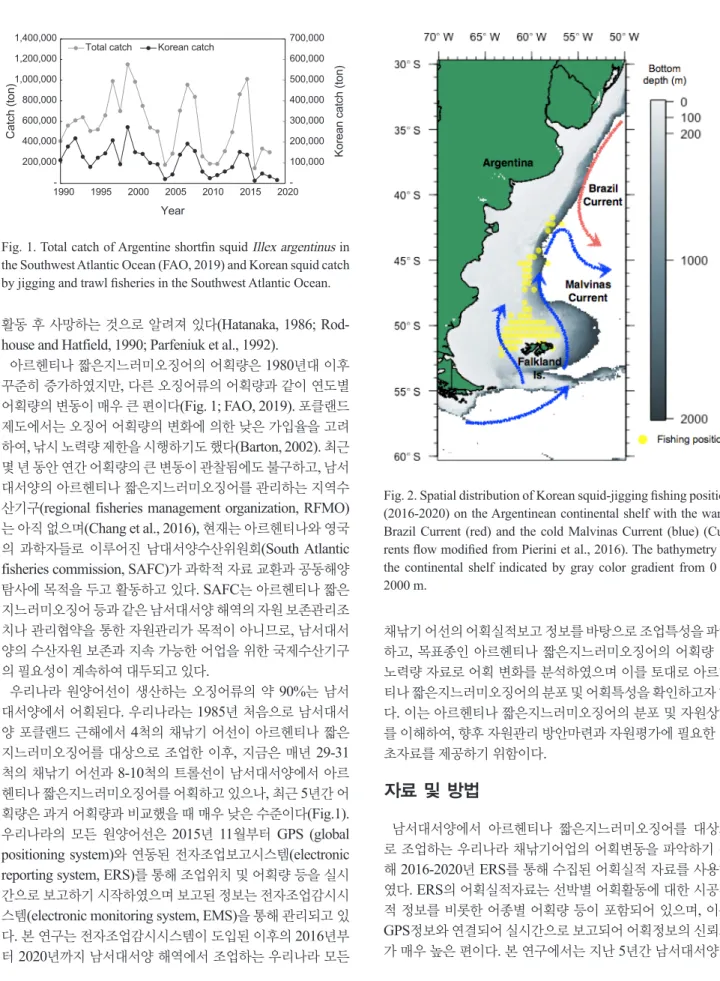
(Castellanos, 1960)]는분류학적으로개안아목(Order Oegop- sida) 살오징어과(Family Ommastrephidae)에속하며, 남서대 서양에서주로어획되는종이다. 남서대서양의대륙붕과대륙 사면을따라약 22˚S-54˚S까지분포하며, 특히 35˚S-52˚S 범위 에서어장이형성된다(Castellanos, 1964; Leta, 1981; Haimov- ici and Pérez, 1990). 분포해역은남극환류에서분화된말비나 한류와브라질난류가만나는해역과관련이있는것으로알려 져 있다(Fig. 2; Brunetti, 1988; Rodhouse and White, 1995;
Brunetti et al., 1998). 아르헨티나짧은지느러미오징어는산란 시기와회유경로에따라여름산란군, 남파타고니아산란군, 그 리고북파타고니아산란군으로나뉘며(Haimovici et al., 1998;
Perez et al., 2009), 수명은약 1년으로성적으로성숙하기시작
하는미성어(ML>230 mm)시기에산란회유를시작하여산란
남서대서양 아르헨티나 짧은지느러미오징어(Illex argentinus)의 어획변동
구정은·최석관·안두해·김은정*
국립수산과학원 원양자원과
Catch Variations of Argentine Shortfin Squid Illex argentinus in the Southwest Atlantic
Jeong Eun Ku, Seok-Gwan Choi, Doo-Hae An and Eunjung Kim*
Distant Water Fisheries Resources Division, National Institute of Fisheries Science, Busan 46083, Korea
The spatial and temporal catch variations of Argentine shortfin squid Illex argentinus in the Southwest Atlantic Ocean (SWA) were analyzed using Korean squid-jigging fishery data collected through electronic reporting system (ERS) from 2016 to 2020. The ERS linked with GPS has been implemented for collecting fishing data from all Korean fish- ing vessels operating in international waters since November 2015. The fishing period of the Korean squid-jigging fishery in the SWA runs from early summer to autumn (December to June) in the Southern Hemisphere. The fish- ing ground was extended from 42°S to 48°S along the Patagonian continental shelf and slope, and the main fishing ground was formed around the Falkland Islands. The yearly catch per unit effort (CPUE) of I. argentinus fluctuated between 1.69 and 7.53 tons/day. In this study, during the fishing season, a south and westward shift on the fishing ground was observed indicating the feeding migration of the south Patagonian stock. The shift in monthly fishing centroids differed according to fishing season. The gradual southward shifts of fishing centroids were observed in the catch years (2017 and 2018), whereas unapparent shifts in fishing centroids were observed in the low catch years (2016 and 2019).
Keywords: Squid-jigging fishery, Illex argentinus, Southwest Atlantic ocean, CPUE, Electronic reporting system (ERS)
*Corresponding author: Tel: +82. 51. 720. 2328 Fax: +82. 51. 720. 2337 E-mail address: [email protected]
This is an Open Access article distributed under the terms of the Creative Commons Attribution Non-Commercial Licens (http://creativecommons.org/licenses/by-nc/3.0/) which permits unrestricted non-commercial use, distribution, and reproduction in any medium, provided the original work is properly cited.
Received 27 October 2020; Revised 13 November 2020; Accepted 2 December 2020 저자 직위: 구정은(연구원), 최석관(연구관), 안두해(과장), 김은정(연구사) https://doi.org/10.5657/KFAS.2020.0934
Korean J Fish Aquat Sci 53(6), 934-941, December 2020
남서대서양 원양 채낚기 어획변동 935
활동후사망하는것으로알려져있다(Hatanaka, 1986; Rod- house and Hatfield, 1990; Parfeniuk et al., 1992).
아르헨티나짧은지느러미오징어의어획량은 1980년대이후 꾸준히증가하였지만, 다른오징어류의어획량과같이연도별 어획량의변동이매우큰편이다(Fig. 1; FAO, 2019). 포클랜드 제도에서는오징어어획량의변화에의한낮은가입율을고려 하여, 낚시노력량제한을시행하기도했다(Barton, 2002). 최근 몇년동안연간어획량의큰변동이관찰됨에도불구하고, 남서 대서양의아르헨티나짧은지느러미오징어를관리하는지역수 산기구(regional fisheries management organization, RFMO) 는아직없으며(Chang et al., 2016), 현재는아르헨티나와영국 의과학자들로 이루어진 남대서양수산위원회(South Atlantic fisheries commission, SAFC)가과학적자료교환과공동해양
탐사에목적을두고활동하고있다. SAFC는아르헨티나짧은
지느러미오징어등과같은남서대서양해역의자원보존관리조 치나관리협약을통한자원관리가목적이아니므로, 남서대서 양의수산자원보존과지속가능한어업을위한국제수산기구 의필요성이계속하여대두되고있다.
우리나라 원양어선이생산하는 오징어류의약 90%는 남서 대서양에서어획된다. 우리나라는 1985년처음으로남서대서 양포클랜드근해에서 4척의채낚기어선이아르헨티나짧은 지느러미오징어를대상으로조업한이후, 지금은매년 29-31
척의채낚기어선과 8-10척의트롤선이남서대서양에서아르
헨티나짧은지느러미오징어를어획하고있으나, 최근 5년간어
획량은과거어획량과비교했을때매우낮은수준이다(Fig.1).
우리나라의 모든원양어선은 2015년 11월부터 GPS (global positioning system)와연동된전자조업보고시스템(electronic reporting system, ERS)를통해조업위치및어획량등을실시 간으로보고하기시작하였으며보고된정보는전자조업감시시 스템(electronic monitoring system, EMS)을통해관리되고있 다. 본연구는전자조업감시시스템이도입된이후의 2016년부
터 2020년까지남서대서양해역에서조업하는우리나라모든
채낚기어선의어획실적보고정보를바탕으로조업특성을파악 하고, 목표종인아르헨티나짧은지느러미오징어의어획량및 노력량자료로어획변화를분석하였으며이를토대로아르헨 티나짧은지느러미오징어의분포및어획특성을확인하고자한 다. 이는아르헨티나짧은지느러미오징어의분포및자원상태 를이해하여, 향후자원관리방안마련과자원평가에필요한기 초자료를제공하기위함이다.
자료 및 방법
남서대서양에서 아르헨티나 짧은지느러미오징어를 대상으 로조업하는우리나라채낚기어업의어획변동을파악하기위 해 2016-2020년 ERS를통해수집된어획실적자료를사용하
였다. ERS의어획실적자료는선박별어획활동에대한시공간
적정보를비롯한어종별어획량등이포함되어있으며, 이는 GPS정보와연결되어실시간으로보고되어어획정보의신뢰도 가매우높은편이다. 본연구에서는지난 5년간남서대서양에 Fig. 1. Total catch of Argentine shortfin squid Illex argentinus in
the Southwest Atlantic Ocean (FAO, 2019) and Korean squid catch by jigging and trawl fisheries in the Southwest Atlantic Ocean.
- 100,000 200,000 300,000 400,000 500,000 600,000 700,000
- 200,000 400,000 600,000 800,000 1,000,000 1,200,000 1,400,000
1990 1995 2000 2005 2010 2015 2020
Korean catch (ton)
Catch (ton)
Year Total catch Korean catch
0 2 4 6 8 10 12
0 5,000 10,000 15,000 20,000 25,000 30,000 35,000 40,000 45,000 50,000
1 2 3 4 5 6 11 12
CPUE (ton/day)
Catch(ton)
Time (Month)
Catch CPUE
Fig. 2. Spatial distribution of Korean squid-jigging fishing position (2016-2020) on the Argentinean continental shelf with the warm Brazil Current (red) and the cold Malvinas Current (blue) (Cur- rents flow modified from Pierini et al., 2016). The bathymetry of the continental shelf indicated by gray color gradient from 0 to 2000 m.
서조업한채낚기어선, 총 34척의선박이보고한 19,503건의 조업위치별어획정보가분석되었다.
본연구에서단위노력당어획량(catch per unit effort, CPUE) 은총어획량(ton)을실제조업일(day)로나눈것으로계산하 였다.
CPUE= Catch
Effort(days)
본연구에서는최근 5년간의아르헨티나짧은지느러미오징 어의변화를바탕으로연도별·월별어획자료와노력량자료를 분석하였으며, 이기간동안어획은남서대서양의대륙붕과대 륙사면해역에서수행되었다(Fig. 2). 구체적인어업특성을확
인하기위해위치별어획시기, CPUE, 어장분포의변화를분
석하였다.
아르헨티나짧은지느러미오징어의월별어획분포의변화를 추정하기 위해무게중심법을이용하여 어장중심을 계산하였 다. 이는넓게분포한어장의어획자료에서어획종의분포중심 을추정하는방법으로월별어장중심(X̅m, Y̅m)은각선박에서 ERS로보고된어획위치(longitude xi, latitude yt)에그위치의 어획량(Ci)을가중하여계산한다.
(X̅m, Y̅m)=(∑∑ni=1nCi·Xi, ∑ni=1Ci·Yi)
i=1Ci ∑ni=1Ci
어장중심계산및조업어장의위도와경도분석과도식화는 R program (R Core Team, 2017)을이용하였다.
결 과
어획량 및 노력량의 변화
최근 5년간남서대서양에서조업한우리나라채낚기어선은
연간 29-31척으로안정적이었으나, 연간어획량은변동이매우
큰편이었다(Table 1). 어획량이가장높은연도(2017)와어획 량이가장낮은연도(2016)는그차이가 5배이상이었다. 각연 도별어획량및노력량(조업일)을비교하였을때(Fig. 3), 노력
량이가장높은시기는어획량이가장높은 2017년으로 4,681
일이었으며, 가장낮은시기는 2019년 3,943일이며, 5년평균 4,219일이었다. 어기는남반구의초여름인 11-12월에시작하 여이듬해가을인 5-6월에종료된다(Fig.3). 연도별로어기의시 작과종료시기에서약간의차이가있었으나주조업시기인 1-5 월은일정하게높은노력량을유지하였으며전어기모두 3월에 Table 1. Catch, number of vessel, catch per unit effort (CPUE) and mean distance between monthly fishing centroid of jigging fishery by fishing season [December (November) to June (May)] in the Southwest Atlantic
Fishing Season 2016 2017 2018 2019 2020 Mean
No. of vessel 31 28 30 29 30 30
CPUE (ton/day) 1.69 7.53 4.50 2.95 4.49 1.69
Mean distance between monthly centroids (km) 142.52 76.02 114.51 175.39 155.121 132.71 Fig. 3 Monthly catch on Argentine shortfin squid Illex argentinus and fishing effort (fishing days) from the Korean squid-jigging fishery.
0 100 200 300 400 500 600 700 800 900 1,000
0 2,000 4,000 6,000 8,000 10,000 12,000 14,000
1 2 3 4 5 6 1112 1 2 3 4 5 6 1112 1 2 3 4 5 6 12 1 2 3 4 5 12 1 2 3 4 5 6
2016 2017 2018 2019 2020
Effort (days)
Catch (ton)
Time (Year)
Effort Catch
남서대서양 원양 채낚기 어획변동 937
가장높은어획량을보였다(Fig. 3).
어장의 위·경도 변화
남서대서양 아르헨티나 짧은지느러미오징어의 어장분포는 위도 41˚S-52˚S, 경도 56˚W-63˚W 범위에서형성되었다(Fig.
4). 주어기가시작되는 12월과 1월에는 42˚S-45˚S에서조업이 시작되어, 조업이진행되는 3월-5월에는어장이남하하여 52˚S 까지확대되었다(Fig. 4a). 반면, 어장의경도분포는어기가시 작된이후동쪽에서서쪽으로이동하는경향을나타내었다. 3-4 월은경도분포가거의동일하며, 5월은동서로가장넓게분포 하다가 6월에는가장서쪽에편중되어나타났다(Fig. 4b).
각위도와경도별어획량과노력량을분석하였을때, 45˚S에 서노력량(33%)이가장높았으나, 어획량은 49˚S-50˚S에서가 장높았다(Fig. 5a). 경도별노력량분포는 60˚W에서전체노력
량의 67%를나타냈고어획량도가장높았다. 60˚W 이서에서
는급격하게노력량과어획량이감소하였다(Fig. 5b).
단위노력당 어획량 (Catch per unit effort, CPUE) 남서대서양채낚기어업의 CPUE는연도별변동이매우컸다. 어획이가장저조하였던 2016년의 CPUE는 1.69톤/일이었으 며, 어획량과노력량이가장높았던 2017년의 CPUE는 7.53톤/ 일로가장높았다(Table 1). 그후차츰감소하여 2019년 2.95 톤/일, 2020년에는 4.49톤/일을기록하였다. 월별 CPUE는어
기가시작된후 3월까지꾸준히증가하여 가장높은값(9.71
톤/일)을나타내었으며, 6월에 0.03톤/일로가장낮았다(Fig. 6).
위도에따른 CPUE를산출하였을때최고값은 48˚S에서 10.5 톤/일, 최소값은 42˚S에서 0.8톤/일로나타났다(Fig. 7). 누적어 획량이높았던 45˚S-46˚S, 49˚S-50˚S 에서의 CPUE 보다 44˚S, 48˚S의 CPUE가높았으며, 모든위도에서산출된 CPUE의편 차가큰편이었다. 반면포클랜드제도북쪽해역인 51˚S-52˚S Fig. 5 Total catch (tonnes) and effort (fishing days) by fishing locations in the Korean squid-jigging fishery from 2016 to 2020.
Fig. 4 The boxplot of the latitudinal and longitudinal components on the fishing locations in the Korean squid-jigging fisheries in the South- west Atlantic during 2016-2020.
구정은ㆍ최석관ㆍ안두해ㆍ김은정 938
의 CPUE는크게높지않았으나편차가작은편이었다.
어기별 어장분포의 변화
각어기별어장분포의변화를확인하기위해어획이시작되는 12월부터어기가종료되는다음해 6월까지매월어획중심을 나타내었다(Fig. 8). 2016년어기의월별어획중심은뚜렷한변 화의경향이없이어획중심이 45˚S-46˚S, 61˚W에위치하였으 나, 2017-2018년은어획중심이어기의시작인 12월부터 45˚S 부근에서뚜렷하게남하하여포클랜드북서쪽까지근접하여어 기가종료하는경향을보였다. 2019년은 12월에 45˚S보다북쪽 에서시작하여급격히남하하고, 2월에서 5월까지포클랜드북 쪽해역에서 59˚W-62˚W 사이에분포하였으며, 2020년은 1월 부터남하하는경향을보이다가어기후반인 5월북쪽으로다 시이동하는경향을보였다. 이어기의 5월어획량은다른어기 의 5월어획량에비해큰편임을알수있다(Fig. 3).
월별 어획중심 간의 평균거리는 2019년에 가장 높았으며, 2017년에가장적은평균거리가관찰되었다(Table 1). 전체연 구기간동안월별어획중심의간의평균거리는 132.7 km였고, CPUE가가장높았던 2017년의어획중심간평균거리는 76.02 km였으며, 그후증가하여 2019년 175.39 km로가장높았다.
고 찰
본연구에서는남서대서양에서조업하는우리나라원양오징 어채낚기어업의어획실적자료를이용하여아르헨티나짧은지 느러미오징어풍도의시·공간적변화를분석하였다.
우리나라 채낚기어선의아르헨티나짧은지느러미오징어의 어획시기는 12월에시작되어 6월까지지속되며어획량은 2월 부터서서히증가하기시작하여 3월에가장높은어획량을보 였다. 또한어획위치는위도의변화에서뚜렷하게나타났으며 어장은어기초기부터서서히남하하여포클랜드제도까지도 달하는것을확인하였다. 이러한경향은 Hatanaka et al. (1985) 에서연구된아르헨티나짧은지느러미오징어의생애주기와일
치한다. 남반구겨울에부화된아르헨티나짧은지느러미오징 어는봄에북파타고니아대륙붕에도달하여남쪽으로회유를 시작하여 보통 2-3월에섭이장인포클랜드제도근처에도착
한다. 이시기에동해역에서어획량과 CPUE가급격히증가하
는현상은이전연구결과(Rodhouse et al., 1995)에서도밝혀진 바있다. 6월에어획량이급격히감소하는것은오징어가산란 활동을위해포클랜드제도를떠나이동을시작하기때문이다 (Rodhouse et al., 1995). 오징어어장의위도변동성은본연구 뿐만아니라대만의오징어채낚기어업과스페인트롤어업에서 도관찰되었다(Sacau et al., 2005; Chiu et al., 2017). 반면, 어 장의경도변동은어장남하에따른대륙붕과아르헨티나배타 적경제수역(exclusive economic zone, EEZ)의위치에기인한 것으로보인다. 아르헨티나짧은지느러미오징어는연안성두 족류로대륙붕과대륙사면에서식하므로어장의위치도대륙
붕에서크게벗어나지않는다(Fig. 2). 어장의북쪽에서는공해
인아르헨티나 EEZ 바깥대륙붕과대륙사면에좁고길게분포 하다가남쪽포클랜드제도주변으로어장이동과서로넓게형 성되는것은우리나라채낚기어선이포클랜드 EEZ로입어하 기때문이다. 본연구에서어획위치변동은아르헨티나짧은지 느러미오징어의남쪽으로회유를나타내며또한인위적인경계 를반영하기도한다. 오징어와같이이동성이큰어종의시공간 적어장분포의변동은어종의이동을나타내는지표로사용될
수있으며, 이는 CPUE 표준화과정에서중요한요인으로선택
된다(Cao et al., 2011).
어기에따른월별오징어어장변동은이해역의아르헨티나 짧은지느러미오징어의산란군과관련된것으로보인다. 남서 대서양 아르헨티나짧은지느러미오징어는 연중산란을하며 (Rodhouse and Hatfield, 1990; Rodhouse et al., 1995), 산란 시기와회유경로에따라크게 43˚S 북쪽의북파타고니아산란
군, 42˚S-45˚S 사이대륙붕에서식하며산란장을가지는여름
Fig. 6 Monthly catch per unit effort (CPUE) of jigging fisheries in the Southwest Atlantic during 2016-2020.
- 100,000 200,000 300,000 400,000
- 200,000 400,000 600,000 800,000
1990 1995 2000 2005 2010 2015 2020
Korean catch (ton)
Catch (ton)
Year
0 2 4 6 8 10 12
0 5,000 10,000 15,000 20,000 25,000 30,000 35,000 40,000 45,000 50,000
1 2 3 4 5 6 11 12
CPUE (ton/day)
Catch(ton)
Time (Month)
Catch CPUE
Fig. 7 Catch per unit effort (CPUE) by latitude in Korean squid- jigging fishery in the Southwest Atlantic during 2016-2020.
남서대서양 원양 채낚기 어획변동 939
산란군, 45˚S 남쪽에주어장이형성되며가장큰산란군을형
성하여상업적으로가장중요한남파타고니아산란군으로나 뉜다(Haimovici et al., 1998; Agnew et al., 2005; Perez et al., 2009). 월별어장중심은어기초인 12-1월과그이후와는확연 히구별되며, 이는목표산란군인남파타고니아산란군의회유 경로와연관이있어보인다. 12월과 1월은 46˚S 부근에서섭이 장으로남하하는남파타고니아산란군의미성숙개체를주로어 획하며, 3월부터는포클랜드섬북쪽에형성된섭이장에서남파 타고니아산란군의성체를목표로어획하는것으로생각된다. 이는다른나라채낚기어선의이동경향과비슷하다(Hatanaka, 1986; Brunetti and Ivanovic, 1992; Leta, 1992; Rodhouse et al., 1995; Arkhipkin, 2000). 남파타고니아산란군의주요어장 인포클랜드제도의북서쪽해역은남파타고니아산란군의섭이 장이며채낚기어업의주어장으로다양한국적의어선이아르헨 티나짧은지느러기오징어를어획하기위해 2-6월포클랜드해 역에입어한다. 따라서어획량이가장높은 3월의어획중심은 포클랜드북쪽해역에서주로형성되었다(Fig. 8). 어기중월별 어획중심의이동은어획의효율성과도연관성이있는듯하다. 어획중심간평균거리가가장짧은어기인 2017년의월별어획 중심은뚜렷하게남하하는경향을보이며이는알려진남파타 고니아산란군의회유경로와비슷한경향을보였다(Fig. 8). 반
면어획량이가장낮았던 2019년의어획중심은뚜렷한경향없
이포클랜드근해에위치하였으며이는어군의이동변화보다는
포클랜드해역의입어시기(2-6월)가되어어장이밀집하여형 성된것으로생각된다. 높은어획량을기록한어기의 1-2월의 어획중심은약 45˚S 부근에형성되고어획량도높은경향을보 인다(Fig. 3, Fig. 8). 이는섭이장으로남하하는미성숙남파타 고니아산란군이충분한크기로성장후어획으로가입되어높 은어획량을나타내거나, 같은위도상의대륙붕에서식하는여 름산란군이어획되었을가능성도있을것이다. 두산란군의산 란시기는겨울과여름으로뚜렷하게나누어져있으므로이시
기에 45˚S 부근에서어획되는개체의생식소발달을확인한다
면어획되는주요산란군의식별이가능할것이다.
다른오징어류와같이아르헨티나짧은지느러미오징어의풍 도와분포는주변환경조건에크게영향을받는것으로알려져 있다(Waluda et al., 2001; Bazzino et al., 2005; Sacau et al., 2005; Chen et al., 2012). 남극해류에서분화된말비나한류는 포클랜드제도와부딪쳐동쪽과서쪽으로나누어져북상하고 적도에서남하하는브라질난류와만나생산력이풍부한두해 류의합류점을형성한다(Fig. 2; Wang et al., 2018). 이합류점 은아르헨티나짧은지느러미오징어의어장형성에중요한역할 을하며, 두해류수렴대의말비나한류쪽인파타고니아대륙붕 과포클랜드제도의근해에서주어장을형성하는것으로알려 져있다(Chen et al., 2007). 수명이짧은오징어의경우한해의 가입량의크기에따라어획변동이매우큰편이며이는본연구 의우리나라채낚기어획량에서도뚜렷하게나타난다. 비록짧 Fig. 8. Monthly distributions of fishing centroid by each fishing seasons (2016-2020) in Korean squid-jigging fishery in the Southwest At- lantic. The first two numbers indicate the fishing season (2016 → 16) and second two letter indicate the month (March → 03).
은연구기간동안에도 2017년의어획량은 2016년의어획량에 비해 5배로증가한것을확인할수있었다. 따라서아르헨티나 짧은지느러미오징어의자원변동을이해하기위해서는어장뿐 만아니라이자원의생활사를고려한산란장및섭이장의환경 변동을함께분석하고연구해야할것이다.
사 사
본연구는국립수산과학원 2020년도수산시험연구사업인 『
원양어업자원평가 및관리연구』(R2020023)의지원으로수
행되었습니다.
References
Agnew DJ, Hill SL, Beddington JR, Purchase LV and Wakeford RC. 2005. Sustainability and management of southwest At- lantic squid fisheries. Bull Mar Sci 76, 579-594.
Arkhipkin AI. 2000. Intrapopulation structure of winter spawned Argentine shortfin squid Illex argentinus (Cephalopoda, Ommastrephidae), during its feeding period over the Pata- gonian Shelf. Fish Bull 98, 1-13.
Arkhipkin AI, Gras M and Blake A. 2015. Water density path- ways for shelf/slope migrations of squid Illex argentinus in the southwest atlantic. Fish Res 172, 234-242. https://doi.
org/10.1016/j.fishres.2015.07.023.
Avigliano E, Ivanovic M, Prandoni N, Méndez A, Pisonero J and Volpedo AV. 2020. Statolith chemistry as a stock tag in the Argentine shortfin squid Illex argentinus. Reg Stud Mar Sci 38, 101355. https://doi.org/10.1016/j.rsma.2020.101355.
Barton J. 2002. Fisheries and fisheries management in Falkland Islands Conservation Zones. Aquatic Conserv Mar Freshwat Ecosyst 12, 127-135. https://doi.org/10.1002/aqc.482.
Bazzino G, Quiñones RA and Norbis W. 2005. Environmen- tal associations of shortfin squid Illex argentinus (Cepha- lopoda: Ommastrephidae) in the Northern Patagonian Shelf. Fish Res 76, 401-416. https://doi.org/10.1016/j.
fishres.2005.07.005.
Brunetti NE. 1988. Contribución al conocimiento biológico- pesquero del calamar argentine (Cephalopoda: ommas- trephidae: Illex argentinus). Ph.D. Thesis, Universidad Na- cional de La Plata, La Plata, Argentina.
Brunetti NE and Ivanovic ML. 1992. Distribution and abun- dance of early life stages of squid Illex argentines in the south-west Atlantic. ICES J Mar Sci 49, 175-183.
Brunetti N, Ivanovic M, Rossi G, Elena B and Pineda S. 1998.
Fishery biology and life history of Illex argentinus. Okutani T. (ed.), Large Pelagic Squid, Japan Marine Fishery Re- sources Center (JAMARC) Special, Tokyo, Japna, 216-231.
Cao J, Chen X, Chen Y, Liu B, Ma J, Li S. 2011. General- ized liner Bayesian models for standardizing CPUE: an application to squid-jigging fishery in the northwest Pa-
cific Ocean. Sci Mar 75, 679-689. https://doi.org/10.3989/
scimar.2011.75n4679.
Castellanos, ZA. 1960. Una nueva especie de calamari Argen- tino Ommastrephes argentinus sp. nov. (Mollusca, Cepha- lopoda). Neotropica 6, 55-58.
Castellanos ZA. 1964. Contribución al conoeimiento biologico del calamar argentine Illex illecebrosus argentinus. Boletín del Instituto de Biología Marina 8, 1-36.
Chang KY, Chen CS, Chin TY, Huang WB and Chiu TS. 2016.
Argentine shortfin squid Illex argentinus stock assessment in the Southwest Atlantic using geostatistical techniques.
Terr Atmos Ocean Sci 27, 281-292. https://doi.org/ 10.3319/
TAO.2015.11.05.01(Oc).
Chen CS, Chiu TS, and Haung WB. 2007. The spatial and temporal distribution patterns of the Argentine short-finned squid, Illex argentinus, abundances in the Southwest Atlan- tic and the effects of environmental Influences. Zool Stud, 46, 111-122.
Chen X, Lu H, Liu B. 2012. Forecasting fishing ground of Illex argentinus by using habitat suitability model in the south- west Atlantic. J Shanghai Oce Uni 21, 431-437.
Chiu TY, Chin TS, Chen CS. 2017. Movement patterns de- termine the availability of Argentine shortfin squid Illex argentinus to fisheries. Fish Res 193, 71-80. https://doi.
org/10.1016/j.fishres.2017.03.023.
Doubleday ZA, Prowse TAA, Arkhipkin A, Pierce GJ, Semmens J, Steer M, Leporati SC, Lourenco S, Quetglas A, Sauer W and Gillanders BM. 2016. Global proliferation of cephalo- pods. Curr Biol 26, R406-R407. https://doi.org/10.1016/j.
cub.2016.04.002.
FAO (Food and Agriculture Organization of the United Nations).
2019. Global capture production 1950-2017. Retrieved from https://www.fao.org/fishery/statistics/global-capture-query- es on September 28, 2020.
Hatanaka H. 1986. Growth and life span of short-finned squid Illex argentinus in the waters off Argentina. Nippon suisan Gakkaishi 52, 11-17. https://doi.org/10.2331/suisan.52.11 Hatanaka H, Kawahara S, Uozumi Y and Kasahara S. 1985.
Comparison of life cycles of five ommastrephid squids fished by Japan: Todarodes pacificus,Illex illecebrosus, Il- lex argentines, Nototodarus sloani sloani and Nototodarus gouldi. NAFO Sci Coun Studes 9, 59-68.
Haimovici M, Brunetti NE, Rodhouse PG, Csirke J and Leta RH. 1998. Illex argentinus. FAO Fisheries Technical Paper No 376, 27-58.
Haimovici M and Alvarez-Perez JA. 1990. Distribution and sexual maturation of the Argentinean squid Illex argentinus of southern Brasil. Sci Mar 54, 179-185.
INIDEP (Inicio Ministerio de Agricultura, Ganadería y Pesca).
2016. Calamar. Pesquría 2016. In: Ivanovic M, Aubone A, Rossi GR, Mc lnnes M, Buono ML and Cozzolino E. eds.
Mar del Plata, Argentina.
남서대서양 원양 채낚기 어획변동 941
Leta HR. 1981. Aspectos biológicos del calamar Illex argenti- nus. Proyecto URU 78, 50.
Leta HR. 1992. Abundance and distribution of Illex argentinus rhynchoteuthion larvae (Cephalopoda, Ommastrephidae) in the waters of the Southwestern Atlantic (Argentine-Uru- guayan common fishing zone). Afr J Mar Sci 12, 927-941.
https://doi.org/10.2989/02577619209504753.
Parfeniuk AV, Froerman YM and Golub AN. 1992. Particulari- dades de la distribución de los juveniles del calamar (Illex argentines) en el área de la depression argentina. Frente Marít 12, 105-111.
Perez JAA, Silva TN, Schroeder R, Schwarz R and Martins RS.
2009. Biological patterns of the Argentine shortfin squid Il- lex argentinus in the slope trawl fishery off Brazil. Lat Am J Aquat Res 37, 409-428.
Pierini JO, Lovallo M, Gomez EA and Telesca L. 2016. Fisher- shannon analysis of the time variability of remotely sensed sea surface temperature at the Brazil-Malvinas conflu- ence. Oceanologia 58, 187-195. https://doi.org/10.1016/j.
oceano.2016.02.003.
R Core Team. 2017. R: A language and environment for sta- tistical computing. R Foundation for Statistical Computing, Vienna, Austria. Retrieved from http://www.R-project.org/
on Oct 1, 2020.
Rodhouse PG, Barton J, Hatfield EMC and Symon C. 1995. Il- lex argentinus: Life cycle, population structure, and fishery.
ICES Mar Sci Symp 199 425-432.
Rodhouse PG and Hatifield EMC. 1990. Dynamics of growth and maturation in the cephalopod Illex argentinus de Castel- lanos, 1960 (Teuthoidea:Ommastrephidae).Philos Trans R Soc Lond B Biol Sci 329 229-241. https://doi.org/10.1098/
rstb.1990.0167.
Rodhouse PG and White MG. 1995. Cephalopods occupy the ecological niche of epipelagic fish in the Antarc- tic Polar Frontal zone. Bio Bull 189, 77-80. https://doi.
org/10.2307/1542457.
Jereb P and Roper CF. 2010. Cephalopods of the world-an anno- tated and illustrated catalogue of cephalopod species known to date. Volume 2. Myopsid and Oegopsid Squids. FAO, Rome, Italy.
Sacau M, Pierce GJ, Wang J, Arkhipkin AI, Portela J, Brickle P, Cardoso X. 2005. The spatio-temporal pattern of Argen- tine shortfin squid Illex argentinus abundance in the south- west Atlantic. Aquat Living Resour 18, 361-372. https://doi.
org/10.1051/alr:2005039.
Waluda CM, Rodhouse PG, Trathan PN, Rierce GJ. 2001.
Remotely sensed mesoscale oceanography and the dis- tribution of Illex argentinus in the South Atlantic. Fish Oceanogr 10, 207-216. https://doi.org/10.1046/j.1365- 2419.2001.00165.x.
Wang J, Chen X and Chen Y. 2018. Projecting distributions of Argentine shortfin squid Illex argentinus in the Southwest
Atlantic using a complex intergrated model. Acta Oceanol Sin 37, 31-37.