• 검색 결과가 없습니다.

IEG 환경지질연구정보센터

N/A
N/A
Protected

Academic year: 2021

Share "IEG 환경지질연구정보센터"

Copied!
2
0
0

로드 중.... (전체 텍스트 보기)

전체 글

(1)

- 287 - PJ107

Changed compression direction in Korean Peninsula at the upper Cretaceous times

Byung-Joo Lee

1*

1

KIGAM, 92, Gwahang-no, Yuseong-gu, 305-305, Daejeon, Korea

* [email protected]

ABSTRACT

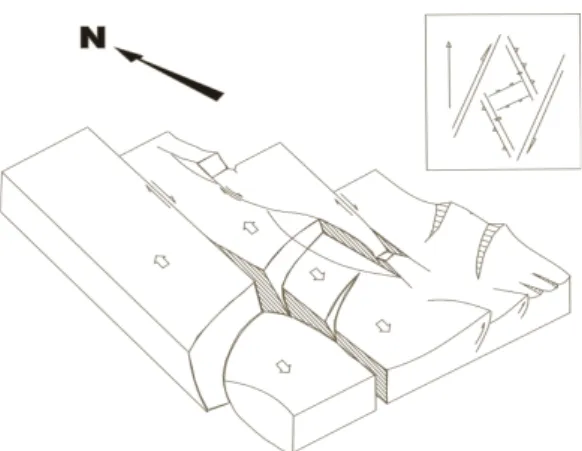
The Tertiary Pohang sedimentary basin which is located in the South eastern coast of Korean peninsula has been the 4 stages of the tectonic evolution since Paleocene.

Sinistral strike-slip motion made Tertiary sedimentary basin with N-S normal fault.

During the second and third stages the Tertiary rocks was faulted by E-W normal faulting and NNE dextral strike-slip faulting. In the last stage (fourth stage) the Tertiary basin was influenced by the compression to make the thrust, namely inversion tectonics.

By this kind of the tectonic evolution Tertiary Pohang Basin was undergone by ENE-WSW to E-W compression regime (Fig. 1).

Fig. 1) Schematic block diagram showing the structure in the Tertiary basin

In the upper Cretaceous sedimentary basin, Kyokpo Basin, three types of faults are

recognized: dextral strike-slip faults, normal faults and reverse faults. The strike-slip faults

can be subdivided into three sets. Among the strike-slip faults, the fault l, which is

running along the northern coastline, has conjugate sinistral strike-slip faults of NW

direction. The normal faults of nearly WEW direction well develop at the northeastern

coastline and the reverse faults of N-S direction are distributed in the western coastline. By

this reason during the upper Cretaceous in Korean peninsular E-W compression direction

is still dominant .(Fig. 2)

(2)

- 288 -

Fig.2) Schematic block diagram of the wedge basin implicated Kyokpo basin formation

Nonmarine basins which were formed at the lower to middle Cretaceous along the both boundary fault systems of the Ogcheon Belt have been investigated to form by sinistral transtensional tectonic motion of the NE direction of the boundary faults. By the NE trend sinistral sirke-silp ones during the lower to middle Cretaceous time, Korean peninsula was undergone by N-S compression regime (Fig. 3)

Fig.3) Block diagram showing the development of the Gongju basin

Finally during the Cenozoic time to upper Cretaceous time Korean peninsula was nearly

E-W direction of compression regime. On the other hand during the lower cretaceous time

Korean peninsula was N-S direction of compression regime.

수치

Fig.  1)  Schematic  block  diagram  showing  the  structure  in  the  Tertiary  basin

참조

관련 문서

Five clear tectonic events can be found in West Goseong, The earliest E-W compression, is characterized by mode I E-W trending joints, dykes and left-lateral NW strike-slip

(1993) Evolution trends of biotite and hornblende in granitic rocks from Yonghae-Yongdok area, northeastern Gyeongsang basin, Korea. Journal of Korean Institute of

The pres- ence of HIMU basalts provides further evidence for the existence of the Kurosegawa Terrane in this area and supports our model on the tectonic evolution of the

An evidence of effects of Miocene igneous intrusions known as diorite sills appears several wells in the study area... Characteristics and tectonic evolution of the East China Sea,