343
and Safety
Available online at http://www.foodhygiene.or.kr
https://doi.org/10.13103/JFHS.2017.32.5.343
Analytical Method of Silicon Dioxide in Health Functional Food Products using ICP-OES
Mi-Hyun Ka, Kwang-Geun Lee1, Heung-Youl Lim, Gunyoung Lee2, Sang Soon Yun2, Ho Soo Lim2, and Yong-Suk Kim3*
Korea Health Supplements Association Sub. Korea Health Supplements Institute, Sungnam, Korea
1Department of Food Science and Biotechnology, Dongguk University Biomedi Campus, Goyang, Korea
2Food Additives and Packaging Division, National Institute of Food and Drug Safety Evaluation, Osong, Korea
3Department of Food Science & Technology, College of Agriculture and Life Sciences, Chonbuk National University, Jeonju, Korea
(Received August 22, 2017/Revised September 3, 2017/Accepted September 15, 2017)
ABSTRACT - The analytical method of silicon dioxide (SiO2) in health functional food products was developed employing inductively coupled plasma optical emission spectrometry (ICP-OES) method assisted by acid (hydroflu- oric acid and boric acid) digestion in open system without alkali fusion. The limit of detection (LOD) and limit of quantification (LOQ) of this method were found to be 0.07 and 0.20 mg/L, respectively. Linearity (r2) and linear range were 0.99 and 0.20~20.0 mg/L, respectively. The accuracy and precision of SiO2 (0.4, 1.0, and 2.0%, w/w) in spiked glucosamine exhibited to be the range of 90.22~94.14% and 0.72~1.67%, respectively. The contents of SiO2 in 11 health functional food products were detected in range of 0.02~1.80% (w/w). Every sample showed below content of the permitted use level (2%, w/w) of SiO2. Therefore ICP-OES method with acid can analyze the content of SiO2 in health functional food products easily and rapidly. Consequently, the application of specification analysis of SiO2 in health functional food products could be a significant work.
Key words: Silicon Dioxide, ICP-OES, Analytical Method, Health Functional Food Products, Acid Digestion
Silicon dioxide (SiO2) has synonyms such as silica and defined silica aerogel, hydrated silica, silicic acid and dehydrated silica gel. Description of SiO2 is silica aerogel (a microcellular silica occurring as a fluffy powder or granules) and hydrated silica (a precipitated, hydrated SiO2 occurring as fine white, amorphous powder, or as beads or granules).
SiO2 is insoluble in water and ethanol and soluble in hydrofluoric acid and alkalis (80-100oC)1,2). Synthetic amorph- ous silica (SAS) is also known as untreated fumed silica.
SiO2 and synthetic amorphous silica are chemically identical.
SiO2 in its forms can be used as a direct ingredient in food and as a component of food-packaging materials, at levels in accordance with good manufacturing practices.
When directly added to food, SiO2 has the following uses:
anticaking agent, antifoaming agent, stabilizer, adsorbent, carrier, conditioning agent, chill proofing agent, filter aid, emulsifying agent, viscosity control agent, and anti-settling
agent. In addition, SiO2 is also used as an indirect additive in manufacture of adhesives, coatings, antifoaming agents, grease and lubricants, paper and paperboard and polymers that are then used as components of food-packaging materials.
The level of SiO2 in food is also regulated by a legislation.
According to the regulation of MFDS, SiO2 and any diluted additives containing it should not be used unless these are indispensable for food manufacturing or processing. SiO2 should be removed before the final food process. For anti- caking agents, however, the content of SiO2 should not be more than 2% (w/w) for anticaking agent in the food3-5). Human daily intake of silicon ranges up to approximately 50 mg per person: males have a higher daily intake than women6).
The SiO2 content is determined by a titration method. SiO2 in crystal is measured by potentiometric titration with fluoride-selective electrode. Crystal is decomposed with a mixture of sodium fluoride and nitric acid7). SiO2 content of magnesite and dolomite is determined by titration method.
Samples are decomposed with a mixture of nitric acid (1:1) and hydrochloric acid8). SiO2 as a food additive content is determined by gravimetric method using hydrofluoric acid1). Gravimetric method by alkali fusion using sodium carbonate
*Correspondence to: Yong-Suk Kim, Department of Food Science
& Technology, Chonbuk National University, 567 Baekje-daero, deokjin-gu, Jeonju-si, Jeollabuk-do 54896, Korea
Tel: 82-63-270-2567, Fax: 82-63-270-2572 E-mail: [email protected]
(900oC) is used to determine the silica in a silicate sample9). SiO2 as a food additive content is determined by atomic absorption spectrometry (AAS) with alkali fusion using potassium peroxide (360oC)2). SiO2 content in glasses is determined by alkali fusion using potassium peroxide and sodium hydroxide using AAS method10,11). Si content in plant samples is determined by inductively coupled plasma optical emission spectrometry (ICP-OES) with alkaline dissolution and alkali fusion method using alkali and carbonate9-12). Si content of silicates is determined by AAS method using designed vessel made from teflon containing hydrofluoric and boric acid13).
Hydrofluoric acid cannot be used with instruments equipped with glass parts such as inductively coupled plasma (ICP) and ICP- mass spectrometry (ICP-MS). Hydrofluoric acid is known to dissolve glass by reacting with SiO2 from silicon tetrafluoride gas and hexafluorosilicic acid14). But hydrofluoric and boric acid reaction are the formation of fluoroboric acid.
Therefore, it can be used with instruments equipped with glass parts. A two-step exothermic reaction is shown in chemical reaction9).
H3BO3+ 3HFF HBF3OH + 2H2O (1)
HBF3OH + HFF HBF4+ H2O (2)
Alkali fusion using fusion reagent (KOH/H3BO3) was melted completely using a torch burner2,14). As the sample (0.5 g) and fusion reagent (5 g KOH/ 2 g H3BO3) have to be completely melted in alkali fusion method. This method takes long sample preparation time, needing torch burner in sample preparation and is extremely dangerous and difficult to handle. Due to these limitations, the development of new analytical method for SiO2 was established.
The purpose of this study was to develop not only com- prehensive but also simple analytical method for health functional food products where ICP-OES was applicable.
Since there is no direct measurement of the contents of SiO2 in the health functional food products, the content of Si that can be converted into soluble form is measured and converted into SiO2 content.
Materials and Methods
Reagents and materials
Silicone standard was purchased from Fluka (St. Louis, MO, USA). Hydrofluoric acid (36%) and boric acid (99.5%) were purchased from J.T. Baker (Phillipsburg, NJ, USA) and Junsei (Tokyo, Japan). Water was purified using the Milli- Q ultrapure water purification system (Milipore Co, Billerica, MA, USA). All other chemicals were analytical grade. SiO2 (98.9%) of Korea food grade from Tae Wang Mulsan (Seoul, Korea) and SiO2 (99.5%) from Sigma-
Aldrich (St. Louis, MO, USA) were used in this study. Three types of SiO2 (0.4, 1.0, and 2.0%) were provided from SH company (Seongnam, Korea). Eleven health functional food products were evaluated for SiO2 content analysis. These products were purchased from markets and pharmacies in Seongnam-si, South Korea. The health functional products were selected according to the products that contain SiO2 contentsand kid’s products.These were including 3 vitamin C supplements, 2 kid vitamin C supplements, 2 calcium and vitamin D supplements, and 3 multiple vitamins and gluco- samine products.
Sample preparation
Samples (0.02~0.05 g) were accurately weighed in pro- pylene conical tube, then 2 mL distilled water and 1.5 mL hydrofluoric acid were added. The tube was closed by propylene cap, shaking until dissolution was completed, and cooled to ambient temperature. Then, 1.4 g of boric acid was added, its dissolution aided by sonication for 30 min. The solution was made up to 50 mL with distilled water. The test solution was prepared by dilution 1~50 times with sample preparation solvent (contained 1.5 mL of hydrofluoric acid and 1.4 g of boric acid).
ICP-OES analytical method
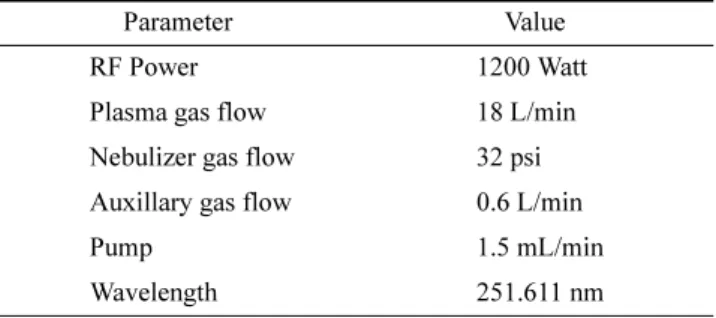
The content of SiO2 in health functional food products was determined after measuring Si which is converted to a soluble form by acid digestion. The content of Si in test solution was determined by ICP-OES (Prism ICP, Teledyne, Camino Dos Rios, CA, USA). The analytical operation conditions are shown in Table 1. Calibration standard solution containing 0.2~20 mg/L was prepared from 1,000 mg/L solution by diluting sample preparation solvent. SiO2 (%) on a dried or ignited basis was calculated from determined values of Si in the solutions. The SiO2 content of sample was calculated using the following equation:
SiO2 (%) = 2.139× Concentration of Si (mg/L) × 50 mL
× Dilution factor / Weight of sample (g)
*2.139 is conversion factor of SiO2 (60.08) from Si (28.09) by calculated molar mass
Table 1. ICP-OES analytical operation parameters
Parameter Value
RF Power 1200 Watt
Plasma gas flow 18 L/min
Nebulizer gas flow 32 psi Auxillary gas flow 0.6 L/min
Pump 1.5 mL/min
Wavelength 251.611 nm
Method validation
Validation to determine recoveries, coefficient of variation (CV, %) values, limit of detection (LOD), limit of quantifi- cation (LOQ), and linearity (r2) were conducted. Intra and inter-day recovery and CV were performed at samples (SiO2 of 0.4, 1.0, and 2.0%). LOD and LOQ of SiO2 were carried out by 3.3× sigma (s)/slope of calibration curve and 10 × sigma (s)/slope of calibration curve. Sigma was obtained by determining the standard deviation. Linearity (r2) were calculated using each standard curve for quantification.
Accuracy and precision were evaluated for SiO2 at the level 0.4, 1.0, and 2.0%.
Statistical analysis
All statistical analysis was conducted using the Statistical Analysis System software (SAS User Guide, ver. 6., SAS Institute, Inc., Cary, NC, USA). Mean values and standard deviations were calculated. All experiments were performed in triplicate. A probability (p) level of 0.05 was considered significant.
Results and Discussion
Validation of method
A calibration curve was obtained by spiking 0.2, 0.5, 1.0, 2.0, 5.0, and 20.0 mg/L of Si in sample preparation solvent.
The recovery, coefficient of determination (R2), limit of detection (LOD) and limit of quantification (LOQ) are pre- sented in Table 2. The linearity was reliable with coefficient of regression, 0.999. The LOD and LOQ were calculated based on the standard deviation and the slope of calibration curve. The LOD and LOQ were 0.07 and 0.20 mg/L re- spectively. LOD and LOQ of sample were 0.007 and 0.02%.
Recoveries, LOD, LOQ, accuracy and precision for SiO2 are shown in Table 3.The recovery was obtained from glucosamine products which were formulated 0.4, 1.0 and 2.0% of SiO2. Recovery tests were conducted for sample with an intra- and inter-day test. Recoveries of intra and inter-day test were 90.60-94.14% and 90.22-93.83%, re-
spectively. Standard (99.5%) and food additive (98.9%) in ICP method were applied to determine recovery of SiO2. Recovery rates (%) of SiO2 are shown in Table 3. Using ICP method, the recoveries of SiO2 standard and food additive were 96.05% and 94.38%; the coefficient of variation was
< 2%. According to Motoh Mutsuga et al14), LOD and LOD of sample were 0.2 mg/L and 0.08%, respectively. The LOD and LOD of sample in ICP with alkali fusion was higher than this study. These results suggest that the ICP analysis method by acid digestion would be similar or better than the alkali fusion method. This validated method could be much safer and provide a shorter sample preparation step taken about 30 minutes than Motoh Mutsuga et al14) and JECFA2) in detecting SiO2 content as Sifrom food additives and functional foods.
Silicon dioxide levels in health functional food products in Korea
For anti-caking agents, the content of SiO2 or diluted additives containing it should not be more than 2% of the food. The levels of SiO2 in 11 samples of health functional foods consumed in Korea market and pharmacy are pre- sented in Table 4. SiO2 was detected in range of 0.02 to 1.80%. The highest SiO2 content was detected in glucosamine product. The mean contents of vitamin C supplements, kid vitamin C, calcium and vitamin D supplements were 0.33, 0.03, 0.73 and 0.48%, respectively. Every sample showed below content of permitted use level (2%) of SiO2.
We have established analytical methods for SiO2 using acid digestion with ICP-OES for food additive and health functional food products. This study provides better accuracy, reproducibility, and efficiency in detecting SiO2 contained in health functional food products than the method regulated Table 2. Coefficient of determination (R2), limit of detection (LOD) and limit of quantification (LOQ) for Si analysis by ICP- OES method
Slope Intercept R2 LOD (mg/L) LOQ (mg/L)
372295 172139 0.999 0.07 0.20
Table 3. Accuracy and precision of silicon dioxide in standard (99.5%) and food additive (98.9%) and spiked in glucosamine product (0.4, 1.0, 2.0%) analyzed by ICP-OES method
Recoveries (%) Concentration (%) Intra-day (n = 3) Inter-day (n = 3) Accuracy2) (%) CV3) (%) Accuracy (%) CV (%)
Standard 96.05 ± 0.481) 0.4 94.14 0.68 93.83 0.57
Food additive 94.38 ± 1.76 1.0 91.77 1.67 91.20 1.08
2.0 90.60 0.15 90.22 0.72
1)Each value is the mean (%) ± standard deviation (SD) (n = 3)
2)Accuracy: (mean/concentration)× 100
3)Coefficient of variation(CV): (standard deviation/mean)× 100
by JECFA 20011) and 20132). ICP method by alkali fusion2,11) takes long sample preparation time, needs torch burner in sample preparation and is both extremely dangerous and difficult to handle. But this method with acid digestion can analyze easily and rapidly. Speciation of analysis is an important part in chemical analysis. The application of specification analysis in health functional food products is of particular significance. The results of such analysis could be useful to set an allowable content level of SiO2 in health functional food products. Consequently, this analysis method was effective in providing useful food specification policy.
Acknowledgement
This research was supported by grant (14162Food008) from Ministry of Food and Drug Safety in 2014.
국문요약
건강기능식품에서 이산화규소 분석 방법을 확립하기 위 하여 산(불산과 붕산)분해를 이용한 ICP-OES 방법을 수 행하였다. 이 방법의 검출한계와 정량한계는 각각 0.07 mg/
L, 0.20 mg/L 이었다. 검량선은 0.2~20.0 mg/L의 농도범위 에서 우수한 직선성(r2 0.99)을 보였다. 글루코사민 제품에 이산화규소 0.4, 1.0, 2.0% (w/w)를 첨가하여 시험한 결과 90.22~94.14%의 회수율과 0.72~1.67%의 정밀성을 나타내 었다. 확립된 방법으로 시중에 유통되는 건강기능식품 11 품목의 이산화규소 함량을 분석한 결과 0.02~1.80% (w/w) 로 나타났다. 이 결과는 건강기능식품에 이산화규소의 사 용기준 2% (w/w) 이하를 만족하는 결과로 시험한 제품들 은 규격에 적합하였다. 따라서 본 연구에서 확립된 이 방 법은 건강기능식품 중 이산화규소를 쉽고, 빠르게 분석할 수 있으며, 건강기능식품 중 이산화규소 함량 분석에 효율 적으로 사용될 수 있다
References
1. Joint FAO/WHO Expert Committee on Food Additives (JECFA, 2001). Silicon dioxide. Available from: http://www.
fao.org/ag/agn/jecfaadditives/specs/Monograph1/Additive-385.
pdf. Accessed Nov. 24, 2015.
2. Joint FAO/WHO Expert Committee on Food Additives (JECFA, 2013). Silicon dioxide. Available from: http://www.
fao.org/ag/agn/jecfaadditives/specs/monograph14/additive- 385-m14.pdf. Accessed Nov. 24, 2015.
3. Ministry of Food and Drug Safety (MFDS, 2015). Silicon dioxide. Available from: http://fa.kfda.go.kr/standard/egongjeon_
standard_view.jsp?SerialNo=420&GoCa=1. Accessed Sep. 24, 2015.
4. Ministry of Health, Labour and Welfare (MHLW, 2015).
Available from: http://www.ffcr.or.jp/zaidan/FFCRHOME.
nsf/7bd44c20b0dc562649256502001b65e9/8a4352b95978- b195492569990007fbaa/$FILE/Standards%20for%20Use%
2015September%2018.pdf. Accessed Sep. 24, 2015.
5. U.S. Food and Drug Administration (FDA) CFR-Code of Fed- eral Regulation Title 21. Silicon dioxide. Available from:
http://www.accessdata.fda.gov/scripts/cdrh/cfdocs/cfcfr/CFR- Search.cfm?fr=172.480&SearchTerm=silicon%20dioxide.
Accessed Nov. 24, 2015.
6. Food and Drug Administration (FDA). Generally recognized as safe determination for silicon dioxide when added directly and/or indirectly to human food. Available from: http://www.
fda.gov/ucm/groups/fdagov-public/@fdagov-foods-gen/ docu- ments/document/ucm269494.pdf. Accessed Nov. 24, 2015.
7. Chesnokova S.M. and Lashuk E.P.: Determination of the concentration of silicon dioxide in crystal by potentiometic titration with a fluoride-selective electrode. Glass and Ceram- ics. 51, 3-4 (1994).
8. Myshkin S.N.: High-speed method of determining silicone dioxide in magnesite and dolomite. Refract. Ind. Ceram. 2, 191-192 (1961).
9. Watanabe M, Otsuki S.: Highly precise determination of sil- ica in silicate by alkali fusion/coagulation gravimetric method.
Table 4. Silicon dioxide levels in health functional food products
Sample type Content(%) of SiO2 Mean contents (%) of SiO2
Vitamin C supplement-1 0.50 ± 0.011)
Vitamin C supplement-2 0.48 ± 0.01 0.33
Vitamin C supplement-3 0.03 ± 0.01
Kid vitamin C supplement-1 0.03 ± 0.01
Kid vitamin C supplement-2 0.04 ± 0.00 0.03
Calcium and vitamin D supplement-1 0.02 ± 0.00
Calcium and vitamin D supplement-2 1.43 ± 0.02 0.73
Multiple vitamin-1 0.49 ± 0.01
0.48
Multiple vitamin-2 0.45 ± 0.02
Multiple vitamin-3 0.51 ± 0.00
Glucosamine product 1.80 ± 0.01 -
1)Data are mean ± SD (n = 3).
Bunseki Kagaku. 57, 31-34 (2008).
10. Mori. H.: Extraction of silicone dioxide from waste colored glasses by alkali fusion using potassium hydroxide. J. Mater Sci. 38, 3461-3468 (2003).
11. Mori. H.: Extraction of silicone dioxide from waste colored glasses by alkali fusion using sodium hydroxide. J. Ceram.
Soc. Jpn. 111, 376-381 (2003).
12. Akiyama K, Nakanishi T, Ohnishi R, Akagi T.: Dissolution method for the determination of silicon in plant samples with
ICP-AES. Bunseki Kagaku. 53, 1229-1232 (2004).
13. Bernas B.: A new method for decomposition and compre- hensive analysis of silicates by atomic absorption spectrom- etry. Anal. Chem. 40(11), 1682-1686 (1968).
14. Motoh M, Kyoko S, Yoshichika H, Yoko K.: Analytical methods for SiO2 and other inorganic oxides in titanium dioxide or certain silicate or certain silicates for food addi- tive specifications. Food Addit. Contam. 28, 423-427 (2011).